CBT AI for Shame Recovery
Quiet the Inner Critic and Rebuild Self-Worth

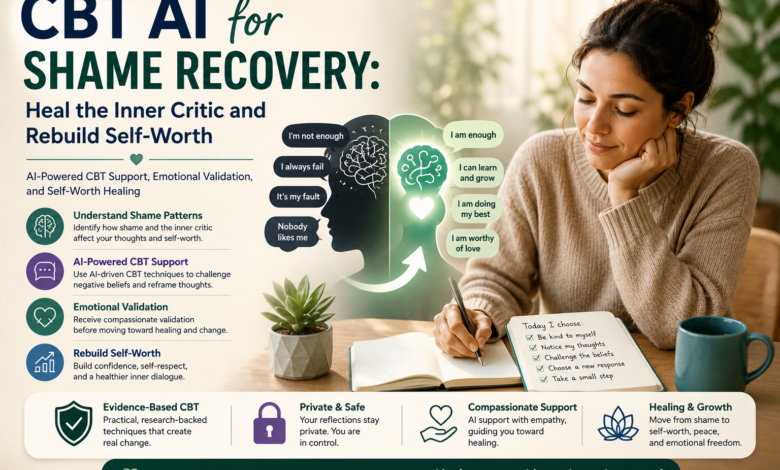
Shame can make a person feel broken, even when they are only overwhelmed, hurt, or carrying old emotional patterns. This blog on CBT AI for shame recovery is for readers who want a safe, practical way to understand shame without attacking themselves.
Thank you for reading this post, don't forget to subscribe!Many articles explain AI tools or CBT separately, but this guide connects AI emotional support for shame, CBT for inner critic patterns, emotional validation AI, and how to rebuild self-worth with CBT in one clear healing framework.
You will learn why shame becomes a harsh inner voice, how AI can support reflection without replacing therapy, and how CBT can help separate facts from fear.
This blog is unique because it does not treat AI as a miracle or a danger only. It shows how to use AI carefully, ethically, and emotionally wisely so readers in the USA, UK, Canada, and Australia can feel heard, think clearly, and rebuild self-trust.
Understanding Shame, the Inner Critic, and CBT AI Support
What Is CBT AI for Shame Recovery?
CBT AI for shame recovery means using AI-supported reflection tools with cognitive behavioral therapy principles to understand shame, question harsh self-beliefs, and rebuild emotional balance.
- It does not mean AI becomes your therapist, diagnoses your condition, or replaces professional care.
- It means AI can act as a structured reflection tool when you are stuck in self-blame, negative self-talk, or emotional confusion.
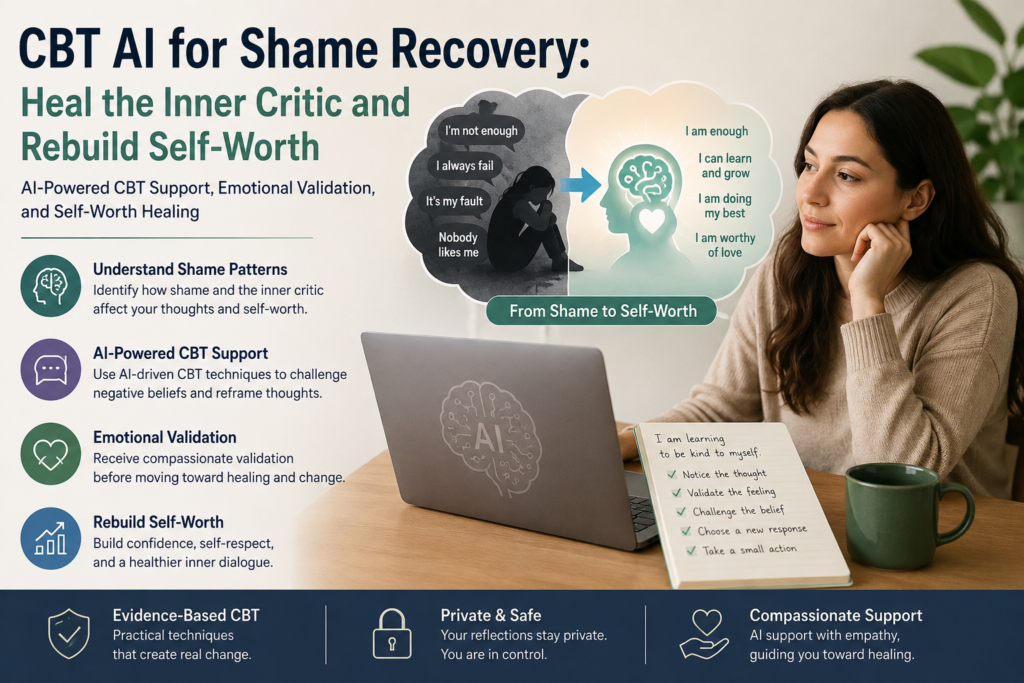
Shame often sounds like a quiet but powerful inner message: “I am not good enough,” “I always fail,” “People will reject me,” or “Something is wrong with me.”
CBT helps by separating thoughts from facts. AI can support this process by helping you write, organize, and reframe these thoughts when your mind feels too overwhelmed to do it alone.
This is why AI emotional support for shame can be useful when handled carefully. A supportive AI tool may help you name the feeling, slow down the thought, and see the difference between emotional pain and truth.
For deeper understanding, you can also read BBH’s guide on AI Emotional Support: Feel Heard Safely, which explains how emotional validation can help people feel understood without becoming dependent on AI.
Why Shame Feels Different From Ordinary Guilt
Guilt usually says, “I did something wrong.” Shame says, “I am wrong.” This difference matters because guilt can sometimes guide repair, responsibility, and growth, but shame often attacks identity. When shame becomes strong, a person may stop seeing one mistake as one moment and start seeing it as proof of personal failure.
This is why shame recovery needs more than positive thinking. A person cannot simply repeat, “I am good enough,” if the nervous system still feels unsafe, exposed, or rejected. Shame often needs understanding before correction. It needs emotional safety before change.
For readers in the USA, UK, Canada, and Australia, this is especially important because many people use AI tools privately when they feel embarrassed to talk about shame with another person.
Privacy can feel comforting, but safe use matters. AI can help with reflection, but serious distress, trauma, abuse, or crisis needs human support.
How CBT Helps Challenge Shame-Based Thoughts
CBT works by helping you notice the connection between thoughts, emotions, body responses, and behavior. In shame, this connection may look like this: one small mistake creates a harsh thought, the body feels heavy or anxious, the person withdraws, and then the withdrawal confirms the belief that something is wrong.
CBT for inner critic patterns helps interrupt this loop. Instead of accepting the inner critic as truth, CBT asks:
- What is the thought?
- What evidence supports it?
- What evidence does not support it?
- Is there another balanced way to understand this situation?
When combined with AI, this process can become easier to practice daily. A person may write: “I feel ashamed because I made a mistake at work.” Then AI can help organize the thought into CBT language: situation, automatic thought, emotion, body response, behavior, and balanced reframe.
For related support, BBH’s article on AI for Negative Self-Talk: Reframe Thoughts and Rebuild Confidence can be internally linked here because shame and negative self-talk often feed the same emotional loop.
Simple CBT Example for the Inner Critic
A shame thought may say: “I failed once, so I am useless.”
A CBT reframe may say: “I made one mistake, but one mistake does not define my full ability, value, or future.”
This is not fake positivity. It is balanced thinking. The goal is not to deny pain. The goal is to stop shame from turning pain into identity.
That is where emotional validation AI can support the first step: helping the person feel heard before asking them to change the thought.
Why Shame Recovery Needs Emotional Validation First
Many people try to defeat shame by arguing with themselves. They tell themselves to stop being weak, stop overthinking, or move on quickly. But shame usually becomes stronger when it is attacked. The inner critic already uses attack as its language, so using more pressure often repeats the same wound.
Emotional validation means acknowledging the feeling without making it the final truth. For example: “It makes sense that I feel hurt and embarrassed right now. This feeling is painful, but it does not define my worth.” This kind of response creates space between emotion and identity.
This is where emotional validation AI can be helpful if used wisely. A person may use AI to express a painful feeling and receive a calm reflection. That reflection can reduce emotional isolation and help the mind become ready for CBT work.
For readers who want practical AI-based support, link here to AI Emotional Support Tools for a Calmer Mind. This supports the article’s wider AI & CBT cluster and helps Google understand that BBH has related AI emotional support content.
The Inner Critic Does Not Respond Well to Force
The inner critic often developed as a protective voice. It may have learned to criticize before others could criticize, control behavior to avoid rejection, or create fear to prevent mistakes. Even though it feels harmful, part of it may be trying to protect the person from embarrassment, abandonment, or failure.
This does not mean the inner critic is right. It means healing works better when we understand the function behind the voice. CBT can challenge the thought, while emotional validation can soften the emotional threat behind it.
A balanced response may sound like: “I understand why my mind is trying to protect me, but I do not need to destroy myself to improve.”
Why Emotional Validation AI Can Feel Helpful in Private Moments
Shame often makes people hide. A person may feel too embarrassed to tell a friend, partner, therapist, or family member what they are thinking. In those private moments, AI can feel less judgmental because the user can type honestly without fearing facial expressions, social rejection, or interruption.
This is one reason AI emotional support for shame is becoming relevant. It can help people start a conversation with themselves when they are not ready to speak out loud. But the key word is support. AI should be used as a reflection companion, not as the only emotional support system.
A safe approach is to use AI for journaling, thought organization, and self-reflection, while still keeping human connection, professional help, and real-life support available when needed.
The Nervous System Side of Shame and Self-Worth
Shame is not only a thought. It can also be a body state. Some people feel heat in the face, tightness in the chest, heaviness in the stomach, or a sudden urge to disappear.
Others become defensive, numb, silent, or overly apologetic. These reactions are not signs of weakness. They are signs that the nervous system may be reading shame as a social threat.
This is why the goal is not only to think better. The goal is to feel safe enough to think clearly. When the body is in threat mode, even a simple mistake can feel like danger. CBT helps the thinking brain return to balance, while grounding practices help the body calm down.
This is also why rebuild self-worth with CBT should be a gradual process. Self-worth does not usually return through one powerful sentence. It returns through repeated evidence, safer self-talk, emotional regulation, and small actions that prove, “I can respond to myself differently now.”
For an AI-related connection, you can internally link to AI Mental Health Detection: Can AI Spot Early Warning Signs? when discussing emotional patterns and early warning signs.
This link is useful because shame often shows up through repeated emotional loops, not only one clear thought.
Shame Can Trigger Threat, Shutdown, or Avoidance
When shame is activated, some people move into fight, flight, freeze, or shutdown.
- Fight may look like defensiveness.
- Flight may look like avoiding people.
- Freeze may look like being unable to speak.
- Shutdown may look like numbness or emotional disconnection.
Understanding this helps remove unnecessary self-blame. The person is not “lazy,” “dramatic,” or “too sensitive.” They may be having a nervous system response to perceived rejection, criticism, or exposure.
A CBT AI reflection can help by asking:
- “What happened?
- What did I think it meant about me?
- What did my body do?
- What did I avoid?
- What would be a balanced next step?”
Why Rebuilding Self-Worth Needs Repetition, Not Pressure
Self-worth grows through repeated emotional evidence. A person needs to experience, again and again, that mistakes can be repaired, feelings can be held, and identity does not collapse because one moment went wrong. This is the deeper purpose of CBT-based shame recovery.
To rebuild self-worth with CBT, the person can create a daily practice: notice the shame thought, validate the emotion, challenge the harsh belief, and write one piece of evidence that supports a more balanced identity. Over time, this trains the mind to stop using shame as the main narrator of life.
Personal note: Healing became easier for me when I stopped treating shame as proof of failure and started seeing it as a signal asking for care, clarity, and support.
Part 1 Closing Transition
CBT AI for shame recovery is not about making AI your healer. It is about using structured reflection to understand the shame story before it becomes your identity.
When used safely, AI can help organize thoughts, support emotional validation, and guide CBT-style reframing. But the real healing still happens through awareness, nervous system safety, honest self-reflection, and human support when needed.
In Part 2, we will move from understanding shame into practice: how to use CBT AI prompts, inner critic reframing, emotional validation, and self-worth journaling in a safe daily system.
How to Use CBT AI for Shame Recovery Safely
How CBT AI Can Help Quiet the Inner Critic
The inner critic often feels like truth because it speaks with emotional force. It may say,
- “You are not enough,”
- “You always ruin things,” or
- “People will leave once they see the real you.”
But in CBT, a thought is not treated as automatic truth. It is treated as a mental event that can be observed, questioned, and reframed.
This is where CBT AI for shame recovery can become useful. AI can help a reader slow down a harsh thought and place it into a clearer structure: situation, automatic thought, emotion, body response, behavior, and balanced response. This matters because shame usually becomes stronger when the mind is vague.
The sentence “I feel terrible” is heavy, but the sentence “I feel shame because I believe this mistake proves I am not worthy” is something CBT can work with.
Read Also: AI & CBT , Read Also: AI Therapy
Step 1 — Name the Shame Thought Without Believing It
The first step is to name the shame thought clearly. Many people jump straight into fixing themselves, but CBT begins with noticing.
A reader can ask: “What exactly is my mind saying about me right now?” This turns shame from a fog into a sentence.
For example, instead of writing, “I feel bad,” the person may write, “I feel ashamed because I believe I disappointed everyone.” This small shift is powerful. The person is no longer fused with shame. They are observing it.
A useful CBT AI prompt is:
Help me identify the shame thought in this situation. Separate the event from the meaning my mind is adding.
This helps the reader understand that shame is often not only about what happened. It is about what the mind believes the event means about identity, belonging, and worth.
Step 2 — Use CBT to Test the Thought Gently
After naming the shame thought, the next step is testing it. This does not mean attacking the thought or pretending everything is fine. It means asking balanced questions.
A reader can ask:
What evidence supports this shame thought?
What evidence does not support it?
Am I using one mistake to define my whole identity?
What would I say to someone I cared about in the same situation?
This is the core of CBT for inner critic work. The goal is not to silence the inner critic by force. The goal is to help the mind become more accurate, fair, and compassionate.
For example, the shame thought “I always fail” may become: “I made a mistake in this situation, but I have also handled many things with effort, care, and responsibility. This moment needs repair, not self-destruction.”
Example Prompt for CBT Inner Critic Reflection
A practical prompt can be added directly into the blog as a reader tool.
I am feeling shame about this situation: [write situation].
Help me identify the inner critic thought, the emotion behind it, the evidence for and against it, and one balanced CBT response that is honest but not self-attacking.
This prompt supports CBT AI for shame recovery because it moves the person through structure instead of emotional spiraling. It also keeps AI in the correct role: a reflection tool that helps organize thinking, not a therapist that decides what is true.
For a strong internal link, this section can connect to: AI Therapy Tools: Benefits, Risks, and Online Counseling Support. That article supports the safety side of this blog and helps readers understand where AI tools can help and where human care is still necessary.
How Emotional Validation AI Supports Shame Recovery
Shame often becomes worse when a person feels alone with it. When the mind says, “No one would understand this,” the emotional burden grows.
This is why validation matters. Emotional validation does not mean agreeing with every thought. It means acknowledging that the feeling makes sense based on the person’s experience.
Emotional validation AI can support this first layer when someone needs a calm space to express what they are feeling.
- A reader may write, “I feel ashamed and scared that people will judge me.”
- A helpful AI reflection may respond by naming the emotion, identifying the possible fear underneath, and offering a grounded next step.
This can be useful because shame needs gentleness before correction. If a person moves too quickly into analysis, the nervous system may feel criticized again. Validation creates emotional safety. Then CBT can help the reader question the belief more clearly.
Why Validation Should Come Before Advice
Advice often fails when the person does not yet feel emotionally safe. If someone is in shame and immediately hears, “Just think positive,” the message may feel dismissive. The nervous system may interpret it as, “Even my pain is wrong.”
Validation works differently.
- It says, “This feeling is painful, and it makes sense that this affected you. Now let us look at it carefully.”
- This is why AI emotional support for shame should begin with reflection, not quick solutions.
A strong validation prompt is:
Before giving advice, help me name what I am feeling, why this might feel painful, and what fear may be underneath my shame.
This makes the AI interaction slower, safer, and more emotionally intelligent. It also helps the reader avoid using AI only for reassurance. The goal is not endless comfort. The goal is emotional clarity followed by a balanced next step.
How AI Can Support Reflection Without Replacing Human Care
AI can help with journaling, emotional labeling, CBT-style questioning, and self-reflection. But it cannot fully understand a person’s life, body language, family history, trauma context, risk level, or real-world safety needs.
This boundary should be clearly stated in the article because readers in the USA, UK, Canada, and Australia are increasingly exposed to AI mental health tools, and trust depends on responsible framing.
A balanced line can be used:
AI may support reflection, but it should not become your only emotional support system, especially during crisis, trauma, abuse, or severe distress.
Rebuild Self-Worth With CBT: A Daily Practice System
To rebuild self-worth with CBT, readers need repetition. Shame recovery is rarely one dramatic breakthrough. It is usually a series of small moments where the person learns to respond differently to their own pain.
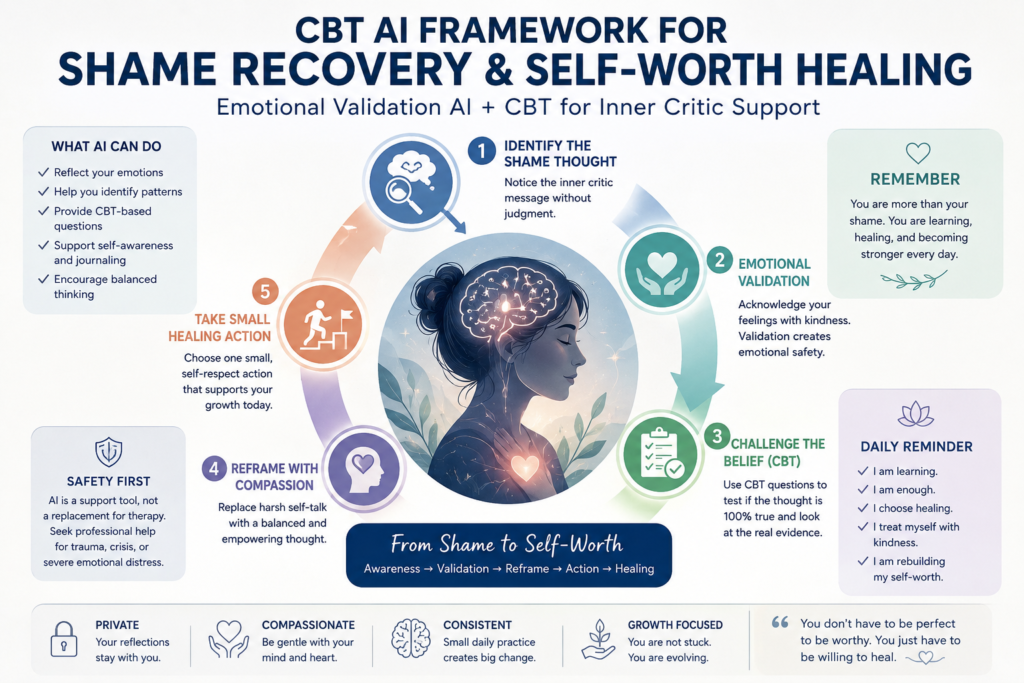
The daily system can be simple: identify the shame thought, validate the emotion, challenge the belief, choose a balanced reframe, and take one small action that supports self-respect. This turns healing into practice, not pressure.
A reader may ask AI to help them create a short daily reflection, but the action must remain human. AI can help write the reframe, but the person must practice believing it, testing it, and living it through small choices.
For example, if the shame thought is “I am unlovable,” the CBT response may be: “This is a shame belief, not a proven fact.
I have felt rejected before, but rejection does not define my worth.
Today I can act with one small step of self-respect.”
Self-Worth Evidence Journal
A self-worth evidence journal is one of the strongest CBT-based practices for shame recovery. The purpose is not to create fake confidence. The purpose is to train the mind to notice evidence that shame ignores.
A reader can write three lines daily:
One thing I handled today:
One moment I showed effort or care:
One reason my worth is not defined by shame:
This practice supports rebuild self-worth with CBT because it gives the brain repeated evidence. Shame often selects only negative proof. A self-worth journal teaches the mind to see a fuller picture.
AI can help by asking better reflection questions, but the answers should come from the reader’s real life. This keeps the work grounded and prevents the reader from depending only on AI-generated comfort.
Weekly Shame Recovery Review
A weekly review helps readers notice progress that daily emotions may hide. Shame often says, “Nothing is changing,” even when the person is slowly becoming more aware, more regulated, and less self-attacking.
A weekly CBT AI review prompt can be:
Help me review this week for shame recovery.
What shame thoughts repeated? What triggers appeared?
What balanced responses helped?
What is one small self-worth practice I can continue next week?
This prompt is useful because it turns emotional healing into a pattern-recognition process. Readers in the USA, UK, Canada, and Australia may be busy, isolated, or overwhelmed, so a weekly structure can make recovery more realistic.
This section can also internally link to AI Tools to Control Emotions: Safe Ways to Pause Before Reacting, especially where the blog explains pausing before shame turns into reaction, withdrawal, or self-attack.
Simple 5-Minute CBT AI Routine
A short routine can make this blog more practical and useful:
Minute 1: Write the situation.
Minute 2: Name the shame thought.
Minute 3: Validate the emotion.
Minute 4: Reframe the thought using CBT.
Minute 5: Choose one small self-respect action.
This routine keeps CBT AI for shame recovery simple. It also prevents the reader from turning the process into over-analysis.
- The purpose is not to spend hours talking to AI.
- The purpose is to use AI as a short structure that helps the person return to awareness, balance, and real-life action.
7 Safe Ways to Use CBT AI for Shame Recovery
This section can work as a strong practical framework for readers and a helpful SEO section for Google. It naturally includes the main keyword, cluster keywords, and search-intent phrases without keyword stuffing.
1. Daily Inner Critic Check-In
Ask AI to help identify the inner critic voice, but do not let AI define your identity. A good prompt is: “What is the harsh thought here, and what would be a fairer way to understand it?” This supports CBT for inner critic work without turning the process into self-judgment.
2. Shame Thought Reframing
Use AI to separate facts from fear. For example, the fact may be “I made an error,” while the fear may be “Everyone will reject me.” This helps reduce shame-based thinking and makes the situation easier to repair.
3. Emotional Validation Prompt
Before asking for advice, ask AI for validation. A helpful prompt is: “Reflect my feeling first, then help me think clearly.” This keeps emotional validation AI supportive instead of rushed, especially when shame feels heavy or confusing.
4. Self-Worth Evidence List
Ask AI to help you create a self-worth evidence list from your own real experiences. Do not let AI invent confidence for you. Let it help organize evidence you provide. This is a grounded way to rebuild self-worth with CBT.
5. Boundary Reflection
Shame often makes people over-apologize, over-explain, or accept unfair treatment. AI can help readers reflect on boundaries by asking: “What is my responsibility here, and what is not my responsibility?” This protects self-worth while still allowing accountability.
6. Nervous System Grounding
If shame feels intense, use AI for a grounding reminder rather than deep analysis. A simple prompt is: “Give me a 60-second grounding exercise before I think about this problem.” This helps the body settle before CBT reframing begins.
7. Human Support Planning
AI should not be the only support system. Readers can ask: “Help me decide whether this is something I should discuss with a therapist, trusted friend, support group, or crisis service.” This keeps AI emotional support safe, especially when shame connects to trauma, abuse, or serious distress.
A Simple CBT AI Shame Recovery Table
| Shame Moment | CBT AI Reflection Question | Healthier Direction |
|---|---|---|
| “I made a mistake.” | “What happened, and what meaning am I adding?” | Separate event from identity. |
| “I feel unworthy.” | “What evidence does shame ignore?” | Build a fuller self-view. |
| “I want to hide.” | “What small safe step can I take?” | Reduce avoidance gently. |
| “My inner critic is loud.” | “What is the fear behind this criticism?” | Understand before reframing. |
| “I need reassurance.” | “What can I validate myself for first?” | Build self-trust slowly. |
Part 2 Closing Transition
CBT AI for shame recovery becomes most useful when it is simple, safe, and grounded in daily practice. AI can help name shame thoughts, support emotional validation, organize CBT reframes, and create self-worth routines.
But the reader remains the center of healing.
- The goal is not to depend on AI for worth.
- The goal is to use structure until the mind learns to respond with more clarity, fairness, and self-respect.
Safety, Therapy Boundaries, Privacy, and Final Healing Direction
CBT AI vs Therapy: What It Can and Cannot Do
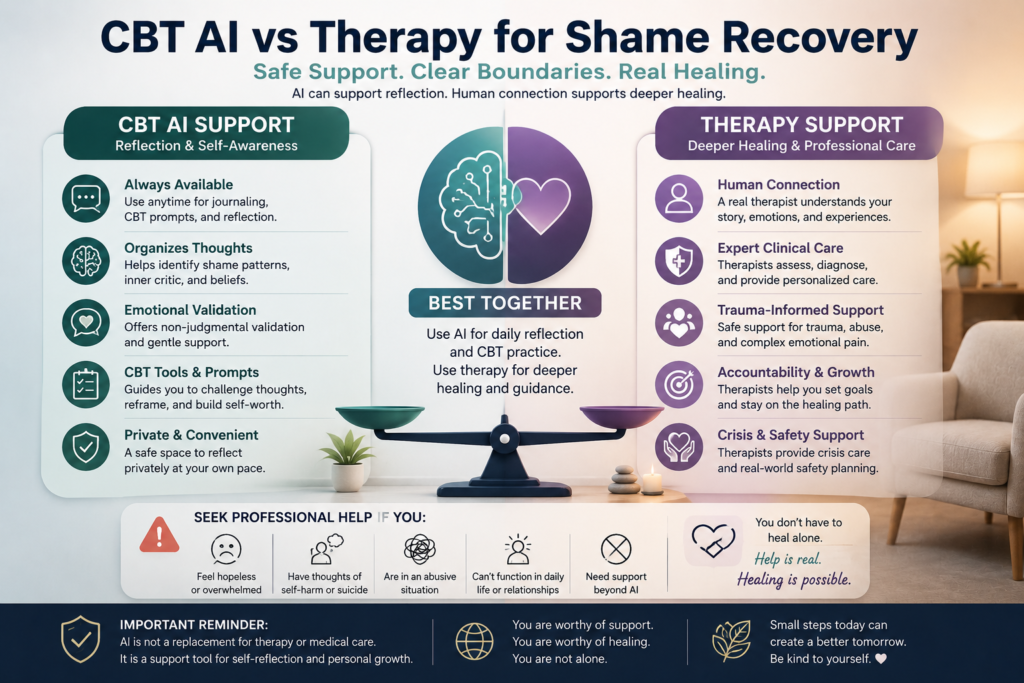
CBT AI for shame recovery can be helpful when someone wants to slow down shame-based thoughts, understand the inner critic, and practice a more balanced response. It can support journaling, emotional labeling, CBT-style reframing, self-worth reflection, and gentle daily check-ins.
For many readers in the USA, UK, Canada, and Australia, this kind of private reflection may feel easier than immediately speaking about shame with another person.
But this boundary must stay clear: AI is not a licensed therapist, doctor, crisis worker, or emergency support system.
- It cannot fully understand someone’s body language, trauma history, family dynamics, safety risk, medical condition, or real-world environment.
- It may sound supportive, but it does not have human clinical judgment.
That is why AI should be used as a reflection tool, not as the final authority over a person’s mental health.
- When shame is mild or moderate, AI may help organize thoughts.
- When shame connects to trauma, abuse, self-harm thoughts, panic, severe depression, or feeling unsafe, human support becomes necessary.
When CBT AI May Be Useful
CBT AI may be useful when the reader wants help identifying the shame thought behind an emotional reaction. For example, they may feel embarrassed after a conversation and want to understand whether the inner critic is exaggerating the situation. AI can help turn vague shame into clearer reflection.
It may also help with emotional validation AI practices. A reader may type what they are feeling and ask for a calm reflection before moving into advice. This can reduce the feeling of emotional isolation and make CBT work easier.
AI emotional support for shame can also support daily self-worth exercises. It can ask questions, help structure a journal entry, suggest a balanced CBT reframe, or remind the reader to pause before reacting.
When a Licensed Therapist or Human Support Is Needed
A licensed therapist or trained professional is needed when shame feels intense, repeated, traumatic, or connected to serious emotional distress.
If a person feels unsafe, has thoughts of harming themselves, is in an abusive relationship, or feels unable to function, AI should not be the main source of help.
This matters because shame can sometimes hide deeper pain. A person may say, “I am worthless,” but underneath that sentence may be depression, trauma, emotional abuse, neglect, grief, or long-term self-criticism. These situations need care that is more personal, trained, and human.
Readers should also seek professional support if they find themselves using AI for constant reassurance but feeling worse afterward. Support should build self-trust, not create emotional dependency.
Important Safety Note for USA, UK, Canada, and Australia Readers
Readers in the USA, UK, Canada, and Australia should treat AI support as a self-reflection tool, not crisis care. If someone feels in immediate danger, unable to stay safe, or at risk of harming themselves or someone else, they should contact local emergency services or a local crisis helpline immediately.
This blog is educational.
It can help readers understand CBT AI for shame recovery, CBT for inner critic patterns, emotional validation AI, and self-worth practices.
It cannot diagnose, treat, or replace mental health care.
A safe sentence to remember is this: AI can help you reflect, but human support should help you recover when life feels unsafe, overwhelming, or too heavy to carry alone.
Privacy, Dependency, and Emotional Safety With AI Support
AI tools can feel private, but readers should still think carefully before sharing deeply personal information. Shame often makes people want to unload everything quickly because they finally feel heard. That is understandable, but emotional relief should not remove privacy awareness.
Before using any AI mental health support tool, readers should check the platform’s privacy settings, data use policy, and account controls.
They should avoid sharing full names, addresses, financial details, workplace secrets, legal issues, private medical information, or identifying details about other people unless they fully understand how that information may be handled.
Do Not Share Deeply Private Details Without Checking Privacy Settings
A safer way to use AI is to describe the emotional pattern without exposing unnecessary personal details.
For example, instead of writing every identifying detail about a workplace conflict, the reader can write, “I felt ashamed after receiving criticism at work. Help me separate the event from the meaning I am adding.”
This still gives the AI enough information to support CBT reflection, but it protects privacy. The goal is to get emotional clarity without oversharing sensitive details.
Use AI as a Reflection Tool, Not Your Only Support System
AI can feel comforting because it is available anytime and does not interrupt. But if a reader starts using AI as their only emotional support, that can become risky.
Healing from shame also needs real-world connection, healthy boundaries, professional help when needed, and small actions that rebuild self-respect.
The purpose of CBT AI for shame recovery is not to create dependence. The purpose is to help the reader practice awareness until they can respond to shame with more balance on their own.
A healthy use pattern may look like this: use AI for a short reflection, write one balanced CBT response, take one grounding breath, and choose one real-life step.
That step may be rest, repair, a boundary, a conversation, a therapist appointment, or simply not attacking yourself for one more day.
Shame After Emotional Abuse, Trauma Bonds, or Manipulation
Some readers may experience shame not because they made a mistake, but because they were manipulated, blamed, controlled, or emotionally harmed. In these cases, shame recovery needs extra care.
The inner critic may not only be an internal habit; it may also carry the voice of someone who repeatedly made the person feel small, guilty, or responsible for everything.
This is where CBT for inner critic work must stay gentle. The reader should not rush into self-blame or assume every painful feeling is their fault.
Sometimes the healthiest CBT question is not, “What did I do wrong?” but “What responsibility truly belongs to me, and what responsibility was unfairly placed on me?”
For this section, add the relevant internal link to BBH’s article on AI for Narcissistic Abuse Recovery: Trauma Bond Help & Signs. Use it only as a supportive link for readers whose shame is connected to manipulation, trauma bonding, or narcissistic abuse recovery.
How to Know If CBT AI Is Helping or Hurting
A tool is helpful when it increases clarity, emotional steadiness, self-trust, and wise action. A tool may be harmful when it increases dependency, confusion, avoidance, reassurance-seeking, or fear.
Readers can ask themselves a simple question after using AI:
“Do I feel more grounded and able to take one healthy step, or do I feel more dependent and unsure?”
This question helps protect emotional safety.
CBT AI for shame recovery should help the reader become more connected to reality, not more trapped in analysis.
- It should help the reader notice shame without becoming shame.
- It should support self-worth, not create another place where the person feels they must ask permission to be okay.
Signs CBT AI May Be Helping
CBT AI may be helping if the reader can name emotions more clearly, challenge shame thoughts more fairly, reduce self-attack, and take small real-life steps.
It may also help if the reader feels less alone but still understands that AI is only one support tool.
Another positive sign is that the reader begins to use the structure without needing AI every time. That means the practice is becoming internal.
The mind is learning the rhythm: notice, validate, question, reframe, act.
Signs CBT AI May Not Be Enough
CBT AI may not be enough if the reader feels worse after using it, keeps seeking reassurance for hours, shares unsafe information, avoids human support, or uses AI instead of addressing serious emotional pain.
It may also not be enough if shame is connected to trauma, abuse, addiction, self-harm thoughts, eating problems, panic, severe depression, or major relationship danger.
In these situations, the reader deserves trained human support.
People Also Ask About CBT AI for Shame Recovery
What is CBT AI for shame recovery?
CBT AI for shame recovery means using AI-supported CBT reflection to notice shame thoughts, understand the inner critic, and create more balanced responses. It can help with journaling and self-awareness, but it should not replace therapy or crisis support.
Can AI help with shame and self-worth?
AI may help some readers name emotions, organize thoughts, and practice self-worth reflections. It can support AI emotional support for shame, but real healing also needs self-awareness, safe relationships, boundaries, and professional help when needed.
Is CBT AI the same as therapy?
No, CBT AI is not the same as therapy. AI can offer prompts, reflection, and general support, but a licensed therapist can understand clinical risk, trauma history, diagnosis, treatment planning, and personal context in a much deeper way.
How does CBT help the inner critic?
CBT helps the inner critic by teaching the reader to identify harsh thoughts, question whether they are accurate, and replace them with more balanced responses. CBT for inner critic work does not deny pain; it stops shame from becoming identity.
Is emotional validation from AI safe?
Emotional validation AI can be helpful when used carefully, especially for journaling and reflection. It becomes risky if the reader uses AI as their only support, shares highly sensitive details without checking privacy, or avoids human help during serious distress.
Can CBT AI rebuild self-worth?
CBT AI can support the process, but it does not rebuild self-worth by itself. To rebuild self-worth with CBT, readers need repeated practice, real-life evidence, self-compassion, emotional regulation, and small actions that support self-respect.
When should someone stop using AI for shame recovery?
A reader should pause AI use and seek human support if AI conversations increase distress, dependency, confusion, or unsafe thoughts. AI should help the person feel clearer and more grounded, not more trapped, isolated, or emotionally dependent.
Final Thought: AI Can Support Reflection, But You Remain the Healer
CBT AI for shame recovery is not about giving your self-worth to technology. It is about using structure when shame makes the mind feel loud, heavy, or unfair. AI can help you write the thought, name the emotion, ask better CBT questions, and slow down the inner critic. But the deeper healing still belongs to you.
Shame loses power when it is brought into awareness with honesty and care.
- The goal is not to erase every painful memory or become perfectly confident.
- The goal is to stop treating shame as identity.
- One mistake does not define your worth.
- One rejection does not define your future.
- One painful belief does not have to become your life story.
Read Also: Start Here – Your Journey to Mental Clarity & Emotional Healing and Healing Resources Hub.