AI Help for Narcissistic Abuse Recovery
AI for Trauma Bond Recovery After Narcissistic Abuse

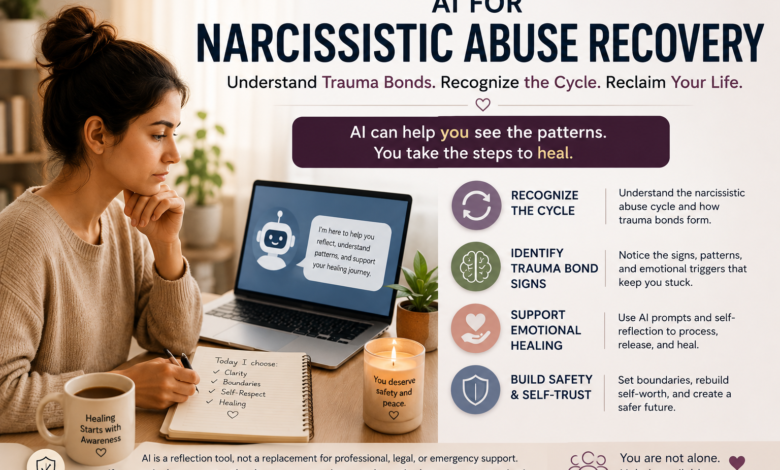
AI for narcissistic abuse recovery can help you organise confusing experiences, recognise repeating patterns, and understand why a trauma bond can feel so difficult to break.
Thank you for reading this post, don't forget to subscribe!This guide explains how to use AI trauma bond help safely while looking for common trauma bond signs, emotional triggers, withdrawal reactions, and the repeating narcissistic abuse cycle.
You will also learn how AI abuse cycle detection can support journaling, timeline review, and fact-based reflection without diagnosing another person or replacing professional care.
The goal is not to let technology decide whether someone is a narcissist. The goal is to help you separate facts from fear, promises from patterns, and temporary relief from genuine safety.
With clear prompts, nervous-system support, and human guidance, AI can become a practical reflection tool for rebuilding self-trust after narcissistic abuse and making safer, more grounded recovery decisions gradually.
AI for Trauma Bond Recovery After Narcissistic Abuse
You may already know that the relationship hurt you.
You remember the silence, blame, broken promises, emotional confusion, and moments when you no longer recognised yourself. Yet when that person withdraws, blocks you, becomes cold, or suddenly returns, part of you may still wait for their message.
You may ask:
“Why do I still miss someone who caused me so much pain?”
“Why do I feel calmer when they return, even though nothing has truly changed?”
“Why can I see the pattern clearly one day and doubt myself the next?”
AI for narcissistic abuse recovery can help you organise confusing experiences, recognise repeating behaviour, and separate facts from emotional pressure. This guide explains how to use AI trauma bond help while noticing the signs of a trauma bond, understanding the narcissistic abuse cycle, and exploring AI abuse cycle detection safely.
The purpose is not to ask technology to diagnose another person. It is to help you see what repeatedly happened, understand what your body may be reacting to, rebuild self-trust, and decide when qualified human support is needed.
A Clear Answer: Can AI Help With Narcissistic Abuse Recovery?
AI may support reflection after emotional or narcissistic abuse by helping you:
- organise incidents in chronological order;
- compare promises with repeated behaviour;
- identify emotional triggers;
- separate facts, feelings, fears, and assumptions;
- prepare questions for a therapist or support professional;
- create a grounding plan for moments of emotional urgency;
- recognise when the same relationship sequence keeps returning.
However, AI for narcissistic abuse recovery has important limits.
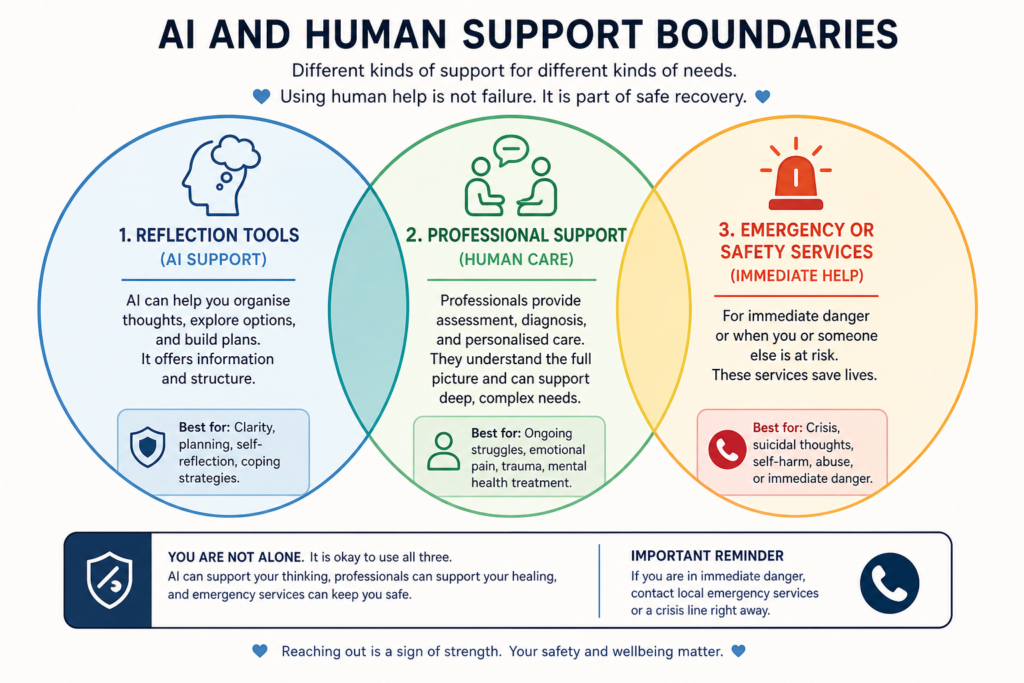
AI cannot confirm that someone has narcissistic personality disorder. It cannot observe what happens outside the information you provide. It cannot accurately assess immediate danger, replace trauma-informed therapy, offer legal protection, or decide whether confronting or leaving someone is safe.
The healthiest role for AI is not judge, therapist, or rescuer.
Its safest role is structured reflection.
You bring the lived experience. AI helps arrange the information. A qualified human professional helps interpret risk, trauma, mental health symptoms, and recovery needs.
Why Missing Someone Who Hurt You Feels So Confusing
The deepest pain of a trauma bond is often not that you cannot identify mistreatment.
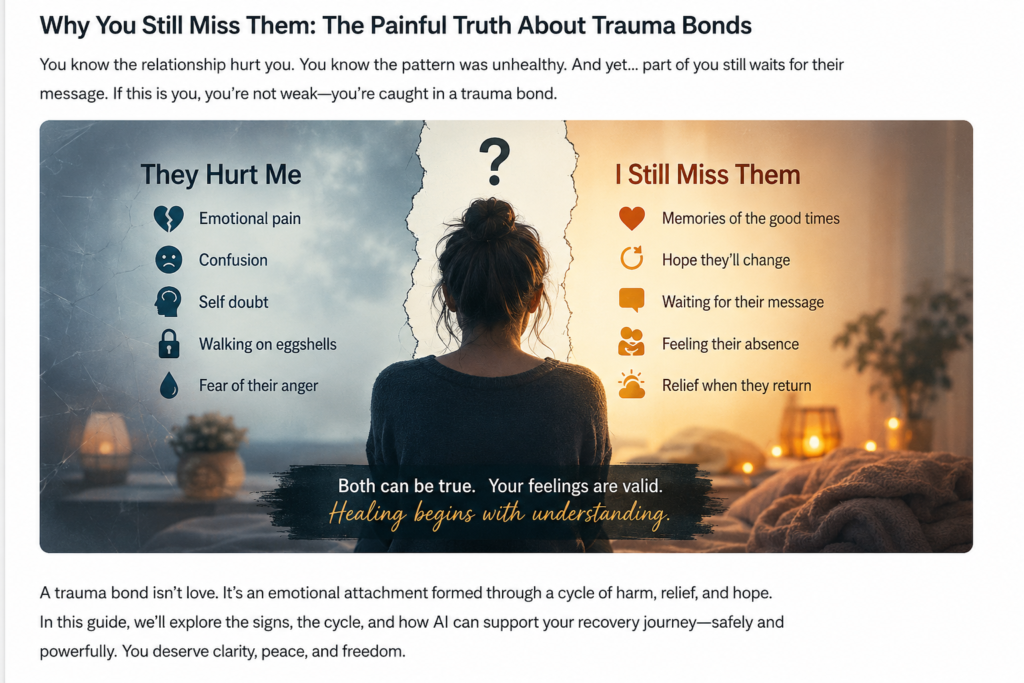
The pain is that two emotional realities seem to exist together:
- “This person repeatedly hurt me.”
- “I still miss them and want them to return.”
This contradiction can create shame. You may think that missing them proves that you exaggerated the harm, misunderstood their behaviour, or secretly wanted the relationship.
It does not.
An emotional attachment does not automatically prove that a relationship was safe. A person may remain attached to hope, familiarity, temporary relief, unfinished conversations, a promised future, or the version of the other person shown during the beginning of the relationship.
You may also be mourning who you believed they were.
That grief can remain even when your logical mind understands that the relationship pattern was harmful.
This is why simple instructions such as “just move on” or “block them and forget them” often feel invalidating. Recovery is not only about removing another person from your phone. It is also about understanding why their presence became connected to your sense of relief, worth, safety, or emotional stability.
For additional support with the period after separation, read how to move on after narcissistic abuse.
What Is a Trauma Bond in an Abusive Relationship?
A trauma bond describes a powerful emotional attachment that can form within a relationship involving a power imbalance, repeated harm, and intermittent periods of affection, attention, apology, or relief.
The bond does not form because a survivor enjoys mistreatment.
It may strengthen because distress and comfort begin coming from the same person.
The relationship may move through periods such as:
- intense affection or emotional closeness;
- criticism, control, confusion, or withdrawal;
- fear, self-doubt, or attempts to repair the relationship;
- apology, attention, affection, or renewed promises;
- temporary calm;
- repetition of the original behaviour.
Research into traumatic bonding has examined how intermittent abuse and unequal power may contribute to strong emotional attachment.
Abuse-support organisations also emphasise that abusive relationships involve patterns of power and control, not merely isolated disagreements.
The term should still be used carefully. Feeling attached to an unhealthy person does not automatically prove that a formal trauma bond exists.
A qualified mental health professional can help you understand your individual experience without reducing it to an online label.
Signs of a Trauma Bond That Are Easy to Excuse
The signs of a trauma bond are not always dramatic. They may appear in small emotional reactions that gradually become normal.
You may notice that:
- you feel intense relief when the person becomes kind after being cold;
- you repeatedly explain or minimise their behaviour;
- you feel responsible for keeping them emotionally stable;
- you fear their silence more than you question the behaviour that preceded it;
- a small apology makes you forget a larger repeated pattern;
- you feel unable to trust your memory after conflict;
- you keep waiting for the person they were at the beginning;
- you defend them publicly while feeling unsafe privately;
- you believe that understanding their past means you must tolerate their behaviour;
- you feel compelled to contact them when they withdraw;
- you interpret temporary peace as proof of permanent change;
- you feel ashamed that leaving has not ended your attachment.
One of the less discussed signs of a trauma bond is emotional dependence on reconciliation.
The person’s return may seem to restore your ability to function. You sleep more easily, stop checking your phone, feel less panicked, or temporarily believe that everything will be all right.
The body feels relief.
The mind may call that relief love.
But relief after distress is not always evidence that the relationship is safe. Sometimes it only means that the immediate emotional threat has paused.
The Core BBH Distinction
Healthy love: Safety remains reasonably consistent even during disagreement.
Trauma-linked relief: Safety appears mainly when the person who created the distress temporarily removes it.
Recognising these signs of a trauma bond is not about proving that the other person is evil. It is about understanding what the relationship repeatedly does to your emotional stability.
The Emotional Permission Loop: A BBH Reflection Framework
Many articles explain trauma bonding as attachment created by alternating harm and affection.
That explanation is important, but it may not fully describe what the survivor feels internally.
The BBH Emotional Permission Loop offers another reflective lens:
Pain → withdrawal → self-doubt → waiting → return → relief → renewed hope → self-abandonment
This is not a medical diagnosis or established clinical model. It is a BBH reflection framework designed to help readers understand one emotional function a trauma bond may perform.
Over time, the other person’s response may begin to feel like emotional permission.
You may wait for them to give you permission to:
- believe that you are still lovable;
- stop feeling afraid;
- trust that you are not a bad person;
- feel that the conflict is officially over;
- return to normal life;
- believe your pain matters;
- feel emotionally real again.
The deepest attachment may therefore involve more than missing the person.
You may also be missing what their temporary kindness allowed you to feel about yourself.
This insight changes the recovery question.
Instead of asking only:
“How do I stop missing them?”
You can begin asking:
“What emotional permission am I waiting for them to give me?”
- Perhaps you are waiting for an apology before allowing yourself to trust your pain.
- Perhaps you are waiting for their agreement before accepting that a boundary was necessary.
- Perhaps you are waiting for their return before allowing yourself to feel worthy.
- Healing begins when emotional permission slowly returns home.
How the Narcissistic Abuse Cycle Keeps Hope Alive
The phrase narcissistic abuse cycle is often used to describe a repeating relationship pattern involving idealisation, devaluation, rejection or withdrawal, and renewed pursuit.
Not every unhealthy relationship follows a fixed sequence, and not every person who behaves harmfully has narcissistic personality disorder. Diagnosis belongs to qualified clinicians.
Still, recognising a repeating narcissistic abuse cycle can help you move away from isolated explanations.
Idealisation or Intense Connection
The relationship may begin with unusual attention, admiration, rapid intimacy, frequent contact, or promises of a special future.
You may feel deeply understood.
Devaluation or Emotional Instability
Criticism, blame, contempt, comparisons, withdrawal, control, or inconsistent affection may gradually appear.
You may begin changing yourself to recover the earlier connection.
Rejection, Silence, or Discard
The person may become unavailable, threaten to leave, block communication, disappear, punish you with silence, or act as though you no longer matter.
This stage can activate panic and self-doubt.
You can explore the emotional impact of withdrawal further in how narcissists use silence as emotional abuse.
Return, Hoovering, or Temporary Repair
The person may return with affection, regret, promises, gifts, emotional vulnerability, or claims that the relationship will now be different.
Your distress decreases.
Hope becomes stronger again.
The difficulty is that the calm period may be remembered as proof of love, while the full narcissistic abuse cycle becomes harder to hold in mind.
For a detailed explanation of these repeating stages, read the cycle of narcissistic abuse.
Relief Can Wear the Face of Love
Imagine that someone repeatedly creates emotional instability and later offers comfort.
The comfort feels powerful because it follows pain.
You may think:
“No one calms me the way they do.”
But another question may be more revealing:
“Would I need this much calming if the same person were not repeatedly creating the distress?”
This does not mean every reconciliation is manipulative. Healthy couples can hurt one another, apologise, learn, repair, and change.
The difference is found in the pattern.
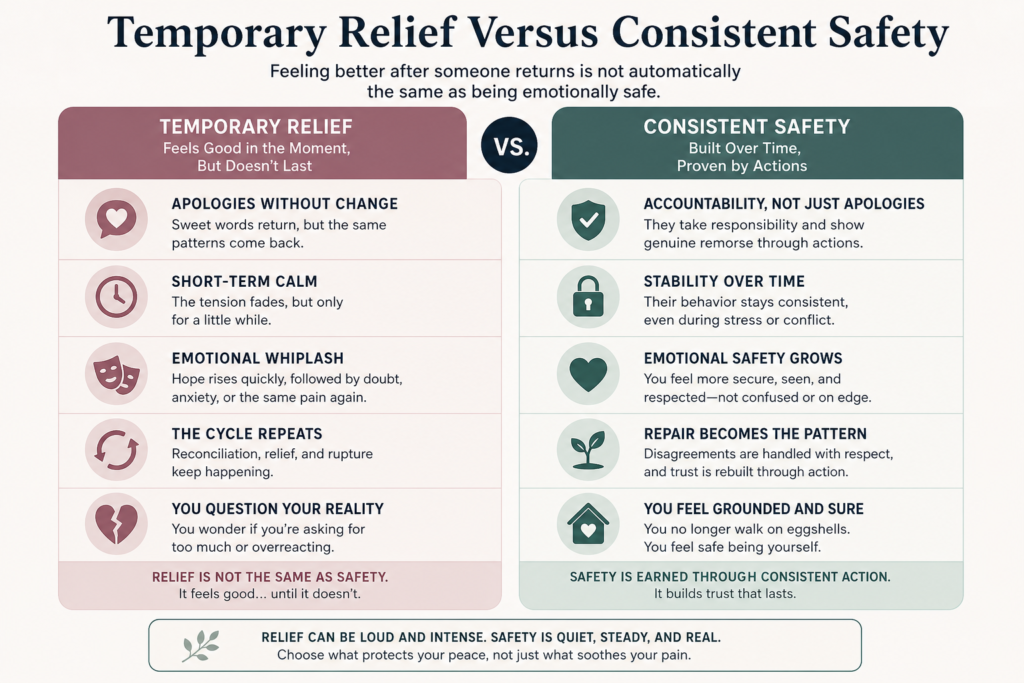
Real repair includes:
- accountability without blaming you;
- concern for the impact of the behaviour;
- respect for boundaries;
- consistent behavioural change;
- willingness to seek appropriate help;
- patience with the time required to rebuild trust.
Temporary relief may include:
- apologies that disappear once access is restored;
- promises without practical change;
- affection used to end the conversation;
- pressure to forgive immediately;
- claims that your reaction is the real problem;
- repeated return to the same behaviour.
The Memory Split: Why Good Moments Become Louder
During separation, loneliness, or silence, the mind may replay affectionate memories more vividly than frightening or humiliating ones.
This can create what we will call the BBH Memory Split.
Again, this is a reflection concept, not a clinical diagnosis.
In the Memory Split:
- the emotional mind remembers who the person sometimes appeared to be;
- the protective body remembers tension, confusion, and fear;
- the survivor feels divided between longing and self-protection.
You may look at an old photograph and remember connection.
A few minutes later, your stomach tightens when you remember their tone, silence, threat, criticism, or unpredictability.
Neither experience is imaginary.
One memory reflects attachment. The other reflects impact.
The purpose of recovery is not to force yourself to remember only the bad moments. It is to hold the complete pattern without allowing one affectionate memory to erase repeated harm.
This is where AI trauma bond help may become useful.
You can ask AI to organise events in order, compare what was promised with what occurred, or identify what happened immediately before each separation and reconciliation.
The purpose is not to create a prosecution document against the person.
It is to protect your own memory from becoming selective during emotionally vulnerable moments.
Compassion Debt: When Empathy Becomes Self-Abandonment
Sensitive people often understand the pain behind another person’s behaviour.
You may know about their childhood, rejection, insecurity, trauma, loneliness, or fear of abandonment.
That understanding may create an unspoken belief:
“Because I understand why they behave this way, I must give them another chance.”
The BBH term Compassion Debt describes the false belief that understanding another person’s pain means you owe them continued access to you.
You do not.
A painful history may help explain behaviour. It does not erase the impact of that behaviour or remove personal responsibility.
Compassion can say:
“I understand that you are wounded.”
A boundary can say:
“I cannot continue being harmed by the way your wounds are expressed.”
Both statements can be true.
You are not required to become cold, hateful, or emotionally detached from your humanity. You are allowed to care about another person while refusing to keep sacrificing your safety, dignity, health, finances, identity, or peace.
To understand how apparent empathy may disappear when accountability is required, read why covert narcissists dismiss emotional pain.
Why Trauma Bond Withdrawal Can Feel Like an Emergency
After contact reduces or ends, some people experience strong emotional and physical reactions.
These may include:
- urges to call or message;
- anxiety and restlessness;
- difficulty sleeping;
- checking social media repeatedly;
- intrusive memories;
- idealising the good periods;
- guilt about setting boundaries;
- fear that the person will replace or forget them;
- sudden doubt about whether the harm was “serious enough”;
- a strong need to explain themselves one final time;
- temporary relief after renewed contact.
These reactions are sometimes described online as trauma bond withdrawal. They are not identical for everyone, and they should not be self-diagnosed as a specific medical condition.
Still, the distress can feel urgent.
Urgency is not always instruction.
An urge to contact someone does not automatically mean contact is safe, necessary, or aligned with your long-term wellbeing.
Read Also: AI Therapy & Self-Help Tools
The BBH Return Window
The Return Window is the period when loneliness, panic, guilt, hope, or selective memory makes renewed contact feel most compelling.
During this window, do not demand a permanent life decision from yourself.
Focus on the next safe interval.
Ask:
- What happened immediately before this urge?
- What am I hoping their response will make me feel?
- What evidence do I have that the pattern has changed?
- Who can I contact other than this person?
- What would protect me for the next ten minutes?
- Is there any risk in contacting, confronting, blocking, or leaving?
When safety is uncertain, speak with a domestic-abuse advocate or qualified professional before taking action.
How AI Trauma Bond Help Can Support the Return Window
AI trauma bond help is most useful when it slows urgency rather than encouraging impulsive action.
Try this prompt:
“I feel a strong urge to contact someone after a painful relationship. Help me separate what I am feeling, what triggered the urge, what outcome I am hoping for, and what safe alternatives I can consider for the next hour. Do not diagnose either person or tell me whether contact is safe.”
Another prompt:
“Help me create two lists: what I miss and what repeatedly harmed me. Do not tell me what decision to make. Help me hold both realities without minimising either one.”
This form of AI trauma bond help supports emotional organisation.
It does not replace safety planning.
AI should not advise you to confront a controlling person, announce that you are leaving, disclose evidence, secretly record someone, or take any action that could increase danger.
Using AI Abuse Cycle Detection Without Diagnosing Anyone
The phrase AI abuse cycle detection can sound as though technology can confirm that abuse occurred or label another person.
It cannot reliably do that.
A safer use of AI abuse cycle detection is pattern organisation.
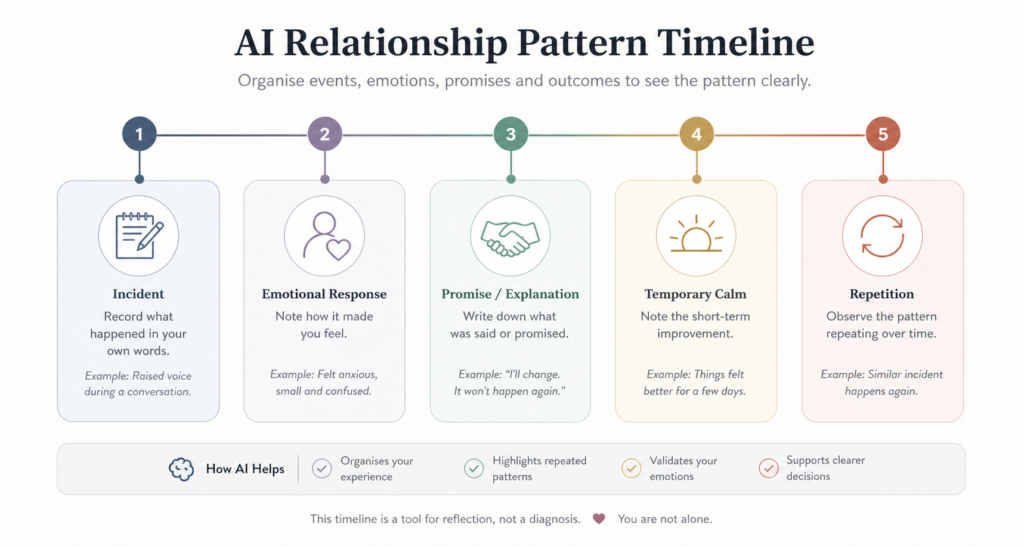
AI can review information you provide and help identify repeated sequences such as:
- what happened before conflict;
- how communication changed;
- what you felt in your body;
- what you did to restore peace;
- what the person promised;
- how long the calm period lasted;
- whether the same behaviour returned.
A Safe Pattern-Review Prompt
“Organise these events chronologically. Create separate sections for observable behaviour, my emotional reaction, what I assumed, what was promised, what changed afterward, and what repeated. Do not diagnose anyone or decide whether the relationship is abusive.”
A Promises-and-Patterns Prompt
“Compare the promises made after each conflict with the behaviour that followed. Use neutral language. Highlight repeated sequences without assigning a personality disorder.”
A Therapy-Preparation Prompt
“Turn these notes into questions I can discuss with a trauma-informed therapist or domestic-abuse professional. Do not provide a diagnosis or safety assessment.”
Used in this way, AI abuse cycle detection becomes closer to an organised journal than an authority.
It can help you see the forest when emotional distress keeps pulling your attention toward one tree.
The Self-Trust Ledger: A Practical BBH Exercise
One effect of prolonged emotional confusion can be reduced trust in your own perception.
You may repeatedly ask:
“Did that really happen?”
“Am I too sensitive?”
“Was I unfair?”
“Maybe I caused everything.”
The BBH Self-Trust Ledger is designed to help you record your experience without turning every entry into a diagnosis.
| What happened | What I felt | What I excused | What repeated | What I know now |
|---|---|---|---|---|
| Communication stopped after I raised a concern | Panic and guilt | They needed space | Silence followed difficult conversations | My concern remained unresolved |
| They promised change after I tried to leave | Relief and hope | Stress caused the behaviour | The same criticism returned | Promises did not become sustained action |
| I apologised to restore peace | Temporary calm | I believed I caused the conflict | I regularly accepted full blame | Peace depended on abandoning my perspective |
Use plain language.
Record observable details when possible.
Instead of writing, “They manipulated me,” write:
“They stopped responding for four days after I disagreed. When they returned, they did not discuss the issue but expected normal contact.”
The second version gives you information that can be reviewed without requiring AI—or you—to establish a diagnosis.
AI for narcissistic abuse recovery can help format this ledger, but you should review every output carefully. AI may misunderstand context, overstate patterns, or mirror assumptions contained in your wording.
A Three-Part Recovery Method: Pattern, Body, Human
Information alone may not break an emotional cycle.
You may understand the pattern intellectually and still feel overwhelmed physically.
A stronger recovery approach includes three parts.
1. Track the Pattern
Use the Self-Trust Ledger, a private journal, or safe AI abuse cycle detection prompts.
The objective is clarity, not obsession.
Set a limited review period so you do not spend the entire day reliving the relationship.
2. Support the Body
When activated, begin with simple grounding:
- place both feet on the floor;
- name five neutral things you can see;
- lengthen your exhale without forcing deep breathing;
- drink water;
- step into a safer or more public space when appropriate;
- delay non-urgent messages;
- eat, rest, or take prescribed medication as directed;
- remind yourself: “This feeling is intense, but I do not have to act immediately.”
Nervous-system language should not be used to diagnose every reaction. It is simply a way of recognising that distress can appear in the body as well as in thoughts.
3. Speak to a Safe Human
A therapist, trusted person, domestic-abuse advocate, legal professional, doctor, or support worker can provide something AI cannot: human judgement, accountability, context, safeguarding, and real-world intervention.
AI for narcissistic abuse recovery works best when it supports this human process rather than replacing it.
Read Also: AI-supported cognitive tools, safe AI therapy guidance, understanding narcissistic behaviour, healing from narcissistic abuse, rebuilding healthier relationships, breakup healing and emotional recovery
When AI Should Not Be Your First Tool
Do not rely on AI as your primary support when there are:
- threats of physical harm;
- stalking or surveillance;
- sexual coercion or assault;
- strangulation or physical violence;
- threats involving children, pets, money, housing, or employment;
- weapons;
- escalating intimidation;
- forced isolation;
- digital monitoring;
- threats of self-harm used to prevent you from leaving;
- immediate fear for your safety;
- thoughts of harming yourself or someone else.
In these situations, contact local emergency services, a domestic-abuse organisation, a qualified mental health professional, or another appropriate human service.
Leaving can sometimes increase risk. A personalised safety plan may be safer than announcing your intentions suddenly.
Also consider digital safety. Search histories, shared devices, cloud accounts, location settings, email, and AI-chat records may be visible to another person.
Do not enter identifying information, legal evidence, private images, financial details, addresses, passwords, or information that could place you at risk.
How to Rebuild Emotional Permission Inside Yourself
Breaking a trauma bond is not only about resisting contact.
It is about reclaiming the emotional permissions that became dependent on another person.
Practice statements such as:
- I do not need their apology to acknowledge my pain.
- I do not need their agreement to recognise a boundary.
- I do not need their return to prove that I am lovable.
- I do not need to solve their pain before protecting myself.
- I can miss someone without returning to the same pattern.
- I can feel guilt without using guilt as my decision-maker.
- I can understand their history without surrendering my future.
- I can pause before responding.
- I can seek help without first proving that the situation was bad enough.
- My feelings deserve attention, but they do not have to control my next action.
This is not instant detachment.
It is a gradual transfer of authority.
Instead of allowing another person’s mood, silence, praise, anger, or return to decide your emotional state, you begin building stability through your own routines, boundaries, support, work, values, health, and relationships.
For a deeper exploration of why the attachment may continue after separation, read why you still miss them after a narcissistic relationship.
What Genuine Change Looks Like
A trauma bond can remain powerful because hope repeatedly attaches itself to promises.
Therefore, do not evaluate change only by intensity.
Evaluate it through consistency.
| Temporary reconciliation | Evidence of genuine change |
|---|---|
| Emotional apology | Clear responsibility |
| Urgent promises | Sustained action over time |
| Pressure to forgive | Respect for your pace |
| Blaming stress or trauma | Seeking appropriate help |
| Affection after withdrawal | Consistent respectful communication |
| Fear of losing access to you | Concern for the impact on you |
| Short peaceful period | Long-term behavioural stability |
No table can determine whether a relationship is safe. Its purpose is to help you compare words with behaviour.
The narcissistic abuse cycle often gains strength from emotionally powerful moments that do not become lasting change.
Clarity asks a quieter question:
“What has been consistently different—not only emotionally promised?”
People Also Ask
Can AI identify a narcissist from text messages?
No. AI may notice communication patterns in the text you provide, but it cannot diagnose narcissistic personality disorder or determine someone’s full psychological condition. Use it to organise observations, not to assign a clinical label.
Can AI help me recognise signs of a trauma bond?
AI can help you reflect on possible signs of a trauma bond, such as repeated return after harm, relief following reconciliation, self-blame, fear of withdrawal, or difficulty holding the complete pattern in mind. A qualified professional should assess your individual experience.
Is missing an abusive partner proof that I should return?
No. Missing someone reflects attachment, grief, familiarity, hope, or emotional conditioning. It does not establish that returning is safe or healthy.
Can AI abuse cycle detection tell me whether I am being abused?
No. AI abuse cycle detection may organise repeated events, but it cannot perform a reliable safety assessment. Speak with a qualified domestic-abuse professional if you feel controlled, threatened, frightened, or unsafe.
Why do trauma bond signs become stronger after separation?
Distance may activate loneliness, uncertainty, selective memories, fear of abandonment, and urges to restore emotional relief. These reactions do not mean the previous pattern has changed.
Read Also: trauma-recovery-start-your-healing-journey-today
Frequently Asked Questions
Is AI trauma bond help private?
Privacy depends on the service, device, account settings, and whether someone else can access your phone, browser, email, or cloud history. Avoid sharing identifying or highly sensitive information and review the platform’s privacy settings.
Can journaling make trauma symptoms worse?
For some people, detailed reflection can become overwhelming or increase distress. Use short, structured sessions and stop when you feel flooded. A trauma-informed professional can help you find a safer pace.
How often should I use AI for narcissistic abuse recovery?
Use it with a clear purpose rather than repeatedly seeking reassurance. For example, spend 10–15 minutes organising one event, save the useful notes, and then return to grounding or human support.
What are the most common signs of a trauma bond?
Possible signs of a trauma bond include intense attachment despite repeated harm, defending the person, minimising mistreatment, feeling responsible for their behaviour, panicking during withdrawal, and experiencing strong relief when they return.
Does everyone in a narcissistic abuse cycle experience trauma bonding?
No. People respond to difficult relationships differently. Some may feel strongly attached, while others feel fear, anger, numbness, detachment, or a mixture of responses.
Can someone with narcissistic traits change?
People can change behaviour when they accept responsibility and engage consistently in appropriate treatment or personal work. However, another person’s potential for change should not require you to remain in a harmful or unsafe situation.
Is no contact always necessary?
No single strategy is safe or possible for everyone. Shared children, work, finances, housing, legal matters, or safety risks may complicate contact. Seek personalised professional guidance rather than applying a universal online rule.
What should I do when I want to contact them?
Pause. Identify the trigger, write what you hope contact will achieve, review your Self-Trust Ledger, speak with a safe person, and consider whether contact could increase risk. Focus first on the next safe step.
Personal Note
For a long time, I thought that understanding another person’s pain meant I had to keep accepting the pain they caused me.
I believed that compassion required one more explanation, one more chance, and one more attempt to prove that my intentions were good.
Later, I understood something different.
Compassion without boundaries can become self-abandonment.
The hardest part was not only missing the person. It was missing the relief that arrived whenever the conflict temporarily ended. Their return made me feel calm for a moment, and that calm could look like proof of love.
Healing began when I stopped waiting for another person to give me permission to feel peaceful, worthy, or emotionally safe.
I could understand their pain without continuing to disappear inside it.
Final Takeaway: Missing Them Is Not an Instruction
The goal of AI for narcissistic abuse recovery is not to let a machine define your relationship.
It is to help you slow down, organise your experiences, see repetition, and prepare for meaningful human support.
- Use AI trauma bond help to separate what happened from what was promised.
- Use your knowledge of the signs of a trauma bond to understand why longing and self-protection may exist together.
- Study the narcissistic abuse cycle as a complete sequence rather than judging the relationship only by its most affectionate moments.
- Use AI abuse cycle detection as a structured reflection process—not as diagnosis, proof, or permission to take a risky action.
Most importantly, remember:
- You do not need to deny that you miss someone.
- You only need to stop treating that feeling as evidence that returning is safe.
- Your attachment is real.
- Your pain is also real.
Healing begins when both truths are allowed to exist—and neither one is permitted to erase your need for safety, dignity, clarity, and support.
Safety and Medical Disclaimer
This article is for education and reflection only. It does not diagnose narcissistic personality disorder, trauma bonding, post-traumatic stress, or any other mental health condition. It is not a substitute for therapy, medical care, legal advice, domestic-abuse advocacy, or emergency assistance.
If you feel unsafe, threatened, monitored, stalked, physically harmed, sexually coerced, or at risk of harming yourself, contact appropriate local emergency services or a qualified crisis and domestic-abuse support organisation.
References and Support Resources
- The National Domestic Violence Hotline: Power and Control
- The National Domestic Violence Hotline: Create a Personal Safety Plan
- The National Domestic Violence Hotline: Narcissism and Abuse
- NHS: Getting Help for Domestic Violence and Abuse
- PubMed: Emotional Attachments in Abusive Relationships
- PubMed: Risk Factors for Traumatic Bonding