OCD Intrusive Thoughts: Symptoms & Recovery | BBH
OCD Thoughts: Treatment & My Recovery Story


OCD intrusive thoughts can turn an ordinary moment into an overwhelming experience. An unwanted image, disturbing question, or fear of making a mistake may lead to worry, checking, mental reviewing, or reassurance-seeking.
For people living with obsessive-compulsive disorder (OCD), the difficulty often lies not only in the thought itself but in the distress and compulsive responses that follow. This article combines evidence-based education with a first-person recovery narrative adapted from the earlier version of this BBH post.
The personal account illustrates one experience; it is not medical evidence, and treatment decisions require qualified professional guidance.
At a glance: OCD intrusive thoughts
Intrusive thoughts are unwanted thoughts, images or urges. In OCD, distress and repeated compulsions—sometimes entirely mental—can create a difficult cycle. Having an intrusive thought does not by itself mean someone will act on it.
What can help? Cognitive behavioural therapy with exposure and response prevention (ERP) is an evidence-based treatment; medication may also be recommended after clinical assessment. Explore OCD treatment and recovery.
What Are OCD Intrusive Thoughts?
OCD intrusive thoughts are recurring unwanted thoughts, images, or urges that become linked with distress, doubt, and sometimes repetitive behaviours or mental rituals. Almost everyone has unexpected thoughts occasionally.
In OCD, a person may interpret a thought as unusually meaningful or threatening, feel responsible for preventing an imagined outcome, or struggle to tolerate uncertainty. Obsessions are recurrent unwanted thoughts, urges, or images.
Compulsions are repetitive actions or mental acts performed to reduce distress or prevent a feared outcome. A thought by itself does not establish a person’s intentions or diagnosis.
OCD is assessed by considering symptoms, distress, time consumed, and effects on daily functioning.
My Personal Experience: When Ordinary Moments Became Frightening
The following first-person reflections are adapted from the previously published account and should be verified by the contributor. They are not a universal description of OCD. In my original account, I described an ordinary moment while preparing tea when an unwanted image about being burned appeared.
The image frightened me because I did not want it. Instead of passing, it triggered questions: Why did I think that? What does it mean about me? Can I trust my mind?
I also described doubts about whether I had switched off the stove. Checking again brought temporary relief, but soon another doubt appeared. My worries extended to germs, mistakes, and moral questions.
Counting, repeating phrases, and mentally reviewing events sometimes felt like ways to gain certainty, yet they could also become exhausting. Looking back at that narrative, the struggle was not simply the presence of a thought.
The repeated effort to prove that nothing bad could happen became part of the problem. I wanted to feel completely sure, but certainty never seemed to last.
Understanding the OCD Cycle
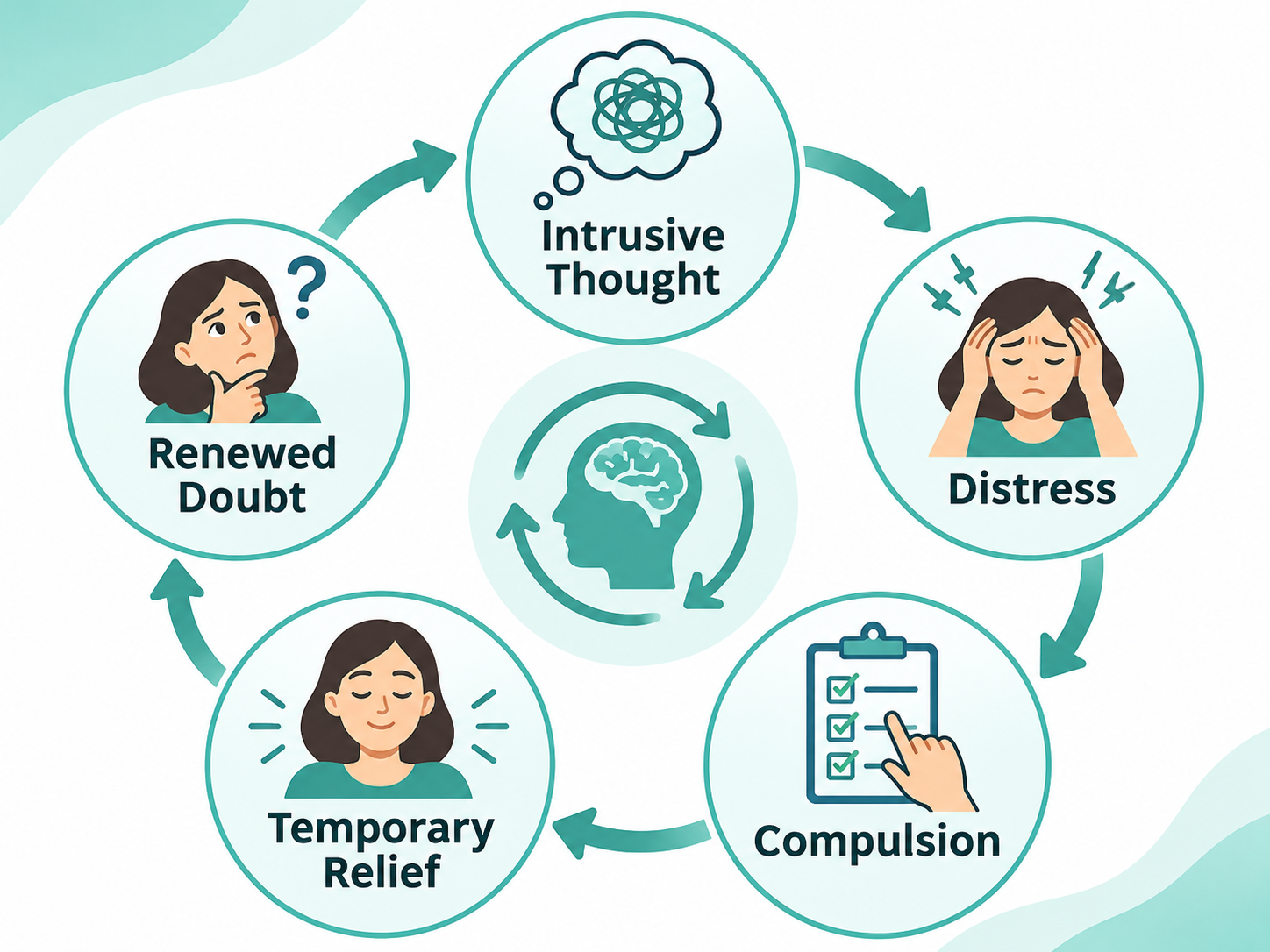
The relationship between obsessions and compulsions is central to understanding OCD intrusive thoughts. A compulsion can briefly reduce anxiety and therefore seem helpful, but repeating it may reinforce the idea that uncertainty must be eliminated.
| Stage | Example | What may happen |
|---|---|---|
| Intrusion | “What if I left the door unlocked?” | An unwanted doubt appears |
| Distress | “I must be absolutely sure” | Fear or responsibility increases |
| Compulsion | Repeated checking or mental review | The person tries to obtain certainty |
| Short relief | Feeling reassured temporarily | The ritual seems useful |
| Renewed doubt | “But what if I missed something?” | The cycle can restart |
Checking a lock once is ordinary. Returning repeatedly, reconstructing the memory, and asking others to confirm the lock despite having checked may reflect a different pattern when accompanied by distress and impairment. Image placement 2: OCD cycle diagram.
Alt: Diagram showing intrusive thought, distress, compulsion, temporary relief and renewed doubt. Title: Understanding the OCD Cycle. Caption: Compulsions can temporarily ease distress while maintaining the OCD cycle. Description: Educational illustration of the obsession–compulsion feedback loop.
Common Types of OCD Intrusive Thoughts
Harm-related thoughts
Some people experience unwanted fears or images about causing harm. These can be deeply distressing precisely because they conflict with a person’s values. The presence of an unwanted image alone does not establish intent; a clinician should assess any genuine safety concern.
Contamination concerns
Fears involving germs, illness, or contamination may lead to excessive washing, cleaning, or avoidance. The distinction from normal hygiene lies in the distress, repetition, and disruption.
Religious and moral concerns
Scrupulosity can involve recurring fears about sin, wrongdoing, or moral responsibility. Compulsions may include repeated prayers, confession, or mental reviewing. Ordinary faith practices are not themselves OCD.
Relationship doubts
People may repeatedly question feelings, analyse interactions, or seek certainty about a relationship. Read BBH’s guide to relationship OCD and recurring doubts.
Just-right and symmetry concerns
Some people repeat actions, arrange objects, or reread text until something feels complete. Not every preference for order is a disorder; clinical context matters. For additional information, explore common OCD themes and signs and symptoms of OCD.
Hidden Mental Compulsions: A Frequently Missed Problem
A major gap in many introductory articles is the limited attention given to rituals that happen entirely inside the mind. OCD intrusive thoughts may be followed by mental reviewing, counting, repeating a phrase, checking feelings, reconstructing memories, or seeking reassurance in disguised forms.
Someone may look calm while experiencing intense internal distress. The informal term “Pure O” is sometimes used for presentations dominated by obsessions, but many people described this way also experience mental compulsions.
NICE guidance recognises the importance of addressing mental rituals and neutralising strategies during CBT with ERP. Repeated reassurance from family or online searches can also become part of the cycle.
Compassionate support remains important, but an OCD-informed therapist can help families avoid unintentionally reinforcing compulsions.
Why Do OCD Thoughts Feel So Real?
OCD often involves heightened threat appraisal, intolerance of uncertainty, and the tendency to assign unusual importance to thoughts. Some people experience “thought–action fusion,” the belief that thinking about an event makes it more likely or says something about their morality.
Thinking about an accident does not cause the accident, but the thought can still feel urgent. Stress and poor sleep may make symptoms harder to manage. However, OCD should not be reduced to a single “chemical imbalance” or a simplistic explanation about a broken brain. It is a complex condition involving multiple biological and psychological factors.
How Is OCD Diagnosed?
Diagnosis requires clinical assessment, not a single online quiz or an isolated unwanted thought. A professional may ask about the frequency and content of obsessions, visible and mental compulsions, avoidance, reassurance-seeking, time consumed, and impact on relationships, work, or daily activities.
Clinicians also consider other possible explanations and coexisting conditions, including depression, anxiety disorders, trauma-related symptoms, and medical or substance-related factors. The Yale–Brown Obsessive Compulsive Scale (Y-BOCS) may help assess severity and monitor progress.
Evidence-Based OCD Treatment: What Research Supports
Established treatment options include cognitive behavioural therapy with exposure and response prevention (ERP) and certain medications. Treatment depends on severity, preferences, access, coexisting conditions, and professional assessment.
CBT with exposure and response prevention
ERP is a specialised form of CBT. Working with a trained clinician, a person gradually approaches feared situations or thoughts while reducing compulsive responses.
The aim is not to guarantee that every feared event is impossible, but to learn to tolerate uncertainty without relying automatically on rituals. ERP is collaborative and individualised; it should never require genuine danger or coercion.
Medication for OCD
Selective serotonin reuptake inhibitors (SSRIs) are established treatment options. Depending on clinical circumstances, medications such as sertraline, fluoxetine, or fluvoxamine may be considered.
Benefits may take weeks to emerge and require follow-up. A prescriber should explain side effects, interactions, monitoring, and discontinuation. Do not start, stop, or change psychiatric medication based on this article.
Combining treatment approaches
Some people benefit from ERP, some from medication, and some from both. NICE recommends approaches according to functional impairment and severity. Temporary distress during ERP does not automatically prove that an exercise is effective; discuss overwhelming or unsafe experiences with the treating clinician. Image placement 3: Professional therapy consultation.
Alt: Mental health professional discussing an individualised OCD treatment plan with an adult. Title: Evidence-Based OCD Treatment. Caption: CBT with ERP is a recommended psychological treatment for OCD. Description: Clinical consultation illustrating collaborative treatment planning.

My Recovery Journey: Learning to Respond Differently
One of the most important changes described in my earlier story was moving away from the belief that every frightening thought had to be solved. I wanted certainty: certainty that I had checked everything, that an unwanted image meant nothing, and that no mistake could happen.
But seeking reassurance again and again became tiring. Learning about OCD helped me consider a different possibility: a thought could appear without requiring an immediate ritual.
In the original narrative, I described working with treatment and learning to reduce compulsive responses. Details about specific therapy or medication should only be presented as verified personal history.
Recovery did not arrive as one dramatic moment. Some days were manageable and others difficult. Small changes mattered: reducing unnecessary checking, returning to activities, and noticing that uncertainty could be present without controlling every decision.
For me, freedom became less about having a perfectly quiet mind and more about having choices in how I responded. This is a personal reflection, not a promise about another person’s treatment outcome.

Practical Support Between Appointments
- Recognise the pattern: Notice when an unwanted thought leads to checking, reviewing, confessing, or reassurance-seeking without judging yourself.
- Practise uncertainty with support: Work with an OCD-informed clinician on reducing compulsive responses.
- Protect daily routines: Sleep, meals, movement, and supportive relationships can improve general wellbeing, but they do not replace OCD treatment.
- Use mindfulness thoughtfully: Observing thoughts may help some people, but meditation or breathing used to neutralise every obsession can become another ritual.
- Support without reinforcing rituals: Families can offer empathy while following a clinician-guided plan around repeated reassurance.
BBH also has a related guide to understanding intrusive thoughts. Editors should review the two pages for overlapping search intent.
What If OCD Treatment Is Not Helping?
If OCD intrusive thoughts remain severe, a clinician may reassess the diagnosis, determine whether therapy included OCD-specific ERP, identify hidden compulsions, review treatment intensity, consider medication response and adherence, and address coexisting conditions. Access barriers and family circumstances may also affect outcomes.
A poor response to initial treatment does not mean recovery is impossible. Specialist assessment may be appropriate. More intensive approaches exist, but they require expert evaluation and are not routine first-line options.
Finding OCD Support in the US, UK, Canada and Australia
United States: A licensed mental health clinician, primary care professional, or OCD specialist can help. The International OCD Foundation offers educational resources and a provider directory.
United Kingdom: A GP and NHS pathways can help people access assessment and treatment. NICE guidance outlines recommended care. Canada: Family physicians and provincial mental health services can provide referrals; availability and coverage differ by province.
Australia: A GP can discuss assessment and referral options, including relevant mental health services and funding pathways. If you believe you may act on an urge to harm yourself or another person, or cannot stay safe, seek immediate local emergency help.
In the US, call or text 988 for suicide and crisis support; call 911 for an immediate emergency. Elsewhere, use local emergency or crisis services.
Support is available
If unwanted thoughts or compulsions interfere with your life, consider speaking with an OCD-informed mental health professional. BBH offers educational resources to help you understand the options.
Frequently Asked Questions About OCD Intrusive Thoughts
Are intrusive thoughts normal?
Unwanted thoughts can occur without OCD. The disorder is considered when obsessions and compulsions cause significant distress, take time, or impair functioning.
Do unwanted thoughts reveal true intentions?
Not necessarily. An unwanted thought alone does not establish intent. Actual safety concerns should be assessed promptly.
Can OCD exist without visible rituals?
Yes. Mental reviewing, counting, neutralising, and reassurance-seeking may be compulsions.
Can OCD be treated?
Yes. CBT with ERP and certain medications can reduce symptoms and improve functioning for many people.
Does recovery mean never having intrusive thoughts?
Not necessarily. Treatment often aims for less distress, fewer compulsions, and greater participation in daily life.
Can meditation replace treatment?
No. It may support wellbeing, but it does not replace recommended OCD-specific care.
When should I seek help?
When symptoms are distressing, time-consuming, or interfere with daily life, seek a qualified assessment.
Final Reflection: Recovery Is More Than Silencing Thoughts
My recovery narrative began with fear and an exhausting search for certainty. One meaningful lesson was that an unwanted thought did not have to determine every action.
OCD can be persistent, but effective treatments exist. Recovery can involve returning to relationships, work, interests, and everyday experiences with greater freedom.
Clinical References
- National Institute of Mental Health: OCD
- NICE Guideline CG31: OCD and Body Dysmorphic Disorder
- NHS: Obsessive-Compulsive Disorder
- International OCD Foundation: Treatment
BBH Article ID: 25