Medicare Supplement Plans: 2027 US Guide
Medicare Supplement Plans: Costs and Benefits


Medicare Supplement plans, also called Medigap, can help US beneficiaries manage expenses left by Original Medicare. Choosing a policy requires understanding which expenses are shared, when enrollment protections apply and how premiums fit into a retirement budget. A low initial quotation is not necessarily the best long-term choice.
Thank you for reading this post, don't forget to subscribe!In This Guide: Eligibility, plan letters, Plan G versus Plan N, 2027 costs, enrollment rights, chronic care, switching coverage, budgeting and common questions.
How Medicare Supplement plans work
Original Medicare includes hospital and medical insurance. Beneficiaries may remain responsible for portions of approved bills. A supplementary policy can absorb some of those expenses according to its contract. It is not a general guarantee that every treatment or service will be paid. Consult the official Medigap overview.
Who can buy Medicare supplemental insurance?
Most purchasers have Original Medicare Parts A and B. Each supplement covers one person, so spouses generally need separate policies. Medicare Supplement Insurance is sold by private insurers rather than by Medicare itself. If you have Medicaid, retiree insurance, union coverage or another secondary payer, consult the benefits administrator or a counselor before purchasing additional protection. Duplicate coverage may be unnecessary or unavailable.
People who qualify for Medicare before age 65 may face different access rules. Federal law generally does not require insurers to sell Medigap to beneficiaries under 65, although many states provide additional protections. When a beneficiary reaches 65 and has Part B, the federal six-month purchasing window is important. Ask the state insurance department about local options rather than assuming that a national advertisement applies to you.
Original Medicare typically leaves a share of approved medical bills to the patient. A supplement coordinates with Medicare for eligible charges; it does not independently make an excluded procedure covered. For example, a service that Medicare does not cover may still leave the beneficiary responsible for the entire bill. Start by checking the underlying benefit and then the supplement’s terms.
Medigap coverage and plan letters
Most states use standardized lettered benefit designs. Massachusetts, Minnesota and Wisconsin have different standardization systems. Compare equivalent benefit designs before comparing insurers. Availability depends on state and insurer.
Plan G versus Plan N
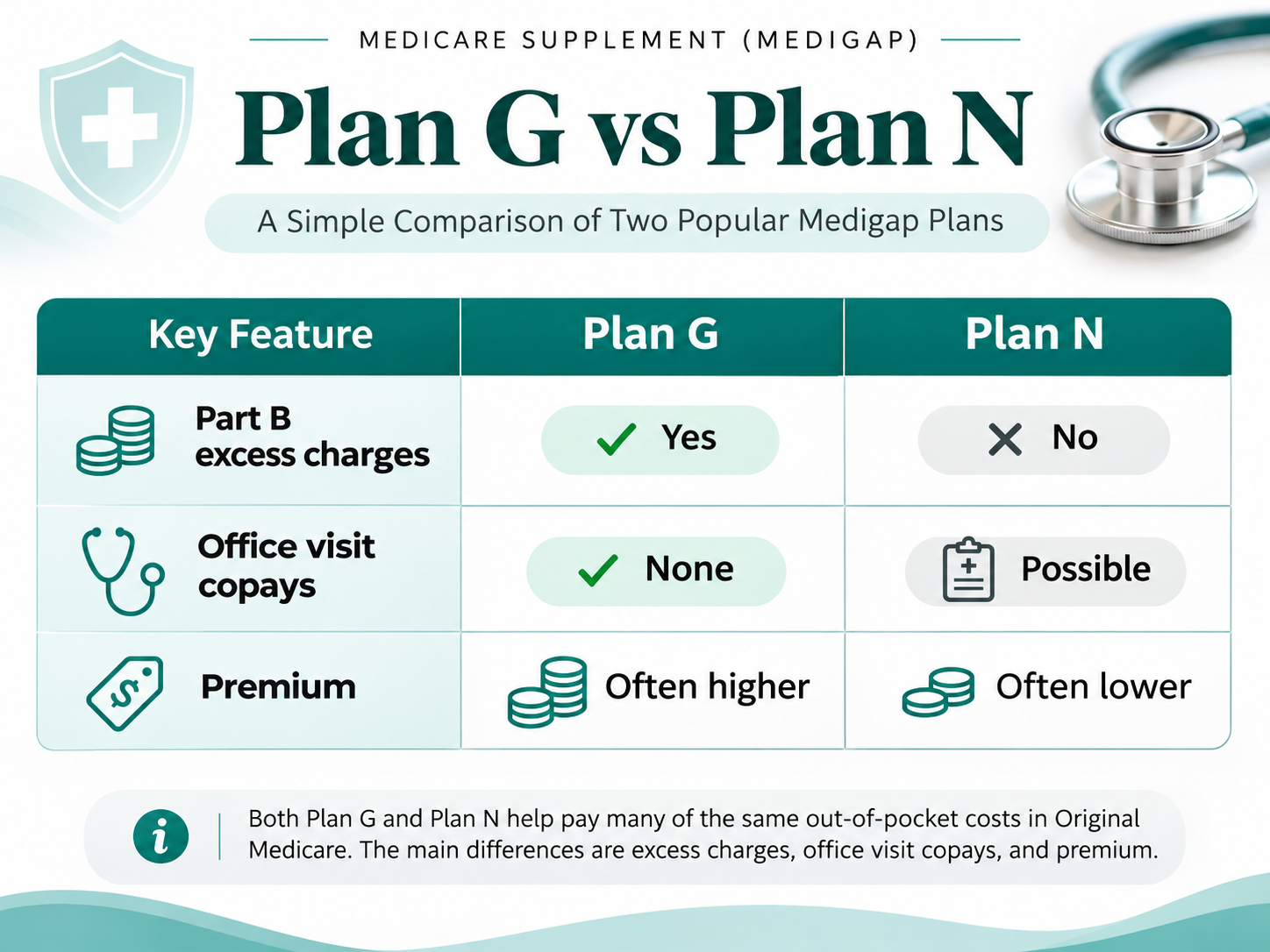
Plan G generally covers a broader range of Original Medicare cost sharing than Plan N, including Part B excess charges. Neither pays the Part B deductible. Plan N can leave certain office and emergency department copayments. Compare the premium difference with your expected use and potential excess charges.
Plans F, K and L
Plan F availability depends on whether you first qualified for Medicare before January 1, 2020. Plans K and L cover different percentages of specified cost sharing. After the applicable annual limit and Part B deductible are met, they cover the remaining eligible services for that calendar year. Review the official benefits chart for the precise design.
Comparing Medicare supplement plans A, B, D and M
Plan A offers a core set of cost-sharing benefits but does not pay the Part A deductible. Plan B adds that deductible. Plan D includes additional standardized benefits such as skilled nursing facility coinsurance, but does not cover Part B excess charges or the Part B deductible. Plan M covers half of the Part A deductible and includes other benefits shown in the official comparison chart. Not every company offers every letter in every location.
Plans C and F cover the Part B deductible but are generally unavailable to people newly eligible for Medicare on or after January 1, 2020. A person eligible before that date may still be able to purchase one if available and permitted by applicable purchasing rules. Do not confuse Medigap Plan D with Medicare Part D, the separate prescription drug benefit.
For Plan N, certain office visits can involve copayments up to $20 and emergency department visits that do not result in inpatient admission can involve copayments up to $50. Plan N does not pay Part B excess charges. Standard Plan G covers those charges but leaves the annual Part B deductible. High-deductible Plan G is a different cost-sharing arrangement from standard Plan G. Compare the exact product, not just the letter.
Medicare Supplement plans: 2027 cost benchmarks
Medicare.gov lists a standard Part B monthly premium of $209.40 and an annual Part B deductible of $292 for 2027. Higher-income beneficiaries may pay more. See the official Medicare cost schedule. The high-deductible versions of Plans F and G have a $3,050 threshold for 2027. The annual limits for Plans K and L are $8,360 and $4,180 respectively. These are benefit parameters, not monthly premiums, and do not represent a cap on every healthcare expense.
Request local quotes because policy premiums vary. Budget separately for Medicare premiums, supplementary insurance, drug coverage and services outside the contract. Ask insurers how they calculate renewal premiums, whether discounts expire, and how premiums have changed historically. The official cost guide provides additional context.
How insurers price Medicare supplement plans
Ask each insurer whether its premium is based on current age, age at purchase or a community rating approach. An attained-age policy may increase as the policyholder grows older; an issue-age policy is based on age when purchased; a community-rated approach generally does not base its premium on the individual’s age. Inflation, claims experience, approved rate changes and discounts may still affect prices. The rating method alone does not predict future premiums.
Request a written quote that states the ZIP code, plan letter, effective date, payment method and discounts. Ask whether a household or introductory discount can disappear. Compare the same benefits and the same coverage start date across insurers. Medicare’s cost guidance explains why estimates should be confirmed directly with the company.
Avoid treating the first monthly premium as a permanent price. Ask the insurer for available rate history and distinguish past increases from future predictions. A beneficiary on a fixed retirement income should consider how a higher premium could affect essential expenses. If affordability is uncertain, seek independent counseling about alternatives and assistance before making a commitment.
When can you enroll in Medigap?
The federal protected enrollment window generally runs for six months beginning with the first month you are at least 65 and enrolled in Part B. Outside that window, acceptance and pricing may depend on underwriting unless another protection applies. Certain pre-existing-condition waiting rules can also matter. State protections and access for beneficiaries younger than 65 vary. Check Medigap enrollment guidance.
Guaranteed issue rights and switching decisions
Certain events may entitle a beneficiary to buy particular supplements without medical underwriting. Examples may include qualifying losses of other coverage or specified Medicare Advantage trial rights. The available plan letters, dates and proof requirements depend on the event. Some protections permit applications before coverage ends and for a limited period afterward; do not assume a single deadline applies to everyone.
Use Medicare’s purchasing rights questionnaire and consult the state insurance department for additional rules. Some states provide extra opportunities to switch policies. Keep the written notice of coverage loss and dates of any applications. A sales representative’s verbal statement is not a substitute for confirming the applicable protection.
During the protected federal window, a company cannot use health history to reject an applicant or charge more because of health conditions. A limited waiting period for some pre-existing conditions may apply in certain circumstances, depending on prior creditable coverage. Ask for the exact rules before committing to a new start date.
Medicare Supplement insurance versus Medicare Advantage
These are different coverage arrangements. Medicare Advantage is an alternative way to receive Medicare benefits; Medigap works alongside Original Medicare. Do not buy a supplement expecting it to pay Medicare Advantage cost sharing. Before switching, verify your eligibility for the new policy, the effective date and separate drug coverage. A change in Medicare coverage does not automatically establish a right to every supplementary policy.
BBH transition checklist: Medicare Advantage to Original Medicare
A person considering a move from Medicare Advantage should verify three separate arrangements: the permissible Medicare election, eligibility for the intended supplement and prescription drug coverage. These decisions must be coordinated; approval of one does not establish approval of the others. Review Medicare’s official comparison and obtain written confirmation of dates.
List planned procedures, recurring medications, specialist appointments and equipment needs. Ask whether each provider accepts Medicare and whether suppliers meet Medicare requirements. A Medicare SELECT supplement may impose network restrictions on certain benefits, so confirm whether the quoted policy is a SELECT product. Do not rely on the assumption that every supplement works identically for provider access.
Do not drop current coverage without knowing whether the replacement application is accepted, when it takes effect and whether separate drug coverage is arranged. For complex transitions, a State Health Insurance Assistance Program counselor can help explain options without selling a policy. The SHIP network can connect you with local counseling.
What Medicare Supplement plans mean for chronic illness
For ongoing diabetes care, confirm that the underlying Medicare benefit covers the service or equipment and that the supplement applies to the remaining eligible charge. Review BBH’s continuous glucose monitor guide and blood glucose meter guide to identify questions for your clinician and insurer.
Ask separately about routine vision services and medical eye treatment. Our diabetes eye examination guide provides educational background. People managing multiple conditions may also benefit from reading diabetes and depression when planning coordinated care.
For diabetes technology and other medical equipment, first verify the applicable Medicare coverage criteria and supplier requirements. Then determine whether the supplement covers the eligible residual cost. For medications, check whether the drug is paid under Part B or a separate Part D benefit. The distinction matters because a supplement covering Part B coinsurance does not provide a general outpatient pharmacy benefit.
For mental healthcare, rehabilitation and home health services, the underlying Medicare coverage decision remains essential. Discuss service eligibility and care planning with the treating clinician. Keep copies of Medicare Summary Notices and insurer explanations so you can identify discrepancies rather than paying an unfamiliar bill immediately. See the Medigap coverage overview for scope and exclusions.
What Medigap generally does not pay for
Budget independently for custodial long-term care, ordinary dental and vision services, hearing devices and outpatient prescriptions. Some benefit designs include limited travel emergency protection, but this is not unrestricted international medical insurance. Read the coverage guide before making assumptions.
BBH practical annual budget comparison
Imagine two fictional policies. One costs $160 per month and leaves $300 in expected eligible cost sharing; the other costs $120 per month and leaves $900. The annual combined amounts are $2,220 and $2,340 respectively. Neither calculation includes Medicare premiums, drug coverage or excluded services. This illustration shows why a premium alone cannot establish affordability. Repeat the calculation for a higher-use year and consider how future rate increases affect retirement savings.
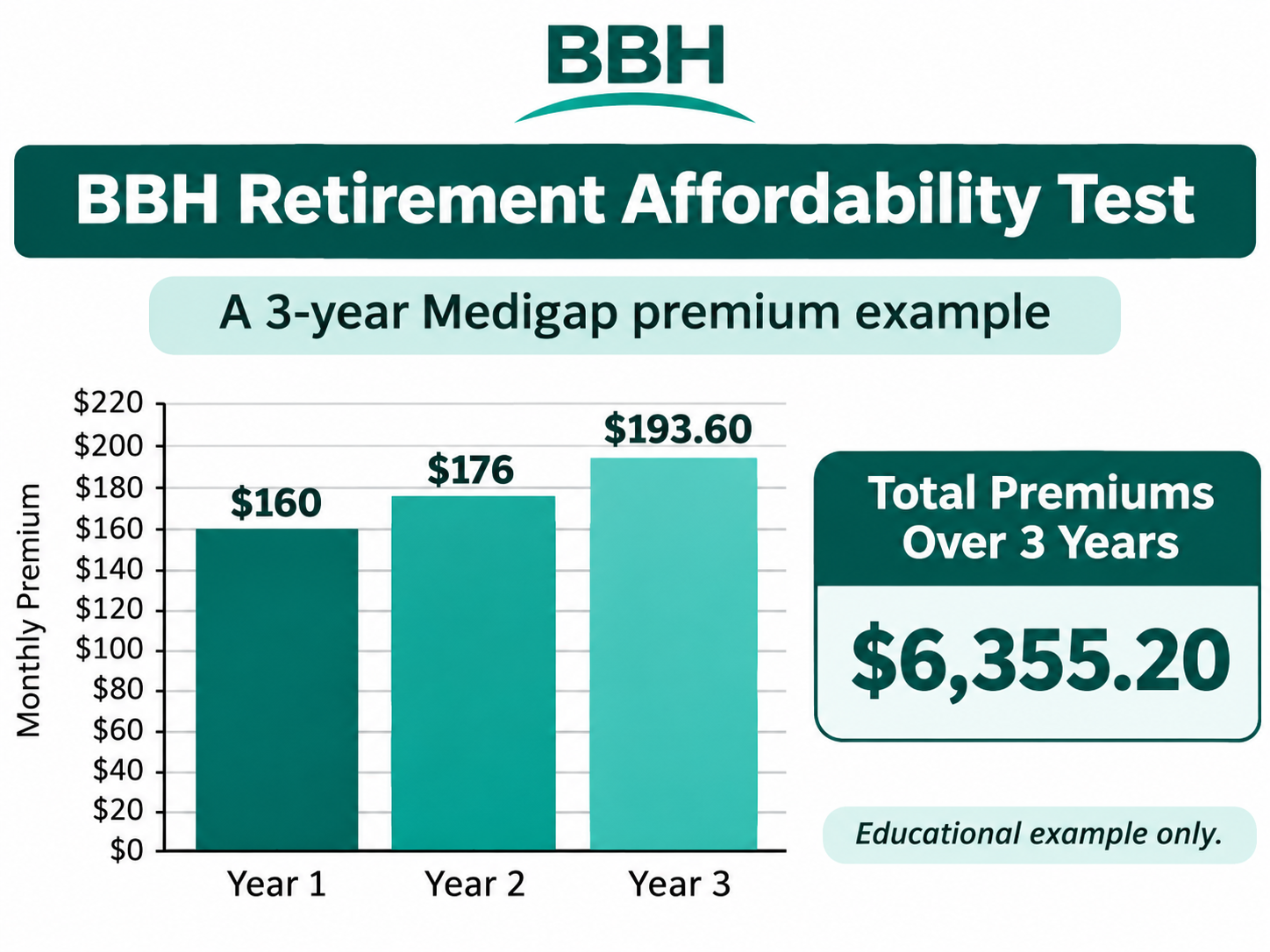
Original BBH content gap: a three-year retirement affordability test
A low introductory premium may look appealing while leaving a household vulnerable to future increases or loss of switching rights. Instead of predicting exact premiums, test several hypothetical increases. Keep the first year’s quoted price as a baseline and repeat the budget with alternative renewal assumptions. Include the Part B premium, Part D costs, expected cost sharing and expenses outside Medicare.
Now add a second scenario: the beneficiary wants to switch insurers after an unexpected diagnosis. Before assuming that a less expensive policy will be available, check whether state or federal purchasing protections apply. If acceptance is not assured, mark the proposed savings as uncertain. This combines renewal affordability with the practical risk of losing purchasing flexibility.
Prepare a one-page record containing the original policy letter, rating method, renewal date, premium history, purchasing-rights documents and contact details for independent counseling. Review the record before each renewal. The BBH test is an educational budgeting framework rather than a validated forecasting model or an individualized recommendation.
How to compare and buy a Medicare Supplement policy
Identify your eligibility and any protected purchasing rights first. Compare the benefit letter, obtain written quotations from licensed insurers, ask about rate-setting methods and confirm the start date. Save the policy documents and correspondence. Do not cancel existing protection before confirming replacement coverage. Free independent counseling is available through your State Health Insurance Assistance Program. See Medicare’s buying guide.
Related BBH guides and free worksheet
Read our Private Health Insurance in the US guide for background on private insurance terminology. Explore the Health Insurance and Healthcare Costs support page for more resources. Four chronic-care articles linked above provide additional educational background.
Frequently asked questions
Is Plan G always the best choice?
No. Compare benefits, premiums, eligibility and your ability to meet remaining expenses.
Can I change my supplement every year?
You may apply to change, but acceptance and pricing protections vary. Verify rights before canceling a policy.
Does Medigap cover my prescriptions?
Modern Medigap policies do not include outpatient prescription drug benefits. Evaluate separate Part D coverage.
Conclusion
Medicare Supplement plans can improve financial predictability, but compare the full retirement healthcare budget and enrollment rights before choosing. Use official benefit charts and independent counseling rather than relying on promotional claims.
Editorial note: Medicare.gov references checked November 28, 2026. Educational information only, not personalized insurance or medical advice.