Private Health Insurance in the US: 2027 Guide
Private Health Insurance: Costs and Coverage


Private health insurance in the United States can help individuals and families pay for healthcare through a workplace benefit or an individually purchased policy. But the word private does not tell you how comprehensive a policy is, whether your doctor participates in its network, or how much you will owe when you need treatment. Understanding the contract is essential before making a financial commitment.
Thank you for reading this post, don't forget to subscribe!In This Guide: Private versus public coverage; employer and individual policies; Marketplace versus direct purchase; HMO, PPO, EPO and POS networks; benefits; costs; medication access; changing jobs; claims and appeals; practical checklist and FAQs.
Related reading: Explore our guides to health insurance for self-employed workers; affordable US health insurance.
What is private health insurance in the US?
Private medical coverage describes arrangements provided through private insurers or private employment-based health plans rather than direct enrollment in a public insurance program. Employers sometimes fund claims themselves and contract with an administrator instead of buying a traditional insurance policy. That distinction matters because oversight and complaint pathways can differ.
Public coverage and private insurance are not always completely separate in practice. A private company may administer benefits within a government program, as with Medicare Advantage. Conversely, individual policies sold through the Affordable Care Act Marketplace are commonly issued by private insurers. A plan’s funding source, enrollment pathway and legal protections are more informative than its marketing label.
Types of private health insurance available in 2027
Employer-sponsored group coverage
Many workers obtain health benefits through an employer. The employer may contribute toward premiums, while employees pay a portion through payroll deductions. Compare employee-only coverage with the cost of adding dependents. The amount paid by an employee can vary substantially between employers, even when the plans have similar benefit designs.
Ask human resources for the current plan documents, enrollment rules, employer contribution and any available health account arrangements. Review the Department of Labor guidance for workers and families to understand applicable federal protections.
Individual Marketplace coverage
A Marketplace policy may be suitable when job-based coverage is unavailable or when a household wants to evaluate other eligible alternatives. The application determines whether financial assistance is available. An employer coverage offer may affect eligibility for savings. Use HealthCare.gov guidance on changing from job-based coverage before assuming that switching will reduce expenses.
For 2027 plan options, use the official Marketplace plan preview. Check the official enrollment calendar and your state marketplace’s deadlines. The preview is a useful starting point, but eligibility and final prices depend on the completed application.
Off-Marketplace individual policies
Some insurers sell comprehensive individual policies directly or through licensed brokers. Direct purchase may offer different network or product choices. However, an individual policy purchased outside the Marketplace does not qualify for Marketplace premium tax credits. Confirm that the plan is comprehensive major medical coverage and understand its enrollment requirements.
A broker’s quotation is not a substitute for the insurance contract. Ask whether the quoted product is an ACA-compliant individual major medical plan, which insurer issues it and whether any additional products are bundled into the price.
Private health insurance plans: HMO, PPO, EPO and POS
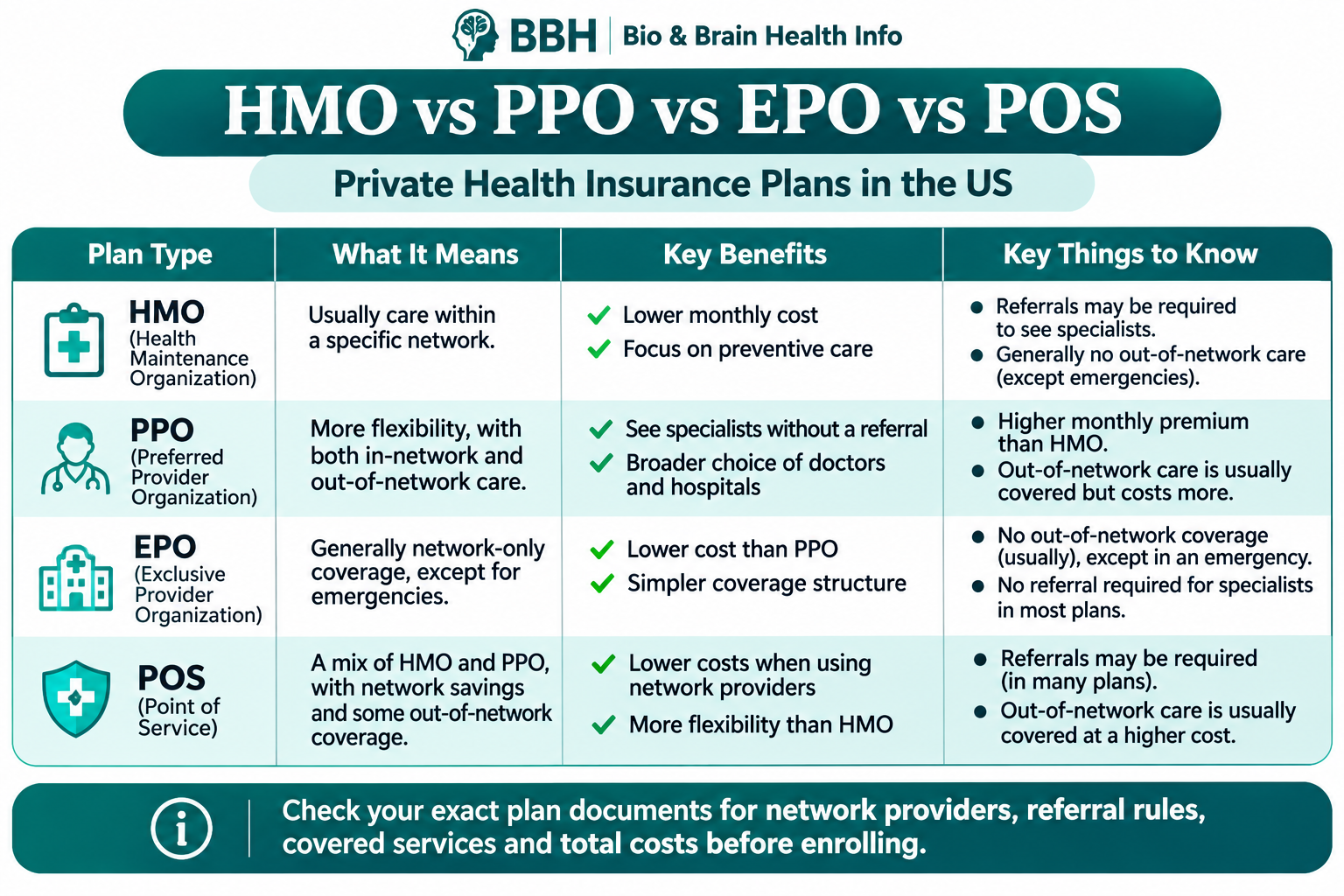
The network design influences which doctors and facilities you can use and what happens when you receive care outside the network. The official Marketplace network guide describes common arrangements. The following distinctions are general patterns; individual contracts can differ.
Health maintenance organization (HMO)
An HMO generally centers care within a defined provider network. Check whether you must designate a primary care clinician and obtain referrals. This design may be suitable when your preferred providers already participate and routine care can be coordinated locally.
Preferred provider organization (PPO)
A PPO commonly offers some benefits outside the network, with higher personal expenses. Check separate deductibles, reimbursement rules and potential balance bills. A PPO label does not establish that every physician is covered or that out-of-network charges are affordable.
Exclusive provider organization (EPO)
An EPO generally restricts nonemergency benefits to participating providers. Verify specialist access and hospital participation, particularly if you live in a region with limited medical facilities.
Point of service (POS)
A POS arrangement can combine network-based savings with referral requirements and some access outside the network. Ask how referrals and prior approvals work before choosing one.
What does comprehensive private medical insurance cover?
Marketplace policies include required categories of healthcare benefits, such as hospital care, outpatient services, prescription drugs, mental healthcare, maternity care and preventive services. The precise covered treatments, equipment and utilization rules differ. Employer coverage can operate under different benefit requirements, depending on the plan. See the official Marketplace coverage overview.
Adult dental and vision services should not be assumed to be included. Check whether separate coverage is available and whether adding it provides useful protection for your expected needs. Similarly, coverage for a broad category such as rehabilitation does not guarantee payment for every specific therapy or device.
Marketplace plans protect people with existing health conditions from rejection or higher premiums based on their health history. Review the pre-existing condition protections. These protections should not be assumed to apply identically to every limited-benefit product advertised as private coverage.
How much does private health insurance cost?
There is no single reliable premium for all US households. Individual Marketplace prices depend on factors such as location, age, family enrollment and applicable tobacco-rating rules, while employer contributions can significantly alter the employee’s share. The official premium-setting guide explains the factors used for Marketplace policies.
The premium is the recurring amount you pay to keep the policy. A deductible is an amount you may need to spend on specified services before the plan starts paying its share. Copayments are fixed charges for certain services, whereas coinsurance is usually calculated as a share of the allowed expense. Some benefits may apply before the deductible is met.
The annual out-of-pocket limit provides an important measure of financial exposure for covered in-network services subject to that limit. Premiums, excluded services and many out-of-network expenses are not included. Family policies may have individual and household limits, so read both.
Consider a hypothetical plan with a $300 monthly premium and a $6,000 in-network out-of-pocket limit. Annual premiums total $3,600. A year in which you reach that limit could cost $9,600 for premiums and applicable cost sharing, before other expenses. This is a budgeting example, not an actual insurance quote or a guarantee of maximum total spending. See the official annual cost comparison guidance.
How to compare private health insurance for ongoing care
Request the Summary of Benefits and Coverage for each candidate. Use it to identify the major costs and limitations, then read the detailed contract for services important to your household.
Prescription drugs and diabetes technology
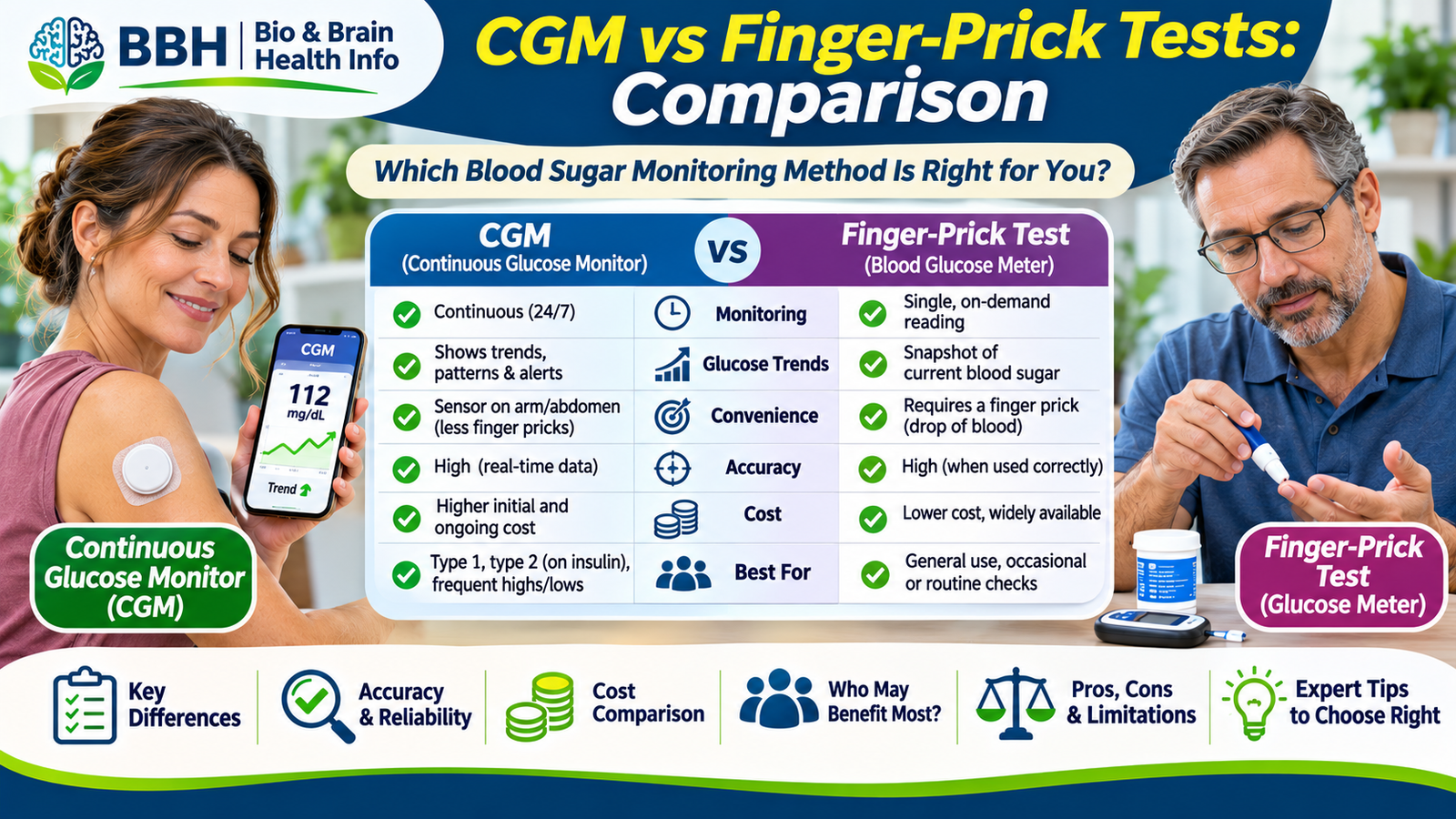
Check each medication using its exact name, strength and formulation. Ask about preferred pharmacies, formulary tiers, quantity limits and authorization requirements. If you use diabetes technology, find out whether supplies are handled through pharmacy benefits or durable medical equipment benefits. BBH’s guides to continuous glucose monitors and blood glucose meters can help you identify the supplies to discuss.
Mental health and specialist services
Ask whether the network includes your existing psychiatrist, therapist and specialist. A directory listing alone does not establish that appointments are available. Contact the practice to verify participation and ask about scheduling. Check telehealth benefits and authorization requirements. For an example of overlapping care needs, read diabetes and depression.
Preventive care and diagnostic follow-up
Preventive services and diagnostic investigations may be billed differently. A screening test can lead to follow-up procedures that carry additional charges. Confirm how the insurer treats the expected service and whether the facility and clinician both participate. Read BBH’s diabetes eye examination guide for an example of ongoing screening needs.
A private health insurance continuity-of-care test
A plan comparison can look favorable on paper while hiding a disruption to existing treatment. Before switching policies, create a dated record of the next 90 days of scheduled visits, medication refills, laboratory tests and planned procedures. For each item, verify the clinician, facility, specific service and exact plan identifier. A hospital being in network does not necessarily mean that every clinician practicing there is in network.
For prescriptions, record the drug name, strength, dosage form, refill date, pharmacy and any authorization expiration date. Ask the insurer whether an existing authorization transfers; do not assume that it does. For equipment, ask which suppliers can bill the new plan and whether fresh clinical documentation is necessary. Review official prescription coverage guidance.
If an insurer cannot confirm coverage, record the item as unresolved rather than assuming it is covered. Ask whether a transition-of-care policy applies. This practical test is a BBH educational framework, not a legally guaranteed right or a validated clinical instrument.
Changing jobs: COBRA versus individual coverage
When employment-based coverage ends, eligible workers and dependents may have the option of temporarily continuing their former plan under COBRA. They may also qualify for a Marketplace special enrollment opportunity. Compare the full continuation premium, alternative plan benefits and the effective dates before deciding.
The Department of Labor COBRA guide explains eligibility and notices. State continuation arrangements may also be relevant. Do not assume that voluntarily ending continuation coverage will always create a new Marketplace enrollment opportunity.
If a treatment course is underway, contact the new insurer about continuity arrangements and authorizations. Coordinate prescriptions and planned visits with your clinical team. Do not cancel existing coverage until you have confirmed when the replacement starts and completed any required first payment.
Avoid confusing limited-benefit products with comprehensive insurance
Products advertised as inexpensive private health insurance may include short-term policies, fixed indemnity benefits, discount programs or healthcare sharing arrangements. Their legal status, benefit limits and exclusions can differ considerably from comprehensive coverage. Review the CMS explanation of limited-duration and fixed-indemnity coverage, and verify current requirements with your state insurance regulator; rules and enforcement can change. Ask for the written policy and confirm applicable state and federal rules rather than relying on advertising.
Be cautious when a seller refuses to identify the issuing insurer, pressures you to purchase immediately or cannot provide clear coverage documents. Verify the broker’s license with the state insurance department. Never provide sensitive financial or identity information to an unverified enrollment service.
What to do if a private insurance claim is denied
Read the explanation of benefits and denial notice. An explanation of benefits is not necessarily a bill. Identify whether the problem involves eligibility, coding, missing documentation, network status, an authorization or a coverage exclusion. Contact the insurer and the provider’s billing department.
Request the relevant contract provision and applicable appeal instructions. Keep a record of dates, documents and reference numbers. Depending on the plan and circumstances, internal appeals and independent external review may be available. Employment-based plans may fall under federal benefit oversight, while state insurance departments may assist with regulated insurance policies.
If an urgent clinical decision is involved, contact your healthcare team immediately to discuss safe options and whether an expedited review is appropriate. Do not postpone emergency care while waiting for an insurance decision.
Private health insurance comparison checklist
Before signing, record the insurer, exact plan name, network design, monthly premium, deductible, in-network spending limit, specialist fees, prescription coverage and medical equipment rules. Identify your preferred hospital and verify the participation of clinicians and facilities relevant to planned care.
Compare two or three options using the same expected healthcare needs. Model an ordinary year, a year with several additional investigations and a year with substantial treatment. Ask which costs are excluded from your spending limit and how the plan handles care away from home.
Finally, write down the effective date, payment requirements, complaint pathway and renewal process. Save a dated copy of the benefit documents. An organized comparison can make future claims or coverage changes easier to manage.
Related BBH resources
Explore our Health Insurance and Healthcare Costs support page and diabetic kidney disease guide for additional care-planning context. The four related guides linked earlier in this article explain other ongoing healthcare needs.
Frequently asked questions
Is private health insurance better than public coverage?
Neither is universally better. Compare eligibility, access, benefits and personal expenses. A public program may offer excellent protection for an eligible person, while a private plan may suit another household.
Can I buy private health insurance without an employer?
Yes. Individual Marketplace and direct-purchase comprehensive policies may be available, subject to eligibility and enrollment rules.
Is a PPO always better than an HMO?
No. Consider your clinicians, travel patterns, referral preferences and budget. A wider network is valuable only if it provides useful access at manageable cost.
Can I get financial assistance when buying directly from an insurer?
Marketplace premium tax credits are not available for plans purchased outside the Marketplace. Use the official application to determine eligibility for Marketplace assistance.
Does private insurance cover every prescription?
No. Check the plan’s current formulary and authorization criteria. Ask about exceptions and discuss clinically appropriate alternatives with your prescriber.
Conclusion
Choosing private health insurance requires more than comparing premiums. Identify the coverage pathway, confirm consumer protections, compare networks and review the expenses associated with your actual healthcare needs. A well-documented decision can support continuity of care and reduce unpleasant financial surprises.
Editorial disclosure: Official US sources checked November 28, 2026. Educational information only; not personalized insurance, tax, legal or medical advice. Verify current policy terms and eligibility before enrollment.