Health Insurance for the Self-Employed: US Guide
Self-Employed Health Insurance: Costs and Plans

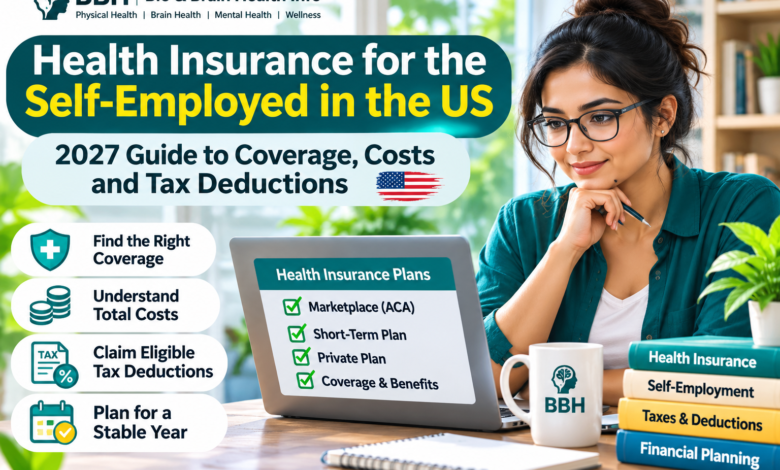
Health insurance for the self-employed can be one of the most important financial decisions for a freelancer, consultant or independent business owner in the United States. Without an employer arranging benefits, you must evaluate coverage yourself while managing variable income, business expenses and personal healthcare needs. The objective is not merely to find an inexpensive monthly premium. It is to maintain access to appropriate care without placing your business or household under unsustainable financial pressure.
Thank you for reading this post, don't forget to subscribe!In This Guide: Coverage choices; Marketplace eligibility; irregular income; financial assistance; tax deductions; annual costs; freelancers with chronic conditions; hiring employees; enrollment transitions; practical checklist and FAQs.
Health insurance for the self-employed: your coverage options
A sole proprietor who has no eligible employees will generally investigate the individual market rather than a small-employer group policy. This also applies to many independent contractors and people operating a one-person consulting business. Whether you have registered a company does not, by itself, establish eligibility for group insurance.
Start with the official HealthCare.gov self-employment guide. The available arrangements depend on your household, state, income, employment relationships and other eligibility factors. A business owner should consider the same coverage protections as any other individual, while accounting for the financial instability that can accompany independent work.
Individual Marketplace health insurance
The Marketplace allows eligible individuals to compare plans offered in their area. It also provides an application process for determining eligibility for financial assistance. Use the 2027 plan preview to begin your comparison. A preliminary estimate is not a confirmation of benefits or eligibility.
Coverage through a spouse or family member
If a spouse has workplace health benefits, ask whether you can join the plan and how much dependent coverage costs. Compare the additional household contribution with the total cost of your own policy. Also check how access to workplace insurance affects eligibility for Marketplace savings. Do not assume that the family plan is automatically cheaper.
Public coverage and direct-purchase alternatives
Depending on your circumstances, Medicaid, CHIP for eligible children or Medicare may be relevant. State rules and eligibility requirements need individual verification. Comprehensive insurance purchased directly from a private insurer may also be available, but Marketplace tax credits cannot be used for an off-Marketplace policy.
How freelancers should estimate income for health coverage
Revenue and profit are different. A business may receive substantial payments but have significant legitimate operating expenses. The Marketplace requests an estimate of net earnings from self-employment and takes account of other relevant household income under its rules. A freelancer should not simply enter total invoices as personal income.
Use a dated forecast of anticipated business receipts and allowable expenses. Include seasonal fluctuations and distinguish confirmed contracts from possible future work. A person with irregular income should base the forecast on realistic assumptions rather than choosing an artificially low figure to obtain more assistance.
For example, a hypothetical designer expects $72,000 in business receipts and $18,000 in allowable business expenses over the year. The simple business profit forecast is $54,000 before other adjustments. This is not necessarily the household income figure used for Marketplace eligibility. Other income, household members and applicable tax adjustments must also be considered.
The official self-employment income guidance and household income guide explain the reporting process. Consult an accountant or certified enrollment assister if your circumstances are complicated.
Affordable health insurance for self-employed workers with changing income
A self-employed person may earn considerably more in one quarter than another. Establish a schedule to review projected annual income when contracts begin or end, business expenses change, or a household member starts a new job. Report material income or household changes promptly through the Marketplace reporting process.
Advance premium tax credits reduce the amount that eligible enrollees pay during the year. The final tax calculation can differ from the advance amount when household circumstances change. Do not treat an initial estimate as a guaranteed permanent subsidy. Beginning with tax year 2026, the IRS states that excess advance premium tax credits must be repaid in full, without the former income-based repayment caps. See IRS guidance on repayment caps. This does not mean every enrollee owes repayment; the final credit calculation determines whether an excess exists. Use the rules applicable to the coverage and tax year rather than relying on a previous year’s threshold.
Maintain invoices, expense records, contracts, payment summaries and a dated forecast. If the Marketplace asks for proof of earnings, follow the documentation request and deadline. The verification guidance describes accepted documentation pathways, including alternatives for irregular earnings.
Self-employed health insurance deduction: what to know
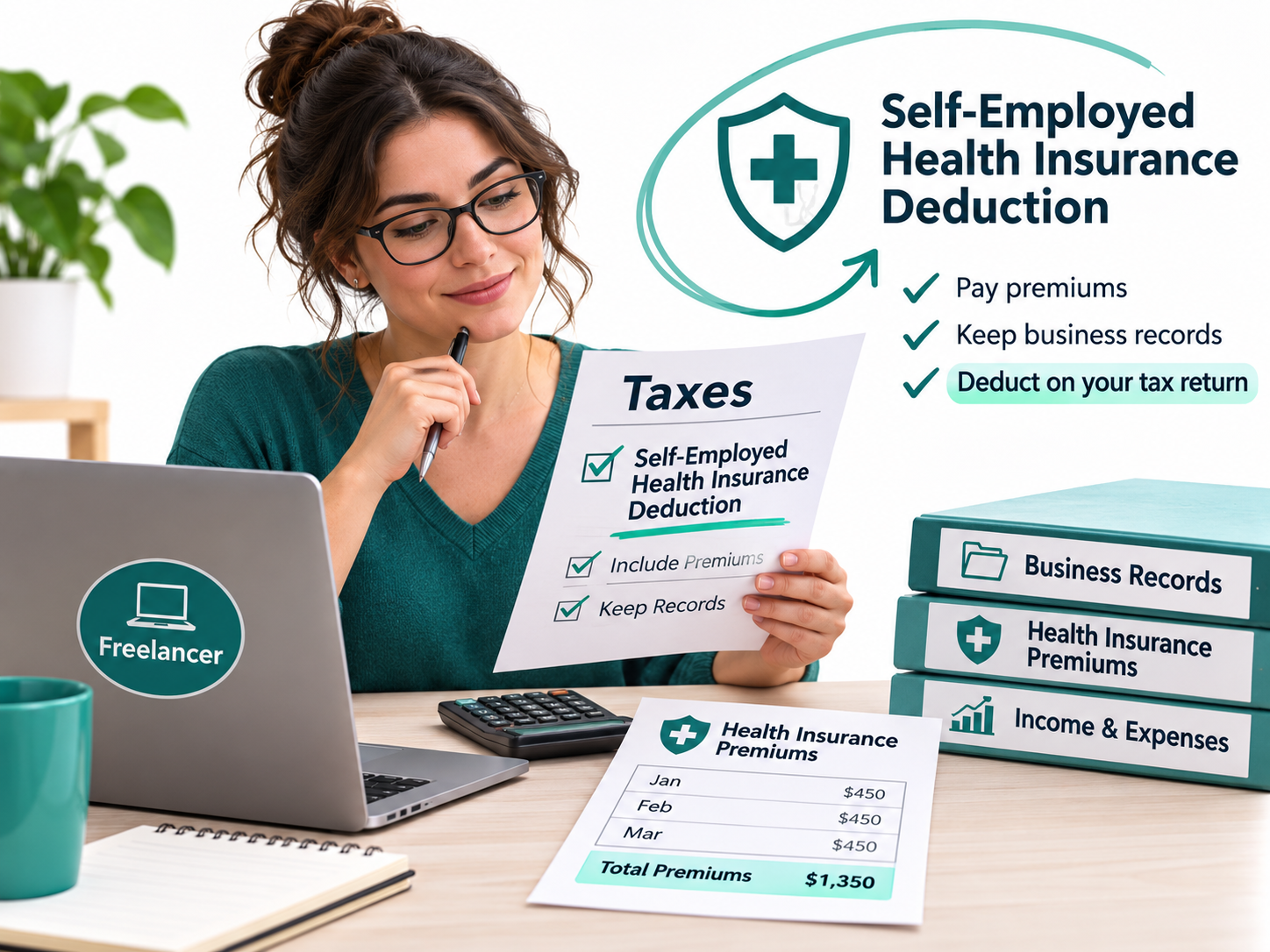
Federal income tax rules may allow qualifying independent workers to deduct certain health insurance premiums. Eligibility depends on the business arrangement, qualifying earnings, how the policy is established and access to subsidized employer coverage. The deduction is not an automatic reimbursement of the premiums paid. Generally, premiums for months when you were eligible for a subsidized employer plan, including certain family-member plans, are not eligible for this deduction. Consult the Form 7206 instructions for eligibility and limits.
The IRS provides Form 7206 and instructions for calculating the deduction when applicable. Sole proprietors, partners and certain S corporation shareholders can have different reporting requirements. An accountant should assess the correct treatment for the actual business structure.
Do not confuse the income tax deduction with a reduction in self-employment tax. Nor should you claim the same premium expense twice. If Marketplace premium tax credits and the deduction interact, the calculation may require special treatment. Consult IRS Publication 974 and the relevant year’s tax instructions.
Keep annual premium statements, payment evidence, Marketplace tax documents and records of any employer insurance eligibility. The finalized IRS instructions currently referenced are for tax year 2025. Use the final instructions applicable to your own tax year, rather than assuming that a draft or an earlier year’s rules are unchanged. This article does not estimate individual tax savings or promise that any reader qualifies.
How much does health insurance for the self-employed cost?
There is no single national premium suitable for every independent worker. Location, age, household composition, plan structure and financial assistance can influence individual market costs. Compare current personalized quotes instead of using outdated national averages.
Include premiums, deductible exposure, prescription charges, specialist visits, diagnostic tests and excluded expenses in your annual budget. Consider how much cash must be available at the beginning of the year if a deductible applies to planned treatment.
Suppose a freelancer compares two hypothetical plans. The first has a $250 monthly premium and expected annual personal medical expenses of $2,500. The second has a $375 monthly premium and expected personal medical expenses of $900. Under these assumptions, the first costs $5,500 for the year and the second costs $5,400. These are fictional scenarios, not quotes. Actual spending will depend on healthcare needs and policy terms.
Model a second scenario in which you need more medical care than expected. Examine the in-network out-of-pocket maximum and identify expenses outside that protection, including premiums and uncovered services. Business income may decline just when medical expenses rise, so the higher-use scenario is particularly valuable to independent workers.
Health insurance for the self-employed with chronic conditions
A freelancer who manages diabetes, cardiovascular disease or a mental health condition should prioritize continuity of treatment. A policy with an attractive premium can be a poor fit if changing plans means losing access to a trusted specialist or experiencing a delay in medication approval.
Diabetes medicines and medical devices
List prescribed medicines, monitoring devices and recurring supplies. Verify the exact formulary, pharmacy network and any authorization requirements. A diabetes device may be covered under a pharmacy or medical equipment benefit, depending on the policy. Read BBH’s continuous glucose monitor guide and blood glucose meter guide to prepare relevant questions.
Mental health and preventive services
Check therapist and psychiatrist participation, appointment availability, telehealth terms and medication benefits. If your work schedule makes routine appointments difficult, ask about accessible services before selecting coverage. BBH’s diabetes and depression guide provides background on coordinated treatment needs.
Do not neglect planned screening and follow-up examinations. Independent workers may be tempted to postpone appointments when business is busy. Ask how preventive and diagnostic services are classified and what referral rules apply. Our diabetes eye exams guide illustrates one important area of ongoing care.
When a self-employed business hires employees
Hiring an eligible employee can change the options available to a business. Small Business Health Options Program (SHOP) coverage may be available when the employer meets applicable requirements. A business consisting only of its owner and spouse or other disqualifying relationships generally cannot assume that it qualifies.
Before establishing a group arrangement, check the official SHOP eligibility guide. Compare contribution requirements, enrollment participation, administrative obligations and any available tax benefits with assistance from a qualified professional.
The decision to offer employee benefits should reflect the business’s ability to sustain contributions, not just its current revenue. Forecast payroll and benefits together, assess employee needs and plan for annual renewals. Group coverage does not automatically guarantee that every provider or prescription is included.
Leaving a salaried job to become self-employed
Before leaving employment, ask when your workplace coverage ends and whether continuation coverage is available. Loss of qualifying insurance can create a Marketplace special enrollment opportunity. HealthCare.gov generally allows applications within 60 days of losing job-based coverage; check the official loss-of-coverage guidance and relevant dates. Confirm dates and documentation through official enrollment channels rather than assuming that you can buy coverage on any future date.
Compare continuation benefits with an individual plan, including the impact on ongoing treatment and existing deductible spending. Ask whether a new insurer requires fresh authorization for planned care. Do not cancel current coverage prematurely. Verify the new policy’s effective date and any initial payment requirements.
During the transition, keep enrollment confirmations and contact information readily accessible. If a medication refill or scheduled procedure falls near the changeover date, coordinate with the treating clinician and insurer. Do not alter prescribed treatment simply to accommodate an insurance change.
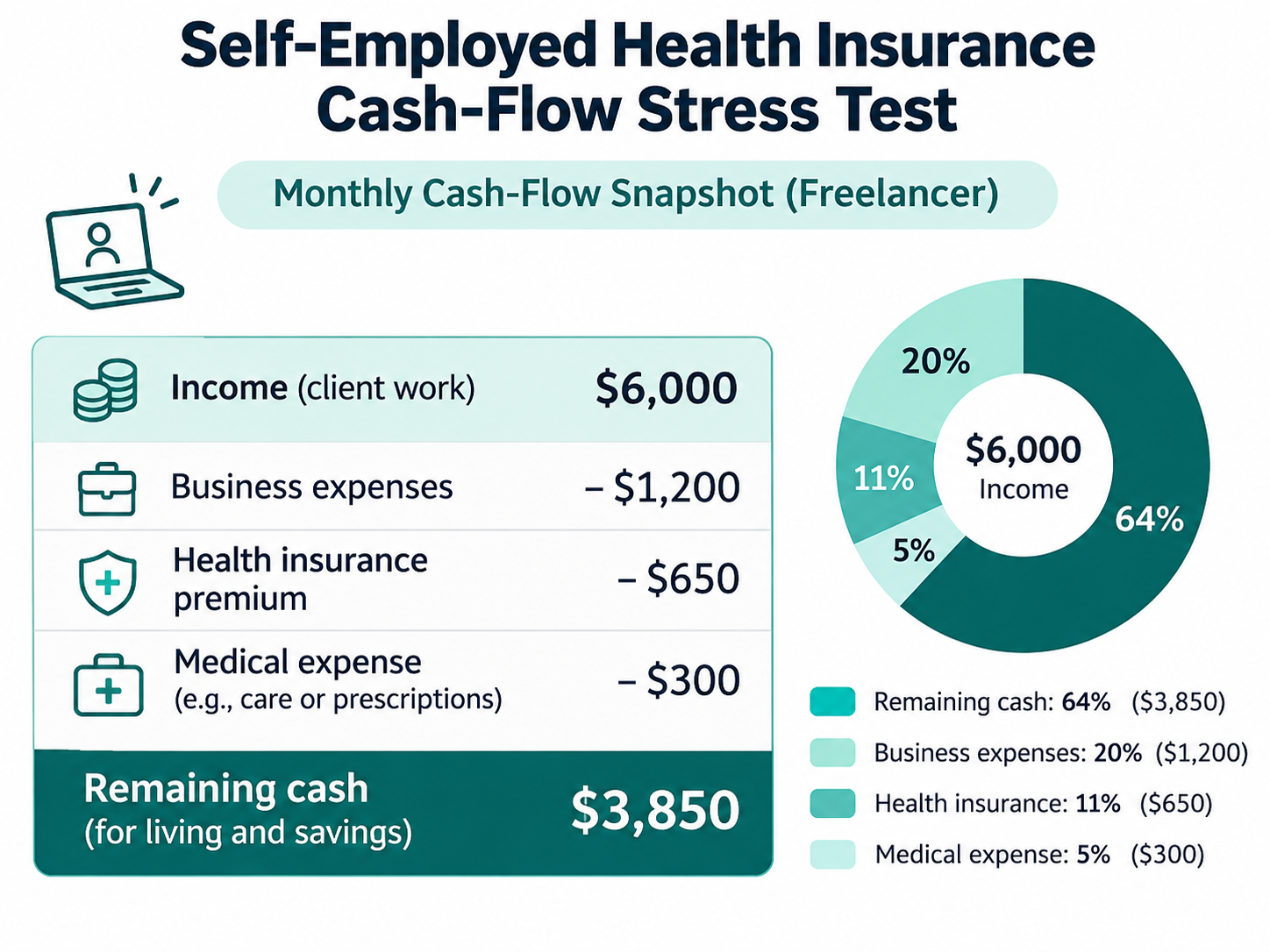
BBH cash-flow stress test for health insurance for the self-employed
An annual premium comparison overlooks the timing of business receipts and medical bills. Build a three-month cash-flow forecast using money actually expected to arrive, not merely invoices sent. Keep household essentials, business commitments, premiums, expected patient charges and tax reserves separate. This helps identify whether a plan is affordable during a slow month, rather than only across a profitable year.
Compare the same scenario using a second plan. Note when the premium is due, when the deductible may be incurred and whether any expected expense is excluded from coverage. Consider a separate reserve for potential tax-credit reconciliation; the size depends on your household circumstances. If the forecast shows a shortfall, consult an enrollment assister and tax professional before choosing a plan. Never compensate by skipping necessary treatment.
Review this forecast monthly during periods of irregular earnings and after major contract changes. A review of business cash flow is not a substitute for reporting annual household income to the Marketplace. Use the official income calculator to prepare an estimate and retain dated records of your assumptions.
A second useful check is to list the dates of recurring medical appointments and prescription refills beside expected customer payments. A plan with a manageable annual cost may still create a difficult first quarter. Before switching coverage, verify the effective date, pharmacy network, provider participation and any fresh prior authorization requirements. This BBH framework is an educational planning tool, not a validated financial model.
Checklist for health insurance for the self-employed
First, identify all eligible coverage pathways. Second, prepare a realistic annual business and household income estimate. Third, collect details of current prescriptions, preferred healthcare providers and planned medical services. Fourth, request plan documents and compare total annual expenses under ordinary and higher-use scenarios.
Fifth, confirm the exact network and prescription formulary. Sixth, review eligibility for assistance through the official Marketplace application. Seventh, discuss tax treatment with a qualified adviser. Finally, confirm active enrollment and maintain a dated record of policy terms, payment and income updates.
A simple financial reserve can help protect both your healthcare and the operation of your business. Set aside funds for predictable premiums and consider how unexpected medical bills or time away from work could affect cash flow. Health insurance does not generally replace lost business income; disability income protection is a separate subject.
Related BBH insurance resources
Read our Private Health Insurance in the US guide and explore the Health Insurance and Healthcare Costs support page. The four related clinical education guides above help readers prepare questions about their ongoing healthcare needs.
Frequently asked questions
Can I buy health insurance for the self-employed without an employer?
Yes. Individual comprehensive coverage may be available through the Marketplace or directly from insurers, subject to eligibility and enrollment requirements.
Can I deduct my health insurance premiums as a freelancer?
Possibly. Eligibility depends on IRS rules, qualifying earnings and other coverage arrangements. Review the correct year’s guidance with a tax professional.
What if my self-employment income changes during the year?
Update your estimate through the Marketplace as required. Keep supporting business records and consider how the change may affect final tax-credit reconciliation.
Can a one-person company buy SHOP insurance?
Generally a business needs an eligible employee beyond the owner and certain related individuals to qualify. Check the official eligibility rules and any state-specific alternatives.
Is the cheapest policy the best option for a new freelancer?
Not necessarily. Compare coverage, access to care, expected yearly spending and the amount you could owe during a high-use year.
If your employment circumstances change, explore our guide to health insurance for unemployed adults.
Conclusion
Health insurance for the self-employed should be treated as part of a sustainable household and business financial plan. Compare comprehensive coverage options, report income accurately, check tax rules and protect access to necessary treatment. Revisit the decision at renewal and after major changes in business or family circumstances.
Editorial disclosure: Key HealthCare.gov and IRS guidance checked November 28, 2026. Tax-year-specific instructions and plan eligibility should be checked again before filing or enrolling. Educational information only; not individualized medical, insurance, financial or tax advice. Verify current eligibility, contract terms and tax-year rules.