PPO Health Insurance Plans
PPO Health Insurance: Benefits, Costs and Risks

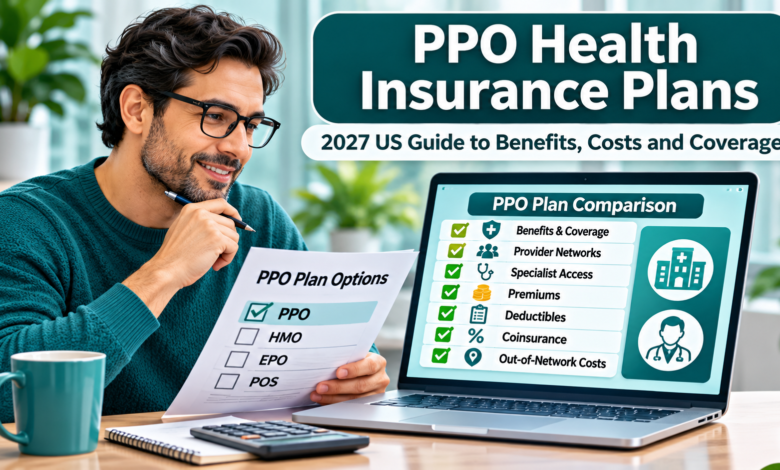
Choosing insurance can be especially stressful when you already have a trusted specialist or need treatment in more than one location. PPO health insurance plans offer a potentially useful combination of network discounts and access to some providers outside the network. However, flexibility is not the same as unlimited coverage. A patient may still face substantial costs when using a nonparticipating clinician. This US guide explains how to evaluate preferred provider organization coverage for 2027 without assuming that a familiar insurer name or a higher monthly premium guarantees better care.
Thank you for reading this post, don't forget to subscribe!In This Guide: PPO meaning, network rules, premiums, HMO and EPO comparisons, specialist access, emergency billing protections, chronic illness, Medicare, family coverage, the BBH out-of-network cost audit and enrollment questions.
What are PPO health insurance plans?
PPO stands for preferred provider organization. The insurer or health plan establishes contracts with participating hospitals, clinicians and other healthcare providers. Those agreements determine relevant payment arrangements and member cost sharing. A patient generally has a financial incentive to receive care within the contracted network, although the policy may also reimburse eligible services outside it.
The HealthCare.gov PPO glossary describes this network-based arrangement. A PPO is a type of insurance network design, not a guarantee of comprehensive benefits by itself. Employer plans, individual insurance policies and Medicare Advantage plans may all use PPO networks, but their benefit rules and enrollment requirements differ.
Before comparing policies, obtain the exact product name, benefit year and network identifier. Two products from the same insurer can have different participating facilities. A clinician who accepts one product may not accept another, even when both carry the same insurance company logo.
How do PPO health insurance plans work?
In-network healthcare
When an eligible service is provided by a participating clinician, the contract generally determines the amount recognized for payment. The member pays applicable deductibles, copayments or coinsurance. Participating providers generally cannot bill the patient for the difference between their original charge and the contracted amount for a covered service, subject to the terms of the arrangement.
The network does not remove the need to verify benefits. A service can be excluded, require prior authorization or involve a separate charge even when the clinician participates. Check both the provider and the specific service. Ask whether laboratory tests, imaging, anesthesia or other associated services involve different billing entities.
Out-of-network healthcare
A PPO may provide reimbursement for eligible services obtained outside the network. Such services often have higher patient charges, separate deductibles or different payment rules. The insurer’s allowed amount may be lower than the provider’s billed charge. When legally permitted, the provider may bill the remaining difference, known as balance billing.
Read the CMS medical billing glossary for terminology. Do not assume that all nonparticipating providers accept the insurer’s payment as full settlement. Ask the provider whether it will accept a negotiated amount and whether you may need to submit a claim yourself.
PPO health insurance plans and specialist access
PPO arrangements generally allow members to consult specialists without a primary care referral. Nevertheless, an insurer can require authorization for particular tests, procedures, drugs or treatment courses. A referral, prior authorization and clinical recommendation are three distinct concepts. None alone guarantees final claim payment.
If you have an established specialist, verify the exact office location and network. Confirm that appointments are actually available and that the clinician can provide the service you need. A listing in a directory is not proof that a particular procedure will be covered. Keep a written record of the date and response when confirming essential care.
PPO versus HMO, EPO and POS insurance
The official HealthCare.gov network comparison explains several common network designs. HMO coverage generally emphasizes participating providers and may restrict nonemergency care outside the network. EPO coverage typically limits covered nonemergency services to the network. POS arrangements may permit outside-network care while requiring a referral for certain specialist services. Individual contracts vary.
| Network type | Nonemergency out-of-network care | Specialist access |
|---|---|---|
| PPO | Often eligible at higher cost | Generally no referral |
| HMO | Generally restricted | Plan-specific referral rules |
| EPO | Generally restricted | Check policy |
| POS | May be eligible at higher cost | Referral often required |
These are general characteristics, not a determination about a particular insurance product. Do not select a network design solely because its label sounds more flexible. A well-matched HMO could provide convenient access to all necessary clinicians, while a PPO could have poor local availability. Compare actual networks and expected expenses.

How much do PPO health insurance plans cost?
Premiums vary according to the market, location, available policy, household details and employer contributions or eligible financial assistance. PPO policies can have higher premiums than more restrictive alternatives, but that is not a universal rule. Obtain quotes for identical coverage periods and eligible people rather than comparing unrelated advertised prices.
Review the medical and prescription deductibles, copayments, coinsurance and applicable out-of-pocket maximum. Some plans apply different cost sharing to preferred and nonpreferred providers. An out-of-network deductible may be separate from an in-network deductible. The annual in-network spending limit should not be interpreted as a cap on every possible medical expense.
Use the official healthcare total-cost guide when comparing premiums with anticipated medical expenses. Include the deductible only once when estimating patient cost sharing. List noncovered charges, travel expenses and legally permitted balance bills separately. A low-premium product is not automatically inexpensive overall.
A hypothetical annual insurance comparison
Consider a fictional PPO with a monthly net premium of $420 and a more restrictive policy costing $300 monthly. Their annual premium costs are $5,040 and $3,600. Suppose the PPO member incurs $1,800 in covered patient charges during the year while the alternative member incurs $2,700. The corresponding totals are $6,840 and $6,300. Under these assumptions, the more restrictive policy costs $540 less. If the necessary specialist is unavailable through that policy, the comparison requires additional investigation. These figures are invented, not insurance quotes or national averages.

Original BBH content gap: the allowed-amount and balance-bill audit
Many comparisons show an out-of-network coinsurance percentage without explaining the amount to which it applies. The BBH audit separates the provider’s billed charge, the insurer’s allowed amount, the remaining deductible, the coinsurance share and any legally permissible balance bill. A percentage alone cannot reveal the patient’s full liability.
For comparison, assume an in-network allowed amount of $600 with 20% coinsurance and a satisfied deductible. The patient would pay $120 under those assumptions. The illustrative difference is $520. Actual allowed amounts, benefit terms and applicable billing protections vary. The example does not apply to services protected against such balance billing.
| Illustrative cost | In network | Outside network |
|---|---|---|
| Allowed amount | $600 | $600 |
| Coinsurance | $120 | $240 |
| Permitted balance bill | $0 | $400 |
| Patient total | $120 | $640 |
Ask for a written estimate that identifies the billing entity and service. Record the assumptions used, and ask how expenses count toward applicable deductibles and spending limits. If the insurer cannot determine its allowed amount beforehand, mark the figure as unresolved. Do not enter zero or assume the insurer will pay a percentage of the provider’s entire bill. This BBH audit is an educational tool, not a validated actuarial assessment.

Emergency care and the No Surprises Act
The federal No Surprises Act offers billing protections in many emergency situations, for certain nonemergency services associated with participating facilities, and for covered air ambulance services. Where these protections apply, patient cost sharing is generally limited to in-network levels and prohibited balance bills should not be charged. Exceptions and additional state protections require case-specific consideration.
Ordinary planned visits to a nonparticipating physician are not automatically protected. Ground ambulance transportation generally falls outside federal surprise-billing protections, although state rules may differ. Review CMS insurance billing rights. Do not sign a notice and consent document without understanding whether it waives important protections.
PPO health insurance plans for chronic illness
People managing diabetes, cardiovascular disease, cancer or kidney disease may require several clinicians and ongoing medications. A PPO may offer useful flexibility, but access to a particular specialist is only one part of the decision. Confirm the treatment facility, laboratory, pharmacy, equipment supplier and any home healthcare provider. Ask whether benefits change when a service is obtained at a different location.
Check prescribed medicines using the current formulary, including the exact formulation and strength. Some products are billed through medical benefits rather than pharmacy benefits. Specialty medicines may require a designated supplier or approval. For diabetes equipment, see BBH’s health insurance for people with diabetes. For cardiac care, consult our heart patient insurance guide.
Family coverage and healthcare away from home
Families may need care near home, work, school and other locations. Do not assume the word PPO indicates nationwide access at in-network rates. Ask whether a national or regional partner network exists and whether its rules apply to routine and specialist care. Confirm telehealth availability, pharmacy access and the treatment of dependents studying away from home.
Compare individual and family deductibles and the additional cost of dependent coverage. A family with several recurring appointments should estimate the actual services it expects rather than using only a generic family premium. If household members use separate plans, confirm each person’s enrollment and benefits independently.
Medicare Advantage PPO coverage
Medicare Advantage PPOs are distinct from commercial individual PPO policies and Original Medicare. The Medicare PPO information explains this arrangement for Medicare beneficiaries. Check the specific plan’s covered services, provider participation, drug benefits and rules for obtaining care outside its network. Do not assume a provider who accepts Original Medicare participates in a specific Medicare Advantage product.
How to find affordable PPO health insurance
Start by checking available employer plans or the official Marketplace for your location. PPO availability differs by region and enrollment year. Eligible Marketplace applicants may qualify for premium assistance, depending on their circumstances. A network type is not the same as a metal category. Bronze, Silver, Gold and Platinum describe different cost-sharing designs, while the network label describes aspects of provider access.
Compare the exact Summary of Benefits and Coverage for each option. Ask for the full contract when the summary cannot answer an important question. Consider both ordinary healthcare spending and the ability to pay an unexpected charge early in the coverage year. Check the official enrollment deadline and confirm the effective date before canceling existing insurance.
Verify the entire treatment pathway before choosing a PPO
For planned care, ask the clinician’s office which organizations will submit separate claims. A consultation may lead to laboratory work, imaging and a follow-up procedure. Confirm each relevant provider and facility with the insurer using the exact product and benefit year. Ask about authorization requirements, the expected setting of care and whether any services are excluded. Record the representative’s response and reference number, if available. This reduces uncertainty but does not guarantee payment.
If an essential clinician leaves the network during ongoing treatment, contact the plan promptly about continuity-of-care arrangements. Certain patients receiving ongoing care may qualify for temporary protections under applicable federal or state rules. Ask whether the clinical situation meets the requirements and obtain the dates and conditions in writing. Do not independently postpone or discontinue treatment while waiting for a coverage decision. Consult the CMS medical billing rights resources linked above.
After a claim is processed, compare the explanation of benefits with the provider invoice. An explanation of benefits is not itself a bill. Check the service date, recognized amount, insurer payment, patient responsibility and reason for any denial. If the invoice exceeds the amount you expected, ask the insurer and provider to explain the difference. Investigate applicable appeal or billing dispute options, and note deadlines. Retain relevant documents securely.
When comparing renewal offers, repeat the provider checks even if the insurer and network label remain unchanged. Changes in employment, residence, dependent eligibility and prescription needs can alter the usefulness of a plan. A policy that worked well last year may not meet next year’s needs. Review the premium increase together with the actual network and benefit changes rather than assuming that the least expensive renewal is the most suitable option.
BBH checklist for PPO health insurance plans
Record the exact network, premium, in-network and out-of-network deductibles, applicable spending limits and authorization rules. Verify each essential provider and medicine, then calculate several annual cost scenarios. For planned outside-network care, complete the allowed-amount audit and investigate applicable billing protections. Preserve written responses and update the comparison at renewal.
Explore BBH’s guides to private health insurance, high-deductible coverage and pre-existing conditions.
Frequently asked questions
Can PPO members see any doctor?
Not necessarily. Eligible nonparticipating care may be covered at higher cost, but exclusions and provider availability still apply.
Do PPO policies always require higher premiums?
No. Compare actual prices and benefit terms in your market.
Is a referral the same as prior authorization?
No. A clinical referral does not establish insurer approval for a service.
Does the out-of-pocket maximum cover balance bills?
Generally, legally permitted balance bills do not count toward the in-network spending maximum. Protected services follow applicable billing rules.
Conclusion
PPO health insurance plans can offer valuable flexibility when the network and benefits match a household’s healthcare needs. Compare actual coverage, total expenses and potential outside-network charges before enrolling. Visit the BBH Health Insurance and Healthcare Costs support page for related educational guides.
Editorial disclosure: HealthCare.gov PPO, network, total cost and benefits summary guidance and CMS surprise billing guidance checked November 29, 2026. Illustrative costs are hypothetical. Individual plan terms and other links require confirmation. This is educational information, not individualized insurance, legal or medical advice.