High-Deductible Health Insurance Plans
High-Deductible Health Plans: 2027 US Guide

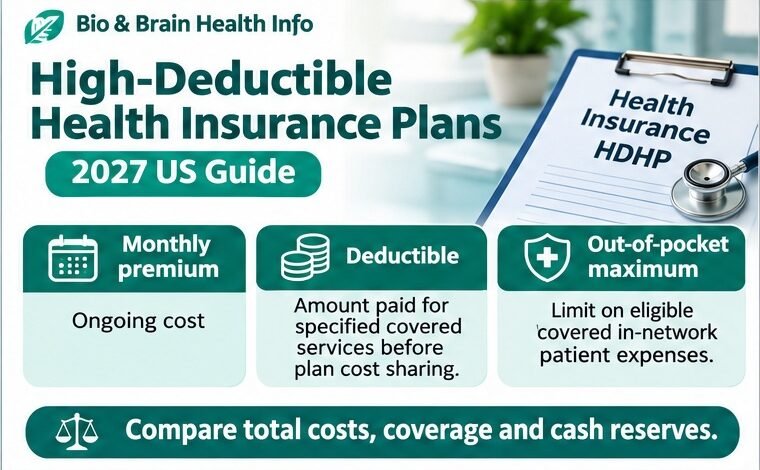
High-deductible health insurance plans can offer lower monthly premiums in exchange for greater responsibility for medical expenses when care is needed. In the United States, some of these policies also allow eligible individuals to contribute to a Health Savings Account (HSA). The arrangement can be useful for households that have sufficient savings and understand their expected medical expenses. However, it can create financial pressure when treatment is frequent or an unexpected illness occurs.
Thank you for reading this post, don't forget to subscribe!Quick Answer: Compare annual premiums, deductible requirements, covered services before the deductible, out-of-pocket maximums, network access and any employer HSA contribution. A high deductible does not automatically make a policy HSA-eligible, and individual HSA contribution eligibility must also be established. Marketplace Bronze and Catastrophic plans have special HSA compatibility rules. Choose according to realistic healthcare needs and your ability to pay upfront costs.
In This Guide: How high-deductible plans work; 2027 IRS limits; HSAs; Marketplace choices; preventive care; annual cost comparisons; chronic conditions; family deductibles; emergency savings; employer contributions; enrollment and frequently asked questions.
What are high-deductible health insurance plans?
A deductible is the amount a person may need to spend on specified covered services before the insurer begins sharing those expenses. A high-deductible plan places more initial responsibility on the enrollee than a lower-deductible alternative. Some benefits can be available before the deductible, depending on the policy and applicable rules.
The deductible is not the same as the monthly premium. You continue paying premiums to maintain coverage even if you receive no treatment. The deductible also differs from the out-of-pocket maximum, which limits certain personal expenses for covered services. Read the benefit summary and policy together to understand when each amount applies.
A plan described as high deductible in advertising does not necessarily meet the federal definition used for HSA eligibility. Confirm the actual plan designation rather than drawing conclusions from a single dollar figure. HealthCare.gov provides an overview of HSA-compatible coverage.
High-deductible health insurance plans: 2027 IRS limits
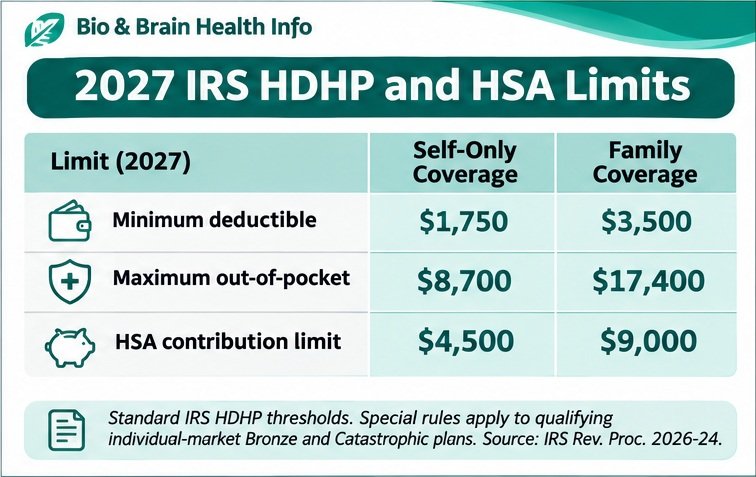
IRS Revenue Procedure 2026-24 establishes the standard HSA-related HDHP thresholds for calendar year 2027. The minimum deductible is $1,750 for self-only coverage and $3,500 for family coverage. The maximum applicable out-of-pocket expense is $8,700 for self-only coverage and $17,400 for family coverage. These amounts exclude premiums.
The annual HSA contribution limit for 2027 is $4,500 for self-only coverage and $9,000 for family coverage. These are general annual limits, subject to individual eligibility, contribution timing and other applicable rules. An additional catch-up contribution may be available to qualifying individuals aged 55 or older. Employer contributions generally count toward the annual limit.
For comparison, the standard 2026 minimum deductibles are $1,700 and $3,400. The 2026 out-of-pocket ceilings are $8,500 and $17,000, while the HSA contribution limits are $4,400 and $8,750. Consult the IRS Revenue Procedure 2026-24 and current IRS Publication 969 for the applicable year.
Important distinction: The standard IRS HDHP thresholds are not universal limits for every Marketplace policy that can be used with an HSA. Special statutory rules apply to qualifying Bronze and Catastrophic plans. Check the policy’s actual deductible and spending maximum.
How do high-deductible health insurance plans work with an HSA?
A Health Savings Account is an individually owned account that can be used for qualifying medical expenses under federal tax rules. It is not an insurance policy. The account may receive eligible contributions from an individual, employer or other permitted contributor. Remaining balances can generally carry over into later years.
Eligible contributions can receive favorable federal tax treatment, and distributions used for qualified medical expenses can generally be tax-free. State tax treatment may differ. Financial institutions may charge account fees or offer investment choices that carry risk. Review the account terms independently of the insurance contract.
HSA funds generally cannot be used tax-free to pay ordinary insurance premiums, although specified exceptions may apply. Keep receipts and records of qualified medical expenses. An individual should not reimburse the same expense twice or claim an incompatible tax benefit for the same payment.
Who can contribute to an HSA?
In addition to qualifying coverage, an individual generally must not have disqualifying additional health coverage, must not be enrolled in Medicare and must not be eligible to be claimed as another person’s tax dependent. Exceptions and special rules can affect particular arrangements. A spouse’s general-purpose flexible spending account, for example, may affect eligibility if it covers the individual.
Someone who loses contribution eligibility may generally retain existing HSA funds and use them for qualifying expenses. Review eligibility month by month when changing jobs, enrolling in Medicare or switching policies. Ask a qualified tax adviser about contribution limits and any required correction of excess contributions.
Bronze, Silver and Catastrophic health insurance plans
Marketplace metal categories describe the general sharing of covered medical expenses between insurers and enrollees, not the clinical quality of care. Bronze plans often have higher initial cost sharing than Gold or Platinum alternatives. However, the actual premiums and benefits must be compared individually.
HealthCare.gov explains that Bronze and Catastrophic Marketplace plans can work with HSAs under current special rules, while other categories may also qualify. Eligibility to purchase a Catastrophic plan is a separate question. Financial assistance and available enrollment options should be checked through the official Marketplace. See the metal category guide and Catastrophic plan guidance.
People eligible for additional cost-sharing reductions should compare eligible Silver plans carefully. A lower deductible or smaller patient charges may provide more immediate financial value than an HSA-compatible option. The appropriate choice depends on both eligibility and anticipated care.
What services can be covered before the deductible?
Applicable preventive services can receive coverage before the deductible under comprehensive insurance rules. Some plans may also cover specified nonpreventive services before the deductible when permitted. Check the actual policy rather than assuming every doctor visit or prescription must be paid in full.
A routine preventive appointment can lead to diagnostic tests or treatment that are billed differently. Ask how the provider expects to classify the service. A preventive-care label does not mean every investigation performed during the encounter is necessarily free.
Before reaching the deductible, an enrollee who visits a participating provider may still benefit from the plan’s negotiated rates for covered services. Verify that the claim was processed and that the appropriate eligible amount was credited toward the deductible. Do not assume that the provider’s initial self-pay quotation is the same as the insurer’s allowed amount.
High-deductible health insurance plans vs lower-deductible coverage
A useful comparison evaluates expenses over a full year. Add annual premiums to estimated patient payments for covered services and separately account for excluded expenses. Include any employer HSA contribution as a distinct financial benefit rather than treating the individual’s own savings deposits as free money.
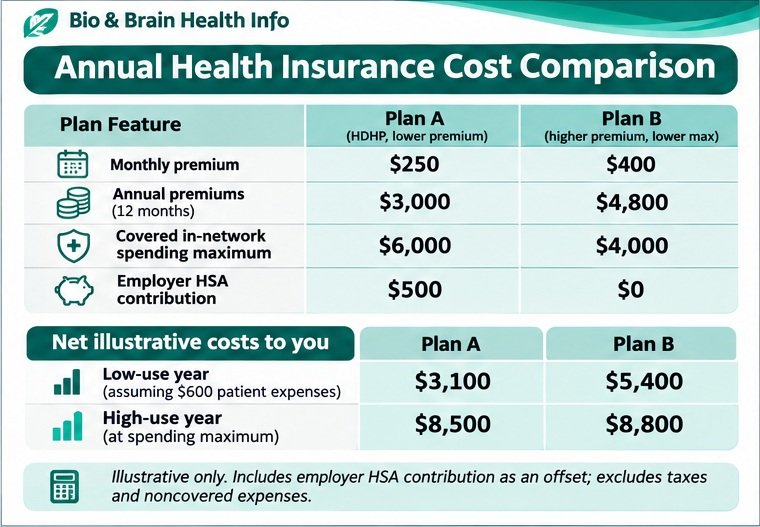
Consider two fictional options. Plan A has a monthly premium of $250, a $3,000 deductible and a $6,000 covered in-network spending maximum. Plan B costs $400 per month, with a $750 deductible and a $4,000 spending maximum. Suppose Plan A has an employer HSA contribution of $500 and Plan B has none.
In a low-use year, assume the patient owes $600 under each plan. Plan A’s premiums and medical expenses total $3,600, or $3,100 after accounting for the employer contribution. Plan B totals $5,400. In a high-use year in which each spending maximum is reached, Plan A totals $9,000 before the contribution, or $8,500 after it. Plan B totals $8,800.
These fictional comparisons demonstrate that the higher deductible does not automatically make Plan A more expensive, even in a high-use year. Changing the premium difference, spending limit, employer contribution or services used could reverse the result. The example assumes the stated benefits apply and excludes noncovered services and tax effects.
BBH annual comparison formula: Annual premiums + eligible patient medical and pharmacy expenses + excluded costs − applicable employer-funded benefits. Do not add the deductible again if it is already included in estimated patient expenses.
High-deductible health insurance plans: annual versus upfront affordability
An insurance arrangement can look favorable over twelve months but still be difficult to use if substantial charges arise early in the year. A person who saves $150 per month in premiums may not have accumulated enough money when a $2,000 medical expense occurs in January. An HSA with a small starting balance does not eliminate the immediate obligation.
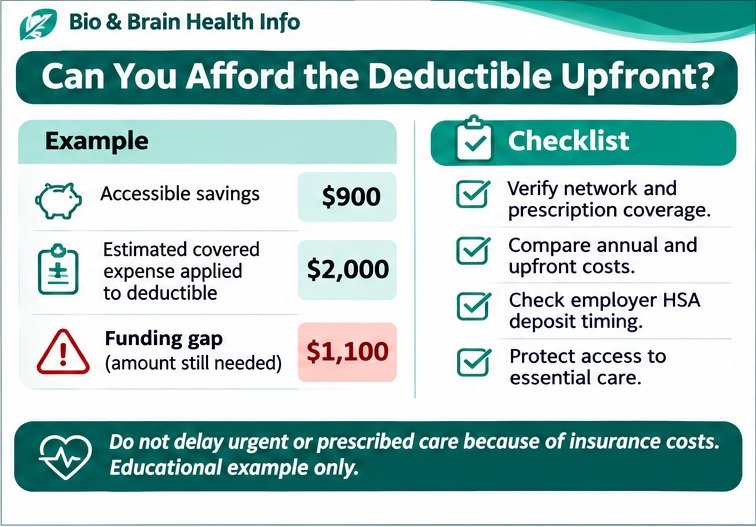
Compare both the annual estimate and the largest payment you could reasonably face at short notice. Ask whether an employer contributes to the HSA at the beginning of the year or deposits smaller amounts throughout the year. Maintain accessible savings appropriate to household circumstances and avoid assuming that future contributions are already available.
A policy is not practically affordable if its expenses cause someone to repeatedly postpone necessary care. Discuss anticipated services and treatment timing with healthcare professionals, and investigate lower-deductible or subsidized alternatives if upfront spending is a concern.
Are high-deductible health insurance plans good for chronic conditions?
There is no universal answer. Chronic conditions can involve recurring medication, specialist appointments, laboratory work and medical equipment. Some high-deductible plans have favorable prescription or disease-management benefits, while others require substantial personal spending before coverage begins. The decision depends on the individual policy and actual treatment needs.
Diabetes treatment and monitoring
Check the exact insulin and other prescribed medicines, glucose monitors, recurring sensors, strips and approved suppliers. Ask which expenses are subject to the deductible and whether specific benefits apply beforehand. BBH’s continuous glucose monitor guide and blood glucose meter guide can help identify equipment questions.
Review ongoing screening and specialist access as well. Our diabetes eye examination guide explains an example of continuing care needs. Ask how medical examinations and routine vision benefits are handled separately.
Mental healthcare and recurring appointments
A person receiving psychotherapy or psychiatric treatment should compare the expected annual number of visits, medication expenses and relevant monitoring. Check whether participating providers are available and whether telehealth is covered. BBH’s diabetes and depression guide illustrates overlapping physical and mental health needs.
Medical safety: Do not ration essential medicines, change prescribed treatment or delay urgent care simply to avoid meeting a deductible. Contact your treating professional and pharmacist if insurance costs threaten access to necessary treatment.
High-deductible health insurance plans for families
Family contracts can have individual and collective deductibles. Determine whether the plan applies an embedded individual threshold or requires a collective family deductible before certain benefits begin. HSA eligibility can impose specific requirements on the deductible arrangement. Ask the plan administrator to confirm the applicable rules rather than relying on a generic family policy description.
If several family members have ongoing healthcare needs, estimate their combined expenses and identify how the spending limits apply. Check separate dental and vision coverage where relevant. Compare the ability to meet an unexpected family expense with the amount saved through lower premiums.
Employer-sponsored HDHPs: benefits to investigate
Ask your employer about premium contributions, HSA deposits, payroll arrangements, account fees and available alternative policies. Compare the employee’s actual premium contribution rather than the total group premium. An employer-funded HSA deposit can materially affect the comparison.
If you leave employment, the HSA is generally yours to retain, although eligibility for future contributions depends on your new circumstances. Ask about account administration and fees after departure. Review replacement health coverage promptly rather than assuming that an HSA alone will provide adequate financial protection.
BBH practical high-deductible insurance checklist
Obtain the Summary of Benefits and Coverage for each option. Record the monthly premium, individual and family deductible, out-of-pocket limit, participating providers, prescription formulary and services available before the deductible. Verify the policy’s HSA designation and your personal contribution eligibility.
Estimate ordinary, moderate and high-use healthcare years. Record the timing of possible treatment expenses and employer account contributions. Compare your accessible savings with the potential upfront obligation. Save written estimates and policy documents, and review your choice after significant changes in health, income or employment.
Enrollment and high-deductible health insurance plans in the US
Use the official Health Insurance Marketplace or your state’s exchange to check available plans and financial assistance. Employer enrollment dates and special enrollment rules may differ. Compare the effective date, coverage for existing conditions and whether the deductible resets at the beginning of the plan year. Check BBH’s affordable health insurance guide and health insurance for the self-employed.
A second affordability test: the January medical bill
Imagine a household has only $900 in accessible medical savings on January 1. A covered outpatient procedure is estimated to cost $2,000 at the insurer’s negotiated rate and the entire amount applies to the deductible. Even if its annual premium savings will eventually exceed the difference, the household faces an immediate $1,100 funding gap. Ask the provider for an estimate, verify coverage and payment arrangements, and compare plans before enrollment. An HSA balance is usable only to the extent funds are available; future deposits do not pay today’s bill.
Review the Summary of Benefits and Coverage and the full policy. Check whether a facility, clinician, laboratory and anesthesia provider are in network, and whether authorization is required. Federal surprise-billing protections apply to specified situations, not every out-of-network service. See CMS No Surprises Act resources. For recurring insulin, therapy or equipment, request a written estimate using the specific drug or service. Compare the BBH diabetes insurance guide and mental health coverage guide.
Medical safety
Seek emergency care when medically necessary. Do not postpone prescribed treatment because of the deductible. Ask your clinician, insurer and pharmacist about safe and affordable access.
Frequently asked questions
Is every high-deductible policy eligible for an HSA?
No. Verify the plan’s eligibility and your own circumstances before contributing.
Do I pay the entire deductible every year?
Not necessarily. Actual expenses depend on services used, the benefits that apply before the deductible and the policy’s rules.
Can I keep my HSA money after changing insurance?
Generally yes. Existing funds may remain available for qualified expenses even if you are no longer eligible to make new contributions.
Can an HSA pay for monthly insurance premiums?
Ordinary premiums generally do not qualify for tax-free payment from an HSA, but specified exceptions exist. Consult IRS guidance.
Is a high-deductible plan always cheaper?
No. Compare the full annual expenses, employer benefits, access to treatment and upfront financial exposure.
Conclusion
High-deductible health insurance plans can be an effective option when their total cost, benefits and financial risks suit the household. Evaluate immediate cash requirements as well as annual expenses, confirm HSA eligibility and protect access to necessary care. Use current plan documents and official tax guidance rather than choosing solely on the basis of a low premium.
Independent Clinical Review
Review status: Pending independent clinical review. This article draws on the research and public guidance linked above. BBH will add the reviewer’s name, credentials, and review date once an independent review is documented.
Editorial disclosure: Core IRS and HealthCare.gov sources reviewed November 28, 2026. Educational information only, not individualized medical, tax, financial or insurance advice. Verify current plan terms and tax-year requirements.
Independent Insurance Specialist Review
Review status: Pending independent US insurance and tax specialist review. BBH will add reviewer credentials and date after documented review.
Related reading on BBH
Explore Physical Health → Health Insurance and Healthcare Costs support page.
Family Health Insurance Plans • Health Insurance for People With Diabetes • Mental Health Insurance Coverage • Affordable Health Insurance • Health Insurance for the Self-Employed
Research and official references
IRS Revenue Procedure 2026-24 • IRS Publication 969 • HealthCare.gov HSA-eligible plans • CMS HSA eligibility guidance • KFF 2026 policy analysis • HealthCare.gov total cost comparison