Health Insurance for Unemployed Adults
Health Insurance After Job Loss: US Guide

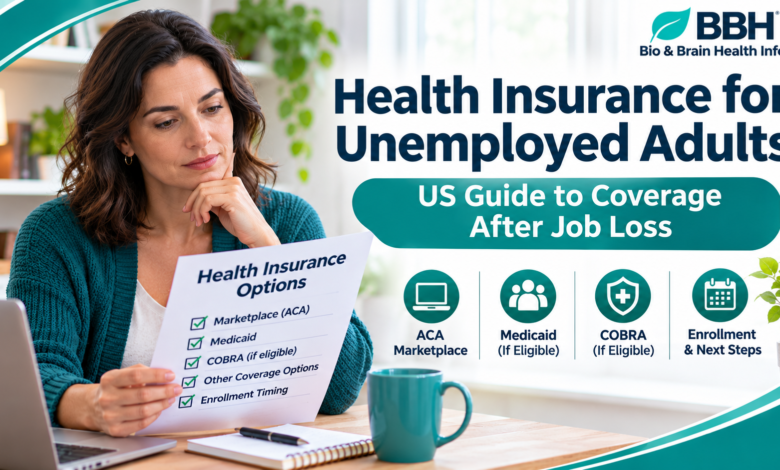
Health insurance for unemployed adults can protect access to medical care during a financially uncertain period. Losing employment may also mean losing the employer contribution that made previous insurance affordable. People searching for replacement coverage should investigate their eligibility, enrollment deadlines, expected household income and ongoing medical needs before making a decision. Being unemployed does not automatically prevent someone from obtaining comprehensive health insurance in the United States.
Thank you for reading this post, don't forget to subscribe!In This Guide: Coverage after job loss; special enrollment; COBRA; Medicaid and CHIP; family insurance; annual income; tax credits; practical cost examples; chronic conditions; coverage gaps; finding assistance; returning to work and FAQs.
Health insurance for unemployed adults: where to start
First establish whether your previous insurance has already ended or will end on a future date. The last day of employment and the last day of health coverage may be different. Request written confirmation from the former employer or benefits administrator, including details of any continuation rights. Record the date so that you can evaluate replacement enrollment deadlines accurately.
Next, identify everyone in the household who needs insurance. Losing employment may affect a spouse or dependent children as well as the worker. Each family member may have different coverage options. A child might qualify for a public program while the parent uses an individual policy. A spouse may already have access to suitable employment-based benefits.
Use the official job-based coverage loss guide to compare the principal replacement pathways. If you already had individual coverage before losing work, a reduction in income may instead affect your eligibility for financial assistance. Do not cancel your policy merely because your employment status has changed.
Marketplace health insurance for unemployed adults
Loss of qualifying employer-sponsored insurance generally creates a special enrollment opportunity. For a typical loss of job-based coverage, you can normally select a Marketplace plan during the 60 days before or after the coverage ends. Other eligibility requirements and documentation rules apply. The deadline should be calculated from the relevant coverage event rather than assuming it begins on the day you receive a termination letter.
Check the specific circumstances through the Marketplace special enrollment guidance. Voluntarily dropping coverage while remaining eligible or losing insurance because premiums were not paid may not establish the same rights as an involuntary loss of eligibility.
If the Marketplace requests documentation, provide acceptable evidence of the prior insurance and its end date. A former employer or insurer may issue a notice that helps establish the event. Keep a dated record of submissions and confirm the new policy’s effective date and any initial payment requirement. Approval of an application does not necessarily mean coverage has already begun.
COBRA health insurance for unemployed adults
COBRA allows certain eligible workers and dependents to temporarily retain their former employment-based health benefits. It can be particularly useful when continuity with a treatment team matters, although keeping the former policy may involve considerably higher personal premium expenses.
COBRA health insurance for unemployed adults: costs
While employed, a worker may pay only part of the group premium because the employer pays the remainder. Under ordinary COBRA continuation arrangements, the individual can be responsible for the full group premium plus an administrative charge of up to two percent. The previous employee payroll deduction therefore does not necessarily reflect the continuation price.
For example, suppose a fictional employer policy has a combined monthly premium of $650. The employee previously paid $180 and the employer contributed $470. If continuation coverage costs 102% of the group premium, the new monthly expense could be $663. This example illustrates how a person may face higher payments even when the underlying benefits remain similar. It is not a current market quote.
COBRA enrollment and duration
Federal COBRA generally applies to qualifying employer group plans maintained by employers with at least 20 employees, subject to the applicable rules. Workers experiencing a qualifying termination of employment or reduction in working hours may be eligible. Continuation following job loss commonly lasts up to 18 months, while other events and qualifying circumstances can affect duration.
The election window is ordinarily at least 60 days from the later of the loss of coverage or provision of the election notice. The initial payment is generally due within 45 days after electing COBRA. Timely election and payment generally restore coverage to the date it otherwise ended, so the first bill may include multiple months. Confirm eligibility, payment deadlines and retroactive claim handling with the administrator. State continuation arrangements may be relevant where federal COBRA does not apply. See the Department of Labor COBRA resource for official guidance.
COBRA versus Marketplace insurance: which is better?
Continuation coverage may preserve existing provider relationships and deductible progress, subject to the terms of the group plan. Marketplace insurance may provide a more affordable alternative if the applicant qualifies for savings. However, changing insurance can mean a different network, deductible and prescription formulary.
Compare the remaining months of the coverage year rather than just monthly premiums. If you have already paid significant amounts toward the former plan’s deductible, restarting cost sharing under a new policy may affect the financial comparison. Ask how the plan handles changes at the next benefit-year renewal.
The Marketplace COBRA comparison guidance is particularly useful because ending COBRA voluntarily before its scheduled expiration does not always create a new special enrollment opportunity. Check your eligibility for replacement coverage before discontinuing continuation benefits.
Affordable health insurance for unemployed adults: Medicaid
Medicaid may provide comprehensive coverage for people who meet the applicable requirements. Eligibility depends on the state, income, household circumstances and other criteria. In states that have expanded Medicaid, many low-income adults may qualify through an income-based pathway. Other states may have narrower eligibility categories.
A person should not assume that having no current wages automatically establishes eligibility. Some rules consider household income, and other pathways can involve additional criteria. Visit Medicaid.gov or the official state agency to obtain a determination. Applications for Medicaid and CHIP can generally be made throughout the year.
Children may qualify for CHIP even if their parents are not eligible for Medicaid. Compare the whole household’s available arrangements instead of assuming everyone must use the same policy. Some eligible people may have little or no premium expense, but the exact benefits and personal costs depend on the program.
Marketplace tax credits and unemployment income
Marketplace savings are assessed using expected annual household income for the coverage year. The application also requests current monthly income, which can matter for Medicaid eligibility. A person who loses work halfway through the year should not simply report zero annual income if they already earned wages earlier in that year. Include income sources as required by the application and prepare a realistic estimate of earnings for the remaining months.
Unemployment compensation generally counts toward Marketplace income calculations. Other relevant sources may include wages, net self-employment earnings and certain investment or retirement income. Consult the official income reporting guidance rather than guessing which payments count.
For example, imagine a worker who earned $24,000 earlier in the year, expects $6,000 in unemployment compensation and anticipates $10,000 from later employment. Those amounts produce a simple $40,000 projected income before considering other household income or applicable adjustments. This is an illustration, not a subsidy eligibility calculation.
Report material changes according to Marketplace instructions. If a new job begins, the original income estimate may no longer be accurate. Advance tax credits are subject to reconciliation under applicable tax rules. Seek help from a qualified tax professional when necessary.
Health insurance through a spouse or parent after job loss
If a spouse has employment-based coverage, ask whether the loss of your previous insurance creates a special enrollment opportunity under that group plan. For eligible group-plan special enrollment after loss of other coverage, the request window is generally at least 30 days; consult the Department of Labor job-loss guidance. Contact the employer’s benefits administrator promptly rather than waiting until the other deadlines approach.
For adults younger than 26, a parent’s plan may offer another potential pathway if dependent coverage is available and the applicable enrollment conditions are satisfied. Review network access and eligibility with the plan administrator. Living in a different state can complicate access to routine medical services.
Compare the incremental cost of joining a family policy against the total cost of other eligible arrangements. Access to employment-based coverage can influence Marketplace financial assistance. Do not assume that an offer of family coverage always makes every other pathway unavailable.
How much does health insurance for unemployed adults cost?
The price depends on the type of policy, residence, eligible household members, financial assistance and personal healthcare needs. Marketplace premiums cannot be calculated from unemployment status alone. Use the official plan comparison process to obtain personalized figures.
A fictional comparison might involve COBRA at $663 per month with an estimated $900 in remaining covered medical cost sharing over six months. The combined expense would be $4,878. A Marketplace alternative at $300 per month with $2,000 in expected medical cost sharing would total $3,800 over the same period. Actual quotes and eligibility may differ substantially.
Calculate a higher-use scenario too. A policy with a lower premium may become more expensive if frequent care is needed or an essential clinician is outside the network. Include premiums, eligible medical expenses, medication costs and excluded services. Avoid double-counting amounts already included in estimated cost sharing.
Health insurance for unemployed adults with chronic conditions
A coverage interruption can create difficulties for someone receiving continuing treatment. Prepare a list of essential medicines, treating clinicians, scheduled procedures and medical supplies before comparing policies. Confirm how the new insurer handles authorizations and medication refills. Ask your clinicians for assistance if a transition threatens continuity of care.
Diabetes and medical equipment
Check insulin and other prescribed medicines, continuous glucose monitoring equipment, meters, test strips and approved suppliers. BBH’s continuous glucose monitoring guide and blood glucose meter guide provide educational background for equipment questions. Do not assume that a new policy uses the same suppliers as the old one.
Mental health and ongoing treatment
Job loss can bring financial stress and changes to daily routines. Verify access to existing therapists, psychiatric clinicians and prescribed medications. Ask whether virtual appointments are covered and whether new authorization is needed. BBH’s diabetes and depression guide and diabetes and anxiety guide discuss examples of overlapping physical and emotional health needs.
What if you are temporarily uninsured?
Ask whether an applicable enrollment or continuation option can address the gap. Community health centers may provide services with fees adjusted according to eligibility and ability to pay. Hospital financial assistance and legitimate medication assistance programs may also be relevant, depending on the circumstances. Such arrangements are not equivalent to comprehensive insurance.
For nonurgent planned services, request written self-pay estimates and clarify which facility and professional charges are included. Discuss billing arrangements with the provider. Do not interpret an estimate as a guarantee that every additional expense will be included.
Avoid products advertised as immediate inexpensive substitutes for comprehensive insurance without examining their benefits and exclusions. Limited-benefit policies and discount programs may leave significant financial exposure. Verify the seller and issuing company with your state insurance authority.
Content gap: returning to work and changing coverage again
A new job may provide an insurance option, but the benefits may not begin on the first day of employment. Ask about eligibility dates, dependent benefits and employee contributions. Confirm whether the new coverage will meet your medical needs before ending an existing policy.
If you receive Marketplace financial assistance, report the new employment and relevant coverage offer. A change in income or access to qualifying workplace benefits may affect assistance eligibility. Follow the official reporting changes guidance and confirm the effective date of any cancellation.
For ongoing care, coordinate refills and scheduled appointments with the clinical team. A second insurance transition in a short period may require new authorizations. Maintain a file of benefit documents, coverage dates and relevant correspondence.
Original BBH two-transition coverage calendar
A job loss can create two separate insurance transitions: leaving the former employer and starting a new job. Write down the old coverage end date, COBRA notice date, Marketplace selection deadline, initial premium due date and next employer coverage start date. Track each separately instead of treating the employment date as the insurance date.
Add the next prescription refill and specialist appointment to the calendar. Record which insurer and pharmacy will handle each. Ask whether new approvals are needed and whether deductibles reset. Keep uncertain dates marked as unconfirmed and ask the administrator for written clarification. This BBH decision aid is not a guarantee of coverage.
BBH job-loss insurance action checklist
Request the former policy end date, continuation notice and complete premium quote. Check Marketplace special enrollment, Medicaid or CHIP eligibility, and any available family group coverage. Record all applicable deadlines separately.
Prepare a current income estimate and household information. Compare premiums, medical networks, prescription benefits, deductible requirements and annual financial exposure. Obtain written confirmation of enrollment and complete required initial payments. Keep records and reassess the arrangement when employment or household income changes.

Related BBH guides and free budget worksheet
Read Health Insurance for Pre-Existing Conditions for consumer protections and compare the four linked chronic-care articles above. Visit the Health Insurance and Healthcare Costs support page for more resources.
Frequently asked questions
Can I get health insurance if I have no job?
Yes, depending on eligibility. Marketplace coverage, Medicaid, family group insurance and continuation coverage may be available.
Is COBRA always more expensive than Marketplace insurance?
No. Compare actual premiums, financial assistance, deductible progress and medical expenses. The best arrangement depends on your circumstances.
Does unemployment compensation count as Marketplace income?
Generally yes. Follow official income reporting instructions and account for relevant household income.
Can I apply for Medicaid outside annual Marketplace enrollment?
Yes. Medicaid applications can generally be made throughout the year, subject to state and program eligibility.
Does losing a job automatically qualify me for special enrollment?
The relevant event is generally loss of qualifying health coverage, not simply losing employment. Confirm your eligibility and deadline.
Conclusion
Health insurance for unemployed adults should be evaluated as part of a broader financial and healthcare transition. Investigate enrollment rights early, compare all eligible coverage options, report income accurately and protect continuity of necessary treatment. Official enrollment assistance and qualified professional advice can help households make an informed decision.
Editorial disclosure: Core HealthCare.gov job-loss, Marketplace income and COBRA guidance and Department of Labor COBRA and job-loss guidance checked November 29, 2026. Other linked resources and individual eligibility require confirmation. General educational information only, not individualized medical, financial, legal, tax or insurance advice. Verify current eligibility and contract terms.