Why Fear of Criticism Stops You From Trying
Fear of Criticism: Why You Hold Back

On Monday, you record a short video. By Friday, you’ve changed the opening twice and watched the clip so many times you can hear the next sentence before you say it. You export the file, open the upload screen, and picture someone you know watching it. In your head, they roll their eyes.
Thank you for reading this post, don't forget to subscribe!You go back to the editor.
Maybe the video still needs work. The captions cover an important part of the screen, or your voice disappears under the music. Those are problems you can fix. But if you open the editor because you’re imagining a former coworker laughing at you, a fourth recording may leave you with the same decision on Sunday.
Fear of criticism is easy to miss when it looks like preparation. You can spend an evening doing real work and still leave the most important decision for tomorrow. The question worth asking is whether another revision will help the person who sees the work.
What does fear of criticism look like before you try?
You’re in a meeting when two people mention different deadlines. You type, “Can we confirm which date we’re using?” Then you add, “Sorry if I missed this.” You take that out, put it back, and finally wait for someone else to ask. Ten minutes later, another colleague raises the same point. The team spends thirty seconds clearing it up.
Or perhaps you write a proposal on Tuesday and keep it in drafts until Friday. You’ve checked the price and scope. You still reopen it to decide whether “Hi” sounds too casual. When your phone rings, you’re relieved to have a reason to close the document.
The hesitation is easier to spot if you look at what you do right before someone could see the work. Do you return to a task you already completed? Ask another person the same question? Change the standard for what counts as ready? One extra review can make sense. The pattern becomes worth examining when unfinished sends, unsaid questions, or missed deadlines start costing you opportunities.
How fear of criticism differs from fear of failure and rejection
These worries often turn up together. Naming the specific outcome you’re picturing can help you choose a response. Researchers use the term fear of negative evaluation for concerns about how others may judge you. The Brief Fear of Negative Evaluation Scale is a research measure of that concern.
| Worry | What you might think | A useful question |
|---|---|---|
| Criticism | “They’ll pick apart my presentation.” | “What feedback would help me improve it?” |
| Failure | “The event might fall short of the attendance target.” | “What can I learn from the first event?” |
| Rejection | “The editor may turn down my pitch.” | “Where else could I send it if they decline?” |
Suppose you’re pitching an article. If the editor can’t tell what the story is, rewrite the pitch. If the editor might decline it, identify another publication. If you’re imagining the editor privately thinking the idea is silly, notice how little more time at your desk can tell you about that reaction. A clear pitch gives the editor something to respond to.
Why another revision can feel easier than sharing
Editing gives you a problem you can control. You can shorten a sentence, swap an example, or fix a slide. Sharing brings questions you can’t answer in advance. Will the reader understand the point? Will they care? What if the first reply comes from someone whose opinion matters to you?
Delaying can bring relief that evening. By the next morning, the same decision is waiting. If you notice that cycle, ask yourself which changes made the work clearer and which simply gave you another day before sending it.
A meta-analysis found that perfectionistic concerns, which include worries about mistakes and evaluation, were associated with more procrastination. Perfectionistic strivings, which involve aiming for high standards, were associated with less procrastination on average. These findings describe associations across studies. For your own draft, the practical question is what another round of editing would change. Sirois, Molnar, and Hirsch, 2017
When an old reaction shows up in a new setting
A teacher once read your incorrect answer aloud and the class laughed. Years later, you still hesitate when a colleague asks you to share your ideas. That memory may help you understand why the moment feels charged. It leaves room to observe how this group actually responds.
You might start by showing the idea to a colleague who gives specific, respectful feedback. If you recognize a pattern of turning corrections into judgments about your ability, the companion article explores how that can develop. How Childhood Criticism Shapes Self-Esteem
Before you revise again, decide which problem you have
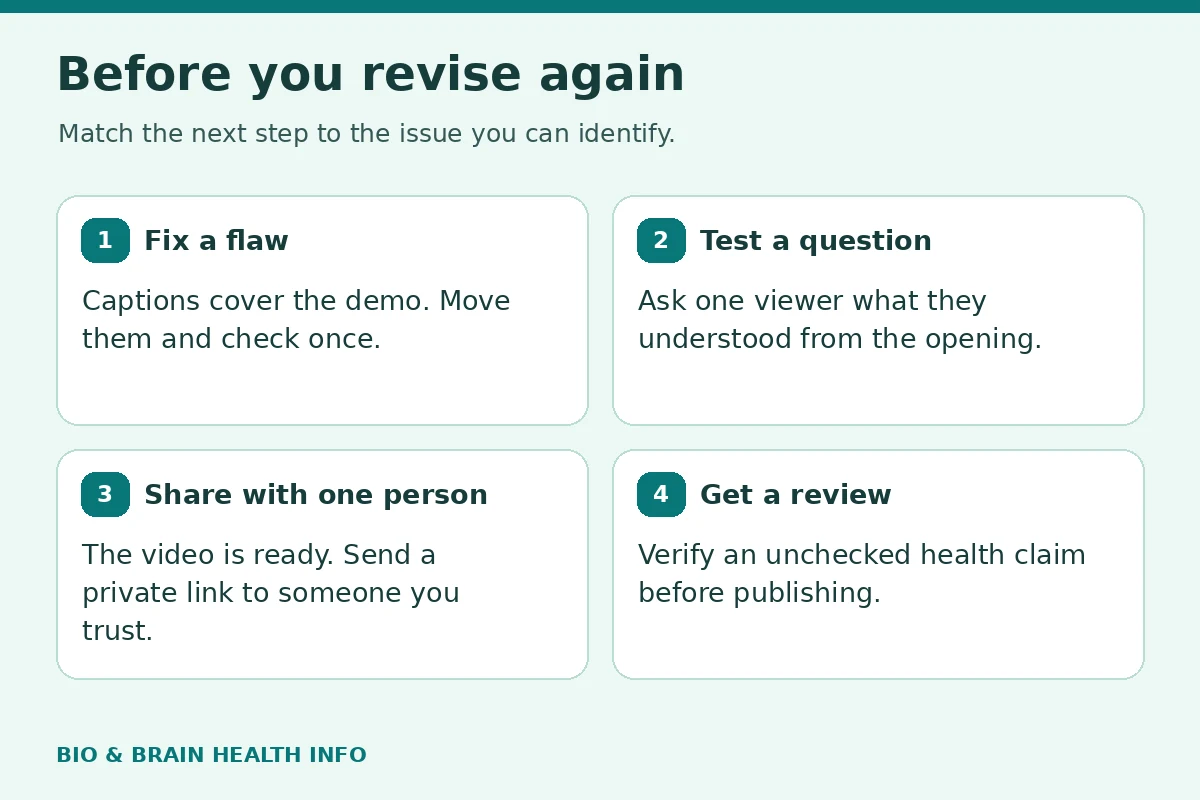
When fear of criticism is driving the next edit, “I’m still working on it” can cover several different decisions. Start by finishing this sentence. If I spend another twenty minutes on this, the reader or viewer will be better able to ___.
If an answer comes to mind, you have a way to judge whether the edit is worth making. If you can’t finish the sentence, use the four choices below.
| What you notice | What to do | Example |
|---|---|---|
| A specific flaw | Fix the part you can point to. | The captions hide the demonstration. Move them, then check the clip once. |
| A question you can test | Get one answer from someone who can help. | Ask one viewer what they thought the video was about after the first 15 seconds. |
| Worry about being seen | Choose a manageable audience and a time to share. | The video is clear. Send a private link to one trusted person first. |
| A real consequence or risk | Get the review, permission, or support the situation calls for. | A health video makes an unverified claim. Check the source before publishing. |
Set a finish line you can see
For a short educational video, check that people can hear it, read the captions, and understand the main point. Verify any factual claims. For a client estimate, check the scope, price, dates, and recipient. For a job application, confirm that you’ve answered the questions and attached the requested files.
A visible finish line helps you tell when you’re done. Suppose you decide your email is ready once the recipient can see what you need and when you need it. If you reopen it to choose between “Thanks” and “Thank you,” read the request once. If you’ve already answered both questions, send it at the time you planned.
Ask for information you can use
“Is it good?” gives the other person a lot to interpret. Ask about the part you’re unsure of.
- Video. “What did you think the main point was after the opening?”
- Proposal. “What would you need clarified before approving the scope?”
- Email. “Can you tell what action I’m asking for?”
- Presentation. “Where did you first have to stop and work out what I meant?”
If the person says your opening is clear but they get lost when you switch examples, you know where to edit. If they say they prefer a different color, you can decide whether that preference affects how your audience will understand the message. If comparing yourself with the reviewer starts to take over, BBH has a companion guide on that pattern. Self-Worth and Comparison
What to do when criticism actually arrives
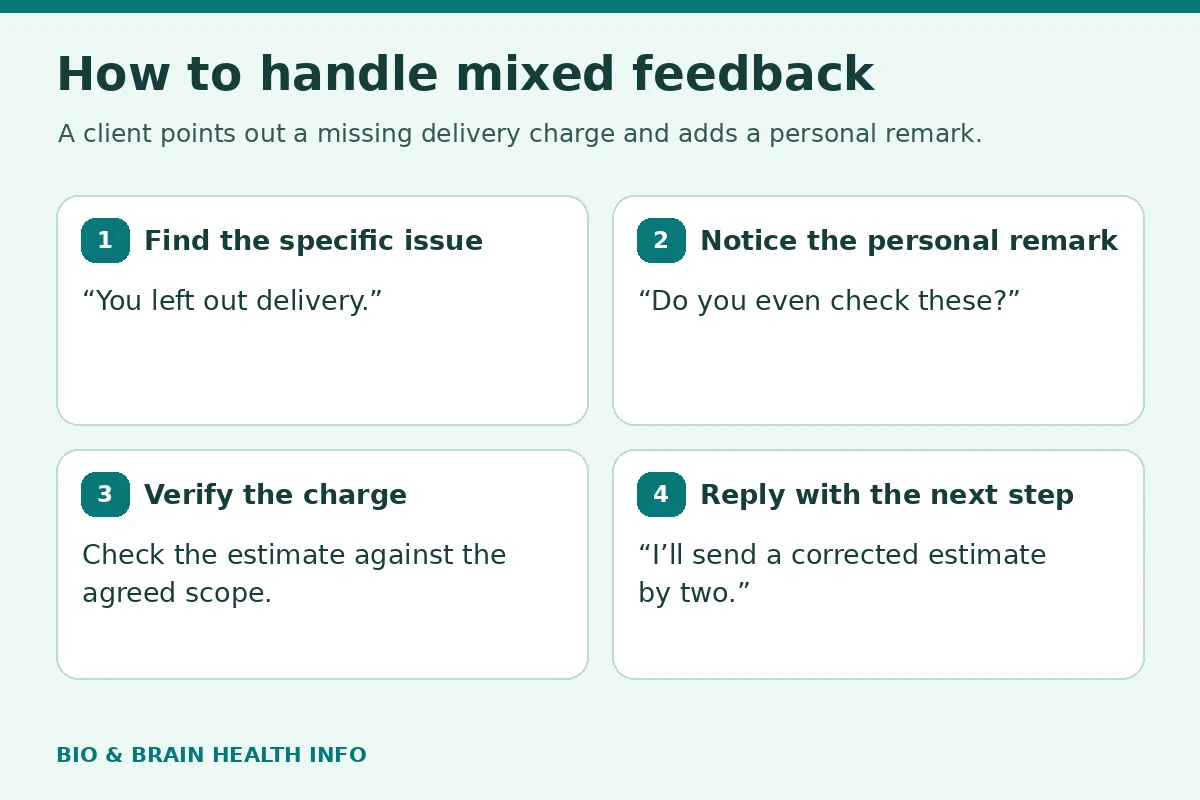
You send a quote. The client replies, “You left out delivery. Do you even check these before sending them?” For a moment, the second sentence gets all your attention. You start drafting a long reply about how busy this week has been.
Read the message once more. Check the delivery charge. If it’s missing, acknowledge that and say when you’ll correct it. You could write, “You’re right that delivery is missing. I’ll send a corrected estimate by two. If there’s another issue with the estimate, please point me to it.”
You can decide later whether to address the tone, especially if personal remarks keep happening. A specific correction gives you something to do today. A pattern of insults may call for documentation, a different review channel, or support from someone with the authority to help.
If the feedback gives you too little to act on, ask for an example. “Which part of the presentation was hard to follow?” gives the conversation somewhere to go. If it leaves you replaying everything you said, you can work through that reaction separately. Why Do I Take Criticism Personally at Work?
When waiting is the responsible choice
Sometimes there’s a good reason to pause. A colleague has mocked you publicly before. A draft includes information you don’t have permission to share. You’re preparing health content and haven’t checked whether a claim applies to the people you’re writing for.
Take the step that fits the risk. Share through a different channel, get permission, verify the claim, or ask for qualified review. You can protect yourself and your audience while still setting a clear point at which you’ll revisit the decision.
How to learn from one small attempt
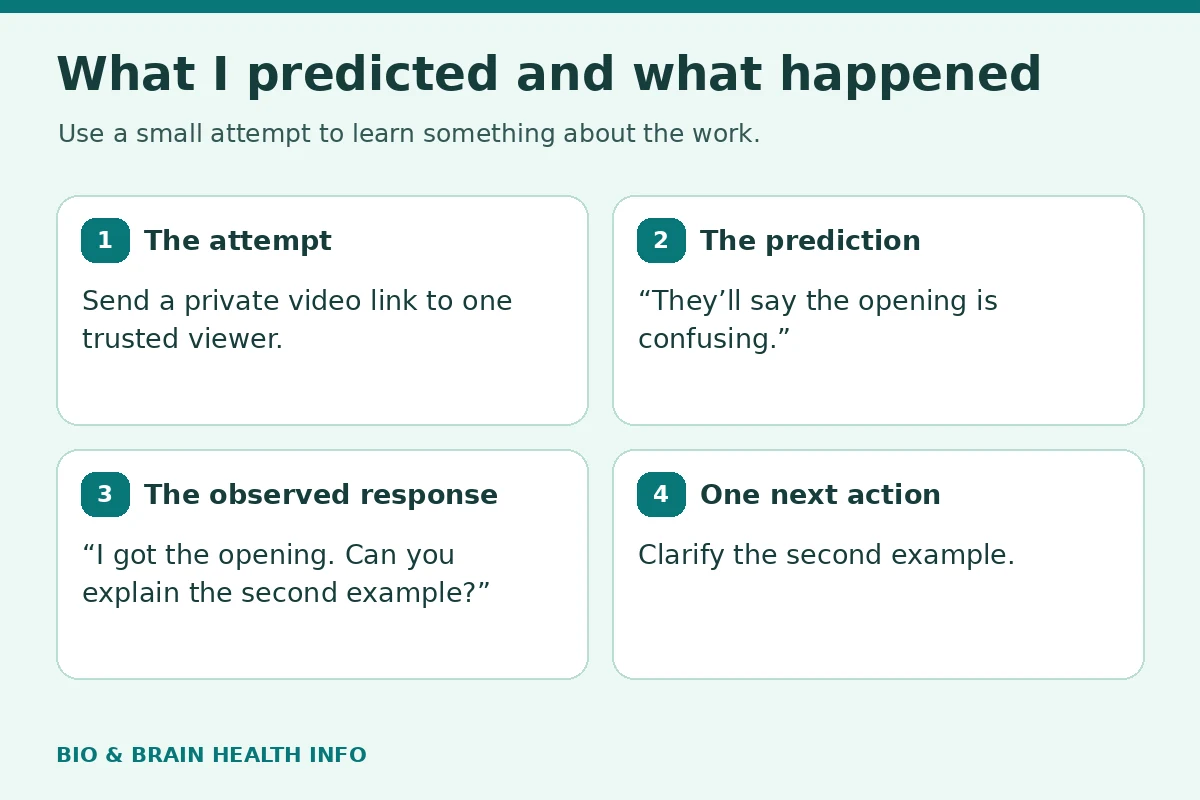
Choose something small enough to try this week. Ask one question in a meeting. Send the private video link. Show a draft to someone you trust. Before you act, write down one prediction in plain language. I think they’ll ask why I sent this and say the opening is confusing.
Some forms of cognitive behavioral therapy for social anxiety use structured behavioral experiments to test feared predictions. The exercise here is a low-stakes way to reflect on an everyday experience. NICE social anxiety guidance
If your notes turn into a list of everything you should have said differently, separate one observable fact from one judgment. “They asked me to explain the second example” gives you a place to start. “I’m terrible at explaining things” gives you very little to work with. BBH Tools for Reflecting on Negative Self-Talk
Frequently Asked Questions
Is fear of criticism the same as social anxiety?
Worrying about a particular review, meeting, or post can happen in ordinary life. The U.S. National Institute of Mental Health describes social anxiety disorder as involving strong fear of being watched or judged, which can lead to avoidance or significant distress. If the pattern repeatedly limits what you do, a qualified mental health professional can help you understand it. National Institute of Mental Health
How do I know when to stop editing?
Define what the person receiving the work needs to understand or do. Check whether the current version gets them there. If you can name one issue, address it. If the same uncertainty remains after several edits, ask one person a specific question or send the work when your checks are complete.
What if I keep asking people whether it’s good enough?
Choose one reviewer and one question before you ask. If you’ve already received a clear answer, write it down. The next time you feel tempted to ask someone else, check whether you need new information or want the same reassurance again. Why Can’t I Stop Overthinking?
What if the person really does dislike my work?
Find out what the response means for the task. A client may need a change to the agreed work. An editor may have a different audience in mind. A casual viewer may simply have different tastes. The role that person plays helps you decide how much weight to give their reaction and whether you need to do anything next.
Give one finished thing a chance to be seen
If fear of criticism has kept something in your drafts, open it and name the one check that matters. Listen to the sound, confirm the price, or reread the question you’re asking. Then choose who needs to see it and when you’ll send it.
If it’s Sunday and you’re still thinking about the video, watch the opening once. If the message comes through, send the link to the person you chose. When their reply arrives, you’ll have something real to work with.
For more BBH guides on self-worth, difficult emotions, and everyday coping, visit Emotional Healing.
Research and References
- Leary (1983). Brief Fear of Negative Evaluation Scale. Research measure.
- Sirois, Molnar, and Hirsch (2017). Procrastination and multidimensional perfectionism. Meta-analysis.
- National Institute for Health and Care Excellence. Social anxiety disorder recognition, assessment, and treatment. Clinical guideline CG159.
- National Institute of Mental Health. Social Anxiety Disorder: What You Need to Know. Public education resource.