Aboriginal Dreamtime Myths: Meaning Beyond Alien Theories
God vs Alien Aboriginal Myths: Dreamtime, Songlines, and Sacred Wisdom

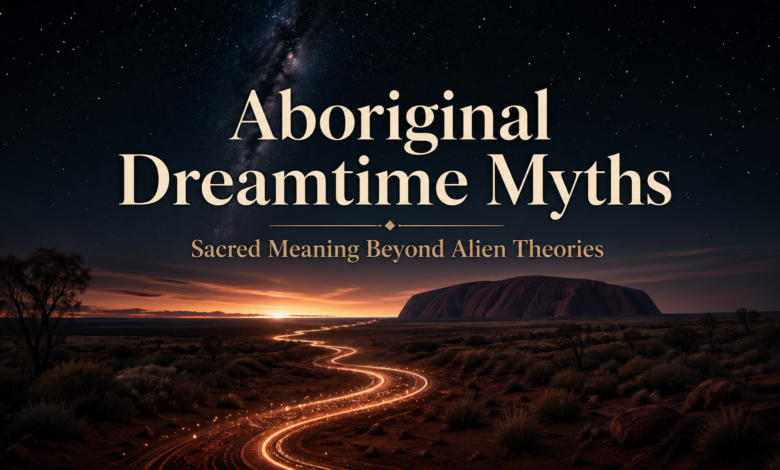
Aboriginal Dreamtime myths are often discussed through mystery, alien theories, or simple folklore, but this blog takes a deeper and more respectful path.
Thank you for reading this post, don't forget to subscribe!Here, you will explore Dreamtime spiritual meaning, Aboriginal creation stories, Rainbow Serpent meaning, and Aboriginal astronomy and songlines not as entertainment, but as sacred ways of understanding land, ancestors, memory, belonging, and human responsibility.
👉The uniqueness of this blog is its BBH approach: it connects ancient sacred storytelling with modern emotional life, showing how disconnection from nature, meaning, and community can affect the mind.
Instead of asking only, “Was it God or alien?” this article asks a wiser question: what emotional and spiritual wisdom are we missing when we reduce sacred stories to theories?
If you feel drawn to mythology, consciousness, spirituality, and mental clarity, this blog will help you read ancient wisdom with humility, depth, and inner reflection.
Aboriginal Dreamtime Myths and the Need for Respectful Interpretation
Aboriginal Dreamtime myths are often misunderstood when they are viewed only through modern curiosity, mystery content, or alien theories. These sacred stories are not simply old legends created for entertainment. They carry memory, identity, land relationship, spiritual responsibility, and deep cultural meaning.
When modern readers search for symbols like sky beings, the Rainbow Serpent, ancient rock art, or unusual ancestral figures, they may quickly connect them with aliens or hidden technology. But this approach can miss the deeper Dreamtime spiritual meaning behind the stories.
A respectful reading begins by understanding that many Aboriginal traditions do not separate land, sky, ancestors, body, memory, and spirit in the same way modern thinking often does.
This blog follows a different path. Instead of treating Aboriginal Dreamtime myths as proof of aliens or dismissing them as fantasy, it explores how sacred storytelling can hold emotional, spiritual, ecological, and ancestral wisdom.
This matters because modern people are often disconnected from nature, community, meaning, and inner stability.
When sacred stories are reduced only to mystery, the reader may lose the real lesson: human beings need belonging, responsibility, and connection to something larger than fear.
Read Also: how perception, identity, and the nervous system create illusion
Why Aboriginal Dreamtime Myths Are More Than Ancient Stories
Aboriginal Dreamtime myths are not only stories about the past. They are often connected with how life, land, people, animals, seasons, water, sky, and sacred law are understood.
In many Aboriginal traditions, creation is not treated as a distant event that happened once and then disappeared. It remains present through place, memory, ceremony, relationship, and responsibility.
👉This is why these stories must be approached with care. They are not empty symbols waiting for modern people to reinterpret them however they want.
When someone reads about Aboriginal creation stories, they may see powerful beings, unusual forms, sky movements, animal ancestors, sacred landscapes, or dramatic transformations.
👉A surface-level reading may ask, “Were these beings gods or aliens?”
👉But a deeper reading asks, “What relationship between life, land, spirit, and human responsibility is being preserved here?”
That second question is more respectful and more useful. It does not steal meaning from the tradition. It allows the reader to slow down and listen.
This is where the uniqueness of this blog begins. It does not use Aboriginal Dreamtime myths only as mystery content. It reads them as sacred knowledge that may help modern people reflect on disconnection, fear, identity, and the human need for rooted meaning.
Dreamtime Spiritual Meaning and the Human Search for Belonging
The Dreamtime spiritual meaning behind many sacred stories points toward belonging. In modern life, many people feel mentally crowded but spiritually empty.
They may have information, technology, and constant entertainment, but still feel disconnected from nature, body, family, community, and inner peace.
👉From a BBH perspective, this disconnection is not only emotional; it can also affect the nervous system.
A mind that feels rootless often searches for control, certainty, and explanation because it does not feel deeply held by life.
This is why sacred storytelling still matters. Aboriginal creation stories remind us that human life is not separate from land, water, sky, animals, ancestors, and responsibility.
This does not mean modern readers should claim these traditions as their own or turn them into self-help techniques. It means we can respectfully notice a universal human truth: people need meaning to feel emotionally safe.
👉When life feels meaningless, the mind becomes more vulnerable to fear, obsession, loneliness, and spiritual confusion.
The blog also connects with Rainbow Serpent meaning, Aboriginal astronomy and songlines, and the idea that sacred stories can carry memory across generations. These themes show that myth is not weakness. Myth can be a vessel for relationship, survival, guidance, and emotional grounding.
Read Also: how attachment creates suffering and mental repetition
Why This Blog Does Not Claim Final Cultural Authority
This article does not claim to speak for Aboriginal people or replace Aboriginal voices. That is important. Aboriginal Dreamtime myths belong to living cultures, communities, elders, and traditions with their own authority, depth, and boundaries.
A respectful reader should never treat sacred stories as open material for careless entertainment, spiritual ownership, or sensational theory-making. The purpose here is educational and reflective, not possessive.
The better approach is humility. This blog compares modern alien interpretations with sacred meaning, but it does not claim that one outside reader can fully explain everything.
Some knowledge may be public, some may be sacred, and some may belong only to specific communities. That boundary itself teaches something valuable. Not every sacred thing is meant to be consumed.
Some things are meant to be respected, approached slowly, and understood through relationship rather than control.
What Makes This Blog Different from Alien Theory Content
Most alien theory content begins with suspicion. It looks at ancient symbols and asks whether hidden beings, advanced technology, or visitors from the sky were involved.
This blog begins with respect. It asks what Dreamtime spiritual meaning may reveal about land, memory, belonging, and the human soul before forcing modern ideas onto sacred traditions. That is the main difference.
This blog also adds the BBH layer. It does not only discuss mythology; it connects sacred stories with emotional wellbeing, mental clarity, and spiritual reflection.
The real question is not only whether a story sounds unusual. The deeper question is why modern people are so quick to convert sacred meaning into fear-based mystery. Sometimes the alien lens says more about the modern mind than it does about the ancient story.
When we read carefully, Aboriginal Dreamtime myths can invite humility, not panic; connection, not control; and reverence, not spiritual consumption.
Read Also: why emotional patterns repeat through hidden Maya cycles
Rainbow Serpent Meaning, Aboriginal Creation Stories, and Sacred Land
To understand Aboriginal Dreamtime myths with more depth, the reader has to move beyond the question of “God or alien?” and look at the relationship between land, water, sky, ancestors, animals, and human responsibility. Many sacred stories are not designed only to explain strange events.
They also preserve knowledge about how people belong to the world. This is why Aboriginal creation stories often feel different from modern fantasy or science fiction. They are connected with place, memory, law, survival, identity, and respect.
This section explores Rainbow Serpent meaning, living land, Aboriginal astronomy and songlines, and the risk of modern projection. The goal is not to claim full cultural authority, but to read these themes with humility.
When ancient stories are reduced only to alien theory, the emotional and spiritual wisdom can disappear. But when they are approached as sacred memory, they can show how human beings once understood life through connection rather than separation.
Rainbow Serpent Meaning in Aboriginal Spirituality
Rainbow Serpent meaning is one of the most powerful themes often discussed in relation to Aboriginal Dreamtime myths. In many Aboriginal traditions, the Rainbow Serpent is connected with creation, water, movement, fertility, landforms, law, life cycles, and sacred power. It is not just a creature in a story.
It can represent the living force that shapes rivers, waterholes, land, and the movement of life itself. This is why reading the Rainbow Serpent only as a mysterious being or alien-like figure is too narrow.
From a spiritual perspective, the Rainbow Serpent shows how life is connected through water and land. Water is not only a physical resource; it is survival, memory, blessing, danger, and responsibility.
When a sacred being is connected with water, creation, and movement, the meaning becomes much deeper than visual mystery. It teaches that life is not random. Life is held within relationship, balance, respect, and consequence.
For BBH readers, this becomes emotionally meaningful too. Modern stress often grows when life feels disconnected and mechanical. Rainbow Serpent meaning reminds us that ancient wisdom often saw life as relational, not isolated. The human mind feels safer when it remembers connection.
Read Also: how identity and awareness affect emotional stability
Aboriginal Creation Stories and the Living Memory of Land
Aboriginal creation stories often present land as more than soil, stone, or geography. Land carries memory. Land holds story. Land is connected with ancestors, responsibility, identity, and sacred relationship.
This is very different from the modern habit of seeing land only as property, resource, or background. In many sacred traditions, place is not empty. Place speaks through story, movement, ceremony, and inherited memory.
This is one reason modern alien interpretations can become shallow. When someone sees an unusual landform, sacred rock, ancient painting, or ancestral story and immediately asks, “Was this alien technology?” they may ignore the deeper relationship between people and place. T
he important question is not only how a landform appeared, but what responsibility it carries. Aboriginal Dreamtime myths often hold this relationship between the visible world and sacred memory.
From a mental health reflection, this matters because modern people often suffer from rootlessness. They live in cities, screens, speed, and pressure, but lose felt connection with place.
The mind becomes busy, but the soul feels homeless. Dreamtime spiritual meaning reminds readers that belonging is not only emotional. It is also geographical, ancestral, ecological, and spiritual.
Aboriginal Astronomy and Songlines as Sacred Knowledge Systems
Aboriginal astronomy and songlines show another layer of sacred knowledge that should not be reduced to alien theory. Sky stories, stars, dark constellations, seasonal signs, and songlines can hold memory, direction, timing, law, and relationship.
The sky is not only a space of mystery; it can also be a living calendar, a teaching system, and a spiritual map. When modern readers see ancient people reading the sky with accuracy and depth, they may wrongly assume that such knowledge must have come from outside Earth.
But this underestimates human observation, memory, and cultural intelligence.
Songlines can be understood as pathways of story, song, place, and navigation. They connect land with memory and movement. They are not simply maps in the modern technical sense. They are living systems where knowledge is carried through sound, place, body, and tradition. This is a powerful reminder that knowledge does not always need to look like a written textbook to be intelligent.
👉For BBH, Aboriginal astronomy and songlines also offer a deep reflection on the mind. Modern people often lose orientation because they lack inner and outer maps.
They know routes on a phone, but not always direction in life. Sacred knowledge systems remind us that human beings need rhythm, memory, place, and meaning to feel grounded.
Why Sacred Maps Are Not the Same as Alien Technology
One common mistake in mystery-based content is to treat ancient knowledge as impossible unless it came from aliens. This attitude may sound exciting, but it can quietly disrespect Indigenous intelligence.
When ancient people understood stars, seasons, land patterns, animal movement, water sources, or symbolic systems, it does not automatically mean they received information from outside beings.
It may mean they had deep observation, long memory, refined oral traditions, and strong relationship with the environment.
This matters for how we read Aboriginal Dreamtime myths. Sacred maps, songlines, sky stories, and creation stories do not need to become alien technology to be powerful. Their power may come from something much deeper: generations of attention, reverence, survival knowledge, and spiritual relationship.
Modern culture often respects technology more than wisdom. That is why it may call ancient sacred knowledge “alien” instead of recognizing human depth.
A respectful reader should pause before turning sacred knowledge into science fiction.
👉The better question is: what kind of awareness did people cultivate when they lived in deep relationship with land, sky, memory, and community?
Read Also: spiritual reflection, hope, and emotional strength
Rock Art, Wandjina Spirits, and the Risk of Modern Projection
Ancient rock art and figures such as Wandjina spirits are often pulled into alien theory discussions because some modern viewers focus only on visual appearance. If a figure has large eyes, unusual shapes, halos, or powerful symbolic features, people may quickly project astronaut imagery onto it.
But this can be a modern projection rather than a respectful interpretation. Sacred art often uses symbolic form, spiritual scale, exaggeration, and visual language that cannot be understood only through modern science fiction.
This is why cultural humility is necessary. Aboriginal creation stories and sacred images are not empty puzzles for outsiders to solve. They may carry local meaning, ceremonial meaning, ancestral presence, and community-specific knowledge.
👉When readers force alien explanations onto them, they may erase the very people and traditions who carry the meaning.
The safer and more respectful approach is to ask: what does this image mean within its own cultural world? That question protects both truth and dignity.
What Readers Should Notice Instead
Instead of asking only whether Aboriginal Dreamtime myths prove aliens, readers can notice something more helpful: these traditions often point toward relationship.
They connect body with land, mind with memory, sky with season, water with life, and story with responsibility. This is where the deeper wisdom lives.
The uniqueness of this blog is not in giving a final answer to every mystery. Its strength is in changing the question.
Instead of reducing sacred stories to fear, spectacle, or argument, it invites readers to see how Dreamtime spiritual meaning can teach humility, belonging, and emotional grounding.
For a modern mind that feels overstimulated, lonely, and spiritually disconnected, that shift itself can become healing.
Read Also: spiritual meaning behind sacred stories
God vs Alien Aboriginal Myths as a Spiritual and Mental Health Reflection
The phrase “God vs alien Aboriginal myths” can attract curiosity, but the deeper value of this topic is not found in argument alone. A mature reading of Aboriginal Dreamtime myths asks what sacred stories may teach about fear, belonging, identity, and emotional grounding.
Modern people often look at ancient traditions through the lens of mystery, technology, or hidden truth. But sacred stories may be trying to guide the human mind toward something more stable than curiosity: relationship, responsibility, humility, and connection.
This is where the BBH mental-health reflection becomes important. Many people today feel overstimulated, isolated, and disconnected from nature and meaning.
Their minds search for answers, but their nervous systems search for safety.
- When sacred stories are reduced only to alien theories, the reader may receive excitement, but not grounding.
- When these stories are approached with respect, they may remind us that emotional wellbeing is not only about reducing symptoms.
It is also about feeling connected to life, memory, community, and something larger than personal fear.
Why Alien Interpretations Can Create Fear Instead of Belonging
Alien interpretations often begin with fascination, but they can also create fear, suspicion, and mental overstimulation. When every ancient symbol is treated as proof of hidden visitors, secret technology, or unknown control, the mind can become more alert than peaceful.
Mystery content may feel exciting for a short time, but if it is not balanced with respect and context, it can turn sacred meaning into anxiety-based entertainment.
This does not mean people should never ask questions. Curiosity is natural. The issue begins when modern theories erase cultural meaning and replace it with fear.
Aboriginal creation stories do not need to be forced into a UFO framework to become important. Their value may already exist in how they connect land, sky, water, ancestors, law, and human responsibility.
From a mental-health view, the mind becomes calmer when it feels connected, not when it feels constantly threatened by mystery. Sacred stories can open wonder without creating panic. That is a healthier way to read them.
Read Also : spiritual-psychology
What Sacred Stories Teach About Emotional Wellbeing
Sacred stories can teach emotional wellbeing by giving the mind a sense of place, meaning, and relationship. In modern life, many people feel mentally active but emotionally unrooted.
They move through work, screens, pressure, comparison, and uncertainty without feeling deeply connected to nature, community, or inner purpose. This kind of disconnection can make the nervous system feel unsafe even when there is no immediate danger.
This is where Dreamtime spiritual meaning can offer a respectful reflection. It reminds readers that human beings were never meant to live as isolated minds separate from land, body, story, and belonging. Sacred traditions often hold a wider view of life. They do not treat the individual as separate from the world, but as part of a living relationship.
This does not mean Aboriginal Dreamtime myths should be used as therapy or self-help tools. They belong to living cultures. But modern readers can still learn humility from them.
Emotional healing often begins when the mind stops living only through control and begins remembering connection, responsibility, and reverence.
Disconnection Is One Reason the Modern Mind Feels Unsafe
One reason the modern mind feels unsafe is that people have become disconnected from natural rhythm. Many wake up to screens, rush through tasks, consume information, and sleep with a mind still full of noise.
The body may be indoors, the attention may be online, and the emotions may be stretched across too many pressures. Over time, this creates inner restlessness. The person may not know what is wrong, but the nervous system feels ungrounded.
Aboriginal astronomy and songlines offer a very different image of human orientation. They suggest a life where sky, land, movement, memory, and story are connected. This does not mean modern people can copy another culture’s sacred systems. But it does show what modern life often lacks: rhythm, place, and relationship.
In BBH language, emotional safety is not built only by thinking positive thoughts. It is built by creating a life that helps the nervous system feel located. Nature, community, meaning, reflection, and humility can help the mind feel less lost.
Read Also: Start Here – Your Journey to Mental Clarity & Emotional Healing
Meaning Helps the Mind Hold Pain Without Panic
Meaning does not remove pain, but it can help the mind hold pain without panic. When people suffer without meaning, the mind often turns pain into personal failure, punishment, or fear.
But when suffering is placed inside a larger story of learning, responsibility, connection, or spiritual growth, the same pain can become more bearable. This is one reason sacred stories have always mattered to human beings.
Rainbow Serpent meaning, for example, can remind readers that life includes movement, creation, danger, renewal, water, and balance. These themes are not shallow.
They speak to the human experience of change.
- Life moves.
- Emotions move.
- Identity changes.
- Fear rises and falls.
When the mind understands life through sacred rhythm rather than random chaos, it may become less reactive.
This is the BBH connection. Emotional healing is not only about escaping discomfort. It is about learning how to carry discomfort with awareness. Sacred stories can remind us that the human mind needs meaning, not only information.
This Is Reflection, Not Therapy or Cultural Ownership
This mental-health connection must be handled carefully. This blog is not saying that Aboriginal Dreamtime myths are a therapy method, medical treatment, or personal healing technique for outsiders to use casually. It is also not claiming ownership over Aboriginal knowledge.
The respectful position is simple: sacred traditions should be learned from with humility, boundaries, and respect for the people who carry them.
The emotional reflections in this article come from a BBH perspective on meaning, belonging, nervous-system safety, and spiritual awareness.
They are not a replacement for professional mental-health care, and they are not a replacement for Aboriginal teachers, elders, or cultural authorities. A mature reader can receive reflection without taking ownership.
Read Also: AI Therapy & Self-Help Tools
Final Reflection: Sacred Myth Can Carry Meaning Without Becoming Science Fiction
Sacred myth does not become weak because it is symbolic. In many ways, symbolism can carry truths that ordinary explanation cannot hold.
Aboriginal Dreamtime myths do not need alien theories to become powerful. Their depth already exists in their connection with land, sky, water, ancestors, memory, responsibility, and belonging.
The modern mind often wants shocking answers, but healing usually begins with better questions. Instead of asking only, “Was it God or alien?” we can ask, “What sacred meaning are we missing because we are rushing to explain?” That question is more respectful and more useful.
For BBH readers, the final lesson is clear: when the mind loses connection, it searches for mystery; when the soul remembers belonging, it finds meaning. Sacred stories deserve more than curiosity. They deserve humility.