Why Your Body Feels Afraid: Somatic Experiencing
Somatic Experiencing for Beginners: A Gentle Body-Based Trauma Healing Guide


Sometimes the mind says, “I am okay,” but the body still feels afraid. This is why somatic experiencing for beginners matters.
Thank you for reading this post, don't forget to subscribe!Many people understand their trauma mentally, but their chest tightens, stomach feels heavy, breath gets stuck, or body freezes when life asks them to move forward again.
In simple words, what is somatic experiencing? It is a gentle, body-based trauma therapy approach that helps people notice body sensations, survival responses, and nervous system patterns without forcing painful memories.
This blog explains safe somatic exercises for trauma, why fear can remain in the body after stress or emotional pain, and how releasing stored trauma from the body really means helping the nervous system feel safer, calmer, and more present.
You will learn how to begin gently, avoid common mistakes, and understand why your body is not broken—it may be trying to protect you.
Introduction: Why You Need to Read This
Sometimes the mind says, “I am okay,” but the body still feels afraid. This is why somatic experiencing for beginners matters. Many people understand their trauma mentally, but their chest still tightens, their stomach feels heavy, their breath gets stuck, or their body freezes when life asks them to move forward again.
In this blog, you will learn what is somatic experiencing in simple language, how trauma can affect the nervous system, and why healing should begin with safety instead of pressure.
Unlike basic guides that only list somatic exercises for trauma, this article explains the deeper body-brain connection behind fear, decision paralysis, emotional shutdown, and stored survival responses.
You will also understand how body-based trauma therapy supports gentle regulation and how releasing stored trauma from the body really means helping the nervous system feel safe enough to relax, respond, and rebuild.
This article is different because it does not treat healing as only a technique. It connects the body reaction with real life: when you want to restart work, make a decision, trust yourself, or rebuild after loss, but the body still behaves as if danger is near. That is where healing needs compassion, not pressure.
What Is Somatic Experiencing?
Somatic experiencing is a body-focused approach to trauma healing that pays attention to physical sensations, nervous system responses, and the body’s survival patterns. Instead of starting only with thoughts, stories, or analysis, it begins with the question: “What is happening inside the body right now?”
This matters because trauma is not only remembered through words. A person may not be thinking about the past, but their body may still react as if danger is present.
- The shoulders may tighten.
- The stomach may contract.
- The breath may become shallow.
- The body may feel frozen, restless, numb, or alert.
For many people, this creates confusion because they logically know they are safe, but physically they do not feel safe.
A simple way to understand what is somatic experiencing is this: it helps a person notice body sensations slowly, safely, and without forcing emotional release. It supports the nervous system in moving from survival mode toward regulation.
This does not mean pushing the body to relive trauma. It means building enough safety so the body can stop protecting itself as intensely.
- Somatic work is often described as a bottom-up approach. Top-down healing begins with thoughts and meaning.
- Bottom-up healing begins with the body, breath, posture, sensation, movement, and nervous system signals.
Both can be helpful. The difference is that somatic work recognizes that some pain cannot be solved by thinking alone.
For beginners, the most important principle is gentleness. The goal is not to shake, cry, remember everything, or release trauma quickly. The goal is to help the body feel safe in small moments.
Body-based trauma therapy is helpful because it works with the body’s signals instead of only asking the mind to explain the pain.

For a wider healing path, read this emotional recovery guide.
Why the Body May Still Feel Afraid After Trauma
Many people blame themselves when they feel afraid without a clear reason. They may say, “Why am I still reacting?” or “Why can’t I just move on?” But the body does not always follow logic. The nervous system learns from experience, especially painful, overwhelming, or unstable experience.
If someone went through childhood trauma, emotional neglect, breakup trauma, panic attacks, financial loss, business failure, unstable relationships, or repeated emotional pressure, the body may begin to associate risk with danger. Later, even a normal decision can feel threatening. Restarting work, using savings, trusting someone, speaking up, or taking one step forward can activate old survival patterns.
This is not weakness. It is protection.
For example, a person may know they need to restart their business.
- They may know that using savings is necessary.
- They may understand the plan logically. But when the time comes to act, their body may freeze.
- Their stomach may feel heavy. Their sleep may become disturbed. Their chest may tighten.
- Their mind may start imagining loss, failure, judgment, and collapse.
From the outside, this may look like procrastination. Inside the body, it may feel like survival.
This is where somatic healing becomes important. It helps people understand that fear is not always a sign to stop.
- Sometimes fear is a body memory of earlier pressure.
- Sometimes the nervous system is not saying, “You cannot do this.” It is saying, “Please make sure we are safe before we move.”
Somatic experiencing for beginners works best when the practice is slow, gentle, and focused on safety rather than pressure.
If fear appears even when there is no clear threat, read why fear can appear even when there is no danger.
The Science of “Stuck” Trauma in the Nervous System
When people hear the phrase “trauma stored in the body,” it can sound confusing. It does not mean trauma is stored like a file inside a muscle.
A safer way to understand it is this: trauma can shape body tension, breathing patterns, threat responses, emotional regulation, and the way the nervous system reacts to stress.
When the brain senses danger, the body prepares to survive. It may move into fight, flight, freeze, or shutdown.
- Fight may show up as anger, tension, defensiveness, or the urge to control.
- Flight may show up as restlessness, overworking, escaping, or racing thoughts.
- Freeze may show up as numbness, stuckness, silence, or inability to act. Shutdown may feel like heaviness, collapse, exhaustion, or disconnection.
The amygdala, often linked with threat detection, can become more sensitive after overwhelming experiences. This does not mean something is wrong with the person. It means the body has learned to scan for danger.
The vagus nerve also plays a role in regulation, breath, heart rhythm, digestion, and the body’s ability to move between alertness and calm. When the nervous system feels unsafe, even small stress can feel large.
This is why talk therapy alone may not always feel complete. A person may understand the story, forgive someone, analyze the pattern, and still feel a body-level reaction. The body may need repeated signals of safety, not just repeated explanations.
This is also why releasing stored trauma from the body should be understood carefully. The aim is not to force the body into dramatic release. The aim is to help the nervous system complete stress responses gently, return to the present, and build more capacity to handle life without collapsing into old fear.
For deeper body-brain calming support, read this guide on calming the nervous system.
How Somatic Experiencing Helps Beginners Reconnect With the Body
Trauma can make the body feel like an unsafe place. Some people feel too much: panic, tightness, shaking, pain, breathlessness, or emotional flooding.
Others feel too little: numbness, disconnection, blankness, or no clear sense of what they feel. Both patterns can happen when the nervous system is trying to protect the person.
This is where body-based trauma therapy can be useful. It does not ask the person to argue with the body. It teaches the person to listen.
Instead of saying, “Why am I like this?” the person learns to ask, “What is my body trying to protect me from?”
That shift is powerful.
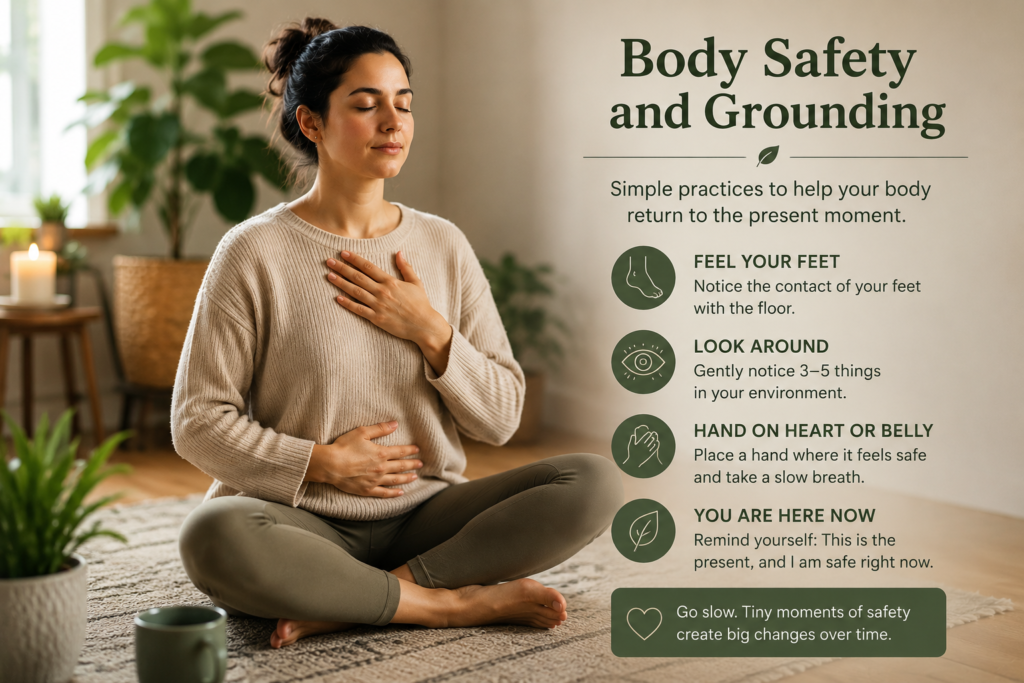
The body often needs small signals of safety before it can soften. This may be as simple as feeling the feet on the floor, noticing the chair supporting the back, looking around the room, breathing slowly, or placing a hand on the chest. These actions look small, but to a stressed nervous system, they can become evidence that the present moment is different from the past.
For beginners, somatic healing should not be intense.
If a practice creates more panic, dizziness, dissociation, or emotional flooding, it is too much for that moment.
The body heals better through pacing.
Safety is not passive. Safety is an active signal that tells the nervous system, “We do not need to fight everything right now.”
If early emotional wounds still affect your reactions, read this inner healing guide.
Before You Begin: Practice Somatic Work Safely
Before trying any exercise, remember this: somatic work is not a competition. You do not need to feel something dramatic for it to be working. You do not need to cry, shake heavily, or remember painful events. In fact, forcing too much can overwhelm the nervous system.
- Start with two to five minutes.
- Choose a quiet place.
- Keep your eyes open if closing them makes you uncomfortable.
- Stay connected to the room.
- Notice colors, objects, light, and sound.
If you feel dizzy, detached, panicked, numb, or unsafe, stop the exercise and return to something simple, like naming objects in the room or feeling your feet on the ground.
Do not try to process severe trauma alone. If you have intense flashbacks, dissociation, self-harm thoughts, severe panic, or a history of complex trauma, work with a qualified trauma-informed professional.
This blog is for education and self-awareness. It does not replace therapy, diagnosis, medication, medical care, or emergency support.
In a safe sense, releasing stored trauma from the body means reducing old survival tension and helping the nervous system recognize the present moment.
The safest rule is simple: begin with the body, but never force the body.
5 Simple Somatic Exercises for Trauma
These somatic exercises for trauma are beginner-friendly, but they should be practiced gently. The purpose is not to remove all pain in one session. The purpose is to create small moments where the body can feel a little more present, supported, and safe.
1. Grounding and Anchoring
Sit or stand in a comfortable position. Feel your feet touching the floor. Notice the pressure under your heels, toes, and soles. If you are sitting, notice the chair holding your body. Let your eyes look around the room slowly. Name five things you can see. Then say quietly, “I am here now.”
You can also place one hand on your chest or stomach if that feels safe. Do not force deep breathing. Just notice the contact between your hand and body.
Grounding is powerful because trauma often pulls the nervous system into the past or future. The body may remember what happened before or fear what may happen next. Grounding gently brings attention back to the present moment.
Try this for one to three minutes. If your body feels calmer, pause and notice that. If your body feels nothing, that is also okay. Numbness is not failure. It may simply mean the body needs more time.
2. Orienting to Safety
Orienting means slowly looking around your environment and letting the body notice where it is. Turn your head gently from side to side. Look at the walls, windows, doors, furniture, light, and colors. Let your eyes land on one object that feels neutral or pleasant.
You might say, “This is my room,” or “I am sitting here,” or “Right now, no one is hurting me.”
Keep it simple.
The goal is not to convince the mind.
The goal is to give the body updated information.
This practice is especially helpful when the body feels frozen, alert, or trapped. Many trauma responses narrow attention. The body becomes focused on threat. Orienting widens awareness and helps the nervous system notice that there may also be safety in the environment.
Do this slowly. If turning your head makes you uncomfortable, simply move your eyes. If looking around feels too much, focus on one steady object.
3. Gentle Somatic Shaking
Shaking can happen naturally after stress, fear, or intense emotion. Some people feel small tremors in the hands, legs, shoulders, or jaw. Gentle shaking may help the body release tension, but it should never be forced.
Start by shaking your hands lightly for ten seconds. Then stop. Notice what you feel. You may feel warmth, tingling, tiredness, calm, or nothing at all. If it feels okay, gently shake the arms or legs. Keep the movement small and controlled.
Avoid dramatic shaking, intense emotional forcing, or trying to “push trauma out.” More intensity does not mean more healing.
For many beginners, less is safer.
- After shaking, pause. Feel the feet.
- Look around. Take one slow breath.
- This pause is important because the body needs time to register the change.
Gentle shaking can be useful when the body feels tense, restless, or overloaded. But if it increases panic or dissociation, stop and return to grounding.
4. The Physiological Sigh
The physiological sigh is a simple breathing pattern that may help the body settle during stress. Take one inhale through the nose. Before exhaling, take a second small inhale. Then exhale slowly through the mouth.
Repeat this two to four times only. Do not overdo it. The purpose is to support calming, not to control the body aggressively.
This practice can help when the breath feels stuck, the chest feels tight, or anxiety starts rising. It gives the body a structured way to release some pressure. But if breathing exercises make you feel dizzy or anxious, stop and breathe normally.
For trauma-sensitive people, breathing practices can sometimes feel uncomfortable because attention to the body may bring up fear. That is why the practice should stay short, gentle, and optional.
5. Safe Self-Touch or Self-Massage
Safe touch can send a message of support to the nervous system. You can place one hand on your heart, one hand on your stomach, or both hands on your arms as if you are holding yourself gently. If this feels uncomfortable, you can massage your hands, fingers, shoulders, jaw, neck, or feet.
Use slow pressure. Do not use painful pressure.
Notice warmth, texture, contact, and support.
You can say, “I am allowed to go slowly,” or “My body is trying to protect me.”
For people with attachment wounds, emotional neglect, or breakup trauma, safe self-touch can be deeply meaningful. It teaches the body that comfort does not always have to come from another person. The body can slowly learn internal support.
If touch feels triggering, skip this practice. You can use visual grounding instead. Healing should respect the body’s boundary.
For more practical support, read these trauma recovery tools.
Common Mistakes Beginners Make With Somatic Work
One common mistake is trying to release everything too quickly. When people are tired of pain, they naturally want fast relief. But trauma healing does not respond well to pressure. If the nervous system has spent years protecting you, it may not relax just because the mind wants immediate change.
Another mistake is chasing intense emotion. Some people believe healing must look dramatic. They may think deep crying, strong shaking, or painful memory recall means progress. Sometimes emotional release can happen, but it is not the goal. Regulation is more important than intensity.
A third mistake is ignoring stop signals. If the body feels dizzy, numb, detached, panicked, or overwhelmed, that is not a sign to push harder. It is a sign to slow down. Somatic work must build trust with the body. Trust grows when the body realizes you will listen when it says “too much.”
A fourth mistake is practicing alone when symptoms are severe. If trauma responses are intense, professional support is not weakness. It is wisdom. Some nervous systems need co-regulation before self-regulation becomes easier.
The body does not heal by being dominated. It heals by being understood.
If relationships leave your body tired and overloaded, read this guide on emotional exhaustion.
When to Seek Professional Somatic Therapy
Professional support is important if your trauma symptoms feel intense, confusing, or unsafe. You should consider working with a trained practitioner if you experience dissociation, flashbacks, panic attacks, severe shutdown, self-harm thoughts, or a strong fear of being inside your body.
A practitioner can help you pace the process. They may use tools such as grounding, resourcing, tracking sensations, pendulation, and slow body awareness. The benefit of professional support is that someone trained can help notice when the nervous system is moving too fast or becoming overwhelmed.
This is especially important for people with complex trauma, childhood abuse, repeated emotional neglect, or severe attachment wounds. These experiences often affect the body deeply because the person may have learned very early that safety was unpredictable.
If you are already under medical or mental health treatment, do not stop medication or therapy because of somatic exercises. Somatic work can be supportive, but it should not replace proper care.
If attachment wounds affect your confidence and safety, read this guide on rebuilding self-worth after attachment pain.
BBH Healing Perspective: Your Body Is Not Broken
The most important message of this blog is simple: your body is not broken.
It may be trying to protect you.
- When the body freezes before a decision, it may be remembering earlier loss.
- When the chest tightens before a conversation, it may be remembering earlier rejection.
- When the stomach feels heavy before work, it may be remembering pressure, criticism, or fear of failure.
- When sleep gets disturbed during stress, the nervous system may be scanning for danger.
This does not mean every fear is correct. It means every fear deserves compassionate attention.
Somatic experiencing helps beginners stop treating the body as an enemy.
Instead of saying, “Why are you stopping me?” you begin asking, “What are you afraid will happen?” That question changes the healing process. It creates a relationship with the body.
For many people, this becomes the missing piece. They have tried motivation, discipline, planning, positive thinking, and self-pressure. But their body still does not move. The reason may not be laziness. It may be that the nervous system needs safety before action.
Safety is the real medicine. Not because life becomes risk-free, but because the body learns that risk does not always mean danger.
- A person can restart slowly.
- A person can take one step.
- A person can feel fear and still remain present.
My healing became easier when I stopped fighting every reaction and started listening to what it was trying to protect.

If decision fear is blocking your next step, read this guide on learning to trust yourself again.
For new readers beginning their healing journey, start here: start-here
Conclusion: Start Small and Let the Body Learn Safety Again
Somatic experiencing for beginners is not about forcing trauma out of the body. It is about helping the nervous system slowly recognize safety again. When the body feels afraid, frozen, tense, numb, or restless, it may not be trying to sabotage you.
It may be trying to protect you from something it once experienced as dangerous.
The healing path begins with small steps.
- Feel your feet. Look around the room.
- Notice your breath. Place a hand where it feels safe.
- Shake gently if your body wants movement. Pause often.
- Stop when the body says stop. Return tomorrow.
Real healing is not always dramatic. Sometimes it is quiet. Sometimes it is the first moment your body realizes, “I am here, and I am safe enough for this breath.”
You are not broken. Your body has been protecting you. Now it can slowly learn another way.
FAQs
1. What is somatic experiencing?
Somatic experiencing is a body-focused trauma healing approach that helps people notice physical sensations, survival responses, and nervous system patterns in a safe and gentle way. It focuses less on forcing memories and more on helping the body slowly feel safe again.
2. Is somatic experiencing safe for beginners?
It can be safe for beginners when practiced gently, slowly, and without forcing trauma memories. Beginners should start with short grounding practices and stop if they feel dizzy, panicked, detached, or overwhelmed. People with severe symptoms should work with a trained professional.
3. Can somatic exercises help trauma?
Somatic exercises may support body awareness, emotional regulation, and nervous system calming. They can help some people notice tension, reconnect with the present moment, and reduce stress responses. They should be used as supportive tools, not as a replacement for therapy or medical care.
4. What are simple somatic exercises for trauma?
Beginner practices include grounding, orienting, gentle shaking, physiological sigh breathing, and safe self-touch or self-massage. These practices should be gentle and short, especially for people who feel easily overwhelmed.
5. What does releasing trauma from the body mean?
It means helping the nervous system reduce survival-based tension, fear, shutdown, and stress patterns. It should not be understood as forcing trauma out quickly. A safer understanding is that the body slowly learns that the present moment is safer than the past.
6. When should I seek professional help?
Seek professional support if you experience dissociation, intense flashbacks, panic attacks, self-harm thoughts, severe trauma symptoms, or if body-based exercises make you feel unsafe. A qualified trauma-informed professional can help you practice at a safer pace.
People Also Ask
1. What is somatic experiencing in simple words?
Somatic experiencing is a gentle way of working with the body’s stress and trauma responses. It helps a person notice body sensations, slow down survival reactions, and build a stronger sense of safety in the present moment.
2. How does trauma affect the body?
Trauma can affect breathing, muscle tension, digestion, sleep, emotional regulation, and the way the nervous system reacts to stress. A person may feel chest tightness, stomach heaviness, freezing, numbness, panic, or restlessness even when there is no current danger.
3. Can the body feel afraid even when the mind feels okay?
Yes. The mind may understand that the danger is over, but the nervous system may still react as if protection is needed. This can happen after trauma, emotional neglect, panic, relationship wounds, or repeated stress.
4. What are the best beginner somatic practices?
The best beginner practices are simple and gentle: grounding, orienting to the room, slow breathing, mild shaking, and safe self-touch. These practices help the body return to the present without forcing intense emotional release.
5. Is somatic therapy different from talk therapy?
Yes. Talk therapy often works through thoughts, emotions, beliefs, and life patterns. Somatic therapy pays more attention to body sensations, survival responses, posture, breath, and nervous system regulation. Many people benefit from both.
6. Can somatic work help with anxiety and panic?
Somatic work may help some people notice early body signals of anxiety and support calming through grounding, breath, movement, and body awareness. However, severe panic symptoms should be discussed with a qualified mental health professional.
External References
- Somatic Experiencing International — SE 101
https://traumahealing.org/se-101/ - Harvard Health Publishing — What is somatic therapy?
https://www.health.harvard.edu/blog/what-is-somatic-therapy-202307072951 - Payne, Levine, Crane-Godreau — Somatic Experiencing: using interoception and proprioception as core elements of trauma therapy
https://pmc.ncbi.nlm.nih.gov/articles/PMC4316402/ - Kuhfuß et al. — Somatic Experiencing effectiveness and key factors of a body-oriented trauma therapy
https://pmc.ncbi.nlm.nih.gov/articles/PMC8276649/