Healing & HopeRelationship

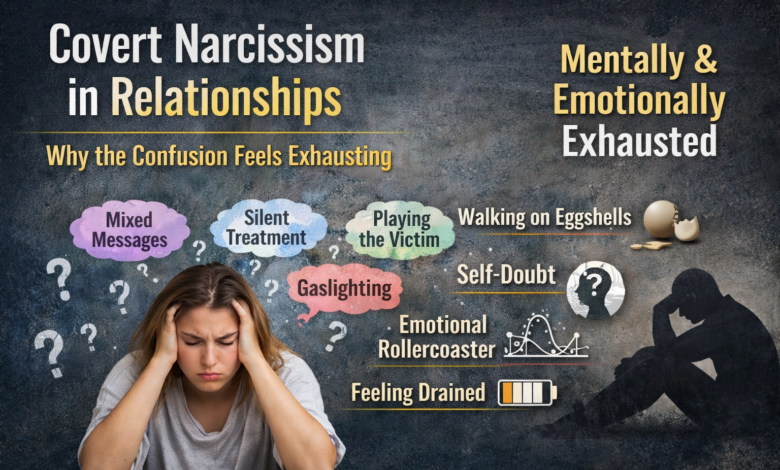
Covert Narcissism in Relationships: Why the Confusion Feels Exhausting

Why You Feel Confused but Drained in Certain Relationships

Covert narcissism in relationships often feels confusing because a covert narcissist partner may use emotional manipulation subtle, trauma bonding covert dynamics, and relationship gaslighting that drain energy without obvious conflict.

Thank you for reading this post, don't forget to subscribe!

“This content explains relationship confusion calmly — it does not accuse, diagnose, or alarm.”

Nothing exploded, yet something kept draining you.
The confusion stayed because your system learned to wait for the next shift.

Even after leaving, the nervous system can stay on alert because it learned unpredictability as normal. Regulation returns through consistency, not force.

Covert Narcissism in Relationships Explained

Many people searching for covert narcissism in relationships are not looking to accuse a partner—they are trying to understand a quiet fear: Am I losing myself here?

When a covert narcissist partner relies on emotional manipulation subtle, trauma bonding covert dynamics, and relationship gaslighting, the experience can feel disorienting without clear moments to point to.

The misunderstanding is often this: confusion is mistaken for weakness, and adaptation is mistaken for identity.

Feeling drained, hesitant, or smaller is not a flaw—it is a response to mixed relational signals.

When care and uncertainty coexist, the mind turns inward to make sense of it.

This article will help you understand what’s happening — without labels, blame, or self-attack.


REASON FOR THIS BLOG

To explain why certain relationships create confusion and emotional drain, and to separate trauma-based reactions from identity—without judgment, diagnosis, or pressure to define anyone.

Please Explore This Blog emotional-neglect-narcissistic-mother


INNER SEARCH MIRROR

You might recognize yourself in questions like:

  • Why do I feel confused but tired?

  • Why do small moments linger?

  • Why do I doubt normal reactions?

  • Why does clarity come late?

  • Why do I feel responsible for peace?

  • Why did leaving not bring relief?

If these questions sound familiar, you’re not alone.


PSYCHOLOGICAL EXPLANATION -Covert Narcissism in Relationships

Psychologically, covert narcissism in relationships can feel destabilizing because the mind adapts to inconsistency rather than open conflict.

With a covert narcissist partner, emotional manipulation subtle enough to avoid confrontation teaches the psyche to monitor tone, timing, and approval.

Trauma bonding covert dynamics strengthen attachment by alternating closeness with distance, while relationship gaslighting blurs cause and effect.

The reaction is adaptation, not intent. The mind learns to stay alert to preserve connection.

This conditioning reduces self-trust over time, not because something is wrong with you, but because ambiguity trains caution.

Personal note: Naming adaptation reduced my self-blame.


NERVOUS SYSTEM EXPLANATION

Covert Narcissism in Relationships Through the Nervous System

From a biological lens, covert narcissism in relationships activates the nervous system before conscious thought.

Around a covert narcissist partner, emotional manipulation subtle and unpredictable cues can trigger fight, flight, or freeze automatically.

Trauma bonding covert patterns reinforce this by linking relief with proximity, while relationship gaslighting keeps the body scanning for reality checks.

These reactions happen faster than thinking. That’s why tension, vigilance, or fatigue can persist even after distance—the body learned to protect first.

Common signs include:

  • Muscle tension

  • Emotional scanning

  • Delayed responses

  • Shallow breathing

  • Mental fatigue

Personal note: Understanding biology eased my urge to explain myself.


CORE DISTINCTION

Identity vs Survival Responses

This distinction anchors the article.

Survival responses exist to protect connection and safety. They narrow expression, delay trust, and prioritize calm.

Identity remains stable. It holds values, conscience, empathy, and intention.

In covert narcissism in relationships, survival strategies are often mistaken for personality change.

Quiet compliance, hesitation, or emotional withdrawal are not who you are—they are what you did to stay safe with a covert narcissist partner amid emotional manipulation subtle enough to confuse, trauma bonding covert enough to attach, and relationship gaslighting enough to doubt.

Identity does not disappear under pressure; it waits. When safety returns, expression follows naturally.

Please Explore This Blog trauma-bonding-narcissistic-mother

TRAUMA VS NARCISSISM (RELIEF SECTION)

Covert Narcissism in Relationships: Motivation Matters

The fear beneath covert narcissism in relationships is often, “What if this is me?” Relief comes from comparing motivation, not behavior.

In dynamics involving a covert narcissist partner, emotional manipulation subtle, trauma bonding covert, and relationship gaslighting, trauma responses can resemble traits—but the inner drivers differ.

Trauma seeks safety and repair; narcissistic motivation protects image and control. Remorse, reflection, and accountability point to intact values, not pathology.

Trauma MotivationNarcissistic Motivation
Remorse after harmLack of remorse
Reflection on impactDeflection
Accepts accountabilityAvoids accountability
Seeks repairProtects image

Personal note: Recognizing remorse ended my self-labeling.


GROWTH DIRECTION –Covert Narcissism in Relationships

Growth within covert narcissism in relationships is about orientation, not fixing.

As pressure eases with a covert narcissist partner, the pull of emotional manipulation subtle patterns weakens; trauma bonding covert softens as steadiness replaces urgency; relationship gaslighting loses influence when internal trust rebuilds.

Signs of healing are quiet: reactions slow, choices feel simpler, and peace becomes preferable to explanation. Agency returns without force when the system feels safe enough to pause.

This direction values gentleness—allowing space for clarity to arrive rather than demanding conclusions.

Personal note: Healing felt real when slowing down felt safe.


 HEALING COMPASS / ORIENTATION TABLE

This compass offers stability for covert narcissism in relationships, mapping movement without pressure.

With a covert narcissist partner, effects of emotional manipulation subtle, trauma bonding covert, and relationship gaslighting can disorient; simple affirmations help the system re-anchor.

StageGrounding Affirmation
Awareness“This reaction has a reason.”
Safety“My body can settle.”
Understanding“Confusion isn’t identity.”
Recovery“Choice returns with calm.”
Protection“I honor limits quietly.”

Each stage supports the next. There’s no rush—stability grows as insight aligns with safety.

1: Why Confusion Is the First Signal, Not a Failure

In covert narcissism in relationships, confusion often appears before anything else. When a covert narcissist partner communicates indirectly, emotional manipulation subtle enough to avoid conflict can slowly erode clarity.

Trauma bonding covert dynamics deepen attachment while increasing doubt, and relationship gaslighting shifts attention away from lived experience.

The breakthrough is realizing that confusion is not weakness; it is information. The mind senses inconsistency before it can name it.

This response is protective, not flawed. Recognizing confusion as a signal allows self-trust to begin returning without needing confrontation or certainty.


2: Motivation Explains More Than Behavior Ever Could

What destabilizes covert narcissism in relationships is not dramatic behavior, but unclear motivation.

A covert narcissist partner may appear caring, while emotional manipulation subtlely redirects responsibility.

Trauma bonding covert patterns link relief to proximity, and relationship gaslighting reframes events without direct denial.

The breakthrough is shifting focus from what happened to why it keeps happening.

When accountability is avoided and impact is minimized, the nervous system responds by becoming vigilant.

This vigilance is not judgment; it is self-protection forming under ambiguity. Understanding motivation reduces self-blame without assigning labels.


3: Self-Doubt Is a Learned Adaptation, Not Your Nature

Repeated exposure within covert narcissism in relationships can train self-doubt over time.

Around a covert narcissist partner, emotional manipulation subtle enough to feel normal teaches the mind to question its own reactions.

Trauma bonding covert cycles reinforce attachment while weakening confidence, and relationship gaslighting encourages internal debate over simple perceptions.

The breakthrough is recognizing self-doubt as conditioning rather than character.

The mind adapts to survive unclear environments by monitoring itself more closely.

When this is understood, self-attack softens naturally and identity separates from adaptation.


4: Quiet Harm Does Not Require Loud Proof

One reason covert narcissism in relationships is so hard to name is the lack of obvious evidence.

A covert narcissist partner often avoids open conflict, while emotional manipulation subtlely shapes outcomes without direct force.

Trauma bonding covert dynamics keep attention on repair, and relationship gaslighting leaves no single moment to point to.

The breakthrough here is accepting that harm does not need to be loud to be real.

Repeated emotional disorientation alone can drain energy and trust. Impact matters even when it is difficult to explain.


5: Healing Begins When the Pressure to Decide Ends

Many people caught in covert narcissism in relationships feel pressure to reach conclusions quickly.

Yet a covert narcissist partner benefits from urgency, while emotional manipulation subtlely thrives under rushed interpretation.

Trauma bonding covert patterns soften when steadiness replaces intensity, and relationship gaslighting loses power as internal calm returns.

The final breakthrough is understanding that healing does not require decisions. It requires safety.

As pressure eases, perception sharpens on its own. Clarity arrives through consistency, not force.


Closing note

Clarity does not come from proving what happened. It comes from trusting what your system learned while protecting you.

Please Explore This Blog inner-child-wounds-narcissistic-mother

Medical / Ethical Positioning — Covert Narcissism in Relationships

From a medical and ethical view, covert narcissism in relationships is often misunderstood because the mind seeks certainty when threat feels ambiguous.

When a covert narcissist partner is discussed without context, language itself can unintentionally turn into accusation or self-blame.

Ethically, the role of education is not to label people, but to explain how meaning is constructed under stress.

The mind interprets confusion as danger when explanations are missing.

Ethical clarity restores safety by offering understanding without defining identity or intent.

Ethical FocusWhat It Restores
ContextMeaning accuracy
LanguagePsychological safety
EducationInformed clarity
BoundariesNon-pathologizing care

I learned that ethical framing prevented unnecessary self-judgment.


Psychological Layer — Covert Narcissism in Relationships

Psychologically, covert narcissism in relationships challenges how meaning is formed when signals conflict.

Emotional manipulation subtle enough to appear normal disrupts the mind’s ability to connect cause and effect.

The psyche responds by replaying interactions, scanning tone, and questioning perception in an effort to restore coherence.

This is not obsession; it is meaning-repair. When the mind cannot predict outcomes, it turns inward to regain stability.

Understanding this layer reframes confusion as a cognitive response to ambiguity, not a personal flaw.

Mental ProcessPsychological Role
ReplayMeaning reconstruction
DoubtRisk reduction
MonitoringPredictability
WithdrawalCognitive relief

Seeing confusion as meaning-repair changed how I treated myself.


Nervous System Layer — Covert Narcissism in Relationships

At the body level, covert narcissism in relationships activates automatic protection. Trauma bonding covert patterns train the nervous system to associate closeness with relief and distance with threat.

Before thought occurs, the body tightens, breath shortens, and attention narrows to preserve safety. These reactions are reflexive, not chosen.

The nervous system prioritizes survival over clarity, which explains why calm can feel unfamiliar even after distance.

Biology reacts faster than understanding.

Body SignalProtective Function
Muscle tensionReadiness
Shallow breathingAlertness
Hyper-focusThreat detection
FatigueEnergy conservation

Body awareness explained reactions my mind could not.


Mental Health Layer — Covert Narcissism in Relationships

From a mental health perspective, covert narcissism in relationships creates prolonged cognitive load.

Relationship gaslighting gradually erodes clarity by forcing the mind to re-evaluate simple perceptions repeatedly.

Over time, energy drops, focus fragments, and self-trust weakens. These effects reflect sustained stress rather than character change.

Mental health stabilizes as the load decreases, not when answers are forced. Reduced pressure allows clarity and confidence to return organically.

Prolonged EffectInner Experience
Cognitive strainMental fatigue
VigilanceReduced focus
Stress carryoverLow energy
DoubtWeakened trust

Rest restored clarity faster than analysis ever did.


Identity Layer (Inner Continuity & Meaning) — Covert Narcissism in Relationships

Identity remains intact beneath survival responses in covert narcissism in relationships. Even when emotional manipulation subtle limits expression, values and conscience persist quietly.

Identity is not defined by hesitation, withdrawal, or compliance under pressure. It is revealed over time through consistency, remorse, and moral orientation.

This layer anchors meaning by separating who someone is from how they protected themselves.

When safety returns, identity naturally becomes visible again.

Identity MarkerWhat Endures
ValuesMoral compass
ConscienceCapacity for care
MeaningInner continuity
ChoiceReturns with safety

Identity felt clearer once pressure eased.


Reflective Support Layer (Including AI) — Covert Narcissism in Relationships

Reflective supports help process covert narcissism in relationships without directing conclusions.

Tools like journaling, conversation, or AI can mirror language and patterns back to the individual, allowing thoughts to organize safely. When used as mirrors rather than authorities, these tools preserve agency.

Reflection externalizes confusion, reduces isolation, and supports meaning-making without pushing decisions.

Insight unfolds through recognition, not instruction.

ToolReflective Role
JournalingExternalizes thought
ConversationNormalizes experience
AIMirrors language
SilenceIntegrates insight

Reflection helped me hear myself without pressure.


Integration Layer (Stability Over Resolution) — Covert Narcissism in Relationships

Integration is where covert narcissism in relationships settles without forcing answers. When the system no longer needs to resolve everything, internal conflict reduces.

Understanding, body signals, and values align instead of competing. Integration is not certainty; it is internal agreement.

Stability grows as urgency fades and meaning stabilizes across layers.

This is the point where peace replaces analysis.

Integrated ElementStabilizing Effect
InsightReduced friction
Body cuesTrusted signals
ValuesCoherent meaning
PaceNatural slowing

Integration felt like relief rather than conclusion.

Please Explore This Blog covert-narcissism-examples-everyday-life

PERSONAL NOTE — Covert Narcissism in Relationships

When I first tried to understand covert narcissism in relationships, what struck me was how easily confusion turns inward. Being close to a covert narcissist partner can quietly shift attention away from one’s own inner signals.

What grounded me was noticing my capacity for reflection and accountability even while feeling uncertain. That capacity became evidence of intact values, not failure.

Lived authority, for me, came from staying honest without forcing conclusions. Over time, clarity felt less urgent and more stable.

The lesson was simple: confusion does not cancel conscience.

It often reveals how deeply someone was trying to preserve connection while protecting themselves.


COSMIC / PHILOSOPHICAL TAKEAWAY — Covert Narcissism in Relationships

“Systems under strain search for meaning before they find rest.”

When viewed broadly, covert narcissism in relationships alongside a covert narcissist partner, emotional manipulation subtle patterns, trauma bonding covert dynamics, and relationship gaslighting reflects a universal human truth.

The mind is meaning-seeking by nature. When signals conflict, it creates stories to restore order.

Philosophy reminds us that identity is not formed in confusion but uncovered when pressure lifts.

What survives uncertainty is not damage, but essence. As safety returns, meaning reorganizes itself quietly, without force or judgment.


FAQ SECTION — CLARITY WITHOUT ALARM

  1. Why does this relationship feel confusing but exhausting?
    Because mixed signals strain emotional clarity over time.

  2. Does confusion mean something is wrong with me?
    No. Confusion is often a response to ambiguity.

  3. Can subtle patterns really cause harm?
    Yes. Impact does not require obvious behavior.

  4. Why do I keep doubting my reactions?
    Adaptation often turns inward to preserve connection.

  5. Is trauma bonding always dramatic?
    No. It can form quietly through inconsistency.

  6. Do I need to label my partner to heal?
    No. Understanding does not require naming.

  7. Why didn’t leaving bring instant relief?
    The nervous system may still be recalibrating.

  8. How do I know this isn’t my personality?
    Values and conscience remain consistent beneath stress.

  9. Will clarity come back?
    Yes. Consistency restores perception over time.


FINAL CLOSING — Covert Narcissism in Relationships

If covert narcissism in relationships brought you here, let this be your reassurance.

Noticing a covert narcissist partner, emotional manipulation subtle patterns, trauma bonding covert experiences, or relationship gaslighting does not mean you must decide anything today.

Nothing is wrong with you for reacting to uncertainty or emotional drain. The mind and body adapt to protect meaning and safety.

With steadiness and understanding, what adapted can soften again.

You are invited to move gently, to trust calm over urgency, and to allow clarity to return at its own pace.

Healing grows where self-attack ends.

Please Explore This Blog covert-narcissism-dsm-diagnosis-clarity


🌿 Final Blog Footer — Bio & Brain Health Info

Written by Lex, founder of Bio & Brain Health Info — exploring the intersections of psychology, spirituality, and emotional recovery through calm, trauma-aware understanding.

Insight & Reflection
Healing does not begin when answers arrive — it begins when self-attack stops.
Clarity grows in spaces where safety is restored.

🧠 Learn
Narcissism • Emotional Healing • Spiritual Psychology

🌍 A Moment for You
💡 Pause for two minutes. Let your body settle before moving on.

🧭 If This Article Helped, Your Next Questions Might Be:
These questions are natural continuations — not obligations.

Cosmic Family Invitation
You are not here by accident. If these words reached you, clarity was already beginning.
We rise together — different souls, one journey. 🕊️

📩 Connect with us
info@bioandbrainhealthinfo.com
Telegram: @bioandbrainhealthinfo
WhatsApp Channel: Punehealth

Lex | Bio & Brain Health Info
Cosmic Family — Different Souls, One Journey.


REFERENCES & CITATIONS

Trusted Sources for Credibility & Transparency

  1. American Psychiatric Association — Personality Disorders Overview
    https://www.psychiatry.org/patients-families/personality-disorders

  2. DSM-5-TR Overview — American Psychiatric Association
    https://www.psychiatry.org/psychiatrists/practice/dsm

  3. National Institute of Mental Health — Personality Disorders
    https://www.nimh.nih.gov/health/topics/personality-disorders

  4. Cleveland Clinic — Narcissistic Personality Disorder (Educational)
    https://my.clevelandclinic.org/health/diseases/9742-narcissistic-personality-disorder

  5. Psychology Today — Covert and Vulnerable Narcissism
    https://www.psychologytoday.com/us/basics/narcissism

  6. Harvard Health — Stress and the Brain
    https://www.health.harvard.edu/staying-healthy/understanding-the-stress-response

  7. National Library of Medicine — Chronic Stress and Cognition
    https://www.ncbi.nlm.nih.gov/pmc/articles/PMC3181836/

  8. APA Dictionary of Psychology — Personality vs Behavior
    https://dictionary.apa.org/personality

  9. NICABM — Trauma Education
    https://www.nicabm.com/trauma/

  10. World Health Organization — Mental Health and Well-Being
    https://www.who.int/teams/mental-health-and-substance-use

Cosmica Family Invitation from bioandbrainhealthinfo

Related Articles

Back to top button