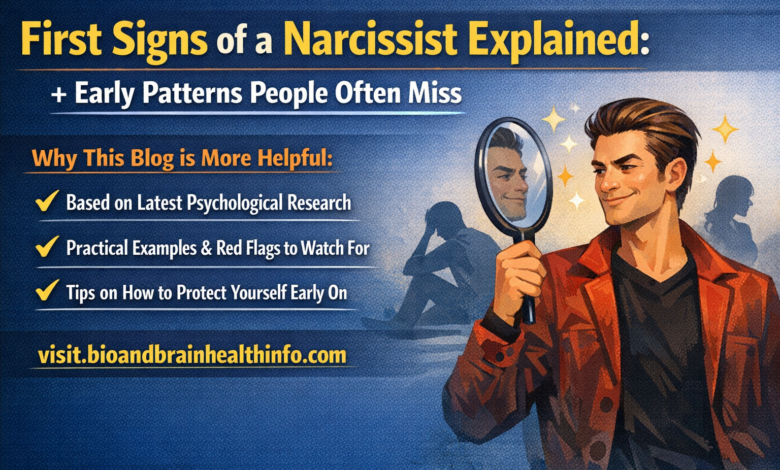
Understanding the first signs of a narcissist often begins by recognizing subtle early narcissism signs like boundary testing, intense love bombing, and quiet entitlement cues that can feel confusing rather than obvious.
Sometimes the earliest signals feel like warmth, intensity, or deep connection — which is why they are difficult to recognize at first.
Patterns that later feel overwhelming often begin as something that appears meaningful or exciting.
Even after leaving, the nervous system can stay on alert because it learned unpredictability as normal. Regulation returns through consistency, not force.
🧠 First Signs of a Narcissist Explained
Recognizing the first signs of a narcissist can feel confusing because early behaviors rarely look harmful at the beginning.
Many people notice subtle early narcissism signs such as emotional intensity, quiet boundary testing, unexpected love bombing, or small entitlement cues, yet struggle to interpret what they mean.
The core fear often becomes: “Am I overthinking this, or am I losing trust in myself?”
This confusion happens because trauma responses can feel like identity changes, even though they are adaptive reactions rather than personal flaws.
When connection feels powerful or unpredictable, the nervous system may prioritize closeness over caution, which makes patterns harder to see clearly.
Nothing about this confusion means you are weak or naive — it reflects how human attachment works under uncertainty.
This article will help you understand what’s happening — without labels, blame, or self-attack.
📍 REASON FOR THIS BLOG
To help readers understand how early relationship patterns create confusion and self-doubt, and to separate trauma-based reactions from identity — without judgment, diagnosis, or pressure.
🔎 INNER SEARCH MIRROR
You may recognize yourself in questions like:
-
Why did intense attention feel safe at first?
-
Why do small boundary moments feel confusing instead of clear?
-
Why does love bombing feel genuine even when something feels off?
-
Why do entitlement cues appear subtle rather than obvious?
-
Why do early narcissism signs become clear only later?
-
Why do I question myself instead of questioning the pattern?
Pleas Explore This Blog first-signs-of-narcissism-early-indicators
🧠 PSYCHOLOGICAL EXPLANATION- First Signs of a Narcissist Explained
Understanding the first signs of a narcissist often means recognizing how perception adapts under emotional intensity.
Early interactions may include love bombing, subtle boundary testing, or small entitlement cues, which can appear meaningful rather than concerning because the brain interprets attention as safety.
These early narcissism signs are not always obvious; they blend positive reinforcement with unpredictability, encouraging emotional investment before clarity develops.
Psychological adaptation works by prioritizing connection — especially when validation feels strong or rare — which reduces immediate threat detection.
This does not mean a person ignored reality; it means the mind was responding to social signals designed to create closeness.
| Pattern |
Common Interpretation |
Later Realization |
| Intensity |
Deep connection |
Emotional acceleration |
Personal note: clarity often arrives slowly, not suddenly.
🌿 NERVOUS SYSTEM EXPLANATION – First Signs of a Narcissist
The first signs of a narcissist can activate biological responses before conscious thinking begins.
When early narcissism signs include rapid closeness, repeated boundary testing, strong love bombing, or subtle entitlement cues, the nervous system may move into fight, flight, or freeze responses automatically.
These reactions happen faster than analysis because the brain prioritizes survival and attachment signals.
Emotional highs followed by uncertainty create a cycle where attention stays focused on restoring safety, making patterns harder to evaluate logically.
Short warning signs:
-
Feeling rushed emotionally
-
Difficulty saying no
-
Strong emotional highs and lows
-
Self-doubt after interactions
-
Pressure disguised as closeness
Personal note: many reactions occur before awareness, which is a biological process — not a personal failure.
🪜 CORE DISTINCTION – Identity vs Survival Responses
The most important distinction when recognizing early relational patterns is separating identity from adaptation.
Survival responses exist to protect connection and safety; identity reflects values, conscience, and deeper self-understanding.
When the first signs of a narcissist appear — including early narcissism signs, love bombing, subtle boundary testing, or quiet entitlement cues — survival strategies may encourage tolerance, curiosity, or emotional investment because the nervous system seeks stability.
This does not redefine who you are. Survival reactions are temporary adjustments shaped by context, while identity remains stable beneath those adaptations.
Authority and clarity emerge when people understand that reacting to unpredictability is a protective mechanism rather than a personality flaw.
Recognizing this difference allows self-trust to return gradually without blame or urgency.
🌿 TRAUMA VS NARCISSISM -First Signs of a Narcissist
Understanding the first signs of a narcissist helps separate early narcissism signs from trauma reactions shaped by love bombing, boundary testing, or subtle entitlement cues.
Focus on motivation rather than behavior:
| Trauma Response |
Narcissistic Pattern |
| Shows remorse |
Avoids accountability |
| Reflects inward |
Blames outward |
| Seeks repair |
Protects image |
Personal note: confusion often fades when motivation becomes clearer.
🌱 GROWTH DIRECTION – First Signs of a Narcissist
Seeing the first signs of a narcissist alongside early narcissism signs, boundary testing, love bombing, and entitlement cues invites slower awareness rather than urgent action.
Healing often looks like pausing, noticing emotional pacing, and choosing calm over reaction.
Signs of growth include clearer boundaries, reduced self-blame, and valuing inner peace.
Personal note: healing rarely feels dramatic; it feels quietly stabilizing.
🧭 HEALING COMPASS / ORIENTATION TABLE
Purpose: convert insight into steady direction.
| Stage |
Inner Orientation |
| Awareness |
“Something feels unclear.” |
| Understanding |
“Patterns can be learned.” |
| Stabilizing |
“I can slow down safely.” |
| Rebuilding |
“Self-trust returns gradually.” |
| Protection |
“Peace guides my choices.” |
Healing moves gently from confusion toward clarity — not through force, but through consistent self-understanding.
Pleas Explore This Blog covert-narcissist-empathy-explained
🌱 10 First Signs of a Narcissist Explained
🧠 First Signs of a Narcissist Explained: Intense Early Attention
The first signs of a narcissist may appear as strong emotional intensity that feels meaningful. These early narcissism signs often include love bombing, subtle boundary testing, and quiet entitlement cues. The nervous system interprets intense connection as safety, which makes early patterns feel positive rather than concerning.
🌿 First Signs of a Narcissist Explained: Subtle Boundary Testing
One of the first signs of a narcissist involves gradual boundary testing that seems playful or harmless. These early narcissism signs, often paired with love bombing and hidden entitlement cues, can feel like closeness rather than pressure. The nervous system may prioritize harmony, delaying recognition of relational imbalance.
🔎 First Signs of a Narcissist Explained: Emotional Highs and Lows
Some first signs of a narcissist include fluctuating emotional intensity. These early narcissism signs combine love bombing, inconsistent responses, quiet boundary testing, and subtle entitlement cues. Emotional unpredictability keeps the nervous system focused on restoring connection, making patterns feel confusing rather than clearly concerning.
🪜 Entitlement Signals
The first signs of a narcissist may appear through mild entitlement cues such as expecting attention or priority. These early narcissism signs, alongside love bombing and gentle boundary testing, feel small at first. The nervous system often normalizes these behaviors because connection and validation feel emotionally rewarding.
🌙 Fast Emotional Pacing
Rapid closeness can be among the first signs of a narcissist. These early narcissism signs include accelerated bonding, strong love bombing, subtle boundary testing, and quiet entitlement cues. Fast emotional pacing reduces reflection time, encouraging attachment before clarity develops.
🔍 First Signs of a Narcissist Explained: Shifting Responsibility
Another of the first signs of a narcissist involves responsibility shifting subtly. These early narcissism signs may show through stories emphasizing victimhood, indirect entitlement cues, boundary testing, and ongoing love bombing. The nervous system often responds with empathy, which can delay noticing imbalance.
🌱 Constant Validation Seeking
Some first signs of a narcissist include repeated need for reassurance. These early narcissism signs combine love bombing, mild boundary testing, and subtle entitlement cues around admiration. Emotional intensity can feel romantic, while the nervous system adapts to ongoing validation cycles.
🧭 First Signs of a Narcissist Explained: Lack of Mutuality
Imbalance in emotional exchange may signal the first signs of a narcissist. These early narcissism signs include one-sided attention, quiet entitlement cues, ongoing boundary testing, and phases of love bombing. The nervous system often compensates by giving more, which can obscure recognition initially.
🌿 Communication Confusion
Confusion itself can be one of the first signs of a narcissist. These early narcissism signs involve mixed signals, alternating love bombing, subtle boundary testing, and shifting entitlement cues. The nervous system seeks clarity by increasing emotional focus, which makes patterns harder to evaluate logically.
🌙 Feeling Responsible for Harmony
Feeling responsible for emotional stability may reflect the first signs of a narcissist dynamic. These early narcissism signs combine love bombing, ongoing boundary testing, and quiet entitlement cues that encourage adaptation. The nervous system prioritizes maintaining connection, often before personal comfort or clarity.
🌱 CLOSING NOTE
Understanding early relational patterns is not about labeling others but about restoring trust in your perception. Awareness grows slowly through observation and emotional regulation. When clarity develops gently, self-trust returns naturally — allowing choices rooted in calm understanding rather than fear or urgency.
Pleas Explore This Blog covert-narcissist-depression-explained
🌱 A Whole-System View of the Human Healing Process
🧭 Medical / Ethical Positioning — First Signs of a Narcissist
Understanding the first signs of a narcissist through ethical awareness prevents oversimplification.
Early relational confusion, including subtle entitlement cues, is better viewed through behavioral patterns rather than labels.
Ethical positioning recognizes complexity: the mind interprets threat and meaning based on context, history, and attachment learning rather than immediate clinical conclusions.
| Ethical Focus |
Meaning Interpretation |
| Observation |
Notice patterns without diagnosing |
| Context |
Behavior exists within relationship dynamics |
| Responsibility |
Separate actions from identity |
| Safety |
Clarity grows without urgency |
Personal note: ethical clarity often reduces emotional reactivity before deeper insight appears.
🧠 Psychological Layer — First Signs of a Narcissist
From a psychological perspective, the first signs of a narcissist may influence how meaning is constructed internally.
Subtle early narcissism signs can create interpretive loops where attention shifts toward resolving ambiguity rather than questioning patterns.
The mind naturally searches for coherence, especially when emotional signals conflict with expectations.
| Psychological Process |
Interpretation Effect |
| Pattern seeking |
Looks for consistency |
| Meaning-making |
Assigns personal significance |
| Ambiguity tolerance |
Delays clear conclusions |
| Attachment bias |
Prioritizes connection |
Personal note: recognizing interpretation patterns can gently restore internal balance.
🌿 Nervous System Layer — First Signs of a Narcissist
The first signs of a narcissist can activate automatic bodily responses before conscious thought.
During phases linked with love bombing, the body reacts to perceived safety or uncertainty through rapid physiological adjustments.
These reactions occur to maintain survival stability rather than logical analysis.
| Automatic Response |
Protective Function |
| Increased alertness |
Scan for consistency |
| Emotional arousal |
Strengthen connection focus |
| Energy shifts |
Prepare for adaptation |
| Somatic memory |
Store relational signals |
Personal note: bodily reactions often reflect protection, not weakness.
🌙 Mental Health Layer — First Signs of a Narcissist
Prolonged exposure to relational ambiguity associated with the first signs of a narcissist may influence clarity, energy levels, and self-trust.
Subtle boundary testing can create cognitive strain as the mind attempts to reconcile conflicting signals, gradually affecting emotional resilience without obvious external triggers.
| Mental Health Impact |
Internal Experience |
| Cognitive fatigue |
Difficulty concentrating |
| Emotional confusion |
Mixed interpretations |
| Reduced self-trust |
Questioning perception |
| Energy depletion |
Persistent mental load |
Personal note: confusion is often a signal of overload, not failure.
🪜 Identity Layer (Inner Continuity & Meaning) — First Signs of a Narcissist
Even when facing the first signs of a narcissist, identity remains deeper than survival responses.
Subtle entitlement cues or relational stress may shape behavior temporarily, yet values and conscience remain stable beneath adaptation.
Identity continuity supports long-term resilience despite shifting emotional reactions.
| Identity Element |
Stable Core |
| Values |
Guide long-term choices |
| Conscience |
Maintains empathy |
| Meaning-making |
Supports growth |
| Inner narrative |
Preserves self-coherence |
Personal note: identity becomes clearer when survival responses are understood, not judged.
🔎 Reflective Support Layer (Including AI) — First Signs of a Narcissist
Tools such as journaling, reflective conversation, or AI-based dialogue can support understanding of the first signs of a narcissist without directing conclusions.
Subtle early narcissism signs become clearer when thoughts are mirrored neutrally, allowing the mind to organize experiences safely.
| Reflective Tool |
Function |
| Journaling |
Externalizes internal dialogue |
| Conversation |
Expands perspective |
| AI reflection |
Mirrors patterns neutrally |
| Structured questions |
Increase clarity |
Personal note: reflection works best when curiosity replaces pressure.
🌱 Integration Layer — Whole-System Healing Orientation
A whole-system view of the first signs of a narcissist integrates psychological interpretation, nervous-system regulation, and reflective understanding to restore internal stability.
Even subtle love bombing patterns can influence meaning-making, which is why healing involves gradual alignment between body signals, cognitive clarity, and identity continuity rather than sudden decisions.
| Integration Focus |
Healing Direction |
| Awareness |
Observe patterns calmly |
| Regulation |
Support nervous-system stability |
| Meaning |
Reframe without blame |
| Continuity |
Reconnect with inner values |
Personal note: healing becomes sustainable when understanding includes the entire system, not isolated reactions.
Pleas Explore This Blog covert-narcissist-coworker-workplace-manipulation
🌱 PERSONAL NOTE
Working through the first signs of a narcissist has taught me that clarity rarely arrives as a sudden realization; it grows slowly through observation and emotional steadiness.
Many early narcissism signs only become visible after distance creates space for reflection.
What helped me most was understanding that confusion was not failure but a natural response to mixed emotional signals.
Instead of asking whether something was “right or wrong,” I began asking whether it felt consistent and safe over time.
That small shift reduced self-criticism and allowed insight to develop without pressure.
This approach is less about judging others and more about protecting inner clarity — recognizing patterns calmly while maintaining compassion for oneself.
🌌 COSMIC / PHILOSOPHICAL TAKEAWAY
“Awareness does not arrive to judge — it arrives to illuminate what was already quietly known.”
Understanding the first signs of a narcissist is ultimately part of a deeper human process: learning how perception evolves through experience.
Subtle early narcissism signs, moments of boundary testing, waves of love bombing, and quiet entitlement cues are not only relational dynamics; they are mirrors showing how humans search for meaning and safety.
Life does not demand perfect judgment — it invites gradual awareness. When confusion transforms into understanding, identity strengthens without becoming rigid.
Healing is not a battle against others but a return to inner alignment, where clarity grows naturally through observation, patience, and compassionate curiosity.
Pleas Explore This Blog covert-narcissism-in-relationships
❓ FAQ SECTION
1. What are the first signs of a narcissist most people miss?
Early patterns often include intense attention, subtle boundary shifts, and emotional confusion rather than obvious harmful behavior.
2. Why do early narcissism signs feel positive at first?
Because emotional intensity activates connection and safety responses in the brain before logical evaluation begins.
3. Is love bombing always manipulation?
Not always; context and consistency matter. Patterns over time reveal more than isolated behaviors.
4. How does boundary testing appear early?
Small jokes, pressure disguised as closeness, or expectations that gradually increase.
5. What are entitlement cues in relationships?
Subtle expectations of special treatment or prioritization without mutual reciprocity.
6. Why do I doubt myself after noticing patterns?
The nervous system seeks stability, which can create internal conflict when signals feel mixed.
7. Can someone change these patterns?
Change depends on consistent self-awareness and accountability over time, not promises alone.
8. How do I know if I am overreacting?
Observing patterns repeatedly and calmly often provides clearer insight than reacting to single moments.
9. Does recognizing signs mean labeling someone?
No. Awareness is about understanding dynamics, not diagnosing individuals.
🌿 FINAL CLOSING
Understanding the first signs of a narcissist becomes easier when awareness replaces urgency.
Subtle early narcissism signs, moments of boundary testing, experiences of love bombing, and quiet entitlement cues can feel confusing because human connection naturally invites trust.
Nothing is wrong with you for responding to intensity or uncertainty — the nervous system learns through experience and adapts to protect safety.
Healing is not about perfect recognition; it is about gentle clarity returning over time. Allow understanding to grow slowly, without forcing conclusions.
If this article offered insight, consider it an invitation to continue observing with calm curiosity. With safety and understanding, what adapted can soften again.
Pleas Explore This Blog covert-narcissism-dsm-diagnosis-clarity
🌿 Final Blog Footer — Bio & Brain Health Info
Written by Lex, founder of Bio & Brain Health Info — exploring the intersections of psychology, spirituality, and emotional recovery through calm, trauma-aware understanding.
✨ Insight & Reflection
Healing does not begin when answers arrive — it begins when self-attack stops.
Clarity grows in spaces where safety is restored.
🧠 Learn
Narcissism • Emotional Healing • Spiritual Psychology
🌍 A Moment for You
💡 Pause for two minutes. Let your body settle before moving on.
🧭 If This Article Helped, Your Next Questions Might Be:
These questions are natural continuations — not obligations.
✨ Cosmic Family Invitation
You are not here by accident. If these words reached you, clarity was already beginning.
We rise together — different souls, one journey. 🕊️
📩 Connect with us
info@bioandbrainhealthinfo.com
Telegram: @bioandbrainhealthinfo
WhatsApp Channel: Punehealth
Lex | Bio & Brain Health Info
Cosmic Family — Different Souls, One Journey.