Why You Feel Lost in Life (Rebuild Your Identity Step by Step)
Feeling Lost and Confused? The Hidden Reason Your Identity Feels Broken

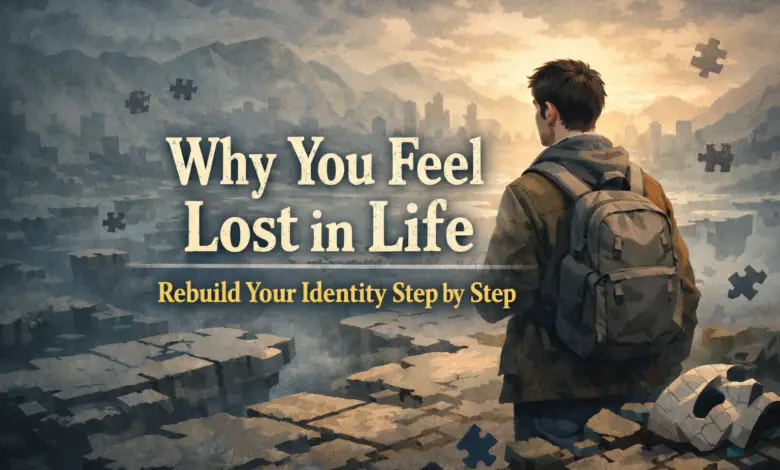
There is a phase in life that is very difficult to explain to anyone, because from the outside, everything may look normal. You are working, you are managing responsibilities, you are talking to people, and you are doing what is expected from you. But inside, something feels disconnected. It is not loud. It is not dramatic. It is quiet, but constant.
Thank you for reading this post, don't forget to subscribe!You wake up, and your day starts, but there is no real sense of direction. You move from one task to another, but there is no deep connection with what you are doing. You try to stay productive, you try to stay engaged, but even in that engagement, there is a strange emptiness that does not leave you.
And slowly, a question starts forming inside you:
“Why do I feel lost in life even when I am doing everything?”
“Why does everything feel unclear even when nothing is wrong?”
I have felt this very deeply, my love. There was a time when I was doing a lot, handling work, responsibilities, and trying to move forward in life, but internally, I felt like I was not going anywhere. It felt like I was walking, but without a direction. I was doing things, but without a clear connection to them.
It was not sadness.
It was not even confusion in the beginning.
👉 It was disconnection from myself.
And that is something most people don’t understand easily.
Feeling Lost and Confused (The Inner Disconnection You Can’t Explain)
When people say they feel lost, they usually think the problem is external. They believe they need a better plan, a better goal, or a better opportunity. So they try to fix it from the outside.
They start:
- setting new goals
- planning new routines
- trying new things
- keeping themselves busy
But the feeling does not go away.
Because the issue is not outside.
👉 The issue is internal alignment.
You are doing things, but you are not connected to them.
You are moving forward, but you don’t know why.
You are achieving things, but you don’t feel fulfilled.
This creates a silent state of confusion:
👉 feeling lost and confused
And the most difficult part is, you cannot explain this to others easily. Because from their perspective, everything seems fine.
But inside, something feels off.
Identity Crisis: When You Don’t Recognize Yourself Anymore
At some point, the confusion becomes deeper.
You start questioning not just your direction, but yourself.
“What do I really want?”
“Why does nothing feel right?”
“Who am I becoming?”
This is where the situation shifts from confusion to something deeper:
👉 identity crisis
But this is not as negative as it sounds.
It simply means that the identity you were living with is no longer working for you.
Your old beliefs, your old patterns, your old way of seeing yourself — they don’t feel aligned anymore. But at the same time, your new identity is not clear yet.
So you feel stuck in between.
👉 Not who you were
👉 Not yet who you want to be
And this space feels uncomfortable.
Read Also: overthinking-emotional-attachment-mental-chaos
My Personal Experience
I remember a phase very clearly where I started feeling this disconnection strongly. I was working, managing tasks, handling responsibilities, and from the outside, everything looked normal. But inside, I was constantly questioning myself.
There were moments where I would stop and think:
“Why does this not feel meaningful?”
“Why am I doing all this if I don’t feel connected to it?”
And the more I tried to answer these questions logically, the more confused I became.
Because the answers were not logical.
👉 They were identity-based.
I was trying to continue with a version of myself that I had outgrown, but I had not yet built a new version.
And that gap created the feeling of being lost.
Why You Feel Lost in Life Even When You Are Doing Everything Right
This is the most confusing part of this experience.
You can be doing everything “correctly” and still feel lost.
You can:
- follow discipline
- stay consistent
- work hard
- meet expectations
And still feel disconnected.
Because being busy is not the same as being aligned.
👉 Activity does not equal clarity.
👉 Movement does not equal direction.
This is something I realized slowly. I thought if I stayed busy, if I kept working, if I kept pushing forward, clarity would come automatically.
But it didn’t.
Because I was moving without alignment.
And when your actions are not aligned with your identity, everything starts to feel heavy.
The Hidden Truth: You Are Not Lost, You Are Transitioning
At some point, I stopped seeing this feeling as a problem.
And I started seeing it as a phase.
A transition.
Because when you feel lost, it usually means one thing:
👉 Your old identity is breaking.
But your new identity is not yet clear.
And this space in between feels uncomfortable.
Because there is no stability.
No clear direction.
No fixed sense of self.
But this is not failure.
👉 This is growth in progress.
Read Also: focus-not-silence-stop-following-every-thought
Why Your Mind Feels Confused During Identity Shift
When your identity is unclear, your mind tries to create clarity.
But because there is no clear direction yet, it keeps asking questions.
- “What should I do?”
- “Where am I going?”
- “Is this right for me?”
And these questions repeat.
Not because you are confused.
👉 But because your identity is restructuring itself.
And restructuring always feels unstable in the beginning.
Emotional Layer of Feeling Lost (What You Actually Feel)
If you go deeper into this experience, you will notice that feeling lost is not just about confusion.
It includes:
- lack of clarity
- lack of motivation
- emotional heaviness
- internal disconnection
- silent restlessness
You may feel like:
👉 nothing excites you the same way
👉 nothing feels fully right
👉 everything feels temporary
This is not because life is empty.
👉 It is because your identity is not aligned yet.
🌱 Grounding Line
“I am not lost in life.
I am in the process of becoming someone I have not fully understood yet.”
Why You Feel Lost in Life Again and Again (Hidden Pattern Most People Miss)
One of the most confusing parts of this experience is not just feeling lost once.
It is feeling lost repeatedly.
You may find direction for some time. You may feel clear for a few weeks or months. Things start making sense again. You feel like you are moving forward.
And then suddenly, the same feeling returns.
👉 confusion
👉 disconnection
👉 lack of clarity
And you ask yourself:
“Why does this keep happening?”
“Why do I feel lost in life again and again?”
I have experienced this cycle personally. There were phases where I felt clear and focused, and I believed that I had finally figured things out. But after some time, that clarity would fade. The same questions would come back. The same internal confusion would return.
At first, it felt frustrating.
It felt like I was going backward.
But slowly, I started understanding something deeper.
👉 It was not repetition.
👉 It was layered growth.
Every time I felt lost, it was not the same level of confusion. It was a deeper level of questioning. A deeper level of identity shift.
And that is something most people don’t see.
Read Also: repetitive-thoughts-stop-thought-loop
Identity Crisis and Past Conditioning (The Root You Don’t See)
Your identity is not something you consciously created from the beginning.
It was built slowly.
Through:
- family expectations
- social environment
- education system
- comparison with others
- past experiences
You learned who you are by observing what is accepted, what is appreciated, and what is expected.
Without realizing it, you built an identity that helped you fit into your environment.
But here is the problem.
👉 That identity was not fully chosen by you.
It was shaped by your surroundings.
And at some point in life, this identity starts feeling misaligned.
You may not notice it immediately.
But internally, something starts shifting.
You begin to feel:
- this is not fully me
- this does not feel natural anymore
- something feels forced
And that is where identity crisis begins.
How Conditioning Shapes Your Identity Without You Realizing
When you grow up, you absorb patterns.
- how to behave
- how to speak
- what to pursue
- what success looks like
These patterns become part of your identity.
You don’t question them.
You live them.
But as your awareness increases, you start seeing a difference between:
👉 who you are
👉 and who you were shaped to be
And this gap creates confusion.
Because now you don’t fully relate to your old identity.
But you don’t yet have a clear new one.
Feeling Lost and Confused Because You Are Outgrowing Your Old Self
This is a very important shift in understanding.
You are not lost because you failed.
You are not lost because you don’t know what to do.
👉 You are lost because you are outgrowing your old identity
This is why things that once felt right start feeling empty.
This is why goals that once excited you start losing meaning.
This is why routines that once worked feel heavy.
Because they were built for a version of you that is no longer fully aligned.
I noticed this clearly in my own life. There were things I used to pursue with full energy at one point. But later, those same things started feeling forced. Not because they were wrong, but because I had changed internally.
And I was still trying to live from an older version of myself.
That is where the friction came from.
Read Also: you-are-not-your-thoughts
Why External Success Does Not Remove the Feeling of Being Lost
Many people believe that feeling lost will go away once they achieve something.
- better income
- better position
- better lifestyle
- more recognition
But this is not always true.
Because external success does not automatically create internal clarity.
You can achieve things and still feel disconnected.
Because:
👉 success without identity alignment feels empty
This is one of the biggest realizations I had. I saw that progress alone does not create fulfillment. You can move forward externally while still feeling stuck internally.
And that creates a very silent conflict.
👉 you are moving ahead
👉 but you don’t feel connected
And that is why the feeling of being lost remains.
Emotional Layer: Why This Phase Feels So Heavy
When your identity is shifting, your emotional state also changes.
You may feel:
- uncertainty
- lack of motivation
- emotional heaviness
- restlessness
- disconnection
This is not because something is wrong.
👉 It is because your internal system is reorganizing itself
You are letting go of one identity.
And you have not yet stabilized into another.
This in-between space feels unstable.
And instability feels uncomfortable.
My Personal Realization
I remember a phase where I started questioning almost everything I was doing. Not in a negative way, but in a deeper way. Things that used to feel clear suddenly felt uncertain. Decisions that used to feel simple started feeling complex.
At first, I thought I was overthinking.
But later, I realized something important.
👉 I was not overthinking.
👉 I was seeing deeper than before
And once you start seeing deeper, you cannot go back to living on surface-level clarity.
That is when real change begins.
Read Also: control-and-ego-pattern-why-you-try-to-control-everything
Why Your Mind Feels Unstable During Identity Shift
When your identity is stable, your mind feels stable.
Because decisions are easier.
Direction is clearer.
But when your identity is changing, your mind becomes active.
It starts asking:
- “What is right for me now?”
- “What should I continue?”
- “What should I leave?”
This creates mental activity.
And that activity feels like confusion.
But it is not confusion.
👉 It is internal restructuring
The Second Breakthrough
At this stage, something becomes very clear.
You are not stuck.
You are not failing.
And you are not going backward.
👉 You are evolving.
And evolution always feels uncomfortable.
Because it breaks what is familiar.
And creates something new.
🌱 Grounding Line
“I am not lost again.
I am just reaching a deeper version of myself.”
📚 REFERENCES (WITH URL)
🧠 Psychology & Identity
- American Psychological Association
👉 https://www.apa.org/topics/identity
(Identity formation, self-concept, personal development) - National Institute of Mental Health
👉 https://www.nimh.nih.gov/health/topics/stress
(Stress, confusion, emotional instability) - Mayo Clinic
👉 https://www.mayoclinic.org/healthy-lifestyle/adult-health/in-depth/stress-management/art-20044456
(Stress, emotional balance, mental clarity)
🧠 Personal Growth & Identity Building
- Atomic Habits
👉 https://jamesclear.com/atomic-habits
(Identity-based habits and behavior change) - Man’s Search for Meaning
👉 https://en.wikipedia.org/wiki/Man%27s_Search_for_Meaning
(Purpose, meaning, and psychological survival)
🧘♂️ Awareness & Spiritual Layer
- Bhagavad Gita
👉 https://www.holy-bhagavad-gita.org
(Self, identity, detachment, awareness) - The Power of Now
👉 https://en.wikipedia.org/wiki/The_Power_of_Now
(Present awareness and identity detachment)