Covert Narcissist Coworker: Subtle Workplace Manipulation
Why Work Feels Draining but You Can’t Explain It

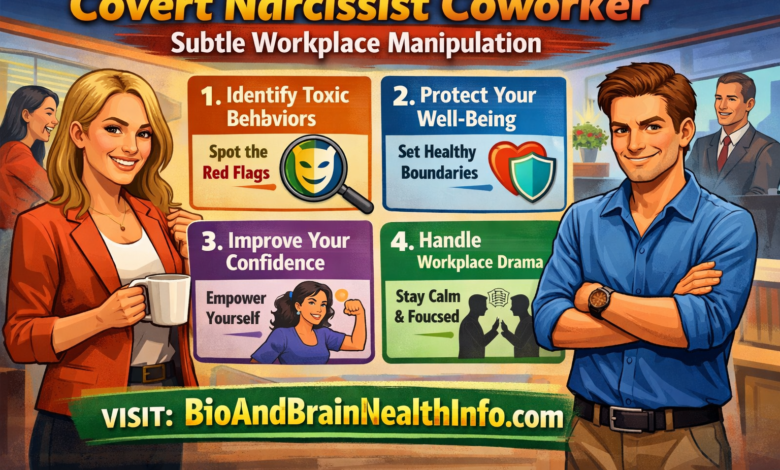
A covert narcissist coworker often creates workplace covert narcissism through passive aggressive coworker behavior, professional gaslighting, and subtle power dynamics at work that leave you drained without clear proof.
“Some environments don’t shout.
They erode — quietly, daily, without witnesses.”
What makes this difficult is that the impact often lingers even after distance is created.
Even after leaving, the nervous system can stay on alert because it learned unpredictability as normal. Regulation returns through consistency, not force.
Covert Narcissist Coworker
Working with a covert narcissist coworker can leave you feeling persistently drained, doubting yourself in ways you cannot clearly explain.
In environments shaped by workplace covert narcissism, the harm rarely looks dramatic; it appears as a passive aggressive coworker, subtle professional gaslighting, and quiet power dynamics at work that slowly distort confidence.
The core fear often becomes internal: Am I losing my judgment? Am I the problem?
What is commonly misunderstood is the difference between trauma responses and identity. This confusion does not mean something is wrong with you. It means your system adapted to prolonged ambiguity and emotional pressure.
This article will help you understand what’s happening — without labels, blame, or self-attack.
REASON FOR THIS BLOG
This article exists to clarify why persistent self-doubt can develop in certain work environments.
Its purpose is to separate trauma-based reactions from identity, without diagnosis or judgment.
INNER SEARCH MIRROR
-
Why does work exhaust me even when I’m doing everything “right”?
-
Why do I replay conversations after work ends?
-
Why does my confidence drop around one specific coworker?
-
Why do I feel watched, corrected, or subtly undermined?
-
Why do small comments affect me more than they should?
-
Why does clarity disappear in meetings but return later?
If these questions feel familiar, you are not alone — and you are not imagining the pattern.
Please Explore This Blog trauma-bonding-narcissistic-mother
1 — PSYCHOLOGICAL EXPLANATION – Covert Narcissist Coworker
A covert narcissist coworker rarely creates obvious conflict. Instead, workplace covert narcissism operates through inconsistency, indirect criticism, and role confusion.
When paired with a passive aggressive coworker, subtle professional gaslighting, and unclear power dynamics at work, the mind begins adapting for safety rather than clarity.
This is not about intent or moral judgment; it is about conditioning.
Repeated exposure to mixed signals teaches the brain to scan constantly for mistakes, tone shifts, or social consequences.
Over time, self-monitoring replaces self-trust.
Personal note: I’ve seen how capable people start doubting themselves not because they lack skill, but because their environment quietly trained vigilance instead of confidence.
2 — NERVOUS SYSTEM EXPLANATION -Covert Narcissist Coworker
Around a covert narcissist coworker, workplace covert narcissism activates biological stress patterns long before logic engages.
A passive aggressive coworker, repeated professional gaslighting, and unstable power dynamics at work signal unpredictability to the nervous system.
The body responds first: fight (defensiveness), flight (avoidance), freeze (mental blankness), or fawn (over-appeasing).
These reactions occur automatically, not by choice. Thinking clarity often returns only after distance is restored.
Common warning signs include:
-
Sudden tension before interactions
-
Overthinking neutral messages
-
Difficulty speaking in meetings
-
Emotional fatigue after work
-
Delayed anger or clarity later
Personal note: Biology explains why reactions feel instant — and why self-judgment usually arrives afterward.
3 — CORE DISTINCTION -Identity vs Survival Responses
This distinction anchors everything.
Survival responses are protective adaptations. Identity is who you are when safety is present.
Survival looks like hesitation, over-explaining, emotional shutdown, or hyper-awareness.
These are not character flaws; they are short-term protections learned in prolonged uncertainty.
Identity, by contrast, is stable: your values, conscience, competence, and capacity to relate with integrity.
When survival runs the system, identity becomes harder to access — not erased. Confusing the two leads to self-attack. Separating them restores orientation.
You are not your reactions.
You are the person who learned how to endure an environment that required constant adjustment.
4 — TRAUMA VS NARCISSISM – Covert Narcissist Coworker
Fear often arises when working with a covert narcissist coworker because workplace covert narcissism can resemble trauma reactions.
A passive aggressive coworker, subtle professional gaslighting, and unstable power dynamics at work blur internal reference points.
The relief comes from comparing motivation, not behavior.
Trauma-based responses
-
Capacity for remorse
-
Willingness to reflect
-
Accountability when safety returns
Narcissistic patterns
-
Absence of remorse
-
Deflection instead of reflection
-
Avoidance of accountability
This distinction is not about labeling anyone. It is about preventing self-labeling.
Personal note: I’ve seen many people fear becoming what hurt them—when their remorse alone already answered that question.
5 — GROWTH DIRECTION – Covert Narcissist Coworker
After exposure to a covert narcissist coworker, growth does not require urgency.
In workplace covert narcissism, healing often begins when the system no longer has to adapt to a passive aggressive coworker, ongoing professional gaslighting, or distorted power dynamics at work.
Growth here means orientation, not fixing. Signs of healing include slower reactions, clearer internal boundaries, and less need to explain yourself.
Choosing peace looks like allowing pauses, limiting emotional engagement, and trusting delayed clarity.
There is no rush to confront, decide, or define outcomes.
Personal note: I’ve noticed recovery often starts the moment someone stops asking how to win—and starts asking how to remain steady.
Please Explore This Blog inner-child-wounds-narcissistic-mother
HEALING COMPASS / ORIENTATION TABLE
A Simple Orientation Map for Steady Recovery
| Stage | Inner Experience | Grounding Reminder |
|---|---|---|
| Awareness | “Something feels off.” | Confusion is information, not failure. |
| Stabilization | Emotional reactions slow. | Safety comes before clarity. |
| Understanding | Patterns make sense. | Insight does not require confrontation. |
| Boundary Formation | Energy is protected quietly. | Distance can be internal. |
| Rebuilding | Confidence returns naturally. | Peace grows through consistency. |
This map is not a timeline. People move back and forth between stages. What matters is direction, not speed.
Each stage restores trust without pressure, allowing identity to re-emerge once the system no longer needs to stay on alert.
Core Breakthrough Insights
1: Why Self-Doubt Grows Quietly at Work
Working with a covert narcissist coworker often creates confusion rather than visible conflict. In environments shaped by workplace covert narcissism, harm accumulates through subtle signals instead of direct attacks.
A passive aggressive coworker may communicate disapproval indirectly, while professional gaslighting slowly disrupts trust in your own perception.
Over time, distorted power dynamics at work teach the mind to self-correct excessively.
This does not happen because you are weak or unaware. It happens because the brain prioritizes belonging and safety.
When clarity feels risky, self-doubt becomes a protective adaptation. Understanding this removes the impulse to self-blame and replaces it with orientation.
The issue is not your judgment — it is the environment that trained vigilance over confidence.
2: Why Exhaustion Persists Even Without Overt Conflict
A covert narcissist coworker rarely appears openly hostile, which is why workplace covert narcissism is so draining.
The absence of clear confrontation forces constant interpretation. With a passive aggressive coworker, emotional meaning is hidden rather than stated.
Professional gaslighting adds further strain by subtly questioning memory or intent. These patterns create unstable power dynamics at work, where effort never leads to resolution.
Exhaustion emerges not from workload alone, but from sustained ambiguity. The nervous system remains active because it cannot predict safety.
This explains why fatigue continues even on “quiet” days. Naming this mechanism restores perspective.
The tiredness is not personal failure — it is the cost of prolonged emotional monitoring in an unpredictable environment.
3: Why Clarity Returns After Distance, Not During Interaction
Around a covert narcissist coworker, mental clarity often disappears mid-interaction. In workplace covert narcissism, conversations are structured to keep meaning indirect.
A passive aggressive coworker communicates through implication, while professional gaslighting destabilizes internal reference points.
These patterns reinforce unequal power dynamics at work, where responses are evaluated but rarely acknowledged.
Clarity returning later is not avoidance; it is neurological timing. The thinking brain comes back online only when the body senses safety.
This delay is a biological sequence, not a character flaw. Recognizing this sequence helps separate identity from reaction.
You are not “slow” or “confused.” Your system simply waits until threat subsides before restoring insight.
4: Why Fear of “Becoming the Problem” Appears
One of the deepest fears when dealing with a covert narcissist coworker is internal: What if I’m the same? In workplace covert narcissism, prolonged exposure can distort self-reflection.
A passive aggressive coworker normalizes indirectness, while professional gaslighting encourages self-questioning.
Within skewed power dynamics at work, responsibility often shifts downward.
The key distinction lies in motivation. Trauma responses involve reflection, remorse, and concern for impact. Narcissistic patterns avoid accountability.
The presence of self-examination itself is evidence of difference. This understanding stops self-labeling and restores moral orientation.
Fear here is not proof of similarity — it is proof of conscience under prolonged pressure.
5: Why Recovery Feels Subtle, Not Dramatic
Recovery after exposure to a covert narcissist coworker rarely looks sudden.
In workplace covert narcissism, healing unfolds quietly as the system no longer adapts to a passive aggressive coworker, ongoing professional gaslighting, or destabilizing power dynamics at work.
Progress shows up as fewer explanations, slower reactions, and less emotional residue after interactions.
This subtlety can be misread as stagnation. In reality, it reflects regulation. The nervous system learns predictability again through consistency, not confrontation.
Identity re-emerges gradually once vigilance is no longer required. Measuring healing by calm rather than action restores agency.
Peace is not achieved by force — it becomes possible when safety no longer has to be negotiated.
Closing Note
Clarity is not something you force yourself into.
It returns naturally when your system no longer has to stay on guard.
Please Explore This Blog covert-narcissism-in-relationships
Covert Narcissist Coworker — Medical / Ethical Positioning
When a covert narcissist coworker is involved, the ethical task is not diagnosis but orientation. Professional gaslighting creates moral confusion by distorting meaning rather than causing visible harm.
Medicine and ethics both prioritize non-maleficence: do no additional harm. This lens explains why clarity must come before action.
The mind interprets threat by assessing consistency, fairness, and predictability—when these collapse, confusion is a rational signal, not weakness.
| Ethical Signal | What It Indicates |
|---|---|
| Inconsistency | Meaning distortion |
| Ambiguity | Safety uncertainty |
| Self-doubt | Ethical dissonance |
| Withdrawal | Protective restraint |
Personal note: Ethical clarity often arrives quietly, not dramatically.
Covert Narcissist Coworker — Psychological Layer
With a covert narcissist coworker, the psychological layer focuses on interpretation, not behavior. Workplace covert narcissism interferes with meaning-making by introducing mixed emotional messages.
The mind attempts to resolve this by increasing self-analysis, not because of insecurity, but because coherence matters for psychological safety.
Confusion persists when cause-and-effect feel unreliable.
Understanding this reframes rumination as an effort to restore internal logic rather than a flaw in confidence.
| Mental Process | Psychological Function |
|---|---|
| Pattern scanning | Threat detection |
| Self-review | Meaning repair |
| Doubt | Conflict resolution |
| Delay | Accuracy protection |
Personal note: Minds seek clarity the same way bodies seek balance.
Covert Narcissist Coworker — Nervous System Layer
Around a covert narcissist coworker, power dynamics at work are often sensed somatically before they are understood cognitively.
The body reacts automatically to subtle dominance cues—tone shifts, pauses, or exclusion—long before conscious thought forms.
These reactions are not emotional overreactions; they are safety reflexes designed to preserve stability.
Automatic protection explains why the body tightens even when the mind lacks words.
| Body Response | Protective Purpose |
|---|---|
| Muscle tension | Readiness |
| Breath changes | Alerting |
| Fatigue | Energy conservation |
| Numbness | Overload buffering |
Personal note: The body protects first, explains later.
Covert Narcissist Coworker — Mental Health Layer
Exposure to a covert narcissist coworker combined with a passive aggressive coworker pattern can quietly affect mental health without creating obvious crisis.
Prolonged stress reshapes attention, drains energy, and erodes self-trust by keeping the system semi-activated. This is not illness; it is depletion.
Mental health impact here is cumulative, not acute, which is why it’s often overlooked or self-dismissed.
| Long-Term Effect | Internal Experience |
|---|---|
| Reduced clarity | Fogged judgment |
| Lower energy | Emotional fatigue |
| Self-questioning | Trust erosion |
| Withdrawal | Load reduction |
Personal note: Subtle harm often leaves the deepest imprint.
Covert Narcissist Coworker — Identity Layer (Inner Continuity & Meaning)
Even with a covert narcissist coworker, identity remains intact beneath adaptation. Professional gaslighting may obscure access to values, but it cannot remove them.
Identity is not how quickly you respond or how confident you appear under pressure; it is the continuity of conscience, preference, and moral orientation that returns in safe conditions.
Survival responses may mask identity, never replace it.
| Identity Marker | What Persists |
|---|---|
| Values | Ethical compass |
| Conscience | Impact awareness |
| Preference | Inner truth |
| Meaning | Directional sense |
Personal note: What survives pressure reveals who you are.
Covert Narcissist Coworker — Reflective Support Layer (Including AI)
When processing a covert narcissist coworker experience, workplace covert narcissism benefits from reflective tools that mirror rather than direct.
Journaling, conversation, or AI support function best when they help organize thoughts without telling the user what to feel or decide.
This layer restores perspective by externalizing confusion safely, allowing insight to emerge without pressure or persuasion.
| Support Tool | Reflective Role |
|---|---|
| Journaling | Pattern visibility |
| Conversation | Reality checking |
| AI reflection | Neutral mirroring |
| Silence | Integration space |
Personal note: Insight deepens when no one rushes it.
PERSONAL NOTE — Covert Narcissist Coworker
There was a time when working around a covert narcissist coworker quietly changed how I related to myself.
In a setting shaped by workplace covert narcissism, I noticed how easily a passive aggressive coworker dynamic and subtle professional gaslighting could distort inner reference points.
What stayed with me was not anger, but confusion — the kind that makes you question your own steadiness.
The most important realization was this: confusion did not mean weakness. It meant my system was trying to orient itself inside unclear power dynamics at work.
That distinction restored trust. Authority, for me, did not come from confronting anything externally — it came from stopping the internal argument against my own perceptions.
Please Explore This Blog covert-narcissism-examples-everyday-life
COSMIC / PHILOSOPHICAL TAKEAWAY — Covert Narcissist Coworker
“Consciousness does not collapse under pressure; it contracts until safety returns.”
A covert narcissist coworker experience can feel deeply personal, yet workplace covert narcissism is not a cosmic judgment on your worth.
A passive aggressive coworker, layered professional gaslighting, and distorted power dynamics at work do not define destiny — they test orientation.
From a wider view, confusion is not failure; it is the mind pausing before choosing meaning. Growth is not dramatic awakening, but gradual alignment.
When safety increases, perspective naturally expands again. Nothing essential is lost. What adapts can also soften. What withdraws can return.
FAQ SECTION — CLARITY & REASSURANCE
1. Why does a covert narcissist coworker affect me so deeply?
Because subtle harm bypasses logic and works through ambiguity, not intensity.
2. Does this mean I am emotionally weak?
No. Sensitivity to inconsistency reflects awareness, not fragility.
3. Why can’t I explain clearly what’s wrong at work?
Mixed signals disrupt meaning-making before words form.
4. Is this the same as being abused?
Some patterns overlap, but this article explains experiences, not labels.
5. Why do I feel better away from work?
Distance restores nervous system predictability.
6. Am I becoming narcissistic myself?
Self-reflection and remorse indicate the opposite.
7. Should I confront the coworker?
Clarity does not require confrontation to exist.
8. How long does recovery take?
There is no fixed timeline; regulation unfolds with safety.
9. Why do small comments stay with me?
Subtle threats linger longer than obvious ones.
Please Explore This Blog covert-narcissism-dsm-diagnosis-clarity
FINAL CLOSING — Covert Narcissist Coworker
If a covert narcissist coworker left you unsettled, nothing is wrong with you.
In environments marked by workplace covert narcissism, the presence of a passive aggressive coworker, ongoing professional gaslighting, and unclear power dynamics at work can quietly train vigilance.
What adapted did so to protect you.
You do not need to force clarity, strength, or forgiveness. With safety and understanding, what tightened can ease again.
Let insight arrive at its own pace.
Let self-trust rebuild through consistency, not pressure.
This article is not an endpoint — only a place to rest your understanding for a moment before moving forward.
🌿 Final Blog Footer — Bio & Brain Health Info
Written by Lex, founder of Bio & Brain Health Info — exploring the intersections of psychology, spirituality, and emotional recovery through calm, trauma-aware understanding.
✨ Insight & Reflection
Healing does not begin when answers arrive — it begins when self-attack stops.
Clarity grows in spaces where safety is restored.
🧠 Learn
Narcissism • Emotional Healing • Spiritual Psychology
🌍 A Moment for You
💡 Pause for two minutes. Let your body settle before moving on.
🧭 If This Article Helped, Your Next Questions Might Be:
These questions are natural continuations — not obligations.
✨ Cosmic Family Invitation
You are not here by accident. If these words reached you, clarity was already beginning.
We rise together — different souls, one journey. 🕊️
📩 Connect with us
info@bioandbrainhealthinfo.com
Telegram: @bioandbrainhealthinfo
WhatsApp Channel: Punehealth
Lex | Bio & Brain Health Info
Cosmic Family — Different Souls, One Journey.
REFERENCES & CITATIONS
(Trusted Sources | Transparency & Credibility)
-
American Psychological Association (APA)
Workplace stress, gaslighting, and psychological safety
https://www.apa.org/topics/workplace-stress -
National Institute for Occupational Safety and Health (NIOSH)
Psychosocial stressors and mental health at work
https://www.cdc.gov/niosh/topics/stress -
Harvard Business Review
Power dynamics, toxic leadership, and emotional exhaustion
https://hbr.org/2015/06/toxic-workers -
Mind (UK Mental Health Charity)
How work environments affect mental health
https://www.mind.org.uk/workplace/mental-health-at-work -
Cleveland Clinic
Trauma responses and nervous system stress
https://health.clevelandclinic.org/trauma-response -
Verywell Mind
Gaslighting and psychological manipulation explained
https://www.verywellmind.com/what-is-gaslighting-4163624 -
National Alliance on Mental Illness (NAMI)
Chronic stress and emotional regulation
https://www.nami.org/About-Mental-Illness -
World Health Organization (WHO)
Mental health in the workplace
https://www.who.int/teams/mental-health-and-substance-use/workplace-mental-health -
Psychology Today
Passive-aggressive behavior in professional settings
https://www.psychologytoday.com/us/basics/passive-aggression -
Stanford Center on Stress and Health
How prolonged stress affects cognition and clarity
https://stresshealth.stanford.edu