Mindfulness vs Conscious Living: Key Differences Explained
Why Being Present Is Not Always the Same as Living Consciously

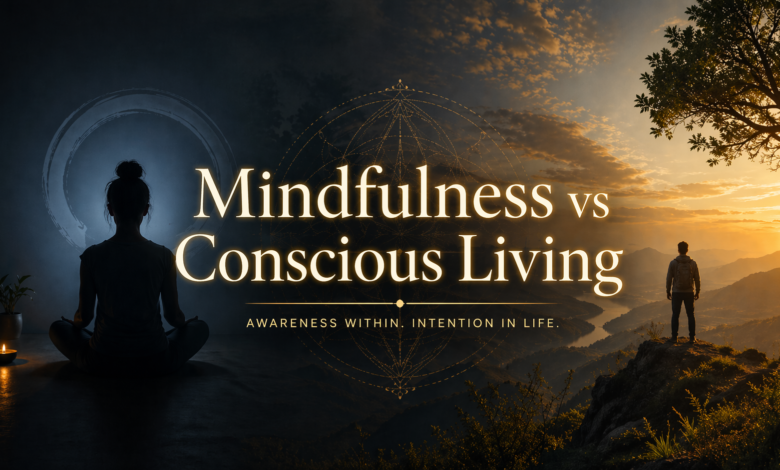
Most people think mindfulness and conscious living mean the same thing, but that confusion keeps many people stuck.
Thank you for reading this post, don't forget to subscribe!You can practice mindfulness for a few minutes, watch your breath, and still remain trapped in emotional reactivity, unconscious habits, attachment, and daily suffering. That is why understanding mindfulness vs conscious living matters.
This blog will also clarify mindfulness vs awareness, explain the deeper conscious living meaning, and show why mindful living vs conscious living is not just a language difference but a life difference.
👉 If you have ever felt calm in one moment but lost, reactive, or disconnected in the rest of your day, this article will help you understand why.
More importantly, it will show how real awareness in daily life can help you think more clearly, respond more consciously, and live with greater emotional balance, inner freedom, and practical spiritual strength.
Why Being Present Is Not Always the Same as Living Consciously
Many people start inner healing by learning mindfulness. They practice breathing, observe thoughts, and try to stay present. This helps for a while. It creates some calm, some space, and some relief from mental noise.
But then daily life begins again.
The same emotional pain returns. The same triggers hurt. The same attachment creates suffering. The same expectations disturb peace. At that point, many people quietly wonder, If mindfulness helps, why do I still feel stuck?
That is exactly why understanding mindfulness vs conscious living matters.
This blog is important because these two ideas are often treated as if they are the same. They are connected, but they are not equal.
👉 Mindfulness is a useful practice. Conscious living is a much larger way of seeing and living life. When people confuse the two, they often expect a small awareness tool to solve a whole unconscious life.
I felt a deeper shift in my own life when I stopped using awareness only to calm myself and started seeing how expectation, attachment, and my interpretation of life were shaping my suffering.
This article will clarify mindfulness vs awareness, explain the deeper conscious living meaning, show the real difference in mindful living vs conscious living, and help readers build real awareness in daily life instead of only momentary peace.
- For deeper foundation, read What Is Conscious Living? Meaning Explained
Mindfulness vs Conscious Living: What Is the Real Difference?
In simple words, mindfulness helps you notice the present moment.
Conscious living helps you notice how you are living your whole life.
That is the core difference.
👉 Mindfulness teaches attention. It helps you observe thoughts, emotions, body sensations, and stress as they happen. It creates a pause between inner experience and automatic reaction.
Conscious living goes further. It asks deeper questions.
- How do you choose?
- How do you react in relationships?
- How do you handle disappointment?
- What patterns shape your suffering?
- What are you attached to?
- Where are you living from fear, habit, ego, or expectation?
So while mindfulness may help you notice the moment, conscious living helps you understand the pattern behind the moment.
Quick Comparison Table
| Area | Mindfulness | Conscious Living |
|---|---|---|
| Main focus | Present moment attention | Whole-life awareness |
| Helps with | Calm, observation, pause | Patterns, choices, suffering, direction |
| Depth | Moment-based | Life-based |
| Main question | What am I feeling now? | How am I living overall? |
| Use in daily life | Useful during stress or practice | Useful in relationships, habits, work, emotion, and identity |
| Limitation | Can stay temporary | Requires deeper honesty and change |
Mindfulness vs Awareness: Where Most People Get Confused
A lot of confusion starts here.
People often think mindfulness and awareness are exactly the same. But mindfulness is better understood as one practice inside the larger field of awareness.
What mindfulness usually gives
Mindfulness can help a person:
- slow down mental speed
- notice thoughts without instantly believing them
- observe emotions before reacting
- return attention to the present moment
- create a small inner pause
This is why mindfulness is helpful. It reduces automatic behavior. It gives breathing room to the mind and nervous system.
What awareness includes beyond mindfulness
Awareness is broader.
It includes:
- noticing patterns across days and years
- seeing how attachment shapes suffering
- recognizing emotional habits
- understanding why the same triggers keep repeating
- observing your role in your pain, not just the pain itself
This is why mindfulness vs awareness matters. Mindfulness may help you observe what is happening now. Awareness helps you understand what keeps happening again and again.
A simple way to remember it
Mindfulness is often moment awareness.
Awareness, in a deeper sense, becomes life awareness.
That does not make mindfulness weak. It simply means mindfulness is the doorway, not always the full house.
Conscious Living Meaning in Real Daily Life
The deeper conscious living meaning is often misunderstood.
Many people think conscious living means becoming overly spiritual, losing interest in life, or becoming detached from everything. But that is not true.
👉 You yourself pointed clearly to this misunderstanding: conscious living is not the end of life, and it does not mean a person becomes inactive, empty, or emotionless.
It means living with greater balance and less unnecessary suffering.
Conscious living means becoming more aware of:
- how you think
- how you react
- what you hold onto
- what hurts you repeatedly
- what creates emotional heaviness
- what keeps you unconscious in daily life
It is not about becoming perfect. It is about becoming more honest.
Conscious living is seen in ordinary life
Real consciousness is not tested only in meditation.
It is tested in:
- family pain
- work stress
- relationship conflict
- unmet expectations
- emotional triggers
- disappointment
- forgiveness
- self-responsibility
That is why awareness in daily life matters so much.
👉 A person may look calm in silence but become completely unconscious in conflict.
👉 A person may know how to breathe deeply but still remain attached to approval, control, or old pain.
Conscious living asks whether awareness is entering real life, not only quiet moments.
A useful metaphor
Think of it like this:
Mindfulness is like lighting a lamp in one room.
Conscious living is like learning the full design of the house.
The lamp matters. Without it, you may stay in darkness.
But if you only light one room and never understand the rest of the house, you will still keep stumbling in the same places. That is what happens when people use mindfulness as a tool but never examine the deeper structure of their habits, suffering, and daily choices.
To understand release without emotional coldness, read Emotional Detachment vs Emotional Suppression: Key Difference Explained
Mindful Living vs Conscious Living in Daily Habits and Choices
The difference between mindful living vs conscious living becomes clearer in daily behavior.
A mindful person may remember to pause before reacting.
A consciously living person also asks:
- Why does this situation trigger me so deeply?
- What expectation is hidden under this pain?
- Why do I keep repeating this emotional pattern?
- What attachment is making this harder than it needs to be?
This is where the blog topic becomes practical, not theoretical.
Signs a person is practicing mindfulness but still not living consciously
Sometimes a person is using mindfulness, but deeper patterns are still controlling life.
Common signs
- they feel calm during practice but reactive in daily life
- they can observe thoughts but still believe old emotional stories
- they want peace but remain attached to control
- they understand spiritual ideas but still live from fear
- they notice emotions but do not question the pattern behind them
This is not failure. It simply means more depth is needed.
What conscious living begins to change
When consciousness deepens, a person slowly begins to:
- react less automatically
- understand their suffering more clearly
- see attachment sooner
- reduce inner blame
- make calmer choices
- feel less trapped by temporary emotions
- forgive with more maturity
- live with more balance
This is where inner change starts to become stable.
Why Awareness in Daily Life Changes Emotional Suffering
Emotional suffering does not come only from events.
It also comes from interpretation, resistance, habit, and attachment. A person may suffer not only because something painful happened, but because the mind keeps gripping the event, replaying it, personalizing it, and building identity around it.
This is why awareness in daily life is so valuable.
When awareness enters daily life, you begin to see:
- what is happening
- what you are adding to it
- what you are resisting
- what you are expecting
- what you are afraid to let go of
That kind of awareness changes suffering from the root.
Mindfulness can calm a moment. Conscious living can change your relationship with your whole life.
Three Serious Reader Questions
Before moving to the next part, these questions matter:
1. Are you using mindfulness to understand yourself, or only to feel better for a few minutes?
2. Are you becoming more aware of your patterns, or only more skilled at managing symptoms?
3. Is your awareness entering your relationships, habits, and reactions, or only your quiet moments?
These questions are serious because they reveal whether awareness is becoming real.
Part 1 Closing Insight
The real difference in mindfulness vs conscious living is not just about language. It is about depth.
👉 Mindfulness helps you pause.
👉 Conscious living helps you see.
👉 Mindfulness helps you notice the moment.
Conscious living helps you understand the life you are creating through your habits, reactions, attachments, and choices.
That is why this topic matters. Many people do not need more techniques. They need a bigger understanding of awareness, suffering, and life itself. Once that shift begins, inner peace stops being a temporary experience and starts becoming a wiser way of living.
For daily practical application, read How to Live Consciously Every Day: Practical Guide to Awareness
Why Mindfulness Alone Does Not Always End Emotional Suffering
Many people feel confused after practicing mindfulness for some time. They become more present. They learn to pause. They observe thoughts better than before. Yet the same emotional pain still returns in relationships, family situations, work pressure, and personal disappointment.
This can feel discouraging.
But the problem is often not that mindfulness is weak. The problem is that emotional suffering usually has deeper roots than a few moments of mental noise. It is connected to attachment, fear, conditioning, identity, expectation, and old emotional patterns.
Mindfulness can help you notice these things, but noticing alone does not always dissolve them.
That is why mindfulness vs conscious living matters so much in real life. Mindfulness may help you become aware during a difficult moment. Conscious living helps you understand why similar difficult moments keep repeating across your life.
Mindfulness vs Awareness in Emotional Reactions
When people compare mindfulness vs awareness, they often focus only on calmness. But calmness is not the full goal. Real awareness is not proved by how peaceful you feel in silence. It is proved by what happens when something painful touches your weak points.
A person may be mindful while sitting alone and still become reactive when ignored, criticized, controlled, or disappointed. That is not hypocrisy.
It simply shows that awareness has entered practice, but not yet the deeper emotional system.
Why reactions return so quickly
Emotional reactions usually move faster than conscious thought.
That happens because:
- the nervous system reads threat before logic fully catches up
- old pain gets activated by present situations
- the mind protects identity, attachment, or control
- the body remembers patterns that the conscious mind has not fully healed
This is why a person can understand a lot and still react automatically.
What mindfulness helps with here
Mindfulness can help you:
- notice the first signs of activation
- slow the speed of reaction
- separate thought from fact
- create a pause before speaking or acting
- feel emotion without instantly becoming it
These are powerful benefits.
What deeper awareness adds
Deeper awareness asks:
- why does this trigger hurt me this much?
- what am I afraid of losing here?
- what expectation is hidden in this reaction?
- what old wound is this moment touching?
- why do I keep personalizing what may not be fully personal?
That is the real difference.
Mindfulness notices the reaction. Awareness understands the pattern. Conscious living then begins to change how that pattern shapes daily life.
Conscious Living Meaning in Relationships, Pressure, and Daily Choices
The deeper conscious living meaning becomes clearer when life gets uncomfortable. It is easy to feel aware in peaceful conditions. It is much harder to remain conscious when emotions are strong.
That is why conscious living is not only a spiritual idea. It is a practical way of moving through ordinary life.
Conscious living in relationships
In relationships, conscious living means you do not only ask, “Why is this person making me feel this way?”
You also ask:
- what am I expecting from this person emotionally?
- where am I seeking stability outside myself?
- why does distance, silence, or rejection affect me so deeply?
- am I responding to the present moment, or to old emotional memory?
This creates maturity.
Instead of only blaming the other person, you begin to understand your own attachment, fear, and emotional dependence. That does not mean your pain is unreal. It means your awareness becomes honest enough to include your own inner patterns.
Conscious living under stress
At work or under pressure, conscious living means noticing how your mind behaves when uncertainty increases.
You start observing:
- the need to control outcomes
- the habit of overthinking
- the fear of failure
- the pressure to prove yourself
- the emotional exhaustion created by constant inner resistance
This is where awareness in daily life becomes deeply practical. It helps you see that many people are not only stressed by life. They are stressed by the way the mind grips life.
Conscious living in daily choices
Many painful life patterns do not come from one major event. They come from repeated small choices made unconsciously.
For example:
- saying yes when you mean no
- checking messages compulsively for reassurance
- staying in draining conversations too long
- replaying hurt instead of processing it
- choosing temporary emotional relief over long-term peace
A consciously living person slowly begins to notice these patterns earlier.
That is how life starts changing.
Mindful Living vs Conscious Living in Real Daily Life
The phrase mindful living vs conscious living matters because many people think living mindfully is enough by itself. Sometimes it is a good beginning, but conscious living goes further.
Here is a simple comparison.
Real-life difference table
| Situation | Mindful Living | Conscious Living |
|---|---|---|
| Stressful conversation | Pauses and breathes | Also notices the emotional pattern behind the stress |
| Relationship hurt | Observes sadness | Also examines attachment, expectation, and dependency |
| Work pressure | Returns to the present moment | Also questions fear, control, and identity tied to success |
| Daily habits | Tries to stay present | Studies repeated choices and their emotional roots |
| Spiritual growth | Practices awareness exercises | Lives with deeper honesty, responsibility, and detachment |
This is why conscious living is broader. It does not reject mindfulness. It includes it, then takes awareness into the full structure of life.
Signs you are becoming more conscious, not just more mindful
A real shift begins when:
- you pause faster during emotional activation
- you question your interpretation, not only the event
- you see where attachment increases suffering
- you stop making every feeling your identity
- you become more honest about your role in repeated pain
- you seek clarity, not just temporary relief
This is where growth becomes stable.
To explore why attachment increases pain, read Why Attachment Causes Emotional Suffering
Why Awareness in Daily Life Changes the Root of Suffering
Most people think suffering is created only by what happens to them.
But a large part of suffering is created by what the mind continues doing after the event.
For example:
- holding tightly to how life “should” have gone
- resisting what has already happened
- turning temporary pain into permanent identity
- expecting others to remove inner emptiness
- replaying emotional stories until they become truth
This is why awareness in daily life matters more than occasional insight. It lets you catch suffering while it is being built.
A simple breakdown
Event
Something painful happens.
Inner reaction
The mind interprets it through fear, attachment, hurt, ego, or expectation.
Repetition
The story repeats internally.
Identification
The pain starts feeling like identity.
Suffering deepens
Now the person is not only hurt by the event, but by their unconscious relationship with it.
Awareness breaks this chain.
Not always instantly, but steadily.
A Moderate Spiritual View: Conscious Living and the Bigger Picture
You wanted this blog to include spiritual strength without becoming too heavy, and that balance matters.
A gentle Gita-based view can help here.
👉 The teaching is not that you should stop living, stop feeling, or stop caring.
👉 The teaching is that suffering grows when identity becomes tightly attached to outcome, control, and temporary roles.
Conscious living does not remove life. It changes how you relate to life.
This is why a broader view can reduce emotional heaviness.
You begin to see:
- not every pain defines your whole existence
- not every relationship owns your inner peace
- not every failure decides your worth
- not every emotional storm is permanent truth
That wider perspective often creates what I would call positive understanding detachment. Not coldness. Not escape. A calmer way of seeing.
Mindfulness helps you step back from a moment. Conscious living helps you step back from the illusion that every moment should control your whole life.
Three Questions the Reader Should Sit With
These questions matter before moving to Part 3.
1. Are you using mindfulness only to calm pain, or also to understand what keeps creating pain?
2. Are your daily choices becoming more conscious, or are you still living from the same emotional patterns with better language?
3. Are you seeking peace as a feeling, or as a wiser relationship with life, attachment, and reality?
These questions are important because they separate temporary relief from real transformation.
Part 2 Closing Insight
The difference between mindfulness vs conscious living becomes most visible when life becomes difficult. Mindfulness helps you stay present with what you feel.
Conscious living helps you understand why you keep suffering in the same ways and how your patterns, choices, attachments, and interpretations keep shaping that suffering.
That is why this blog is not only about definitions.
It is about depth.
👉 If mindfulness is the practice that opens your eyes, conscious living is the path that teaches you how to walk with those eyes open in relationships, stress, disappointment, daily decisions, and spiritual growth.
How to Move From Mindfulness to Conscious Living in Daily Life
Understanding the difference between mindfulness vs conscious living is important, but real change begins when that understanding becomes daily practice.
Many people stay at the level of insight. They understand the concept, agree with it, and even feel inspired by it, but their actual way of living does not change much.
That is where the deeper work begins.
Conscious living is not built by one powerful realization. It is built by repeated inner honesty. It grows when awareness enters your habits, choices, relationships, speech, expectations, and emotional reactions.
In simple words, mindfulness helps you notice. Conscious living helps you live differently because of what you noticed.
The shift is small at first
You usually do not become conscious in one dramatic moment.
You begin to notice:
- when you are reacting instead of responding
- when expectation is creating emotional pain
- when attachment is turning care into suffering
- when fear is silently controlling a decision
- when your mind is adding extra pain to reality
This is how awareness in daily life starts becoming real. It becomes less about techniques and more about how you move through ordinary situations.
A practical shift table
| From | To |
|---|---|
| only calming the mind | understanding the mind |
| only observing emotion | understanding the pattern behind emotion |
| only staying present | living with awareness in choices |
| only wanting relief | wanting truth and balance |
| only reacting to pain | learning from pain |
That is the movement from mindfulness into conscious living.
Awareness in Daily Life: What This Looks Like Practically
A lot of people understand awareness in theory but struggle to apply it in daily life. So let us make it practical.
In the morning
Instead of starting the day with automatic pressure, conscious living asks:
What is my inner state today?
- rushed
- resistant
- peaceful
- emotionally heavy
- already attached to an outcome
That small check changes the tone of the day. It stops unconscious momentum from taking over.
During emotional triggers
When something hurts, conscious living does not only ask, “How do I calm down?”
It also asks:
- what exactly is hurting here?
- what expectation was hidden inside this pain?
- what fear has this activated?
- am I reacting to this moment only, or to older pain too?
This is where mindfulness vs awareness becomes practical. Mindfulness helps you pause. Awareness helps you interpret more truthfully.
In relationships
Conscious living changes how you relate to people.
Instead of only asking what others are doing, you begin to ask:
- where am I emotionally dependent?
- where am I overgiving from fear?
- where am I making someone else responsible for my inner stability?
- where am I holding on because I fear emptiness?
That kind of reflection creates maturity.
In daily decisions
Small choices reveal consciousness more than big ideas do.
For example:
- Do you keep returning to what drains you?
- Do you choose peace, or only familiar pain?
- Do you pause before speaking from hurt?
- Do you notice when your ego wants to win more than your heart wants truth?
That is conscious living meaning in real life. It is not abstract. It is visible in repeated daily choices.
Mindful Living vs Conscious Living: How to Grow Beyond Temporary Calm
The comparison of mindful living vs conscious living matters most when a person starts asking what actually creates lasting inner change.
Mindful living may help you build beautiful habits:
- breathing
- reflection
- slowing down
- noticing thoughts
- staying present during stress
These are all useful.
But conscious living asks for more than practice. It asks for integration.
What integration means
Integration means your awareness starts affecting:
- how you speak when angry
- how you choose when afraid
- how you love when attached
- how you detach without becoming cold
- how you accept reality without becoming passive
That is the difference between insight and transformation.
A simple way to see it
- Mindful living helps you create better moments.
- Conscious living helps you create a wiser life.
That is why many people still feel incomplete after learning mindfulness alone. The practice helped them pause, but it did not yet teach them how to examine attachment, identity, suffering, and emotional habit.
Conscious Living Meaning in Psychological and Spiritual Terms
The deeper conscious living meaning becomes strongest when psychology and spiritual insight support each other instead of competing.
Psychology helps us understand:
- emotional triggers
- nervous system reactivity
- attachment patterns
- unconscious habits
- repeated behavior loops
- identity wounds
Spiritual understanding helps us see:
- the temporary nature of emotional storms
- the danger of over-identifying with every thought
- the suffering created by attachment
- the value of witness consciousness
- the possibility of inner freedom without escape
Together, these create a more complete path.
Why this balance matters
If a person uses only psychology, they may understand patterns but still remain deeply attached.
If a person uses only spirituality, they may use high language while avoiding emotional truth.
But when both are balanced, healing becomes deeper and more stable.
That is where this blog’s message lives.
It is not asking you to reject mindfulness. It is asking you to see that mindfulness is one part of a larger awakening into conscious living.
A Moderate Gita-Based Insight on Conscious Living
You wanted the Gita to be present in a moderate and useful way, and that fits this topic well.
A gentle reading of the Gita shows that consciousness is not about leaving life. It is about learning how to live without becoming completely trapped by attachment, ego, fear, and outcome.
Action still continues.
Relationships still continue.
Pain and duty still exist.
But the inner relationship to these things begins to change.
What this means practically
You start seeing:
- life is bigger than one emotional moment
- not every pain deserves total identification
- not every loss destroys your deeper self
- not every role is your permanent identity
- not every disappointment is the end of meaning
This creates strength.
Not hardness.
Not numbness.
Not emotional distance.
It creates steadiness.
A simple spiritual correction
One misunderstanding is that conscious living means becoming less interested in life. But real consciousness often makes life more meaningful, not less. You begin to live with more clarity, more balance, and less unnecessary suffering.
That is why conscious living can help forgiveness too.
When your view becomes wider, you stop reducing your whole existence to one role, one relationship, one hurt, or one chapter. You begin to see more calmly. That wider seeing softens emotional heaviness.
A Friendly Daily Practice for Conscious Living
If a reader wants one simple way to begin, this is a strong daily structure.
Daily conscious living practice
1. Morning check-in
Ask:
- what is my emotional state today?
- what am I already attached to?
- what pressure am I carrying?
2. Midday pause
Ask:
- have I been reacting or responding?
- what has disturbed my peace most today?
- what story is my mind repeating?
3. Evening reflection
Ask:
- where was I unconscious today?
- where did I choose more wisely?
- what pattern is asking for attention now?
This is a very practical form of awareness in daily life.
It is simple, but powerful.
Mindfulness helps you return to the present moment. Conscious living helps you return to yourself, your truth, and a wiser way of living.
Three Final Serious Reader Questions
Before closing the article, these are the three most important questions.
1. Do you want temporary calm, or do you want a deeper change in how you live?
2. Are you observing your pain, or are you also observing the attachment, fear, and interpretation around that pain?
3. Is your awareness helping you feel better only in quiet moments, or helping you live better in real life?
These questions matter because they reveal whether your inner work is becoming real.
Final Conclusion: Mindfulness vs Conscious Living
The real difference between mindfulness vs conscious living is depth, range, and integration.
Mindfulness is a valuable practice.
It helps you pause, observe, and become more present.
It is a meaningful doorway into awareness. But conscious living is the larger path.
It includes your habits, choices, relationships, triggers, expectations, attachments, interpretations, and your deeper relationship with life itself.
That is why mindfulness vs awareness is also an important comparison. Mindfulness trains attention in the moment. Awareness grows into a wider understanding of your patterns and your life.
That is also the deeper conscious living meaning. It is not perfection. It is not cold detachment. It is not becoming overly spiritual. It is learning to live with greater honesty, balance, observation, and inner freedom.
And that is the real difference in mindful living vs conscious living. One may improve moments. The other begins to transform the person living those moments.
When real awareness in daily life grows, suffering does not disappear overnight. But your relationship with suffering changes.
Your reactions become clearer.
Your attachments become more visible.
Your choices become wiser.
Your inner life becomes less driven by unconscious force and more guided by understanding.
That is where peace becomes more than a temporary feeling.
That is where conscious living truly begins.
For the broader spiritual-psychology path, visit Spiritual Psychology and Detachment & Awareness
FAQs
Is mindfulness the same as conscious living?
No. Mindfulness is a practice of present-moment attention, while conscious living is a broader way of living with awareness across habits, emotions, choices, and relationships.
What is the main difference between mindfulness and awareness?
Mindfulness usually focuses on observing the present moment. Awareness is broader and includes understanding repeated patterns, emotional conditioning, and the deeper structure of how you live.
What is conscious living meaning in simple words?
Conscious living means living with greater awareness of your thoughts, emotions, habits, attachments, and choices instead of moving through life only on autopilot.
Can mindfulness help without conscious living?
Yes, mindfulness can still reduce stress and improve self-observation. But without deeper conscious living, many emotional patterns may continue repeating beneath the surface.
Why do I still suffer after practicing mindfulness?
Because suffering often comes from deeper patterns such as attachment, fear, identity wounds, nervous system reactivity, and repeated emotional habits. Mindfulness helps you notice them, but deeper awareness helps you work through them.
Is conscious living spiritual or psychological?
It can be both. Conscious living has psychological value because it improves self-awareness and emotional regulation. It also has spiritual value because it helps reduce identification, attachment, and unnecessary suffering.
How can I practice awareness in daily life?
You can start with simple daily check-ins, emotional reflection, noticing your triggers, observing repeated choices, and questioning the expectations and attachments behind your suffering.
Does conscious living mean detachment from life?
No. Conscious living does not mean becoming cold or disconnected. It means participating in life with more balance, honesty, and inner freedom.
Read Also: community-support
People Also Ask
What is the difference between mindfulness and conscious living?
Mindfulness is the practice of paying attention to the present moment. Conscious living is a broader way of living with awareness of your habits, emotions, choices, attachments, and daily patterns.
Is mindfulness the same as awareness?
Not exactly. Mindfulness is one form of awareness, usually focused on the present moment. Awareness is broader and can include self-observation, emotional understanding, and recognition of deeper life patterns.
What does conscious living mean?
Conscious living means living with more awareness, intention, and inner honesty instead of moving through life on autopilot. It includes your thoughts, emotions, habits, reactions, and choices.
Can you practice mindfulness without living consciously?
Yes. A person can practice mindfulness during meditation or quiet moments and still live unconsciously through repeated habits, emotional reactivity, attachment, and automatic behavior.
Why does mindfulness not always stop emotional suffering?
Because emotional suffering often comes from deeper patterns such as attachment, expectation, fear, nervous system reactivity, and emotional conditioning. Mindfulness helps you notice these patterns, but conscious living helps you change your relationship with them.
What is mindful living vs conscious living?
Mindful living usually means trying to stay present, calm, and observant in daily moments. Conscious living goes further by helping you understand your deeper patterns, choices, suffering, and the way you live overall.
Reference URLs
1. American Psychological Association (APA) — Mindfulness
https://www.apa.org/topics/mindfulness
Website: American Psychological Association (APA)
2. NHS — Mindfulness
https://www.nhs.uk/mental-health/self-help/tips-and-support/mindfulness/
Website: NHS
3. NHS Every Mind Matters — What is mindfulness?
https://www.nhs.uk/every-mind-matters/mental-wellbeing-tips/what-is-mindfulness/
Website: NHS Every Mind Matters
4. NCCIH / NIH — Meditation and Mindfulness: Effectiveness and Safety
https://www.nccih.nih.gov/health/meditation-and-mindfulness-effectiveness-and-safety
Website: National Center for Complementary and Integrative Health (NIH)
5. NIH News in Health — Mindfulness for Your Health
https://newsinhealth.nih.gov/2021/06/mindfulness-your-health
Website: National Institutes of Health (NIH)
6. APA Dictionary — Mindfulness Meditation
https://dictionary.apa.org/mindfulness-meditation
Website: APA Dictionary of Psychology
7. APA — Mindfulness Meditation
https://www.apa.org/topics/mindfulness/meditation
Website: American Psychological Association (APA)
8. Vedabase — Bhagavad-gita detachment / action insight
https://vedabase.io/en/library/transcripts/660808bg-new-york/
Website: Vedabase