Ego and Inner Stability: How Success Triggers
The Silent Ego in Success: How Achievement Weakens Inner Stability

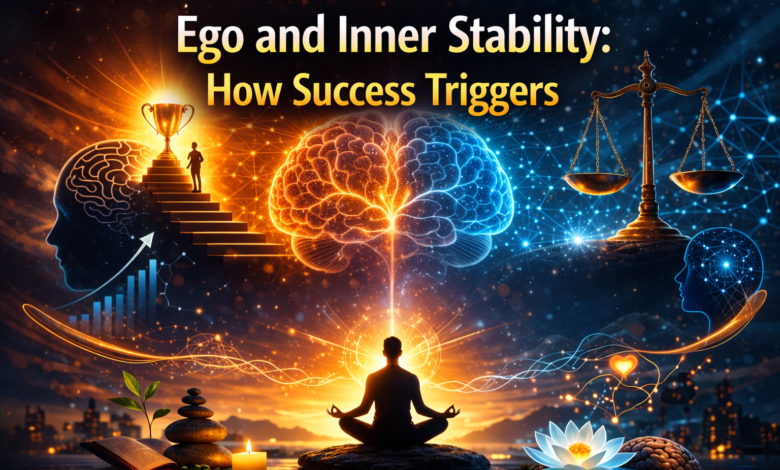
The silent ego in success slowly disrupts ego and inner stability, revealing how success affects mental health through subtle identity attachment, leading to ego and identity collapse and eventual success and emotional instability when achievement becomes self-definition.
Thank you for reading this post, don't forget to subscribe!“Success did not change me overnight — it changed me quietly. Each achievement felt like stability, each recognition felt like security, yet beneath the progress something fragile was forming.
I did not notice when my peace began depending on performance. I only noticed when a small setback felt larger than it should.
That was the moment I realized success can build structure outside you, while silently weakening stability within.”
Research Note:
Studies show that repeated reward reinforcement strengthens identity-performance linkage in the brain. When achievement becomes self-definition, even minor fluctuations trigger stress responses, increasing emotional instability and weakening inner regulation over time.
Introduction — Ego And Inner Stability
There was a time when I believed success automatically meant stability.
- Recognition increased.
- Responsibilities expanded.
- People listened more carefully.
- Decisions carried weight.
Externally, it looked like progress. Internally, something subtle was forming. I did not notice it immediately. The ego does not announce itself loudly.
It grows quietly. This is where ego and inner stability begin to disconnect.
- Success creates structure around identity.
- Performance becomes self-definition.
- Approval becomes subtle reinforcement.
The silent ego in success is not arrogance in its loud form. It is dependency in its quiet form. I did not feel unstable when things were working. But I began to notice something important:
My calm depended on performance. That is where how success affects mental health becomes visible. If inner peace depends on achievement, then achievement becomes psychological oxygen.
And oxygen dependency is fragile.
Insight
Success feels stable until identity depends on it.
How Success Slowly Distorts Identity – Ego And Inner Stability
Ego does not grow in failure first. It grows in achievement. When outcomes align repeatedly, the mind starts creating narrative:
- “I did this.”
- “I built this.”
- “I control this.”
There is nothing wrong with confidence. But when confidence shifts into over-identification, fragility increases. This is the early stage of ego and identity collapse, though it is invisible at first.
Success strengthens external structure. But if awareness is not cultivated, it weakens internal flexibility.
The silent ego in success thrives on subtle comparison:
- Am I ahead?
- Am I respected?
- Am I recognized?
Over time, this comparison builds internal tension.
The science of how success affects mental health shows that high-achieving individuals often experience increased anxiety because identity merges with outcome.
When outcome fluctuates, identity trembles. This is how success and emotional instability become connected. The ego does not fear growth.
It fears decline.
And once identity attaches to upward movement, any slowdown feels threatening.
Insight
Ego strengthens through success, but inner stability weakens when identity depends on growth.
Please Explore This Blog spiritual-awakening-after-suffering-ego-collapse
The Psychology Behind Silent Ego in Success – Ego And Inner Stability
Ego does not form only from insecurity. It also forms from reinforcement.
Every time success is rewarded with praise, status, or authority, the brain strengthens that association. Recognition becomes rewarding. Validation becomes reinforcing.
This is where silent ego in success begins to operate invisibly.
Dopamine research shows that anticipation of reward activates motivation circuits. When performance produces recognition repeatedly, identity begins to anchor in achievement. Over time, this affects how success affects mental health.
Calm becomes conditional.
- You begin to feel stable when things are progressing.
- You begin to feel unsettled when they are not.
- This is where ego and inner stability separate.
The ego says:
- “As long as I am moving forward, I am secure.”
But inner stability requires something deeper than forward movement. It requires identity that survives fluctuation.
When success becomes identity, decline becomes threat. This creates subtle success and emotional instability, because the nervous system begins reacting not to danger — but to status change.
That is the psychological side of ego and identity collapse.
- You do not collapse because of loss.
- You collapse because identity was attached.
Insight
The ego grows through reinforcement; stability grows through awareness.
15 Gita Corrections That Melt Ego in Daily Life – Ego And Inner Stability
Now we shift from analysis to correction.
- Not destruction of ego.
- Not humiliation.
- Correction.
Each of these Gita principles targets ego and inner stability directly.
1. Impermanence of Praise (Gita 2.14)
Krishna teaches that pleasure and pain are temporary. In success, praise feels permanent. But it fluctuates like everything else.
When I began observing carefully, I noticed that approval changes quickly. The same people who admire can criticize later. The silent ego in success ignores this impermanence.
Understanding fluctuation stabilizes identity. This reduces how success affects mental health because emotional dependence on praise decreases.
Insight
Praise fluctuates. Stability must not.
2. You Are Not the Sole Doer (Gita 3.27)
Ego quietly claims authorship.
- “I built this.”
- “I achieved this.”
- “I deserve this.”
But circumstances include timing, support, opportunity, and unseen factors. When ego believes it controls everything, loss feels like personal failure. This intensifies ego and identity collapse during decline.
Recognizing shared causality reduces emotional rigidity and protects inner stability.
Insight
Control illusion increases fragility.
3. Action Without Ownership (Gita 2.47)
Perform action without attachment to fruits. This principle directly protects ego and inner stability.
When results define identity, anxiety increases. When effort defines discipline, calm improves.
Shifting focus from recognition to responsibility reduces success and emotional instability.
Insight
Effort builds character; ownership builds ego.
4. Moderation in Lifestyle (Gita 6.16–17)
Excessive ambition often disguises insecurity. During phases of success, I noticed that intensity increased — more work, more pressure, less rest.
Over time, imbalance affected how success affects mental health. Moderation stabilizes physiology, which stabilizes perception.
Ego thrives on excess; awareness thrives on balance.
Insight
Intensity impresses others; moderation protects you.
Please Explore This Blog ego-dissolution-and-inner-clarity-emotionally-free
5. Equality in Praise and Criticism (Gita 12.18–19)
Ego feeds on praise and fears criticism. If criticism destabilizes you deeply, identity is externally anchored. Learning to hold composure during criticism weakens silent ego in success.
It reduces emotional volatility and protects inner stability.
Insight
When praise and blame lose control, ego weakens.
6. Witness Consciousness (Gita 13.2)
Separating awareness from thought is powerful. When reaction arises — defensiveness, superiority, comparison — observing it reduces its power.
This interrupts ego-driven impulses before they escalate into success and emotional instability.
Insight
Observation dissolves impulsive ego.
7. Duty Over Image (Gita 3.35)
Choosing what is right over what is impressive stabilizes identity.
- The ego prefers prestige.
- Stability prefers integrity.
When action aligns with responsibility rather than applause, ego and inner stability begin to reconnect.
Insight
Integrity stabilizes what image destabilizes.
8. Reduction of Comparison
Comparison strengthens ego silently. It creates superiority or insecurity — both unstable.
Reducing comparison directly reduces how success affects mental health because it removes constant evaluation.
Insight
Comparison creates instability on both ends.
9. Desire Regulation (Gita 3.37)
Unregulated desire fuels ego expansion.
- More status.
- More growth.
- More validation.
When desire moderates, emotional volatility reduces. This prevents ego and identity collapse during inevitable fluctuation.
Insight
Unchecked ambition multiplies fragility.
10. Acceptance of Change (Gita 2.27)
Change is inevitable. Ego resists change because it threatens structure.
Accepting transition protects ego and inner stability during uncertain phases.
Insight
Resistance increases instability.
11. Discipline of the Mind (Gita 6.5)
Krishna teaches that the mind can elevate or degrade the self.
During success, I noticed something subtle — external discipline was strong, but internal discipline was inconsistent. Thoughts became sharper, reactions quicker, defensiveness stronger.
That is how silent ego in success operates — it hides behind productivity.
The more the mind is left unchecked, the more ego reinforces identity attachment. This directly affects how success affects mental health, because unregulated thoughts amplify minor threats.
Mental discipline softens ego gradually.
When thought is regulated, emotional spikes reduce. When reaction slows, inner stability strengthens.
Insight
A disciplined mind protects stability more than achievement does.
Please Explore This Blog trust-issues-causes-modern-world
12. Humility as Strength (Gita 13.8)
The Gita lists humility as knowledge. Earlier, humility felt like weakness. Success made humility appear unnecessary. But over time, I realized something important: defensiveness exhausts. Superiority isolates.
Humility reduces psychological pressure.
It softens ego and inner stability conflicts. It prevents ego from inflating beyond flexibility. When humility increases, success and emotional instability decrease.
Humility does not shrink you.
It stabilizes you.
Insight
Humility strengthens stability without weakening confidence.
13. Surrender of Excess Control (Gita 18.66)
There is a difference between responsibility and control.
- Responsibility stabilizes.
- Control rigidifies.
In success, control expands quietly. Plans must work. Outcomes must align. But excessive control intensifies ego and identity collapse when unpredictability appears.
Learning to release what cannot be controlled protects ego and inner stability.
Acceptance reduces internal friction.
Insight
Control creates tension; intelligent surrender creates space.
14. Compassion Over Comparison (Gita 12.13–14)
Ego compares upward and downward. It seeks superiority or fears inferiority. Compassion interrupts comparison.
When I shifted from evaluating others to understanding them, internal tension reduced. Comparison had been feeding silent ego in success unconsciously.
Compassion lowers hostility and reduces emotional spikes, protecting how success affects mental health.
This is not moral instruction. It is psychological regulation.
Insight
Compassion dissolves ego without force.
15.Redefining Success
The final correction is internal.
- Success is not growth alone.
- Success is stability during growth.
When achievement becomes identity, success and emotional instability become linked. When achievement becomes participation, stability returns.
This is where ego and inner stability reconnect. Ego melts not through humiliation, but through awareness.
- Not through loss, but through clarity.
- Not through collapse, but through disciplined correction.
Insight
Success without awareness strengthens ego; success with awareness strengthens stability.
🧠 Research Foundation — Identity, Reward & Stability – Ego And Inner Stability
Modern neuroscience shows that achievement activates the brain’s reward circuitry, particularly dopamine pathways associated with motivation and reinforcement (Schultz, 1997).
When recognition repeatedly follows performance, the brain strengthens the association between success and self-worth. Over time, identity can subtly anchor itself to outcome rather than internal regulation.
Psychological research on identity threat further explains that when self-concept becomes externally dependent, even minor setbacks can trigger defensive stress responses and emotional instability (Steele, 1988).
This supports the idea that silent ego in success is not loud arrogance — it is reinforced attachment. Stability weakens not because success is harmful, but because identity becomes rigid instead of flexible.
Please Explore This Blog ego-dissolution-and-spiritual-transformation
🧠 THE 4 DIMENSIONS OF SILENT EGO IN SUCCESS
▢ BOX 1 — NERVOUS SYSTEM – Ego And Inner Stability
When Identity = Performance
What Happens:
• Constant alertness
• Fear of slowing down
• Stress during fluctuation
• Hyper-focus on status shifts
Hidden Pattern:
The body treats reputation change as danger.
Stability Indicator:
Calm remains steady even when growth pauses.
▢ BOX 2 — PHYSICAL HEALTH – Ego And Inner Stability
When Ego Drives Overextension
What Happens:
• Sleep disruption
• Fatigue masked as ambition
• Digestive imbalance
• Tension accumulation
Hidden Pattern:
Achievement becomes adrenaline-based survival.
Stability Indicator:
Energy is sustainable, not urgency-driven.
▢ BOX 3 — EMOTIONAL HEALTH – Ego And Inner Stability
When Worth Depends on Recognition
What Happens:
• Mood rises with praise
• Criticism feels personal
• Comparison increases insecurity
• Setbacks trigger shame
Hidden Pattern:
Emotional baseline becomes externally controlled.
Stability Indicator:
Emotional balance survives applause and silence.
▢ BOX 4 — IDENTITY STRUCTURE – Ego And Inner Stability
When Success Becomes Self-Definition
What Happens:
• Fear of decline
• Over-identification with growth
• Rigidity in self-image
• Ego and identity collapse during change
Hidden Pattern:
Identity hardens instead of stabilizing.
Stability Indicator:
You remain grounded during expansion, plateau, and rebuilding.
🌿 Bottom Line Visual Statement
Nervous system reacts.
Body absorbs.
Emotions fluctuate.
Identity either hardens — or stabilizes.
True success strengthens stability, not ego.
Please Explore This Blog silent-ego-in-success-and-inner-stability
When Ego Cracks — Identity Without Collapse – Ego And Inner Stability
There is a difference between ego collapse and ego correction.
- Collapse feels like destruction.
- Correction feels like realignment.
I experienced phases where identity trembled. Not because success disappeared, but because awareness increased. That awareness revealed dependency.
- Once that dependency was visible, the correction began.
- The silent ego in success loses power when observed consistently.
- Inner stability strengthens when identity shifts from recognition to regulation.
- That is how ego and inner stability reconnect.
Conclusion — Inner Stability Is Not Achievement
If someone asked me earlier what creates stability, I would have answered: progress.
Today, I would answer differently.
- Progress without awareness strengthens ego.
- Awareness without discipline creates inconsistency.
- Discipline with awareness creates stability.
The deeper question is not whether success is good or bad.
The deeper question is:
- Does success strengthen ego, or does it strengthen stability?
- When we understand how success affects mental health, we stop measuring calm by achievement.
- When we recognize silent ego in success, we soften attachment.
- When we prevent ego and identity collapse through awareness, growth becomes safer.
And when we separate ego from identity, success and emotional instability no longer travel together.
Final Insight
True success is not expansion of ego — it is preservation of inner stability.
🌿 Conclusion — What I Understand Now – Ego And Inner Stability
There was a time when I believed stability meant progress. If things were moving forward, I felt secure; if recognition increased, I felt grounded. But over time I noticed something subtle and uncomfortable — my calm was quietly depending on performance.
That realization changed everything. Success itself is not dangerous, but unconscious attachment to success slowly weakens inner stability.
When achievement becomes identity, even small fluctuations feel threatening. When identity rests on awareness rather than applause, growth becomes lighter and less fragile.
I do not want to reduce ambition; I want to regulate it. I do not want to reject success; I want to remain stable within it.
Stability now means I can expand without inflating, grow without hardening, achieve without attaching. Success may rise and fall in intensity, but if my inner ground remains steady, nothing collapses.
That is the correction — not shrinking ego, not destroying drive, but separating identity from outcome. And for me, that is real stability.
Please Explore This Blog spirituality-as-spirit-science-15-laws-consciousness-suffering
🔎 FAQ — Ego And Inner Stability
1️⃣ What is the silent ego in success?
The silent ego in success is the subtle attachment that forms when identity becomes dependent on achievement, recognition, or authority. Unlike loud arrogance, it operates quietly by making ego and inner stability conditional on performance.
2️⃣ How does success affect mental health?
How success affects mental health depends on identity structure. When identity merges with outcomes, stress increases during fluctuation, leading to anxiety, emotional reactivity, and potential ego and identity collapse during setbacks.
3️⃣ What causes ego and identity collapse?
Ego and identity collapse occurs when external validation or achievement declines suddenly. If self-worth is tied to performance, even small losses can feel like personal failure, triggering success and emotional instability.
4️⃣ Why does achievement sometimes create emotional instability?
Success and emotional instability become connected when growth becomes psychological security. If calm depends on upward movement, any slowdown activates internal threat responses.
5️⃣ How can I strengthen ego and inner stability together?
Ego and inner stability reconnect when identity shifts from recognition to regulation. Practicing detachment from outcomes, moderating ambition, and cultivating awareness protects stability without reducing growth.
6️⃣ Is ambition harmful to inner stability?
Ambition is not harmful. Unregulated attachment to ambition is. When ambition defines identity, mental pressure increases. Disciplined ambition supports stability instead of weakening it.
7️⃣ Why do high achievers struggle with anxiety?
High achievers often experience anxiety because identity merges with performance. When success becomes self-definition, the nervous system reacts strongly to status changes.
8️⃣ Can ego soften without failure or humiliation?
Yes. The silent ego in success can soften through awareness, humility, moderation, and emotional regulation. Ego correction does not require collapse; it requires conscious separation of identity from outcome.
9️⃣ How does comparison affect mental health during success?
Comparison strengthens ego attachment and increases stress. Constant evaluation activates threat perception, which directly impacts how success affects mental health.
🔟 What is true inner stability in success?
True inner stability means calm remains steady whether achievement expands, plateaus, or contracts. When ego and inner stability are separated, success no longer determines emotional security.
Reference And Study – Ego And Inner Stability
📑 Scientific & Medical References – Ego And Inner Stability
Harvard Health – Understanding the Stress Response
Explains how chronic stress affects body and brain, linking physiology with emotional regulation. Understanding the Stress Response – Harvard HealthPolyvagal Theory – Nervous System & Emotional Regulation
Overview of how the autonomic nervous system influences safety, emotional response, and regulation. Polyvagal Theory – Frontiers in Integrative NeurosciencePubMed Central – Comprehensive View of Mental Health
Defines mental health and well-being as biological, psychological, and social dimensions. Concept of Mental Health & Well‑Being – PMCPolyvagal Theory (Wikipedia overview)
Summarizes basic principles about the vagus nerve’s role in stress and emotion regulation. Polyvagal Theory Explained (Wikipedia)HelpGuide – Personality, Emotional Stability & Mental Health
Overview of how traits like emotional stability affect mental health outcomes. Personality Traits & Mental Health – HelpGuide
🧠 Optional Psychological Foundations – Ego And Inner Stability
These are additional academic links you can reference if you want deeper citations (not all required, but useful for authority):
Attachment & Ego-Identity Development Study (ResearchGate) – explores ego and identity development.
Attachment & Mental Health Relationships (Indian Mental Health) – attachment styles, anxiety, and self-esteem.
📌 How to Cite in Your Blog – Ego And Inner Stability
You can format these references like this:
Scientific Sources:
– Harvard Health Publishing: “Understanding the Stress Response” — https://www.health.harvard.edu/staying-healthy/understanding-the-stress-response
– Frontiers in Integrative Neuroscience: “Polyvagal Theory provides scientific perspective on nervous system regulation and safety cues.”
– PubMed Central: “Comprehensive overview of mental health determinants.”
– HelpGuide: “Personality traits such as emotional stability and their impact on mental health.”