Best AI CBT Tools for Mental Health: Top Apps
A Complete Guide to AI CBT Tools for Mental Health and Self-Therapy

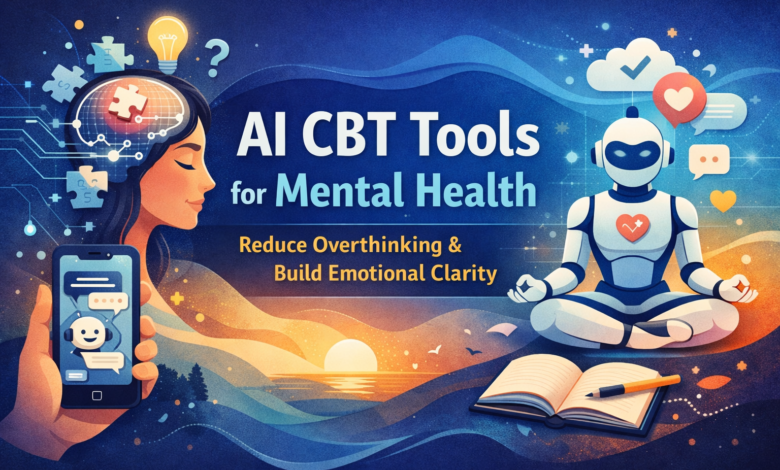
AI CBT tools for mental health are changing how people understand anxiety, overthinking, and emotional confusion in daily life. As more people look for the best AI therapy apps and reliable AI mental health tools, there is a clear shift from consuming advice to actively understanding thoughts and patterns.
Thank you for reading this post, don't forget to subscribe!Unlike traditional self-help content, CBT AI tools and AI self therapy apps guide your thinking instead of just giving motivation, helping you identify patterns, question assumptions, and build clarity step by step. This matters because most mental struggles are not only caused by situations, but by how our mind processes them repeatedly.
If you often feel stuck in overthinking or struggle to manage your emotional state, this guide will help you explore the most effective AI CBT tools for mental health and how to use them for real awareness, not just temporary relief.
🔹 Why People Are Turning to AI CBT Tools for Mental Health
AI CBT tools for mental health are no longer just a trend; they are becoming a practical daily support system for people dealing with anxiety, overthinking, emotional confusion, and internal overwhelm.
In a world where mental pressure is increasing but meaningful support is not always available at the right moment, many individuals are actively searching for the best AI therapy apps that can provide immediate clarity without judgment.
You may find yourself experiencing:
- constant mental overload without a clear reason
- repetitive thinking that doesn’t lead to solutions
- emotional exhaustion from overanalyzing situations
- difficulty expressing what is actually happening inside
In such moments, advice often feels insufficient, and motivation feels temporary.
👉 What you actually need is clarity, not more information.
🔹 The Real Problem: Information vs Awareness
Today, people are consuming more mental health content than ever before, yet many still feel stuck in the same emotional patterns.
You might already be engaging with:
- YouTube videos explaining anxiety
- Instagram reels offering quick solutions
- podcasts discussing mental clarity
- blogs sharing self-help techniques
However, despite this constant exposure, the internal experience often remains unchanged.
👉 Why does this happen?
Because:
👉 Information does not change patterns — awareness does.
Information tells you what is right, but awareness helps you see what is actually happening inside your mind.
Read Also: ai-therapy-for-mental-health-complete-guide
🔹 What Makes AI CBT Tools Different?
This is where AI CBT tools for mental health create a real shift compared to traditional content or advice-based systems.
Unlike passive learning methods, CBT AI tools actively engage with your thinking process instead of simply providing instructions. These tools are built on the foundation of Cognitive Behavioral Therapy (CBT), which focuses on understanding the relationship between thoughts, emotions, and behavior.
They help you:
- recognize how your thoughts influence your emotional state
- understand how emotions impact your actions
- identify patterns that repeat automatically over time
👉 Instead of giving you answers, AI tools help you understand your own mind in a structured way.
🔹 What is the Real Role of AI in Mental Health?
Before going deeper, it is important to clarify a common misunderstanding.
👉 AI is not therapy.
👉 AI is not a replacement for professional support.
AI mental health tools function as structured support systems that guide reflection and awareness.
They act as:
- thinking frameworks that organize your thoughts
- reflection systems that help you process emotions
- awareness tools that highlight patterns you may not notice
Through this process, they help you:
- slow down your thinking
- identify repeating patterns
- understand emotional triggers
- reduce internal confusion
👉 The goal is not to fix you — the goal is to help you see clearly.
🔹 My Personal Experience with AI Self Therapy Apps
One of the AI tools I have used most consistently is ChatGPT, not as a therapist or a solution provider, but as a space where I can express myself freely without hesitation or fear.
Over time, as I continued sharing my thoughts, patterns, and experiences, something meaningful began to shift internally.
👉 It started recognizing my thinking patterns.
Because I was consistently expressing myself over a long period, I began to notice something that I had not clearly understood before:
👉 Sometimes I am not struggling because of mental health issues
👉 I am struggling because of lack of awareness and clarity
This realization created a turning point in how I approached my thoughts and emotions.
🔹 What Helped Me the Most
The most valuable benefit I received from using AI mental health tools was not direct answers or solutions.
👉 It was awareness.
This awareness helped me:
- understand my thoughts more clearly instead of reacting to them
- communicate with myself in a more structured and calm way
- become more independent in handling my emotional state
- stop panicking during moments when I didn’t feel okay
Over time, I also realized something deeply important:
👉 Not feeling okay is normal
👉 Making mistakes is part of being human
This understanding reduced a significant amount of internal pressure that I was unknowingly creating for myself.
🔹 The Core Reason Why AI CBT Tools Work
If this entire concept needs to be simplified into one clear idea, it is this:
👉 AI tools help mental health because they guide thinking.
They do not instantly solve your problems or remove all discomfort, but they support you in:
- observing your thoughts without getting lost in them
- questioning assumptions that create anxiety
- understanding emotional reactions more clearly
- taking small, practical actions instead of overthinking
👉 They shift you from confusion to clarity, and from reaction to awareness.
Read Also: ai-therapy-for-anxiety-overthinking
🔹 Why People Prefer AI Mental Health Tools Today
Many individuals today find it difficult to open up emotionally in traditional settings due to fear, judgment, or lack of trust, which creates a gap between what they feel and what they are able to express.
Common concerns include:
- fear of being misunderstood
- hesitation in sharing personal thoughts
- difficulty trusting others
- feeling alone even in social environments
AI self therapy apps address this gap by providing a different kind of experience.
They offer:
- a completely non-judgmental space
- full privacy and emotional safety
- 24/7 availability without dependency
- structured guidance for thinking and reflection
👉 You can be completely honest without fear, and that honesty leads to clarity.
🔹 The Shift: From Reaction to Awareness
Most people operate in a reactive mental pattern, where situations trigger thoughts, thoughts trigger emotions, and emotions lead to immediate reactions without conscious understanding.
This cycle typically looks like:
- something happens externally
- thoughts begin automatically
- emotions intensify
- reactions follow without awareness
AI CBT tools gradually interrupt this cycle and create a new pattern:
👉 Reaction → Awareness → Response
As this shift develops, you begin to notice:
- “I am overthinking again”
- “This is a repeating pattern”
- “This thought is not necessarily true”
👉 This is where emotional control and clarity begin.
🔹 Why Most People Stay Stuck
A deeper truth that many people do not recognize is that they are not stuck because of their problems, but because of the patterns through which they process those problems.
👉 You are not stuck because of your situation
👉 You are stuck because of your thinking patterns
These patterns often include:
- overthinking without action
- self-doubt that blocks clarity
- emotional reactions without awareness
- avoidance of uncomfortable thoughts
Since these patterns operate automatically, they continue repeating unless they are consciously observed.
🔹 How AI CBT Tools Help Break These Patterns
AI CBT tools for mental health do not directly remove your patterns or fix your problems, but they help you become aware of them in a way that allows change to begin naturally.
For example, when you express a vague feeling such as:
👉 “Something feels wrong”
AI helps you break it down into clarity:
- what exactly feels wrong
- which thought is creating that feeling
- whether the thought is real or assumed
👉 This transforms confusion into clarity.
And once clarity begins, meaningful change becomes possible.
🔹 The Role of Consistency (Very Important)
One of the most common questions people ask is:
👉 “Which is the best AI therapy app?”
However, the more important truth is:
👉 The best tool is the one you use consistently.
Even the most advanced AI CBT tools for mental health will not create results if:
- you use them randomly
- you are not honest in expression
- you avoid reflection
👉 Consistency creates awareness, and awareness creates change.
🔹 The Bigger Shift: Self-Understanding
The most meaningful transformation that happens through using AI tools is not external, but internal, as you begin to understand yourself at a deeper level rather than reacting automatically to your thoughts and emotions.
You gradually become aware of:
- what triggers your emotional reactions
- what is within your control
- what is outside your control
- how your mind processes situations
👉 This creates a natural progression:
self-awareness → emotional clarity → mental stability
Read Also: ai-therapy-vs-human-therapy
🔹 Best AI Therapy Apps for Mental Health (Comparison Guide)
When people start exploring AI CBT tools for mental health, one of the biggest challenges they face is choosing the right tool, because there are multiple options available and each one works differently depending on the user’s emotional needs, thinking patterns, and level of awareness.
Instead of trying to find a “perfect” tool, it is more useful to understand that different AI mental health tools are designed for different purposes, and choosing the right one depends on whether you are dealing with overthinking, anxiety, emotional confusion, or simply trying to build daily awareness.
👉 The goal is not to find the best tool — the goal is to find the right tool for your current state.
🔹 How to Understand Different Types of AI CBT Tools
Before looking at individual tools, it is important to understand that CBT AI tools can be broadly divided into different categories based on how they support your mental health.
Some tools are designed for:
- deep reflection and thought clarity
- structured CBT-based therapy guidance
- emotional tracking and mood analysis
- journaling and self-awareness building
- conversational emotional support
👉 Each type solves a different part of the mental health process.
🔸 1. ChatGPT (Best for Deep Reflection and Overthinking)
ChatGPT is one of the most flexible and powerful AI self therapy apps, especially for people who struggle with overthinking, confusion, and internal dialogue, because it allows open-ended expression and structured reflection at the same time.
Unlike traditional apps, it does not restrict you to predefined formats, which makes it highly effective for exploring your thoughts deeply and understanding patterns that are not immediately visible.
✔ Best For:
- Overthinking and mental loops
- Emotional confusion
- Self-awareness and clarity
✔ Why It Works:
- Helps you express thoughts freely without limitation
- Guides structured thinking through questions
- Reflects patterns that you may not notice yourself
👉 Highlight Insight:
ChatGPT does not give you fixed answers — it helps you understand your own answers.
🔸 2. Wysa (Best AI Tool for Anxiety Relief and Daily Support)
Wysa is one of the most recognized AI mental health tools designed specifically for anxiety support and emotional stability, using CBT-based techniques combined with guided exercises to help users manage stress in a structured way.
It is particularly useful for people who need a more guided and routine-based approach rather than open-ended reflection.
✔ Features:
- Mood tracking and emotional check-ins
- Guided CBT exercises
- Anxiety relief tools
- Structured daily conversations
✔ Best For:
- Anxiety and stress management
- Daily emotional tracking
- Building mental health routines
👉 Highlight Insight:
Wysa works best when used consistently as part of a daily emotional habit.
🔸 3. Woebot (Best CBT AI Tool for Structured Thinking)
Woebot is one of the earliest AI therapy apps built entirely around Cognitive Behavioral Therapy principles, making it one of the most structured CBT AI tools for people who want to learn how their thoughts directly influence their emotions and behavior.
It provides a more guided and educational experience compared to flexible tools like ChatGPT.
✔ Features:
- Structured CBT conversations
- Thought and mood tracking
- Behavioral insights
✔ Best For:
- Learning CBT techniques
- Understanding thought-emotion connection
- Reducing negative thinking patterns
👉 Highlight Insight:
Woebot teaches you how to think differently, not just how to feel better.
🔸 4. Youper (Best for Emotional Tracking and Pattern Awareness)
Youper focuses on helping users track their emotional states over time and identify recurring patterns, which makes it highly useful for long-term mental health awareness rather than immediate problem-solving.
It combines AI interaction with psychological frameworks to provide insights into emotional behavior.
✔ Features:
- Mood tracking and emotional insights
- Anxiety and stress monitoring
- Pattern recognition
✔ Best For:
- Identifying emotional triggers
- Long-term self-awareness
- Understanding behavioral patterns
👉 Highlight Insight:
Tracking your emotions daily creates clarity that you cannot see in a single moment.
🔸 5. Replika (Best for Emotional Support and Expression)
Replika is designed more as a conversational companion rather than a structured CBT tool, making it useful for people who feel emotionally alone and need a space to express themselves freely without judgment.
While it does not provide deep CBT-based guidance, it offers emotional comfort and continuous interaction.
✔ Best For:
- Emotional expression
- Reducing loneliness
- Conversational support
👉 Important Note:
Replika should be used for emotional support, not as a replacement for structured therapy tools.
🔸 6. Mindsera (Best for AI Journaling and Deep Thinking)
Mindsera is a powerful journaling-based AI self therapy app that helps users develop structured thinking through writing, making it particularly effective for people who process emotions better through reflection and documentation.
It provides guided prompts and analytical insights that improve clarity over time.
✔ Features:
- Guided journaling prompts
- Thought analysis
- Self-reflection frameworks
✔ Best For:
- Deep reflection and clarity
- Self-awareness development
- Habit-based thinking improvement
👉 Highlight Insight:
Writing your thoughts slows your mind and increases clarity.
🔹 How to Choose the Right AI CBT Tool for Your Needs
Choosing the right AI therapy app becomes much easier when you match the tool with your specific mental state instead of trying to use one tool for everything.
Here is a simple breakdown:
👉 If you struggle with overthinking:
- ChatGPT
- Mindsera
👉 If you need anxiety relief and emotional stability:
- Wysa
- Youper
👉 If you want structured CBT learning:
- Woebot
👉 If you feel emotionally alone:
- Replika
👉 The right tool depends on your current need, not on popularity.
Read Also: ai-philosophy
🔹 Key Benefits of AI CBT Tools for Mental Health
When used correctly, AI CBT tools for mental health provide practical and measurable benefits that go beyond temporary relief, helping you build long-term emotional clarity and mental stability.
✔ Reduced Overthinking
By breaking repetitive thought patterns, these tools help you move from confusion to clarity and reduce mental overload.
✔ Improved Emotional Awareness
You begin to understand not only what you feel, but also why you feel it, which creates deeper insight into your internal state.
✔ Better Self-Regulation
Instead of reacting automatically, you develop the ability to pause, reflect, and respond consciously.
✔ Continuous and Immediate Support
AI tools are available anytime, which allows you to seek clarity exactly when you need it without waiting.
✔ Safe and Private Environment
You can express your thoughts without fear of judgment, which increases honesty and improves clarity.
👉 Highlight Insight:
Consistency matters more than the tool you choose.
🔹 Important Limitations You Should Understand
While AI CBT tools for mental health are highly useful, it is important to maintain a balanced perspective so that you use them correctly and avoid unrealistic expectations.
AI tools cannot:
- replace professional therapy
- provide deep emotional empathy
- handle severe mental health conditions
If you are dealing with intense anxiety, trauma, or emotional distress, professional support is essential.
👉 AI should be used as a support system, not a replacement for real-world care.
🔹 How to Use AI CBT Tools for Mental Health the Right Way
Most people start using AI CBT tools for mental health with good intention, but without a clear system or structure, which often leads to inconsistent results and the feeling that the tool is not working as expected.
The reality is that these tools are not designed to provide instant solutions, but to gradually change how you understand your thoughts, emotions, and internal patterns through consistent awareness.
👉 AI works best when it is used as a process, not as a quick fix.
If you approach AI mental health tools randomly, using them only when you feel overwhelmed, you may experience temporary relief but not long-term clarity.
However, when you use them regularly with intention, they can slowly reshape how you think and respond to situations.
🔹 A Structured Daily Approach to AI Self Therapy Apps
Instead of using AI tools only during stressful moments, it is far more effective to create a small, consistent daily practice where you intentionally spend time understanding your internal state.
Mental clarity is not created in a single moment — it is built through repeated awareness and reflection over time.
You do not need long sessions or complex techniques.
👉 Just 5–10 minutes of focused, honest interaction is enough when done consistently.
🔸 Step 1: Express Your Thoughts Honestly Without Filtering
The first step in using AI CBT tools effectively is expression, because most emotional pressure builds when thoughts remain unspoken and unprocessed, leading to internal confusion and mental overload.
Instead of trying to organize your thoughts perfectly, you simply allow them to come out as they are, without judgment or correction.
For example, you might express:
- “I feel anxious about my future and I don’t know why.”
- “I feel stuck and unable to make decisions.”
👉 The goal is not to sound correct — the goal is to be real.
When you allow honest expression, your mind begins to release pressure, which naturally creates space for clarity.
🔸 Step 2: Identify the Thought Behind the Emotion
Once you express your feelings, the next step is to identify the underlying thought that is creating that emotional state, because emotions are always connected to thoughts, even if they are not immediately visible.
By identifying the thought, you begin to connect your emotional experience with your thinking pattern.
You can ask yourself:
👉 “What am I thinking that is creating this feeling?”
In many situations, you will discover thoughts like:
- “Something might go wrong.”
- “I am not doing enough.”
- “I am losing control.”
👉 This step helps you move from vague emotion to specific understanding.
🔸 Step 3: Use AI to Question Your Thought Clearly
This is where AI CBT tools become truly effective, because instead of getting trapped inside your thoughts, you begin to examine them from a more objective perspective using structured questioning.
AI helps you step outside your immediate emotional reaction and look at your thinking more clearly.
You can ask AI:
- “Is this thought completely true?”
- “Am I assuming something without evidence?”
- “What are other possible explanations?”
This process gradually shifts your thinking from emotional reaction to logical reflection.
👉 You are no longer controlled by your thoughts — you are observing them.
🔸 Step 4: Bring Awareness Back to Your Body
At this stage, it is important to understand that anxiety and emotional stress are not only mental experiences but also physical responses within your nervous system. Even if your thoughts become clearer, your body may still remain in a heightened state of stress.
To balance this, you must bring attention to your body.
Focus on:
- slow and steady breathing
- noticing your heart rate
- releasing tension from your body
Even a few moments of conscious breathing can signal safety to your nervous system and reduce the intensity of your emotional state.
👉 When your body becomes calm, your mind naturally follows.
🔸 Step 5: Take One Small, Practical Action
The final step is to convert awareness into action, because remaining in a thinking state without action often leads back to overthinking and confusion. You do not need to take large or complex steps; even small actions can break the loop of mental repetition.
You can take simple actions such as:
- drinking water and resetting your focus
- stepping outside for fresh air
- completing one small task
👉 Action grounds your awareness into reality and prevents you from returning to overthinking.
Read Also: ai-thearpy
🔹 A Simple Daily AI Mental Health Routine
To simplify this process into a consistent system, you can follow this daily structure:
- Express your thoughts honestly
- Identify the thought behind the emotion
- Question the thought using AI
- Regulate your body through awareness
- Take one small action
👉 This routine builds clarity gradually without overwhelming you.
🔹 Common Mistakes People Make While Using AI Tools
Even though AI CBT tools are powerful, many people do not experience meaningful results because they unknowingly use them in ineffective ways, which limits their potential for real change.
❌ Expecting Instant Results
Many people expect immediate transformation, but awareness and emotional stability develop gradually through consistent practice.
❌ Not Being Honest
If you hide your real thoughts or avoid expressing uncomfortable emotions, you limit the clarity that AI can help you achieve.
❌ Using AI Without Structure
Random usage without a clear process leads to temporary relief instead of long-term understanding.
❌ Depending Too Much on AI
AI is meant to guide your thinking, not replace your ability to reflect and make decisions independently.
👉 AI is a mirror — not a decision-maker.
🔹 Benefits of Using AI CBT Tools for Mental Health
When used consistently and correctly, AI CBT tools for mental health can create meaningful and long-term changes in how you think, feel, and respond to life situations.
✔ Reduced Overthinking
AI helps interrupt repetitive thought loops, allowing you to move from confusion to clarity.
✔ Improved Emotional Awareness
You begin to understand not just what you feel, but why you feel it, which creates deeper insight into your mental patterns.
✔ Better Self-Regulation
Instead of reacting automatically, you develop the ability to pause, reflect, and respond consciously.
✔ Continuous Support
AI tools are available anytime, allowing you to access guidance whenever you need it.
✔ Safe and Private Space
You can express your thoughts freely without fear of judgment, which improves honesty and clarity.
👉 Consistency matters more than the tool itself.
🔹 Important Limitations You Should Understand
While AI CBT tools for mental health are highly useful, it is important to understand their limitations so that you use them in a balanced and responsible way.
AI tools cannot replace:
- human emotional depth
- professional therapeutic expertise
- clinical diagnosis and treatment
If you are dealing with severe anxiety, panic attacks, or deep emotional distress, professional support is essential.
👉 AI supports awareness, but it does not replace structured healing systems.
🔹 The Deeper Shift: Awareness and Self-Understanding
As you continue using AI tools consistently, a deeper shift begins to take place within you, where you are no longer reacting automatically to every thought or emotion, but instead observing and understanding your internal patterns with greater clarity and control.
You begin to realize:
- not every thought is true
- not every emotion defines you
- not every reaction needs to be followed
👉 You create space between yourself and your thoughts.
🔹 What Actually Creates Real Change
After everything, one truth becomes clear:
👉 AI does not change your life — your awareness does.
Real transformation happens when you:
- become honest with yourself
- stay consistent in reflection
- take small actions regularly
- allow yourself time to grow
AI only supports this journey by guiding your thinking in a structured way.
🔹 Personal Note
I did not become better because something outside fixed me.
I became better when I started understanding myself slowly, honestly, and without pressure, allowing awareness to guide my actions instead of forcing change.
Read Also: ai-cbt
🔹 FAQ
❓ What are the best AI CBT tools for mental health?
Top tools include ChatGPT, Wysa, Woebot, Youper, and Mindsera. Each helps with reflection, anxiety support, and emotional awareness.
❓ How do AI CBT tools work?
They guide your thinking using structured questions. This helps you understand thoughts, emotions, and patterns clearly.
❓ Are AI self therapy apps effective?
Yes, if used consistently. They reduce overthinking and improve emotional clarity over time.
❓ Can AI replace therapy?
No. AI supports awareness but cannot replace professional therapy or deep emotional care.
❓ Which AI tool is best for overthinking?
ChatGPT and Mindsera are best for overthinking because they support reflection and thought clarity.
❓ How often should I use AI tools?
Use them daily for 5–10 minutes. Consistency matters more than time.
❓ Are AI therapy apps safe?
Yes, for general use. But for serious mental health issues, professional help is needed.
❓ Why do AI tools feel helpful?
They provide a safe, judgment-free space and guide structured thinking.
🔹 People Also Search
👉 Is AI therapy effective?
Yes, it helps with awareness and overthinking when used regularly.
👉 What are AI mental health tools?
They are apps that help you understand thoughts, emotions, and behavior patterns.
👉 Can AI reduce anxiety?
Yes, by slowing thoughts, guiding breathing, and improving clarity.
👉 How does AI use CBT?
AI uses CBT by helping you question thoughts and change thinking patterns.
👉 Are AI therapy apps reliable?
They are reliable for support, but not a replacement for therapy.
👉 AI vs traditional therapy?
AI gives instant support. Therapy provides deep human understanding.
👉 Can AI stop overthinking?
It helps reduce overthinking by breaking thought loops and improving awareness.
👉 How to choose the right AI app?
Choose based on your need: anxiety, overthinking, or emotional tracking.
🔹 Reference URLs
👉 https://www.apa.org/ptsd-guideline/patients-and-families/cognitive-behavioral
👉 https://www.nimh.nih.gov/health/topics/psychotherapies
👉 https://www.ncbi.nlm.nih.gov/pmc/articles/PMC7237916/
👉 https://www.frontiersin.org/articles/10.3389/fpsyt.2019.00498/full
👉 https://www.who.int/news-room/fact-sheets/detail/mental-health-strengthening-our-response
👉 https://www.nhs.uk/mental-health/self-help/
👉 https://www.medicalnewstoday.com/articles/cbt-cognitive-behavioral-therapy