Spiritual Ego: Signs and AI Reflection
How to Build Humility and Self-Awareness

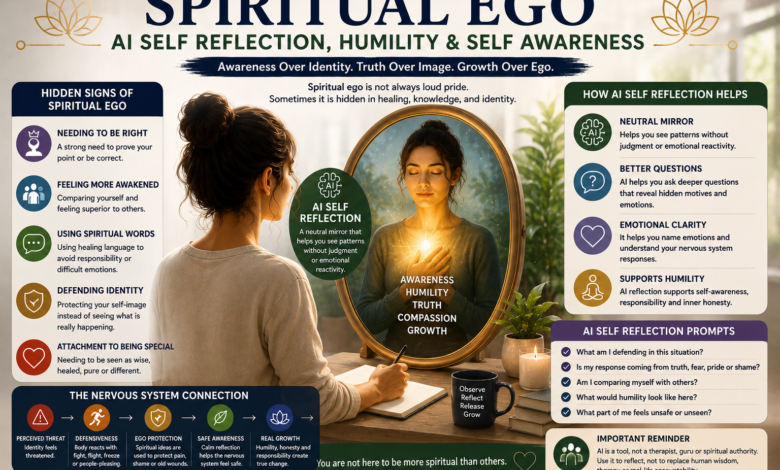
Most people think spiritual ego means obvious pride, superiority, or acting “more awakened” than others. But ego is often quieter than that. Sometimes it hides behind healing words, spiritual knowledge, self-improvement, or even the desire to look calm and evolved.
Thank you for reading this post, don't forget to subscribe!This is why understanding ego and spirituality matters deeply for real inner growth. In this blog, you will learn how AI self reflection can become a neutral mirror, helping you notice defensiveness, shame, comparison, and hidden ego patterns without attacking yourself.
The unique BBH angle is that ego is not treated as an enemy, but as a nervous-system protection pattern that needs awareness, safety, and honesty.
You will also understand how humility and self awareness work together, and how to overcome spiritual ego through practical reflection, emotional regulation, and grounded inner responsibility.
What Is Spiritual Ego?
Spiritual ego is the part of the self that uses spirituality, healing, knowledge, meditation, awareness, kindness, or moral goodness to protect identity instead of deepening truth. It does not always look like arrogance.
Sometimes it looks like being overly attached to being “calm,” “wise,” “different,” “more conscious,” or “more healed” than others.
This is why spiritual ego can be difficult to notice. The person may genuinely want growth, but slowly the growth becomes another identity to defend.
Real spirituality softens the ego; spiritual ego turns spirituality into a self-image.
Spiritual Ego Meaning in Simple Words
In simple words, spiritual ego means the ego wearing spiritual clothes. It happens when a person becomes attached to the image of being evolved, awakened, wise, pure, or emotionally mature.
The problem is not spirituality itself. The problem begins when ego and spirituality mix in a way that makes the person less honest, less humble, and less open to correction.
Instead of asking, “What can I learn here?” the mind quietly asks, “How do I protect my image?”
This is where spiritual growth can become spiritual performance.
Why Spiritual Ego Is Not Always Loud Pride
Many people imagine ego as loud confidence, dominance, or obvious superiority. But spiritual ego can be subtle. It may appear as defensiveness, silent comparison, emotional withdrawal, or the need to prove that you are not like others.
A person may not say, “I am better than you,” but may quietly feel, “I understand life more deeply than you.” That hidden superiority creates distance from real humility.
As one personal line says clearly: “I learned that ego does not always shout; sometimes it silently protects pain.”
This is the key to understanding spiritual ego with compassion instead of shame.
Why Spiritual Ego Is Hard to See in Yourself
Spiritual ego is hard to see because it often hides behind positive language. The mind may use words like healing, boundaries, energy, detachment, self-worth, awareness, or truth, but the deeper emotional pattern may still be fear, control, pride, shame, or avoidance.
This does not mean the person is fake. It means the nervous system may be using spiritual ideas to feel safe.
When identity feels threatened, the mind protects itself. That protection can feel like wisdom, even when it is actually fear wearing a calm face.
Ego Can Hide Behind Healing Language
Healing language becomes unhealthy when it is used to avoid responsibility. For example, saying “I am protecting my peace” can be healthy when it comes from clarity, but it can become spiritual ego when it is used to avoid feedback, apology, or emotional accountability.
Saying “that person has low energy” may sometimes be discernment, but it can also become judgment covered in spiritual vocabulary.
If shame is strong inside, the ego may use polished words to avoid feeling exposed.
For deeper support around shame and self-judgment, readers can also explore CBT AI shame recovery: cbt-ai-shame-recovery
When Self-Improvement Becomes Self-Image
Self-improvement becomes self-image when the goal quietly changes from inner honesty to outer identity. The person no longer wants to simply grow; they want to be seen as someone who has grown.
They may become attached to being the wise one, the spiritual one, the emotionally intelligent one, or the person who always understands deeply.
This attachment creates pressure. Instead of freedom, spirituality becomes another performance.
Instead of humility, the person carries a hidden fear of being seen as ordinary, wounded, confused, or still learning.
Signs of Spiritual Ego in Daily Life
The signs of spiritual ego are not always dramatic. They often appear in small reactions, especially when someone gives feedback, disagrees, misunderstands you, or challenges your self-image.
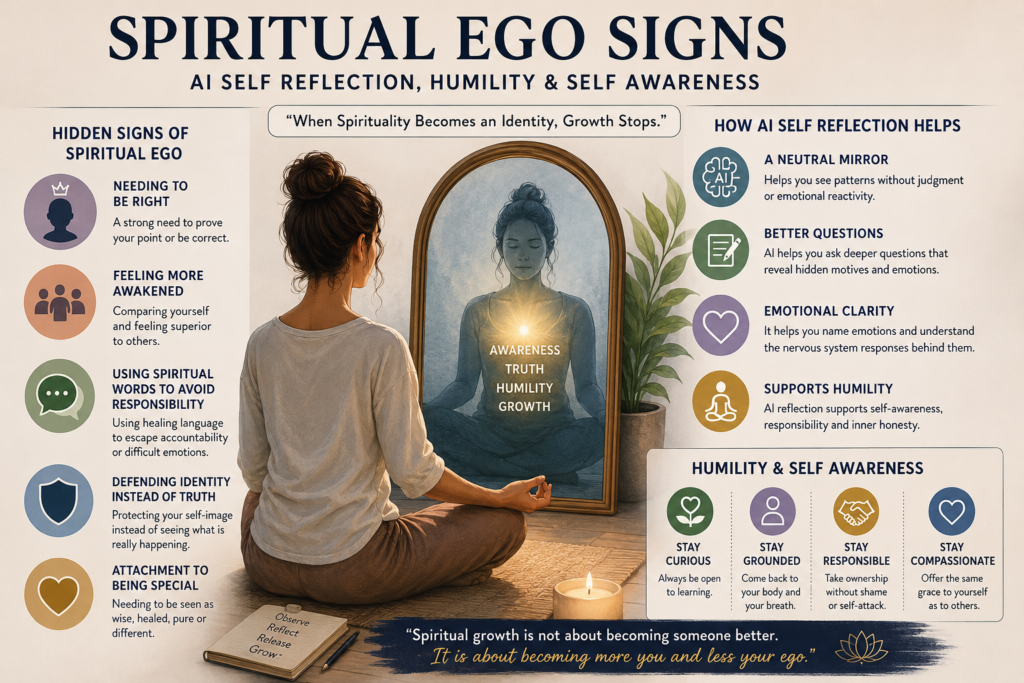
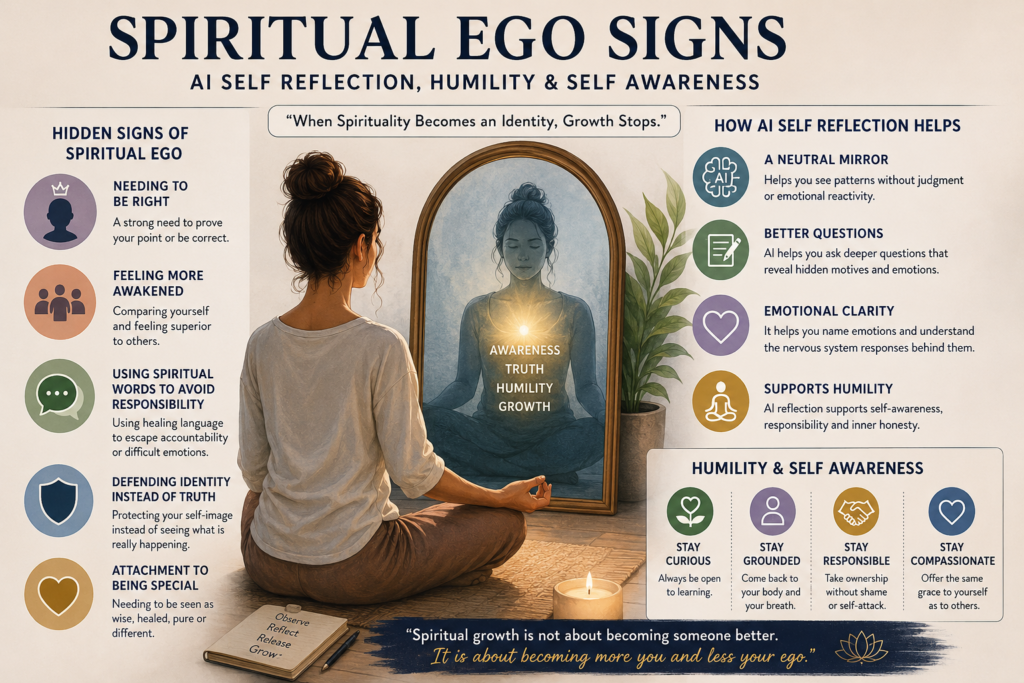
In daily life, spiritual ego may show up as needing to be right, feeling secretly superior, using spiritual words to avoid responsibility, or defending your identity instead of observing your reaction.
These signs do not mean you are bad. They simply show where awareness is needed. The goal is not self-attack; the goal is honest observation with emotional maturity.
Needing to Be Right
One clear sign of spiritual ego is the strong need to be right. The person may speak about awareness, consciousness, or healing, but when challenged, they become defensive. Instead of listening, they start explaining. Instead of reflecting, they start proving.
This happens because the ego feels that being wrong means losing worth. In reality, being corrected is not humiliation; it is growth.
A person with real humility can pause and ask, “Is there something here I need to see?” That small pause is often more spiritual than any perfect answer.
Feeling More Awakened Than Others
Another sign is secretly feeling more awakened, evolved, or conscious than other people. This may not be spoken openly, but it can appear through judgment.
The mind may think, “They are still trapped in ego,” “They are not conscious enough,” or “They do not understand energy like I do.”
This creates spiritual superiority. Real awareness does not make a person look down on others. It creates compassion because you understand that everyone is carrying conditioning, pain, fear, and survival patterns.
If comparison is affecting self-worth, readers can also explore AI comparison healing self-worth:ai-comparison-healing-self-worth
Using Spiritual Words to Avoid Responsibility
Spiritual ego can also appear when a person uses spiritual ideas to avoid emotional responsibility.
For example, “I am detached” may sometimes mean, “I do not want to feel this.” “I trust the universe” may sometimes mean, “I do not want to take action.”
“Everything is illusion” may sometimes become a way to avoid someone else’s pain. True spirituality does not remove responsibility.
- It deepens responsibility.
- It helps a person respond with more honesty, not less.
- Detachment should create clarity, not emotional escape.
Defending Identity Instead of Observing Reaction
The deeper sign of spiritual ego is identity defense.
When someone questions you, do you observe your reaction, or do you immediately protect your image?
When someone points out a mistake, do you feel curious, or do you feel attacked?
Spiritual ego says, “I must protect who I think I am.” Awareness says, “Let me understand what is happening inside me.”
This is where AI self reflection can help later in the process. Used carefully, it can support emotional observation, similar to how AI emotional support tools can help people name feelings and slow down reactions: ai-emotional-support-tools
Why Spiritual Ego Often Comes From Pain
A deeper way to understand spiritual ego is to see it as protection, not just pride. Many people develop strong identities because they have felt unseen, powerless, ashamed, rejected, or emotionally unsafe.
When spirituality gives them meaning, strength, or respect, they may become attached to that identity. This attachment is human.
But if it becomes rigid, the person stops growing.
The ego says, “This identity saved me, so I must protect it.”
Healing says, “This identity helped me, but I do not need to become trapped inside it.”
Spiritual Ego and Negative Self-Talk
Spiritual ego can also grow from harsh inner criticism. If a person already feels not good enough, they may use spirituality to build a better self-image. But underneath that image, negative self-talk may still remain.
The person may look calm outside while fighting shame inside. This is why humility and self awareness must be gentle. If awareness becomes another weapon, the ego becomes stronger.
A helpful related guide is negative self-talk AI reframe confidence, which supports the same idea of reducing self-attack while building clarity:negative-self-talk-ai-reframe-confidence
Part 1 Closing: The First Step Is Honest Seeing
The first step in how to overcome spiritual ego is not to hate the ego. Hatred only creates another form of inner conflict. The first step is to see the pattern clearly.
- Notice when you want to be right.
- Notice when you feel superior.
- Notice when you use spiritual words to avoid a difficult feeling.
- Notice when your identity feels threatened.
This kind of observation is not weakness. It is the beginning of real inner maturity. Spiritual ego softens when awareness becomes honest, safe, and humble.
AI Self Reflection: A Quiet Mirror for Ego Patterns
AI self reflection can be useful when it is used as a mirror, not as a master. A person dealing with spiritual ego may not always notice their own defensiveness, comparison, pride, shame, or need to appear “more evolved.”
When the mind is emotionally activated, it often protects identity before it seeks truth. This is where AI can help by asking neutral questions, organizing thoughts, and helping the reader observe patterns with less emotional heat.
The important point is this: AI does not make someone spiritual. It does not replace wisdom, therapy, meditation, human guidance, or real-life accountability.
But used carefully, it can support reflection. It can help a person pause before reacting and ask, “What am I defending right now?” That pause can become the doorway to humility and self awareness.
How AI Can Help You Notice Emotional Reactions
When ego and spirituality become mixed, emotional reactions can feel justified.
A person may think, “I am only speaking truth,” when the deeper pattern is anger.
They may think, “I am protecting my peace,” when the deeper pattern is avoidance.
They may think, “I am detached,” when they are actually disconnected from pain.
AI self reflection can help by turning reaction into language.
For example, you can ask:
- “What emotion may be behind my defensiveness?” or
- “Am I responding from humility or from identity protection?”
This kind of question does not shame the person. It creates a space between reaction and response.
For readers working with emotional overwhelm, a related guide on AI tools to control emotions can support this process:ai-tools-to-control-emotions
Why AI Should Support Awareness, Not Replace Wisdom
AI should be used with maturity.
- It can help you reflect, but it cannot fully understand your life, body, culture, trauma history, relationships, or spiritual path the way a trained human professional or wise guide can.
- It can offer questions, but it cannot carry responsibility for your choices.
This matters because spiritual ego can even use AI as another identity tool. A person may start using AI answers to prove they are right, diagnose others, or avoid direct human conversation.
That is not awareness. That is the ego using technology as a shield.
For this reason, it is helpful to understand both the benefits and limits of AI through a balanced guide like AI therapy tools benefits and risks:ai-therapy-tools-benefits-risks-online-counseling
Ego and Spirituality: Why Inner Growth Can Trigger Pride
The relationship between ego and spirituality is delicate. Spiritual practice can make a person more aware, kind, disciplined, and peaceful. But it can also become a new identity.
The same mind that once wanted success, attention, or approval may now want to be seen as awakened, detached, wise, or emotionally advanced.
This is why inner growth needs humility.
- Without humility, spiritual knowledge becomes decoration.
- Meditation becomes performance.
- Healing becomes status.
- Awareness becomes superiority.
The person may know many spiritual words but still struggle to listen, apologize, receive correction, or admit emotional pain.
When Awareness Becomes an Identity
Awareness becomes an identity when the person starts protecting the image of being aware. Instead of using awareness to see truth, they use it to appear different from others. This can happen quietly.
The person may not openly say they are better, but they may feel irritated by people who are “less conscious,” “too emotional,” or “still stuck in ego.”
This is one of the most hidden forms of spiritual ego.
It does not always look aggressive.
Sometimes it looks calm, intellectual, or detached.
But inside, there is still comparison. True awareness does not need to feel superior. It simply sees more clearly and responds more responsibly.
Why Humility Is Not Weakness
Humility is not self-rejection. It does not mean thinking less of yourself or allowing people to disrespect you. Real humility means you are stable enough to learn.
- You can be corrected without collapsing.
- You can listen without feeling erased.
- You can admit a mistake without losing your worth.
This is why humility and self awareness belong together. Self-awareness without humility becomes ego. Humility without self-awareness can become people-pleasing.
Together, they create mature growth.
- You can stand in your truth and still remain open.
- You can set boundaries and still stay kind.
- You can grow spiritually without making your growth a weapon against others.
Humility and Self Awareness: The Nervous System Side
A powerful BBH way to understand spiritual ego is through the nervous system. When identity feels threatened, the brain and body may react as if there is danger. Feedback can feel like attack. Being wrong can feel like rejection.
Someone disagreeing can feel like humiliation. In that moment, the person is not only thinking; their nervous system is protecting them.
This is why telling someone “drop your ego” rarely helps. It often creates more shame. A safer approach is to ask, “What felt unsafe inside me?” That question moves the person from self-attack into self-observation.
Why the Brain Defends Identity When It Feels Unsafe
The brain likes familiar identity because identity creates a sense of control. If someone strongly identifies as spiritual, wise, healed, kind, or emotionally mature, any challenge to that identity can feel threatening.
The nervous system may respond with defensiveness, withdrawal, explanation, judgment, or silence.
This does not excuse harmful behavior, but it helps explain it. Many ego reactions are protection strategies. The person may be protecting old pain, shame, fear of being wrong, or fear of losing respect.
When this is understood, how to overcome spiritual ego becomes less about fighting the ego and more about creating enough safety to observe it honestly.
Calm Reflection Reduces Shame and Reactivity
Calm reflection works better than harsh self-criticism.
When you notice a spiritual ego reaction, the goal is not to say, “I am fake” or “I am bad.”
The better question is, “What part of me felt unsafe, unseen, or exposed?”
This is where AI self reflection can support emotional regulation. It can help you name the feeling, identify the trigger, and separate the reaction from your identity.
Instead of saying, “I am egoistic,” you can say, “A defensive pattern came up in me.” That small shift reduces shame and makes change possible.
For deeper emotional support, readers can explore AI emotional support tools:ai-emotional-support-tools
The BBH Rule: Awareness Must Feel Safe
Awareness becomes healing only when it feels safe enough to continue.
- If self-awareness becomes punishment, the ego will hide again.
- If reflection becomes shame, the nervous system will protect itself again.
So the BBH rule is simple: observe honestly, but do not attack yourself.
This is the middle path.
- You do not worship the ego, and you do not hate it.
- You study it.
- You listen to the pain it protects.
- You take responsibility without losing compassion.
That is where spiritual ego begins to soften, and real humility becomes possible.
How to Overcome Spiritual Ego Without Fighting Yourself
Learning how to overcome spiritual ego does not mean destroying the ego, hating yourself, or forcing yourself to become perfectly humble. That approach usually creates more inner conflict.
The better path is honest awareness with emotional safety. Spiritual ego softens when you can notice your defensiveness, pride, comparison, or need to be right without turning that awareness into shame.
The goal is not to become ego-free. The goal is to become less controlled by ego patterns.
When you notice a reaction, you can pause and ask, “Is this truth, or am I protecting my identity?” This single question can change the direction of your response.
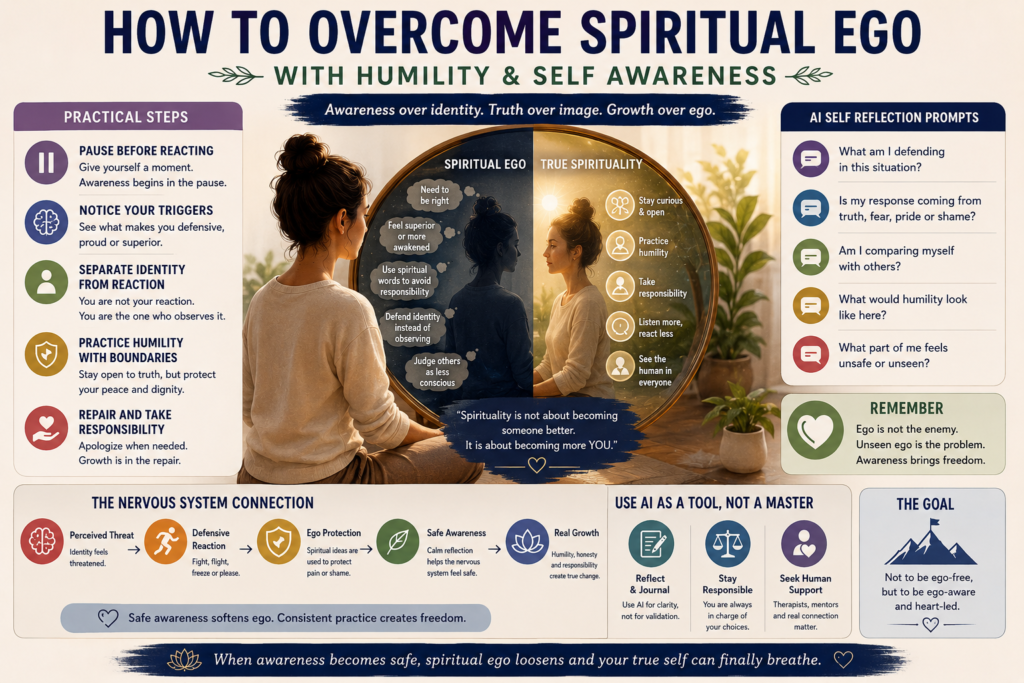
Pause Before Defending Yourself
The first practice is pausing before defending yourself. When someone questions you, corrects you, or disagrees with you, the nervous system may react quickly.
You may want to explain, prove, withdraw, judge, or appear unaffected. That moment is where spiritual ego often becomes visible.
A simple pause gives you space. You do not need to respond immediately. You can breathe, notice the body, and ask, “What am I trying to protect?”
- Sometimes the answer is pride.
- Sometimes it is shame.
- Sometimes it is an old fear of not being respected.
That observation is already growth.
Separate Identity From Reaction
One powerful step in humility and self awareness is separating identity from reaction. Instead of saying, “I am egoistic,” say, “An ego reaction appeared in me.”
This small language shift matters because it reduces shame. You are not making the reaction your whole identity.
This is especially important when working with ego and spirituality. A spiritual person may feel pressure to always be calm, kind, and wise. But real growth allows honesty.
You can admit, “I felt defensive,” without losing your worth. You can say, “I still have work to do,” without calling yourself a failure.
Practice Humility With Boundaries
Humility does not mean allowing disrespect. It does not mean agreeing with everyone. It does not mean becoming passive. Real humility means you can stay open while still having boundaries.
- You can listen without surrendering your judgment.
- You can apologize without collapsing.
- You can disagree without superiority.
This is important because some people confuse humility with self-erasure. That is not healing. Healthy humility is strong, grounded, and honest. It says, “I am willing to learn, but I am also allowed to protect my dignity.”
What Not to Do When You Notice Ego
When you notice spiritual ego, do not attack yourself. Do not say, “I am fake,” “I am not spiritual,” or “I have failed.” That kind of self-talk only strengthens fear. Also, do not use the word ego to shame other people.
The moment you use ego as a label to feel superior, the same pattern returns.
The better response is simple:
- Notice, name, regulate, and repair.
- Notice the reaction.
- Name the emotion.
- Regulate the body.
- Repair where needed.
This is more useful than spiritual performance.
Practical AI Prompts for Spiritual Ego Awareness
AI self reflection can help when you use it carefully. The purpose is not to ask AI to prove you are right. The purpose is to ask better questions. AI can help you slow down, identify emotional patterns, and reflect with more honesty.
Use AI as a journal partner, not as a final authority. You can write what happened, how you reacted, and what you felt. Then ask for reflection questions that help you understand your reaction without blame.
Prompts for Defensiveness
Try these prompts when you feel attacked or misunderstood:
“What might I be defending in this situation?”
“Is my response coming from truth, fear, pride, or shame?”
“What would humility look like here without abandoning my boundary?”
“Help me separate my identity from my emotional reaction.”
These questions support how to overcome spiritual ego because they move you from automatic defense into conscious reflection.
Prompts for Spiritual Superiority
When you feel more aware, evolved, or right than someone else, ask:
“Am I observing clearly, or am I comparing myself?”
“What pain or insecurity may be hiding behind my judgment?”
“How can I hold my understanding without looking down on another person?”
“What would compassion say in this situation?”
This helps soften spiritual ego without denying your insight.
Prompts for Shame and Self-Attack
When awareness turns into self-criticism, ask:
“How can I take responsibility without attacking myself?”
“What is the lesson here, not the punishment?”
“What part of me felt unsafe or exposed?”
“How can I repair this situation calmly?”
This approach protects humility and self awareness from becoming another form of inner violence.
When to Seek Human Support
AI can support reflection, but it cannot replace human care. If your reactions are connected to trauma, intense anxiety, emotional breakdowns, relationship abuse, self-harm thoughts, or serious mental health symptoms, you should seek professional support.
AI may help you organize thoughts, but a qualified therapist, doctor, or crisis service can provide care that technology cannot.
Readers who are unsure about the limits of AI can also explore this related guide: Can AI detect mental health ?
If you are beginning your healing journey and need a calmer direction, visit Start Here – Your Journey to Mental Clarity & Emotional Healing.
You can also explore the Healing Resources Hub for supportive pathways, tools, and guided emotional education.
Final Thoughts: Ego Softens When Awareness Feels Safe
Spiritual ego is not only pride. Sometimes it is a protection pattern that forms around pain, shame, fear, identity, or the need to feel safe. This is why forcing humility does not work. Real humility grows when awareness feels safe enough to continue.
The relationship between ego and spirituality becomes healthier when you stop using spirituality as an image and start using it as a mirror. AI self reflection can support that mirror when used with maturity, honesty, and limits. It can help you pause, ask better questions, and notice hidden reactions.
The deeper goal is not to appear awakened. The goal is to become more honest, more responsible, and more compassionate.
That is how to overcome spiritual ego without self-attack: observe the pattern, soften the defense, repair where needed, and keep returning to truth with humility.