Why Can’t I Stop Overthinking? Calm the Thought Loop
Why Emotionally Important Thoughts Keep Repeating and How to Feel More in Control

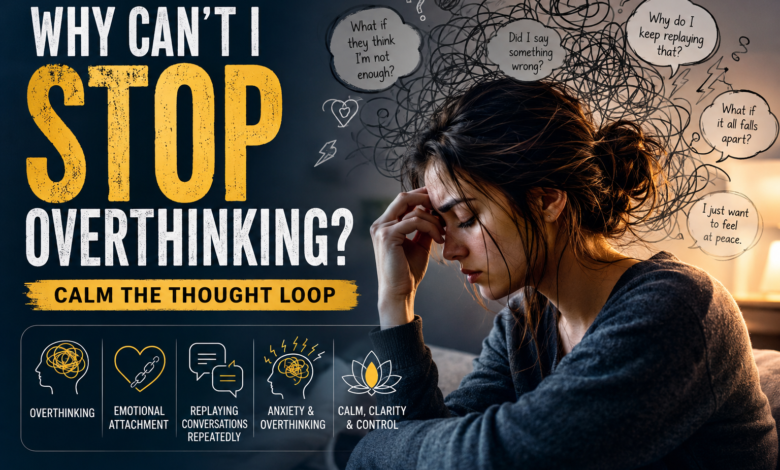
You may keep asking yourself, “Why can’t I stop overthinking?” even when you know the same thoughts are exhausting you.
Thank you for reading this post, don't forget to subscribe!You may keep asking, “Why can’t I stop overthinking?” while replaying conversations repeatedly, predicting negative outcomes, and searching for reassurance. Emotional attachment overthinking can make one person, message, decision, or fear feel impossible to release.
When anxiety and overthinking begin feeding each other, your mind may believe that more analysis will create safety, but the thought loop usually becomes more exhausting.
But relief does not last.
Instead, another question appears.
This often happens when a thought becomes connected to something emotionally important: rejection, love, safety, belonging, self-worth, control or the future. Your mind may believe that more analysis will protect you from pain or help you regain certainty.
Learning how to stop overthinking everything does not mean forcing your mind to become silent. It means recognising the trigger, separating facts from predictions, calming the body and choosing one realistic next step.
This guide explains why repetitive thoughts continue and how to respond with greater clarity, emotional safety and self-respect.
Why Can’t I Stop Overthinking Even When I Know It Is Hurting Me?
You may struggle to stop because your mind believes the situation is still unresolved.
When something feels uncertain or emotionally significant, the mind naturally looks for information. It reviews what happened, predicts what might happen next and tries to prevent a painful outcome.
At first, this may feel like useful problem-solving.
You may think:
- If I examine the conversation carefully, I will understand what they meant.
- If I consider every possibility, I will avoid making the wrong decision.
- If I check one more time, I will finally feel reassured.
- If I understand why they changed, I will be able to let go.
- If I prepare for the worst, I will not be caught off guard.
But overthinking rarely produces permanent certainty. It often creates more interpretations, more questions and more emotional tension.
The mind starts with one uncertainty and ends with ten possible dangers.
So when you ask, “Why can’t I stop overthinking?”, the answer is not that you are weak or incapable of controlling yourself.
Your mind may be trying to protect you through analysis.
The problem is that the protection strategy has become repetitive, exhausting and ineffective.
Emotional attachment overthinking can begin when uncertainty, rejection, or relationship fear makes one thought feel impossible to release.
Clear SERP Answer
You may be unable to stop overthinking because your mind sees the concern as emotionally important and still requiring an answer. Repeated analysis can briefly feel protective, but it often creates more doubt and keeps your attention fixed on the same unresolved issue.
Overthinking may also appear alongside stress, perfectionism, anxiety, low confidence, relationship insecurity or difficulty tolerating uncertainty.
Overthinking is not a diagnosis by itself. Different people may experience repetitive thoughts for different reasons.
Signs You Are Caught in an Overthinking Loop
Overthinking does not always look dramatic.
Sometimes it looks like being careful, responsible or prepared. You may genuinely believe that thinking longer will help you make the safest decision.
You may be caught in an overthinking loop when you:
- replay the same conversation several times;
- reread messages looking for hidden meaning;
- imagine many negative possibilities;
- mentally explain or defend yourself;
- rehearse what you should have said;
- repeatedly check your phone or email;
- seek reassurance but feel uncertain again soon;
- postpone decisions because no option feels completely safe;
- struggle to focus on work or ordinary tasks;
- feel unable to relax until everything makes sense;
- remain awake reviewing the day;
- return to a concern even after you have already acted.
A useful distinction is:
Problem-solving moves towards action, acceptance or a decision. Overthinking keeps reopening the same question without creating lasting clarity.
You may think about a practical problem for twenty minutes and decide what to do next. That is problem-solving.
You may also analyse the same problem for three hours, create ten new fears and remain unable to act. That is more likely to be a repetitive thought loop.
How One Thought Becomes Emotionally Powerful
A thought becomes harder to release when it gains personal meaning.
Imagine that you send an important message and receive no reply.
The observable fact is:
No reply has arrived yet.
But your mind may begin adding interpretations:
- They are losing interest.
- I said something wrong.
- They are intentionally ignoring me.
- I am no longer important.
- The relationship is ending.
- I need to act before I lose them.
The unanswered message has now become connected to rejection, abandonment or self-worth.
That is when the mind stops treating the situation as a simple delay and begins treating it as an emotional threat.
This is how emotional attachment and overthinking can reinforce each other. The more important the person or outcome feels, the more closely your mind monitors it. The more closely you monitor it, the more meaning every silence, delay or change may seem to carry.
For a deeper explanation of why certain bonds can feel so intense, read:
Read Also : understand why emotional bonds can feel difficult to release
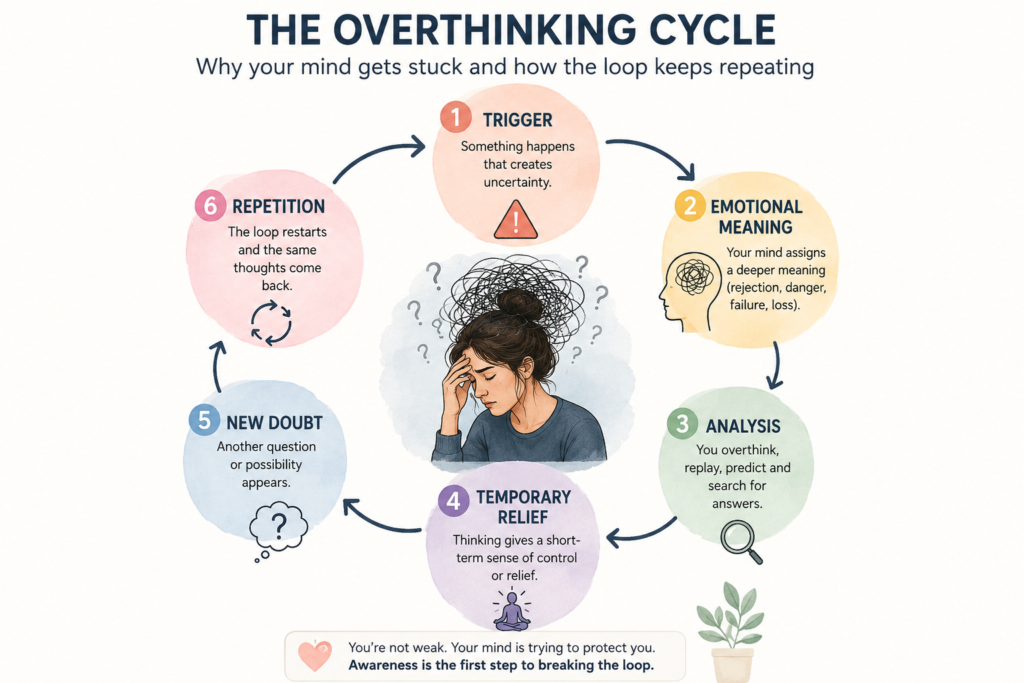
How the Thought Loop Develops
| Stage | What Happens |
|---|---|
| Trigger | A message, memory, decision, silence or uncertain event appears |
| Emotional meaning | The mind connects it with rejection, failure, danger or loss |
| Analysis | You replay, predict, compare and search for certainty |
| Temporary relief | Thinking creates a brief sense of control |
| New doubt | Another interpretation or question appears |
| Repetition | The mind returns to the concern and restarts the process |
The goal is not to stop every thought from appearing.
The goal is to recognise when thinking has stopped helping.
Why Do I Keep Replaying Conversations in My Mind?
Many people find themselves replaying conversations repeatedly after criticism, conflict, emotional distance or an awkward interaction.
You may remember the person’s tone. You may examine their facial expression. You may hear your own words and imagine a better response.
The mind may be trying to:
- understand what happened;
- detect whether you were rejected;
- identify a mistake;
- protect you from future embarrassment;
- restore your sense of control;
- prepare the perfect response;
- prove that your reaction was justified.
This mental replay feels important because the conversation may be connected to belonging, respect or self-worth.
You are not only thinking about words.
You may be thinking about what those words mean about you.
You may find yourself replaying conversations repeatedly, searching for a meaning or mistake that will finally make the discomfort stop.
A More Helpful Question
Instead of asking:
“What exactly did they mean?”
Try asking:
“What did this interaction make me fear?”
The answer may be:
- I fear that I am not respected.
- I fear that they will leave.
- I fear that I looked foolish.
- I fear being misunderstood.
- I fear that I am not good enough.
- I fear that I have lost control of the relationship.
This shift does not solve every situation. But it moves you from endless interpretation towards emotional understanding.
Sometimes the real pain is not the conversation itself.
It is the belief the conversation activated.
Anxiety and Overthinking: Why the Body Feels Involved
Anxiety and overthinking are not experienced only as words inside the mind.
You may also notice:
- pressure in your chest;
- shallow breathing;
- a tight jaw;
- tense shoulders;
- restlessness;
- stomach discomfort;
- difficulty sleeping;
- an urge to check, explain or act;
- difficulty concentrating on anything else.
When you feel emotionally threatened or uncertain, your body may become more alert. That alertness can make a thought feel urgent, even when no immediate action is required.
This does not mean every repetitive thought is caused by nervous-system dysregulation.
It means that mental and physical tension can influence each other.
The more physically activated you feel, the harder it may become to think flexibly. The more you analyse the threat, the more activated your body may become.
Anxiety and Overthinking: Why the Mind Feels Unable to Rest
Use it in:
- introduction;
- nervous-system section;
- PAA answer;
- conclusion;
- one image alt if relevant.
Why Regulating the Body Can Help
At the height of emotional activation, telling yourself to “be logical” may not be enough.
Before trying to solve the entire issue, create a little physical space.
You can:
- Place both feet firmly on the floor.
- Look around and identify five neutral objects.
- Unclench your jaw.
- Drop your shoulders.
- Exhale slightly longer than you inhale.
- Notice where your body feels tense.
- Remind yourself that urgency is a feeling, not always a fact.
This is not a cure or a replacement for professional treatment. It is a low-risk way to reduce the immediate intensity so that you can think more clearly.
For more information about the connection between the body and emotional reactions, read:
Read Also : understand how the body influences emotional reactions
Emotional Attachment and Overthinking: The Search for Safety
Attachment is not a weakness.
Human beings naturally form emotional bonds. We need connection, affection, trust and belonging.
The difficulty begins when your emotional stability becomes completely dependent on another person’s reply, approval or presence.
You may begin to believe:
- I cannot relax until they reply.
- I cannot move on until they explain.
- I cannot feel worthy unless they choose me.
- I cannot make a decision until they approve.
- I cannot accept the ending without perfect closure.
This is where emotional attachment overthinking may become intense.
The mind may not only be looking for information.
It may be looking for emotional safety.
A reply may temporarily feel like safety. An explanation may temporarily feel like control. Reassurance may temporarily feel like love.
But when your inner stability depends entirely on an external response, relief remains fragile.
Attachment Is Not the Same as Love
Healthy love can include:
- care;
- respect;
- honesty;
- mutual responsibility;
- realistic acceptance;
- emotional space;
- the freedom to remain yourself.
Painful attachment may include:
- panic during distance;
- repeated checking;
- fear of abandonment;
- loss of self-respect;
- emotional dependence;
- inability to accept another person’s choices;
- believing you cannot recover without their return.
You can love someone and still recognise that their behaviour is inconsistent, harmful or unavailable.
You can miss someone without making their return the condition for your peace.
For a deeper look at attachment-related pain, read:
Read Also : explore why attachment can create emotional suffering
Why Trying to Force Thoughts Away Can Make Them Stronger
When repetitive thinking becomes exhausting, your first instinct may be to fight it.
You may tell yourself:
- Stop thinking.
- Forget it.
- Be strong.
- Get over it.
- Think positively.
- Do not feel this.
But now you are facing two problems.
The first is the original thought.
The second is the judgment that you should not be having it.
You may then begin checking whether the thought has disappeared:
“Am I still thinking about it?”
That monitoring keeps your attention connected to the thought.
A more useful response is to acknowledge the thought without automatically treating it as a command, fact or emergency.
You might say:
- This thought is here.
- My mind is searching for certainty.
- I feel emotionally activated.
- I do not need to solve everything in this moment.
- I can decide later whether this concern requires action.
Acceptance does not mean that you agree with the thought.
It means that you stop fighting the fact that the thought appeared.
How to Stop Overthinking Everything Without Fighting Your Mind
Trying to stop overthinking everything through willpower alone can feel impossible.
A more practical method is to give your thinking structure.
Use the following seven-step reset.
Step 1: Name the Trigger
Write one sentence:
“My overthinking started when…”
Examples:
- they did not reply;
- I received criticism;
- I remembered an old mistake;
- someone changed their tone;
- I had to make an important decision;
- I felt excluded;
- I noticed a physical symptom.
Naming the trigger makes the problem more specific.
Step 2: Separate Facts From Predictions
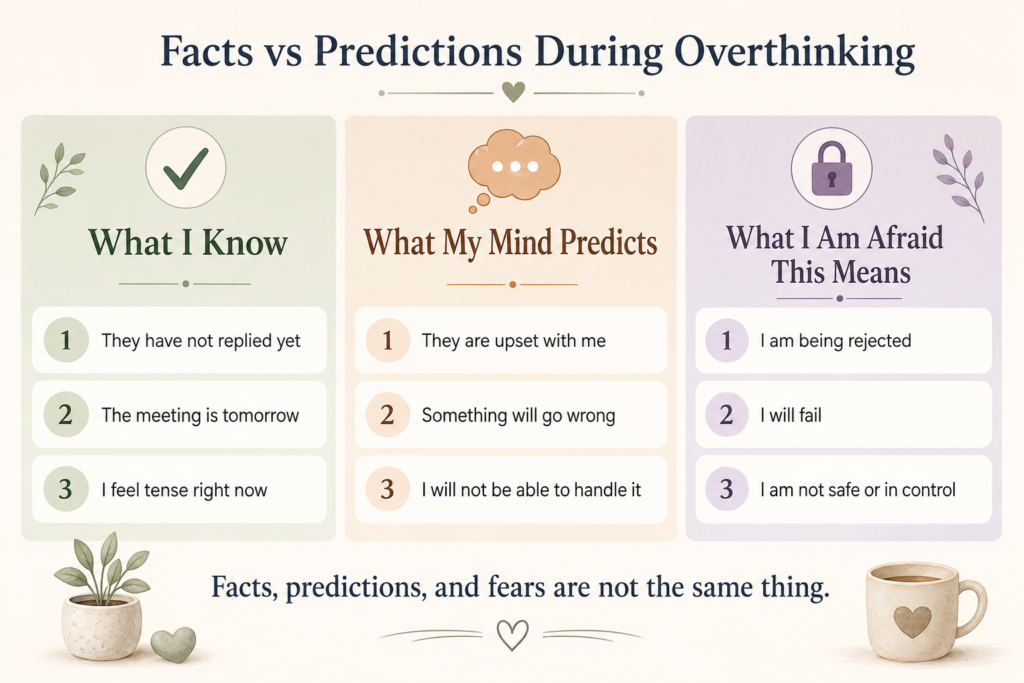
Create two columns.
| Facts | Predictions |
|---|---|
| They have not replied for five hours | They no longer care about me |
| My manager asked to speak tomorrow | I am going to lose my job |
| I made one mistake | Everyone thinks I am incompetent |
| I feel chest tension | Something terrible is definitely happening |
Facts may still be uncomfortable.
But predictions often carry the greatest emotional intensity.
Step 3: Find the Hidden Fear
Ask:
“What am I afraid this situation says about me, my safety or my future?”
Your fear may involve:
- rejection;
- failure;
- abandonment;
- humiliation;
- loneliness;
- loss of control;
- regret;
- uncertainty.
When you identify the hidden fear, the thought becomes easier to understand.
Step 4: Regulate Before You React
When it is safe to wait, avoid making a major decision at the peak of emotional activation.
Pause.
Walk.
Breathe.
Drink water.
Move away from your phone.
Give your body time to settle.
This is not avoidance. You are reducing emotional urgency so that the next step is less reactive.
Step 5: Decide Whether Action Is Possible
Ask:
- Is there a practical action I can take?
- Have I already taken it?
- Is more information genuinely available?
- Am I trying to solve something that only time can reveal?
- Am I seeking certainty that no one can provide?
Choose one realistic action.
Examples:
- send one clear message;
- ask one direct question;
- correct an error;
- schedule an appointment;
- write down a decision deadline;
- pause further contact;
- return to the task in front of you.
Step 6: Place a Limit Around Analysis
Give the concern a defined period, such as fifteen minutes.
During that time, write:
- the trigger;
- the facts;
- the prediction;
- the hidden fear;
- the action available.
When the period ends, return to another activity.
The thought may return. That does not mean the method failed.
Each return is another opportunity to practise a boundary.
Step 7: Accept What Cannot Be Known Yet
Some situations cannot be solved today.
Another person may not explain themselves.
The future may remain unclear.
A past conversation cannot be rewritten.
Acceptance means recognising the limit of control without abandoning yourself.
For additional practical guidance, read:
Read Also : learn practical ways to calm an overactive mind
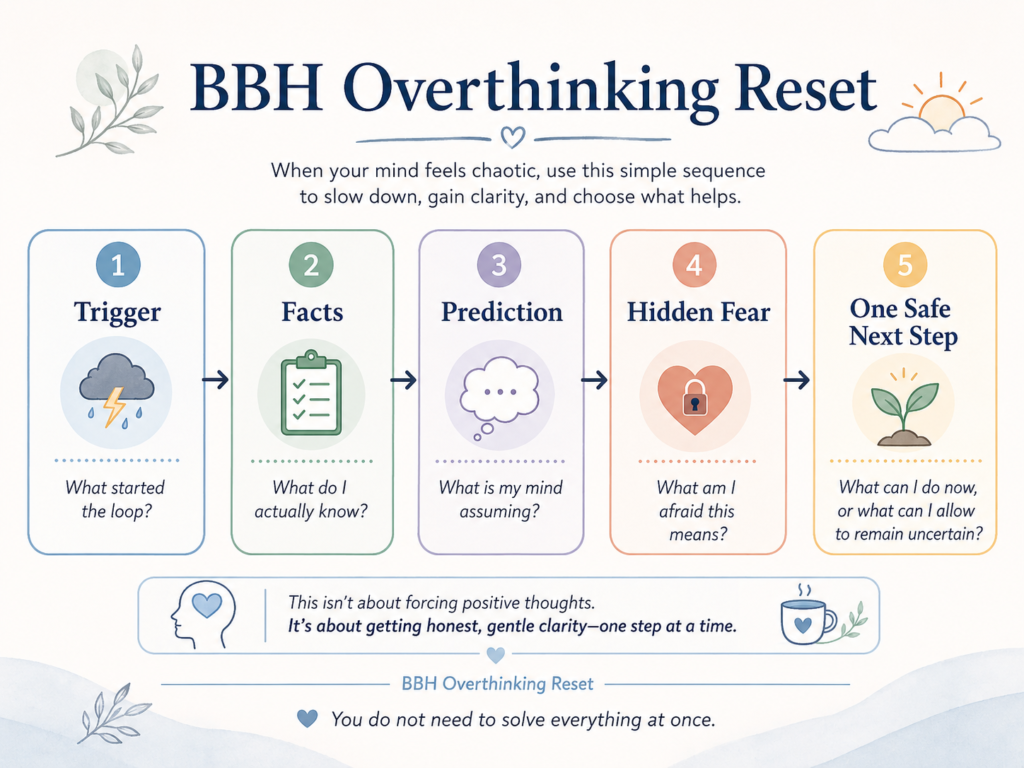
The Five-Minute Thought-Loop Reset
Use this short reset when you notice yourself entering another round of repetitive analysis.
| Minute | Question or Action |
|---|---|
| 1 | What triggered this thought loop? |
| 2 | What facts do I actually know? |
| 3 | What is my mind predicting? |
| 4 | What feeling or fear is underneath? |
| 5 | What is one safe next step—or what must remain uncertain? |
End with this sentence:
“I have listened to the concern. I do not need to continue analysing it right now.”
You may not feel completely calm.
The purpose is not immediate emotional perfection.
The purpose is to interrupt automatic repetition.
Why Reassurance Does Not Always Last
When you feel uncertain, reassurance can provide quick relief.
You may ask:
- Are you angry with me?
- Are we okay?
- Did I do something wrong?
- Do you still care?
- Are you sure nothing bad will happen?
- Do you think I made the right decision?
There is nothing wrong with asking for clarification when you genuinely need it.
The pattern becomes difficult when reassurance must be repeated because no answer feels secure for long.
The cycle may look like this:
- You experience doubt.
- You seek reassurance.
- You feel temporary relief.
- Another possibility appears.
- You seek reassurance again.
Before checking or asking again, pause.
Ask:
- What answer am I hoping to receive?
- Have I already received that answer?
- Will another answer create lasting clarity?
- Can I tolerate a small amount of uncertainty?
- Am I asking for information—or emotional rescue?
Delaying reassurance by even ten minutes can help you observe whether the urge changes.
Why Overthinking Is Often Worse at Night
At night, many distractions disappear.
Work ends. Messages slow down. The room becomes quiet.
Thoughts that remained in the background during the day may move into the centre of your attention.
Tiredness can also make flexible thinking harder. A concern that felt manageable in the afternoon may feel overwhelming at midnight.
To reduce night-time overthinking:
- write unresolved concerns before bed;
- note one action for tomorrow;
- avoid repeatedly checking messages;
- reduce emotionally activating content;
- keep your phone away from the bed when possible;
- use a simple sensory grounding exercise;
- avoid making major life conclusions while exhausted.
You can remind yourself:
“This concern matters, but I do not need to solve it tonight.”
When a Small Event Activates a Larger Emotional Wound
Sometimes the present situation is only part of the pain.
A delayed reply may awaken an old fear of being ignored.
Criticism may activate a long-standing belief that you are never good enough.
A disagreement may feel like proof that every relationship will eventually end.
This does not mean that every reaction comes from childhood or trauma.
It means that current events can sometimes connect with earlier emotional learning.
When your reaction feels much larger than the event, ask:
- What does this remind me of?
- Have I felt this emotional pattern before?
- What meaning am I giving this event?
- Am I responding only to today—or also to an older fear?
For more support in understanding intense reactions, read:
Read Also: recognise why apparently small situations can hurt deeply
Read Also: healing-resources-hub
People Also Ask
1. Why can’t I stop overthinking everything?
You may continue overthinking because your mind interprets a situation as uncertain, unresolved or emotionally important. Repeated analysis can briefly feel protective, but it often produces more possibilities and prevents lasting closure.
2. Why do I replay conversations in my head?
You may replay conversations to understand what happened, identify a mistake, predict another person’s reaction or protect yourself from rejection. The pattern can become stronger when the interaction affects your self-worth or relationship security.
3. Can emotional attachment cause overthinking?
Emotional attachment can contribute to overthinking when a person or outcome becomes closely connected to safety, identity or belonging. However, anxiety, stress, perfectionism and difficulty tolerating uncertainty may also contribute.
4. Why is overthinking worse at night?
Overthinking may feel stronger at night because there are fewer distractions and more room for unresolved concerns. Fatigue, poor sleep and checking messages before bed may also make repetitive thinking more intense.
5. Is overthinking a symptom of anxiety?
Overthinking can occur alongside anxiety, but repetitive thoughts alone do not confirm an anxiety disorder. A qualified professional can assess persistent worry or fear that causes distress or interferes with daily life.
Read Also: Community Support – Free Zoom Healing Space
A Personal Note From Inside the Thought Loop
There is a difference between reading about overthinking and living inside it.
When your mind becomes attached to one possibility, advice such as “just stop thinking” can feel dismissive.
You may already know that the thought is repetitive.
You may already understand that it is not helping.
Yet some part of you still believes that one more round of analysis will create safety.
One lived insight I carry is:
“Sometimes the pain is real, but the story my mind builds around it becomes larger than what I actually know.”
That does not mean the emotion is false.
The feeling is real.
But the interpretation may not be the whole truth.
That small distinction creates space between pain and reaction.
You do not need to hate your mind for trying to protect you.
You can appreciate its intention while changing the method.
When to Seek Professional Support
Occasional overthinking is common.
Consider speaking with a qualified mental-health professional or healthcare provider when repetitive thoughts:
- cause persistent or severe distress;
- regularly interfere with sleep;
- make work or daily responsibilities difficult;
- damage relationships;
- lead to repeated checking or reassurance seeking;
- feel impossible to manage alone;
- occur alongside panic, depression or severe anxiety.
A professional can help determine whether the pattern may be associated with anxiety, obsessive-compulsive symptoms, trauma, depression or another concern.
This article cannot make that determination.
YMYL safety note: Self-help strategies may support emotional regulation, but they cannot replace professional assessment, personal safety or appropriate support when repetitive thoughts involve severe distress, coercion, abuse, humiliation or fear.
Seek urgent local support if you feel unable to keep yourself or someone else safe.
Read Also: mental-health To Try This mind-emotions
Frequently Asked Questions
1. How can I stop overthinking immediately?
You may not be able to remove every thought immediately, but you can interrupt the cycle. Name the trigger, separate facts from predictions, reduce physical tension and identify one practical next step.
2. Should I ignore repetitive thoughts?
Aggressively ignoring thoughts may create more frustration. Notice the thought without automatically treating it as a fact or emergency. Decide whether it contains useful information, an unproven prediction or an emotion that needs acknowledgment.
3. Can journaling help with overthinking?
Journaling may help when it provides structure. Write the trigger, facts, predictions, hidden fear and one safe action. Avoid repeatedly rewriting the same worry without moving towards action or acceptance.
4. How can I stop seeking reassurance?
Pause before asking and write down what you fear, what you already know and whether reassurance has helped before. Delay checking briefly and practise tolerating a small amount of uncertainty.
5. When should I seek help for overthinking?
Seek professional support when repetitive thinking causes serious distress, disrupts sleep or concentration, affects relationships or work, or leads to checking and reassurance patterns that feel difficult to control.
BBH Support Resource
Want a Simple Tool to Interrupt the Thought Loop?
Download the BBH Overthinking Reset Worksheet to identify your trigger, separate facts from predictions, recognise the hidden fear beneath the thought and choose one safe next step.
Email request:
Email info@bioandbrainhealthinfo.com and write:
“Send me the Overthinking Reset Worksheet.”
Final Reflection: You Do Not Have to Solve Every Thought
Overthinking promises certainty but often delivers exhaustion.
The mind tells you that peace will arrive after one more explanation, one more check, one more message or one more mental review.
But peace may begin somewhere else.
It may begin when you recognise that a thought is emotionally important without allowing it to occupy the entire day.
It may begin when you separate facts from predictions.
It may begin when you stop demanding perfect certainty from an uncertain situation.
When you ask, “Why can’t I stop overthinking?”, try not to answer with shame.
Ask instead:
- What feels threatened?
- What am I trying to control?
- What answer am I hoping to receive?
- What do I actually know?
- What remains uncertain?
- What is one safe action I can take?
Your mind does not need punishment.
It needs structure, compassion and boundaries.
You may not stop every thought from appearing. But you can learn not to follow every thought into another hour of fear.
That is how the thought loop gradually loses its power.
External References and Further Reading
- National Institute of Mental Health — Anxiety Disorders
https://www.nimh.nih.gov/health/topics/anxiety-disorders - World Health Organization — Anxiety Disorders
https://www.who.int/news-room/fact-sheets/detail/anxiety-disorders - Mayo Clinic — Anxiety Disorders: Symptoms and Causes
https://www.mayoclinic.org/diseases-conditions/anxiety/symptoms-causes/syc-20350961 - Cleveland Clinic — Anxiety Disorders: Causes, Symptoms, Treatment and Types
https://my.clevelandclinic.org/health/diseases/9536-anxiety-disorders - Centers for Disease Control and Prevention — About Emotional Well-Being
https://www.cdc.gov/emotional-well-being/about/index.html
Educational Disclaimer
This article is intended for general educational and emotional-awareness purposes. It does not diagnose or treat anxiety, obsessive-compulsive disorder, trauma or any other mental-health condition. Individual experiences differ, and personalised guidance should come from an appropriately qualified professional.