AI Emotional Support Tools for a Calmer Mind
How AI Can Help Emotional Regulation and Personal Growth

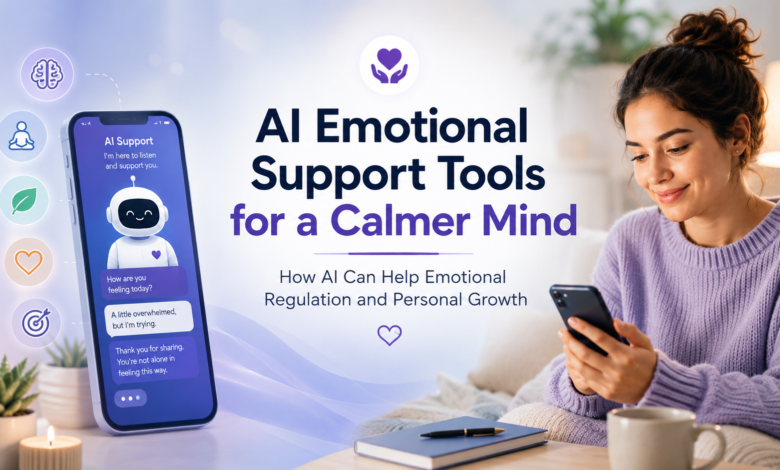
AI emotional support is becoming one of the most searched digital wellness topics because people want safe AI mental health tools, practical emotional regulation tools, emotional maturity development, and responsible AI therapy tools that support reflection without replacing human care.
Thank you for reading this post, don't forget to subscribe!Most people do not need another generic self-help article telling them to “stay calm.” They need a practical way to understand why their emotions take control before their wisdom can speak.
This blog explains AI emotional support in a fresh and responsible way: not as a replacement for therapy, but as a daily reflection tool that can help you pause, name your emotions, regulate your nervous system, and choose mature responses.
Unlike many articles that only discuss AI mental health tools from a technology angle, this guide connects them with real human growth, emotional regulation tools, and emotional maturity development. You will also learn the safe difference between support and AI therapy tools, so you do not become dependent on technology.
The unique BBH angle is simple: AI is useful only when it helps you become more aware, more responsible, more emotionally steady, and more connected to real life.
Introduction: Why AI Emotional Support Matters Today
Many people are not struggling because they are weak. They are struggling because their emotions move faster than their awareness.
One difficult message, one relationship conflict, one mistake at work, one lonely evening, or one anxious thought can suddenly pull the nervous system into reaction mode. The mind starts overthinking. The body becomes tense. The heart feels unsafe.
Before the person can understand what is happening inside, they may already react, withdraw, blame themselves, send the wrong message, or make a decision from emotional pressure instead of calm clarity.
This is where AI emotional support becomes an important modern tool.
AI emotional support is not about replacing therapy, human connection, spiritual wisdom, or professional mental health care. That would be dangerous and unrealistic. But when used wisely, AI can become a structured reflection space.
It can help you slow down, name what you are feeling, ask better questions, organize emotional confusion, and practice healthier responses before your reactions damage your peace, relationships, or self-respect.
In countries like the USA, UK, Canada, and Australia, many people are already searching for digital self-help, online therapy options, journaling tools, emotional wellness apps, and AI mental health tools because daily life has become mentally overloaded.
People want support that is private, immediate, affordable, and easy to access. But support must also be safe, grounded, and emotionally responsible.
The real value of AI is not that it gives you perfect answers. The real value is that it can help you pause long enough to hear yourself clearly.
That pause can become the beginning of emotional maturity.
For deeper support on using AI carefully for self-help, you can also explore BBH’s guide on AI Therapy & Self-Help Tools.
What Is AI Emotional Support?
AI emotional support means using artificial intelligence tools to support emotional awareness, reflection, journaling, calming, and personal growth. It may include guided prompts, emotional check-ins, self-reflection questions, pattern recognition, mood journaling, breathing reminders, and supportive conversation.
But it is important to understand the boundary clearly.
AI emotional support is not a doctor. It is not a licensed therapist. It should not diagnose you, treat serious mental health conditions, replace emergency help, or become your only source of emotional connection. Instead, it works best as a daily reflection companion that helps you understand what is happening inside you before you act from confusion.
For example, if you feel angry after a conversation, AI can help you ask:
“What am I actually feeling under this anger?”
“Is this reaction about the present moment or an older wound?”
“What would a calm response look like?”
“What do I need to regulate before I reply?”
These questions are simple, but they can interrupt automatic reactions. That is where emotional regulation tools become useful. They help create space between trigger and response.
This is also where emotional maturity begins. Maturity is not the absence of emotion. Maturity is the ability to feel emotion without becoming controlled by it.
For readers who want to understand self-reflection as a growth practice, BBH also has a related guide here: ai-self-reflection-personal-growth
AI Emotional Support Is a Mirror, Not a Master
The safest way to use AI emotional support is to see it as a mirror.
A mirror does not live your life for you. It does not decide your values. It does not replace your conscience. It simply helps you see what may be difficult to see when you are emotionally overwhelmed.
When a person is triggered, the brain often narrows its focus. The body prepares for protection. The mind may search for danger, rejection, insult, blame, or loss. In that state, it becomes harder to think with balance. You may believe your first reaction is the truth, even when it is only a nervous system response.
AI can help you gently step back and examine the reaction.
It may help you notice patterns such as:
You become defensive when you feel misunderstood.
You overexplain when you fear rejection.
You go silent when conflict feels unsafe.
You blame yourself when someone becomes distant.
You react quickly when your nervous system feels threatened.
These patterns are not proof that something is wrong with you. They are signals. They show where awareness is needed.
Emotional maturity development is not about becoming perfect; it is about becoming more aware before reacting. With safe AI emotional support, emotional maturity development becomes easier because the reader can notice triggers, reflect on patterns, and choose calmer responses. This kind of emotional maturity development grows slowly through daily practice, honest reflection, and responsible action.
This is why emotional maturity development is not about becoming cold, emotionless, or always calm. It is about becoming honest enough to recognize your patterns and responsible enough to choose a better response.
For more support on calming the body before reacting, connect this blog internally with BBH’s nervous system regulation content: nervous-system-regulation
Why AI Emotional Support Is Growing in the USA, UK, Canada, and Australia
AI emotional support is becoming popular because many people feel emotionally alone even when they are digitally connected.
In the USA, UK, Canada, and Australia, people often face high work pressure, relationship stress, social isolation, therapy waiting lists, financial strain, constant news exposure, and digital overstimulation. Many people want emotional support, but they may not always know where to begin.
- Some hesitate to talk to friends because they fear judgment.
- Some cannot afford regular therapy.
- Some are waiting for appointments.
- Some want privacy.
- Some simply need a calm space at night when anxiety, shame, or overthinking becomes louder.
This does not mean AI should replace human help. It means AI can fill a smaller but useful role: helping people organize their emotions before they reach a crisis point.
Used wisely, AI mental health tools can support small daily practices such as journaling, naming emotions, tracking triggers, preparing for therapy, calming before a difficult conversation, and reflecting after conflict. These tools are most helpful when they encourage awareness, responsibility, and real-world action.
They are less helpful when people use them to avoid human connection, seek constant reassurance, or escape difficult decisions.
This is the BBH position: technology should strengthen humanity, not weaken it.
AI should help you become more emotionally present, not more dependent. It should help you understand your feelings, not outsource your wisdom. It should support your healing, not become your entire support system.
For readers exploring AI and emotional healing more deeply, add this internal link naturally in the blog: ai-emotional-healing-spiritual-self-care
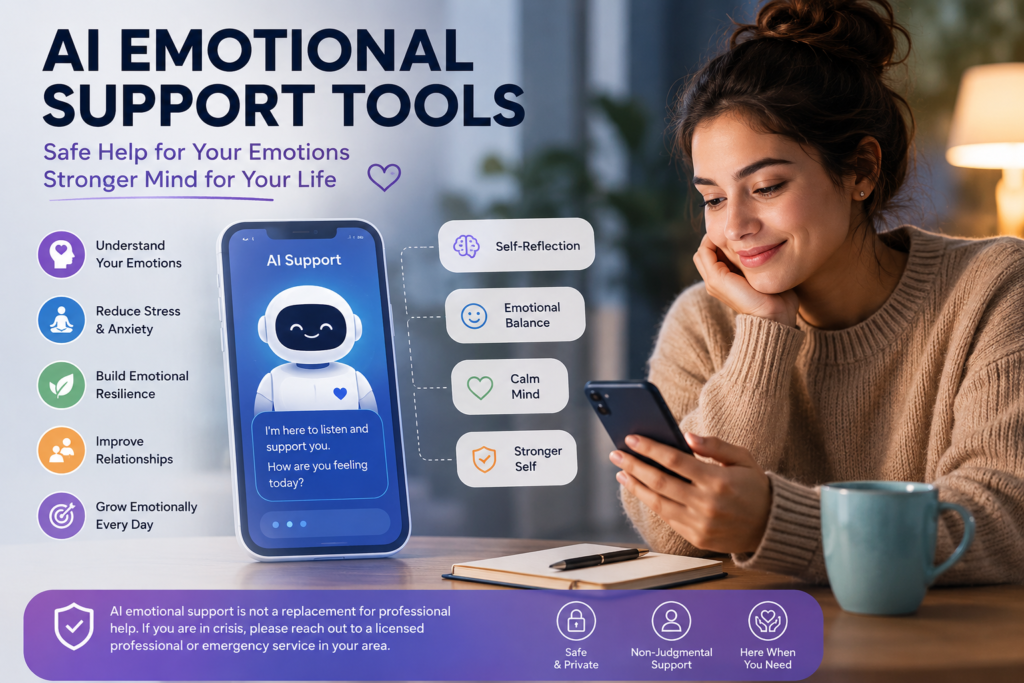
AI Emotional Support vs AI Therapy Tools
Many people use the words AI emotional support and AI therapy tools as if they mean the same thing, but they are not exactly the same.
AI emotional support is broader. It can include journaling, reflection, calming prompts, self-awareness questions, emotional naming, and daily personal growth support.
AI therapy tools usually refer to digital tools designed to support mental health conversations, CBT-style prompts, emotional tracking, or therapy-like guidance. Some may be built with clinical ideas, but that still does not make them a replacement for a licensed professional.
This distinction matters because mental health requires safety.
AI may help you reflect on sadness, anger, overthinking, relationship stress, or emotional confusion. But if you are dealing with self-harm thoughts, severe depression, abuse, trauma crisis, panic that feels unmanageable, addiction, psychosis symptoms, or any situation where you may be unsafe, you need real human and professional support.
A safe AI tool should never make you feel trapped inside the tool. It should guide you toward grounding, trusted people, therapy, crisis support, or medical help when needed.
That is emotional responsibility.
That is also part of emotional maturity.
For a related BBH article on online counseling and AI therapy tools, use this internal link: ai-therapy-tools-a-new-era-of-online-counseling
Quick Reflection Box
Before using AI emotional support, ask yourself:
Am I using this tool to understand myself, or to avoid real action?
Am I looking for calm reflection, or constant reassurance?
Do I need journaling support, or do I need professional help?
Will this help me respond better in real life?
Am I becoming more emotionally responsible after using it?
BBH Insight: AI becomes helpful when it increases awareness, regulation, responsibility, and human connection. It becomes unhealthy when it replaces judgment, relationships, or professional care.
How AI Mental Health Tools Support Emotional Regulation
Emotional regulation does not mean forcing yourself to be calm. It means learning how to notice what is happening inside you before the emotion becomes stronger than your awareness.
Many people react quickly because their body feels unsafe before their mind has time to understand the situation.
- A short message can feel like rejection.
- A delayed reply can feel like abandonment.
- A disagreement can feel like attack.
- A mistake can feel like failure.
In those moments, the nervous system may move into protection mode, and the person may react through anger, silence, overexplaining, people-pleasing, or self-blame.
This is where AI emotional support can become useful. It can help a person slow down and ask clearer questions before reacting.
Instead of immediately replying from anger, a person can ask an AI tool:
“What am I feeling right now?”
“What is the emotion under this reaction?”
“What is the safest calm response?”
“What should I do before sending this message?”
“How can I regulate my body before I make a decision?”
These questions may look simple, but they create a pause. That pause is powerful because most emotional damage happens when there is no pause between trigger and response.
Good AI mental health tools can support emotional regulation by helping users identify emotions, separate facts from assumptions, organize thoughts, and choose grounding steps. They can remind a person to breathe slowly, write what they feel, delay a reactive message, or reframe a thought with more balance.
But the goal is not to depend on AI every time you feel something. The goal is to practice a new emotional skill repeatedly until your mind learns to pause on its own.
For deeper body-based calming support, internally link this section to: Nervous System Regulation
Emotional Regulation Tools: From Reaction to Response
The most important emotional skill is not control. It is choice.
When a person is emotionally triggered, they often believe they have only one option: react, defend, explain, escape, or shut down. But emotional regulation tools help the person create more options. AI can support this process by turning emotional confusion into structured reflection.
For example, when someone feels hurt, AI can help them separate four layers:
What happened: the actual event.
What I felt: sadness, fear, anger, shame, loneliness.
What I assumed: “They do not care about me.”
What I need now: calm, clarity, boundary, conversation, rest.
This structure matters because people often suffer not only from what happened, but from the meaning their nervous system adds to what happened.
A delayed reply may be real. But the thought “I am not important” may be an emotional interpretation. A disagreement may be real. But the belief “I am being rejected” may come from an older wound.
AI emotional support can help the reader slow down enough to see the difference between reality, emotion, memory, and reaction.
This is one of the strongest reasons this blog is useful. It does not only tell the reader to “be mature.” It shows them how emotional maturity is built through small repeated moments of awareness.
A mature response may sound like:
“I feel hurt, but I do not need to attack.”
“I feel anxious, but I do not need to chase reassurance.”
“I feel angry, but I can wait before replying.”
“I feel rejected, but I need more evidence before believing that story.”
“I feel overwhelmed, so I need regulation before conversation.”
This is how emotional regulation becomes practical.
For related support on self-reflection and growth, add this internal link: AI Self-Reflection and Personal Growth
Emotional Maturity Development: How AI Helps You Stop Reacting Automatically
Emotional maturity development is not about becoming perfect. It is about becoming less automatic.
An emotionally immature reaction usually says, “My emotion is the full truth.”
An emotionally mature response says, “My emotion is important, but I still need awareness.”
This difference can change relationships, decision-making, self-respect, and mental peace.
AI emotional support can help emotional maturity development in five practical ways.
First, it helps with emotional naming.
Many people say, “I feel bad,” but they do not know whether that bad feeling is fear, sadness, guilt, shame, disappointment, loneliness, or anger. Naming the emotion reduces confusion and gives the mind a clearer starting point.
Second, it helps with pattern recognition.
If someone repeatedly becomes anxious after small conflicts, AI can help them journal the pattern and notice common triggers. The person may realize the issue is not only the present conflict, but a deeper fear of being misunderstood or abandoned.
Third, it helps with perspective-taking.
AI can ask, “What might the other person be experiencing?” This does not mean excusing harmful behavior. It means widening awareness so the person does not react from only one emotional angle.
Fourth, it helps with responsible communication.
Before sending a message, a person can ask AI to help rewrite it in a calmer, clearer, more respectful way. This can prevent impulsive words that create regret later.
Fifth, it helps with self-leadership.
AI can ask, “What response matches your values?” This question is powerful because emotional maturity is not only about what you feel. It is about who you choose to be while feeling it.
For a related BBH support page, add this internal link: Start Here – Your Journey to Mental Clarity & Emotional Healing
The Healing Compass: Human Wisdom + AI Reflection
AI emotional support becomes powerful when it is used with human wisdom. The tool should not become your authority. It should help you return to your own deeper awareness.
Here is a simple BBH-style healing compass:
| Emotional Trigger | AI Support Question | Mature Response |
|---|---|---|
| Anger after conflict | What is the hurt under this anger? | Pause before replying |
| Fear of rejection | What evidence do I have right now? | Seek clarity, not panic |
| Shame after mistake | What can I learn without attacking myself? | Repair and improve |
| Overthinking at night | What is one grounded action for tomorrow? | Rest before solving |
| Relationship anxiety | What is my need, and how can I express it calmly? | Communicate with respect |
| Emotional overwhelm | What does my nervous system need first? | Regulate before deciding |
This framework is important because it teaches the reader that AI is not the healer. Awareness is the healer. Regulation is the bridge. Human action is the proof.
Many people read emotional wellness articles and feel inspired for a moment, but they do not know what to do when the next trigger happens. This blog gives them a practical system: pause, name, reflect, regulate, choose.
That is the real use of AI emotional support.
When AI Emotional Support Can Help
AI emotional support can be helpful in many everyday situations where the person is not in immediate danger but needs clarity, grounding, and emotional organization.
- It can help when you are overthinking a conversation.
- It can help when you feel angry but do not want to react harshly.
- It can help when loneliness becomes heavy at night.
- It can help when you are trying to understand why a small event created such a strong emotional reaction.
- It can help when you are preparing for a difficult conversation and want to communicate without blame.
- It can help when you are journaling after conflict, breakup pain, work stress, or emotional confusion.
It can also help people prepare for therapy by organizing thoughts before a session. For example, a person can use AI to list patterns, triggers, repeated emotions, and questions they want to discuss with a licensed professional. This makes AI a supportive bridge, not a replacement.
This distinction is essential for trust, especially when discussing AI therapy tools. Readers in the USA, UK, Canada, and Australia are often open to digital mental health support, but they also need ethical clarity.
A strong article must not create false promises.
AI can help with reflection.
AI can help with emotional naming.
AI can help with journaling.
AI can help with calming prompts.
AI can help with communication practice.
But AI should never replace emergency care, professional diagnosis, licensed therapy, real relationships, or medical treatment.
For deeper related reading, internally link to: AI Therapy Tools: A New Era of Online Counseling
AI emotional support is most useful when it helps you pause before reacting, understand your emotional pattern, regulate your nervous system, and return to real human responsibility. It becomes unhealthy when it replaces therapy, truth, relationships, or personal action.
Safe AI Emotional Support, Practical Prompts, and Final BBH Perspective
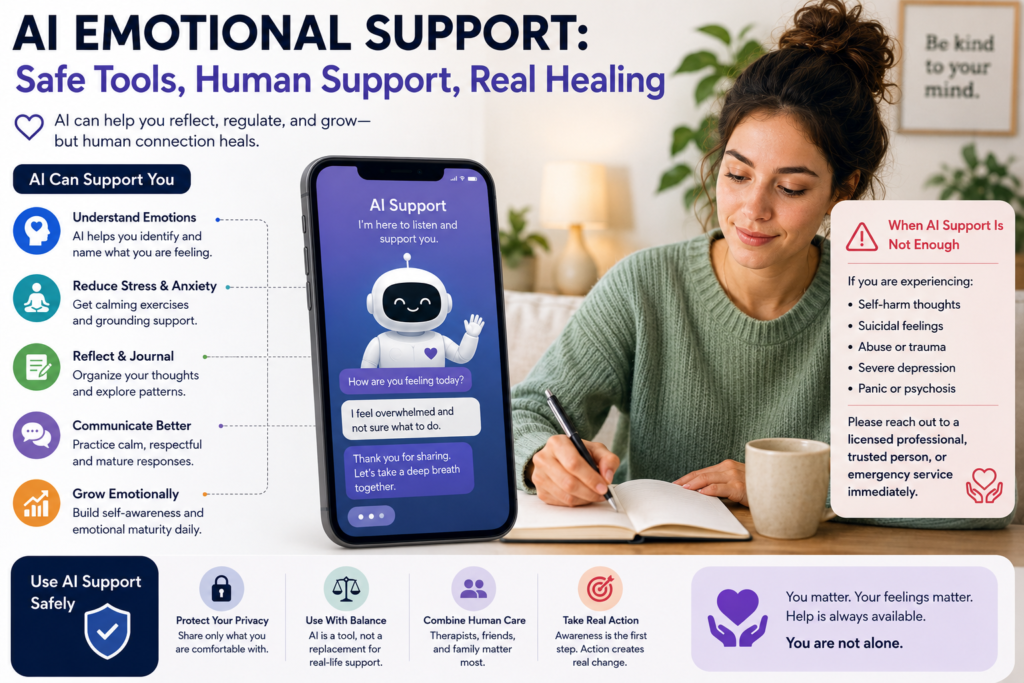
When AI Emotional Support Is Not Enough
AI emotional support can be helpful for reflection, emotional naming, journaling, grounding, and building daily self-awareness. But it has clear limits.
This section is important because mental health content must never give the reader false confidence. AI can support emotional reflection, but it cannot replace a trained therapist, doctor, crisis worker, emergency service, trusted family member, or safe human support system.
If someone is dealing with severe depression, self-harm thoughts, suicidal feelings, abuse, trauma crisis, panic that feels unmanageable, addiction, hallucinations, psychosis symptoms, or any situation where they may not be safe, AI mental health tools are not enough. In those moments, the person needs real human help, professional support, and emergency care when required.
This does not make AI useless. It simply places AI in the correct role.
- AI is best used as a reflection tool before things become overwhelming, or as a supportive tool alongside therapy, journaling, emotional education, and healthy relationships.
- It can help you prepare what to say to a therapist.
- It can help you organize your thoughts after a stressful event.
- It can help you identify repeated emotional patterns. It can help you practice calm communication.
- But it should never become the only place where your pain is held.
Human beings heal through awareness, regulation, responsibility, safe connection, and real-world support. AI can assist some of these steps, but it cannot replace the human nervous system’s need for presence, trust, compassion, and relationship.
For safety-first support content, internally connect this section with: AI Therapy & Self-Help Tools
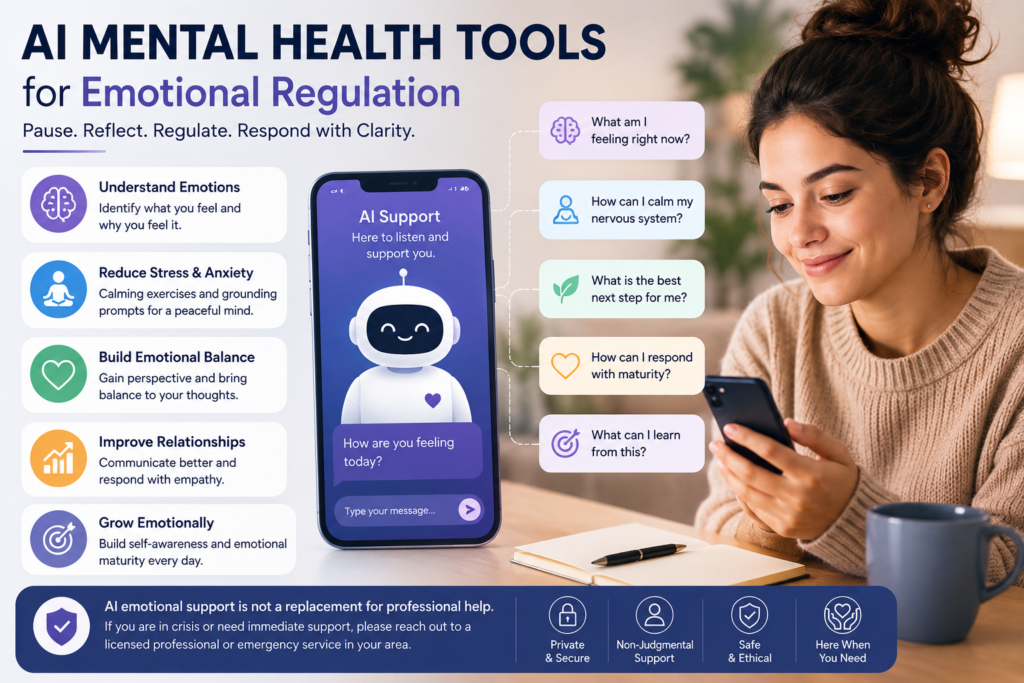
How to Use AI Emotional Support Safely
The safest way to use AI emotional support is to treat it as a helper, not an authority.
Before using AI for emotional support, the reader should understand one rule clearly: AI can help you reflect, but it should not decide your life for you.
- It should not become the final judge of your relationship, identity, health, or future.
- It should not diagnose your mental state or tell you to cut people off, stop medication, avoid therapy, or make major decisions while emotionally activated.
A healthy use of AI looks like this:
You feel triggered.
You pause before reacting.
You ask AI to help you name the emotion.
You separate facts from assumptions.
You regulate your body.
You choose a response that matches your values.
You take real-world action responsibly.
An unhealthy use of AI looks like this:
You feel anxious.
You ask AI for constant reassurance.
You avoid talking to real people.
You use AI to confirm your fear.
You let AI decide what someone else “must” be thinking.
You keep looping without taking action.
You become more dependent instead of more aware.
This distinction is very important for readers in the USA, UK, Canada, and Australia because many people are already comfortable using digital tools for wellness. But comfort does not always mean safety. A tool can be useful and still require boundaries.
AI therapy tools and AI emotional support tools should always be used with privacy awareness, emotional responsibility, and clear limits.
- Personal information should be shared carefully.
- Serious mental health concerns should be discussed with qualified professionals.
- Crisis situations should be taken to emergency or crisis services, not handled only through a chatbot.
For a broader BBH guide on emotional healing with AI, internally link here: AI Emotional Healing and Spiritual Self-Care
Practical AI Prompts for Emotional Regulation
The best emotional regulation tools are simple enough to use when the mind is overwhelmed. These prompts can help the reader use AI emotional support in a calm, responsible way.
1. Emotion Naming Prompt
“I feel overwhelmed. Help me identify whether this is anger, fear, sadness, shame, guilt, or anxiety. Ask me one question at a time.”
2. Trigger Awareness Prompt
“I reacted strongly to something small. Help me understand what emotional trigger may have been activated without blaming me or the other person.”
3. Nervous System Calming Prompt
“Give me a simple grounding exercise I can do in two minutes before I reply or make a decision.”
4. Facts vs Assumptions Prompt
“Help me separate what actually happened from what my mind is assuming because I feel hurt or anxious.”
5. Mature Response Prompt
“Help me write a calm response that is honest, respectful, and emotionally mature. Do not make it cold or aggressive.”
6. Self-Compassion Prompt
“I made a mistake and I am attacking myself. Help me reflect with responsibility but without shame.”
7. Relationship Conflict Prompt
“Help me understand my need in this conflict and how to express it without blame.”
8. Overthinking Prompt
“I am overthinking this situation. Help me identify the one practical next step I can take instead of looping.”
9. Therapy Preparation Prompt
“Help me organize my emotions, triggers, and repeated patterns so I can discuss them with a licensed therapist.”
10. Values-Based Decision Prompt
“Help me choose a response that matches my values, not just my current emotional reaction.”
These prompts work because they do not ask AI to control life. They ask AI to support awareness. That is the correct direction.
For readers who want a deeper growth pathway, internally link to: Start Here – Your Journey to Mental Clarity & Emotional Healing
Emotional Maturity Development Means Returning to Responsibility
The heart of emotional maturity development is responsibility.
Responsibility does not mean blaming yourself for every emotion. It means recognizing that your emotions are real, but your actions still matter.
- You may feel angry, but you are responsible for how you speak.
- You may feel rejected, but you are responsible for not chasing panic.
- You may feel hurt, but you are responsible for not turning pain into attack.
- You may feel afraid, but you are responsible for seeking clarity instead of living inside assumption.
AI emotional support can help because it gives people a structured pause before reaction.
But the deeper growth happens when the person takes that pause into real life.
A mature person does not become emotionless. A mature person becomes more honest, more aware, more regulated, and more careful with the impact of their actions. They learn to say, “This is what I feel, but this is how I choose to respond.”
That one sentence can change a life.
It can protect relationships.
It can reduce regret.
It can calm conflict.
It can increase self-respect.
It can help people stop repeating the same emotional cycle.
For this reason, AI should not be used only for comfort. It should be used for growth. Comfort helps in the moment, but growth changes the pattern.
BBH Perspective: AI Should Strengthen Humanity, Not Replace It
The BBH view is clear: AI should help human beings become more conscious, not more disconnected.
Technology is dangerous when it makes people avoid life. But it can become useful when it helps people return to life with more clarity. The purpose of AI emotional support should not be emotional dependency. It should be emotional self-leadership.
When AI helps someone pause before reacting, it is useful.
When AI helps someone understand a pattern, it is useful.
When AI helps someone prepare for therapy, it is useful.
When AI helps someone communicate with more calm, it is useful.
When AI helps someone remember their values, it is useful.
But when AI replaces human support, real therapy, responsibility, spirituality, relationships, or action, it becomes unhealthy.
This is the balanced path: use AI as a mirror, not as a master.
- A mirror helps you see.
- It does not live for you.
- It does not love for you.
- It does not repair for you.
- It does not choose your values.
- It simply reflects what needs awareness.
That is the healthiest role of AI emotional support.
For BBH’s broader AI category, add this internal link naturally: AI Therapy
Final Thought
AI emotional support is not the future because machines can replace human healing. It is useful because it can help people create one powerful pause between emotion and action.
In that pause, a person can name what they feel.
They can notice the story their mind is creating.
They can calm the nervous system.
They can choose a response instead of repeating an old pattern.
They can become more emotionally mature, not by suppressing feelings, but by learning how to carry them with wisdom.
The goal is not to become dependent on AI. The goal is to become more aware, more regulated, more responsible, and more connected to real life.
When used safely, AI mental health tools, emotional regulation tools, emotional maturity development practices, and AI therapy tools can support healing. But the real growth still happens inside the human being.
AI can offer reflection.
Awareness creates change.
Responsibility makes that change real.
People Also Ask
1. What is AI emotional support?
AI emotional support means using AI tools for reflection, journaling, emotional naming, calming prompts, and self-awareness. It can help users pause before reacting, but it should not replace therapy or emergency support.
2. Can AI emotional support replace therapy?
No, AI emotional support should not replace a licensed therapist, doctor, or crisis support service. It is best used as a reflection tool alongside human care and professional mental health support when needed.
3. How can AI help with emotional regulation?
AI can help users identify emotions, separate facts from assumptions, slow down reactive thoughts, and choose calmer responses. This makes it useful as one of many emotional regulation tools.
4. Are AI mental health tools safe?
AI mental health tools can be helpful, but safety depends on how they are used, whether they protect privacy, and whether users understand their limits. NIMH notes that mental health apps have potential, but effectiveness and regulation remain uncertain. (National Institute of Mental Health)
5. Can AI help with emotional maturity development?
Yes, AI can support emotional maturity development by helping users notice patterns, reflect before reacting, and communicate more calmly. The real growth still depends on human awareness, responsibility, and real-life action.
FAQ
1. What is the best use of AI emotional support?
The best use is guided self-reflection: naming emotions, journaling triggers, calming the nervous system, and preparing for healthier communication. It should support awareness, not replace human judgment.
2. What are examples of AI emotional support prompts?
Examples include: “Help me separate facts from assumptions,” “What emotion is under my anger?” and “Help me write a calm response.” These prompts guide reflection instead of creating dependency.
3. What is the difference between AI emotional support and AI therapy tools?
AI emotional support is broader and may include journaling, grounding, and reflection. AI therapy tools may use therapy-style methods, but the APA warns such tools should not replace qualified mental health care. (American Psychological Association)
4. When should someone not use AI for emotional support?
AI should not be the only support during self-harm thoughts, suicidal feelings, abuse, severe depression, psychosis symptoms, trauma crisis, or emergencies. In these situations, professional or emergency human support is needed.
5. Can AI mental health tools help before therapy?
Yes, AI tools can help users organize emotions, triggers, and questions before a therapy session. This can make therapy more focused, but it should remain a support tool, not a clinical replacement.
External References
- National Institute of Mental Health — Technology and the Future of Mental Health Treatment
URL: https://www.nimh.nih.gov/health/topics/technology-and-the-future-of-mental-health-treatment
Use for: digital mental health tools, benefits, limits, and uncertainty around app effectiveness. (National Institute of Mental Health) - American Psychological Association — Use of Generative AI Chatbots and Wellness Apps
URL: https://www.apa.org/topics/artificial-intelligence-machine-learning/health-advisory-chatbots-wellness-apps
Use for: safety warning that AI chatbots and wellness apps should not replace qualified mental health providers. (American Psychological Association) - World Health Organization — Harnessing Artificial Intelligence for Health
URL: https://www.who.int/teams/digital-health-and-innovation/harnessing-artificial-intelligence-for-health
Use for: responsible AI in health, safety, equity, and health-system support. (World Health Organization) - U.S. Food & Drug Administration — Artificial Intelligence in Software as a Medical Device
URL: https://www.fda.gov/medical-devices/software-medical-device-samd/artificial-intelligence-software-medical-device
Use for: AI/ML health software, regulation, safety, and medical-device context. (fda.gov)