Anxiety Chest Pain vs Heart Attack: How to Tell the Difference
anxiety chest pain vs heart attack

Anxiety Chest Pain vs Heart Attack: How to Tell the Difference Safely
Chest pain can create instant fear.
Thank you for reading this post, don't forget to subscribe!One moment you may feel normal. The next moment your chest feels tight, sharp, heavy, or uncomfortable. Your heartbeat may feel faster. Your breathing may change. Your mind may immediately ask, “Is this anxiety chest pain or heart attack?”
This fear is understandable.
Anxiety can create real physical chest symptoms. But heart problems can also create chest pain that needs urgent medical attention. That is why anxiety chest pain vs heart attack is not a topic to handle casually.
This guide explains the difference in a safety-first way.
The goal is not to help you self-diagnose dangerously. The goal is to help you understand anxiety chest pain symptoms, recognize heart attack warning signs, understand panic attack chest pain, and learn how to tell anxiety from heart attack with more clarity.
Important Safety Note Before Reading Further
Chest pain should never be ignored.
If chest pain is sudden, severe, crushing, spreading, or comes with shortness of breath, sweating, nausea, faintness, or unusual weakness, seek emergency medical help immediately.
Anxiety can cause chest pain.
But only medical evaluation can safely rule out a heart problem.
BBH Safety Rule
Do not use anxiety as an explanation until danger signs are respected.
Calm yourself, but do not dismiss your body.
This is the most important rule in this article.
Anxiety Chest Pain vs Heart Attack: Why They Feel So Similar
The confusion between anxiety chest pain vs heart attack happens because both can affect the chest, heartbeat, breathing, and nervous system.
During anxiety, your body may enter fight-or-flight mode.
This means your brain senses threat, even if there is no actual physical danger. The body then prepares to protect you.
Your heart may beat faster.
Your breathing may become shallow.
Your chest muscles may tighten.
Your body may release stress hormones.
All of this can create real chest discomfort.
Why Anxiety Feels Physical
Anxiety is not only a thought problem.
It is also a body reaction.
That is why anxiety chest pain symptoms can feel intense and frightening. A person may feel chest pressure, stabbing pain, tightness, burning, or a sudden wave of discomfort.
This can make the mind think, “Something is seriously wrong.”
That fear then increases the body’s alarm response.
Read Also: Brain Health
Panic Attack Chest Pain: Why It Feels So Scary
Panic attack chest pain can feel sudden and powerful.
Some people feel a sharp pain.
Some feel tightness.
Some feel a heavy band around the chest.
Some feel breathless, dizzy, sweaty, or shaky.
During a panic attack, the mind may also create frightening thoughts.
You may think:
What if this is a heart attack?
What if I collapse?
What if I cannot breathe?
What if something is wrong with my heart?
These thoughts make the body more alert.
Then the symptoms become stronger.
The Panic Loop
Panic often works like a loop:
Chest sensation → fear thought → body alarm → faster heartbeat → more chest tightness → stronger fear
This is why panic attack chest pain can feel dangerous, even when anxiety is involved.
But this does not mean you should ignore symptoms.
If the pain is new, severe, spreading, or unusual, medical help comes first.
Anxiety Chest Pain Symptoms: What They May Feel Like
Common anxiety chest pain symptoms may include:
- Chest tightness
- Sharp chest pain
- Stabbing chest pain
- Burning feeling
- Pressure in the chest
- Racing heartbeat
- Shortness of breath
- Dizziness
- Tingling in hands or face
- Fear of dying
These symptoms may happen during stress, panic, overthinking, poor sleep, caffeine overload, emotional shock, or fear.
They may also appear after a stressful event, not only during it.
This is why anxiety chest pain can confuse people. The body may still be carrying stress even after the mind thinks the situation is over.
Why Anxiety Can Cause Chest Pain
Anxiety can create chest pain through different body mechanisms.
1. Muscle Tension
When you are anxious, your chest, shoulders, neck, ribs, and upper back may tighten.
This tension can create pain, pressure, or soreness.
2. Fast Breathing
During anxiety, breathing may become quick or shallow.
This can cause chest tightness, dizziness, tingling, and the feeling that you cannot get enough air.
3. Stress Hormones
Anxiety can release adrenaline and other stress hormones.
This may increase heart rate and make the body feel unsafe.
4. Body Checking
When you keep checking your heartbeat, breathing, or chest sensations, your fear may increase.
That fear can make the symptoms feel stronger.
Understanding anxiety chest pain is useful, but safety must still come first.
Heart Attack Warning Signs: Symptoms You Should Not Ignore
Now we need to look at the medical side.
Heart attack warning signs can include chest pressure, squeezing, heaviness, fullness, or pain. The pain may last more than a few minutes.
It may also go away and come back.
A heart attack may not always feel like sharp pain. Many people describe it as pressure or heaviness.
Common Heart Attack Warning Signs
Watch for these symptoms:
- Chest pressure or squeezing
- Pain spreading to arm, jaw, neck, back, or shoulder
- Shortness of breath
- Cold sweating
- Nausea or vomiting
- Dizziness or faintness
- Unusual weakness
- Extreme fatigue
- Pain lasting more than a few minutes
These heart attack warning signs need urgent attention.
Do not wait to see if they disappear.
Do not assume it is anxiety if the symptoms feel severe, new, or different from your usual pattern.
Why Heart Attack Symptoms Can Be Confusing
Heart attack symptoms are not always dramatic.
Some people expect a heart attack to look like sudden collapse. But symptoms can be slower, milder, or unclear.
This is especially important for women, older adults, and people with diabetes, because symptoms may not always look classic.
That is why how to tell anxiety from heart attack cannot depend on one symptom only.
You need a safety-first framework.
How to Tell Anxiety From Heart Attack Safely
Many people search for how to tell anxiety from heart attack because they want fast reassurance.
But chest pain needs careful thinking.
The safer question is not:
“Can I prove this is anxiety?”
The safer question is:
“Do I have any emergency signs that need medical help now?”
This small shift matters.
It stops you from guessing.
It helps you take the safest next step.
The BBH 3-Layer Chest Pain Check
This is the unique BBH framework for this blog.
Use it in this order.
1. Medical Layer
Ask yourself:
- Is the pain sudden?
- Is it severe?
- Is it crushing or pressure-like?
- Is it spreading to arm, jaw, neck, back, or shoulder?
- Is there sweating, nausea, faintness, or shortness of breath?
If yes, seek emergency help.
This layer always comes first.
2. Nervous System Layer
After danger signs are respected, look at the nervous system.
Ask:
- Did this begin during panic?
- Was I under stress?
- Did I sleep poorly?
- Did I have too much caffeine?
- Was I overthinking?
- Did I feel emotionally triggered?
If yes, anxiety may be involved.
This does not replace medical judgment. It only helps you understand the body’s stress pattern.
3. Pattern Layer
Now look at history.
Ask:
- Has this happened before?
- Was it medically checked?
- Did it improve when I calmed down?
- Did breathing, grounding, or relaxation help?
- Does it follow my usual anxiety pattern?
This layer helps you track panic attack chest pain over time.
If a doctor has ruled out heart-related causes, pattern tracking can reduce fear and improve awareness.
Anxiety Chest Pain vs Heart Attack: The Safer Way to Think
The safest way to understand anxiety chest pain vs heart attack is this:
Medical first. Nervous system second. Pattern tracking third.
This protects you from two mistakes.
The first mistake is panic-checking every body sensation again and again.
The second mistake is dismissing real danger by saying, “It is only anxiety.”
A balanced approach is better.
Respect the body.
Calm the nervous system.
Track the pattern.
That is how you build safety and clarity together.
Anxiety Chest Pain vs Heart Attack: Side-by-Side Difference
When chest pain appears, the mind wants one fast answer.
“Is this anxiety or heart attack?”
But the safer approach is not panic. The safer approach is comparison, awareness, and action.
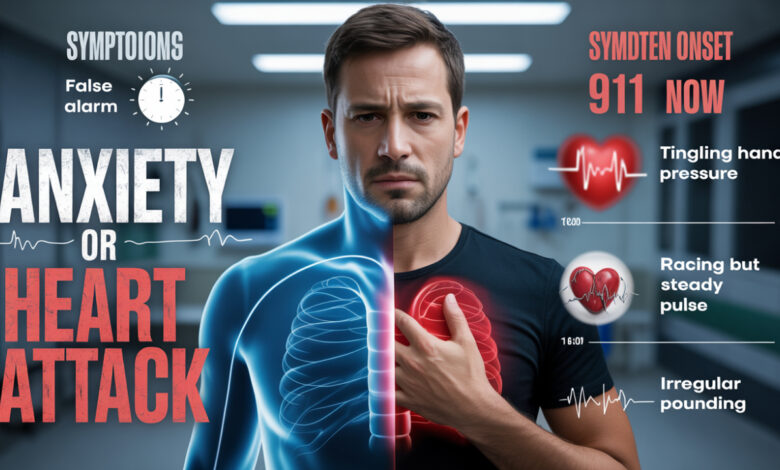
Anxiety chest pain and heart attack chest pain can overlap. Both can affect breathing, heartbeat, sweating, and fear. But there are some common differences that may help you understand what is happening.
Still, one rule must stay clear.
If chest pain feels new, severe, spreading, or unusual, do not guess. Seek medical help.
The table below is not for self-diagnosis. It is for education and awareness.
Anxiety Chest Pain vs Heart Attack Comparison Table
| Feature | Anxiety Chest Pain | Heart Attack Chest Pain |
|---|---|---|
| Onset | Often starts during stress, panic, fear, or overthinking | May start during exertion, rest, or without clear emotional trigger |
| Pain Type | Sharp, stabbing, tight, burning, or sudden discomfort | Pressure, squeezing, heaviness, fullness, or crushing pain |
| Location | Often stays in the chest, but may feel left-sided | May spread to arm, jaw, neck, back, shoulder, or stomach |
| Duration | May reduce as anxiety settles | May last more than a few minutes, return, or worsen |
| Breathing | Fast breathing, air hunger, panic feeling | Shortness of breath may feel heavy or persistent |
| Other Symptoms | Trembling, racing thoughts, fear, tingling, dizziness | Cold sweat, nausea, faintness, unusual weakness, fatigue |
| Relief Pattern | May improve with calming, breathing, grounding, or reassurance | May not improve with rest or calming techniques |
| Safety Rule | Still get checked if symptoms are new or unclear | Emergency medical help is needed immediately |
This comparison can help you understand patterns.
But it should never replace medical judgment.
Chest pain safety comes before symptom interpretation.
Read Also: Mental Health
Pain Type: Sharp Pain vs Pressure Pain
One common difference is the type of pain.
Anxiety chest pain may feel sharp, stabbing, sudden, or tight. Some people feel quick zaps or twinges. Others feel pressure caused by muscle tension or shallow breathing.
Heart attack chest pain is often described as pressure, squeezing, heaviness, fullness, or crushing discomfort.
But this difference is not perfect.
Some anxiety pain can feel heavy.
Some heart-related symptoms may feel mild or unusual.
That is why the question is not only, “What kind of pain is this?”
The safer question is, “Does this pain come with emergency signs?”
Location: Staying in Chest vs Spreading Pain
Anxiety chest pain often stays in the chest area.
It may feel centered, left-sided, or spread around the rib cage because muscles are tight. Sometimes the pain may move because tension shifts across the chest, shoulder, neck, or back.
Heart attack pain may spread beyond the chest.
It may move to the left arm, both arms, jaw, neck, shoulder, back, or upper stomach.
This spreading pattern is important.
Pain that spreads to the arm, jaw, neck, back, or shoulder should be treated seriously.
Do not wait and overanalyze.
Get medical help.
Duration: Short Panic Waves vs Continuing Pain
Panic attack chest pain may rise quickly and then slowly reduce as the body calms.
It may last minutes.
Sometimes it may continue longer if the person keeps panicking, checking symptoms, or breathing too fast.
Heart attack chest pain may last more than a few minutes. It may go away and come back. It may continue, worsen, or feel heavy and persistent.
The duration matters.
But again, duration alone is not enough.
Some panic symptoms can last longer.
Some heart symptoms can be subtle.
If the pain is persistent, worsening, or different from your usual pattern, seek medical help.
Triggers: Emotional Stress vs Physical Warning
Anxiety chest pain often appears during or after emotional stress.
Common triggers may include:
- Panic
- Overthinking
- Poor sleep
- Caffeine
- Emotional conflict
- Work pressure
- Health anxiety
- Fear after reading symptoms online
- Body checking
- Recent trauma or stress
The body may stay activated even after the stressful moment ends.
That is why anxiety chest pain may appear later, when the person finally sits down or tries to rest.
Heart attack pain may happen during physical exertion, emotional stress, or even at rest. This is why trigger alone cannot confirm the cause.
A clear emotional trigger may suggest anxiety, but it does not automatically rule out a heart problem.
Other Symptoms: Panic Signs vs Emergency Signs
Anxiety chest pain may come with panic symptoms.
These may include trembling, tingling, racing thoughts, dizziness, fast breathing, tight throat, stomach discomfort, or fear of dying.
Heart attack warning signs may include sweating, nausea, faintness, shortness of breath, unusual weakness, fatigue, and pain spreading beyond the chest.
The overlap is real.
Both anxiety and heart attack can involve sweating, shortness of breath, nausea, and fear.
This is why it is unsafe to rely only on one symptom.
Look at the full pattern.
And when in doubt, choose safety.
Read Also: Anxiety & Overthinking
When Chest Pain Needs Emergency Help
Some symptoms should never be handled as “just anxiety.”
Call emergency services or seek urgent medical help if you have:
- Chest pressure, squeezing, heaviness, or crushing pain
- Pain spreading to arm, jaw, neck, back, or shoulder
- Shortness of breath
- Cold sweat
- Nausea or vomiting
- Faintness or dizziness
- Sudden weakness
- Pain lasting more than a few minutes
- Chest pain during physical activity
- New or unusual chest pain
- Symptoms that feel different from your normal anxiety pattern
This is the most important section for reader safety.
Do not try to prove it is anxiety when emergency signs are present.
Your body deserves protection before explanation.
Why “It Is Only Anxiety” Can Be Dangerous
Many people with anxiety feel embarrassed after repeated health scares.
They may think, “I always panic. This must be anxiety again.”
But that thinking can become risky.
Even if you have anxiety history, new chest pain should still be respected.
Anxiety history does not make you immune to heart problems.
And heart symptoms do not always look the same every time.
The safer sentence is:
“This may be anxiety, but I will first check whether it needs medical attention.”
That is a responsible mindset.
It protects the body without feeding panic.
Why Panic Makes Chest Pain Feel Worse
Panic attack chest pain can intensify because of fear.
When you notice chest pain, your mind may scan for danger.
You may check your pulse.
You may search symptoms online.
You may keep asking, “Is this serious?”
Each check may create temporary reassurance.
But then fear returns.
This cycle trains the brain to watch the body more closely.
The more you watch the chest, the more sensations you may notice.
The more sensations you notice, the more fear rises.
Then the chest feels worse.
This is not weakness.
It is a nervous system loop.
The BBH Fear-to-Safety Shift
When chest pain appears, fear asks:
“What if this is dangerous?”
Safety asks:
“What action protects me right now?”
This shift is important.
Fear makes the mind spin.
Safety gives the body a clear next step.
If symptoms match emergency signs, the safest action is medical help.
If a doctor has already ruled out heart issues and the symptoms match your known anxiety pattern, the next safest action is nervous system calming.
The goal is not blind reassurance. The goal is safe order.
Medical first.
Nervous system second.
Pattern tracking third.
Read Also: Panic Disorder
How to Calm Anxiety Chest Pain Safely
Use calming tools only after emergency signs are not present or after medical danger has been ruled out.
Calming techniques are not meant to replace medical care.
They are meant to help the nervous system settle when anxiety is likely.
1. Slow Your Breathing
Do not force deep breathing.
Forced breathing can sometimes make panic worse.
Instead, breathe gently.
Let your exhale become slightly longer than your inhale.
This tells the body that danger may be reducing.
2. Relax the Chest and Shoulders
Drop your shoulders.
Relax your jaw.
Let your hands rest.
Notice if your chest, neck, or upper back is tight.
Anxiety often hides inside muscle tension.
Softening the body can reduce the alarm signal.
3. Use Grounding
Look around the room.
Name what you can see.
Feel your feet on the floor.
Touch something stable.
Let your mind return to the present moment.
Grounding helps move attention away from fear imagination and back to current reality.
4. Reduce Body Checking
If a doctor has already ruled out heart danger, repeated checking can keep anxiety alive.
Checking pulse again and again may increase fear.
Searching symptoms again and again may increase uncertainty.
Asking for reassurance again and again may train the mind to doubt itself.
After safety is confirmed, reduce checking slowly.
5. Track the Pattern
Tracking is not the same as obsessing.
Obsessing asks, “What is wrong with me?”
Tracking asks, “What pattern can I understand?”
This is where awareness becomes useful.
Write down what happened before the chest pain.
Look at stress, sleep, caffeine, emotional triggers, food timing, breathing, and body tension.
Over time, this may help you see whether anxiety chest pain follows a repeated pattern.
The BBH Chest Pain Awareness Tracker
A tracker can help you understand symptoms without becoming trapped in fear.
Use it after the urgent moment has passed.
Track:
- Time the chest pain started
- What the pain felt like
- Where the pain was located
- What symptoms came with it
- What happened before the pain
- Stress level that day
- Sleep quality
- Caffeine intake
- Emotional triggers
- What helped
- Whether medical help was needed
- What the doctor advised, if checked
This makes the blog more practical for readers.
It also gives them a calm structure instead of panic-searching online.
The purpose of tracking is awareness, not self-diagnosis.
When to Talk to a Doctor About Anxiety Chest Pain
You should talk to a doctor if chest pain keeps returning.
You should also speak to a doctor if symptoms are new, unclear, or affecting your daily life.
Medical review is especially important if you have:
- High blood pressure
- Diabetes
- High cholesterol
- Family history of heart disease
- Smoking history
- Previous heart condition
- Chest pain during activity
- Repeated panic attacks
- Severe health anxiety
A doctor can help rule out medical causes.
After that, you can work more confidently on anxiety, nervous system regulation, panic recovery, and stress management.
Part 2 Closing
The difference between anxiety chest pain and heart attack is not always simple.
That is why chest pain needs a safety-first approach.
Comparison can help.
Awareness can help.
Calming techniques can help.
But emergency signs must always come first.
Respect the body first. Calm the nervous system second. Track the pattern third.
Read Also: Support Page
After Medical Clearance: What To Do Next
If a doctor has ruled out a heart-related cause, the next step is not to shame yourself.
Many people feel embarrassed after anxiety chest pain.
They may think, “Why did I panic so much?”
Or, “Why does my body keep doing this?”
Or, “Why can’t I control my mind?”
But anxiety chest pain is not a character weakness.
It is a nervous system response.
Once medical danger is ruled out, your work shifts from emergency fear to recovery structure.
The goal is not to ignore the body. The goal is to understand the body safely.
Build a Calm Response Plan for Anxiety Chest Pain
A calm response plan helps you avoid panic when symptoms return.
Without a plan, the mind may start searching online, checking the pulse, imagining the worst, or asking for repeated reassurance.
With a plan, you already know the next safe step.
Step 1: Check Safety First
Ask yourself:
- Is this pain new?
- Is it severe?
- Is it spreading?
- Is it pressure-like or crushing?
- Is there shortness of breath, sweating, nausea, faintness, or unusual weakness?
If yes, seek medical help.
This step always comes first.
Step 2: Slow the Alarm
If emergency signs are not present, begin calming the body.
Sit down.
Unclench your jaw.
Drop your shoulders.
Let your hands rest.
Breathe gently.
Do not force deep breathing.
A slow exhale can help the nervous system settle.
Step 3: Name the Pattern
Instead of saying, “Something is wrong with me,” say:
“This may be my nervous system reacting.”
This does not dismiss the symptom.
It gives the mind a calmer explanation after safety is checked.
Step 4: Track What Happened Before It
Look at the hours before the chest pain.
Was there stress?
Poor sleep?
Too much caffeine?
Conflict?
Overthinking?
A health fear?
A work pressure moment?
This helps you understand the pattern without panicking.
Nervous System Regulation for Anxiety Chest Pain
When anxiety chest pain happens repeatedly, the nervous system may be living in a high-alert state.
This means the body is scanning for danger too often.
Small sensations feel bigger.
Normal heartbeat changes feel threatening.
Muscle tension feels like a warning sign.
Breathing changes feel scary.
The goal of nervous system regulation is not to become emotionless.
The goal is to teach the body that it does not need to stay in alarm all day.
Practice Gentle Breathing
Do not breathe aggressively.
Do not force huge breaths.
Try soft breathing.
Let the exhale become longer than the inhale.
This can help reduce body alarm.
Reduce Stimulants
Caffeine, nicotine, poor sleep, and too much screen stress can make anxiety symptoms stronger.
If chest pain appears during anxious periods, notice whether stimulants are increasing body activation.
You do not need to become extreme.
You need awareness.
Move the Body Carefully
Gentle walking can help discharge stress.
Stretching the chest, shoulders, and upper back may reduce muscle tension.
But if chest pain happens during physical activity, stop and seek medical advice.
Exercise-related chest pain should be taken seriously.
Create a Wind-Down Routine
An anxious body often needs a clear shutdown signal.
At night, reduce intense content.
Avoid symptom-searching before sleep.
Keep the room calm.
Let the body understand that the day is ending.
This can slowly reduce background stress.
How to Stop the Fear Cycle Around Chest Pain
The fear cycle is one of the hardest parts.
The symptom appears.
The mind becomes afraid.
The body becomes more activated.
The symptom gets stronger.
Then the mind says, “See, it is serious.”
This loop can repeat many times.
Breaking it does not mean arguing with the body.
It means changing your response.
Stop Fighting the Sensation
Fighting the sensation often increases fear.
Instead of saying, “Go away, go away,” try saying:
“My body feels alarmed right now.”
This creates distance between you and the panic.
Stop Searching Symptoms Again and Again
Searching online may feel helpful for five minutes.
But repeated searching often increases uncertainty.
One article says one thing.
Another article says another.
Then the mind feels more confused.
After safety is checked, reduce repeated searching.
Stop Testing Yourself Constantly
Some people keep checking pulse, breathing, chest pressure, or oxygen feeling.
This can train the brain to monitor the body too closely.
The body then becomes a source of fear.
After medical clearance, slowly reduce checking behavior.
Use the BBH Grounding Question
Ask:
“What is the safest next step right now?”
Not the scariest possibility.
Not the worst imagination.
Just the safest next step.
This one question can bring the mind back from panic to action.
Daily Habits That May Reduce Anxiety Chest Pain
Long-term improvement usually comes from small repeated habits.
One calming technique helps in the moment.
But daily regulation helps reduce how often the body enters alarm.
Improve Sleep Rhythm
Poor sleep can increase anxiety sensitivity.
When the body is tired, small sensations feel more threatening.
A steady sleep routine can support emotional stability and reduce panic sensitivity.
Eat on Time
Skipping meals can sometimes increase shakiness, weakness, and anxiety feelings.
This can make chest symptoms feel more frightening.
Balanced meals support nervous system stability.
Limit Health Anxiety Triggers
Some people become more anxious after watching medical videos, reading symptoms, or checking forums.
Education is useful.
Compulsive checking is not.
Choose trusted medical sources.
Avoid endless searching.
Practice Body Awareness Without Fear
Body awareness is different from body checking.
Body checking asks, “Is something wrong?”
Body awareness asks, “What is my body trying to communicate?”
This shift reduces fear.
It helps you notice tension, tiredness, stress, and breathing changes earlier.
Build Emotional Release
Sometimes the body holds stress that the mind ignored.
Unspoken fear, grief, pressure, anger, or exhaustion may appear as body tension.
Journaling, talking to someone safe, gentle movement, and quiet reflection can help release pressure slowly.
When Anxiety Chest Pain Keeps Returning
If anxiety chest pain keeps returning, do not only fight each episode separately.
Look at the bigger pattern.
Repeated chest pain may be connected to:
- Chronic stress
- Panic disorder
- Health anxiety
- Unresolved fear
- Sleep problems
- Caffeine sensitivity
- Work pressure
- Emotional overload
- Muscle tension
- Breathing pattern problems
A doctor can help rule out physical causes.
A mental health professional can help if panic, anxiety, trauma, or health fear is driving the pattern.
Getting support does not mean you are weak. It means you are building safety.
What Not To Do During Chest Pain
Some reactions can make fear stronger.
Avoid these if emergency signs are not present or after medical danger has been ruled out.
Do Not Keep Googling Symptoms
Repeated searching often creates more fear.
It rarely gives lasting peace.
Do Not Ignore New or Severe Symptoms
Do not force yourself to be “strong” if symptoms feel serious.
Medical help is not overreaction when chest pain is concerning.
Do Not Shame Yourself
Shame increases stress.
Stress increases body alarm.
Body alarm increases symptoms.
This cycle does not help healing.
Do Not Rely Only on Reassurance
Reassurance may calm you briefly.
But if you need it again and again, the mind becomes dependent on external confirmation.
Build a response plan instead.
A Simple BBH Recovery Framework
After medical safety is clear, use this recovery framework.
1. Respect
Respect chest pain enough to check danger signs.
Do not dismiss the body.
2. Regulate
Use breathing, grounding, muscle relaxation, and gentle routine to settle the nervous system.
3. Reflect
Ask what was happening before the symptom.
Stress often leaves clues.
4. Record
Track symptoms, triggers, and what helped.
Patterns reduce confusion.
5. Rebuild
Create daily habits that support calm, sleep, movement, emotional processing, and medical follow-up when needed.
Recovery is not one perfect calm moment. Recovery is a safer relationship with your body.
Final Thoughts on Anxiety Chest Pain vs Heart Attack
Anxiety chest pain vs heart attack can be confusing because both can affect the chest, breathing, heartbeat, and fear response.
That is why the safest approach is not guessing.
The safest approach is order.
Medical first.
Nervous system second.
Pattern tracking third.
If chest pain is sudden, severe, spreading, pressure-like, or comes with sweating, nausea, faintness, shortness of breath, or unusual weakness, seek emergency medical help.
If medical danger has been ruled out and the symptoms match anxiety patterns, then calming the nervous system becomes the next step.
Anxiety chest pain is real.
Panic attack chest pain can feel frightening.
Heart attack warning signs must be respected.
And learning how to tell anxiety from heart attack should always begin with safety, not denial.
Your body is not your enemy. It needs protection, understanding, and calm training.
Frequently Asked Questions
1. Can anxiety chest pain feel like a heart attack?
Yes. Anxiety chest pain can feel like a heart attack because it may involve chest tightness, racing heartbeat, shortness of breath, sweating, dizziness, and fear.
This is why chest pain should be treated carefully.
If symptoms are new, severe, spreading, or unusual, seek medical help.
2. How do I know if chest pain is anxiety or heart attack?
Anxiety chest pain may happen during panic, stress, overthinking, or emotional overload. It may feel sharp, tight, stabbing, or sudden.
Heart attack chest pain may feel like pressure, squeezing, heaviness, or pain spreading to the arm, jaw, neck, back, or shoulder.
If you are unsure, choose medical safety first.
3. Can panic attack chest pain happen on the left side?
Yes. Panic attack chest pain can happen on the left side.
But left-side chest pain can also be related to heart problems.
Do not decide based on location alone. New, severe, spreading, or unusual pain should be medically checked.
4. How long does anxiety chest pain last?
Anxiety chest pain may last a few minutes or longer, especially if panic continues.
It may reduce as breathing slows, muscles relax, and the nervous system settles.
But if chest pain lasts, worsens, returns, or feels different from your normal pattern, seek medical advice.
5. What are serious heart attack warning signs?
Serious heart attack warning signs include chest pressure, squeezing, heaviness, pain spreading to arm, jaw, neck, back, or shoulder, shortness of breath, cold sweat, nausea, faintness, unusual weakness, or extreme fatigue.
These symptoms need urgent medical attention.
6. Should I use breathing exercises during chest pain?
Breathing exercises may help if anxiety is likely and emergency signs are not present.
But breathing exercises should not replace emergency care.
If chest pain is severe, spreading, pressure-like, or comes with serious symptoms, get medical help first.
7. Can anxiety cause chest tightness every day?
Anxiety can cause repeated chest tightness, especially during chronic stress, panic, poor sleep, muscle tension, or shallow breathing.
Still, repeated chest pain should be discussed with a doctor to rule out medical causes.
8. What should I do after a doctor says my chest pain is anxiety?
After medical clearance, create a nervous system plan.
Track triggers, reduce body checking, practice gentle breathing, improve sleep, manage caffeine, and learn grounding techniques.
Support from a mental health professional may help if panic or health anxiety continues.
People Also Ask
1. How do I know if chest pain is anxiety or heart attack?
Anxiety chest pain often appears during panic, stress, or overthinking. Heart attack pain may feel like pressure, heaviness, or pain spreading to the arm, jaw, neck, or back. If unsure, seek medical help.
2. Can anxiety chest pain feel like a heart attack?
Yes, anxiety chest pain can feel like a heart attack because it may cause chest tightness, racing heartbeat, shortness of breath, sweating, and fear.
3. What does anxiety chest pain feel like?
Anxiety chest pain may feel sharp, stabbing, tight, burning, or pressure-like. It may come with fast breathing, dizziness, trembling, or fear.
4. What are heart attack warning signs?
Heart attack warning signs include chest pressure, pain spreading to the arm or jaw, shortness of breath, sweating, nausea, faintness, or unusual weakness.
5. Should I go to the ER for anxiety chest pain?
Go to the ER if chest pain is severe, spreading, pressure-like, new, or comes with sweating, nausea, faintness, or shortness of breath.
6. How can I calm anxiety chest pain safely?
After emergency signs are ruled out, sit down, relax your shoulders, breathe gently, ground yourself, and reduce repeated body checking.
External References
- American Heart Association – Warning Signs of a Heart Attack
https://www.heart.org/en/health-topics/heart-attack/warning-signs-of-a-heart-attack - Mayo Clinic – Chest Pain: Symptoms and Causes
https://www.mayoclinic.org/diseases-conditions/chest-pain/symptoms-causes/syc-20370838 - Mayo Clinic – Heart Attack Symptoms
https://www.mayoclinic.org/diseases-conditions/heart-attack/in-depth/heart-attack-symptoms/art-20047744 - NHS – Chest Pain
https://www.nhs.uk/symptoms/chest-pain/ - NHS – Heart Attack
https://www.nhs.uk/conditions/heart-attack/