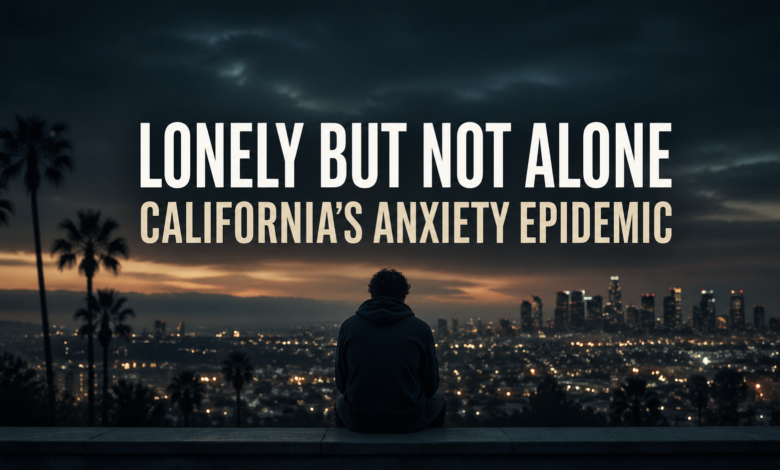
California Anxiety Epidemic: Why People Feel Lonely But Not Alone
Lonely But Not Alone: How California’s Anxiety Epidemic Is Growing

Many people feel surrounded by people, messages, work, and social media, yet still feel emotionally alone. This blog helps readers understand why the California anxiety epidemic is not only about stress, but also about loneliness, digital overload, social isolation, and the loss of safe human connection.
Thank you for reading this post, don't forget to subscribe!Readers need this blog because anxiety and loneliness often hide behind daily life. A person may look successful, active, and connected outside, but inside they may feel tired, unseen, anxious, or disconnected. This article explains that pattern clearly.
What makes this blog unique is the BBH Modern Loneliness Framework, which shows five deeper layers: contact without connection, performance without rest, digital closeness without emotional safety, independence without support, and anxiety without language.
This blog gives readers clarity, emotional validation, and practical steps to reconnect safely without shame.
California Anxiety Epidemic: Why People Feel Lonely But Not Alone
California is often seen as a place of opportunity, success, technology, beauty, creativity, and social life.
People are surrounded by offices, beaches, restaurants, traffic, gyms, events, group chats, and social media. From Los Angeles to San Francisco, life looks active and connected.
But many people are quietly struggling inside.
They are not always physically alone. They may have coworkers, online followers, family contacts, and people around them every day. Still, they may feel emotionally unseen, unsupported, and anxious.
This is the deeper problem behind the California anxiety epidemic.
The issue is not only isolation. The deeper issue is contact without connection.
People are reachable, but not emotionally held.
They are visible, but not deeply known.
They are busy, but not truly supported.
That is why loneliness in California is not only a social problem. It is also a mental health problem. When emotional connection becomes weak, anxiety and loneliness can grow together.
Read Also: Loneliness & Isolation
What Is the California Anxiety Epidemic?
The California anxiety epidemic means the rising emotional stress, nervous system pressure, worry, loneliness, and social disconnection many people feel in modern California life.
This does not mean every person in California has anxiety.
It means the lifestyle pressure around many people can increase anxiety symptoms.
High living costs, work pressure, social comparison, digital overload, housing stress, climate worry, and emotional disconnection can all affect mental health.
A person may look successful outside but feel unsafe inside.
They may work, post, smile, reply to messages, and keep moving. But internally, they may feel tired, restless, disconnected, or afraid of falling behind.
This is why the California anxiety epidemic is not only about panic attacks. It is also about daily emotional pressure.
Why California Anxiety Feels Different
California has a unique emotional environment.
There is ambition, technology, beauty culture, competition, financial pressure, migration, diversity, and constant comparison.
People may feel they must be productive, attractive, successful, socially active, emotionally stable, and financially strong at the same time.
That creates hidden pressure.
The mind may start thinking:
“Everyone else is doing better.”
“Everyone else has better friends.”
“Everyone else is more successful.”
“Everyone else belongs somewhere.”
These thoughts can increase anxiety and loneliness.
The mind does not only compare money or success. It compares lifestyle, confidence, relationships, body image, social life, and emotional stability.
That is why this topic needs a deeper explanation.
The California anxiety epidemic is not only stress.
It is stress mixed with disconnection.
Loneliness in California: Alone in a Crowded Life
Loneliness in California can feel confusing because many people are surrounded by people.
There are cities, offices, campuses, cafés, beaches, workplaces, and social spaces. But being around people does not always mean feeling connected.
A person can sit in a crowded café and still feel invisible.
A person can have hundreds of contacts and still feel like no one truly knows them.
A person can live in a beautiful city and still feel emotionally homeless.
This is the “lonely but not alone” problem.
The person is not empty of people.
They are empty of safe connection.
Read Also: Anxiety & Overthinking
Contact Is Not the Same as Connection
Modern life gives people many forms of contact.
Messages.
Likes.
Comments.
Meetings.
Notifications.
Short conversations.
Online reactions.
But contact is not the same as connection.
Connection requires emotional safety. It requires trust, presence, honesty, and space where a person does not have to perform.
This is why loneliness in California can grow even when someone is socially active.
Many interactions stay surface-level. They do not reach the deeper need for belonging.
A person can be highly connected online and still feel emotionally alone.
This line is central to the blog.
Anxiety and Loneliness: How They Feed Each Other
Anxiety and loneliness often work together.
When a person feels lonely, the nervous system may start scanning for danger.
The mind may ask:
“Why do I feel disconnected?”
“What is wrong with me?”
“Why does nobody understand me?”
This can create anxiety.
Then anxiety makes connection harder.
The person may avoid messages.
They may cancel plans.
They may overthink what to say.
They may fear rejection.
They may scroll instead of reaching out.
This creates a loop.
Loneliness increases anxiety.
Anxiety increases avoidance.
Avoidance increases loneliness.
Over time, this loop can quietly become a lifestyle.
The Hidden Anxiety Behind Loneliness
Many people do not say, “I am lonely.”
They say:
“I feel tired.”
“I cannot focus.”
“I do not feel like meeting anyone.”
“I feel behind.”
“I keep scrolling.”
“I feel empty.”
“I feel anxious for no clear reason.”
This is why anxiety and loneliness need to be understood together.
Sometimes anxiety is not only fear.
Sometimes anxiety is the body’s way of saying:
“I need safety.”
“I need belonging.”
“I need real connection.”
“I need rest from performing.”
This does not mean connection solves every anxiety problem. But emotional disconnection can make anxiety stronger.
Social Isolation and Anxiety: The Modern Disconnection Problem
Social isolation and anxiety do not always look like complete isolation.
A person may still go to work.
They may still attend college.
They may still talk to people.
They may still post online.
But emotionally, they may feel cut off.
This is modern social isolation.
It is not always physical distance.
It is emotional distance.
Social isolation and anxiety become stronger when people hide their real emotional state.
They may hide stress because they do not want to look weak.
They may hide loneliness because they feel ashamed.
They may hide anxiety because they think everyone else is coping better.
This creates silent suffering.
Digital Loneliness: Online Connection Without Emotional Safety
Digital loneliness is one of the strongest parts of the California anxiety epidemic.
Technology allows people to stay connected all day. But constant online activity does not always create emotional closeness.
A person may scroll for hours and still feel empty.
They may see friends, influencers, success stories, relationships, vacations, and achievements.
Instead of feeling connected, they may feel behind.
This is digital loneliness.
It is the feeling of being surrounded by online contact while missing real emotional connection.
A person may receive likes but not comfort.
They may get views but not belonging.
They may be seen but not understood.
Visibility is not the same as emotional connection.
Read Also: Burnout & Stress
The BBH Modern Loneliness Framework
The BBH Modern Loneliness Framework explains why people can feel lonely even when they are not alone.
It has five layers.
1. Contact Without Connection
People may have messages, followers, coworkers, and contacts.
But they may not have safe emotional connection.
They may talk every day but never feel deeply heard.
2. Performance Without Rest
Modern culture rewards achievement, image, productivity, and confidence.
Many people feel they must keep performing even when they are tired inside.
This increases anxiety and loneliness.
3. Digital Closeness Without Emotional Safety
Digital tools create instant contact.
But they do not always create trust, presence, or emotional depth.
This is why digital loneliness can exist in a constantly connected life.
4. Independence Without Support
Modern life teaches people to be strong and independent.
But too much emotional independence can become isolation.
Healing does not mean needing nobody.
Healing means learning safe connection again.
5. Anxiety Without Language
Many people do not know how to name their loneliness.
So loneliness appears as anxiety, tiredness, scrolling, irritability, avoidance, or emotional numbness.
This is why the California anxiety epidemic must be understood beyond symptoms.
It is not only about stress.
It is also about belonging.
Part 1 Closing
The California anxiety epidemic is not only about people feeling stressed.
It is about people living in a world where contact is everywhere, but emotional connection is often missing.
Loneliness in California can happen in a crowd, at work, online, in relationships, and even inside a successful life.
Anxiety and loneliness grow when people feel unseen, unsupported, and unsafe to be honest.
Social isolation and anxiety become stronger when people hide their real emotional state.
Digital loneliness grows when online visibility replaces real belonging.
The problem is not only being alone. The deeper problem is connection without emotional safety.
Main Causes of the California Anxiety Epidemic
The California anxiety epidemic does not come from one single cause.
It grows from many pressures working together.
A person may feel stressed because of money, work, housing, loneliness, technology, and social comparison at the same time.
When these pressures continue for months or years, the nervous system can stay in a high-alert state.
The person may not always notice it at first.
They may simply feel tired, irritated, distracted, restless, or emotionally heavy.
Over time, anxiety and loneliness can become part of daily life.
Digital Overload and Constant Mental Noise
Digital overload is one of the biggest causes of modern anxiety.
People wake up and immediately check messages, emails, news, social media, work updates, and notifications.
The mind does not get enough quiet space.
Even rest becomes filled with scrolling.
This creates constant mental noise.
A person may not be physically busy all the time, but mentally they are never fully off.
This can increase anxiety symptoms because the brain keeps receiving new information, comparison, alerts, and emotional triggers.
Why Digital Loneliness Feels So Empty
Digital loneliness happens when online connection replaces real emotional connection.
A person may talk to many people online but still feel unsupported inside.
They may receive likes but not comfort.
They may get replies but not presence.
They may watch other people’s lives but feel disconnected from their own.
This is why digital loneliness is so powerful.
It gives the feeling of connection without the nourishment of connection.
The screen may reduce silence, but it does not always reduce loneliness.
Social Media Comparison and Emotional Pressure
Social media can make people feel like everyone else is ahead.
Someone else has better friends.
Someone else has a better body.
Someone else has a better relationship.
Someone else has more money.
Someone else seems happier, calmer, and more successful.
Even when people know social media is edited, the nervous system may still react.
The mind compares.
The body feels pressure.
The heart feels left out.
This can increase anxiety and loneliness, especially when a person is already emotionally tired.
The Hidden Cost of Always Looking Fine
Many people online appear confident and socially active.
But appearance is not the same as emotional safety.
A person can post smiling photos and still feel lonely.
A person can attend events and still feel disconnected.
A person can seem successful and still feel anxious at night.
This is one of the hidden layers of the California anxiety epidemic.
People may feel pressure not only to succeed, but also to look emotionally okay while struggling.
Work Pressure and Hustle Culture
California is strongly connected with ambition.
Technology, entertainment, startups, creative industries, education, and business culture can create pressure to keep improving.
This can be motivating.
But it can also become exhausting.
When people feel they must always achieve, always network, always upgrade, and always stay competitive, the body may not feel safe to rest.
Work pressure can slowly turn into anxiety.
The person may feel guilty when resting.
They may feel behind when slowing down.
They may measure their worth through productivity.
Performance Without Rest
In the BBH Modern Loneliness Framework, this is called performance without rest.
It means a person keeps functioning outside while feeling unsupported inside.
They may answer emails, attend meetings, meet deadlines, pay bills, and keep smiling.
But emotionally, they may feel empty or disconnected.
This is important because anxiety is not always loud.
Sometimes anxiety looks like overworking.
Sometimes it looks like perfectionism.
Sometimes it looks like never allowing yourself to stop.
A nervous system without rest eventually starts asking for help through symptoms.
Read Also: Nervous System Regulation
Financial Stress and Housing Pressure
Financial pressure is another major part of anxiety in California.
High rent, housing costs, bills, debt, job insecurity, and lifestyle expenses can create constant worry.
Even people who are working hard may feel they are not secure.
This creates emotional pressure.
A person may think:
“Will I be able to afford this life?”
“What if I lose my job?”
“How will I catch up?”
“Why am I working so much but still anxious?”
Financial stress can make people feel trapped.
It can also increase loneliness because people may avoid social life when money is tight.
They may feel ashamed to talk about financial pressure.
They may compare themselves with others who seem more stable.
Anxiety and Loneliness Around Money
Money stress is not only practical.
It is emotional.
It can affect identity, confidence, relationships, sleep, and social life.
When someone feels financially unsafe, the nervous system may stay alert.
The person may become more irritable, withdrawn, or afraid of the future.
This can increase anxiety and loneliness together.
Financial stress can make life feel crowded with responsibilities but empty of support.
Housing Instability and Emotional Safety
Housing is not just about having a place to sleep.
It is connected to safety.
When housing feels uncertain or unaffordable, the body may not fully relax.
A person may live in a city full of opportunity but still feel internally unsafe.
This can make anxiety stronger.
It can also make connection harder.
When someone is constantly trying to survive financially, emotional connection may become secondary.
They may not have energy for friendships, community, or self-care.
Over time, this can deepen social isolation and anxiety.
Social Isolation and Anxiety in Busy Cities
Busy cities can hide loneliness.
People move quickly.
Everyone appears occupied.
Conversations become short.
Neighbors may not know each other.
Friendships may become difficult to maintain.
A person can be surrounded by thousands of people and still feel emotionally invisible.
This is why social isolation and anxiety are not only rural problems or old-age problems.
They can happen in fast, modern, crowded places too.
Why Connection Becomes Harder
Connection requires time, emotional energy, and consistency.
But modern life often breaks these three things.
People are tired.
Schedules are full.
Attention is divided.
Trust takes time.
Many people want connection, but they do not know where to begin.
They may fear rejection.
They may feel awkward.
They may think everyone else already has their circle.
This is how social isolation and anxiety can quietly grow.
Climate Anxiety and Future Uncertainty
California also faces climate-related stress.
Wildfires, heat, drought, air quality concerns, and environmental uncertainty can affect emotional well-being.
For some people, climate anxiety becomes part of daily background stress.
They may worry about safety, housing, future stability, or their children’s future.
This does not affect everyone equally, but for many people, future uncertainty adds another layer to anxiety.
The mind begins to live in “what if” mode.
What if things get worse?
What if life becomes harder?
What if I cannot protect myself or my family?
This uncertainty can keep the nervous system activated.
Read Also: Start Here
Emotional Disconnection in Relationships
Another hidden cause of anxiety and loneliness is emotional disconnection inside relationships.
A person may have family, friends, coworkers, or a partner, but still not feel emotionally safe.
They may not feel heard.
They may feel judged.
They may feel used, ignored, or misunderstood.
This kind of loneliness can hurt deeply because the person is not technically alone.
They are lonely inside connection.
That can create confusion.
They may think, “Why do I feel lonely when I have people?”
The answer may be emotional safety.
Being around people is not enough. The nervous system needs safe connection.
Part 2 Closing
The California anxiety epidemic is not caused by weakness.
It grows from digital overload, social media comparison, work pressure, financial stress, housing pressure, climate worry, and emotional disconnection.
Loneliness in California becomes stronger when people have contact without connection.
Anxiety and loneliness grow when life demands performance but does not provide enough safety.
Social isolation and anxiety can exist even in crowded cities, busy workplaces, and active online lives.
Digital loneliness becomes stronger when people are visible online but unsupported emotionally.
The deeper message is simple:
Modern life can make people look connected while leaving their nervous system unsupported.
How to Reconnect During the California Anxiety Epidemic
The California anxiety epidemic is not only a problem of stress.
It is also a problem of disconnection.
Many people do not need more pressure, more advice, or more performance. They need safer ways to reconnect with themselves, with people, and with real life.
Reconnection does not mean becoming socially busy overnight.
It does not mean forcing yourself into large groups.
It means rebuilding emotional safety slowly.
For many people, anxiety and loneliness improve when connection becomes small, honest, and repeatable.
Start With Low-Pressure Human Contact
When loneliness in California becomes heavy, people often think they need a big social life.
But healing usually begins smaller.
A short conversation can matter.
A walk with someone safe can matter.
A simple message can matter.
Sitting in a public space instead of staying isolated can matter.
The goal is not instant friendship.
The goal is to teach the nervous system that safe contact is still possible.
Choose Safer Connection First
Not every person is emotionally safe.
Not every group will feel comfortable.
Not every conversation needs to become deep.
Start with people or places that feel low-pressure.
This may include:
- A calm friend
- A support group
- A library
- A walking group
- A class
- A café you visit regularly
- A community activity
- A therapist or counselor
Healing connection should feel steady, not forced.
Reduce Digital Loneliness Slowly
Digital loneliness grows when online contact replaces real emotional contact.
This does not mean you must quit technology.
That is not realistic for most people.
The better goal is to change your relationship with digital life.
Use technology as a bridge, not as a replacement.
A message can begin connection.
But real support often needs voice, presence, honesty, or shared time.
Create Digital Boundaries
Start with small boundaries.
Do not check social media immediately after waking.
Avoid scrolling when you already feel emotionally low.
Reduce content that makes you feel behind, unwanted, or not enough.
Choose one time of the day to step away from comparison.
This protects the nervous system.
Your attention is emotional energy. Spend it carefully.
How to Break the Anxiety and Loneliness Loop
Anxiety and loneliness feed each other.
Loneliness makes the mind feel unsafe.
Anxiety makes connection feel risky.
Then avoidance creates more loneliness.
Breaking this loop requires one small safe action.
Not a perfect plan.
Not a complete personality change.
Just one action that interrupts isolation.
Use the Smallest Safe Step
If calling someone feels too hard, send a message.
If meeting a group feels too hard, visit a public place.
If talking honestly feels too hard, write your feelings first.
If leaving home feels difficult, stand outside for five minutes.
The nervous system learns through repetition.
Small safe steps can slowly reduce social isolation and anxiety.
The BBH 7-Day Reconnection Reset
The BBH 7-Day Reconnection Reset is a simple practice for people who feel lonely but not alone.
It is not a medical treatment.
It is a gentle structure to rebuild connection.
Use it slowly and safely.
Day 1: Notice Your Loneliness Pattern
Ask yourself:
When do I feel most lonely?
Morning?
Night?
Weekends?
After social media?
After work?
After meeting people?
This helps you understand your pattern.
Day 2: Reduce Comparison Input
Take one short break from content that makes you feel behind or not enough.
This may include social media, influencer content, lifestyle videos, or status comparison.
Notice how your body feels after reducing comparison.
Day 3: Send One Honest Message
Message one safe person.
Keep it simple.
You do not need a perfect emotional speech.
You can say, “I was thinking of you today. Hope you are doing okay.”
Connection often begins with small honesty.
Day 4: Choose One Low-Pressure Place
Go somewhere human but not intense.
A library.
A café.
A park.
A class.
A walking space.
A quiet community place.
You do not need to talk to everyone.
Just let your nervous system experience being around people safely.
Day 5: Replace Scrolling With One Real Action
Before opening social media, do one grounding action.
Call someone.
Journal.
Walk.
Clean one small area.
Plan one meet-up.
Sit outside.
This helps move your energy from passive comparison to real life.
Day 6: Practice One Real Sentence
Say one honest sentence to someone safe.
It can be simple:
“I have been a little overwhelmed lately.”
“I am trying to reconnect more.”
“I have been feeling a bit isolated.”
Small honesty builds emotional safety.
Day 7: Build One Weekly Connection Habit
Choose one repeatable habit.
A weekly call.
A walking group.
A class.
A support space.
A coffee with a friend.
A community event.
Loneliness reduces when connection becomes rhythm, not accident.
When to Seek Professional Help
Sometimes loneliness and anxiety need more support than self-help.
That is not failure.
It is wisdom.
Consider professional help if anxiety is affecting sleep, work, relationships, appetite, concentration, or daily functioning.
Also seek support if loneliness feels heavy, hopeless, or impossible to manage alone.
A therapist, counselor, doctor, support group, or crisis line can help create safety.
If loneliness is connected with thoughts of self-harm, seek immediate support from emergency services, a crisis line, or a trusted person near you. You do not have to handle that moment alone.
How Communities Can Reduce Loneliness in California
The California anxiety epidemic is not only an individual issue.
Communities matter.
Workplaces, schools, neighborhoods, faith spaces, wellness centers, libraries, and local groups can help reduce isolation.
People need spaces where they are not only productive, but human.
This means more low-pressure groups.
More mental health education.
More community events.
More safe conversations.
More emotional honesty.
Modern loneliness cannot be solved only by telling individuals to “be more social.”
Society also needs better spaces for real connection.
Final Thoughts on California Anxiety and Loneliness
The California anxiety epidemic is not only about stress, ambition, or overthinking.
It is also about the loss of safe emotional connection.
Loneliness in California can happen even when people are surrounded by people, technology, work, beauty, and opportunity.
Anxiety and loneliness grow when life offers contact but not connection.
Social isolation and anxiety become stronger when people hide their real feelings.
Digital loneliness grows when online visibility replaces emotional safety.
The BBH message is simple:
The problem is not only being alone. The deeper problem is connection without emotional safety.
Reconnection does not have to begin loudly.
It can begin with one message.
One walk.
One honest sentence.
One safer habit.
One repeated human rhythm.
Healing begins when the nervous system learns that connection can be safe again.
People Also Ask
1. Why are people feeling lonely in California?
People may feel lonely in California because fast lifestyles, high costs, digital overload, work pressure, and shallow social contact can reduce real emotional connection.
2. Can loneliness cause anxiety?
Yes. Loneliness can increase anxiety because the nervous system may feel unsafe, unsupported, or disconnected when a person lacks meaningful connection. The CDC notes that loneliness and social isolation are linked with depression and anxiety risks.
3. What is digital loneliness?
Digital loneliness means feeling emotionally alone even while using social media, messaging apps, or online communities. A person may be visible online but still lack real support.
4. How does social isolation affect mental health?
Social isolation can increase emotional stress and is linked with higher risk of depression, anxiety, and other health concerns.
5. How can I reduce loneliness and anxiety?
Start with small, safe connection steps: message one trusted person, reduce comparison-heavy scrolling, join a low-pressure group, or create one weekly connection habit.
6. When should I seek help for anxiety and loneliness?
Seek professional help if anxiety or loneliness affects sleep, work, relationships, daily functioning, or feels hopeless. NIMH notes anxiety symptoms can interfere with school, work, and relationships.
FAQ
1. What is the California anxiety epidemic?
The California anxiety epidemic refers to rising stress, loneliness, digital overload, financial pressure, and emotional disconnection affecting mental health.
2. Why do people feel lonely but not alone?
People feel lonely but not alone when they have contact, messages, coworkers, or followers, but lack safe emotional connection and real belonging.
3. Is social media increasing loneliness?
Social media can increase loneliness when it replaces real connection or creates constant comparison, pressure, and emotional disconnection.
4. Can anxiety make people avoid connection?
Yes. Anxiety can make people avoid calls, messages, social events, and honest conversations, which can increase loneliness over time.
5. What is the BBH Modern Loneliness Framework?
It explains five layers: contact without connection, performance without rest, digital closeness without emotional safety, independence without support, and anxiety without language.
6. What is the first step to reconnect?
The first step is one small, safe action: send a simple message, visit a calm public space, reduce scrolling, or speak honestly to someone trusted.
External References
- U.S. Surgeon General — Our Epidemic of Loneliness and Isolation
https://www.hhs.gov/sites/default/files/surgeon-general-social-connection-advisory.pdf - CDC — Health Effects of Social Isolation and Loneliness
https://www.cdc.gov/social-connectedness/risk-factors/index.html - WHO — Social Isolation and Loneliness
https://www.who.int/teams/social-determinants-of-health/demographic-change-and-healthy-ageing/social-isolation-and-loneliness - NIMH — Anxiety Disorders
https://www.nimh.nih.gov/health/topics/anxiety-disorders - NCBI Bookshelf — U.S. Surgeon General Advisory
https://www.ncbi.nlm.nih.gov/books/NBK595227/