AI Emotional Support: Feel Heard Safely
How AI Emotional Validation Helps When You Feel Alone

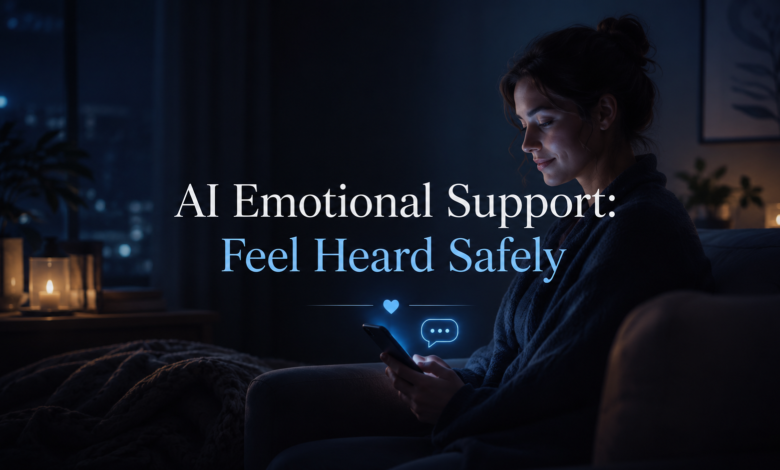
Many people search for AI emotional support not because they want to replace human connection, but because they do not always have a safe person to talk to in the moment.
Thank you for reading this post, don't forget to subscribe!When loneliness, overthinking, anxiety, breakup pain, or emotional confusion becomes heavy, an AI chatbot for emotional support can feel like a private space where feelings are not judged, rushed, or dismissed.
This blog is unique because it explains AI emotional validation through psychology, emotional safety, nervous system awareness, and healthy boundaries.
It also explains how AI self-help tools can support emotional reflection, and why AI empathy and mental health must be understood carefully: supportive AI language may feel calming, but it should never replace therapy, crisis care, or real human connection.
Why People Search for AI Emotional Support
People often turn to AI emotional support when they feel emotionally alone, even if they are surrounded by people. The problem is not always the absence of family, friends, partners, or coworkers. Sometimes the real problem is the absence of emotional safety.
A person may have people around them, but still feel afraid to open up. They may worry that others will judge them, misunderstand them, gossip about them, give quick advice, or dismiss their pain.
This is common during anxiety, breakup pain, overthinking, relationship confusion, emotional insecurity, or moments when the person cannot fully explain what they feel.
In countries like the USA, UK, Canada, and Australia, many people are digitally connected but emotionally isolated. They may have social media, messages, and online contact, yet still lack one safe space where they can say, “This is what I am really feeling.”
That is why AI emotional support feels useful to some people. It gives them a place to express emotions before they react, suppress, or emotionally collapse.
What Is AI Emotional Support?
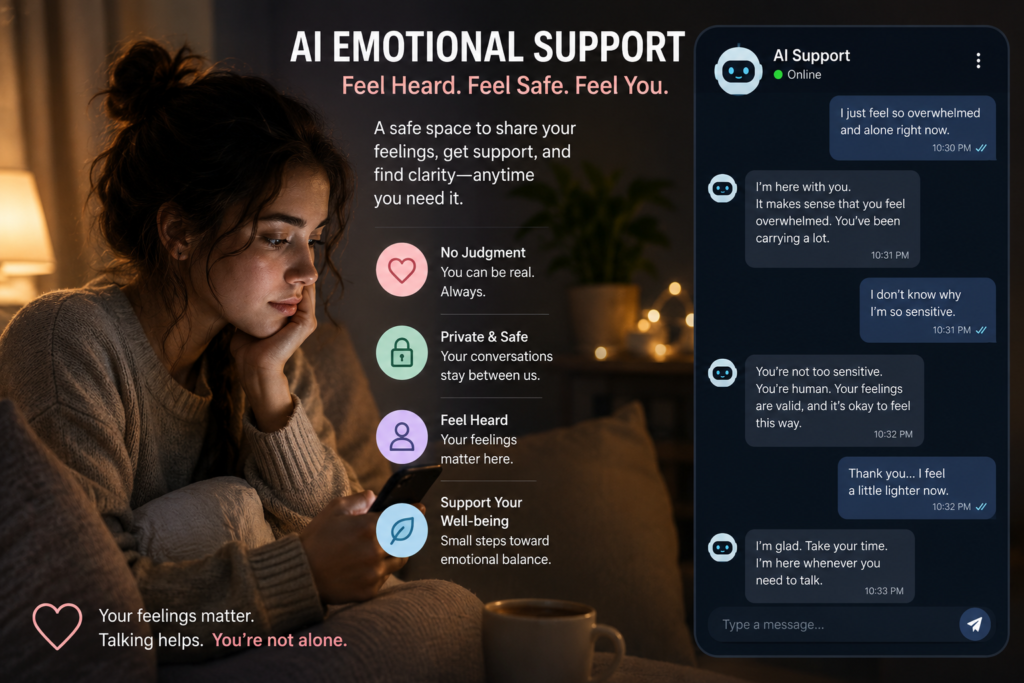
AI emotional support means using an AI tool, chatbot, or digital assistant to express feelings, organize thoughts, and receive reflective responses when you feel emotionally overwhelmed.
It can help you write what you are feeling, name an emotion, understand why something affected you, or prepare for a difficult conversation. For example, someone may use AI after an argument, during a lonely night, after a breakup, or when anxiety makes their thoughts feel too loud.
But this support must be understood clearly. AI emotional support is not therapy. It is not crisis care. It is not a replacement for a trained mental health professional, a safe human relationship, or real-life support.
The safest way to see AI is this: it can be a reflection tool. It can help you pause, organize your thoughts, and look at your emotions with more clarity.
- It may support emotional healing by helping you notice what is happening inside you, but it cannot do the deeper healing work for you.
2. AI self-help tools can support emotional reflection, but they should not become the only place where a person feels heard or understood.
3. AI can help you begin a conversation with yourself. It should not become the only place where your emotions are allowed to exist.
Why an AI Chatbot for Emotional Support Feels Safe
One reason an AI chatbot for emotional support feels safe is that it reduces the social risk of expression.
With people, opening up can feel dangerous.
A person may think,
- “What if they laugh at me?”
- “What if they call me weak?”
- “What if they tell someone else?”
- “What if they say I am overreacting?”
These fears can make someone hide their pain, even when they deeply need support.
AI feels different because there is no face watching, no immediate interruption, and no visible judgment. You can type messy thoughts, pause, rewrite, ask again, or say something you are not ready to say to another person.
This does not mean AI is emotionally equal to a trusted human being. It simply means an AI chatbot for emotional support can make the first step of expression feel less threatening.
Many people hide pain because they fear judgment, but hiding emotions is not the same as healing them. Understanding the difference between emotional detachment and emotional suppression can help readers see why safe expression matters.
AI Emotional Validation: Why Feeling Heard Matters
AI emotional validation means AI reflects your feelings in language that helps you feel seen, understood, and less ashamed.
Validation does not mean every thought is true. It does not mean every reaction is healthy. It means the emotion is acknowledged before it is judged, corrected, or dismissed.
This matters because many people do not only feel pain; they also attack themselves for feeling pain.
Someone may think, “Why am I so sensitive?” “Why can’t I move on?” “Why do I need reassurance?” “Why am I still hurt?”
A validating AI response may help that person slow down and say, “Maybe this feeling has a reason.” That shift can reduce shame and create emotional space.
For example, after a breakup, someone may feel embarrassed for missing a person who hurt them. AI emotional validation may help them understand that attachment does not disappear instantly just because the mind knows something was painful.
This is not about making AI your emotional authority. It is about using reflection to understand yourself before reacting. Feeling heard is useful only when it leads to more awareness, not more dependency.
AI Therapy Emotional Support: Helpful, But Not Therapy
A balanced article about AI therapy emotional support must be very clear. AI can help with emotional naming, journaling, calming reflection, and preparing for better communication. But AI therapy emotional support is not the same as professional therapy.
A therapist can understand long-term patterns, trauma history, safety risks, family background, and emotional behavior across time. AI cannot fully know your life, observe your condition clinically, or take responsibility for your safety.
This is why AI therapy emotional support should be used as a supportive reflection tool, not as a replacement for trained care. If someone is facing crisis, self-harm thoughts, abuse, trauma activation, severe anxiety, depression, or ongoing symptoms, real human and professional help is necessary.
AI can support reflection, but it should not become the only place where a person feels emotionally held.
AI Empathy and Mental Health: A Safe Way to Understand It
A serious discussion about AI empathy and mental health must stay honest. AI can sound kind, supportive, and emotionally aware. It can reflect your words, summarize your feelings, and help you organize inner confusion. But AI does not truly feel empathy.
It does not have a nervous system. It does not personally know your life. It cannot fully understand your history, monitor your safety, or provide professional responsibility in the way a therapist should.
This does not make AI useless. It simply means we must use it wisely. AI empathy and mental health should be understood as a support conversation, not a complete healing relationship.
The goal is not to replace people with AI. The goal is to use AI emotional support as a temporary mirror that helps you return to self-awareness, better boundaries, and safer communication.
This is where conscious living and emotional awareness becomes important, because AI can reflect your thoughts, but awareness must come from you.
“Sometimes healing does not begin with a perfect answer. It begins when one honest feeling finally has a safe place to land.”
In Part 2, we will look at how AI emotional support can help with overthinking, emotional overload, nervous system calming, and safe use without becoming emotionally dependent on AI.
AI empathy and mental health should be discussed with honesty because AI can reflect emotional language, but it cannot truly feel care, responsibility, or human concern.
How an AI Chatbot for Emotional Support Can Help in the Moment
An AI chatbot for emotional support can be useful when emotions feel too heavy to understand alone. In those moments, the mind may not think clearly. It may repeat the same fear, create worst-case meanings, or push the person toward a reaction they may regret later.
AI can help by slowing the emotional process down.
When someone types, “I feel anxious, but I do not know why,” AI may help separate the situation, the emotion, the body response, and the thought pattern. This can reduce emotional confusion because the feeling is no longer trapped inside as one unclear experience.
This is why AI emotional support can feel helpful during loneliness, anxiety, breakup pain, overthinking, or relationship stress. It gives the person a place to put the feeling into words before reacting.
But AI should stay in the right role. It can help you reflect, ask better questions, and prepare for a conversation. It should not become the final authority over your relationships, mental health, or life decisions.
For readers exploring digital self-help, the wider BBH section on AI and CBT self-help tools can support this topic further.
Naming the Emotion Reduces Mental Overload
One of the most useful parts of AI emotional validation is emotional naming.
Many people do not suffer only because they feel something. They suffer because they cannot clearly name what they feel. A person may say, “I am upset,” but underneath that one word there may be rejection, insecurity, fear, sadness, guilt, anger, disappointment, or grief.
When the emotion is unnamed, the nervous system may treat it like a general threat. This can create mental overload. The person may replay the situation again and again, check messages, imagine what someone meant, or blame themselves for reacting.
An AI chatbot can help by asking simple reflective questions:
“What emotion feels strongest right now?”
“What part of this situation felt unsafe?”
“Are you feeling hurt, rejected, confused, or afraid?”
“What do you need before responding?”
This does not solve the whole problem. But it helps the person move from emotional chaos into emotional clarity.
That first step matters because emotional clarity often comes before emotional regulation.
Reflection Can Help When Overthinking Becomes Too Loud
Overthinking often becomes loud when the mind is trying to create safety.
A person may replay a conversation because they want certainty.
- They may analyze someone’s tone because they fear rejection.
- They may keep checking whether they made a mistake because they want control.
- From the outside, it may look like “too much thinking,” but inside, it often feels like survival.
AI emotional support can help interrupt that loop by creating reflection instead of reaction.
For example, someone may write, “They did not reply for five hours, and now I feel anxious.”
A helpful AI response may separate facts from interpretations.
The fact is that the person did not reply.
The interpretation may be, “They are ignoring me,” “I am not important,” or “Something is wrong.”
This difference is important.
When AI helps someone separate facts, feelings, and assumptions, emotional intensity may reduce. The person can then decide whether they need rest, a calm message, a boundary, or simply more time before reacting.
This connects with how detachment can reduce anxiety and stress, because detachment creates space between the trigger and the response.
Useful AI Prompts for Emotional Clarity
AI becomes more helpful when the user asks for reflection, not blind reassurance.
Try prompts like:
“Help me name what I am feeling without judging me.”
“Separate the facts, emotions, and assumptions in this situation.”
“Help me understand why this triggered me, but do not tell me what decision to make.”
“Give me a calming reflection before I respond.”
“Help me write a respectful message without anger or emotional pressure.”
These prompts keep AI in the correct role. They make it a support tool for emotional awareness, not a replacement for personal judgment.
This matters because people sometimes use AI when they feel desperate for certainty. But healing does not come from outsourcing every decision. It comes from learning to hear yourself more clearly.
The best use of AI emotional support is not, “Tell me what to do.”
The better use is, “Help me understand what is happening inside me so I can choose more wisely.”
The safest use of AI self-help tools is emotional naming, journaling, calming reflection, and preparing for better communication.
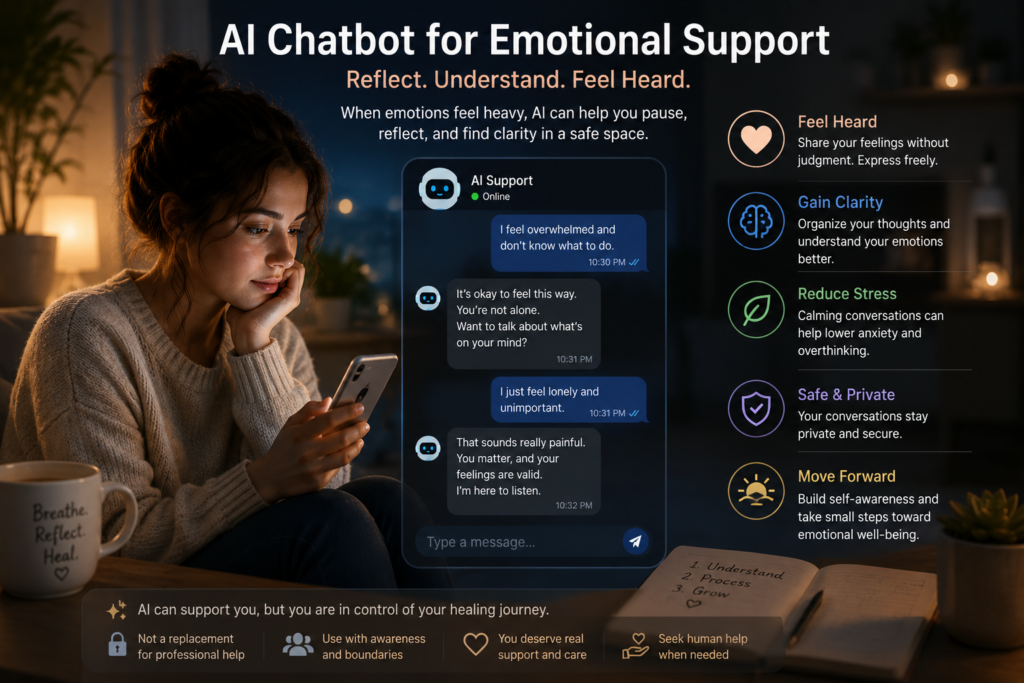
The Nervous System Side of AI Emotional Support
The value of AI emotional support is not only mental. It can also affect the nervous system.
When someone feels judged, rejected, ignored, or unsafe, the body may move into a threat response.
- The heart may beat faster.
- The chest may feel tight.
- The stomach may feel unsettled.
- Thoughts may become urgent, defensive, or fearful.
In that state, the person may not need a complicated explanation first. They may need emotional slowing.
Calm reflective language can help the nervous system feel less alone in the experience. When AI names the emotion gently, reflects the situation, and encourages a pause, the person may feel a small sense of safety. That safety can create enough space to breathe, think, and respond with more awareness.
This is where AI can become useful as a regulation support tool.
It does not regulate the nervous system by magic. It supports regulation by helping the person organize emotional chaos into clearer words.
For more depth, readers can explore nervous system regulation.
Why Feeling Heard Can Calm the Threat Response
Feeling heard is not a small emotional need. It is connected to safety.
When someone feels misunderstood, the nervous system may stay alert. The person may feel the need to explain more, defend themselves, prove their pain, or keep searching for validation. This becomes exhausting because the body does not feel settled.
Validation can reduce that pressure.
When AI says something like, “It makes sense that this feels painful because you expected care and received distance,” the person may feel less confused. The response does not need to be perfect. It simply helps the person feel that their inner experience has some meaning.
This can reduce self-attack.
Instead of thinking, “Why am I like this?” the person may think, “This feeling may be connected to hurt, fear, or an unmet emotional need.”
That shift matters because shame often increases emotional distress.
When shame reduces, the nervous system may soften. The person may stop rushing to react and become more able to choose the next step with balance.
This is where AI empathy and mental health become important, because supportive language can calm emotions while still having clear limits.
AI Empathy and Mental Health: Helpful, But Limited
The topic of AI empathy and mental health needs honesty.
AI can sound empathic. It can respond with warmth, validation, and understanding. It can help someone feel less judged in a difficult moment. For many people, that may feel meaningful, especially when they do not have a trusted support circle around them.
But AI empathy is not the same as human empathy.
- AI does not feel concern.
- It does not experience compassion.
- It does not know your full life context like a therapist, close friend, partner, or support group might.
- It can generate supportive language, but it cannot truly sit with you as a living human presence.
This difference matters because mental health support is not only about words. It is also about trust, relationship, safety, accountability, clinical judgment, and real-world care.
That is why AI therapy emotional support should be treated carefully. It may support reflection, but deeper emotional repair still needs real safety, real people, and trained care when needed.
The Risk of Depending Too Much on AI Emotional Support
AI emotional support has value, but overdependence can create problems.
If a person uses AI every time they feel uncomfortable, they may slowly lose confidence in their own emotional judgment. Instead of learning to sit with discomfort, name emotions, speak to safe people, or make grounded decisions, they may begin seeking constant AI reassurance.
This can create emotional dependency.
The person may feel calm only after AI validates them. They may start avoiding difficult human conversations. They may trust AI responses more than their own inner wisdom, therapist, family, or lived experience.
This is not healthy emotional growth.
Real healing requires more than temporary reassurance. It requires capacity. Capacity means learning to feel emotions without being controlled by them. It means developing boundaries, self-trust, communication skills, and safe human connection.
AI can support this journey, but it should not become the whole journey.
In Part 3, we will build a safe BBH framework for using AI emotional support wisely, with clear therapy boundaries, privacy awareness, and human connection.
AI Therapy Emotional Support: What It Can and Cannot Do
AI therapy emotional support can be helpful when you need reflection, emotional naming, journaling help, or a calm space to organize your thoughts. It may support you when you feel lonely, anxious, confused, rejected, or emotionally overwhelmed.
But AI therapy-style support is not the same as real therapy.
A trained therapist can understand long-term patterns, trauma history, safety risks, family background, body responses, and emotional behavior across time. AI cannot fully know your life, observe your condition clinically, or take responsibility for your safety.
This difference matters because many people use AI emotional support when they are emotionally vulnerable. In that state, a calm response may feel comforting. But comfort is not the same as clinical care.
So the balanced view is simple: use AI for reflection, emotional clarity, journaling, communication practice, and self-awareness. But do not use AI as your only support if you are in crisis, danger, severe distress, abuse, trauma activation, or ongoing mental health symptoms.
When AI Support May Be Helpful
AI emotional support may be useful when your emotions are intense but not dangerous.
You may use AI to understand why a message triggered you, why you feel anxious after a conversation, or why a breakup still hurts even when you know the relationship was not healthy.
You can also use AI to prepare for human communication. Instead of sending a reactive message, you can ask AI to help you write calmly. Instead of blaming yourself, you can ask AI to help separate facts, feelings, assumptions, and needs.
This is where AI can support emotional maturity. It gives you a pause between pain and reaction.
But the goal should always be self-awareness, not dependency. AI is helpful when it brings you closer to clarity, grounded action, and real communication. It becomes unhealthy when it replaces your judgment, real relationships, or professional support.
When You Should Seek Human or Professional Help
You should seek human or professional support when emotions become too heavy, unsafe, repeated, or difficult to manage alone.
AI cannot replace a therapist, doctor, crisis line, emergency service, support group, or trusted person when the situation is serious. If you feel at risk of harming yourself or someone else, feel unsafe at home, are experiencing abuse, or feel unable to cope, you need real-time human help.
You should also seek professional support if anxiety, depression, trauma symptoms, panic, addiction, grief, or relationship distress keeps affecting your daily life.
AI may help you write what you are feeling. But a trained professional can help you understand what is happening more safely and deeply.
This is important for readers in the USA, UK, Canada, and Australia because AI mental health tools are becoming more common, but mental health safety still needs qualified human care.
AI self-help tools work best when they help you become clearer, calmer, and more responsible, not more dependent.
Crisis, Self-Harm, Abuse, Trauma, or Severe Symptoms Need Real Help
AI should not be used as crisis care.
If someone is experiencing self-harm thoughts, suicidal thoughts, abuse, violence, trauma flashbacks, severe depression, panic attacks, or feeling out of control, they should contact emergency services, a crisis hotline, a therapist, a doctor, or a trusted person immediately.
AI may sound calm, but it cannot physically reach you, protect you, assess danger fully, or provide emergency intervention.
This is the most important safety boundary in the whole article.
AI emotional support may help with reflection. It should never replace real help when safety is involved.
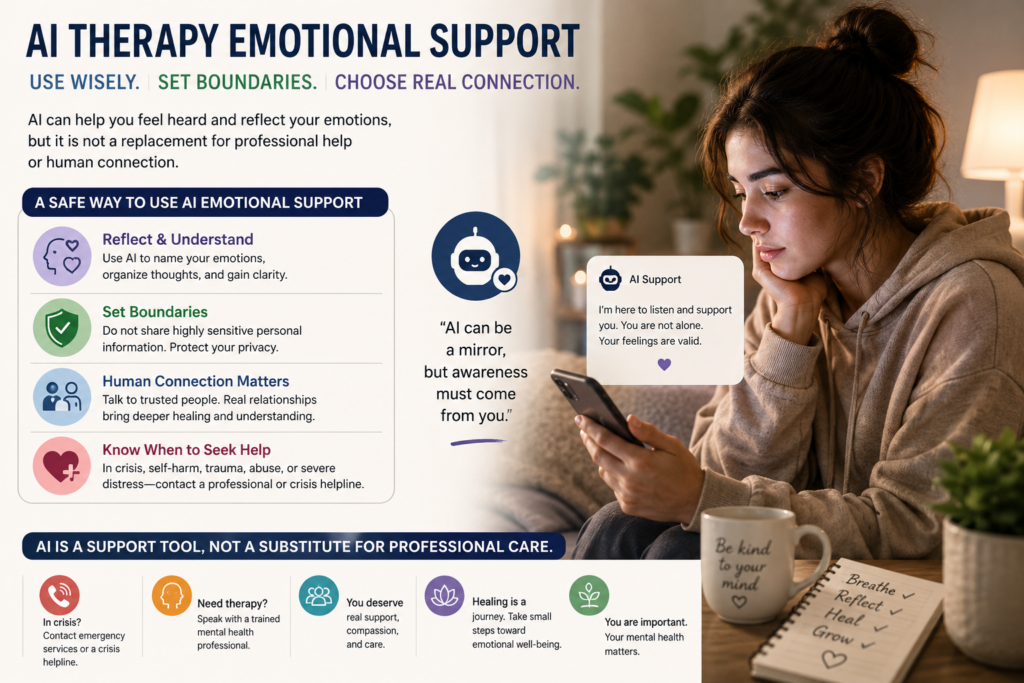
A Safe BBH Framework for Using AI Emotional Support
A healthy way to use AI emotional support is to treat it as a mirror, not a master.
AI can reflect your words, help you organize emotions, and support calmer thinking. But it should not control your decisions, replace your values, or become the only place where you feel understood.
Use this simple BBH framework:
Step 1 — Use AI to Name the Feeling
Start by asking AI to help you name the emotion.
You might ask, “Am I feeling hurt, rejected, anxious, guilty, angry, or confused?” Naming the emotion reduces inner pressure because the mind no longer has to fight a vague emotional storm.
The goal is not to label yourself. The goal is to understand the feeling.
Step 2 — Use AI to Organize Thoughts, Not Decide Your Life
AI can help you separate facts, assumptions, emotions, and needs.
But avoid asking AI to make serious decisions for you, such as whether to leave a relationship, diagnose someone, quit a job, or cut off a person. AI does not know the full context.
Use AI to think more clearly. Do not use it to surrender responsibility.
Step 3 — Use AI to Prepare for Human Communication
One of the safest uses of AI is communication practice.
You can ask AI to help you write a calm message, prepare for a difficult conversation, or express pain without blame. This can be especially helpful when emotions are high and you do not want to react impulsively.
AI becomes useful when it helps you move toward healthier human communication, not away from it.
Step 4 — Use AI With Privacy and Boundaries
Do not share highly sensitive personal details unless you understand the privacy limits of the tool you are using.
Avoid sharing passwords, private documents, medical records, legal details, financial information, or identifying information about other people.
Also set emotional boundaries. AI should support your clarity, not become your only emotional home.
For deeper support, readers can start their emotional healing journey here with a more guided path. They can also explore the healing resources hub for more structured emotional clarity and self-support resources.
A safe view of AI empathy and mental health means using AI for reflection, not for crisis decisions, diagnosis, or professional treatment.
Why Human Connection Still Matters
AI can help you feel heard in the moment, but human connection still matters.
A real person can offer presence, warmth, memory, accountability, shared history, tone, care, and relational repair. AI can respond to your words, but it cannot truly know you as a living human being.
This does not mean you should open up to unsafe people. Boundaries are important. Not everyone deserves access to your emotions.
But safe human connection is still part of healing. That may come from a therapist, trusted friend, support group, mentor, partner, family member, or community.
AI may be a bridge from silence to expression. But the deeper goal is not to live inside the bridge. The goal is to return to self-trust, wise boundaries, and healthier connection.
Learning how to practice detachment in daily life can help readers use AI support without becoming emotionally dependent on it.
AI Can Be a Mirror, But Awareness Must Come From You
AI can reflect your emotions, but it cannot do your awareness for you.
- It may help you notice that you are hurt, anxious, afraid, ashamed, or attached.
- It may help you write a calmer message.
- It may help you understand a trigger.
- But the final responsibility for your healing still belongs to you.
This is not a burden. It is empowerment.
When you use AI consciously, it can become a tool for self-reflection. When you use it unconsciously, it can become another form of dependency.
Ask yourself: “Is this helping me become clearer, calmer, and more responsible? Or am I using this to avoid real feelings, real people, or real help?”
That question keeps AI emotional support in a healthy place.
Final Thoughts on AI Emotional Support
AI emotional support can help people feel heard when they do not have anyone safe to talk to in the moment. It can support emotional naming, reflective thinking, calmer communication, and temporary relief from loneliness or overthinking.
But it should be used wisely.
AI is not therapy. It is not crisis care. It is not human love. It is not a replacement for professional support or safe human connection.
The healthiest use of AI is as a temporary mirror: a place to slow down, understand your emotions, and prepare for wiser action.
If AI helps you move from confusion to clarity, from reaction to reflection, and from isolation toward safer connection, it can be useful. But deeper healing still comes from awareness, boundaries, self-trust, and real support.
The healthiest approach to AI self-help tools and AI empathy and mental health is balance: use AI for clarity, but return to real support, self-awareness, and human connection.
People Also Ask
1. Can AI help with emotional support?
Yes, AI emotional support can help people express feelings, organize thoughts, and feel heard in the moment. But it should be used as a reflection tool, not as therapy or crisis care.
2. Why do people use AI chatbots for emotional support?
People often use an AI chatbot for emotional support when they feel lonely, judged, misunderstood, anxious, or unsure who they can safely talk to. AI can feel private and non-judgmental.
3. Is AI emotional validation real empathy?
AI emotional validation can sound supportive and help people feel understood, but AI does not truly feel empathy. It reflects emotional language; it does not replace human care.
4. Can AI replace therapy?
No, AI cannot replace therapy. The American Psychological Association warns that generative AI wellness tools should not replace qualified mental health care providers.
5. Is AI emotional support safe?
AI emotional support may be safe for journaling, reflection, and emotional clarity, but it is risky during crisis, self-harm thoughts, abuse, trauma activation, or severe symptoms.
FAQ Section
1. What is AI emotional support?
AI emotional support means using AI tools or chatbots to express emotions, name feelings, and receive reflective responses. It can help with clarity, but it is not professional mental health treatment.
2. How does AI emotional validation help?
AI emotional validation helps by reflecting feelings in a calm and non-judgmental way. This may reduce shame and help the person understand what they are feeling before reacting.
3. What is the best use of an AI chatbot for emotional support?
The best use is emotional naming, journaling, calming reflection, and preparing for better communication. Avoid using AI to make serious life, health, or relationship decisions.
4. What are the risks of AI therapy emotional support?
Risks include emotional dependency, privacy concerns, wrong advice, missed crisis signals, and avoiding real human support. Mental Health UK also warns AI is not a therapy replacement and may be unsafe in crisis.
5. How should I use AI emotional support safely?
Use AI as a mirror, not a master. Let it help you organize emotions, but seek real human or professional help for crisis, trauma, abuse, self-harm thoughts, or severe distress.
External References
- PNAS — AI Can Help People Feel Heard
URL: https://www.pnas.org/doi/10.1073/pnas.2319112121
Use for: AI emotional validation, feeling heard, AI empathy research. (PNAS) - American Psychological Association — AI Chatbots and Wellness Apps Advisory
URL: https://www.apa.org/topics/artificial-intelligence-machine-learning/health-advisory-chatbots-wellness-apps
Use for: AI should not replace qualified mental health care. (American Psychological Association) - Mental Health UK — Artificial Intelligence and Mental Health
URL: https://mentalhealth-uk.org/help-and-information/health-and-wellbeing/artificial-intelligence-and-mental-health/
Use for: risks, crisis limits, privacy, and safe mental health use. (Mental Health UK) - Stanford HAI — Exploring the Dangers of AI in Mental Health Care
URL: https://hai.stanford.edu/news/exploring-the-dangers-of-ai-in-mental-health-care
Use for: AI therapy chatbot risks, harmful responses, and limits of AI mental health care. (Stanford HAI) - PMC / NIH — Chatbot-Based Mobile Mental Health Apps
URL: https://pmc.ncbi.nlm.nih.gov/articles/PMC10242473/
Use for: chatbot-based mental health support, accessibility, and safety discussion.