AI Tools for Inner Critic Healing and Self-Compassion
How AI Self-Compassion Tools Help Calm Harsh Self-Talk

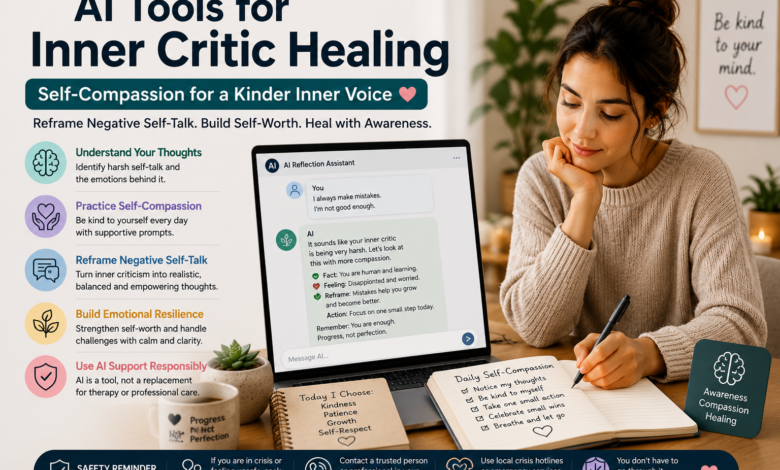
Many people try to silence their harsh inner voice, but the real problem is not only negative thinking — it is the way the mind uses criticism to create a false sense of control.
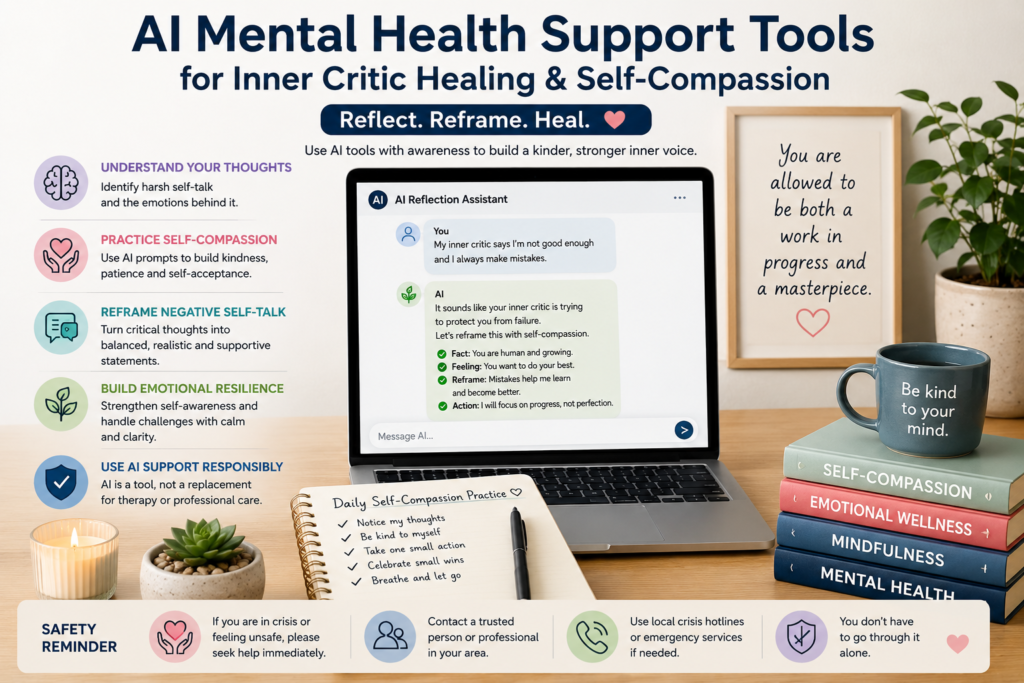
Thank you for reading this post, don't forget to subscribe!This guide on AI tools for inner critic healing is different because it does not treat AI as a therapist or a magic solution. Instead, it shows how inner critic healing tools can help you notice self-attack, understand the fear behind it, and rebuild a more honest inner voice.
You will also learn how AI self compassion tools can support daily reflection, gentle reframing, and emotional regulation without replacing professional care.
If you struggle with shame, perfectionism, or harsh self-talk, this article explains self compassion for inner critic healing in a practical way. It also shows how AI mental health support tools can be used safely, responsibly, and with real human awareness.
What Are AI Tools for Inner Critic Healing?
AI tools for inner critic healing are not meant to remove your pain, diagnose your mind, or replace professional therapy. Their real value is different. They can help you slow down harsh self-talk, organize confusing thoughts, and see the difference between a real problem and a fear-based inner attack.
When used carefully, these tools can become a reflection space where you write what your inner critic says, examine the emotion behind it, and create a more balanced response.
Many people do not notice how automatic the inner critic becomes. A small mistake can quickly turn into “I always fail,” “I am not good enough,” or “People will reject me.”
These thoughts feel true because they come with emotional pressure. AI can help by asking structured questions, offering compassionate reframes, and helping you write a kinder sentence that still respects reality.
The important point is this: AI does not heal you by itself. It supports awareness. Healing begins when you stop obeying every harsh thought as if it is your identity.
For deeper emotional healing support, link here: emotional healing — emotional-healing
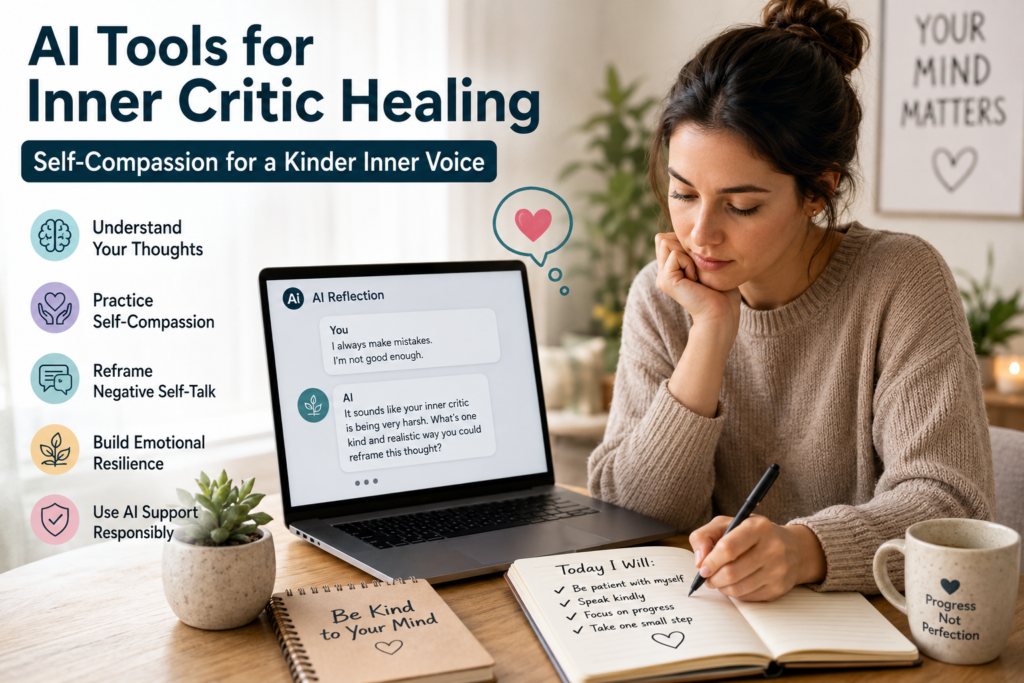
The inner critic feels powerful because it often speaks in the language of protection. It may say, “You must be perfect,” “Do not make mistakes,” or “You are behind everyone else.”
On the surface, these thoughts look like motivation, but underneath they often come from fear, shame, rejection, comparison, or old emotional conditioning. The mind believes criticism will prevent future pain, so it attacks before the world can attack first.
This is why the inner critic can feel like truth even when it is only a threat response. When the nervous system feels unsafe, the brain searches for danger, predicts rejection, and exaggerates mistakes. A simple delay, silence, comment, or failure can become emotional evidence that something is wrong with you.
This is where inner critic healing tools become useful. They help you pause before believing the thought. Instead of asking, “Is this criticism true?” you begin asking, “What fear is this criticism trying to manage?”
For body-based emotional safety, link here: nervous system regulation
AI can work like a reflection mirror when you use it with awareness. A mirror does not decide who you are; it simply helps you see what is present.
In the same way, AI self compassion tools can help you notice the exact words of your inner critic, identify emotional patterns, and separate facts from fear. This is especially useful when your thoughts are moving too fast and you cannot organize them alone.
For example, you may write: “I feel like a failure because I did not finish my work today.” AI can help you break this into three parts: the fact, the emotion, and the interpretation.
The fact may be that one task was unfinished. The emotion may be fear or disappointment. The interpretation may be “I am a failure.” Once these are separated, the thought becomes less controlling.
This is the unique value of AI in inner critic work. It gives structure to emotional confusion. But the final wisdom must still come from your awareness, values, and real-life action.
For related AI support content, link here: AI therapy tools
Important Safety Note Before Using AI for Emotional Support
AI can support journaling, reflection, self-compassion practice, and thought reframing, but it should not be used as a replacement for therapy, medical care, crisis support, or diagnosis.
This matters because people often search for AI mental health support tools when they are emotionally overwhelmed, lonely, ashamed, or unable to speak openly with others.
Use AI as a supportive tool, not as your only support system.
If you feel unsafe, out of control, severely depressed, manic, suicidal, or at risk of harming yourself or someone else, contact emergency services, a crisis helpline, or a licensed mental health professional in your country.
AI can help you reflect, but human care is still essential for serious mental health needs.
Why Self-Compassion Works Better Than Fighting the Inner Critic
Many people try to defeat the inner critic with force. They argue with it, suppress it, or shame themselves for having negative thoughts. But this often makes the problem stronger.
When you attack the inner critic, the nervous system may experience even more pressure. The mind becomes trapped between two harsh voices: one that criticizes you and another that criticizes you for being critical.
Self compassion for inner critic healing works differently.
- It does not say, “Everything is fine,” when something needs attention.
- It says, “Something is painful here, and I can respond without self-attack.”
This creates emotional safety. When the body feels safer, the mind becomes more flexible, honest, and capable of change.
Self-compassion is not weakness. It is a more mature form of responsibility. You can admit a mistake without turning that mistake into your identity. You can improve without hatred. You can take action without needing fear to push you.
For identity and emotional understanding, link here: self-worth and emotional healing
The Difference Between Self-Compassion and Self-Excuse
A common misunderstanding is that self-compassion means avoiding responsibility.
This is not true.
Self-excuse says, “I do not need to change.”
Self-compassion says, “I can change without destroying myself emotionally.”
The difference is important, especially for people who use self-criticism as their main source of discipline.
If your inner critic says, “You are lazy,” a self-excuse may ignore the issue completely. But self-compassion asks a better question: “What made action difficult today, and what is one small honest step I can take now?” This keeps responsibility alive without turning it into shame.
This is why AI tools for inner critic healing should not only create positive affirmations.
They should help you become more accurate.
- The goal is not fake positivity.
- The goal is truthful kindness.
You learn to speak to yourself in a way that supports correction, repair, and growth.
What Google Searchers Are Really Looking For
People searching for this topic are usually not looking for theory only. They want help with negative self-talk, harsh self-judgment, shame spirals, perfectionism, low self-worth, and emotional overwhelm.
They want practical inner critic healing tools that can be used in daily life, especially when they feel alone with their thoughts.
This is why this blog should not simply say “AI can help you feel better.” It must show how to use AI safely, how to write better prompts, how to reframe thoughts, how to regulate the body first, and how to know when professional support is needed.
That makes the article stronger for readers in the USA, UK, Canada, and Australia, where mental health awareness and responsible AI use are both growing search needs.
The real promise is not that AI will heal the inner critic. The promise is that AI can help you pause long enough to stop believing every self-attacking thought.
“Healing did not begin when I defeated my inner critic. It began when I stopped treating every painful thought as my real identity.”
How to Use AI Tools for Inner Critic Without Becoming Dependent
The best way to use AI tools for inner critic healing is not to ask AI to tell you what to feel, what to believe, or what decision to make.
The healthier method is to use AI as a guided reflection tool. It can help you slow down, name the harsh thought, separate facts from fear, and build a more compassionate response before you act.
This is important because people often turn to AI mental health support tools when they feel emotionally overloaded.
In that state, the mind may want quick reassurance, instant answers, or someone to remove the discomfort. But real healing does not come from outsourcing your inner wisdom. It comes from using support to return to your own awareness.
A safe rule is simple: let AI help you organize your thoughts, but do not let AI replace your judgment. Use it to pause, reframe, regulate, and choose one small grounded action.
For related AI support content, link here: AI mental health support tools
Step 1 — Write the Harsh Thought Exactly as It Appears
Before using any inner critic healing tools, write the harsh thought exactly as it appears in your mind.
- Do not soften it too early.
- If the thought says, “I am useless,” write that.
- If it says, “I always ruin everything,” write that.
- If it says, “Nobody will respect me,” write the sentence clearly.
This matters because the inner critic becomes stronger when it stays vague. A vague feeling like “something is wrong with me” can control your whole body. But when you write the exact sentence, you create distance. You begin to see it as a thought, not as your complete identity.
This is the first stage of emotional awareness.
- You are not agreeing with the thought.
- You are identifying it.
The moment you name the inner critic clearly, you create a small space between the pain and your response.
Step 2 — Ask AI to Reframe It With Compassion and Reality
After writing the harsh thought, ask AI to help you reframe it with both compassion and honesty. This is where AI self compassion tools can be useful.
- The goal is not to create fake positive thinking.
- The goal is to build a sentence that is kinder, more accurate, and more supportive of real action.
For example, the thought “I failed again, so I am useless” can become: “I am disappointed because I did not complete what I planned, but one unfinished task does not define my worth.
I can choose one small next step now.” This type of reframe does not deny the problem. It removes the identity attack from the problem.
Good AI use should help you move from shame to responsibility. Shame says, “I am bad.” Responsibility says, “Something needs attention, and I can respond with clarity.”
Sample Prompt for Harsh Self-Talk
Use this prompt when your inner critic becomes loud:
Prompt:
“Help me reframe this harsh thought with compassion and reality. Do not give false reassurance. Separate the fact, the emotion, and the fear behind the thought. Then give me one kinder sentence and one small action I can take.”
This prompt works because it asks AI to slow the thought down instead of simply giving comfort. It keeps the focus on awareness, emotional regulation, and practical action.
Step 3 — Add a Nervous System Check Before Taking Action
Before taking action, check your body. Harsh self-talk is not only a thinking problem. It is often a nervous system state.
When the body is tense, tired, threatened, or overstimulated, the mind becomes more likely to believe negative predictions.
- A small mistake may feel like danger.
- A delay may feel like rejection.
- A normal challenge may feel like proof that you are failing.
This is why self compassion for inner critic work should include the body. Before asking AI for a solution, pause and ask: “What is happening in my body right now?” Notice the chest, stomach, jaw, shoulders, breathing, and energy level.
Then do one small regulation step.
- Breathe slowly.
- Drink water.
- Stand up.
- Walk for two minutes.
- Relax your jaw.
After the body softens slightly, your mind can use the AI reframe more wisely. Regulation makes reflection more accurate.
For body-based emotional safety, link here: nervous system regulation for emotional safety
Step 4 — Turn the Reframe Into One Small Action
A compassionate reframe is helpful, but it becomes stronger when it leads to one small action. The inner critic often traps people in analysis. You may understand your pain, rewrite your thoughts, and still remain frozen. That is why the final step should be simple and physical: send one message, clean one small area, complete one paragraph, take one walk, or open the document again.
This is where AI tools for inner critic healing must stay practical.
- The goal is not to feel perfectly confident before acting.
- The goal is to act without needing the inner critic to push you.
A small action teaches the brain that change can happen without self-attack.
You can ask AI: “Based on this reframe, give me one small action I can complete in five minutes.” Keep it small enough that your nervous system does not treat it as another threat.
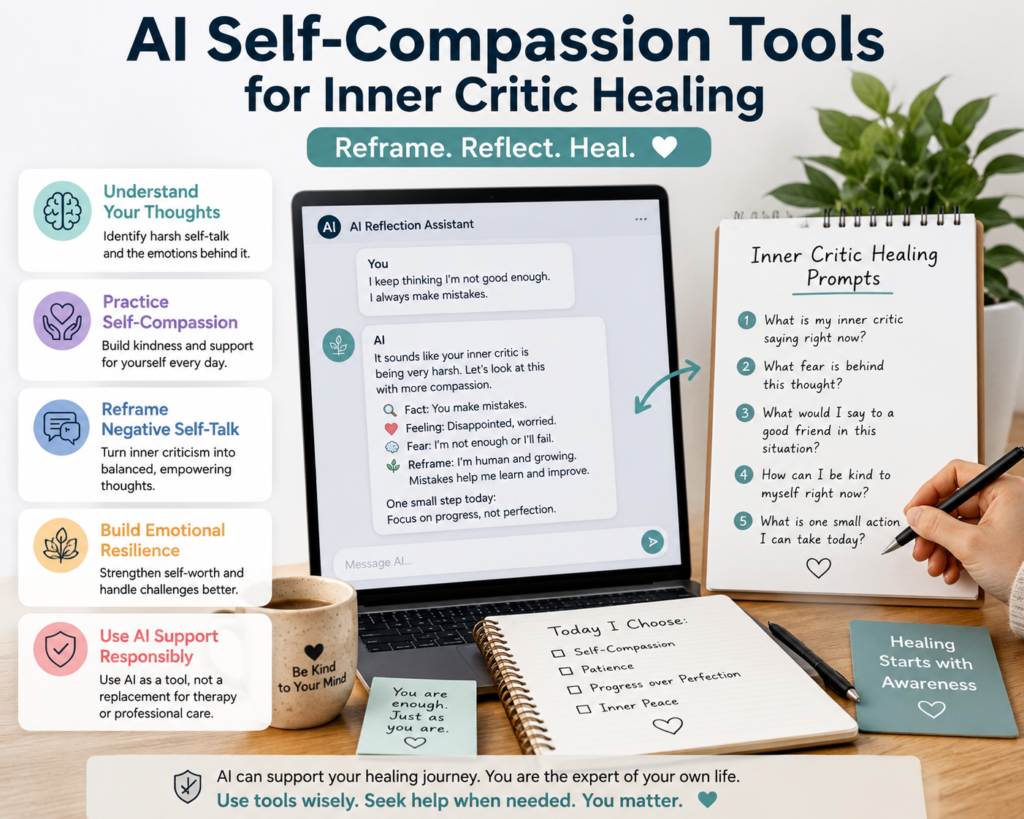
7 AI Inner Critic Healing Prompts You Can Use Daily
These daily prompts can turn AI self compassion tools into practical reflection support. Use one prompt at a time. Do not use all seven when you are emotionally overwhelmed. The purpose is clarity, not mental overload.
Prompt 1 — Find the Fear Behind the Inner Critic
“Here is my harsh thought: [write thought]. What fear may be hidden behind this inner critic? Help me understand it without shaming myself.”
Prompt 2 — Turn Self-Attack Into Self-Responsibility
“Rewrite this self-attacking thought into a responsible but compassionate sentence. Keep it honest and practical.”
Prompt 3 — Reframe Shame Without Denying Reality
“I feel ashamed about [situation]. Help me separate what actually happened from the identity story my mind is creating.”
Prompt 4 — Separate Feeling From Fact
“Help me divide this experience into three parts: facts, feelings, and assumptions. Then show me what I can respond to calmly.”
Prompt 5 — Create a Kinder Inner Voice
“Write a kinder inner voice that still encourages growth. Make it supportive, mature, and not overly soft.”
Prompt 6 — Build One Small Confidence Action
“Based on this situation, give me one small action I can take today that supports self-respect.”
Prompt 7 — End the Day With a Compassionate Review
“Help me review my day without self-attack. Show me one thing I handled, one thing I learned, and one small correction for tomorrow.”
These prompts work best when they are used with patience. Inner critic healing tools are not about instantly removing pain. They are about training the mind to respond differently, one sentence and one action at a time.
[Image 2 Placement: Add image before or after this prompt section]
Best Time to Use AI Self Compassion Tools
The best time to use AI self compassion tools is when you are aware enough to reflect but not so overwhelmed that you need urgent human support. For many people, the best moments are morning journaling, after a mild emotional trigger, before a difficult conversation, or at the end of the day when reviewing mistakes.
Morning use can help you begin the day with a calmer inner voice. After a trigger, AI can help you separate facts from emotional assumptions. Before a conversation, it can help you prepare without attacking yourself. At night, it can help you review the day without turning every mistake into shame.
However, do not use AI as a way to avoid real relationships, therapy, or direct action. The tool should bring you back to life, not pull you deeper into overthinking. The best result is not more chatting. The best result is clearer awareness and one grounded next step.
When Not to Use AI for Emotional Support
There are times when AI mental health support tools are not enough. If you are experiencing thoughts of self-harm, suicidal thoughts, severe depression, mania, psychosis, abuse danger, panic that feels unmanageable, or any situation where you may harm yourself or someone else, do not rely on AI alone. Contact emergency services, a licensed professional, or a crisis helpline in your country.
This safety boundary matters especially for readers in the USA, UK, Canada, and Australia, where crisis support systems and licensed mental health services are available but vary by location. AI can help organize thoughts, but it cannot provide emergency care, human judgment, diagnosis, or a treatment plan.
A healthy rule is this: use AI for reflection, not rescue. Use it for journaling, reframing, and self-awareness, but reach for human help when the pain becomes unsafe, confusing, or too intense to manage alone.
AI Mental Health Support Tools vs Therapy: What Is the Difference?
AI mental health support tools can help with reflection, journaling, emotional labeling, thought organization, and compassionate reframing. They may support people who struggle with harsh self-talk, shame spirals, perfectionism, or the feeling that their inner critic never stops.
But AI is not therapy. It does not know your full history, body language, trauma background, family system, medical condition, risk level, or long-term emotional pattern in the way a trained professional can.
This difference is important because many people use AI tools for inner critic healing when they feel lonely, ashamed, or unable to speak openly. AI may feel safe because it does not judge, interrupt, or react emotionally. That can be useful for daily self-reflection, but it can also create risk if someone starts depending on AI instead of real human care.
A healthy approach is to use AI as a support layer, not the whole healing system. Let AI help you write, notice, and reframe. Let therapy, trusted people, medical care, and real-world action remain part of deeper healing.
For guided support resources, link here: AI Therapy & Self-Help Tools
What AI Can Help With
AI can help you notice patterns that are difficult to see when emotions are intense. For example, it can help you identify repeated harsh sentences, separate facts from assumptions, and turn self-attacking thoughts into more grounded responses.
This makes AI self compassion tools useful for daily journaling, emotional check-ins, compassionate self-talk, and self-awareness practice.
AI can also help create structure. When your mind says, “I am failing,” you can ask AI to divide the thought into fact, feeling, fear, and next step. This turns emotional confusion into a clearer reflection process. For people who struggle with negative self-talk, this can create a pause between the inner critic and the action that follows.
Still, the power is not in AI alone. The power is in how you use it. AI should help you return to your own awareness, not make you dependent on its answer.
What AI Should Not Do
AI should not diagnose you, replace therapy, handle crisis situations, confirm harmful beliefs, or make serious life decisions for you. It should also not become your only emotional support system.
If you are using AI mental health support tools because you feel completely alone, unsafe, or unable to function, that is a sign to add human support, not reduce it.
AI can sometimes sound confident even when it does not fully understand your situation. It may give general advice that feels comforting but does not match your personal history, culture, safety needs, or clinical reality. This is why every AI answer should be treated as a reflection aid, not final truth.
For self compassion for inner critic work, the safest use is simple: ask AI to help you slow down, reflect, and choose a small grounded step. Do not ask it to replace your therapist, doctor, family, or emergency support.
When to Contact a Therapist or Crisis Support
Contact a therapist, doctor, emergency service, or crisis helpline if your thoughts feel unsafe, extreme, uncontrollable, or connected to self-harm, suicidal thoughts, severe depression, mania, psychosis, abuse, or trauma overwhelm. In these situations, inner critic healing tools are not enough by themselves.
Readers in the USA, UK, Canada, and Australia should use their local emergency number or national crisis service when immediate safety is involved. AI can support reflection, but urgent human care is necessary when emotional pain becomes dangerous or unmanageable.
For a broader healing path, link here: Start Here – Your Journey to Mental Clarity & Emotional Healing
A Simple 5-Minute Daily Practice Using AI Tools for Inner Critic
A daily practice does not need to be complicated. In fact, the best use of AI tools for inner critic healing is often short, structured, and repeatable.
- The goal is not to spend one hour analyzing every emotion.
- The goal is to build a healthier inner response through small daily repetition.
Start by writing one harsh thought that appeared during the day. Then ask yourself where you feel it in the body. This keeps the practice connected to emotional regulation, not only thinking.
After that, ask AI to help reframe the thought with compassion and reality. Then choose one small action that supports self-respect.
This practice works because it trains four skills together: awareness, regulation, reframing, and action.
Over time, the inner critic may still appear, but you become less obedient to it. You stop treating every harsh sentence as a command.
Minute 1 — Name the Thought
Write the harsh thought exactly as it appears. Do not edit it too early. This helps you see the inner critic as a sentence in the mind, not as your whole identity.
Minute 2 — Notice the Body
Ask, “Where do I feel this thought in my body?” Notice the chest, stomach, throat, jaw, shoulders, or breath. This helps you understand whether the thought is connected to fear, shame, anger, or pressure.
Minute 3 — Ask for a Compassionate Reframe
Use AI self compassion tools to create one kinder and more accurate sentence. Ask AI to avoid fake positivity and keep the reframe honest, practical, and grounded.
Minute 4 — Choose One Small Action
Ask, “What is one small action I can take now?” This may be sending one message, completing one task, taking a walk, or resting without guilt. Healing becomes stronger when reflection leads to action.
Minute 5 — Save the New Sentence
Write down the new sentence somewhere visible. Over time, these sentences become new inner language. This is how self compassion for inner critic healing slowly becomes a daily mental habit.
Internal link placement:
For step-by-step recovery support, link here:
emotional healing roadmap — https://bioandbrainhealthinfo.com/emotional-healing-roadmap/
Final Takeaway: The Goal Is Not to Silence the Inner Critic
The goal of this work is not to silence the inner critic forever. That expectation can become another form of pressure. The real goal is to build enough awareness that you no longer believe every harsh thought automatically.
You may still hear the voice of fear, shame, or perfectionism, but you can learn to respond with steadiness instead of self-attack.
This is where AI tools for inner critic healing can be helpful. They can support you in slowing down the thought, naming the fear, creating a compassionate reframe, and choosing one small action. But the deeper healing comes from your repeated choice to stop turning pain into identity.
Used wisely, inner critic healing tools can help you build a new relationship with your mind.
Not a perfect mind. Not a mind without fear.
But a mind that can correct itself without cruelty and grow without constant self-punishment.
FAQs
Can AI tools for inner critic healing replace therapy?
No. AI tools for inner critic healing can support reflection, journaling, and self-compassion practice, but they do not replace licensed therapy, diagnosis, or crisis support.
What are AI self compassion tools best used for?
AI self compassion tools are best used for reframing harsh self-talk, organizing emotional thoughts, writing compassionate prompts, and building daily self-awareness.
How does self compassion for inner critic healing work?
Self compassion for inner critic healing works by helping you respond to mistakes, fear, and shame with honesty and kindness instead of self-attack.
Are inner critic healing tools safe?
Inner critic healing tools can be safe for mild self-reflection, but they should not be used alone during crisis, severe depression, trauma overwhelm, or self-harm thoughts.
Can AI mental health support tools help negative self-talk?
Yes, AI mental health support tools may help you pause, label thoughts, and reframe negative self-talk, but deeper mental health concerns need professional care.
Closing Note
AI can help you write a kinder sentence, but your healing grows when that sentence becomes a lived practice. The inner critic may not disappear overnight, but every time you pause before believing it, you weaken the old pattern and strengthen a more compassionate inner voice.
The most important shift is simple: you do not have to obey every thought that sounds urgent, harsh, or afraid. You can listen, breathe, reflect, and choose again.
People Also Ask
1. Can AI tools help with the inner critic?
Yes, AI tools for inner critic healing can help you slow down harsh self-talk, separate facts from fear, and create a more balanced response. They are best used as reflection tools, not as therapy replacements.
2. What are inner critic healing tools?
Inner critic healing tools include journaling, self-compassion exercises, CBT-style reframing, emotional regulation, and guided reflection prompts. AI can support these tools by helping organize thoughts and soften self-attacking language.
3. How does self-compassion help the inner critic?
Self compassion for inner critic healing works by reducing shame and helping you respond to mistakes with honesty instead of cruelty. Self-compassion research emphasizes goodwill toward pain, not forced positivity.
4. Are AI self compassion tools safe?
AI self compassion tools can be safe for mild reflection, journaling, and self-talk practice. They should not be used alone for crisis, suicidal thoughts, severe depression, trauma overwhelm, or urgent mental health needs.
5. Can AI mental health support tools replace therapy?
No, AI mental health support tools cannot replace licensed therapy, diagnosis, emergency support, or clinical care. NIMH notes that crisis and professional mental health support are important when someone is struggling or unsafe.