Why Your Mind Keeps Repeating the Same Thoughts
Repetitive Thoughts Explained: Why Your Brain Gets Stuck in Mental Loops

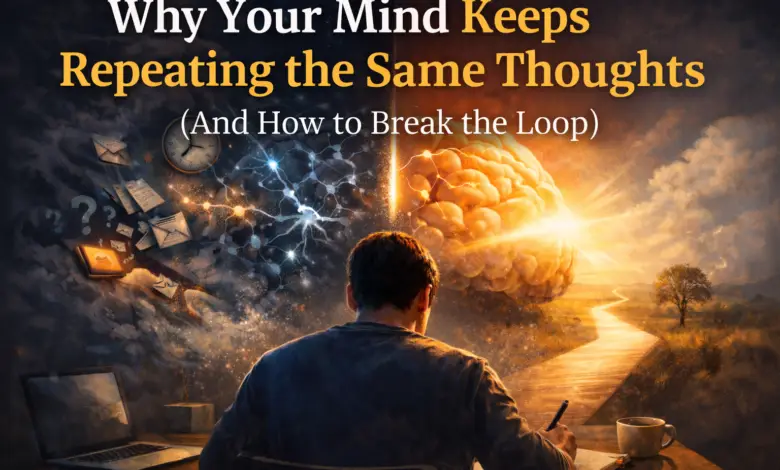
There is a very specific kind of mental experience that is difficult to explain, but once you notice it, you cannot ignore it.
Thank you for reading this post, don't forget to subscribe!A thought appears in your mind, and at first, it feels small. It may be about something simple, something that already happened, or something that might happen in the future. It does not feel serious in the beginning.
But instead of passing like a normal thought, it stays. And not only does it stay, it comes back again. Sometimes after a few minutes, sometimes after a few hours, and sometimes even after days.
You try to ignore it. You try to distract yourself. You try to move your attention somewhere else. But it returns. And the more it returns, the more real it starts to feel.
The more important it starts to feel. Slowly, without realizing it, your mind starts treating this thought as something that needs attention, something that needs to be solved. And then a question begins to form inside you, very quietly but very clearly — “Why does my mind keep repeating the same thoughts again and again?”
I have felt this personally, and for a long time I misunderstood it. I thought something was wrong with my mind. I thought maybe I was thinking too much, or maybe I was not able to control my thoughts properly. I even tried to stop thinking completely at some point, believing that silence would solve everything.
But the more I tried to stop the thought, the more it came back. Not weaker, but stronger. Not less frequent, but more repetitive. And that is where I realized something important — the problem was not the thought itself. The problem was the pattern that was forming around it.
This is what we call repetitive thoughts, but the real issue is not repetition. The real issue is the loop.
Why Do Thoughts Repeat (Real Reason Most People Miss)
Most people believe that thoughts repeat because they are important. That is the most common assumption. If something keeps coming back in your mind, it must mean it matters. It must mean there is something serious behind it.
But if you observe carefully, you will notice something different. Many of the thoughts that repeat are not actually useful. They are not leading to action. They are not creating clarity. They are simply repeating.
So the question changes.
It is no longer, “Why is this thought important?”
It becomes, “Why is this thought not closing?”
Your brain works in a very simple but powerful way. It does not like open loops. Anything that feels incomplete, unresolved, or unclear is marked as unfinished. And anything unfinished is brought back into awareness again and again. Not to disturb you, but to complete itself.
This means thoughts do not repeat because they are important.
👉 They repeat because they are internally unfinished.
This was a major shift for me. I started seeing that my mind was not attacking me. It was not creating problems randomly. It was trying to finish something that I had not fully processed. But the problem was, instead of completing the thought, I was engaging with it in a way that created more questions, more branches, and more confusion.
And that is where repetition turned into a loop.
Thought Loop Psychology: How Repetitive Thoughts Are Created
If you slow down and observe your thinking pattern, you will see that repetitive thoughts follow a structure. They are not random. They are built step by step, even if it feels automatic.
A thought appears.
You give it attention.
Emotion gets attached to it.
You try to understand it or solve it.
But instead of closing it, you open more angles.
More questions come.
More possibilities come.
More doubt comes.
And at the end of all this, there is no clear closure.
So your brain marks it as unfinished.
And then, after some time, it brings it back again.
This is the cycle of thought loop psychology.
And the most important part is this:
👉 The loop is not created by the thought.
👉 The loop is created by engagement without closure.
I realized this slowly through my own experience. There were thoughts that I kept analyzing again and again, believing that one more round of thinking would finally solve them. But instead of solving, I was strengthening the loop. Every time I re-engaged, I was telling my brain — “This is still important, keep bringing it back.”
And my brain followed that instruction perfectly.
Read Also: feeling-lost-in-life-rebuild-identity
Overthinking Loop: Why Your Mind Gets Stuck
This is where repetitive thoughts turn into an overthinking loop. The mind does not just repeat a single thought. It starts expanding it.
One thought leads to another, that thought leads to another, and suddenly you are not dealing with one idea anymore. You are dealing with a network of thoughts, all connected, all active, all unfinished.
You start with something simple like, “Did I handle that situation correctly?”
Then it becomes, “What if I made a mistake?”
Then, “What will people think?”
Then, “What if this affects my future?”
Now the mind is no longer processing one thought. It is running multiple scenarios at once. And none of them are reaching closure.
This is why it feels like your mind is stuck.
Because it is not moving forward.
It is moving in circles.
And the more it moves in circles, the stronger the loop becomes.
At one point, I noticed that I was not thinking to understand. I was thinking because the loop had already started. The thought was no longer under my control. It was repeating automatically, and I was just following it.
That is when I understood:
👉 Overthinking is not deep thinking.
👉 It is repetitive looping without resolution.
Why Emotional Thoughts Repeat More Than Others
Not every thought becomes repetitive. Some thoughts come and go naturally. They don’t stay. They don’t return. They don’t create loops. But some thoughts behave very differently. They come back again and again, even when you don’t want them to.
The difference is emotion.
When a thought is connected to emotion, your brain treats it differently. It becomes more important, more urgent, more real. Thoughts connected to fear, uncertainty, self-worth, identity, or future outcomes carry more weight. And because they carry more weight, your brain keeps bringing them back.
This is why repetitive thoughts are often emotional.
They are not just ideas.
They are experiences.
For me, this was very clear. The thoughts that repeated the most were not random thoughts. They were thoughts that had some emotional charge attached to them.
Either fear, doubt, or some form of inner insecurity. And because I kept engaging with them, trying to solve them completely, they never got the closure they needed.
Instead, they kept looping.
🌱 Grounding Line
“My thoughts don’t repeat because they are important.
They repeat because I am still engaging with them without closure.”
Why Your Brain Refuses to Let Go (Nervous System + Identity Layer)
Why Repetitive Thoughts Increase When Your Nervous System Feels Unsafe
If you observe your mind carefully, you will notice something very important. Repetitive thoughts do not increase randomly. They become stronger at specific times in your life — when something feels uncertain, when something feels out of control, or when something feels emotionally uncomfortable.
There are moments when your mind feels relatively calm, and thoughts come and go without much disturbance. But there are also moments when one thought keeps coming back again and again, almost as if your mind is stuck on it. The difference between these two states is not the thought itself.
👉 The difference is your nervous system state.
When your nervous system feels safe and stable, your brain does not need to hold onto thoughts. It allows them to pass naturally. But when your system feels even slightly unsafe — not necessarily physically unsafe, but emotionally or psychologically unsettled — your brain becomes alert. It starts scanning, analyzing, and trying to predict outcomes.
In this state, your mind behaves differently. It does not just think.
👉 It tries to solve uncertainty through thinking.
And this is where repetitive thoughts begin to increase.
I noticed this in my own experience. The same type of thoughts would not repeat all the time. They would repeat more when I felt unsure, when something in my life felt unclear, or when I was trying to control an outcome that I could not fully control. It was not the thought that changed.
It was my internal state.
Read Also: focus-not-silence-stop-following-every-thought
Thought Loop Psychology and Survival Mode Thinking
When your nervous system is slightly activated, your brain shifts into a subtle form of survival mode. This is not the extreme fight-or-flight response that people usually imagine. It is a quieter version — a background alertness that keeps your mind active.
In this state, your brain starts asking:
- What could go wrong?
- What did I miss?
- What should I do next?
- How do I make sure everything is okay?
These questions seem logical. They feel like problem-solving. But when they repeat without resolution, they create thought loop psychology.
Your brain is trying to create safety by thinking more.
But the more it thinks, the more possibilities it creates.
And the more possibilities it creates, the less certain everything feels.
This creates a cycle:
👉 uncertainty → thinking → more uncertainty → more thinking
And this is exactly how repetitive thoughts get stronger.
They are not random disturbances.
They are your brain trying to protect you in a way that actually keeps the loop active.
Why Emotional Attachment Keeps Thoughts Repeating
Not all thoughts trigger this cycle. Only certain thoughts do.
The thoughts that repeat the most are usually connected to something deeper:
- your identity
- your self-image
- your fear of losing control
- your need for certainty
- your emotional security
This is where emotional attachment thoughts become important.
When a thought is emotionally neutral, it passes easily. But when a thought is connected to how you see yourself or what you fear losing, your brain holds onto it.
For example, a simple thought like:
👉 “What if I made a mistake?”
does not stay simple.
It becomes:
- “What if people judge me?”
- “What if I lose respect?”
- “What if this affects my future?”
Now the thought is no longer about a situation.
👉 It is about you.
And when a thought feels connected to your identity, your brain does not let it go easily.
This is why some thoughts repeat more than others.
Because they are not just thoughts.
They are tied to your sense of self.
Identity and Repetitive Thoughts: The Hidden Connection
There is a deeper layer behind repetitive thinking that most people never see clearly.
Your identity is not just who you are. It is also what you believe you should be.
- “I should be right”
- “I should not fail”
- “I should be in control”
- “I should be understood”
When a situation or thought challenges this identity, your mind reacts.
It tries to correct it.
It tries to protect it.
It tries to restore it.
And this is where the loop begins.
Because now your thinking is not just about understanding something.
👉 It is about protecting who you think you are.
I realized this slowly. Many of the thoughts that repeated in my mind were not really about solving a problem. They were about protecting an image — an idea of how things should be or how I should be.
And because that image felt important, my mind kept returning to the same thought again and again.
Read Also: acceptance-inner-peace-letting-go-control
Why Your Brain Does Not Close the Loop
At this point, an important question comes up:
👉 “If my brain wants closure, why does it not complete the loop?”
The answer is subtle.
Your brain tries to complete the loop.
But the way you engage with the thought prevents closure.
Instead of reaching a clear conclusion, you:
- reopen the thought
- question the answer
- explore another angle
- create another possibility
This creates more branches.
And more branches mean:
👉 no clear ending
So your brain cannot mark the thought as finished.
And anything unfinished will repeat.
This is why repetitive thoughts feel endless.
Not because they are unsolvable…
But because they are never allowed to close.
The Illusion of Solving Through Overthinking
There is another layer that keeps this cycle alive.
The belief that:
👉 “If I think more, I will solve it completely”
This belief feels logical.
It feels like effort.
It feels like responsibility.
But in reality, it creates a trap.
Because not all thoughts can be solved through thinking alone.
Some things require:
- time
- action
- acceptance
- uncertainty
But when you try to solve everything through thinking, your mind keeps working without reaching a real conclusion.
And that keeps the loop active.
I saw this clearly in my own experience. The more I tried to find the perfect answer inside my mind, the more confused I became. Not because the answer did not exist, but because I was trying to force clarity through continuous thinking.
And thinking was only creating more layers.
Mental Energy Drain: Why Repetitive Thoughts Exhaust You
All of this has a direct impact on your energy.
Repetitive thinking is not just mentally tiring.
It is energetically draining.
Because your brain is constantly:
- processing the same thought
- re-evaluating the same situation
- generating new possibilities
- holding emotional tension
This creates mental energy drain.
And over time, this leads to:
- fatigue
- lack of clarity
- reduced focus
- emotional heaviness
This is why you can feel tired even when you have not done much physically.
Because your mind has been working continuously in the background.
Read Also: overthinking-emotional-attachment-mental-chaos
The Second Breakthrough
At this stage, something becomes very clear.
Your mind is not broken.
Your thoughts are not the enemy.
And repetition is not random.
👉 It is a pattern.
A pattern created by:
- emotional attachment
- identity protection
- lack of closure
- continuous engagement
And once you see this pattern clearly, something shifts.
You stop fighting your thoughts.
You start understanding them.
And that is where real change begins.
🌱 Grounding Line
“My mind is not stuck.
It is trying to close something I keep reopening.”
How to Stop Repetitive Thoughts Without Fighting Your Mind
How to Stop Repetitive Thoughts Without Suppressing Them
At this point, one thing becomes very clear.
You don’t need to fight your thoughts.
You don’t need to force your mind into silence.
You don’t need to eliminate thinking.
Because the problem was never the existence of thoughts.
👉 The problem was continuous engagement without closure.
So the solution is not suppression.
The solution is completion and disengagement.
This is a very important shift.
Because most people try to stop repetitive thoughts by avoiding them or pushing them away. But avoidance does not create closure. It only delays the loop. And anything delayed without completion returns again.
I understood this slowly through my own experience. The more I tried to ignore certain thoughts, the more they came back. Not because I was weak, but because the loop was still open. My mind was still waiting for a clear signal that the thought had been processed.
And until that signal was given, the repetition continued.
The Practical System: How to Break the Thought Loop Step by Step
Now we move from understanding to action.
This is the system that actually helps in how to stop repetitive thoughts in a practical and sustainable way.
Not by force.
But by structure.
🔹 Step 1: Identify the Loop (Awareness Before Control)
When a thought repeats, don’t react immediately.
Pause for a moment and notice:
👉 “This thought is repeating”
This step is simple, but powerful.
Because without awareness, you automatically engage.
With awareness, you create a gap.
That gap is where change begins.
🔹 Step 2: Externalize the Thought (Move It Out of Your Mind)
If a thought keeps coming back, write it down.
Not in detail.
Just clearly.
👉 One line is enough.
This tells your brain:
👉 “This thought is acknowledged”
When a thought stays only in your mind, it feels incomplete. But when it is written, it becomes visible. And visibility reduces internal pressure.
This is one of the most effective ways to reduce mental loops.
🔹 Step 3: Decide Closure (Very Important Step)
Now ask yourself one question:
👉 “Does this thought need action or not?”
Be honest.
- If YES → decide when you will act
- If NO → mark it as closed
This step is critical.
Because your brain needs a conclusion.
Not endless thinking.
Once you give it a clear decision, the loop starts weakening.
🔹 Step 4: Stop Reopening the Thought (Core Breakthrough)
This is where most people fail.
Even after deciding, they reopen the thought.
They analyze again.
They question again.
They go deeper again.
And the loop restarts.
So the rule becomes:
👉 Once closed, do not reopen
When the thought comes again, remind yourself:
👉 “This is already processed”
No re-analysis.
No emotional engagement.
This is where repetitive thoughts lose their power.
🔹 Step 5: Return to Present Direction (Stability Building)
After closing the loop, bring your attention back to your current activity.
Not forcefully.
Gently.
This is important.
Because breaking the loop is only half the process.
👉 Stability comes from returning to one direction.
Read Also: emotional-healing-roadmap
Thought Loop Psychology: Why This System Works
This system works because it matches how your brain functions.
Your brain repeats thoughts when they are:
- unclear
- unfinished
- emotionally engaged
So this method does three things:
- it creates awareness
- it provides closure
- it reduces re-engagement
And when these three happen together:
👉 the loop naturally weakens
Not by force.
But by completion.
Repetitive Thoughts and Emotional Release
Some thoughts are not just logical.
They are emotional.
And emotional thoughts cannot be closed only by thinking.
They need:
👉 acceptance
If a thought carries emotion:
- don’t suppress it
- don’t analyze it endlessly
Instead:
👉 allow it to exist without reacting
Feel it.
But don’t build a story around it.
This reduces emotional intensity.
And once emotional intensity reduces, repetition reduces.
Why You Don’t Need to Solve Every Thought
One of the biggest traps of the mind is this belief:
👉 “Every thought needs an answer”
This belief creates pressure.
Because your mind keeps searching for perfect clarity.
But reality is different.
Not every thought needs solving.
Some thoughts need:
- acknowledgment
- acceptance
- or simply no engagement
Understanding this reduces unnecessary thinking.
And this is where mental freedom begins.
From Repetition to Awareness: The Real Shift
At the beginning, your experience was:
- constant repetition
- confusion
- mental exhaustion
- emotional loops
Now the shift becomes:
- thoughts still come
- but loops reduce
- engagement becomes selective
- clarity increases
This is not sudden.
It is gradual.
But it is real.
And sustainable.
Because it is based on understanding, not force.
Rebuilding Mental Clarity and Stability
As repetitive thoughts reduce, something changes naturally.
Your mind becomes:
- lighter
- clearer
- more stable
Your attention improves.
Your energy returns.
And most importantly:
👉 your inner space becomes quieter
Not because thoughts disappeared…
But because loops stopped repeating.
Read Also: spiritual-psychology
The Real Meaning of Mental Freedom
Mental freedom is not:
- having no thoughts
- having perfect control
- having complete silence
Mental freedom is:
👉 not being trapped inside repeating thoughts
Thoughts can exist.
But they don’t control you.
They don’t repeat endlessly.
They don’t drain your energy.
This is real clarity.
🌱 Personal Note
At one point, I believed that I needed to fix my mind completely.
I thought if I understood every thought, solved every question, and controlled every pattern, I would finally feel calm.
But the more I tried to solve everything, the more my mind kept repeating the same thoughts.
Clarity started to return when I stopped reopening everything.
Not every thought needed my attention.
Not every loop needed to continue.
And slowly, my mind started becoming lighter without force.
❗ Reflection Disclaimer
This content is for awareness and understanding.
It is not a medical or psychological diagnosis.
If your condition feels overwhelming, consider professional support.
🔍 People Also Ask about Repetitive Thoughts
1. Why do repetitive thoughts happen?
Repetitive thoughts happen because the brain tries to resolve unfinished or emotionally charged thoughts.
2. How to stop repetitive thoughts naturally?
By identifying loops, writing them down, deciding closure, and not re-engaging with them.
3. Are repetitive thoughts a sign of anxiety?
Yes, they are often linked to anxiety and nervous system activation.
4. Why does my brain repeat the same thoughts?
Because it feels the thought is unresolved or important.
5. Can you completely stop repetitive thoughts?
No, but you can reduce them significantly by changing engagement patterns.
6. What is thought loop psychology?
It is the pattern where thoughts repeat due to emotional attachment and lack of closure.
7. How to break overthinking loops?
By creating awareness, externalizing thoughts, and avoiding re-engagement.
8. Do emotional thoughts repeat more?
Yes, emotionally attached thoughts repeat more because they feel important.
Read Also: mental-health
❓ FAQ For Repetitive Thoughts
1. How to stop repetitive thoughts without suppression?
Allow thoughts, provide closure, and reduce re-engagement.
2. Why do thoughts repeat even after solving them?
Because they are reopened and re-analyzed.
3. What causes thought loops?
Emotional attachment, lack of closure, and continuous engagement.
4. Can writing thoughts help stop repetition?
Yes, it helps the brain feel the thought is processed.
5. Is overthinking the same as repetitive thinking?
They are connected, but repetitive thinking is a loop pattern within overthinking.
6. How to calm repetitive thoughts quickly?
Acknowledge them, write them, and avoid engaging again.
7. Does anxiety increase repetitive thoughts?
Yes, it activates the brain’s problem-solving mode.
8. Can awareness reduce thought loops?
Yes, awareness breaks automatic engagement.
🌿 Final Grounding Line
“A thought stops repeating the moment you stop feeding it.”
📚 REFERENCES (WITH URL)
🧠 Psychology & Repetitive Thinking
- American Psychological Association
👉 https://www.apa.org/topics/anxiety
(Anxiety, repetitive thinking, cognitive patterns) - National Institute of Mental Health
👉 https://www.nimh.nih.gov/health/topics/obsessive-compulsive-disorder-ocd
(Intrusive thoughts, repetition, loop patterns) - Mayo Clinic
👉 https://www.mayoclinic.org/diseases-conditions/anxiety/symptoms-causes/syc-20350961
(Anxiety, repetitive thoughts, mental stress)
🧠 Cognitive Behavioral Understanding
- Feeling Good: The New Mood Therapy
👉 https://en.wikipedia.org/wiki/Feeling_Good:_The_New_Mood_Therapy
(Cognitive distortions, repetitive thinking patterns) - Thinking, Fast and Slow
👉 https://en.wikipedia.org/wiki/Thinking,_Fast_and_Slow
(Automatic thinking and mental loops)
🧘♂️ Awareness & Thought Detachment
- Bhagavad Gita
👉 https://www.holy-bhagavad-gita.org
(Mind, awareness, detachment from thoughts) - The Power of Now
👉 https://en.wikipedia.org/wiki/The_Power_of_Now
(Observing thoughts without engagement)