Voices in Your Head: Why It Happens and How to Stay Grounded
Hearing Voices Meaning, Warning Signs, and Safe Grounding Steps

Hearing voices in your head can feel frightening because the experience is often misunderstood, hidden, or judged too quickly.
Thank you for reading this post, don't forget to subscribe!Many people immediately fear the worst, but hearing voices meaning is not always simple; it can be connected with stress, trauma, sleep loss, emotional overload, intrusive thoughts, or deeper mental health concerns.
This blog is unique because it does not only explain symptoms — it helps you understand the difference between intrusive thoughts vs voices, the connection between stress and hearing voices, and the mental health warning signs that should never be ignored.
Instead of creating panic, this guide gives you a calm, safe, and practical way to observe what is happening inside your mind, reduce shame, and know when professional support is needed.
You will learn how to stay grounded, protect yourself emotionally, and take the next right step with clarity rather than fear.
Why Voices in Your Head Can Feel So Frightening
When someone experiences voices in your head, the fear usually does not come only from the sound or thought itself. The deeper fear comes from the meaning the person gives to it.
A person may think,
- “Am I losing control?”
- “Is something wrong with me?”
- “Will people judge me?”
- “Does this mean I am dangerous?”
These fears can become heavier than the original experience.
This is why the first response should not be shame. It should be understanding.
The mind can become loud during emotional pressure, trauma, grief, anxiety, poor sleep, loneliness, or long-term stress.
- Sometimes the experience may feel like harsh self-talk.
- Sometimes it may feel like repeated unwanted thoughts.
In some cases, it may feel like hearing a voice that seems separate from normal thinking.
The important point is this: hearing voices meaning should be understood carefully, not fearfully.
Some experiences may be connected with emotional overload, while others may need professional mental health support.
- The goal is not to label yourself quickly.
- The goal is to notice what is happening with honesty and safety.
This blog is also written from the same BBH direction: clarity before fear, awareness before self-attack, and support before isolation.
If you want to understand why the mind becomes afraid of uncertainty, you can also read: why the mind fears uncertainty.
The First Step Is Not Panic, It Is Observation
When the mind feels loud, panic can make everything worse. Fear increases alertness, and alertness makes every inner signal feel stronger.
This is why a person may feel trapped in a loop: the voice-like experience creates fear, the fear increases stress, and the stress makes the mind feel even louder.
- Observation is different from panic. Observation means asking calm, practical questions.
- When do the voices in your head appear?
- Do they come mostly at night?
- Do they happen after conflict, sleep loss, sadness, anxiety, or emotional exhaustion?
- Do they sound like your own inner critic, or do they feel separate from your normal thoughts?
- Do they tell you to do something unsafe?
- Do they affect your work, relationships, sleep, or daily life?
These questions are not for self-diagnosis. They are for safety and clarity. When you observe without shame, you begin to understand whether this is closer to intrusive thoughts, stress-related inner noise, emotional self-attack, or something that needs professional support.
Hearing Voices Meaning Is Not Always One Simple Answer
The phrase hearing voices meaning does not have one fixed explanation.
- For one person, it may mean an inner critical voice that repeats old shame.
- For another person, it may mean unwanted thoughts that feel strong during anxiety.
- For someone else, it may mean a voice-like experience that feels separate, external, or difficult to control.
This is why the context matters.
Some people notice voice-like experiences during extreme stress, after trauma, during grief, after poor sleep, or when they feel emotionally isolated.
In those moments, the nervous system may become highly alert.
- The brain starts scanning for danger.
- Thoughts become louder.
- Memories feel more alive.
- The mind may begin to feel less calm and more reactive.
This does not mean every experience is harmless. It also does not mean every experience is a severe illness.
A balanced understanding is needed.
Hearing voices meaning may include emotional, psychological, neurological, medical, or substance-related factors. That is why the safest direction is to avoid both extremes: do not panic, but do not ignore serious signs.
If the voices are frequent, threatening, commanding, or connected with fear of harm, they should be treated as important mental health warning signs. In that case, professional support is not weakness; it is protection.
When the Mind Becomes Loud During Emotional Overload
At BBH, we often look at emotional suffering through the connection between the nervous system, attachment, fear, and awareness.
When the nervous system is overloaded, the mind does not always speak gently. It may become critical, loud, suspicious, fearful, or repetitive. The person may feel as if the mind is no longer a peaceful space.
This is where stress and hearing voices can be understood with more compassion. Stress does not explain every case, but stress can make inner experiences feel stronger. If someone is already exhausted, emotionally wounded, isolated, or not sleeping well, the mind may begin to feel louder than normal.
Sometimes the inner voice says things connected with fear: “You are unsafe,” “Something bad will happen,” “No one understands you,” or “You cannot handle this.”
These experiences can increase emotional suffering, especially when the person believes every inner message as truth.
This is why awareness matters. You are allowed to notice an inner experience without immediately believing it, obeying it, or attacking yourself for having it.
For a deeper understanding of emotional attachment and suffering, read: emotional suffering and attachment.
Intrusive Thoughts vs Voices: What Is the Difference?
Understanding intrusive thoughts vs voices is one of the most important parts of this topic. Many people confuse unwanted thoughts, inner criticism, anxiety loops, and hearing voices.
Because of that confusion, they may become more afraid than necessary or ignore something that actually needs support.
Intrusive thoughts are unwanted thoughts, images, fears, or mental statements that enter the mind without permission. They may feel disturbing, repetitive, or opposite to what the person actually wants.
For example, someone may suddenly think,
- “What if something terrible happens?” or
- “What if I lose control?”
- These thoughts can be frightening, but they are often experienced as thoughts inside the mind.
An inner critic is different. It is usually a harsh self-talk pattern.
It may say, “You are a failure,”
- “You are not good enough,” or
- “Nobody will accept you.”
- This may feel like a voice, but it is often connected with shame, childhood conditioning, trauma, or repeated emotional self-attack.
Hearing voices may feel different from both. A person may experience a voice that feels separate from their usual thinking, like it is being heard rather than thought.
- It may feel internal or external.
- It may be neutral, critical, comforting, frightening, or commanding.
This is why intrusive thoughts vs voices should be understood carefully and not casually dismissed.
A Simple Way to Compare the Experience
| Experience | How It May Feel | What to Notice |
|---|---|---|
| Intrusive thoughts | Unwanted thoughts, images, fears, or mental loops | Are they linked with anxiety, fear, or repeated worry? |
| Inner critic | Harsh self-talk, shame, self-blame, emotional attack | Does it sound like old criticism or low self-worth? |
| Hearing voices | Voice-like experience that feels separate or not fully voluntary | Is it frequent, threatening, commanding, or affecting life? |
This comparison is not a diagnosis. It is a starting point for awareness. The purpose is to help you describe your experience more clearly if you speak with a therapist, psychiatrist, doctor, or trusted mental health professional.
If your experience is more connected with emotional self-attack, you may also find this useful: how detachment helps control emotions.
Detachment does not mean ignoring your pain. It means learning not to merge your whole identity with every thought, fear, or emotional wave.
Simple Self-Check Questions
Before assuming the worst, gently ask yourself:
- Does this feel like my own thought or a separate voice?
- Does it happen mostly during stress, sleep loss, or emotional overload?
- Is it critical, fearful, comforting, neutral, or threatening?
- Does it tell me to harm myself or someone else?
- Am I able to continue daily work, sleep, and relationships?
- Is this becoming more frequent or harder to manage?
- Do I feel safe right now?
These questions help you notice possible mental health warning signs without falling into panic. If the experience feels unsafe, threatening, commanding, or disconnected from reality, do not handle it alone.
Reach out to a qualified mental health professional, local emergency service, or trusted person immediately.
Personal Note
“Clarity begins when we stop attacking ourselves for what the mind is experiencing and start asking what kind of support the mind is asking for.”
Why You Are Not Weak for Experiencing This
Many people silently suffer because they believe voices in your head means they are weak, broken, or beyond help. This belief creates shame, and shame creates isolation. Isolation then makes the mind even louder.
The healing direction begins when the person stops hiding and starts understanding.
- You are not weak because your mind is struggling.
- You are not bad because your inner world feels confusing.
- You are not hopeless because you need support.
The human mind can react strongly to stress, trauma, fear, grief, and exhaustion.
- Sometimes the first step is not a perfect solution.
- Sometimes the first step is simply saying,
- “Something is happening inside me, and I deserve help understanding it.”
This is also why inner peace is not about forcing silence inside the mind. Real peace begins with safety, honesty, and support. You can read more here: what inner peace really means.
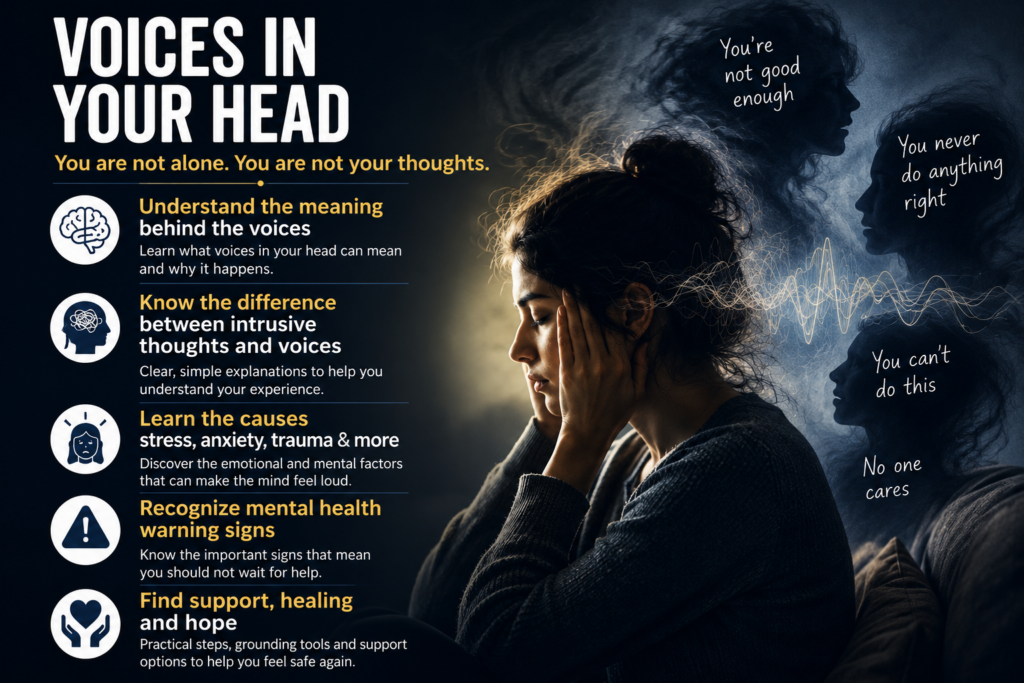
Stress and Hearing Voices: Why the Mind Can Feel Louder Under Pressure
The connection between stress and hearing voices should be understood with care. Stress does not explain every experience, and it should never replace professional assessment. But stress can make the mind feel louder, more reactive, and harder to calm, especially when the person is already emotionally exhausted, sleep-deprived, traumatized, isolated, or anxious.
When the body stays in survival mode for too long, the nervous system becomes alert to possible danger.
In that state, the brain may scan for threat, repeat fearful thoughts, and give more emotional weight to inner experiences.
- For some people, this may feel like racing thoughts.
- For others, it may feel like harsh self-talk.
In some cases, a person may describe voices in your head that become stronger during emotional pressure.
This is why stress and hearing voices should not be viewed with shame. The mind may be showing that the inner system is overloaded. But if the experience becomes frequent, threatening, commanding, or disconnected from reality, it should be treated as one of the important mental health warning signs that need proper support.
For readers who want to understand the body-mind connection more deeply, link here: nervous system regulation
Link: use your Brain Health → Nervous System Regulation category
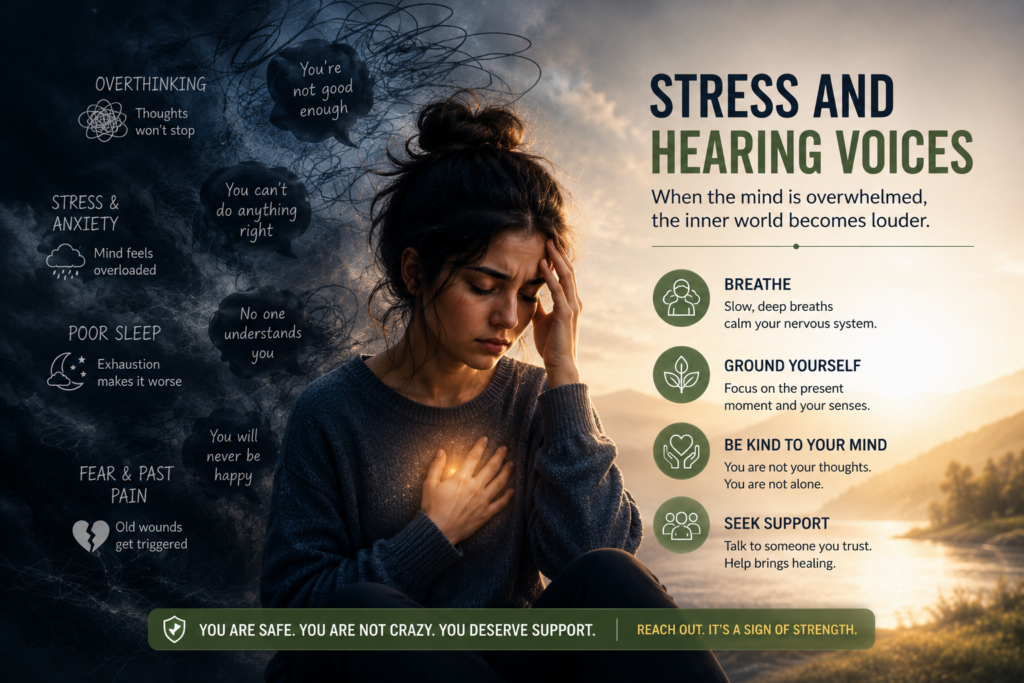
Sleep Loss, Anxiety, and Emotional Exhaustion Can Intensify Inner Experiences
Sleep has a direct relationship with emotional balance. When sleep becomes poor, the mind loses some of its natural ability to regulate fear, memory, mood, and attention. A person may become more sensitive, more suspicious, more reactive, and more easily overwhelmed by inner noise.
This is why some people notice voices in your head more at night, early in the morning, or after many days of poor sleep. When the outside world becomes quiet, the inner world may feel louder. Anxiety can make this worse because an anxious brain keeps checking, analyzing, and predicting danger.
In this state, hearing voices meaning should be explored carefully. It may be connected with stress and sleep disruption, but it may also need medical or mental health evaluation. The safest direction is to observe patterns without self-diagnosing.
Ask yourself: did this begin after sleep loss?
- Is it worse during anxiety?
- Does it reduce when I rest?
- Or is it becoming stronger even when I am trying to take care of myself?
Read Also: why you can’t stay present
If anxiety keeps pulling your attention away from the present moment, you may also find this guide helpful: why you can’t stay present.
Trauma and the Mind’s Protective Alarm System
Trauma can change the way the mind listens to danger. After painful experiences, the nervous system may become trained to expect rejection, betrayal, punishment, abandonment, or threat. Even when the present moment is safe, the inner system may behave as if danger is still near.
This can create a painful inner atmosphere.
The person may hear or feel critical messages such as, “You are not safe,” “Do not trust anyone,” “You will be hurt again,” or “Something bad will happen.”
- Sometimes these are intrusive thoughts.
- Sometimes they are emotional memories.
- Sometimes they may feel voice-like.
This is why understanding intrusive thoughts vs voices becomes important.
A trauma-aware approach does not say, “Ignore it.” It also does not say, “Believe everything the mind says.”
It says: notice the experience, check safety, regulate the body, and seek professional support if the experience feels intense, repeated, threatening, or confusing.
This is a very important BBH point: the mind may be trying to protect you, but protection without regulation can become emotional suffering.
- The goal is not to fight the mind aggressively.
- The goal is to understand what the system is reacting to and create safety again.
Read Also : emotional suffering and attachment
For a deeper understanding of how emotional attachment can increase inner suffering, read: emotional suffering and attachment.
Mental Health Warning Signs You Should Not Ignore
Some experiences need immediate seriousness. The goal is not to scare the reader, but to create safety. Mental health warning signs should never be ignored when the person feels unsafe, controlled, or disconnected from reality.
You should seek professional help quickly if the voices are telling you to harm yourself or someone else,
- if they feel threatening or controlling,
- if you feel unable to resist them, or
- if you feel like you may act on something unsafe.
These are urgent mental health warning signs, not something to handle alone.
Other serious signs include not sleeping for days, feeling extremely paranoid, feeling disconnected from reality, believing others are trying to harm you without clear evidence, using alcohol or drugs and noticing symptoms getting worse, or losing the ability to manage work, relationships, hygiene, food, or daily responsibilities.
If voices in your head are becoming stronger, more frequent, or more distressing, this is not a reason for shame. It is a reason to get support early. Early help is protection. It can reduce risk, confusion, and emotional suffering.
Read Also : nervous-system-regulation
When Professional Support Becomes Important
Professional support becomes important when the experience is repeated, distressing, unsafe, or difficult to understand.
- A therapist can help explore emotional triggers, trauma history, anxiety patterns, intrusive thoughts, and coping tools.
- A psychiatrist can assess whether medication, mood support, or deeper mental health treatment is needed.
- A doctor can also check whether sleep problems, substances, medical conditions, or neurological issues may be involved.
This is where hearing voices meaning needs professional clarity. Online reading can help you understand the basics, but it cannot replace assessment.
Two people may use the same phrase — “I hear voices” — but their causes and support needs may be very different.
For one person, it may be trauma-related inner fear. For another, it may be severe depression, bipolar mood disturbance, psychosis-related symptoms, substance effects, or another medical factor. That is why the safest message is: do not hide, do not panic, and do not self-label too quickly.
Professional support is not a judgment against you. It is a structured way to protect your mind.
You can also explore more emotional clarity guides in the Mental Health section.
Why You Should Avoid Self-Diagnosing Too Quickly
When someone searches online for voices in your head, they may quickly find frightening words and severe conditions. This can increase fear, especially if the person is already anxious. But self-diagnosis can be misleading because the same experience may have different causes.
A person may confuse anxiety-based intrusive thoughts with hearing voices.
- Someone may confuse inner criticism with a separate voice.
- Someone else may minimize a serious symptom because they do not want to accept that help is needed.
This is why understanding intrusive thoughts vs voices is useful, but it should not become a replacement for proper evaluation.
Avoid saying, “This means I have this disorder,” only from one article or one search result.
Also avoid saying, “This is nothing,” if the experience feels unsafe or is affecting life.
The balanced path is better: observe, document patterns, reduce stressors, improve sleep, avoid substances, speak to someone trusted, and consult a professional when needed.
Read Also: nervous-system-and-emotions
A Balanced Understanding of Causes
There is no single answer that explains every case. Hearing voices meaning may include stress, trauma, sleep loss, grief, anxiety, depression, bipolar mood changes, psychosis-related symptoms, substance use, neurological factors, or medical conditions. This is why the blog must stay balanced and safe.
The reader should understand two truths together. First, voices in your head do not automatically mean you are broken or beyond help. Many people experience unusual inner experiences during emotional pressure, trauma, or exhaustion.
Second, if the experience is intense, threatening, repeated, or affecting life, it should not be ignored. These may be mental health warning signs, and support should be taken seriously.
This balanced view is the heart of the blog. It reduces shame without reducing safety. It gives hope without giving false reassurance. It teaches the reader to observe carefully, regulate gently, and reach help early.
Read Also : how detachment helps control emotions
To understand how emotional distance can help you respond more calmly to inner fear, read: how detachment helps control emotions.
How to Stay Grounded When You Experience Voices in Your Head
When you experience voices in your head, the first goal is not to fight the mind aggressively. The first goal is safety and grounding.
Many people make the experience more frightening by arguing with it, searching symptoms for hours, or blaming themselves. But when the mind feels loud, the body needs calm signals before the mind can think clearly.
Grounding means bringing attention back to the present moment through the body, senses, environment, and safe connection.
- It does not mean pretending nothing is happening.
- It means saying, “Something is happening inside me, and I need to respond with care.”
This is especially important when stress and hearing voices are connected. Stress can increase alertness, fear, and emotional intensity. Grounding helps reduce the nervous system load so the experience becomes less overwhelming.
But if the voices feel threatening, commanding, or unsafe, grounding should not replace professional help. Those are mental health warning signs that need support quickly.
For deeper emotional stability practices, you can also read: how to practice detachment in daily life.
5 Grounding Steps You Can Try Safely
1. Name the Experience Without Attacking Yourself
The first step is to describe what is happening in a neutral way.
Instead of saying, “I am going crazy,” say, “I am noticing a voice-like experience,” or “My mind feels very loud right now.” This small language change reduces shame and fear.
When you understand hearing voices meaning with calm observation, you create space between yourself and the experience. You are not denying it. You are also not merging your whole identity with it. You are simply noticing it.
This is also helpful when you are trying to understand intrusive thoughts vs voices. If you can describe the experience clearly, it becomes easier to explain it to a therapist, psychiatrist, doctor, or trusted support person.
2. Check Safety First
Ask yourself one serious question: “Am I safe right now?”
If the voices are telling you to harm yourself or someone else, if you feel unable to resist them, or if you feel at risk of acting on something unsafe, get urgent help immediately. Contact a trusted person, local emergency number, mental health crisis line, doctor, or nearby hospital.
This is not overreacting. These are mental health warning signs that require support. Safety must come before shame, privacy, or fear of judgment. You deserve help before the situation becomes heavier.
3. Use Sensory Grounding
Sensory grounding helps the brain reconnect with the present environment. Try placing both feet on the floor and slowly naming five things you can see, four things you can feel, three things you can hear, two things you can smell, and one thing you can taste.
You can also hold a cold glass of water, wash your face, touch a textured object, or gently press your feet into the ground. These actions remind the nervous system that you are in the present moment.
When voices in your head feel intense, the body can become your anchor. You may not be able to control every thought immediately, but you can guide your body toward steadiness.
4. Reduce the Nervous System Load
A loud mind often becomes worse when the body is exhausted. Check the basics: sleep, food, hydration, sunlight, movement, and isolation. These may sound simple, but they strongly affect emotional stability.
If you have not slept properly, eaten enough, or spoken to anyone for a long time, your mind may become more reactive. This is why stress and hearing voices should be understood through the body too, not only through thoughts.
Try one small stabilizing action: drink water, eat something light, step outside for sunlight, take a short walk, reduce caffeine, avoid alcohol or substances, and keep your environment calm. Small regulation steps can create a safer mental state.
5. Reach Support Early
You do not need to wait until everything becomes extreme. If the experience is repeated, confusing, or emotionally heavy, reach support early. Speak to a trusted person, therapist, psychiatrist, doctor, or mental health helpline.
Support helps you understand whether the experience is closer to anxiety-based intrusive thoughts, trauma-related inner fear, mood changes, sleep disruption, or something that needs medical care. This is why hearing voices meaning should not be guessed alone.
If you are new to emotional healing work, begin here: Start Here – Your Journey to Mental Clarity & Emotional Healing.

What Not to Do When the Mind Feels Loud
When the mind feels loud, avoid fighting the experience aggressively. Fighting can increase fear and make the nervous system more alert.
Also avoid isolating completely, searching symptoms for hours, using alcohol or substances to cope, or believing that you must solve everything alone.
- Do not ignore unsafe commands.
- Do not hide serious mental health warning signs because of shame.
- And do not punish yourself for needing support.
A better approach is calm naming, safety checking, grounding, reducing stress load, and reaching help early. This gives the mind a safer structure instead of leaving it alone with fear.
A Balanced Recovery Direction: Awareness, Care, and Support
Recovery does not always mean forcing the mind to become silent immediately. Recovery begins with awareness. You notice the experience. You understand the context. You reduce shame. You protect your safety. You build support.
If voices in your head appear mostly during stress, sleep loss, or emotional overload, your healing direction may include nervous system regulation, therapy, routine, sleep care, and emotional support.
If the voices are threatening, commanding, frequent, or affecting reality testing, professional assessment becomes more urgent.
This balanced direction matters because hearing voices meaning is not one-size-fits-all. Some people need emotional regulation support. Some need trauma-informed therapy. Some need medical evaluation. Some need psychiatric care. The right support depends on the full picture.
For structured healing guidance, connect this section with your Emotional Healing Roadmap support page.
Final Thought: You Are Not Your Symptoms
Experiencing voices in your head can feel frightening, but it does not make you weak, bad, or beyond help. The most important step is to stop turning the experience into self-hatred. Your mind may be asking for rest, regulation, support, professional care, or deeper safety.
The difference between intrusive thoughts vs voices, the role of stress and hearing voices, and the seriousness of mental health warning signs should all be understood with calm honesty. Do not panic, but do not ignore what feels unsafe.
You are not your symptoms. You are a person having an inner experience that deserves understanding, care, and the right support. Healing begins when shame reduces and safety becomes the first priority.
To continue building emotional steadiness, read: how detachment helps control emotions.
People Also Ask — 5 Short Answers
1. What does voices in your head mean?
Voices in your head may mean intrusive thoughts, harsh inner self-talk, or hearing voices that feel separate from normal thinking. The meaning depends on stress, sleep, trauma, mental health, and safety context.
2. Is hearing voices always a mental illness?
No, hearing voices is not always a mental illness, but it should be taken seriously if it is distressing, frequent, threatening, or affects daily life. Medical sources explain that auditory hallucinations can be temporary in some cases but may also signal mental health or neurological concerns.
3. What is the difference between intrusive thoughts vs voices?
Intrusive thoughts vs voices mainly differ in how they are experienced. Intrusive thoughts usually feel like unwanted mental content, while hearing voices may feel more voice-like, separate, or heard rather than simply thought.
4. Can stress cause hearing voices?
Stress and hearing voices can be connected because stress, trauma, poor sleep, and emotional overload may make inner experiences feel louder. However, stress is not the only possible cause, so repeated or unsafe symptoms need professional support.
5. When should I seek help for voices in my head?
Seek help quickly if the voices tell you to harm yourself or others, feel threatening, cause paranoia, disturb sleep, or affect daily functioning. These are important mental health warning signs and should not be handled alone.
FAQ — 5 Short Answers
1. Can poor sleep make voices in your head worse?
Yes, poor sleep can make the mind more reactive and emotionally sensitive. Some voice-like experiences may become stronger when the brain is exhausted, anxious, or under stress.
2. Should I ignore voices in my head?
Do not panic, but do not ignore serious signs. If voices in your head are threatening, commanding, frequent, or affecting your life, speak with a mental health professional or doctor.
3. Can grounding help when the mind feels loud?
Grounding can help reduce fear and nervous system overload. Simple steps like naming the experience, checking safety, breathing slowly, and using your senses may help you feel steadier.
4. Are hearing voices and psychosis the same thing?
Not always. Hearing voices can happen for different reasons, but hallucinations can also be a symptom of psychosis, especially when connected with delusions, confusion, or difficulty functioning.
5. What should I do first if I feel unsafe?
If you feel unsafe or the voices are telling you to harm yourself or someone else, contact emergency services, a crisis helpline, a trusted person, or a nearby hospital immediately. Safety comes before shame.
External References
- Cleveland Clinic — Auditory Hallucinations
Explains auditory hallucinations, possible causes, and when they may be temporary or linked with serious health concerns.
URL: https://my.clevelandclinic.org/health/symptoms/23233-auditory-hallucinations - Mind — About Hearing Voices
Explains different reasons people may hear voices, including trauma, spiritual experiences, and mental health conditions.
URL: https://www.mind.org.uk/information-support/types-of-mental-health-problems/hearing-voices/about-hearing-voices/ - NHS — Hallucinations and Hearing Voices
Gives basic medical guidance and advises getting medical help if someone is experiencing hallucinations.
URL: https://www.nhs.uk/mental-health/feelings-symptoms-behaviours/feelings-and-symptoms/hallucinations-hearing-voices/ - NIMH — Understanding Psychosis
Explains hallucinations, hearing voices, delusions, and broader warning signs such as anxiety and difficulty functioning.
URL: https://www.nimh.nih.gov/health/publications/understanding-psychosis - Mental Health Foundation — Hearing Voices
Explains support options and notes that a GP may check physical reasons before diagnosis or referral.
URL: https://www.mentalhealth.org.uk/explore-mental-health/a-z-topics/hearing-voices