Emotional Detachment vs Emotional Suppression
Are You Detached or Suppressing Emotions?

I Thought I Had Developed Emotional Detachment vs Emotional Suppression
Thank you for reading this post, don't forget to subscribe!For many years, I believed I had developed emotional detachment.
I thought I had moved on from my past.
I thought time had healed what life had broken.
I thought the pain of betrayal, abandonment, loneliness, and heartbreak had become something distant—something finished.
On the surface, my life looked functional.
I worked constantly.
I stayed busy.
I kept myself occupied with responsibilities and goals.
There was no silence long enough to ask deeper questions like:
- Why am I still emotionally restless?
- Why do certain memories still hurt?
- Why does trust feel dangerous?
- Why do I fear being abandoned so deeply?
At the time, I truly believed this was what emotional detachment looked like.
But I later learned I had misunderstood the entire emotional detachment meaning.
I was not detached.
I was distracted.
How Busyness Hid My Emotional Suppression for Years
One of the clearest emotional suppression signs in my life was constant busyness.
I did not even have time to check on myself.
I never stopped long enough to ask:
- Why am I like this?
- Why do I become emotionally unstable so quickly?
- What inside me is still hurting?
Even while taking counseling and medication, I remained focused on functioning rather than understanding.
My life was built around performance, not reflection.
Looking back now, I understand that productivity had become my form of emotional avoidance.
Work kept me moving fast enough that I never had to face what still lived inside me.
This is why many people confuse emotional suppression vs detachment—
because suppression often looks productive, disciplined, and functional from the outside.
Read Also : Attachment vs Love: Why You Seek It from the Wrong People
When Silence Forced Me to Face What I Had Buried
Then Covid came.
Work slowed down.
Life became quiet.
Distraction disappeared.
And for the first time in years, I was left alone with myself.
That is when everything I had buried came back.
Not as a thought.
Not as a mild sadness.
But as panic.
As anxiety attacks.
As emotional flooding.
As grief and rage stronger than my nervous system could contain.
The pain I thought had ended years ago suddenly felt present again.
This is when I first understood the reality of trauma and emotional suppression:
⭐ Pain that is buried does not disappear. It waits until distraction is gone.
My Old Relationship Wounds Had Never Truly Healed
The person I once loved most deeply—my first love, the person I emotionally trusted and attached to—had been gone from my life for over twenty years.
He had married.
He had children.
He had built a life far away from me.
And yet when silence arrived—
his absence still hurt.
That terrified me.
Because it meant one thing:
⭐ I had not healed. I had only avoided. What I believed was healing was actually emotional avoidance psychology in action. The wound was still alive. It had simply been hidden beneath movement.
Read Also: Detachment in Relationships: How to Love Without Losing Yourself
The Pain Was Bigger Than One Breakup
As the panic intensified, I realized the pain was never only about one relationship.
That heartbreak had attached itself to much deeper wounds.
At forty-two, I felt profoundly alone.
My family no longer felt like emotional safety.
I had been pushed out of my own home.
I lived alone in a rented apartment.
I feared illness, aging, emergencies, and suffering with no one beside me.
My panic was not just about lost love.
It was about:
- abandonment
- emotional insecurity
- fear of having no support
- fear of never being chosen
- fear of being alone forever
The breakup had become a container for every unresolved wound beneath it.
My Trauma Was Bigger Than I Understood
That was when I realized:
I was not just heartbroken. I was traumatized.
I had never fully understood:
- my attachment wounds
- my abandonment fears
- my inner insecurity
- my emotional dependency
- my trauma-patterned reactions
This was the moment I began seeing the true difference between detachment and suppression.
The Realization That Changed My Entire Understanding of Healing
What broke me most was not the pain itself.
It was the realization that after all those years— Part of me had never truly left the wound.
I had spent years believing I had moved on while unconsciously carrying the same unresolved pain.
That forced me to confront an uncomfortable truth: I was functioning, not healing.
I was surviving, not peaceful.
I was appearing stable while carrying internal chaos.
That realization changed how I understood emotional detachment psychology forever.
Real Detachment Is Awareness, Not Avoidance
My healing began only when I stopped asking:
⭐ “Why did life hurt me?”
And started asking:
- What is this pain trying to teach me?
- Why did I abandon myself for so long?
- Why were my emotions so available that others could misuse them?
- Why did I never learn how to protect my own heart?
- Why did I treat my own pain as something to outrun instead of understand?
That is when I learned:
⭐ Real emotional detachment is not avoiding pain. It is understanding pain deeply enough that it no longer controls you.
Real detachment means:
- feeling pain without becoming it
- learning from suffering without drowning in it
- facing wounds without self-punishment
- observing emotion without identifying with it
That is not numbness.
That is awareness.
Why Emotional Suppression vs Detachment Matters
This is why understanding emotional suppression vs detachment matters so deeply.
Because many people believe they are detached simply because:
- they stopped reacting
- they became quieter
- they look functional
- they buried their pain beneath discipline
But if your peace depends on constant distraction— It is not peace. It is suppression waiting to break.
Transition to Part 2
To understand why so many people confuse suppression with healing, we first need to understand: Why emotional shutdown often looks like emotional detachment from the outside.
Why Emotional Shutdown Often Looks Like Emotional Detachment
One of the main reasons people misunderstand emotional detachment is because emotional shutdown can look calm from the outside.
A person may:
- stop reacting
- stop crying
- stop chasing
- stop arguing
- become quieter than before
And everyone around them assumes:
“They have healed.” “They have moved on.” “They finally learned emotional detachment.”
But outward silence is not proof of inner peace.
Sometimes silence means regulation.
Sometimes silence means exhaustion.
Sometimes silence means a person has simply learned how to hide pain better.
This is why many people confuse emotional suppression vs detachment without realizing the internal difference.
The Real Difference Between Emotional Detachment and Suppression
At a surface level, both suppression and detachment may appear similar.
In both states, a person may:
- remain externally calm
- avoid impulsive reaction
- withdraw from emotional conflict
- appear emotionally controlled
But internally, they are completely different experiences.
The true difference between detachment and suppression is this:
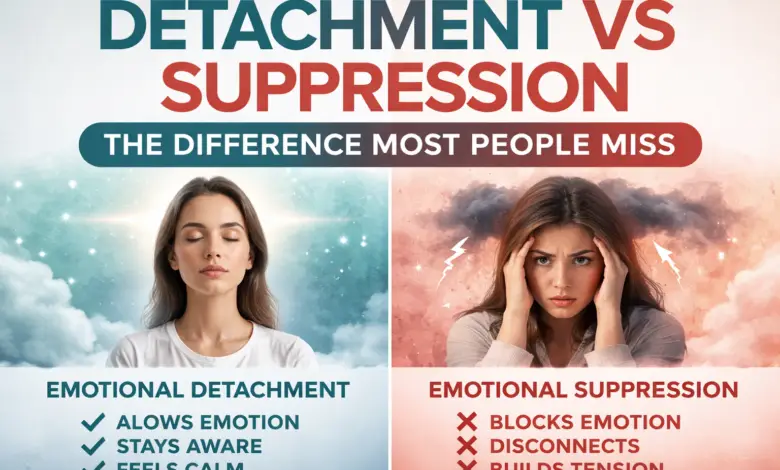
⭐Suppression resists emotion. Detachment allows emotion.
⭐Suppression says:“I should not feel this.”
⭐Detachment says: “I feel this, but I do not need to become it.”
That distinction changes everything.
Internal Signs of Emotional Suppression
If you are suppressing rather than healing, you may notice:
- repeating thoughts despite trying to “let go”
- constant mental replay of painful situations
- emotional numbness followed by sudden breakdowns
- body tension despite outward calm
- anger building beneath silence
- exhaustion from constantly controlling yourself
These are common emotional suppression signs.
Suppression may reduce visible reaction—
but it increases invisible suffering.
Internal Signs of Healthy Emotional Detachment
When someone has developed healthy emotional detachment, they still feel pain—
but they are no longer ruled by it.
Signs include:
- painful memories arise without obsessive spiraling
- emotions pass more quickly through the body
- triggers create discomfort but not identity collapse
- pain is acknowledged without panic
- decisions remain conscious during emotional activation
This is not emotional numbness.
It is regulated awareness.
Why Suppression Creates Repeating Thought Loops
Many people ask: “If I moved on, why do I still think about it every day?”
Because suppressed pain remains unresolved.
The mind revisits what it has not emotionally processed.
⭐This is the psychological reality behind suppressing emotions vs processing emotions: Unprocessed pain repeats. Processed pain softens.
The brain continues replaying emotionally charged experiences because it still perceives them as unfinished.
Why Your Mind Replays What You Have Not Processed
When pain is suppressed:
- the brain marks the wound as unresolved
- emotional memory remains active
- thoughts repeat in search of closure
- nervous system stays partially activated
That is why many people cannot stop overthinking old pain.
The issue is often not obsession—
It is incomplete processing.
Why Trauma Makes Emotional Detachment So Difficult
Many people intellectually understand detachment—
but cannot practice it when emotionally triggered.
Why?
Because trauma changes how the nervous system experiences pain.
This is where trauma attachment and emotional detachment become deeply connected.
For traumatized minds:
⭐Emotional pain does not feel uncomfortable. It feels dangerous.
Why Pain Feels Like Survival Threat After Trauma
When someone has abandonment wounds, abuse history, or deep emotional insecurity—
their nervous system often interprets pain as threat.
Loss may feel like:
- emotional death
- total abandonment
- collapse of safety
- proof of worthlessness
- survival danger
That is why traumatized individuals struggle with healthy emotional detachment.
Their body reacts to emotional pain as if survival is at risk.
Why Trauma Makes You Attach More Deeply
If someone becomes:
- your first emotional safety
- your only source of love
- your main sense of worth
- your emotional home
Then losing them does not feel like losing “just a person.”
It feels like losing survival itself.
That is why trauma survivors often confuse:
- trauma attachment for love
- obsession for connection
- fear of loss for emotional depth
⭐ And it is why detachment can feel impossible even when logic says: “This relationship is over.”
The Deepest Psychological Difference Between Suppression and Detachment
⭐ At the deepest level: Suppression fears pain. Detachment understands pain.
⭐ Suppression asks: “How do I stop feeling this?”
⭐ Detachment asks: “Why does this hurt so much?”
Suppression runs from emotion. Detachment learns from emotion. And that is the true psychological divide between them.
Transition to Part 3
Once you understand the difference—
⭐ the next question becomes: How do you actually practice emotional detachment without turning pain into suppression again?
Because awareness alone is not enough.
You need a practical way to feel pain without being controlled by it.
How to Detach Without Suppressing Emotions
Understanding the difference between suppression and detachment is important—
but knowledge alone does not create healing.
Many people intellectually understand how to detach without suppressing emotions, yet still collapse when pain actually arrives.
Why?
Because emotional awareness without practice is only theory.
Real emotional detachment develops when awareness becomes behavior.
Stop Treating Emotion as the Enemy
The first mistake most people make is trying to eliminate pain.
They believe healing means:
- never feeling hurt
- never missing someone
- never being triggered
- never thinking about the past
But this is unrealistic.
And more importantly—
it turns healing into self-rejection.
The goal is not to stop feeling.
The goal is to stop fearing feeling.
Ask This Instead of “How Do I Stop Feeling?”
When painful emotion rises, stop asking: “How do I make this go away?”
Ask instead:
- What is this pain trying to show me?
- What fear is beneath this emotion?
- What wound is being touched right now?
- Is this pain about the present, or the past being reactivated?
This shift moves you from resistance into awareness.
That is the beginning of healthy emotional detachment.
Let the Nervous System Complete the Emotional Wave
Most people suppress emotion because they panic when it rises.
⭐ They assume: “If I allow this pain fully, it will consume me.”
But emotions naturally rise and fall when not resisted.
They become overwhelming mainly when feared, resisted, or amplified through mental spiraling.
Practice Emotional Wave Tolerance
When triggered:
- Pause before reacting
- Breathe deeply and slowly
- Name the emotion honestly
- Observe body sensations without judgment
- Let the wave move through you without impulsive action
⭐ This teaches your nervous system: “Pain is present, but survivable.”
That is how regulation begins.
Separate Present Pain From Past Wounds
Many emotional reactions feel bigger than the current situation because they are not only about the present.
They are present pain mixed with old pain.
Ask yourself:
- Is this reaction proportional to what happened?
- What past wound does this remind me of?
- Why does this situation hurt more than logic suggests it should?
⭐ This helps separate: current trigger – from historical wound
And that distinction is essential for healthy emotional detachment.
Build Emotional Safety Inside Yourself
Detachment becomes difficult when another person is your only source of safety.
If someone is your:
- only comfort
- only validation
- only emotional home
- only source of worth
Then losing them feels like losing yourself.
That is why many people cannot detach—
not because they love too deeply—
but because they have not built internal emotional support.
Internal Safety Makes Detachment Possible
Healing begins when you slowly become someone who can provide yourself:
- emotional validation
- nervous system calming
- self-protection
- self-respect
- realistic perspective during pain
When you become emotionally safer for yourself—
attachment softens naturally.
What the Bhagavad Gita Teaches About Emotional Detachment
Psychology explains patterns.
But spirituality explains identity.
⭐ The Bhagavad Gita teaches :- You are not the mind. You are not the emotion. You are the awareness witnessing both.
This is the deepest level of emotional detachment meaning.
Because when you understand this—
pain can be present
without becoming your identity.
Witness Consciousness Is Not Emotional Avoidance
Witnessing does not mean disconnecting from feeling.
It means:
- feeling emotion fully
- while remembering you are larger than the emotion
It means:
- observing sadness without becoming sadness
- observing fear without becoming fear
- observing thought without obeying thought
This is not suppression.
It is conscious observation.
Detachment Is Not Coldness — It Is Consciousness
Many people fear emotional detachment because they think it means becoming numb or uncaring.
It does not.
Healthy detachment means:
- loving without losing yourself
- caring without collapsing
- grieving without self-destruction
- feeling deeply without drowning
Detachment is not emotional distance.
It is emotional maturity.
Final Reflection
Emotional suppression hides pain.
Emotional detachment understands pain.
⭐ Suppression says: “Do not feel.”
⭐ Detachment says: “Feel fully, but do not lose yourself inside it.”
The moment you stop trying to control every emotion— and start learning from what emotion is trying to teach you—
you begin moving from suffering
into awareness.
And awareness is where real freedom begins.
or years, I thought detachment meant no longer feeling pain.
But healing taught me something different:
Pain does not mean you failed to move on—
sometimes it means part of you is still asking to be understood.
Real detachment began for me when I stopped running from pain
and started learning from it.
⭐ True healing is not feeling less— it is understanding more.
FAQ — Emotional Detachment vs Emotional Suppression
1. What is emotional detachment in psychology?
Emotional detachment in psychology refers to the ability to experience emotions without becoming overwhelmed, controlled, or fully identified with them. Healthy emotional detachment allows awareness and regulation without emotional numbness.
2. What is the difference between emotional detachment and emotional suppression?
The difference between emotional detachment and emotional suppression is that detachment allows emotions to be felt without losing control, while suppression blocks or hides emotions without processing them.
3. How do I know if I am detached or suppressing my emotions?
You may be suppressing emotions if you still experience internal tension, repeating thoughts, delayed breakdowns, emotional numbness, or private suffering despite appearing calm externally.
4. Is emotional detachment healthy or unhealthy?
Emotional detachment is healthy when it means emotional awareness and regulation. It becomes unhealthy when used to avoid intimacy, numb pain, or disconnect from feelings entirely.
5. Can emotional suppression cause anxiety or panic attacks?
Yes. Emotional suppression can contribute to anxiety, panic attacks, nervous system dysregulation, and emotional overwhelm because unprocessed emotions remain active in the body and mind.
6. Why do old emotional wounds come back years later?
Old emotional wounds often return when distraction decreases, life becomes quieter, similar triggers reactivate past pain, or the nervous system can no longer maintain suppression.
7. Why is emotional detachment difficult after trauma?
Emotional detachment is difficult after trauma because the nervous system often interprets emotional pain as danger, making loss, rejection, or conflict feel like survival threats rather than manageable discomfort.
8. How can I detach without suppressing emotions?
You can detach without suppressing emotions by allowing feelings to arise, observing them without impulsive reaction, regulating your nervous system, and learning from emotional pain rather than resisting it.
9. Does emotional detachment mean not caring anymore?
No. Emotional detachment does not mean becoming cold or uncaring. It means caring without allowing emotions, relationships, or outcomes to control your peace and identity.
10. What does healthy emotional detachment look like in real life?
Healthy emotional detachment looks like feeling pain without spiraling, maintaining self-control during emotional activation, setting boundaries calmly, and experiencing emotions without losing identity or self-respect.
People Also Ask About Emotional Detachment and Suppression
1. Why do people confuse emotional detachment with emotional numbness?
Many people confuse emotional detachment with emotional numbness because both can reduce visible emotional reaction. However, numbness disconnects you from feeling, while healthy detachment allows feeling without being overwhelmed.
2. Can someone be emotionally detached and still love deeply?
Yes. Healthy emotional detachment allows a person to love deeply while maintaining boundaries, self-respect, and emotional stability.
3. Why does suppressing emotions make overthinking worse?
Suppressing emotions often increases overthinking because the brain continues revisiting unresolved emotional pain until it feels processed or understood.
4. How does trauma affect emotional attachment in relationships?
Trauma can increase emotional attachment by making relationships feel like sources of survival, safety, or worth rather than simply connection.
5. Why do I feel calm outside but chaotic inside?
Feeling calm externally but chaotic internally often suggests emotional suppression rather than regulation, where pain is controlled outwardly but still active inwardly.
6. Can emotional suppression damage relationships?
Yes. Emotional suppression can damage relationships by creating emotional distance, hidden resentment, communication problems, and delayed emotional explosions.
7. Why do some people become emotionally detached after heartbreak?
Some people appear emotionally detached after heartbreak because they develop protective emotional walls, numbness, or avoidance patterns to prevent future pain.
8. Is emotional detachment a trauma response?
Sometimes. What looks like emotional detachment may actually be a trauma response such as emotional shutdown, dissociation, or protective numbness rather than healthy detachment.
9. How long does it take to develop healthy emotional detachment?
Healthy emotional detachment develops gradually through awareness, nervous system regulation, emotional processing, and repeated conscious practice over time.
10. Can spiritual practices help with emotional detachment?
Yes. Spiritual practices such as mindfulness, meditation, and witness-consciousness teachings can support emotional detachment by helping individuals observe thoughts and emotions without identifying with them.
Reference URLs / Scientific Sources for Credibility
Emotional Suppression & Emotion Regulation
- Gross, J. J. (1998). The Emerging Field of Emotion Regulation
https://doi.org/10.1037/1089-2680.2.3.271
Use For: Emotional suppression, emotion regulation theory, suppression consequences
- Gross, J. J., & John, O. P. (2003). Individual Differences in Two Emotion Regulation Processes
https://doi.org/10.1037/0022-3514.85.2.348
Use For: Suppression vs reappraisal, long-term effects of suppression
Trauma & Nervous System
- van der Kolk, B. A. – The Body Keeps the Score
https://www.besselvanderkolk.com/resources/the-body-keeps-the-score
Use For: Trauma stored in body, nervous system trauma responses
- Porges, S. W. – Polyvagal Theory Overview
https://www.stephenporges.com/
Use For: Nervous system regulation, threat response, trauma physiology
Attachment & Trauma Bonds
- Bowlby, J. – Attachment Theory and Loss
https://www.simplypsychology.org/bowlby.html
Use For: Attachment wounds, emotional security theory
- Levine, A. & Heller, R. – Attached
https://www.attachedthebook.com/
Use For: Adult attachment and relationship insecurity
Suppression / Mental Health Effects
- American Psychological Association – Emotional Avoidance / Suppression Research Summary
https://www.apa.org/monitor/2013/11/emotion
Use For: Why suppression worsens distress
Mindfulness / Witnessing / Observing Thoughts
- Hayes, S. C. – Acceptance and Commitment Therapy (ACT)
https://contextualscience.org/act
Use For: Observing thoughts without identification, acceptance-based detachment
Bhagavad Gita / Spiritual Integration
- Bhagavad Gita – Chapter 2 (Witness / Equanimity / Detachment Teachings)
https://www.holy-bhagavad-gita.org/chapter/2
Use For: Core detachment/witness consciousness references
Recommended Shlokas:
- 2.14 — Temporary nature of pleasure/pain
- 2.47 — Detachment from outcomes
- 2.48 — Equanimity in action
- 2.56 — Stability amid suffering
References
- Gross, J. J. (1998). The Emerging Field of Emotion Regulation. Review of General Psychology.
- Gross, J. J., & John, O. P. (2003). Emotion Regulation Processes. Journal of Personality and Social Psychology.
- van der Kolk, B. A. The Body Keeps the Score.
- Porges, S. W. Polyvagal Theory.
- Bowlby, J. Attachment Theory and Loss.
- Bhagavad Gita, Chapter 2.