Why You Feel Drained in Relationships and Emotionally Exhausted
Why Relationships Feel Exhausting When You Give Too Much

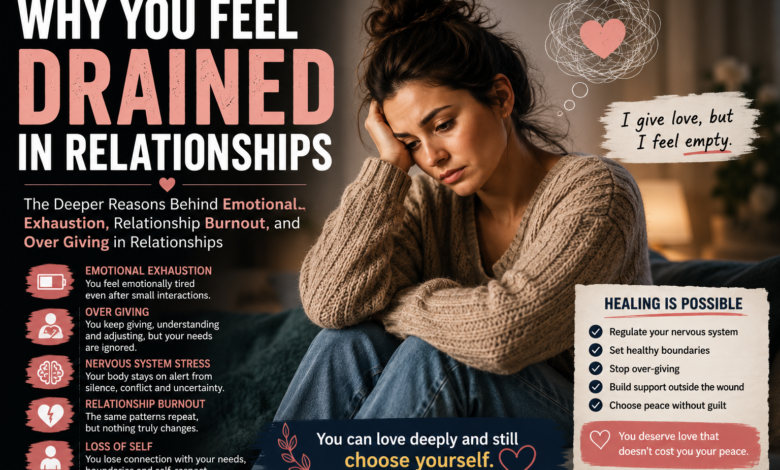
Relationship burnout and relationship fatigue can make you ask why you feel drained in relationships, even when you still care deeply.
Thank you for reading this post, don't forget to subscribe!Many people experience emotional exhaustion in relationships because they keep understanding others, managing silence, overthinking moods, forgiving quickly, and feeling guilty for creating boundaries.
This is not always because love is missing. Sometimes your nervous system is exhausted from carrying too much emotional responsibility alone.
Unlike common advice that only says “leave toxic people” or “set boundaries,” this blog explains over giving in relationships, emotional neglect, loneliness, nervous system stress, and self-abandonment together.
You will learn why love can start feeling like emotional work, why distance feels painful even when a relationship hurts, and how to rebuild emotional safety without becoming cold, guilty, or disconnected from yourself.
Why You Feel Drained in Relationships Even When You Still Care
If you keep asking why you feel drained in relationships, the answer is not always simple. It does not always mean you stopped caring. It does not always mean the relationship is completely wrong. Sometimes, it means your emotional system has been carrying too much for too long.
A relationship can drain you when love becomes mixed with repeated silence, arguments, emotional distance, criticism, guilt, or confusion.
You may still care deeply, but every interaction starts costing your nervous system energy. You begin preparing for moods, explaining your feelings, predicting reactions, and wondering what you did wrong.
This can happen in romantic relationships, family relationships, friendships, or any close emotional bond. The body does not only respond to obvious danger.
It also responds to repeated emotional uncertainty. When someone’s silence, anger, rejection, or distance becomes unpredictable, your mind may start scanning for signs of conflict before anything even happens.
That is why emotional exhaustion in relationships can feel so confusing.
- You may love the person, but you no longer feel calm around them.
- You may want closeness, but contact leaves you heavy, tense, guilty, or emotionally empty.
Read Also : How nervous system regulation helps emotional exhaustion.
Emotional Exhaustion Is Not Always a Sign You Are Weak
Many people blame themselves when they feel emotionally drained.
They think, “Maybe I am too sensitive,” “Maybe I expect too much,” or “Maybe I should be stronger.”
But emotional exhaustion is not weakness. It is often the result of repeated emotional over-effort without enough safety, repair, or support.
When the same pattern keeps happening again and again, your nervous system starts remembering it.
- A small silence may feel bigger than it looks.
- A delayed reply may trigger fear.
- A harsh tone may make your whole body tense.
- A normal conversation may feel like emotional work because your mind is already preparing for pain.
This is one reason relationship burnout can build quietly. It may not begin with one big event.
It may begin with many small moments where you keep swallowing your feelings, explaining yourself, forgiving too quickly, or staying calm while your body is not calm.
Read Also: Why Attachment Causes Emotional Suffering
The Hidden Pattern: You Keep Understanding, but No One Holds You
One of the deepest signs of relationship exhaustion is this feeling:
“I am tired of always understanding others.”
You may understand their mood, their stress, their childhood, their anger, their silence, their pressure, and their limitations. But after understanding everyone, you may realize no one is trying to understand what it costs you.
This is where love slowly becomes self-abandonment. You keep adjusting so the relationship does not break, but inside, something in you starts breaking quietly.
What Relationship Burnout Feels Like in Real Life
Relationship burnout is not only boredom or temporary irritation. It is a deeper emotional tiredness that grows when a relationship keeps taking more energy than it returns. You may still care, but you no longer feel emotionally safe, relaxed, or restored.
In real life, relationship burnout can feel like dread before a call, tension before a message, or heaviness after meeting someone.
- You may overthink what to say.
- You may avoid honest conversations because you already expect misunderstanding.
- You may feel guilty for needing space, even when that space is necessary.
This kind of relationship fatigue often appears when there is no emotional repair. Fights happen, but nothing truly changes. Silence happens, but no one explains. Hurt happens, but the responsibility quietly falls on you to move on.
When love starts feeling like emotional labor, the body begins to resist. You may not know exactly what is wrong, but your energy tells the truth before your mind can explain it.
Read Also: relationship patterns that slowly hurt trust
Signs You Are Emotionally Drained, Not Just Moody
There are clear signs that you may be emotionally drained rather than simply having a bad day.
- You may feel tired after small interactions.
- You may cry after conversations.
- You may feel anxious when their name appears on your phone.
- You may replay their tone, silence, or expression for hours.
You may also feel numb. This numbness does not always mean you do not care. Sometimes it means your nervous system is trying to protect you from feeling too much at once.
Another sign of emotional exhaustion in relationships is losing connection with your own needs.
You may ask, “What do they need from me?” before asking, “What is this doing to me?”
Over time, this pattern can make you feel invisible inside your own relationship.
Read Also : How Detachment Helps Control Emotions
When Love Starts Feeling Like Emotional Work
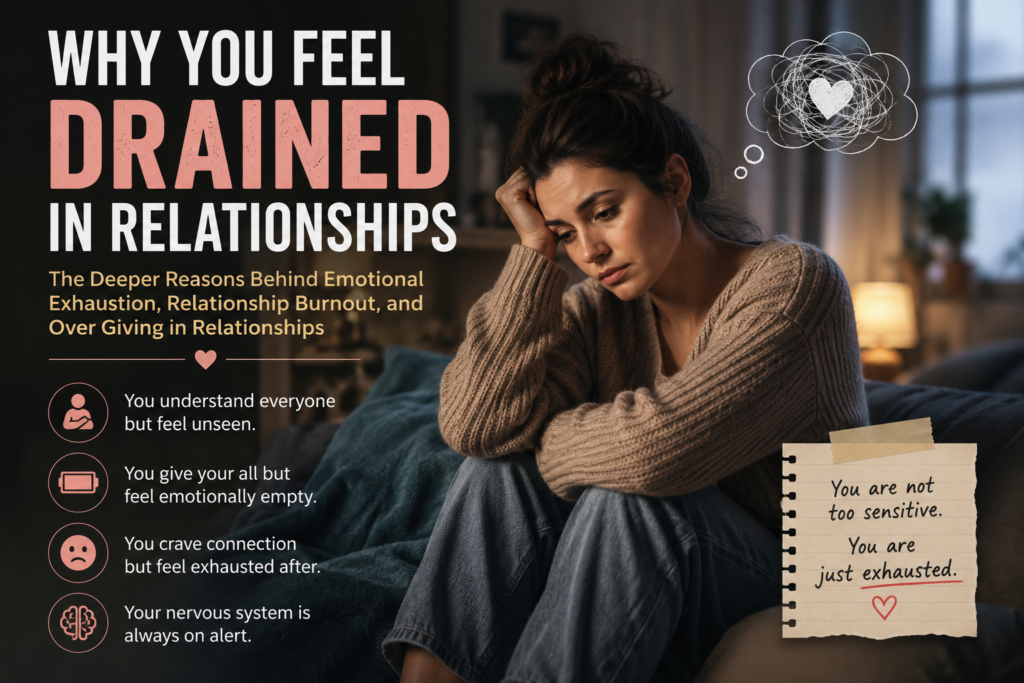
A relationship becomes draining when care is no longer mutual. You listen, explain, forgive, support, adjust, and stay available — but after giving so much, you still feel unseen.
This is the emotional line many readers will recognize:
“I give love, but I feel empty.”
That emptiness is important. It may be your body’s way of saying that love has become one-sided emotional effort.
You are not only loving. You are managing the relationship, managing their mood, managing your guilt, and managing your fear of losing connection.
The Nervous System Reason Relationships Can Feel So Heavy
To understand why you feel drained in relationships, you have to look beyond thoughts and emotions. You also have to look at the nervous system.
Your nervous system is always asking one silent question: “Am I safe?” In healthy connection, the body can relax. You can speak, listen, disagree, repair, and return to calm. But in emotionally stressful relationships, the body may stay alert.
This alert state can happen when you are used to silence, sudden anger, criticism, emotional distance, guilt, or unpredictable reactions. Your body may begin preparing for hurt even before the hurt happens. That preparation uses energy.
This is why relationship pain can feel physical.
- Your chest may feel tight.
- Your stomach may feel heavy.
- Your shoulders may stay tense.
- Your sleep may become disturbed.
- You may feel tired even when you have not done much physically.
That is not imagination. Emotional stress can become body stress. When the relationship repeatedly activates threat, confusion, or abandonment fear, relationship fatigue becomes a nervous system experience, not just a mental one.
Your Body May Be Scanning for Conflict Before It Happens
When a relationship has hurt you repeatedly, your body may start scanning for conflict before it arrives. You may notice small changes in tone, facial expression, message timing, or silence. You may feel the emotional weather shift before anyone says anything directly.
This is common when love feels unpredictable. The mind starts collecting clues because it wants to prevent pain. But constant scanning is exhausting. It keeps the body in a low-grade survival mode.
This is also where over giving in relationships often begins. You may become extra kind, extra careful, extra available, or extra silent just to avoid conflict. On the outside, it may look like patience. Inside, it may feel like fear.
Read Also: why uncertainty makes relationships feel unsafe.
Why Silence Can Feel Like Threat
Silence is not always harmful. Some people need time to think. Some need space to cool down. But in a repeated painful pattern, silence can become emotionally threatening.
If silence has often meant punishment, rejection, coldness, or withdrawal, your nervous system may stop reading it as neutral. It may read silence as danger.
You may start overthinking:
- “Are they angry?”
- “Did I do something wrong?”
- “Will they leave?”
- “Should I apologize even if I am hurt?”
This is why silence can drain more energy than a direct conversation. At least direct words give the mind something to work with. Silence forces the mind to fill the gaps, and anxious attachment often fills those gaps with fear.
“Emotional exhaustion begins when love becomes constant self-abandonment.”
This is the core truth of Part 1. When you keep understanding, adjusting, waiting, apologizing, explaining, and shrinking yourself to keep a relationship alive, your body eventually starts asking for honesty.
Feeling drained is not always a message to hate someone or leave immediately. But it is a message to stop ignoring yourself. A relationship should not require you to disappear emotionally just to keep the peace.
Over Giving in Relationships Can Become Self-Abandonment
Over giving in relationships often begins with love, care, and good intention.
- You want the other person to feel understood.
- You want the relationship to stay peaceful.
- You want to avoid conflict, distance, or disappointment.
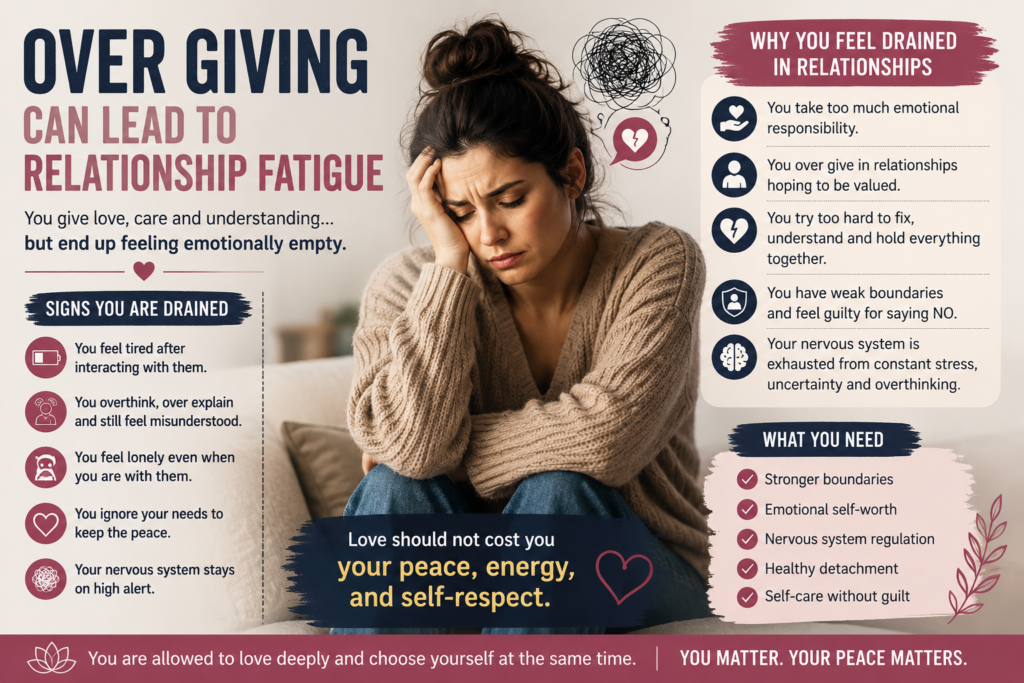
At first, this may look like kindness. But when giving becomes one-sided, constant, and emotionally costly, it slowly turns into self-abandonment.
You may keep adjusting your tone, hiding your hurt, replying quickly, forgiving too soon, and staying emotionally available even when your body is exhausted.
You may tell yourself, “They are stressed,” “They did not mean it,” or “Maybe I should understand more.”
But after repeating this pattern for months or years, your inner world begins to feel empty.
This is one reason why you feel drained in relationships even when you still care. The problem is not love itself. The problem is love without limits. When your needs disappear so someone else can stay comfortable, the relationship stops feeling safe and starts feeling like emotional survival.
Read Also : emotional neglect and adult relationship patterns.
When You Feel Responsible for Everyone’s Emotions
One of the most exhausting patterns in close relationships is feeling responsible for everyone’s emotional state. You may feel responsible for their anger, their silence, their stress, their disappointment, their mood, and even their reaction to your boundary.
This is where many people silently carry the line:
“I feel responsible for everyone’s emotions.”
That responsibility can become heavier than the relationship itself.
- You do not only respond to the person; you begin managing the atmosphere around them.
- You notice their face, their voice, their delay, their irritation, their withdrawal.
- Before speaking, you may ask yourself, “Will this upset them?” instead of asking, “Is this honest and healthy for me?”
Over time, this creates emotional exhaustion in relationships because your nervous system never truly rests. Even peaceful moments may not feel peaceful because your body is waiting for the next shift in mood.
People-Pleasing Looks Loving Until Your Body Collapses
People-pleasing can look soft, patient, and caring from the outside. But inside, it often carries fear.
- Fear of rejection.
- Fear of conflict.
- Fear of being blamed.
- Fear of being called selfish.
- Fear that if you say no, the relationship will become cold or unsafe.
This is why people-pleasing becomes dangerous for emotional health.
- You may keep saying yes while your body is saying no.
- You may keep smiling while resentment builds quietly.
- You may keep understanding others until you no longer know what you honestly feel.
At that point, love becomes performance. You are no longer connecting freely. You are trying to stay safe by being easy to love.
Why You Feel Guilty When You Create Boundaries
Many people do not avoid boundaries because they lack knowledge. They avoid boundaries because boundaries make them feel guilty.
You may know that you need space, but the moment you take that space, your mind starts attacking you: “Maybe I am being rude,” “Maybe I am hurting them,” “Maybe I should call back,” or “Maybe I am a bad person.”
This guilt can become one of the strongest causes of relationship fatigue. You are tired from the relationship, but you are also tired from the guilt you feel when you try to protect yourself.
The painful truth is this: if you were trained to earn love by being available, silent, obedient, useful, or emotionally understanding, boundaries will not feel peaceful at first. They may feel wrong, even when they are healthy.
That does not mean the boundary is wrong. It means your nervous system is still learning that self-protection is not selfishness.
Read Also: healthy detachment without emotional coldness.
Boundaries Feel Wrong When You Were Trained to Earn Love
Some people learn early that love is not freely given. They learn that love comes when they behave properly, stay quiet, understand others, avoid conflict, or take care of other people’s emotions. When this pattern continues into adulthood, boundaries can feel like danger.
You may feel panic after saying no. You may feel shame after choosing distance. You may feel the urge to explain yourself repeatedly, even when your boundary is reasonable. This happens because your body may associate distance with rejection, abandonment, or punishment.
This is why relationship burnout can become so difficult to heal. The exhausted part of you wants rest, but the attached part of you fears losing connection.
One part says, “I cannot keep doing this.” Another part says, “But what if they leave, hate me, or stop loving me?”
That inner conflict drains enormous emotional energy.
Distance Can Feel Cruel Even When It Is Protective
“You feel bad for creating distance, even when the relationship is hurting you.”
This line matters because many readers are not struggling to understand whether they are hurt. They already know they are hurt. The real struggle is that distance feels emotionally painful too.
You may feel sad, angry, guilty, lonely, and protective at the same time. That does not make you confused. It makes you human. A boundary can be necessary and still hurt. Space can protect you and still feel heartbreaking.
Why You Still Want Closeness With People Who Hurt You
This is one of the deepest reasons why you feel drained in relationships. Sometimes you do not return to people because they are emotionally safe. You return because loneliness is painful, attachment is strong, and a part of you is still hoping that this time they will finally understand.
This can happen with parents, partners, siblings, friends, or anyone whose love matters deeply to you. The relationship may hurt you, but the absence of that relationship may also hurt. That emotional conflict can make you feel trapped between two pains: the pain of staying close and the pain of creating distance.
This is especially powerful when the relationship connects to old emotional hunger. If you did not receive consistent emotional support, concern, protection, or understanding earlier in life, your adult heart may still search for it from the same type of people.
You may know they cannot give you what you need, but the childlike part inside still hopes.
That hope is not foolish. It is wounded. But if that hope keeps pulling you back into repeated pain, it needs compassion and boundaries together.
The Child Inside May Still Be Waiting for Emotional Safety
Some relationship pain feels bigger than the present moment because it touches old unmet needs.
- A simple silence may not feel simple.
- It may feel like abandonment.
- A harsh word may not feel like one harsh word.
- It may activate years of feeling unseen, unwanted, or emotionally unsupported.
This is why emotionally draining relationships can affect the body so deeply.
The adult mind may say, “I should not care this much.” But the nervous system may say, “This feels like the same old wound.”
For people who grew up without emotional availability, love can become confusing.
- They may keep trying to earn care from people who are not able to give it.
- They may keep explaining their pain to people who repeatedly dismiss it.
- They may keep returning to the same relationship hoping that one day it will finally feel safe.
This pattern can intensify emotional exhaustion in relationships because the person is not only dealing with present disappointment. They are also grieving the emotional safety they never fully received.
Loneliness Can Make Old Pain Feel Like Home
Loneliness can make painful relationships feel familiar. When someone feels alone, unsupported, unmarried, friendless, or emotionally isolated, even an unsafe connection can feel like something to hold onto. This is one reason people may return to relationships that hurt them.
“I don’t know if I am loving or losing myself.”
That sentence carries the core wound. You may want love, closeness, family, belonging, and emotional support. But if the relationship repeatedly leaves you crying, anxious, guilty, or empty, then closeness is coming at the cost of your self-respect and nervous system safety.
Love should not require you to keep reopening the same wound to avoid loneliness.
Relationship Fatigue Builds When Repair Never Happens
Conflict does not automatically destroy a relationship. Healthy relationships can have disagreement, distance, stress, and difficult conversations. What protects the relationship is repair. Repair means someone listens, takes responsibility, communicates honestly, and tries to change the pattern.
Relationship fatigue builds when repair never truly happens.
- The same fight repeats.
- The same silence returns.
- The same hurt is dismissed.
- The same apology happens without change.
- The same emotional responsibility falls on one person again and again.
This is when the body begins to feel tired before the conversation even starts.
You may think, “What is the point of explaining again?” You may become quiet, not because you are peaceful, but because you are exhausted.
You may stop expecting care, but still feel hurt when it does not come.
That repeated disappointment is one of the strongest roots of relationship burnout. It is not just the pain of one incident. It is the pain of realizing that nothing changes after you have explained your pain many times.
Read Also: brain-health, Also try to read: trauma , explore more :- elationship
Why Repeated Silence, Fights, and Ignoring Feel So Exhausting
Repeated silence, fights, and ignoring are exhausting because they keep the nervous system in uncertainty. The mind wants clarity, but the relationship gives confusion. The heart wants connection, but the pattern gives distance. The body wants safety, but the interaction keeps creating stress.
After enough repetition, you may begin to overthink everything.
- Their mood. Their words.
- Their silence. Their face.
- Their message timing.
- Their reaction. Their anger. Their absence.
This is why over giving in relationships often becomes automatic.
- You may try harder because you want the pain to stop.
- You may become more understanding, more available, more careful, or more forgiving.
But if the other person does not also repair, your effort becomes emotional overwork.
The deepest healing begins when you finally ask: “Am I trying to create love alone?”
Read Also : how-to-stop-getting-defensive
Part 2 Closing Reflection
A draining relationship is not always painful because you do not love enough. Sometimes it is painful because you have loved without enough protection for yourself.
- You may have understood others for years.
- You may have forgiven quickly.
- You may have stayed available.
- You may have felt guilty for needing space.
But healing begins when you stop confusing self-abandonment with love.
The next step is not to become cold. The next step is to become honest with your body, your limits, and the emotional cost of staying connected without repair.
How to Stop Feeling Drained Without Becoming Emotionally Cold
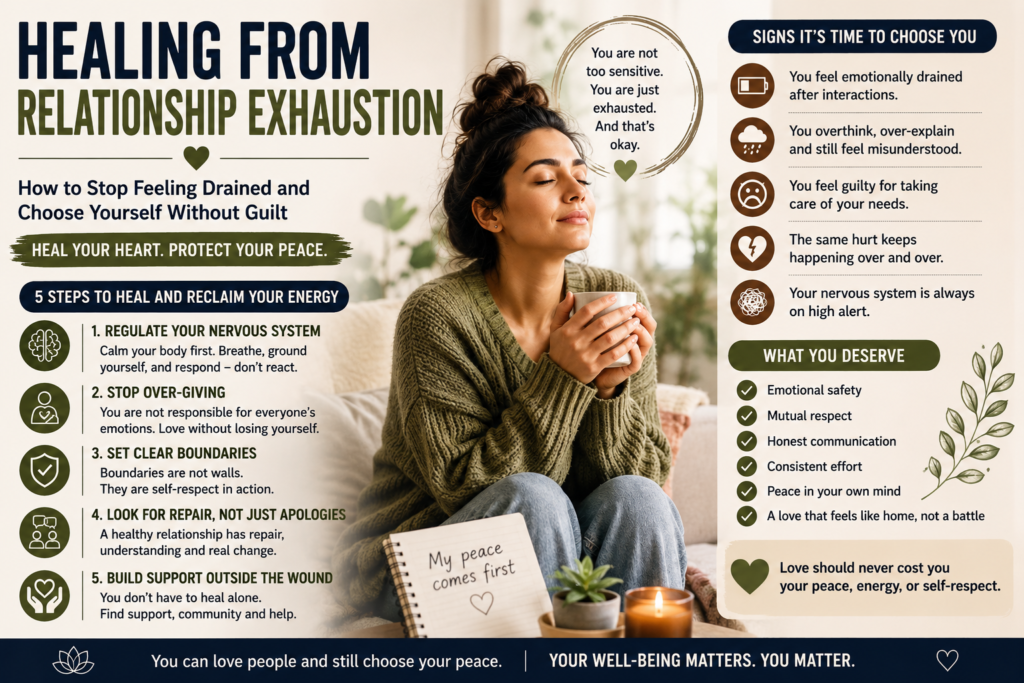
Healing from relationship exhaustion does not mean becoming cold, careless, or emotionally unavailable. It means learning how to love without losing yourself. When you understand why you feel drained in relationships, you begin to see that the problem is not always that you care too much. The deeper problem is that you may care without enough protection for your own nervous system, boundaries, and emotional needs.
Many people think the only options are staying and suffering, or leaving and becoming hard. But there is another path. You can become more regulated, more honest, more self-aware, and more selective about where your emotional energy goes.
This matters because emotional exhaustion in relationships often makes people doubt themselves.
They may ask, “Am I selfish?” “Am I too sensitive?” “Am I giving up too easily?” But healing does not begin with self-attack.
Healing begins when you listen to the body that has been tired for too long.
Read Also: Start Here – Your Journey to Mental Clarity & Emotional Healing
Step 1 — Regulate Before You React
When a relationship activates hurt, silence, guilt, or fear, your first job is not to send the perfect message or explain everything again. Your first job is to regulate your nervous system.
This is important because emotional pain can create urgency. You may feel like calling immediately, sending long messages, defending yourself, apologizing quickly, or asking for answers. But if your body is in panic, your response may come from fear instead of clarity.
Regulation does not mean ignoring the problem. It means calming your system enough to respond wisely.
- Before reacting, pause.
- Breathe slowly.
- Feel your feet on the ground.
- Drink water.
- Notice your chest, stomach, jaw, and shoulders.
Ask yourself, “Am I trying to solve the relationship, or am I trying to stop the pain inside my body?”
This simple pause can reduce impulsive emotional overwork and help you see whether the relationship needs communication, distance, or stronger boundaries.
A 60-Second Reset Before You Reply
Try this before replying to a painful message or after a draining conversation:
Place one hand on your chest. Exhale slowly.
Name what is happening: “I feel hurt,” “I feel scared,” “I feel ignored,” or “I feel guilty.”
Then ask: “Am I responding from clarity or fear?”
This reset will not fix every relationship, but it can stop your nervous system from turning every painful moment into immediate self-abandonment.
Step 2 — Separate Love From Emotional Over-Responsibility
One of the biggest healing shifts is learning that love and emotional over-responsibility are not the same.
- You can care about someone without carrying their mood.
- You can respect someone without abandoning your limits.
- You can want connection without becoming responsible for repairing everything alone.
This is where over giving in relationships needs to be understood clearly. Over-giving is not just doing kind things. It becomes harmful when your giving comes from fear, guilt, loneliness, or the belief that you must keep everyone emotionally stable.
A healthy relationship does not require one person to constantly monitor the other person’s emotions. It allows both people to speak, listen, repair, and take responsibility.
If one person always explains, forgives, adjusts, and absorbs the emotional cost, relationship burnout becomes almost unavoidable.
Read Also : emotional healing roadmap for relationship exhaustion.
What Is Yours and What Is Not Yours?
A powerful way to reduce relationship fatigue is to separate what belongs to you from what does not.
Your communication is yours. Their reaction is not fully yours.
Your boundary is yours. Their discomfort with that boundary is not fully yours.
Your honesty is yours. Their willingness to listen is not yours.
Your healing is yours. Their emotional maturity is not yours.
This does not mean becoming careless. It means becoming realistic. If you keep trying to control another person’s mood, silence, anger, or emotional availability, your nervous system will remain trapped in survival mode.
You are responsible for being respectful. You are not responsible for making every person comfortable with your truth.
The Boundary Sentence to Practice
“I care about this relationship, but I cannot keep hurting myself to keep the peace.”
This sentence is strong because it does not attack the other person. It also does not abandon your truth. It says both things together: care and limit.
A healthy person may not like the boundary immediately, but they will try to understand it. An unsafe pattern may punish you for having a boundary. That difference matters.
Step 3 — Notice Whether the Relationship Has Repair
Not every draining relationship is toxic. Sometimes people are stressed, tired, overwhelmed, grieving, or emotionally immature but still capable of repair. A relationship can go through a difficult phase and still become healthier if both people are willing to listen and change.
The key question is not only, “Do we fight?” The better question is, “Do we repair?”
- Repair means someone can listen without always blaming you.
- Repair means the same hurt does not repeat forever without change.
- Repair means both people can say, “I see how this affected you,” and make an honest effort to behave differently.
Without repair, emotional exhaustion in relationships deepens. The body starts expecting disappointment. The mind stops trusting apologies. The heart still wants closeness, but the nervous system begins preparing for pain.
When a Draining Relationship May Be Emotionally Unsafe
A draining relationship may be emotionally unsafe when there is repeated disrespect, fear, humiliation, gaslighting, control, emotional punishment, threats, or constant blame.
It may also be unsafe when every attempt to express pain becomes another reason for the other person to attack, dismiss, or shame you.
This part must be handled carefully. Feeling drained does not automatically mean someone is abusive or toxic. But repeated patterns matter.
If you regularly feel afraid to speak, afraid to set boundaries, afraid to say no, or afraid of someone’s reaction, your body may be telling you that the relationship does not feel emotionally safe.
If there is abuse, intimidation, violence, or danger, the priority is safety and support. Speak to a trusted person, mental health professional, domestic violence helpline, or local emergency service if needed.
Not Every Draining Relationship Is Toxic — But Patterns Matter
One painful conversation does not define an entire relationship. One bad week does not always mean the bond is unsafe. But repeated patterns show the truth.
If you keep crying after contact, shrinking before conversations, apologizing for normal needs, or feeling guilty for protecting yourself, do not ignore that pattern. Your body may be showing you the emotional cost before your mind is ready to accept it.
This is one reason why you feel drained in relationships even when love still exists. Love can be real, and the pattern can still be unhealthy.
Step 4 — Build Support Outside the Same Wound
One person should not be your whole emotional world, especially if that person is also the source of repeated pain. Healing often begins when you stop going back to the same wound for the comfort it cannot give.
This is especially important for people who feel lonely, unsupported, unmarried, friendless, or emotionally isolated.
When loneliness is intense, even painful connection can feel better than no connection. But if the relationship repeatedly leaves you empty, anxious, guilty, or broken, then your healing must include support outside that pattern.
Support can look like therapy, a support group, a safe friend, journaling, a daily routine, community spaces, spiritual or emotional reflection, or structured self-healing resources.
- The goal is not to replace love with isolation.
- The goal is to stop depending on one painful connection as your only emotional shelter.
Read Also: Nervous System Reset Program for Anxiety & Stress
You Can Love People and Still Stop Self-Abandoning
You can love your parents, partner, friend, sibling, or family member and still stop giving them unlimited access to your nervous system.
- You can care about someone and still reduce contact.
- You can miss someone and still know they are not emotionally safe for you right now.
This is not cruelty. This is emotional maturity.
Healing from relationship burnout means learning that your emotional life matters too.
- Your sleep matters. Your peace matters.
- Your body matters. Your tears matter.
- Your ability to function matters.
A relationship that repeatedly destroys your inner stability cannot be treated as harmless simply because there is love or history attached to it.
The goal is not to hate anyone. The goal is to stop disappearing.
People Also Ask
Why do I feel drained after being around someone?
You may feel drained after being around someone because your body is doing emotional work before, during, and after the interaction. Mood scanning, fear of conflict, people-pleasing, and lack of repair can create emotional exhaustion in relationships.
Is relationship burnout the same as falling out of love?
No. Relationship burnout often means you still care, but your emotional system is exhausted from stress, conflict, silence, or one-sided effort. Falling out of love usually feels more like emotional disconnection, indifference, or loss of desire to reconnect.
Can over giving in relationships cause anxiety?
Yes. Over giving in relationships can create anxiety when you ignore your own limits to keep others calm. Your nervous system may stay alert because it is constantly trying to prevent conflict, rejection, guilt, or disappointment.
How do I know if I need boundaries or distance?
You may need boundaries or distance if contact repeatedly leaves you crying, anxious, guilty, tense, or emotionally empty. Distance can be protective when communication keeps becoming harmful and the same pattern never repairs.
Can a relationship heal after emotional exhaustion?
A relationship can heal after emotional exhaustion if both people take responsibility, respect boundaries, listen honestly, and repair repeated patterns. If only one person keeps trying, relationship fatigue usually continues.
FAQ
What causes emotional exhaustion in relationships?
Emotional exhaustion in relationships is often caused by repeated conflict, silence, emotional labor, people-pleasing, lack of repair, poor boundaries, and feeling responsible for another person’s mood. It builds slowly when the relationship takes more emotional energy than it returns.
Why do I feel guilty setting boundaries?
You may feel guilty setting boundaries because your nervous system has learned that love means being available, understanding, obedient, or self-sacrificing. Guilt does not always mean the boundary is wrong. Sometimes it means your body is learning a new pattern of self-protection.
What is the difference between relationship fatigue and relationship burnout?
Relationship fatigue is the growing tiredness that comes from repeated emotional stress, conflict, or one-sided effort. Relationship burnout is a deeper state where you feel emotionally exhausted, detached, hopeless, or unable to keep giving in the same way.
How can I stop over-giving without feeling selfish?
Start by pausing before saying yes, noticing your body’s reaction, and asking whether your giving is coming from love or fear. Healthy giving includes your limits. Self-protection is not selfish when the relationship has been costing your emotional health.
When should I seek professional support?
Seek professional support if relationship stress affects your sleep, daily functioning, panic, depression, anxiety, self-worth, or safety. Support is also important if there is emotional abuse, control, intimidation, or if you feel unable to set boundaries without intense fear.
External References
- American Psychological Association — Stress effects on the body
https://www.apa.org/topics/stress/body - Cleveland Clinic — Stress and the body
https://my.clevelandclinic.org/health/articles/11874-stress - National Domestic Violence Hotline — Emotional abuse and relationship safety
https://www.thehotline.org/resources/what-is-emotional-abuse/ - Verywell Mind — Emotional exhaustion overview
https://www.verywellmind.com/emotional-exhaustion-4691283 - Psychology Today — Boundaries in relationships
https://www.psychologytoday.com/us/basics/boundaries
Part 3 Closing Conclusion
If you have been asking why you feel drained in relationships, the answer may not be that you are weak, selfish, or too emotional. It may be that your nervous system has been carrying too much emotional responsibility for too long.
You may be tired from silence, tired from explaining, tired from being ignored, tired from understanding everyone, and tired from feeling guilty every time you choose yourself. That tiredness deserves attention, not shame.
The deepest healing begins when you stop confusing love with self-abandonment.
- You can care deeply and still have limits.
- You can miss someone and still protect your peace.
- You can love people and still stop giving them permission to repeatedly injure your emotional life.
A healthier relationship does not require you to disappear. It allows you to exist, speak, feel, rest, and be cared for too.