Why You Spend Money Emotionally (And Regret It Later)
Why You Overspend Even When You Know Better

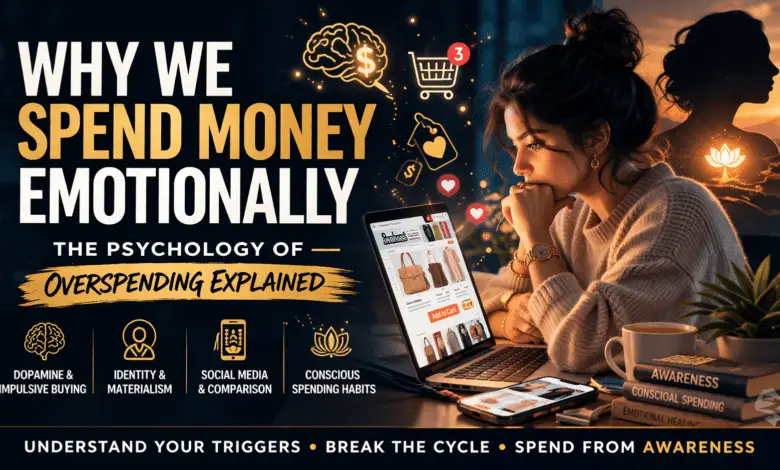
Understanding why we spend money emotionally requires looking deeper than budgeting advice or financial discipline. The truth is that emotional spending psychology is often rooted in internal discomfort, where people use purchases to regulate emotions, soothe stress, or feel temporary relief.
Thank you for reading this post, don't forget to subscribe!Many spending habits are also shaped by identity and materialism behavior, where possessions become tied to self-worth and personal image.
Modern life further intensifies this through the social media influence on spending habits, constantly exposing people to comparison and lifestyle pressure.
Underneath it all, dopamine and impulsive buying behavior help explain why spending can feel emotionally rewarding in the moment—even when regret follows later.
Why We Spend Money Emotionally Is Not Really About Money
Most people think emotional spending is a money issue. They believe the reason they overspend is because they lack discipline, budgeting skills, or financial education. But if that were true, then simply knowing how to manage money would solve the problem.
The reality is that many intelligent, financially aware people still struggle with impulsive purchases, emotional buying, and regret after spending. This is because why we spend money emotionally has far less to do with numbers and far more to do with internal emotional regulation.
At its core, emotional spending psychology shows us that people often spend money not because they need something, but because they need relief from what they are feeling internally. The purchase becomes a temporary emotional regulator.
The product itself may be unnecessary, but the feeling attached to buying it becomes psychologically rewarding. In that moment, spending money feels less like a financial decision and more like a solution to discomfort.
What makes this dangerous is that most people do not consciously realize they are doing this. They believe they simply “wanted” the item. But if they slow down and observe honestly, they often notice that the desire to buy intensifies during moments of stress, loneliness, boredom, self-doubt, frustration, or emotional emptiness.
This is the beginning of understanding the real psychology of emotional spending—that many purchases are emotional responses disguised as rational decisions.
Read Also: Why Success Leads to Self Destruction: The Psychology of Money
The Real Reason Emotional Spending Feels So Hard to Control
One of the most confusing parts of emotional spending behavior is that people often know what they are doing while they are doing it. They may actively think, “I should not buy this,” and still complete the purchase.
This creates internal conflict and shame because they assume awareness should automatically create control. But awareness alone is not enough when the nervous system and reward system are driving behavior.
This is why so many people ask themselves, “Why do I keep buying things I know I do not need?” T
he answer lies in the fact that emotional spending is usually not a logic problem.
It is a regulation problem. In emotional moments, the mind is not prioritizing long-term financial wisdom. It is prioritizing short-term emotional relief. That means the brain temporarily values feeling better now over making the best decision later.
This is where dopamine and impulsive buying behavior become central to understanding the cycle.
Dopamine and Impulsive Buying Behavior: Why Spending Feels Rewarding
Many people misunderstand dopamine and assume it is the chemical of happiness. In reality, dopamine is more accurately the chemical of anticipation and reward-seeking.
It rises not when you receive the reward, but when your brain anticipates the possibility of reward. This is why often the strongest excitement comes before buying, not after receiving the item.
When you browse products, imagine yourself owning them, compare options, or place something into your cart, your brain begins releasing dopamine.
That dopamine creates motivation, anticipation, and temporary emotional elevation. Suddenly the item feels more valuable than it objectively is because your nervous system has attached relief and reward to the possibility of obtaining it.
This explains why dopamine and spending habits can become deeply conditioned over time. If your brain repeatedly experiences relief after purchases, it begins learning a dangerous association:
Emotional discomfort → Buying → Temporary Relief
Once that association forms strongly enough, your mind starts offering spending as a default coping mechanism whenever discomfort appears.
My Personal Experience: When I Saw Emotional Spending Clearly
One of the moments I personally recognized this pattern was not during some huge luxury purchase. It appeared in ordinary daily choices. I noticed internal conflict in moments like deciding between buying fruit for health versus ordering unnecessary hotel food simply for temporary pleasure.
I noticed it when comparing responsible spending on my dog’s needs versus wasting money on alcohol or comfort-based purchases that gave no long-term value.
Those moments taught me something important: emotional spending is not always about large financial irresponsibility. Often it is hidden in small repeated decisions where comfort quietly defeats consciousness.
The deeper realization came when I began seeing how different I felt after the purchase. Before spending, the urge felt urgent and emotionally justified. After spending, especially when awareness returned, I often felt disturbed by my own behavior.
Not merely guilty about the money, but disappointed by what the behavior represented. It felt like I was treating life casually in moments where I could have invested in something meaningful instead—books, learning, helping others, supporting real needs, or directing money toward values that aligned with the kind of person I wanted to become.
That internal disturbance was painful, but it was also useful. It showed me the issue was not really financial. It was behavioral and emotional.
Emotional Spending Psychology: You Are Often Buying a Feeling, Not a Product
A major part of emotional spending psychology is recognizing that people are rarely buying only the object itself. They are often buying the emotional state they associate with the object. In other words, the real purchase is psychological.
Someone buying expensive clothing may not merely want the clothes—they may want confidence, admiration, or status.
Someone buying luxury gadgets may not merely want the technology—they may want to feel successful, advanced, or validated.
Someone repeatedly purchasing self-improvement tools may not simply want the product—they may want hope, control, or the feeling of “finally changing.”
This is where identity and materialism behavior begin entering the conversation.
Many spending habits are tied not to practical need, but to emotional identity construction. People unconsciously use possessions to shape how they feel about themselves. Buying becomes a way to temporarily reinforce identity, status, self-worth, or self-image.
Why Emotional Spending Often Increases During Stressful Life Periods
If you observe closely, emotional spending usually intensifies during unstable periods of life. This is because when internal stability decreases, external soothing behaviors increase.
When someone feels emotionally grounded, clear, purposeful, and regulated, they generally make calmer decisions. But when someone feels lost, uncertain, lonely, stressed, or emotionally overwhelmed, the urge for external comfort rises.
This is why many people overspend during:
- Breakups
- Career instability
- Emotional loneliness
- Burnout
- High anxiety periods
- Identity confusion
- Stressful transitions
The brain starts searching for anything that creates momentary reward or relief. Spending money becomes attractive because it offers a quick and socially acceptable dopamine hit.
Why Awareness Alone Does Not Stop Emotional Spending
One of the hardest truths to accept is that understanding your behavior intellectually does not automatically stop it. Many people fully understand why they spend money emotionally, yet continue repeating the pattern. This frustrates them because they assume knowledge should equal control.
But habits rooted in nervous system regulation are not broken by information alone. They are broken by creating space between urge and action.
This is why one of the most effective systems I developed personally was simple: if I felt an emotional urge to buy something online, I would place it in the cart and leave it there for two days. When I returned later, the emotional charge was often gone. Many times I would look at the cart, laugh, and think, “Why did I even want this so badly?”
That experience taught me a critical truth:
The urge was real—but it was temporary.
The desire felt urgent—but it was emotional, not rational.
Learning this changes everything because once you repeatedly witness your urge disappearing with time, you begin trusting awareness over emotion.
The Core Truth of Part 1
Understanding why we spend money emotionally begins with recognizing that spending is often an emotional coping mechanism, not a financial decision. Emotional spending psychology shows that the brain uses buying behavior to regulate discomfort, chase dopamine, reinforce identity, and temporarily soothe internal instability.
If you do not understand this, you will keep attacking the wrong problem. You will keep trying to fix spending with stricter budgets, harsher self-judgment, or forced discipline while ignoring the emotional system driving the behavior underneath.
And until that underlying system is understood, the pattern continues.
Identity and Materialism Behavior: Why Spending Becomes Personal
To fully understand why we spend money emotionally, we have to go deeper than dopamine and impulsive buying behavior. Emotional spending psychology is not only about chasing temporary pleasure. In many cases, spending becomes tied to identity itself. People begin using money and possessions to shape how they feel about who they are.
This is where identity and materialism behavior become dangerous. Once possessions start carrying emotional meaning, spending is no longer just transactional. It becomes psychological. A purchase begins to represent status, self-worth, belonging, attractiveness, intelligence, or success. The object stops being just an object and becomes a symbol of identity.
That is why some people do not simply buy clothes—they buy confidence. Some do not simply buy cars—they buy status. Some do not simply buy expensive technology—they buy the feeling of being modern, successful, or ahead of others. Some do not even realize they are doing this because the mind disguises emotional identity purchases as “preferences” or “taste.”
But if the emotional need underneath disappeared, many of those purchases would no longer feel necessary.
Why Buying Things Temporarily Changes How You Feel About Yourself
One of the most overlooked parts of emotional spending psychology is that spending can temporarily improve self-perception.
For a short period after buying something desirable, many people feel more put together, more worthy, more successful, or more in control. This internal shift is why shopping becomes psychologically reinforcing even when the financial consequences are negative.
The problem is that this effect does not last.
When identity is built through possessions, the confidence created is temporary because it depends on external reinforcement. Once the novelty fades, the emotional state fades with it.
Then the person feels the need to purchase again, improve again, upgrade again, or prove themselves again. This creates an endless cycle of external validation through spending.
I personally began noticing this in my own reflections when I asked myself an uncomfortable question: “Am I buying this because I need it, or because I like how it makes me feel about myself?” That question exposed how many desires were not practical at all. They were emotional attempts to create a better self-image.
This is why buying things for identity becomes such a subtle trap. It feels productive because you are “improving” something externally, but internally nothing has actually changed.
Social Media Influence on Spending Habits: Why Desire Is No Longer Entirely Yours
A massive driver of modern emotional spending is the social media influence on spending habits. Human beings naturally compare themselves to others, but social media has amplified this instinct to an unprecedented level. Today, people are exposed daily to highly curated images of wealth, beauty, success, travel, luxury, aesthetics, and lifestyle presentation.
This creates a psychological distortion: your brain begins treating repeated exposure as normal.
When you constantly see luxury restaurants, expensive gadgets, branded clothing, beautiful homes, vacations, and curated lifestyles, your perception of what is “normal” begins shifting upward. Even if you intellectually know much of social media is curated or exaggerated, emotionally your nervous system still registers comparison.
That is why social media and overspending are closely linked. People begin feeling lacking not because their life objectively lacks anything, but because their comparison standard has been artificially inflated.
Suddenly, ordinary life feels insufficient.
Ordinary clothes feel plain.
Ordinary meals feel boring.
Ordinary routines feel unsuccessful.
Ordinary finances feel embarrassing.
And once normal life starts feeling inadequate, spending becomes an attempt to close the perceived gap.
Comparison and Spending Behavior: The Hidden Emotional Pressure
Comparison rarely announces itself directly. Most people do not think, “I am buying this because I envy someone.” Instead, comparison influences desire subtly. You see someone’s lifestyle enough times and begin feeling a vague sense that you should also have more, do more, spend more, or look better.
This is how comparison and spending behavior quietly distort judgment. Desire becomes socially constructed rather than internally chosen.
Many people are not spending based on genuine values.
They are spending based on absorbed expectations from:
- Their social circle
- Their peer group
- Their industry or profession
- Influencers and online personalities
- Cultural narratives of success
- Family pressure and status expectations
Once this happens, money is no longer being used simply to meet needs. It is being used to maintain perceived social positioning.
That is one reason emotional spending feels so persistent: you are not merely resisting desire. You are resisting social conditioning.
Why Materialism and Self-Worth Become Linked
A person with strong internal grounding can enjoy possessions without depending on them emotionally. But when self-worth is unstable, possessions often become tools for emotional compensation.
This is the deeper problem with materialism and self-worth: the more insecure someone feels internally, the more attractive external symbols of worth become.
People begin unconsciously thinking:
- “If I look successful, I will feel successful.”
- “If I own quality things, I will feel valuable.”
- “If others admire my lifestyle, I will feel worthy.”
- “If I keep upgrading, I will feel like I am progressing.”
But external symbols cannot permanently repair internal insecurity. They can only distract from it temporarily.
This is why some of the most externally impressive people remain deeply dissatisfied. Their possessions have improved, but their internal identity has not.
My Realization: Most Desire Is Conditioned, Not Conscious
One of the most freeing realizations I had was understanding that not every desire I felt was truly mine. Many wants were conditioned by exposure, comparison, ego, or temporary emotional state. The urge felt personal, but much of it had been shaped by environment.
That realization changed how I viewed desire entirely.
Instead of asking, “Do I want this?” I began asking:
- “Why do I want this?”
- “Where did this desire come from?”
- “Would I want this if nobody saw it?”
- “Would I still value this if comparison disappeared?”
Those questions expose whether desire is authentic or conditioned.
And often the answer is uncomfortable.
Many wants disappear when comparison is removed.
Social Media Spending Pressure Creates False Urgency
Another major issue is that modern platforms intentionally create emotional urgency around spending. Scarcity tactics, limited drops, flash sales, influencer promotions, “everyone has this” trends, and constant exposure to aspirational content keep the nervous system in a subtle state of dissatisfaction.
This creates social media spending pressure, where the mind begins feeling:
- “I am behind.”
- “I should get this before I miss out.”
- “Everyone else is progressing.”
- “This will improve my life.”
This pressure often has little to do with actual need. It is manufactured urgency designed to convert emotional discomfort into spending behavior.
When you understand this, you stop seeing every urge as personal desire and begin seeing many urges as environmental programming.
The Deeper Truth: Emotional Spending Is Often a Search for Identity
At the deepest level, much emotional spending is an unconscious attempt to answer painful internal questions:
- Am I enough?
- Am I successful enough?
- Am I respected enough?
- Am I attractive enough?
- Am I behind in life?
- Do I matter?
When those questions remain unresolved internally, spending becomes a temporary strategy for emotional reassurance.
But no purchase can permanently answer identity questions.
That is why the relief never lasts.
Core Truth of Part 2
If Part 1 taught us that emotional spending is often about emotional regulation, then Part 2 shows that emotional spending is also deeply tied to identity, self-worth, and environmental conditioning.
Many spending decisions are not practical choices. They are emotional attempts to:
- Reinforce identity
- Escape comparison
- Reduce insecurity
- Keep up socially
- Feel valuable temporarily
Understanding identity and materialism behavior and the social media influence on spending habits is essential because once you see how much desire is conditioned, you stop trusting every urge automatically.
You begin realizing:
Not every desire deserves obedience.
Not every urge reflects your real values.
Not every want is truly yours.
Why Stopping Emotional Spending Requires More Than Discipline
Once you understand why we spend money emotionally, the next question naturally becomes: how do you actually stop?
Most advice online gives surface-level solutions such as budgeting more carefully, deleting shopping apps, cutting up credit cards, or using stricter financial rules.
While those strategies can help temporarily, they do not address the root issue. Emotional spending psychology teaches us that the problem is rarely a lack of information. It is a lack of emotional awareness and regulation.
If spending is being used to soothe discomfort, reinforce identity, or regulate emotional instability, then simply restricting money does not solve the underlying pattern. In fact, restriction without understanding often increases frustration and eventually leads to rebound spending.
Real change happens when you learn to interrupt the emotional process before it becomes action.
That is why the true solution is not just financial discipline. It is conscious awareness.
The First Step: Recognize the Emotional Moment Before the Purchase
Every emotional spending habit begins before the payment screen. It begins in the moment discomfort meets desire. If you want to build conscious spending habits, you must start noticing what is happening internally before you buy.
Ask yourself simple but powerful questions:
- What am I feeling right now?
- Am I calm or emotionally activated?
- Do I want this item, or do I want the feeling attached to this item?
- Am I solving a real need, or escaping discomfort?
These questions sound basic, but they force the mind to slow down. And slowing down is critical because emotional spending thrives on speed. The faster the urge moves into action, the less awareness has a chance to intervene.
Over time, I learned that the moment I felt urgency around a purchase was often the exact moment I needed to pause, not proceed. Genuine needs rarely feel emotionally urgent. Emotional purchases often do.
My 48-Hour Delay Method: How I Broke the Dopamine Loop
One of the simplest and most effective systems I personally developed was the 48-hour delay method. Whenever I felt a strong urge to buy something online, I would place it in my cart but refuse to purchase it immediately. Instead, I left it there for two days.
This method worked because it interrupted dopamine and impulsive buying behavior. The initial emotional excitement around buying would begin fading once anticipation dropped.
By the time I returned to the cart later, I often felt completely different. In many cases, I would look at the items and genuinely laugh at myself, wondering why they had felt so important just 48 hours earlier.
That experience taught me a profound lesson:
Many desires are emotionally intense but psychologically temporary.
The urge feels powerful in the moment because the nervous system is activated, not because the purchase is truly important.
The 48-hour rule creates space for emotional intensity to settle so rational thought can return. It is not just a financial strategy. It is a dopamine interruption system.
Replace Impulsive Spending With Conscious Redirection
Stopping emotional spending is easier when you replace the pattern rather than simply suppress it. The mind resists pure restriction. If you only tell yourself “no” repeatedly without offering an alternative, spending begins to feel like deprivation. That deprivation can later trigger rebound behavior.
A better approach is conscious redirection. When the urge to spend arises, redirect the desire toward something aligned with your values.
Personally, I began asking myself: if I am going to use money, can I use it in a way that actually improves life instead of merely soothing emotion?
That shift changed everything. Instead of random comfort purchases, I began considering:
- Books that build understanding
- Tools that increase skill
- Gifts that strengthen relationships
- Support for causes that matter
- Investments in health or long-term stability
This changed spending from emotional escape into intentional value creation.
The deeper principle here is simple:
Spend to build life, not to numb discomfort.
Guilt After Spending: Why It Is Not Always a Bad Sign
Many people feel intense guilt after emotional purchases and assume that guilt means something is wrong with them. But in many cases, guilt is not evidence of failure—it is evidence of awareness.
When I became more conscious of my own spending patterns, I often felt disturbed after unnecessary purchases. Not because the amount of money was catastrophic, but because the action reflected misalignment. It felt like I had betrayed my own values for temporary comfort. That discomfort was painful, but it was also clarifying.
The purpose of guilt, when handled correctly, is not self-attack. It is feedback.
Healthy guilt says:
- “This behavior does not align with who I want to become.”
- “You are capable of better choices.”
- “Pay attention—something deeper is happening here.”
Used properly, guilt can become information rather than shame.
Conscious Spending Habits Begin With Defining What Real Value Means to You
One of the strongest realizations you shared—and one of the most powerful truths in this entire blog—is this:
“Real life is not about spending money. It is about how you invest your emotion without spending.”
That statement captures the deeper solution to emotional spending. The real issue is not money. It is where emotional energy is being invested.
People overspend when they lack internal definitions of meaning, value, and purpose. Without those definitions, the mind defaults toward stimulation and comfort. But once you become clear on what genuinely matters to you, spending decisions become easier.
When you know what kind of life you are building, random purchases lose some of their emotional power.
You begin asking different questions:
- Does this support the life I want?
- Does this align with my values?
- Is this helping me grow, or distracting me temporarily?
- Am I investing in comfort, or in meaning?
These are not merely financial questions. They are identity questions.
Gita and Maya: Why Attachment to Possessions Creates Suffering
From a deeper spiritual perspective, emotional spending can also be understood through the lens of Maya—the illusion that external things can permanently complete internal emptiness.
The mind constantly suggests:
- “If I get this, I will feel better.”
- “If I own this, I will feel more complete.”
- “If I achieve this lifestyle, I will finally feel enough.”
But as you have observed in your own life, that completion never lasts.
Why?
Because the object was never the true need.
The Bhagavad Gita repeatedly points toward this deeper truth: attachment to temporary external outcomes creates suffering because the mind keeps seeking fulfillment where permanent fulfillment cannot be found.
Possessions can be enjoyed. Comfort can be appreciated. Wealth can be used wisely. But once identity, peace, or worth become attached to external acquisition, suffering follows.
Emotional spending becomes one more expression of Maya—the illusion that external possession can solve internal dissatisfaction.
Final Truth: Emotional Spending Stops When Awareness Becomes Stronger Than Urge
Ultimately, learning how to stop emotional spending is not about becoming perfect. It is not about never feeling desire again. It is not about removing pleasure from life.
It is about increasing the gap between urge and action.
That gap is where freedom lives.
The longer the gap becomes, the more likely awareness can intervene. And the more awareness intervenes, the less automatic the pattern becomes.
You do not need to eliminate desire. You need to stop obeying every desire automatically.
Because maturity is not the absence of urge.
Maturity is the ability to observe urge without immediate obedience.
Final Personal Note
Clarity did not come when I simply tried to stop spending. Clarity came when I started asking deeper questions about what spending was doing for me emotionally. Once I saw that many purchases were not about the object at all—but about temporary relief, identity, comfort, or escape—the pattern lost much of its unconscious power.
I did not just learn to spend less.
I learned to understand myself more honestly.
And that, in the end, is the real value of awareness.
FAQ – why we spend money emotionally?
1. Why do we spend money emotionally?
People spend money emotionally because buying creates temporary emotional relief, dopamine reward, and distraction from stress, loneliness, boredom, or internal discomfort.
2. What is emotional spending psychology?
Emotional spending psychology explains how emotions influence buying decisions, often causing people to purchase things for comfort, validation, or temporary mood improvement rather than actual need.
3. Why does buying things feel good emotionally?
Buying feels good because dopamine rises during anticipation of reward, making purchases feel exciting and emotionally relieving before the pleasure quickly fades.
4. How does dopamine affect impulsive buying behavior?
Dopamine creates anticipation and reward-seeking behavior, which makes impulsive purchases feel urgent and emotionally satisfying in the moment.
5. Can social media influence spending habits?
Yes. Social media increases comparison, perceived inadequacy, and lifestyle pressure, which can trigger emotional spending and overspending.
6. How is identity connected to spending money?
Many people buy things to reinforce self-image, status, confidence, or belonging, linking possessions to identity and self-worth.
7. How can I stop emotional spending habits?
You can stop emotional spending by increasing awareness, delaying purchases, identifying emotional triggers, and creating conscious spending habits.
8. Is emotional spending a sign of poor discipline?
Not necessarily. Emotional spending is often an emotional regulation pattern rather than a simple discipline issue.
People Also Ask – why we spend money emotionally
1. Why do I buy things when I feel sad?
Because your brain may use spending as a coping mechanism to temporarily relieve emotional discomfort.
2. Why do I regret purchases after buying?
Because the emotional relief fades quickly while the financial consequence remains.
3. Is emotional spending a trauma response?
It can be. Some people use spending to self-soothe unresolved emotional pain, anxiety, or chronic stress.
4. Why do I keep shopping even when I know I shouldn’t?
Because emotional urges often overpower logic when buying has become a learned coping habit.
5. Does anxiety cause overspending?
Yes. Anxiety can increase impulsive spending as the brain seeks quick relief or control.
6. Why does online shopping feel addictive?
Because anticipation, novelty, convenience, and dopamine reward loops make online shopping highly stimulating.
7. How do I know if I am emotionally spending?
If you buy when stressed, sad, bored, lonely, or seeking comfort rather than out of practical need, emotional spending may be involved.
8. How long should I wait before buying impulsively?
A 24–48 hour pause is often enough for emotional urgency to reduce significantly.
9. Why do social media influencers make me want to spend more?
Because repeated exposure to curated lifestyles creates comparison and perceived inadequacy.
10. Can emotional awareness improve financial habits?
Yes. Greater emotional awareness helps reduce impulsive decisions and supports conscious spending.
Blog References / Supporting Sources
- American Psychological Association – Stress and Consumer Behavior
https://www.apa.org
Supports emotional coping / stress-driven purchasing behavior
- Harvard Business Review – The Psychology Behind Spending Decisions
https://hbr.org
Supports emotional and identity-based spending psychology
- Journal of Consumer Research – Emotions and Consumer Behavior Studies
https://academic.oup.com/jcr
Supports emotional spending psychology / consumer decision patterns
- Psychology Today – Retail Therapy and Emotional Spending
https://www.psychologytoday.com
Supports emotional regulation through shopping / retail therapy research
- National Institutes of Health (NIH) – Dopamine Reward System Research
https://www.nih.gov
Supports dopamine and impulsive buying / reward pathway explanations
- Frontiers in Psychology – Social Comparison and Consumer Behavior
https://www.frontiersin.org
Supports social media influence / comparison-based spending
- Bhagavad Gita – Chapter 2 / Chapter 3
Supports attachment, desire, and Maya concepts used in spiritual integration
Suggested Verses:
- BG 2.62–63 → Desire → Attachment → Anger / Delusion cycle
- BG 3.37 → Desire as the force behind compulsive behavior