AI Emotional Support for a Calmer Mind
AI Self-Care for Healing and Inner Peace

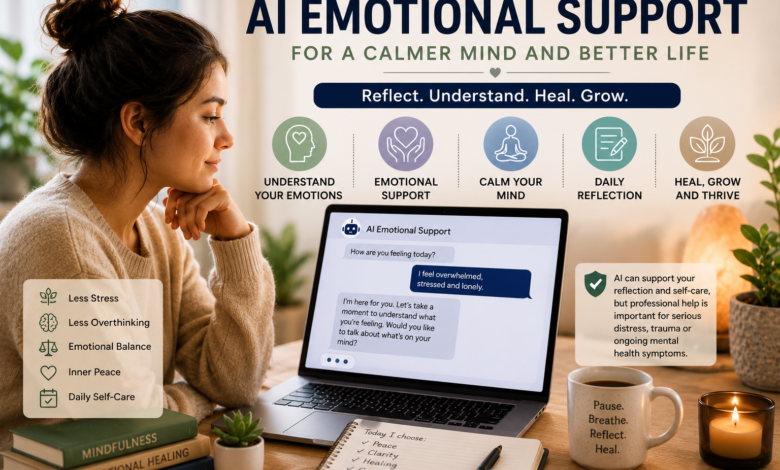
Many people today feel emotionally alone even when they are surrounded by people, work, messages, and digital noise.
Thank you for reading this post, don't forget to subscribe!This is why AI emotional support is becoming important for people who need a safe space to pause, reflect, and understand what they are feeling. But this blog is not another simple article about AI mental health tools or chatbot apps.
Here, you will learn how AI self care can support loneliness, stress, overthinking, and emotional tiredness without replacing therapy or real human connection.
You will also understand how AI mindfulness tools can help with breathing, grounding, awareness, and nervous system calm.
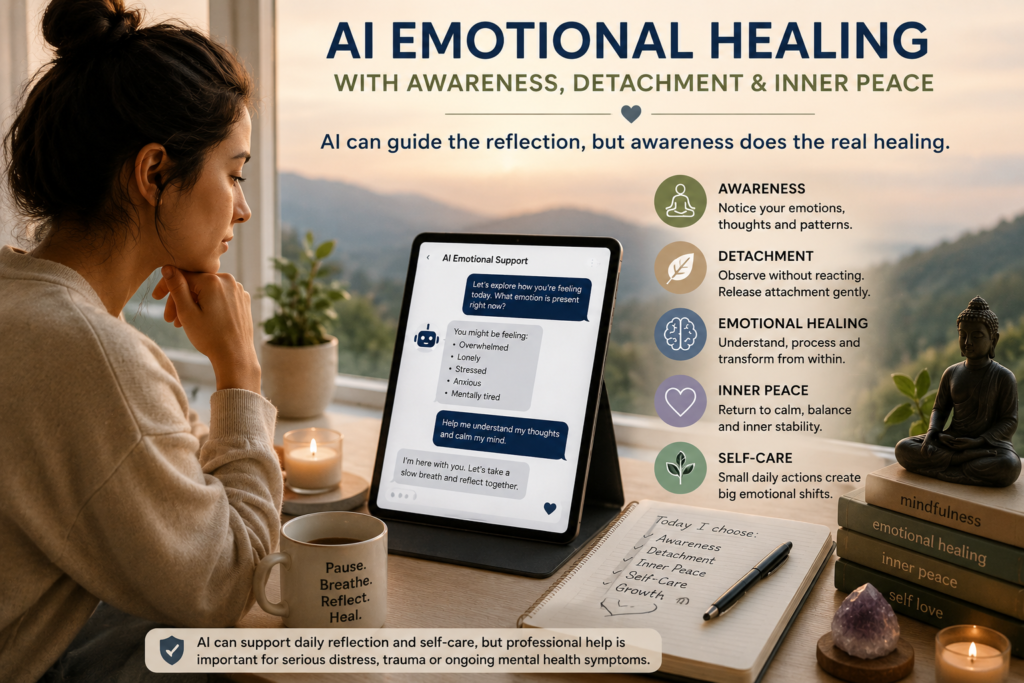
The unique part of this blog is the deeper BBH view: AI emotional healing works best when it helps you return to awareness, inner peace, detachment, and honest self-reflection. AI can guide the pause, but your awareness does the real healing.
What AI Emotional Support Really Means
Many people today are not only tired; they are emotionally overloaded. They may have work pressure, family expectations, relationship confusion, loneliness, racing thoughts, or a deep need to talk to someone without being judged.
This is where AI emotional support becomes a new kind of daily reflection tool. It cannot replace therapy, medical care, friendship, or spiritual guidance, but it can help a person pause, name emotions, organize thoughts, and return to a calmer state before emotions become reactions.
The important point is to understand AI correctly. AI mental health tools are not magic healers.
They are not human therapists.
They do not truly feel pain.
But when used wisely, they can become a structured mirror for self-reflection, emotional awareness, and gentle self-care.
For readers in the USA, UK, Canada, and Australia, where loneliness, stress, digital pressure, and mental fatigue are rising, this type of support can be useful when used with boundaries.
What Is AI Emotional Support?
AI emotional support means using artificial intelligence tools to help you reflect on emotions, understand thought patterns, create self-care routines, and calm the mind through structured prompts.
It may include journaling support, emotional check-ins, breathing guidance, mindfulness prompts, mood reflection, or gentle questions that help you understand what is happening inside you.
This is different from asking AI to fix your life. The real purpose of AI is not to replace your inner wisdom but to help you access it more clearly.
When the mind is overwhelmed, even simple questions can feel difficult:
- “What am I feeling?”
- “Why am I reacting?”
- “What do I need right now?”
AI can help bring structure to this confusion.
A Simple Definition for Daily Emotional Life
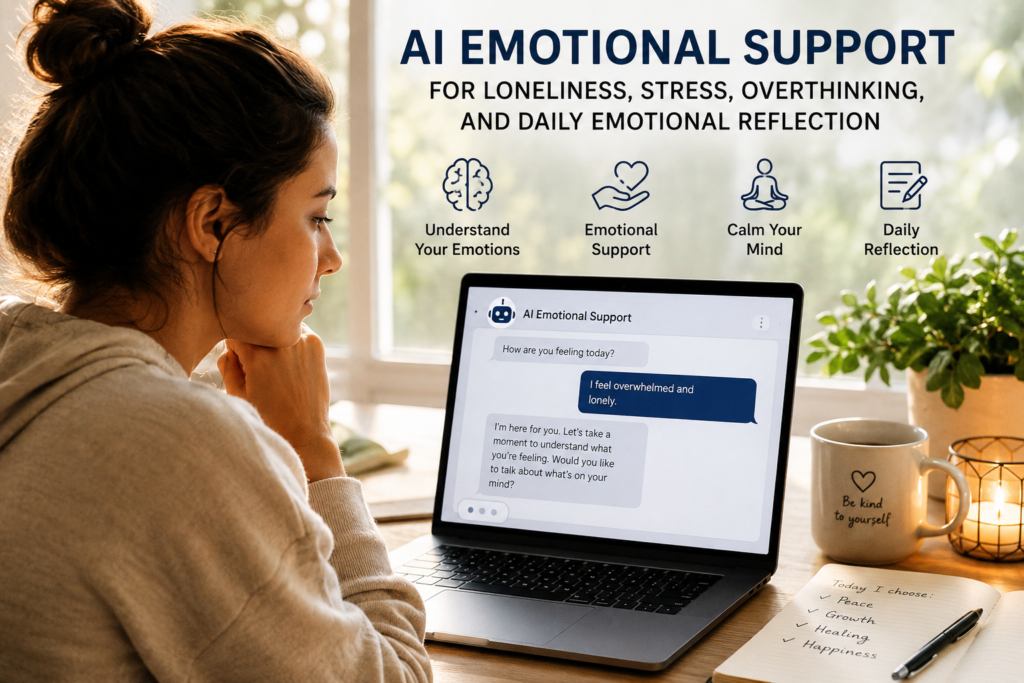
In simple words, AI emotional support is a digital self-reflection companion that helps you slow down and understand your emotions. It may help with stress, loneliness, emotional overwhelm, overthinking, self-doubt, and mental fatigue.
It can also support daily emotional routines, especially when you feel stuck but do not know where to begin.
For example, instead of keeping painful thoughts inside, a person may ask AI: “Help me understand why I feel emotionally heavy today.”
The response may guide the person to explore body signals, repeating thoughts, recent stress, unmet needs, or emotional triggers. This is not therapy, but it can become a helpful first step toward emotional clarity.
For deeper digital support guidance, readers can also explore AI Therapy & Self-Help Tools.
Why People Use AI When They Feel Alone
Many people use AI because they feel alone at the exact moment they need emotional support.
- Sometimes friends are busy.
- Sometimes family may not understand.
- Sometimes people are afraid of being judged.
- Sometimes they do not want advice; they only want space to express what is happening inside them.
In those moments, AI self care can offer a private place to pause and reflect.
“AI helped me feel emotionally supported when I felt alone, not because it replaced people, but because it gave me a safe place to pause, reflect, and understand my emotions.”
This is the unique angle of this blog. Most articles talk only about tools, apps, or chatbot features.
This article looks deeper. It explains how AI can support emotional awareness, nervous system calm, inner peace, and detachment when it is used wisely.
AI gives the prompt, but the person still does the healing. For a wider healing path, readers can follow the Emotional Healing Roadmap.
What AI Can Help With in Daily Life
AI can help with many everyday emotional struggles, especially when the person needs reflection instead of emergency help.
It may support stress, loneliness, overthinking, racing thoughts, emotional tiredness, low mood, self-doubt, inner confusion, and nervous system stress.
It can also help a person create a short self-care plan, journal about feelings, or practice grounding when the mind feels noisy.
For example, someone who is overwhelmed may ask AI: “Give me a five-minute calming practice.”
- Someone who is lonely may ask: “Help me understand why I feel disconnected today.”
- Someone who is overthinking may ask: “Turn my racing thoughts into three clear questions.”
These small prompts can help the mind move from emotional chaos into structured awareness.
This is where AI mindfulness tools can support breathing, grounding, present-moment awareness, and nervous system regulation.
Why AI Emotional Support Is Becoming Popular
The popularity of AI emotional support is growing because many people want immediate, private, and accessible emotional reflection.
In countries like the USA, UK, Canada, and Australia, people may face long therapy wait times, high costs, busy work schedules, isolation, digital burnout, and emotional pressure. AI cannot solve these problems fully, but it can offer a bridge between emotional silence and human support.
People often need help at night, after work, during anxiety, or when they feel mentally frozen. At those times, AI may help them write down what they feel, identify one small next step, or calm the body with a grounding exercise.
This is why AI mental health tools are becoming part of the wider conversation around mental wellness, digital self-care, and daily emotional regulation.
Accessibility, Privacy, and 24/7 Reflection
One reason people turn to AI is accessibility. A person may not always have someone available to talk to, but they may still need emotional clarity. AI can be used at any time for journaling prompts, emotional check-ins, breathing exercises, or self-reflection.
This makes AI self care practical for daily use, especially when someone needs support between therapy sessions or during ordinary emotional stress.
Privacy is another reason. Some people feel safer writing to AI before they are ready to speak openly with another person.
This can be useful for exploring emotions, but it also needs boundaries. AI should not become the only emotional relationship in someone’s life.
It should support self-understanding, not replace trusted human connection.
This is close to the practice of conscious living, where a person learns to observe thoughts and emotions before reacting.
AI Emotional Support vs AI Therapy
There is a big difference between using AI for emotional support and depending on AI as therapy.
AI emotional healing can begin when a person becomes more aware of thoughts, body signals, emotional triggers, and inner patterns. But deeper healing often needs human connection, professional guidance, nervous system safety, and time.
AI can ask helpful questions like:
- “What emotion are you avoiding?”
- “What thought keeps repeating?”
- “What does your body feel right now?”
- These questions may open awareness.
But AI does not know your full life, trauma history, medical condition, family background, risk level, or clinical needs. That is why AI should be used as a support tool, not as the final authority.
Safe Use Rule
AI can support daily reflection, emotional clarity, and self-care, but professional help is important for serious distress, trauma, crisis, or ongoing mental health symptoms.
The best use of AI emotional support is not to escape life, avoid people, or replace therapy. The best use is to pause, observe, reflect, regulate, and then take one healthier step in real life.
In the deeper BBH view, AI can guide the question, but awareness must do the real healing.
How AI Mental Health Tools Support Daily Emotional Regulation
AI mental health tools can support emotional regulation by helping a person slow down before reacting. When stress, loneliness, or overthinking becomes intense, the mind often moves fast and the body becomes tense.
At that moment, many people do not need a perfect answer. They need a calm structure that helps them ask, “What am I feeling, what triggered this, and what is one safe next step?” This is where AI emotional support can become useful for daily reflection.
AI can help organize emotional noise into simple questions. For example, a person may write, “I feel overwhelmed and I do not know why.”
A helpful AI response may guide them to notice body signals, recent pressure, repeating thoughts, and emotional needs. This does not replace therapy, but it can help the person move from confusion into awareness.
Naming Emotions Before They Become Reactions
Many emotional reactions become stronger because the emotion is not named early. A person may think they are angry, but underneath the anger there may be fear, rejection, shame, exhaustion, or loneliness.
AI emotional support can help the reader pause and name the emotion before it becomes an argument, shutdown, impulsive message, or self-attack.
This is especially helpful for people who struggle with overthinking or emotional overwhelm. AI can ask gentle questions like, “Is this sadness, fear, anger, guilt, or tiredness?”
That small pause can reduce emotional intensity. In the BBH view, naming an emotion is not weakness. It is the beginning of emotional awareness. Once the emotion is named, the nervous system gets a little more space to settle.
Turning Overthinking Into Structured Reflection
Overthinking often feels like problem-solving, but many times it is fear repeating itself. The mind keeps asking the same questions:
- “What if this goes wrong?”
- “What if they leave?”
- “What if I fail?”
- “What if I am not enough?”
AI mental health tools can help turn this loop into structured reflection.
For example, a reader can ask AI: “Separate my fear-based thoughts from practical facts.” This can help the person see the difference between real action and mental noise.
For deeper reading, you can internally link here to Why Your Mind Fears Uncertainty with the anchor text why the mind fears uncertainty.
Example Prompt Readers Can Use
“Help me understand what I am feeling right now without judging me. Ask me three gentle questions, separate facts from fear, and suggest one small calming action.”
This prompt supports AI self care because it does not ask AI to control life. It asks AI to support reflection, awareness, and one practical next step.
AI Self Care for Stress, Loneliness, and Mental Fatigue
AI self care is useful when a person needs emotional structure but feels too tired to create it alone. Self-care is often misunderstood as only rest, entertainment, or motivation.
Real self-care is also emotional honesty, nervous system calm, boundaries, reflection, and small actions that protect mental stability.
When someone feels lonely, mentally tired, or emotionally heavy, AI can help them create a simple check-in routine. It can ask:
- “What are you feeling?”
- “Where do you feel it in your body?”
- “What thought is repeating?”
- “What support do you need?”
- “What is one small action you can take now?”
These questions bring the person back from emotional chaos into self-contact.
Building a Daily Reflection Routine
A healthy AI self care routine can be very simple. The reader does not need a complex app or long process. They can begin with a daily five-minute reflection.
- First, name the emotion.
- Second, notice the body signal.
- Third, write the repeating thought.
- Fourth, ask what is needed.
- Fifth, choose one small action.
This small routine is powerful because it trains awareness. Many people wait until emotions become too intense before they reflect. But daily reflection helps catch emotional signals earlier.
This is where AI emotional healing begins—not by forcing positivity, but by understanding the emotional pattern before it becomes behavior.
Why Self-Care Needs Structure, Not Just Motivation
Motivation is unreliable when the nervous system is tired. A person may know they need rest, journaling, movement, prayer, meditation, or connection, but still feel frozen. This is why structure matters. AI can help create small steps when the mind feels blocked.
For example, instead of asking, “How do I fix my life?” the reader can ask, “Give me one small self-care action for the next five minutes.”
This aligns with a strong healing principle: action does not always need emotional permission. Sometimes one small structured step creates the emotional shift later.
5-Minute AI Self-Care Practice
Minute 1: What am I feeling right now?
Minute 2: Where do I feel this in my body?
Minute 3: What thought is repeating?
Minute 4: What do I need emotionally?
Minute 5: What is one small action I can take?
This practice makes AI emotional support practical instead of abstract.
AI Mindfulness Tools and Nervous System Calm
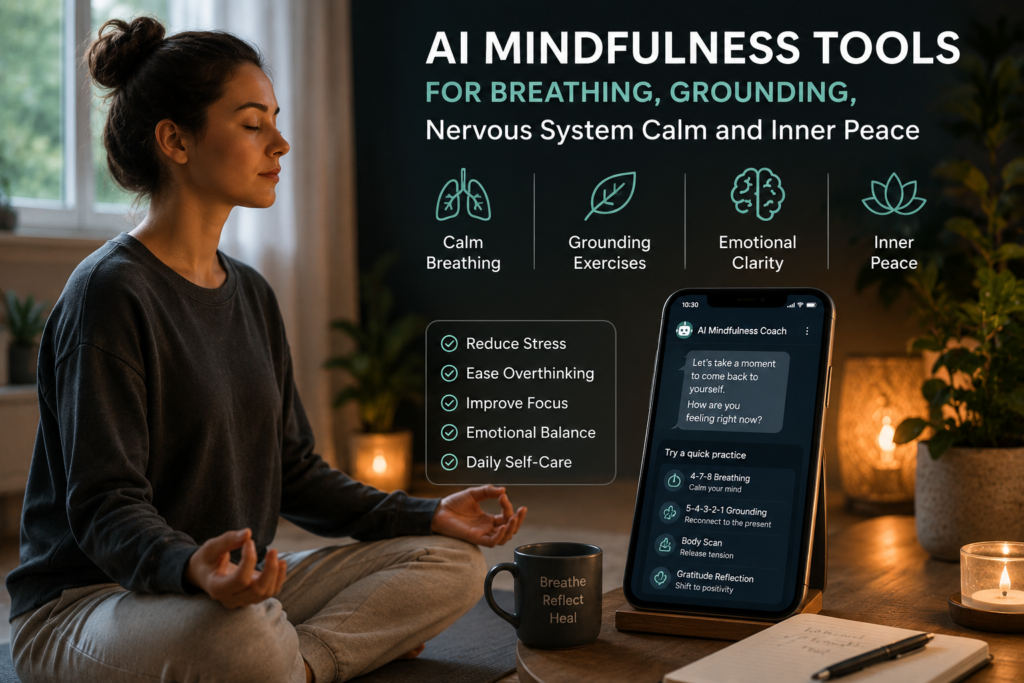
AI mindfulness tools can support breathing, grounding, body awareness, present-moment reflection, and emotional regulation. They are useful when the mind is racing and the body feels activated.
A person may ask AI for a breathing practice, a grounding exercise, a calming journal prompt, or a short reflection to return to the present moment.
Breathing, Grounding, and Present-Moment Awareness
Breathing and grounding work because they bring attention back to the body. When the mind is caught in fear, memory, regret, or future worry, the body often carries the pressure.
AI mindfulness tools can guide simple practices such as slow breathing, five-senses grounding, body scan reflection, or a short pause before reacting.
But the tool is not the healer. The practice is what matters. AI can guide the steps, but the reader must breathe, observe, and return to awareness.
This is why AI emotional healing should be understood as a support process, not a shortcut.
From Emotional Noise to Inner Peace
Inner peace does not mean the absence of emotion. It means the ability to observe emotion without becoming completely controlled by it. This is where AI, mindfulness, and spiritual self-care can meet.
- AI may help the reader notice the thought.
- Mindfulness helps them return to the present.
- Awareness helps them see the emotion clearly.
- Detachment helps them stop obeying every fear.
For deeper BBH internal linking, add How Detachment Helps Control Emotions with the anchor text detachment helps control emotions.
Where AI Helps and Where Human Support Is Better
AI helps with reminders, reflection, journaling, grounding, breathing, and daily emotional organization.
Human support is better for trauma, grief, abuse, crisis, severe anxiety, depression, bipolar symptoms, self-harm thoughts, and ongoing emotional distress.
The safest approach is balanced: use AI emotional support for daily reflection, but choose professional help when the pain is serious, repeated, or difficult to manage alone.
AI Emotional Healing and Spiritual Self-Care
AI emotional healing becomes deeper when it does not only focus on feeling better for a few minutes, but also helps a person understand their inner patterns. Many people are not only stressed; they are attached to thoughts, fears, expectations, outcomes, and emotional stories.
They may keep asking,
- “Why did this happen to me?”
- “Why am I not enough?”
- “Why can’t I stop thinking?”
This is where spiritual self-care becomes important.
In the BBH view, AI emotional support is useful when it helps a person pause and observe the emotion instead of immediately becoming the emotion.
- AI can ask reflective questions, but awareness must do the real work.
- AI self care can guide journaling, breathing, and reflection, but the person must still practice honesty, patience, and inner discipline.
Awareness Is the First Step in Emotional Healing
Awareness means noticing what is happening inside you before you react from it. For example, a person may feel rejected and instantly want to send a message, argue, isolate, or blame themselves.
But if they pause and ask AI, “Help me understand what I am feeling without judging me,” they may discover that the real emotion is fear, not anger.
This is where AI mental health tools can support emotional clarity. They can help separate facts from fear, emotion from identity, and reaction from wise action.
This does not mean AI understands the soul or replaces human wisdom. It means AI can become a mirror that helps the person slow down enough to see clearly.
A helpful internal link here is Why Attachment Causes Emotional Suffering because attachment is often the hidden root behind emotional pain, overthinking, and inner unrest.
Gita-Style Reflection: Detachment From Thought and Outcome
Gita-style reflection does not mean becoming cold, careless, or emotionless. It means learning to act with awareness without losing yourself in every result.
Many people suffer because they attach their peace to another person’s reply, one future outcome, one mistake, one fear, or one painful memory. Detachment helps the mind return to balance.
AI mindfulness tools can support this process by offering reflection prompts, grounding practices, and self-inquiry questions.
A person may ask AI: “What am I attached to right now?” or “How can I respond with awareness instead of fear?” These questions can help a person step back from emotional overidentification.
A Reflection Prompt for Detachment
Use this prompt during emotional pressure:
“What emotion am I attached to right now, and what would I notice if I observed it instead of obeying it?”
This is one of the safest ways to use AI emotional support: not for escaping reality, but for returning to clear seeing.
Safe Ways to Use AI Emotional Support
The safest way to use AI emotional support is to treat it as a reflection companion, not as a therapist, doctor, guru, or final authority.
AI can support daily journaling, emotional naming, calming practices, and self-care planning. But professional help is important when distress is serious, repeated, unsafe, or affecting daily life.
This boundary matters because readers in the USA, UK, Canada, and Australia may be searching for quick emotional help during anxiety, loneliness, emotional overwhelm, or mental fatigue.
The blog must be caring, but also responsible. AI can support daily reflection, but it should never become the only place where a person seeks help.
Use AI for Daily Reflection, Not Crisis Dependence
AI can help someone reflect on ordinary stress, write a journal entry, calm racing thoughts, or create a self-care plan. But if someone is experiencing self-harm thoughts, suicidal thoughts, severe depression, panic, trauma flashbacks, abuse, addiction, or symptoms that feel unmanageable, they should contact emergency support, a doctor, therapist, counselor, crisis line, or trusted person.
This is not a weakness. It is wisdom.
AI emotional healing should move a person toward real support, not away from it.
AI can help prepare thoughts before a therapy session, write questions for a doctor, or organize emotions before speaking to someone trusted.
Privacy, Accuracy, and Emotional Overdependence
Readers should also use AI carefully because privacy and accuracy matter. They should avoid sharing unnecessary personal, financial, medical, or highly sensitive details.
AI can make mistakes, misunderstand context, or give general advice that may not fit a person’s full life situation.
There is also a risk of emotional overdependence. If someone starts using AI as their only emotional connection, they may feel supported in the moment but become more isolated over time.
Healthy AI self care should help a person build awareness, regulation, and real-world connection—not avoid human life.
Best Use Rule
AI is best used as a reflection companion, not a replacement for therapy, medical care, spiritual guidance, or trusted human relationships.
This rule keeps AI mental health tools safe, grounded, and emotionally responsible.
How to Start a Healthy AI Self-Care Routine
A healthy routine does not need to be complex. The best routine is simple, repeatable, and connected to real action. AI mindfulness tools can support this by giving daily prompts, grounding exercises, and reflection questions. But the goal is not to talk to AI forever.
The goal is to become more aware, steady, and connected with yourself.
For readers who need a wider healing path, support page link: Start Here – Your Journey to Mental Clarity & Emotional Healing with the anchor text start your healing journey.
A Simple 7-Day AI Emotional Support Practice
Day 1: Ask AI to help you name your emotion.
Day 2: Ask where this emotion may be felt in the body.
Day 3: Write the repeating thought behind the emotion.
Day 4: Ask for one grounding or breathing practice.
Day 5: Reflect on what you are attached to.
Day 6: Choose one small real-life action.
Day 7: Review the emotional pattern and write what you learned.
This routine supports AI emotional support without creating dependence. It teaches the reader to pause, observe, reflect, and act with awareness.
When AI Support Becomes a Bridge to Human Help
The best use of AI is often as a bridge. It may help a person understand what they need to say to a therapist, doctor, counselor, friend, family member, or support group. It can help them prepare words when emotions feel too heavy.
If a reader needs human community and emotional connection, add this support page link here: Community Support – Free Zoom Healing Space with the anchor text community support space.
Final Thoughts: AI Can Support Healing, But Awareness Does the Real Work
AI emotional support can help a person feel less alone, organize painful thoughts, practice grounding, and begin daily reflection. AI mental health tools, AI self care, and AI mindfulness tools can all support emotional regulation when used with honesty and boundaries.
But the deepest truth is simple:
- AI can guide the pause, but awareness does the healing.
- AI can offer a prompt, but the person must breathe.
- AI can suggest detachment, but the person must practice releasing attachment to every thought, fear, and outcome.
This is the BBH view of AI emotional healing: use technology wisely, but return to the human center—awareness, inner peace, detachment, nervous system calm, and real support when life feels too heavy to carry alone.