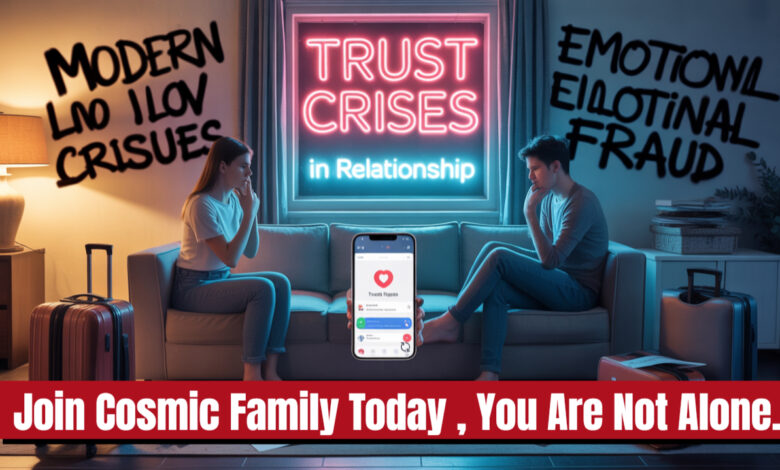
Modern Love Crisis and Emotional Fraud in Relationship
Modern Love Crisis and spiritual relationships.

When Love Became Entertainment
In this guide, we will explore how to navigate a modern love crisis, emotional fraud in relationships, and spiritual challenges, along with tips for overcoming relationship difficulties. There was a time when love was sacred. Union held significance. But today, we live in a modern love crisis—a reality where entertainment and ego have replaced divine connection.
Thank you for reading this post, don't forget to subscribe!Swipe. Match. Chat. Entertain. Disappear.
This is no longer dating—this is spiritual disconnection disguised as desire.
People don’t build relationships; they build content.
They don’t seek understanding; they seek attention.
They don’t pray for soulmates; they play with souls like digital toys.
I say this not from judgment but from my own wounds.
I once believed emojis could carry love. I was spiritually starved but emotionally impulsive. The result? Pain. Silence. I couldn’t identify the strange emptiness I felt. That was my turning point. And a strange emptiness I couldn’t name. That was my turning point. It was at that moment that I began to question, “Is love meant to feel like a distraction or like a return to one’s true self?” After experiencing a profound sense of disconnection in my relationships, I realized that I needed to redefine what love truly meant to me.
Emotional Fraud in Relationships: Modern Love Crisis
We speak often about online scams, but there’s a bigger theft happening—emotional fraud in relationships.
People sell dreams without sincerity.
They showcase depth they haven’t lived.
They offer “forever” with the lifespan of a trending reel.
This is a soul-level betrayal.
And it’s damaging an entire generation’s ability to trust, to bond, to heal.
Bhagavad Gita, Chapter 3, Verse 16 says:
“He who does not follow the wheel of creation set in motion lives in vain.”
Love is part of that sacred wheel. When misused, the pain it causes is not just individual—it ripples into society.
Please enjoy reading spiritual-telepathy-and-relationship-healing.
When Sacred Roles Are Forgotten—Emotional Fraud in Relationships
We no longer honor the divine blueprint.
Today’s dating culture laughs at the idea of being a “wife” or “husband” in the spiritual sense. We glorify independence without emotional maturity. We want divine outcomes without doing divine work.
But the modern love crisis isn’t just a romantic problem—it’s a spiritual breakdown.
We must ask:
- Where is devotion?
- Where is sacrifice?
- Where is the soul in “soulmate”?
Quran—Surah Ar-Rum 30:21 reminds us:
“He created for you from yourselves mates that you may find tranquility in them.”
Yet most relationships today create stress, not serenity. Confusion, not clarity. Lust, not love.
Drama Is Not Divine—Modern Love Crisis
Some say, “But love should be exciting!”
Yes, but not chaotic.
Yes, but not manipulative.
Yes, but not toxic.
When you confuse drama with depth, you invite destruction.
As 1 Corinthians 13:4–7 (Bible) says:
“Love is patient, love is kind… It is not proud; it is not self-seeking.”
Real love is divine love. Real relationships reflect spiritual commitment, not emotional addiction.
We Are Products of Broken Teachings—Emotional Fraud in Relationships
How can we build spiritual relationships when no one teaches us what that looks like?
Our parents were also raised in trauma.
Our society pushes us to perform, not to heal.
Instagram teaches trends, not traditions.
We must ask:
“Are we victims of love, or are we untrained warriors misusing love’s power?”
This isn’t just my story—it’s your story, your friend’s story, your inner child’s grief.
And it’s time we collectively take responsibility.
A Collective Karma: Why Love Is Breaking Down Everywhere
Today, almost everyone has a love story that ended in pain. This is not just coincidence. This is collective karma.
When a society forgets the sanctity of relationships, love begins to rot from within. This rot becomes normalized, and we pass it down like culture.
We must now rise—not just for ourselves—but for future generations.
We must rebuild love not as romance, but as a spiritual responsibility.
Spiritual Relationships Are Our Future—Emotional Fraud in Relationships
Imagine a world where we learn to:
- Clean our hearts before entering someone’s life.
- Practice emotional discipline like spiritual tapasya.
- Treat our partner not as an object of relief but as a reflection of the divine.
This is not fantasy. This is the future of sacred love.
And it starts with you.
💠 Call to Action: Heal Before You Hold Hands—Modern Love Crisis
If you’re reading this with a broken heart, a lonely spirit, or silent tears—pause.
This is not your ending. This is your calling.
You are not “too emotional.”
You are not “too intense.”
You are just in a world that forgot how deep love truly is.
✨ Let this be your prayer:
“May I learn to love as a soul, not as an ego.”
“May I attract not a partner for pleasure, but a partner for purpose.”
“May I walk the path of divine union, even when the world laughs?”
This is what it means to rise above the modern love crisis.
This is the rebirth of sacred love.
Please enjoy reading Signs You Might Be a Narcissist.
Sacred Teachings & Spiritual Guidance -Modern Love Crisis
🌸 Divine Models of Love: Radha-Krishna & Ram-Sita
Our ancestors once looked to divine couples as reflections of sacred union. The love between Radha and Krishna was not about possession—it was about soulful surrender and eternal remembrance. The bond between Ram and Sita was rooted in duty, sacrifice, and unwavering commitment.
“Where there is Dharma, there is love. Where there is ego, there is desire.”
These examples were not just stories—they were spiritual love guidance. They taught how masculine and feminine energy, when aligned with cosmic values, create a relationship of strength and service.
📉 Chart: Today’s Reality vs. Sacred Relationship Values
| Sacred Relationship Teachings | Today’s Relationship Norms |
| Union for dharma & higher purpose | Union for pleasure or popularity |
| Patience, forgiveness, deep empathy | Impulse, ego, emotional immaturity |
| Seen as spiritual discipline | Seen as entertainment or validation |
| Service to one another and to God | Service to self or social media image |
| Built over lifetimes of karma healing | Built over moments of attraction |
💫 How Spirituality Refines Love for Modern Love Crisis
Real love isn’t about attraction—it’s about vibrational alignment. When we walk the path of karma cleansing, empathy, and soul awareness, our connection transforms.
🧘 Energy: Every thought, intention, and touch carries frequency.
🕊️ Empathy: True love feels each other’s silence more than words.
🔄 Karma: Past wounds echo into our current dynamics. Love becomes a healing ground—not a battleground.
Bhagavad Gita 2.70:
“One who is not disturbed by the incessant flow of desires… such a person attains peace.”
Modern love fails because it’s distracted by pleasure, not purified through presence.
🧠 Counselling vs. Spiritual Transformation
Yes, relationship counseling is helpful—but it’s often mind-based. True transformation happens when hearts are spiritually trained.
🌿 Counseling helps you “manage” fights.
🌌 Spiritual teachings help you dissolve the ego that causes them.
A spiritual path doesn’t just heal your relationship—it refines your soul’s purpose within it.
🔁 Collective Healing & The Future of Love
We are not just individuals with failed love stories. We are a society experiencing collective karma. When relationships break down in mass—when marriages fall apart, when loyalty dies—it means a deeper spiritual breakdown has occurred.
“Love is not broken. Society is. And broken society produces broken love.”
So now, rebuilding love is not just personal—it is a collective spiritual mission.
🧭 Why We Must Redefine Love & Marriage Preparation
Why are people allowed to marry with no training in patience, no emotional literacy, and no spiritual clarity?
Marriage is not a hobby. It’s a karmic contract with cosmic implications.
Before two souls unite, they must ask:
- Have I healed my childhood traumas?
- Do I see my partner as a soul or a possession?
- Am I prepared to serve, not just receive?
📋 Proposed Spiritual Preparation for Marriage
Here’s a Spiritual Marriage Checklist we propose for the Cosmic Family movement:
✅ Attend workshops on divine masculine/feminine roles.
✅ Study the Gita, Quran, and Bible verses on love & duty.
✅ Meditate on ego, anger, and attachment.
✅ Serve together in a community or for a spiritual cause.
✅ Share personal karmic history with transparency.
✅ Establish a shared mission and prayer practice as a couple.
✅ Weekly couple check-ins based on energy, not ego
🛑 The Broken System: How Society Fails Us Modern Love Crisis and Emotional Fraud in Relationships
The system teaches us how to earn, buy, and consume—but not how to forgive, reflect, or love with grace.
From social media to films, from school to college—everything trains us for lust, not loyalty.
“If school taught us how to debate, why didn’t it teach us how to reconcile?”
“If society pushed us to succeed in careers, why did it never prepare us for emotional commitment?”
Because broken systems don’t build sacred relationships—they manufacture fragile ones.
Please enjoy reading alcohol-destroying-relationships-signs-effects-and-how-to-save-your-bond.
💖 A Personal Reflection (inserted naturally)
I remember a time when I thought I was ready for divine love. But I wasn’t even ready to sit in silence with my shadow. I chased perfection in others because I feared my imperfections. It wasn’t until I started reading scriptures and doing karma healing that I realized:
“Love is not what you find. Love is what you prepare for.”
✊ Call to Action: Heal Before You Love
Let us not keep blaming love. Let us blame our lack of preparation, clarity, and intention.
Let us start:
- Healing our emotional trauma
- Understanding spiritual partnership
- Learning the sacred responsibility of love
💌 If you’ve felt pain, been ghosted, betrayed, or misunderstood in love—we invite you to share your story. The Cosmic Family movement is opening safe spaces, healing circles, and spiritual love training. You are not alone. Together, we build a new love culture.
📩 DM or join our WhatsApp Support Group here: [insert link]
📚 Enroll in our Spiritual Love Prep Course (coming soon).
🧘 Weekly online soul-healing sessions open to all
✨ Final Quote (for visual card):
Quran 25:74
“Our Lord, grant us from among our wives and offspring comfort to our eyes and make us an example for the righteous.”
Spiritual Healing in Relationships—Reclaiming Love with Soul, Not Ego
“Love is entertainment. When entertainment is over, love is also over.”
This painful truth echoes in millions of broken hearts today. But what if the problem isn’t love itself—what if it’s how we’ve misunderstood it?
We live in a society where love has become a transaction, a distraction, or an escape. As a result, emotional wounds are growing deeper. Relationships fail not always because of “wrong partners” but because of wrong paradigms.
It’s time to shift the focus from emotional drama to spiritual healing in relationships—because only when two souls connect beyond the flesh and the ego can true love begin to breathe.
Love Broken = Society Broken
We often think heartbreak is personal. But a broken love is never just about two people—it’s a mirror of a broken system. When relationships collapse, families weaken. When families weaken, societies shatter. The rise of emotional abuse, infidelity, and divorce is not an individual problem—it is collective karma.
Today’s love is based on attraction, expectations, and control, not spiritual healing in relationships. We seek intensity, not integrity. Validation, not values. This disconnection is a wound we’ve all inherited—and now, we must all participate in its healing.
Example (can be placed near the healing call to action):
“Where there is Dharma, there is victory.” — Mahabharata
→ Use this to show that love rooted in dharma (not drama) is the path forward.
Please enjoy reading. identifying-narcissistic-behavior-7-signs-youre-dealing-with-a-narcissist
How to Heal a Relationship Spiritually
You don’t need a perfect partner.
You need spiritual awareness.
Here are practical skills to bring spiritual healing in relationships:
- 🕊 Learn to See the Soul: Remind yourself—your partner is not just a body or a role; they are an eternal soul with their own journey.
- 🌱 Daily Energy Check-In: Sit quietly with your partner, hold hands, and exchange how your energies feel. Tired? Angry? Cold? Warm? Do this once a week.
- 🙏 Chant Together: Even 5 minutes of chanting a sacred name like “Hare Krishna” or “Om Namah Shivaya” can realign both your auras.
- ✍️ Write Forgiveness Letters: You may never send them, but write what hurt you and also what you forgive. Burn the letter to release the karma.
By practicing these rituals, you’re not just surviving your relationship—you’re spiritually resurrecting it.
Marriage Is Not a Goal—It’s a Sacred Task
True spiritual healing in relationships begins before the wedding. If we treated marriage as sacred preparation, not social performance, half of today’s divorces would vanish.
We propose a Soul Marriage Checklist before commitment:
- Can you sit in silence together for 15 minutes every day for a week?
- Do you know each other’s emotional wounds and respect their healing pace?
- Have you discussed spiritual goals—not just wedding destinations?
- Can you accept their past with zero need to change it?
Love without alignment is dangerous. It drains both people. But love with spiritual healing in relationships becomes the most powerful force of emotional growth and service.
Films, Influencers & the Broken Love Model—Modern Love Crisis
Media constantly misrepresents love as grand, instant, and ego-driven. “If they don’t post you, they don’t love you.” “If it’s not intense, it’s not real.”
No! Real love is gentle, boring at times, deeply rooted, and divine.
We need to detox from the romanticism of pain and drama. Pain isn’t passion. Control isn’t commitment. And love doesn’t have to hurt.
As Krishna said in the Bhagavad Gita (6.5):
“Let a man lift himself by his own self alone, and let him not lower himself. For this Self alone is the friend of oneself, and this Self alone is the enemy of oneself.”
Let us raise ourselves—so we stop hurting others.
Real-Life Story: My Love Was Emotion, Not Devotion
I once fell in love thinking it was eternal.
But it was emotional fraud—not from malice, but from immaturity.
We both were emotionally sick, expecting love to cure everything.
But love without spiritual healing became poison.
I cried alone. I screamed to God.
That’s when I realized, before we love someone else, we must heal within.
And now, I say to all broken hearts:
Don’t chase a person—heal your spirit.
Because when your soul glows, the right soul will come to you.
Example:
Healing Practice Tip: Tonight, write one letter to your younger self. Say the words you needed to hear about love, respect, and commitment. This is your beginning.
Collective Call: Rebuild Love With Us for Modern Love Crisis
We’re not alone in this pain. Millions suffer, but few speak.
Let us create a sacred space where we don’t judge each other’s pain—but hold it.
💠 Hold my hand. Let’s start loving again—not with ego, but with soul.
💠 I am waiting for you. To feel you. To heal you. To walk beside you.
💠 This is not just about lovers. This is brotherhood. This is sisterhood.
💠 This is how we regain our path, our purity, and our light.
💠 Come join our Cosmic Family—a spiritual home for every wounded heart.
✨ Actionable Tips for Daily Practice for Modern Love Crisis
- 🔅 Meditate with “I forgive, I release, I evolve.”
- 🔅 Read one verse a day from the Gita, Bible, or Quran with your partner.
- 🔅 Sleep after gratitude—not argument.
- 🔅 Ask, “How can I serve you today?” once a day.
Conclusion: Love Is Not Lost—It Is Waiting
Spiritual healing in relationships is the only path forward. No therapy, book, or movie can replace the power of two souls walking together toward light. When you fall, I’ll lift you. When I cry, you’ll hold me. That’s love—not noise, not fame, not likes.
Let’s rebuild a world where love is sacred again.
Let’s become divine lovers, divine partners—ready to serve, not just to receive.
Are you ready? Let’s begin today. Join our cosmic family. Your healing is sacred.
Insert your personal story briefly, without shifting structure:
After your line:
“Love is entertainment. When entertainment is over, love is also over.”
You can naturally insert:
“I say this not from judgment, but from my own emotional wounds. I was once deeply invested in a connection I thought was love. But that connection, based on instant messaging, emojis, and false dreams, vanished the moment life demanded depth. That pain was not just heartbreak—it was a spiritual awakening. I realized I never knew what I was seeking in love because no one taught me what sacred love meant.”
📖 Disclaimer and Heartfelt Intention—Modern Love Crisis
This blog is not written by someone with formal degrees in psychology, medicine, or theology. It is born from lived experience, deep inner healing, and sacred study of ancient scriptures like the Bhagavad Gita, Bible, and Quran.
We do not claim to diagnose or cure, but to share, reflect, and heal together.
If you are struggling with mental health, please also seek support from licensed professionals.
🙏 This page is a spiritual offering, not a commercial one. There are no products or sponsors involved—only a shared humanity, a divine connection, and the voice of lived truth.
Cosmic Family—Modern Love Crisis
🌿 This article is part of the Cosmic Family initiative—a sacred movement to awaken mental health, soulful connection, and spiritual awareness in a disconnected world. Join us at bioandbrainhealthinfo.com and be part of the healing. 🌿
“This is not a brand. This is not a product. This is a calling—a collective journey of souls ready to heal, awaken, and rise together.”
🕊️ We are not here to sell you anything. We are here to remind you of who you truly are. 🌌
At the conclusion, you can remind them:
Thank you for walking this journey with me. Everything here is from the soul, not a certification—only shared pain, sacred texts, and spiritual growth.
People ask questions for Modern Love Crisis.
1. How can I identify emotional fraud in my relationship?
Answer: Look for signs like inconsistent behavior, secretive communication, and feeling manipulated or undervalued. Trust your intuition and communicate openly with your partner.
2. What are effective ways to rebuild trust after a love crisis?
Answer: Be honest and transparent, set clear boundaries, and give each other time to heal. Seeking couples counseling can also help rebuild trust and improve communication.
3. How can I stay spiritually balanced during relationship struggles?
Answer: Practice mindfulness, meditation, or prayer to stay centered. Focus on self-care and seek support from spiritual or community groups to maintain inner peace.
Please enjoy reading more. urban-loneliness-concrete-jungle-blog
Self-Assist Worksheet: Navigating Love Crisis & Emotional Fraud
Part 1: Self-Reflection
1. Recognize Signs of Emotional Fraud or Trust Issues
- List three behaviors or situations that made you feel suspicious or hurt in your relationship:
2. Assess Your Feelings
- How do you feel about your relationship right now? (Check all that apply.)
- Hurt or betrayed
- Confused or unsure
- Hopeful for change
- Ready to move on
- Seeking clarity
3. Personal Boundaries & Needs
- What boundaries are important for you to feel safe and respected?
- What do you need from your partner to rebuild trust?
Part 2: Strategies for Healing & Moving Forward
4. Communication Plan
- Write down two honest points you want to discuss with your partner about your feelings:
5. Self-Care & Support
- List three activities that will help you feel grounded and supported during this time:
6. Seek Help if Needed
- Do you need professional support (therapist, counselor)? Yes / No
- If yes, list possible resources: ______________________________________
Part 3: Affirmations & Closing Reflection
7. Write three positive affirmations for yourself:
8. Reflection
- What is one thing you want to grow or learn from this experience?
- _____________________________________________________________________________________________________________________
YouTube Video Reference for Modern Love Crisis
Here are three actual YouTube videos with their titles and URLs related to modern love crises, emotional fraud, and relationship recovery:
1. “How to Recognize Emotional Abuse & Stop It”
2. “Healing and Rebuilding Trust After a Breakup”
3. “Understanding Modern Love & How to Overcome Relationship Challenges”
Reading References: Modern Love Crisis and Emotional Fraud in Relationships
- “Recognizing Emotional Abuse in Relationships”
URL: https://www.helpguide.org/articles/abuse/abusive-relationships.htm - “Rebuilding Trust After Betrayal”
URL: https://psychcentral.com/lib/how-to-rebuild-trust-in-a-relationship - “Healing from Modern Relationship Challenges”
URL: https://www.psychologytoday.com/us/blog/the-moment-you-realize/201607/how-heal-your-relationship-after-infidelity