AI Mental Health Tools for Emotional Pain Mapping
How AI Helps Detect Stress, Emotions, and Hidden Pain

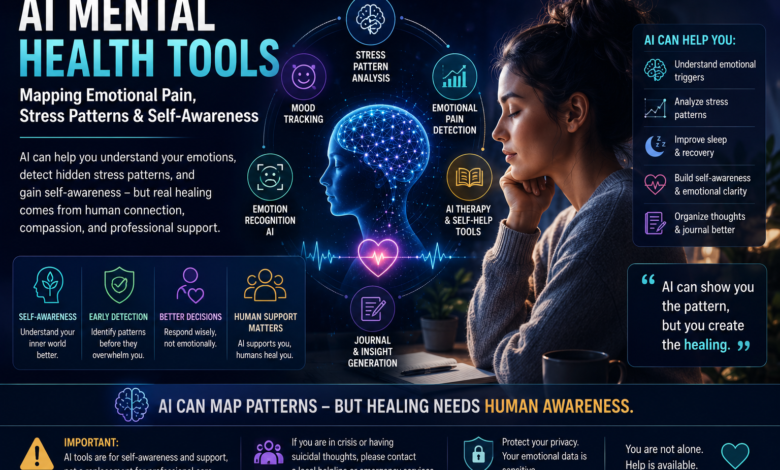
Most people search for AI mental health tools because they are not only looking for technology; they are looking for a safer way to understand emotional pain before it becomes too heavy.
Thank you for reading this post, don't forget to subscribe!This blog is different because it does not present AI as a therapist replacement or a magic solution.
Instead, it explains how AI therapy tools, emotion recognition AI, emotional pain detection AI, and stress pattern analysis can help you notice hidden emotional signals, repeated triggers, self-critical thoughts, sleep changes, avoidance patterns, and nervous system overload.
Many articles only discuss apps, chatbots, or AI features, but this guide connects AI with emotional healing, trauma-informed self-awareness, and human support.
You will learn how AI can act like an emotional mirror, helping you see patterns clearly while reminding you that real healing still needs awareness, safety, compassion, and professional care when distress becomes serious.
What Are AI Mental Health Tools?
AI mental health tools are digital systems that use artificial intelligence to support emotional reflection, mood tracking, journaling, self-check-ins, and early pattern awareness. They may appear as AI chatbots, guided journaling apps, CBT-style tools, mood trackers, or digital self-help platforms.
People in the USA, UK, Canada, and Australia often search for these tools because therapy can be expensive, waiting lists can be long, and many people want private support before they feel ready to speak openly with someone.
But this is where clarity matters. AI is not a therapist, doctor, psychiatrist, or crisis worker. It can help organize emotional signals, ask reflective questions, and notice repeated patterns in words, mood, sleep, and stress. Still, it cannot diagnose a person, feel human suffering, understand trauma the way a trained professional can, or replace real clinical care.
For readers who want gentle digital support, AI emotional support for a calmer mind can be a useful related guide because emotional pain often needs calm awareness before deeper healing becomes possible.
Why People Use AI Mental Health Tools for Emotional Support
Many people turn to AI mental health tools when they feel emotionally overwhelmed but cannot clearly explain what is happening inside them. Someone may feel anxious every morning, emotionally tired after conversations, ashamed after making small mistakes, or stuck in repeated overthinking.
These experiences may not always look like a crisis from outside, but inside they can feel heavy, lonely, and confusing.
This is where AI can support emotional language. It may help someone name a feeling, organize journal thoughts, notice self-critical patterns, or ask, “What triggered this reaction?”
For people dealing with shame or harsh inner dialogue, AI tools for inner critic healing can connect well with this process because many emotional pain patterns begin as silent self-attack.
The real value is not that AI “knows” the person better than they know themselves. The value is that AI can slow the inner chaos enough for the person to observe it.
AI Therapy Tools vs Human Therapy
AI therapy tools can support daily reflection, emotional check-ins, CBT-style questions, journaling prompts, and self-awareness exercises. They may help users identify thinking patterns such as catastrophizing, guilt loops, fear of rejection, avoidance, emotional numbness, or perfectionism.
For mild stress or everyday emotional confusion, this can feel useful because the person gets structure when the mind feels scattered.
But human therapy is different. A licensed therapist can assess risk, understand trauma history, respond to emotional complexity, notice safety concerns, and build a real therapeutic relationship.
A psychiatrist or doctor can evaluate medication, diagnosis, bipolar symptoms, OCD, panic attacks, depression, and serious mental health changes. AI cannot replace that level of clinical judgment.
This is why the safest view is balanced: use AI as support, not as authority. AI can help you prepare for therapy, reflect between sessions, or organize what you want to say, but it should not become your only emotional support system.
Safety Rule Before Using AI for Mental Health
Use AI for reflection, not emergency care. If someone has suicidal thoughts, self-harm urges, severe panic, psychosis, abuse risk, dangerous impulses, or feels unable to stay safe, they should contact local emergency services, a crisis helpline, a doctor, a therapist, or a trusted person immediately.
AI can respond with words, but crisis care needs real human support, safety planning, and professional responsibility.
How Emotional Pain Mapping With AI Works
Emotional pain mapping means noticing the repeated signals that show where inner distress is forming. These signals may appear in journal entries, mood changes, sleep problems, repeated relationship triggers, avoidance patterns, body tension, shame thoughts, or sudden emotional shutdown.
Many people do not notice these signals early because they are busy surviving daily responsibilities.
This is where AI mental health tools can help. A journaling tool may notice that someone repeatedly writes about rejection. A mood tracker may show that anxiety rises after work calls.
A chatbot may reflect that the same fear appears in different situations. This does not mean AI has “discovered the truth.” It means the tool may help organize clues that the person can then explore with awareness.
For deeper self-observation, AI self reflection for personal growth is a strong related reading path because emotional pain mapping works best when it leads to maturity, not dependency.
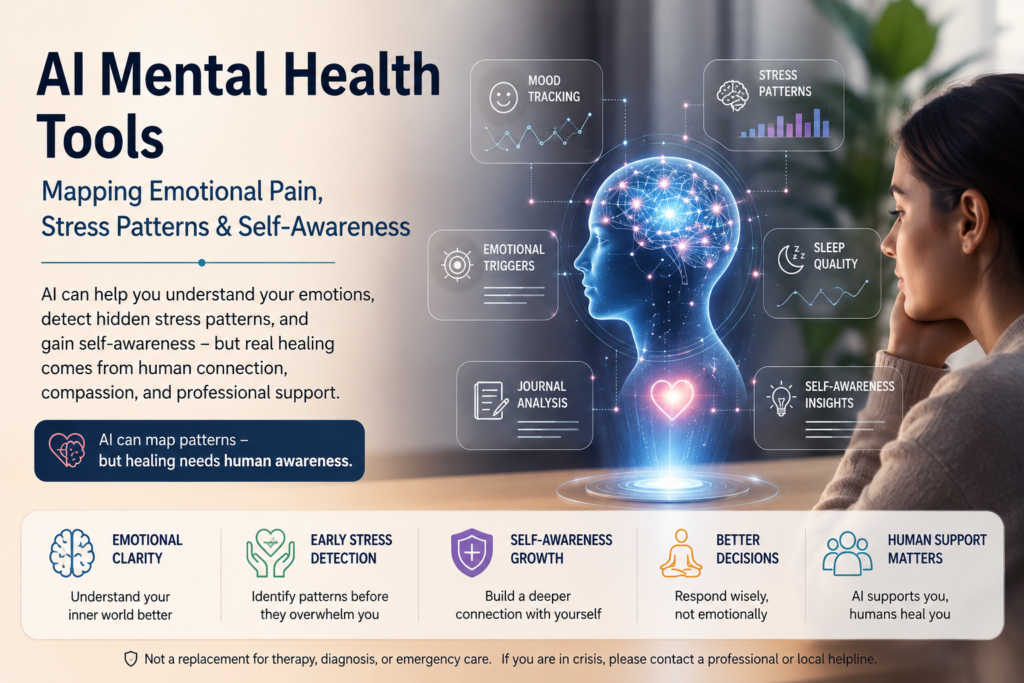
Emotional Pain Detection AI and Hidden Inner Signals
Emotional pain detection AI does not truly feel human pain. It cannot understand grief, abandonment, trauma, shame, or loneliness the way a person does. What it can do is analyze patterns in text, mood logs, and behavior data to highlight possible emotional themes.
For example, repeated words like “tired,” “worthless,” “stuck,” “afraid,” or “alone” may suggest emotional distress that deserves attention.
This can be helpful because many people minimize their own suffering. They may say, “I am fine,” while their sleep, thoughts, body, and relationships are showing overload.
Emotional pain often hides behind productivity, people-pleasing, anger, silence, scrolling, overeating, overworking, or emotional withdrawal.
The safest use of emotional pain detection AI is not diagnosis. It is gentle awareness.
The question is not, “What label does AI give me?” The better question is, “What pattern is my mind and body repeatedly showing me?”
Emotion Recognition AI: Voice, Text, Mood, and Behavior
Emotion recognition AI may use text, voice tone, facial expressions, typing style, mood records, or behavior patterns to estimate emotional states.
Some systems may look at whether language sounds anxious, sad, angry, hopeless, pressured, or emotionally flat. Others may study voice stress, facial tension, or repeated mood entries.
But emotion recognition has limits. A person may smile while suffering. Someone may speak calmly while feeling panic inside. Another person may write strongly because they are overwhelmed, not because they are dangerous or unstable.
Human emotion is layered, cultural, personal, and deeply contextual. AI can detect signals, but it cannot fully understand the lived meaning behind those signals.
This is also why the question can AI become conscious matters in this discussion. AI may process emotional data, but processing emotion is not the same as having human awareness, conscience, pain, love, or inner experience.
Why AI Should Be a Mirror, Not a Master
The strongest way to use AI in mental health is to treat it as a mirror. A mirror can show a reflection, but it should not control your identity.
In the same way, AI may show repeated stress patterns, emotional words, triggers, or mood changes, but it should not decide who you are or what your life means.
This is where stress pattern analysis becomes useful. AI may help you see that certain people, deadlines, memories, conversations, or habits repeatedly activate your nervous system. But the healing decision still belongs to you.
You decide whether to rest, set a boundary, journal, pray, walk, call someone, book therapy, or change a daily pattern.
“Technology can show us a pattern, but healing begins when we face the emotion with honesty, safety, and compassion.”
For readers who feel emotionally lost and want direction beyond symptom tracking, AI life purpose coach can be a natural next step because emotional clarity often opens the door to deeper life direction.
Stress Pattern Analysis and the Nervous System
Stress pattern analysis is one of the most useful ways to understand emotional pain before it becomes too heavy. Many people do not suddenly collapse emotionally.
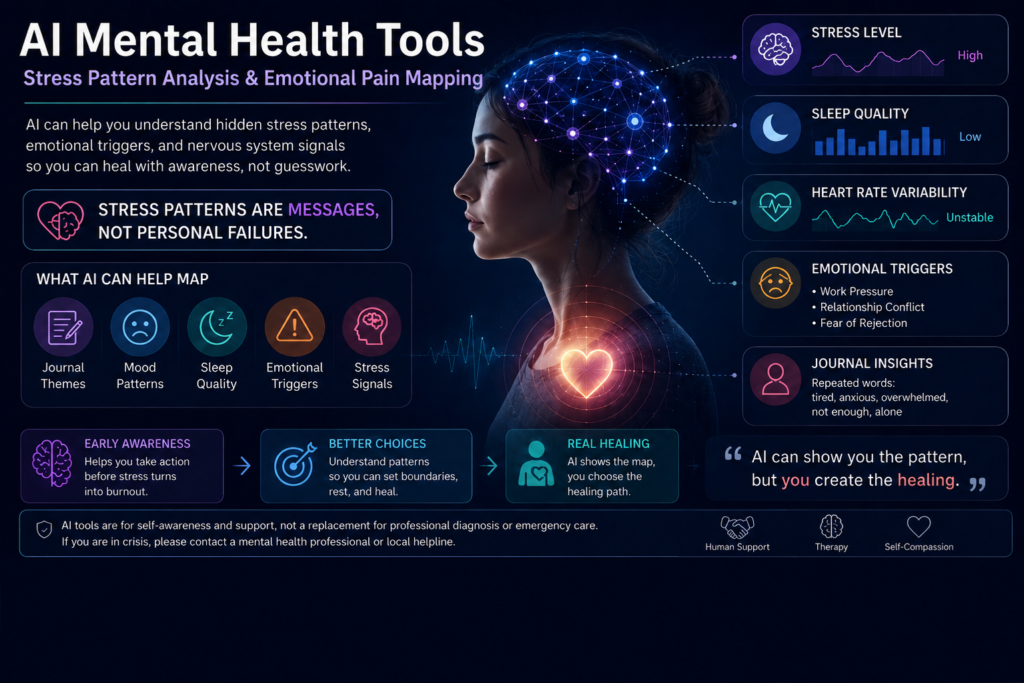
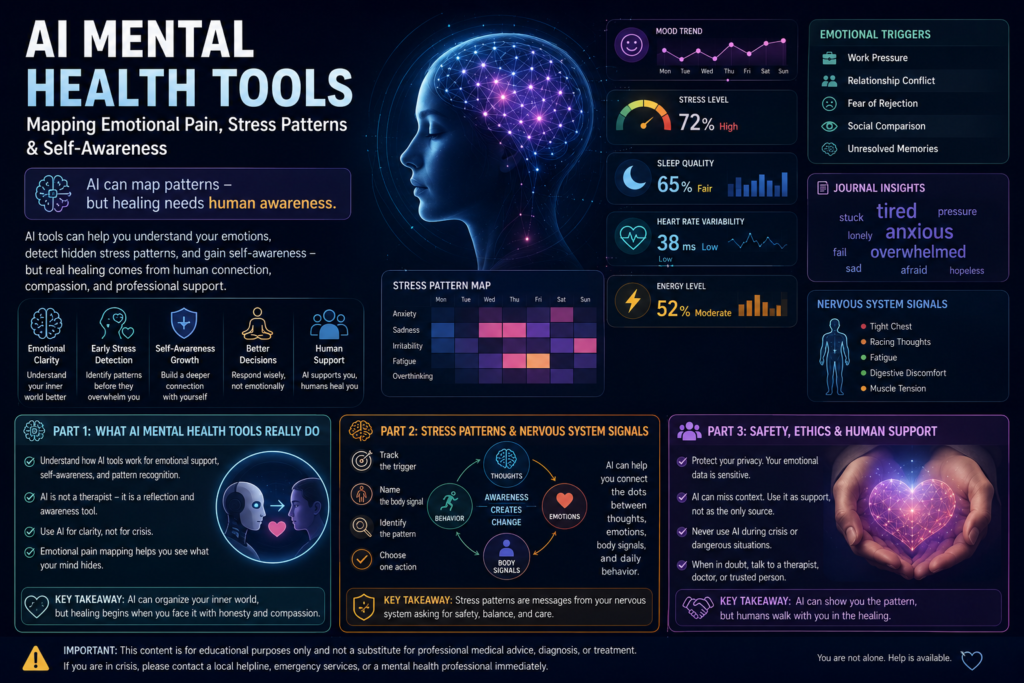
First, their nervous system begins sending signals: poor sleep, racing thoughts, tight chest, irritability, digestive discomfort, emotional numbness, avoidance, overworking, people-pleasing, or sudden withdrawal from relationships.
This is where AI mental health tools can support self-awareness. They may help a person track repeated mood changes, journal themes, stressful situations, and emotional triggers over time.
For example, someone may notice that anxiety increases after work calls, sadness rises after family conflict, or shame appears after social comparison. These patterns are not personal weakness. They are nervous system information.
The goal is not to let AI define your mental health. The goal is to use AI as a structured reflection tool so you can notice what your body and mind have been trying to communicate.
How AI Can Notice Patterns Humans Often Ignore
Many people ignore emotional signals because life demands performance. They continue working, replying, managing family responsibilities, and solving problems even when their inner system is overloaded. Over time, emotional pain becomes normal, and the person may forget what calmness feels like.
AI therapy tools may help by organizing small details that a stressed mind often misses.
- A journaling tool may notice repeated words like “tired,” “afraid,” “alone,” “pressure,” or “failure.”
- A mood tracker may show that low energy appears every Sunday night.
- An AI reflection tool may show that one emotional trigger is connected to a deeper fear of rejection.
This does not mean AI understands your soul or your full story. It means AI can help collect scattered emotional data into a visible pattern. Once the pattern becomes visible, the person can take wiser action instead of reacting from confusion.
Emotional Pain Often Appears Before Mental Collapse
Emotional pain usually appears in small forms before it becomes a serious mental health struggle. It may appear as overthinking, fear of messages, social avoidance, sudden anger, emotional eating, scrolling for hours, not answering calls, or feeling tired even after rest.
These signals are often early signs that the nervous system is carrying more stress than the person admits.
This is especially important for people struggling with social fear, shame, or emotional sensitivity. A person may think, “I am weak,” but the real issue may be repeated threat activation.
For this reason, AI for social anxiety and confidence growth is a useful related guide because social anxiety often hides deeper patterns of fear, judgment, rejection, and nervous system protection.
Emotional pain detection AI may help identify these repeated patterns, but the interpretation must remain gentle. The purpose is not to label yourself. The purpose is to understand what needs care.
The Nervous System Does Not Need Judgment — It Needs Safety
When stress becomes chronic, the nervous system does not respond well to shame. Saying “I should be stronger” often increases pressure.
A better response is: “My system is overloaded, and I need safety.”
Safety may include breathing, movement, rest, therapy, honest communication, boundaries, or reducing stimulation.
This is the BBH healing view: emotional pain is not just a thought problem. It is also a body-state problem. The body needs regulation before the mind can think clearly.
Practical Emotional Pain Mapping Routine
A simple routine can make AI mental health tools more useful and safer. Instead of asking AI to “fix” your emotions, use it to organize your awareness. This turns AI into a reflection partner, not an emotional authority.
Step 1 — Track the Trigger
Write what happened before the emotional reaction. Was it a message, a tone of voice, a family issue, a deadline, loneliness, criticism, silence, or comparison? Triggers often reveal where the nervous system feels unsafe.
Step 2 — Name the Body Signal
Before analyzing the thought, notice the body. Was there chest tightness, stomach pressure, racing heart, headache, fatigue, numbness, trembling, or heaviness? Emotion recognition AI may track language, but your body gives direct information.
Step 3 — Identify the Repeated Pattern
Ask what this trigger repeats. Is it fear of rejection, abandonment, guilt, shame, failure, being misunderstood, or losing control? Relationship-based emotional pain often repeats through attachment patterns.
For deeper reading, friendship attachment and healthy emotional bonds can support this section because friendship wounds can also activate deep emotional fear.
Step 4 — Choose One Regulating Action
After identifying the pattern, choose one small action. Walk for 10 minutes, drink water, breathe slowly, journal one honest paragraph, pause the conversation, contact a safe person, or book professional support if the pattern feels serious. Healing grows when awareness becomes action.
Are AI Mental Health Tools Safe?
AI mental health tools can be helpful when they are used for reflection, journaling, mood tracking, emotional check-ins, and stress pattern analysis.
They may help someone notice repeated emotional triggers, language patterns, sleep changes, avoidance habits, and nervous system overload. But safety depends on how the tool is built, how private the data is, and whether the user understands its limits.
The American Psychological Association has warned that generative AI chatbots and wellness apps should be used carefully because they are not the same as regulated mental health care, and consumer safety depends on evidence, oversight, privacy, and appropriate use. (APA) This means AI should support self-awareness, not become the final authority over someone’s mental health.
For this reason, AI therapy tools are best used as daily support tools, not as a replacement for therapists, psychiatrists, doctors, crisis workers, or medication guidance.
The safest position is simple: AI can help you reflect, but human care must guide serious emotional pain.
Privacy and Emotional Data Matter
When someone uses emotion recognition AI or an AI journaling tool, they may share deeply personal information: fears, trauma memories, relationship pain, family conflict, self-critical thoughts, sleep problems, panic patterns, or depression symptoms. This is not ordinary data. Emotional data is sensitive because it can reveal private mental health patterns.
Before using any AI mental health app, users in the USA, UK, Canada, and Australia should check whether the tool explains data storage, deletion options, third-party sharing, training use, privacy protections, and crisis limitations. A tool that gives emotional support but does not clearly explain privacy should be used with caution.
The FDA has also discussed AI-enabled digital mental health technologies as an emerging area with potential benefits, while emphasizing the need for careful evaluation, safety, and appropriate regulatory thinking. (U.S. Food and Drug Administration)
For BBH readers, the rule is clear: never give a tool more emotional trust than its privacy and safety design deserves.
AI Can Miss Subtle Mental Health Risk
Emotional pain detection AI may identify repeated words, sad tone, emotional intensity, or stress patterns, but it can also miss context. A person may sound calm while feeling suicidal.
Another person may joke while emotionally collapsing. Someone with trauma may describe serious pain in a detached way because numbness has become normal.
This is why AI should not be used alone for severe depression, bipolar symptoms, OCD spirals, panic attacks, psychosis, trauma flashbacks, abuse risk, or suicidal thoughts.
A recent National Academy of Medicine discussion noted both promise and harm in mental health chatbots, including the need to reinforce human relationships instead of replacing them. (NAM)
AI can organize emotional patterns, but trained humans can ask follow-up questions, evaluate risk, notice contradictions, understand clinical history, and respond with responsibility.
Mental health is not only about answers; it is also about safety, connection, timing, and trust.
Never Use AI as Your Only Support During Crisis
Use AI only for reflection, not emergency care. If someone feels unsafe, suicidal, unable to function, at risk of self-harm, trapped in abuse, severely dissociated, psychotic, or overwhelmed by panic, they should contact local emergency services, a crisis helpline, a doctor, a therapist, or a trusted person immediately.
This boundary should be visible in the article because it protects readers and improves trust.
When AI Helps — and When Human Support Is Needed
AI mental health tools can help when the goal is daily emotional awareness. They can support journaling, mood tracking, trigger mapping, self-reflection, CBT-style prompts, and stress pattern analysis.
They can also help a person prepare notes before therapy, understand repeated emotional reactions, or organize what they want to discuss with a professional.
But AI cannot replace the healing power of human presence. Therapy is not only advice. It is a structured relationship where a trained person listens, tracks risk, understands emotional history, and helps the person move safely through difficult material.
This is especially important for trauma, bipolar symptoms, OCD, major depression, panic disorder, grief, abuse, self-harm risk, and medication questions.
For readers who need a guided starting point, link here: Start Here – Your Journey to Mental Clarity & Emotional Healing.
Best Uses of AI Therapy Tools
The best use of AI therapy tools is structured support between real-life actions.
They can help users write journal prompts, summarize emotional patterns, identify repeated triggers, reframe harsh self-talk, track mood changes, and notice when sleep, stress, and relationships are affecting emotional balance.
They may also support people who feel hesitant to talk openly at first. Someone may use AI to find words for their pain before speaking to a therapist, doctor, friend, or support group. In this way, AI becomes a bridge to human support, not a wall against it.
For safe BBH navigation, add this support link near the end: AI Therapy & Self-Help Tools.
When to Talk to a Therapist or Doctor
A therapist or doctor is needed when emotional pain is intense, recurring, or affecting daily life. This includes suicidal thoughts, self-harm urges, panic attacks, trauma flashbacks, compulsive behavior, severe depression, bipolar mood shifts, paranoia, hallucinations, abuse, addiction, or inability to work, sleep, eat, or function normally.
AI can help organize what you are feeling, but it cannot provide diagnosis, medication decisions, crisis care, or deep trauma treatment.
People with complex relationship wounds may also need real human support because attachment pain often becomes activated through closeness, fear, conflict, and abandonment patterns.
Read Also: AI relationship coach for attachment styles
Final Takeaway: AI as a Mirror, Human Awareness as the Healer
The best way to understand AI mental health tools is this:
- AI can be a mirror, but it should not become the master.
- It may reflect emotional patterns, repeated thoughts, mood changes, and body-stress signals.
- It may help with emotion recognition AI, journaling, emotional pain detection AI, and stress pattern analysis.
But it cannot replace inner honesty, nervous system safety, compassionate support, and professional help when needed.
The unique BBH message is that emotional pain is not only a data pattern. It is a human signal asking for care.
AI can help organize the signal, but healing happens when the person responds with awareness, boundaries, regulation, and wise support.
The BBH Healing View
Technology can show a pattern. The nervous system needs safety. The person needs compassion. And healing needs action.
When used carefully, AI can support emotional self-awareness. But the final healing path must stay human, grounded, ethical, and connected to real support.
People Also Ask —
1. What are AI mental health tools?
AI mental health tools are digital tools that use artificial intelligence to support mood tracking, journaling, emotional reflection, and stress pattern awareness. They can help organize emotional signals, but they do not replace licensed mental health care.
2. Can AI detect emotional pain?
AI may detect possible emotional pain patterns through language, mood logs, behavior signals, and repeated stress markers. But emotional pain detection AI cannot truly feel pain, diagnose a person, or understand life context like a trained human professional.
3. Are AI therapy tools safe?
AI therapy tools can be safe for reflection, journaling, and mild emotional support when privacy and crisis limits are clear. They are not safe as the only support for suicidal thoughts, severe depression, psychosis, abuse, or serious mental health symptoms.
4. Can AI replace a therapist?
No. AI can support self-reflection, but therapy provides human connection, clinical judgment, diagnosis, trauma care, and risk assessment. Current professional guidance warns against treating AI chatbots as substitutes for regulated mental health care. (APA Services)
5. How does stress pattern analysis help mental health?
Stress pattern analysis helps people notice repeated emotional and body signals before they become burnout, panic, shutdown, or emotional collapse. It turns vague distress into clearer patterns that can guide rest, boundaries, therapy, and daily regulation.
External References With URLs
- American Psychological Association — Use of generative AI chatbots and wellness applications for mental health
URL:https://www.apa.org/topics/artificial-intelligence-machine-learning/health-advisory-chatbots-wellness-apps
Use for: AI chatbot safety, wellness app limits, consumer caution. - APA Services — Using generic AI chatbots for mental health support
URL:https://www.apaservices.org/practice/business/technology/artificial-intelligence-chatbots-therapists
Use for: AI chatbots should not be presented as therapist replacements. - FDA — AI-enabled digital mental health medical devices discussion paper
URL:https://www.fda.gov/media/189391/download
Use for: regulatory and safety framing around digital mental health AI. - National Academy of Medicine — AI Chatbots for Mental Health: What Works, What Harms, and What’s Next
URL:https://nam.edu/news-and-insights/ai-chatbots-for-mental-health-what-works-what-harms-and-whats-next/
Use for: balanced promise, harm, and need for human relationship safeguards. - ScienceDirect — Emotion recognition and artificial intelligence: A systematic review
URL:https://www.sciencedirect.com/science/article/pii/S1566253523003354
Use for: emotion recognition AI, multimodal emotional signal detection, healthcare relevance.