AI for Social Anxiety: Build Real Confidence
Safe AI Coaching for Social Confidence

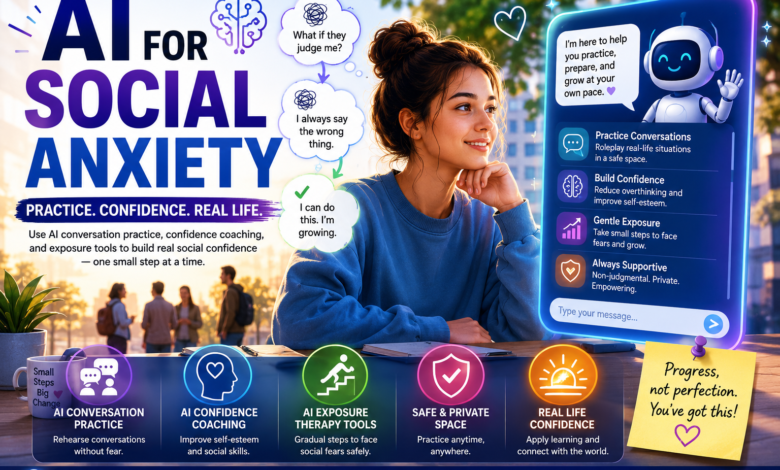
Social anxiety is not only a confidence problem; it is often a nervous system alarm that makes ordinary conversations feel unsafe. That is why AI for social anxiety can be helpful when it is used carefully, not as a replacement for therapy, but as a private practice space for emotional rehearsal, self-reflection, and gradual courage.
Thank you for reading this post, don't forget to subscribe!This blog is different because it does not simply promote an AI social anxiety coach or warn against AI without guidance. It explains how AI confidence coaching, AI conversation practice, and AI exposure therapy tools can support real-life social growth when combined with nervous system regulation and self-trust.
You will learn what AI can do, what it cannot do, how to use it safely, and how to move from screen-based practice into real human connection without shame, pressure, or emotional overload.
What Is AI for Social Anxiety?
Social anxiety is not only shyness or low confidence. For many people, it feels like the body is preparing for danger even during simple moments such as saying hello, joining a meeting, answering a message, speaking in class, or entering a group conversation.
This is why AI for social anxiety has become an important topic in the USA, UK, Canada, and Australia, where remote work, digital communication, isolation, and performance pressure often make social confidence harder to rebuild.
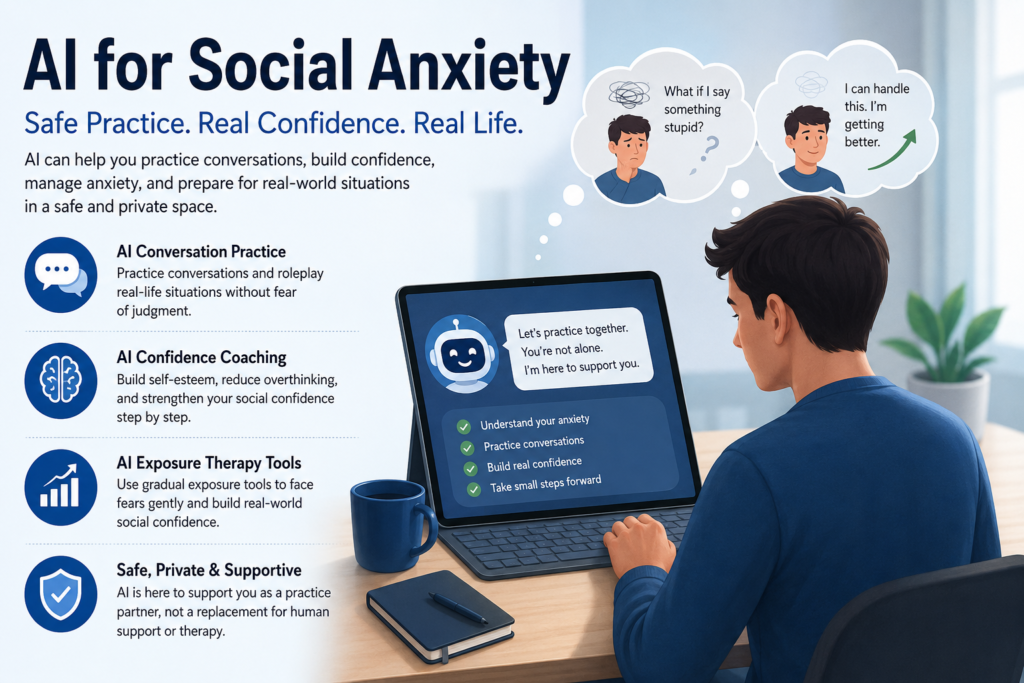
At its safest level, AI for social anxiety means using artificial intelligence as a private practice space. It can help you rehearse conversations, organize anxious thoughts, prepare for social situations, and reflect on what triggers fear.
It does not mean AI becomes your therapist, doctor, or emotional authority. A better way to understand it is this: AI can become a practice partner, but real healing still needs real-world action, nervous system regulation, self-awareness, and human connection.
For example, if someone fears introducing themselves at work, an AI social anxiety coach can help them prepare three simple introduction lines, roleplay the situation, and practice a calmer response.
If someone feels anxious before a video call, AI can help them organize what to say instead of spiraling into overthinking.
Learn how AI tools to control emotions can support emotional regulation before difficult conversations: ai-tools-to-control-emotions
Why People Look for AI Before Human Support
Many people with social anxiety do not avoid people because they do not care. They avoid interaction because it feels emotionally expensive.
A short conversation can create thoughts like:
- What if I sound strange?
- What if they judge me?
- What if I freeze?
- What if I say too much?
- What if I say nothing?
Over time, silence may feel safer than being seen.
This is where AI conversation practice can feel useful. AI does not embarrass, interrupt, or reject the person. Someone can practice the same conversation many times, make mistakes privately, ask for simpler wording, and slowly build tolerance. For a person who feels emotionally frozen, this kind of private practice can become the first bridge back to expression.
But balance is important. AI should not become a hiding place where someone only practices with a screen and never moves toward real life.
The purpose of AI confidence coaching is not to create perfect performance. It is to prepare the nervous system for real participation, one small action at a time.
This guide on AI reframe for negative self-talk and confidence can support deeper self-talk repair: negative-self-talk-ai-reframe-confidence
Social Anxiety Is Often a Nervous System Alarm
A person with social anxiety may logically know that a conversation is not dangerous, but the body may still react as if danger is present. The heart beats faster, the face feels warm, the voice tightens, breathing becomes shallow, and the mind starts scanning for rejection.
This is not weakness. It is the nervous system trying to protect the person from shame, embarrassment, rejection, or emotional exposure.
That is why AI for social anxiety should be used with nervous system awareness. If someone uses AI only to collect perfect answers, they may become dependent on scripts. But if they use AI to understand triggers, practice slowly, and calm the body before action, the tool becomes more useful.
The real shift happens when the person learns, I can feel anxiety and still take one small step.
An AI social anxiety coach can help break social challenges into smaller steps. Instead of forcing yourself to “be confident,” you can practice one greeting, one question, one short reply, or one meeting sentence.
This reduces pressure and teaches the brain that social contact does not always have to be a performance.
BBH Safety Note
AI can support reflection, rehearsal, journaling, conversation practice, and confidence-building, but it should not replace therapy, diagnosis, medication guidance, or crisis support.
If social anxiety includes panic attacks, trauma, self-harm thoughts, severe avoidance, or major disruption in work, school, relationships, or daily life, professional mental health support is important.
What Makes This Blog Different?
Many articles about AI and mental health go in one of two directions. Some make AI sound like a miracle solution. Others make it sound too risky to use at all.
This blog takes a balanced BBH position: AI for social anxiety can be helpful when it is used as a structured practice tool, not as a replacement for human healing.
The unique focus here is the connection between social anxiety, nervous system safety, self-worth, and gradual action. Social fear is rarely only about not knowing what to say.
It is often about the fear of being judged, rejected, misunderstood, exposed, or compared. That is why confidence cannot be built only by memorizing better sentences. Confidence grows when the body learns that visibility is survivable.
This is where AI confidence coaching can help if used wisely. It can help you prepare for specific situations, reduce mental chaos, and practice realistic responses. But the deeper goal is not to become socially perfect. The deeper goal is to become less afraid of being human.
“Confidence does not return when fear disappears. Confidence returns when we practice safely, slowly, and stop attacking ourselves for feeling afraid.”
Read this related guide on AI comparison and self-worth healing: ai-comparison-healing-self-worth
How AI Can Safely Support Social Confidence
The safest use of AI conversation practice is preparation, not dependency. A person can ask AI to roleplay small talk, prepare for a workplace introduction, practice answering a simple question, or rewrite a nervous message in a calmer tone. This allows social practice without immediate pressure.
AI can also help someone notice patterns. If a person repeatedly fears being judged, AI can help them reflect on what they imagine others are thinking, what body sensations appear, and what avoidance behavior follows.
This matters because social anxiety often becomes automatic: fear appears, avoidance gives short-term relief, and the brain learns that avoidance means safety.
This is where AI exposure therapy tools need careful framing. Exposure does not mean forcing yourself into overwhelming situations. Healthy exposure means gradual practice with emotional regulation.
AI may help create a small exposure ladder, but the person should move slowly and pause when distress becomes too intense.
The goal is not to shock the nervous system. The goal is to teach safety through repeated, manageable steps.
When AI Confidence Coaching Helps Most
AI confidence coaching works best when the person has a clear situation to practice.
For example: “Help me introduce myself in a meeting,” “Help me reply to a friend without sounding anxious,” or “Roleplay a short conversation at a shop.”
Specific practice is stronger than asking AI to “fix my confidence,” because social confidence grows through repeated small actions.
This matters in modern social life because people now face communication pressure across meetings, interviews, university settings, dating apps, healthcare appointments, online communities, and video calls.
An AI social anxiety coach can reduce the emotional load before these moments by helping you prepare one sentence, rehearse one response, or understand one trigger.
But the final step must still move toward real life. The screen is a bridge. It should not become the destination.
This guide on CBT AI for shame recovery gives a deeper emotional healing path: cbt-ai-shame-recovery
Part 1 Closing Transition
The most important idea is simple: AI for social anxiety is helpful only when it supports courage, not avoidance. If AI helps you understand fear, regulate your body, practice conversations, and take one small real-world action, it can become a meaningful support tool.
In Part 2, we will go deeper into how AI conversation practice, nervous system regulation, and AI exposure therapy tools can work together through the BBH method: calm first, practice second, real life third.
How AI Conversation Practice Helps the Nervous System
Social anxiety is not only a thought pattern. It is also a body pattern. When the brain expects judgment, the nervous system may react before the person can think clearly. The body may tighten, the voice may shake, the face may feel hot, and the mind may start searching for escape.
This is why AI conversation practice can help when it is used gently. It gives the person a lower-pressure space to rehearse before facing real people.
The nervous system learns through repetition. If every social moment feels unpredictable, the body keeps treating conversation as danger.
But when someone practices simple greetings, short replies, interview answers, or meeting introductions with AI, the brain gets repeated exposure to the structure of conversation. This does not remove anxiety immediately, but it can reduce the fear of not knowing what to say.
For readers in the USA, UK, Canada, and Australia, this matters because modern communication is often mixed between real life and digital life.
Work calls, university discussions, dating apps, healthcare appointments, customer conversations, networking, and online communities all require social confidence. AI for social anxiety can become a bridge between private rehearsal and real-world communication.
You can also explore AI apps for anxiety relief for broader nervous system and anxiety support: ai-apps-for-anxiety-relief
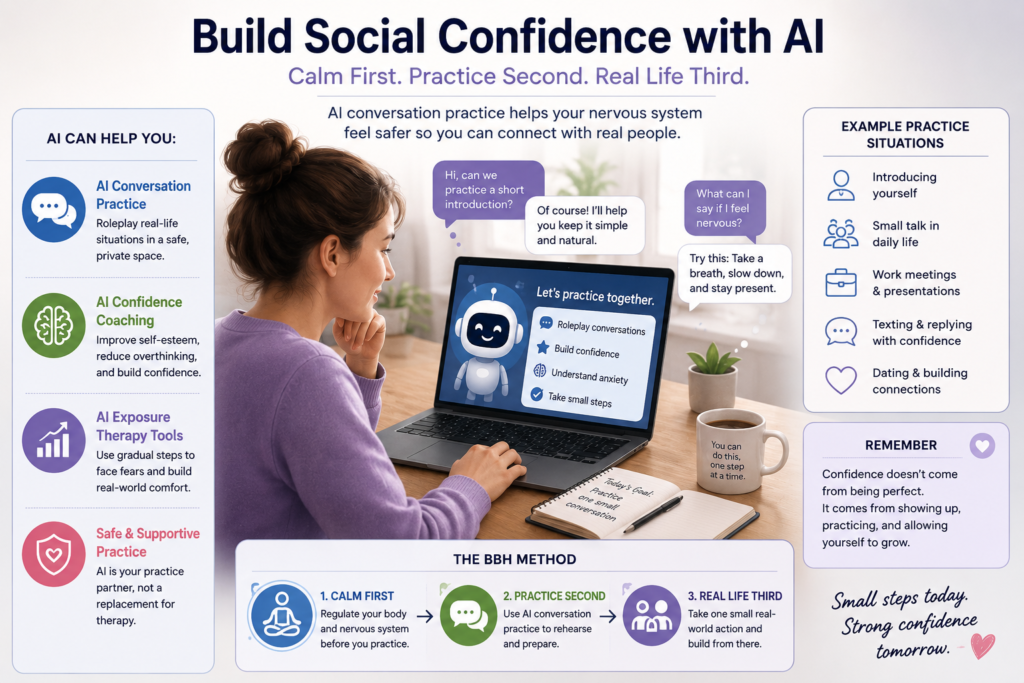
The BBH Method: Calm First, Practice Second, Real Life Third
The safest way to use AI for social anxiety is not to jump straight into difficult roleplay.
- First, calm the body.
- Second, practice with AI.
- Third, take one small real-life action.
This order matters because an anxious brain cannot learn well when the body feels under threat. If someone practices while emotionally overloaded, they may only reinforce the belief that social situations are dangerous.
Step 1 — Regulate Before You Rehearse
Before using an AI social anxiety coach, take one minute to settle your body. Slow your breathing, relax the shoulders, place your feet on the ground, and remind yourself that practice is not performance.
This helps the nervous system receive the exercise as learning instead of pressure.
The goal is not to become fearless. The goal is to stay present enough to practice.
Step 2 — Use AI as a Practice Partner, Not a Judge
AI should not be used as a judge of your worth. It should be used as a practice partner.
You can ask it to roleplay a situation, give softer wording, prepare a short answer, or help you understand why a specific interaction feels threatening.
This keeps AI confidence coaching practical and emotionally safe.
Step 3 — Take One Small Real-World Action
After practicing, choose one real-world action so the nervous system learns from life, not only from the screen.
This could be saying hello to someone, sending one message, asking one question, joining one short call, or making brief eye contact.
Small action matters because confidence grows through evidence. The body needs proof that social contact can be survived.
How AI Confidence Coaching Builds Real-World Courage
AI confidence coaching is helpful when it teaches the person to prepare, not pretend. Confidence is not the ability to speak perfectly. It is the ability to stay connected with yourself while speaking imperfectly.
Many socially anxious people wait until they feel completely ready before taking action, but that day rarely comes. Real confidence usually grows after small action, not before it.
An AI tool can help you prepare for specific situations. You can ask it to help with a job interview, a team meeting, a school presentation, a first message, a phone call, or a difficult conversation.
Instead of facing the situation with a blank mind, you walk in with a few practiced sentences. This lowers mental chaos and makes the situation feel more manageable.
Use prompts like:
- “Help me practice introducing myself in a work meeting.”
- “Roleplay a short conversation with a new classmate.”
- “Help me answer this question without sounding too nervous.”
- “Give me gentle feedback on my response.”
- “Help me prepare one sentence for a video call.”
The power of AI conversation practice is not that it gives perfect words. The power is that it helps you start. For someone who feels frozen, starting is often the real breakthrough.
This guide explains whether AI can detect mental health patterns and where its limits are: can-ai-detect-mental-health
AI Exposure Therapy Tools: What They Can and Cannot Do
AI exposure therapy tools can support gradual practice, but they must be used carefully. Exposure does not mean throwing yourself into overwhelming situations.
Real exposure means taking small, repeated steps that teach the nervous system, “I can feel discomfort and still remain safe.”
When done too aggressively, exposure can make fear stronger.
When done slowly, it can rebuild trust.
AI may help create a gentle exposure ladder.
- For example, the first step could be writing a greeting.
- The second step could be practicing it with AI.
- The third step could be sending a real message.
- The fourth step could be making a short call.
- The fifth step could be joining a group conversation for five minutes.
Each step should be small enough that the person can complete it without emotional collapse.
But AI exposure must not become another form of avoidance. If someone spends months practicing with AI but never takes real-life steps, the fear may stay protected.
The goal is to transfer courage into daily life. AI for social anxiety works best when it supports real connection, not when it replaces connection.
When AI Practice Becomes Too Much
Stop or slow down if AI practice increases panic, shame, obsessive checking, or emotional overwhelm. Ground your body first. If social anxiety is severe, connected with trauma, or disrupting work, education, relationships, or daily functioning, professional support is important.
This guide on trauma bond help with AI explains how AI can support pattern detection after narcissistic abuse: trauma-bond-help-ai-narcissistic-abuse-cycle-detection
Emotional Intelligence Matters More Than Perfect Scripts
Social confidence is not only about having the right words. It is also about emotional intelligence: noticing your body, understanding your fear, respecting boundaries, reading situations, and responding with awareness instead of panic.
This is where an AI social anxiety coach can support reflection. It can ask what you felt, what you feared, what you avoided, and what one small next step could be.
But emotional intelligence must remain human-led. AI can help organize thoughts, but it cannot fully understand your history, relationships, culture, nervous system, or lived experience.
The user must stay in charge. The best use of AI confidence coaching is when it helps you become more self-aware, not more dependent.
For BBH, the deeper goal is not to make people socially perfect. The goal is to help people become emotionally safer inside themselves. When the body feels safer, conversation becomes less like a test and more like a human exchange.
Read more about AI emotional intelligence and mental health here: ai-emotional-intelligence-mental-health
Part 2 Closing Transition
The strongest use of AI for social anxiety is structured practice: calm the body, rehearse with AI, then take one small real-life step. AI conversation practice, AI exposure therapy tools, and AI confidence coaching can all support confidence when they move the person toward life, not away from it.
In Part 3, we will look at safety, limits, therapy boundaries, ethical use, and a simple 7-day starter plan for using AI without becoming dependent on it.
Can an AI Social Anxiety Coach Replace Therapy?
An AI social anxiety coach can support practice, reflection, and preparation, but it cannot replace therapy. This difference is important.
Social anxiety can sometimes be connected with trauma, panic attacks, depression, shame, bullying, rejection, family patterns, workplace stress, or deeper nervous system dysregulation.
AI may help you organize your thoughts, rehearse a conversation, or create a practice plan, but it cannot fully understand your history, diagnose your condition, prescribe medication, or hold clinical responsibility.
This is why AI for social anxiety should be used as a support tool, not as your only source of care.
If your fear is mild to moderate, AI may help you prepare for everyday situations. But if anxiety is stopping you from working, studying, attending appointments, building relationships, or leaving home, professional help is important.
A therapist can notice emotional patterns, body responses, avoidance cycles, trauma memories, and safety risks in a way AI cannot reliably manage.
The safest position is simple: AI can help you practice, but human support helps you heal relationally. Social anxiety often grows around the fear of being seen. That fear eventually needs safe human connection, not only digital rehearsal.
Clear Safety Boundary
Do not use AI confidence coaching as a replacement for crisis care, diagnosis, medication decisions, trauma therapy, or emergency support.
If you have self-harm thoughts, severe panic, extreme isolation, or feel unable to stay safe, contact local emergency services, a licensed mental health professional, or a crisis helpline in your country.
Start here with BBH’s mental clarity and emotional healing journey: start-here-your-journey-to-mental-clarity-emotional-healing
How to Use AI for Social Anxiety Safely
The safest way to use AI for social anxiety is to keep practice simple, short, and connected to real life. Begin with low-pressure situations rather than jumping into the hardest fear first.
For example, do not start with public speaking if saying hello already feels overwhelming. Start with one greeting, one small message, one short reply, or one calm sentence for a meeting.
Keep sessions short. Ten to fifteen minutes of AI conversation practice may be more helpful than one hour of overthinking. Long sessions can turn into reassurance seeking, perfectionism, or avoidance if the person keeps asking AI for the “perfect” response.
The goal is not to keep preparing forever. The goal is to prepare enough to take one real step.
Also, track your body response. Before practice, ask: How anxious am I from 1 to 10?
After practice, ask: Did this help me feel clearer, or did I become more stuck?
Good practice should create a little courage, not emotional collapse. If distress becomes too high, pause and regulate first.
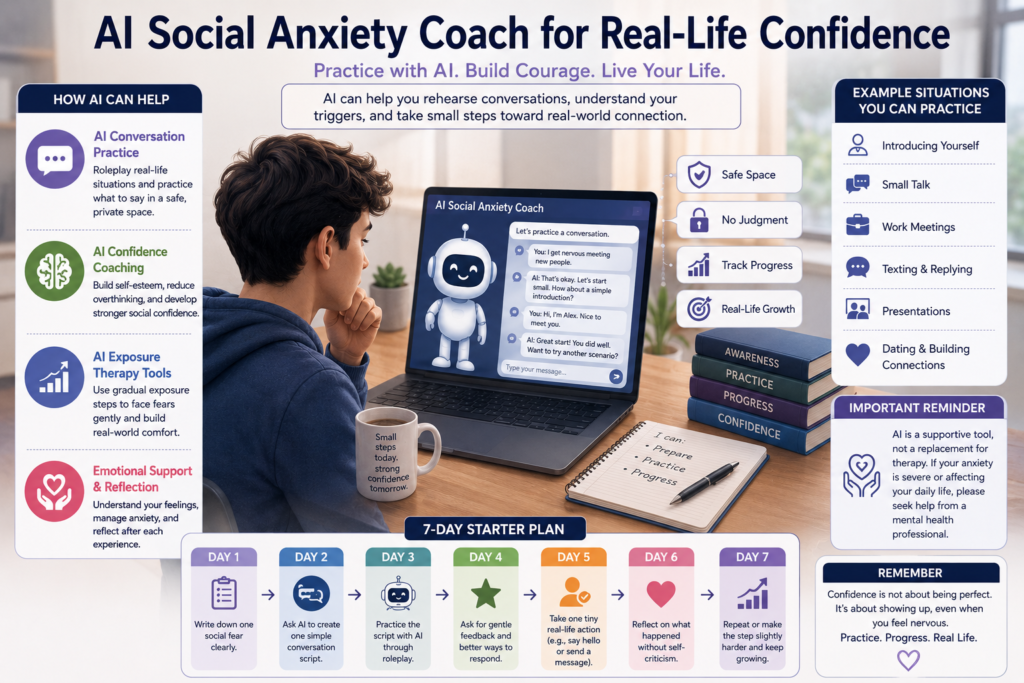
7-Day Starter Plan
Day 1: Write one social fear clearly.
Day 2: Ask AI to create one simple conversation script.
Day 3: Use AI conversation practice to roleplay that script.
Day 4: Ask for gentle feedback, not harsh correction.
Day 5: Take one tiny real-world action, such as greeting someone or sending one message.
Day 6: Reflect on what happened without self-attack.
Day 7: Repeat the same step or make it only slightly harder.
This plan keeps AI exposure therapy tools gentle. It teaches the nervous system through small evidence, not pressure.
What Makes the BBH Approach Different?
The BBH approach does not treat AI for social anxiety as a quick fix. It also does not reject AI completely.
The balanced view is that AI can support social confidence when it is used with emotional awareness, nervous system regulation, gradual exposure, and clear boundaries. This is different from many generic AI articles that only discuss tools, features, or productivity.
Social anxiety is not only about conversation skills. It is also about self-protection. The body may fear judgment because past experiences taught it that being visible was unsafe.
That is why AI confidence coaching should not only focus on sounding confident. It should help you become more compassionate with the part of you that feels afraid.
A useful AI practice session may include three layers: what you want to say, what you feel in your body, and what small real-life action you can take next.
This keeps the process human. The aim is not to become robotic, polished, or socially perfect. The aim is to become more present, more flexible, and less controlled by fear.
This related guide on AI, soul, consciousness, and awareness supports deeper reflection: ai-soul-debate-consciousness-awareness
When AI Exposure Therapy Tools Are Helpful
AI exposure therapy tools are most helpful when they create a gradual bridge from fear to action. They can help you list feared situations, rank them from easiest to hardest, write small scripts, rehearse conversations, and reflect after each attempt. This can be especially useful for people who freeze before speaking because it reduces the unknown.
However, exposure should never be used as punishment. If you push too hard, the nervous system may learn that social situations are even more dangerous.
Gentle exposure respects your current capacity. A good rule is this: the step should feel challenging but possible. If the step feels impossible, make it smaller.
For example, if joining a group conversation feels too much, start by reading the group chat.
- Then react with one emoji.
- Then write one short sentence.
- Then reply to one person.
- Then join a short call.
Confidence grows through small wins that your body can actually absorb.
Final Thoughts on AI for Social Anxiety
AI for social anxiety can be helpful when it gives you structure, practice, and emotional clarity.
- An AI social anxiety coach may help you prepare for difficult moments.
- AI conversation practice may help you rehearse what to say.
- AI exposure therapy tools may help you move step by step.
- AI confidence coaching may help you rebuild courage after shame, avoidance, or fear of judgment.
But the final goal is not to become dependent on AI. The goal is to return to life with more steadiness. AI should help you walk toward real people, not hide from them. It should help you understand yourself, not replace your own judgment. It should help you practice courage, not chase perfect performance.
Social anxiety does not disappear because someone tells you to “just be confident.” It changes when the body slowly learns that connection can be safe again. Start small. Practice gently. Move toward real life one step at a time.
Explore BBH’s AI Therapy & Self-Help Tools support page: ai-therapy-self-help-tools