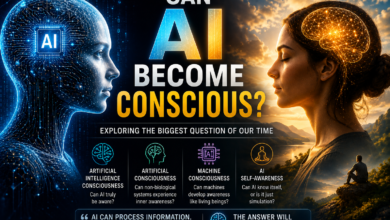
AI Self Reflection: A Guide to Personal Growth
AI Prompts for Self-Awareness and Clarity

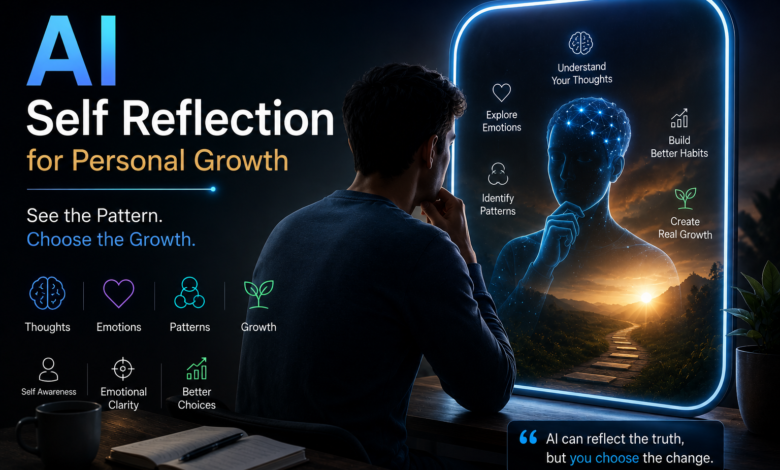
AI self reflection is becoming more than a digital trend; it is becoming a new way to understand thoughts, emotions, habits, and hidden patterns with more honesty. Many people use AI for personal growth, but most articles only give basic prompts or tool lists.
Thank you for reading this post, don't forget to subscribe!This guide goes deeper. It explains how AI can work like a calm mirror for your mind, helping you notice emotional reactions, repeated choices, avoidance patterns, and the inner stories that shape your life.
You will also learn how to use AI self-reflection prompts, AI journaling for self awareness, and AI self coaching tools without becoming dependent on technology.
The unique part of this blog is its human-first approach: AI is not shown as a therapist or final answer, but as a structured support for emotional clarity, nervous system awareness, and real personal growth through honest daily action.
What Is AI Self Reflection?
AI self reflection means using artificial intelligence as a structured mirror for your thoughts, emotions, decisions, and repeated life patterns.
- It is not about giving your power to technology.
- It is about using AI to slow down your thinking, organize your inner confusion, and ask deeper questions that you may normally avoid.
Many people in the USA, UK, Canada, and Australia are now using AI for personal growth because life has become mentally overloaded.
People are managing stress, relationships, career pressure, identity confusion, emotional reactions, and constant digital noise. In that pressure, it becomes easy to act automatically instead of understanding what is happening inside.
AI can help by turning vague thoughts into clear language. For example, when someone says, “I feel stuck,” AI can help them explore whether the real issue is fear, shame, uncertainty, burnout, avoidance, or a repeating emotional pattern.
This is why AI self reflection is useful when it is used with honesty, emotional safety, and personal responsibility.
AI Is a Mirror, Not a Master
The most important thing to understand is this: AI can reflect your words, but it cannot live your life. It can help you notice patterns, but it should not become your final authority.
This is where many people make a mistake. They expect AI to give them a perfect answer, but real personal growth does not come from receiving an answer. It comes from becoming honest enough to face the pattern.
This is also why self-reflection needs humility. When people use AI only to confirm what they already believe, it can strengthen ego instead of creating awareness.
A helpful related read is Spiritual Ego and AI Self Reflection, which explores how AI can support humility when used as a mirror rather than a tool for self-justification: ego-spirituality-ai-humility
The healthiest use of AI is not, “Tell me what is right.” A better use is, “Help me understand what I may be avoiding, repeating, defending, or misunderstanding.” That shift changes AI from a shortcut into a self-awareness tool.
“AI can organize your thoughts, but growth begins when you stop hiding from the pattern it reflects.” — Shubhangi
Why People Use AI for Personal Growth
People use AI for personal growth because reflection is difficult when the mind is emotionally charged. When someone feels anxious, ashamed, rejected, confused, or overwhelmed, the brain often moves into defense mode. Instead of calmly understanding the situation, it may overthink, blame, avoid, react, or shut down.
AI gives structure to that inner noise. It can help a person ask,
- “What emotion am I feeling?”
- “What triggered me?”
- “What story am I telling myself?”
- “What action would be healthier?”
These questions may sound simple, but they create distance between emotion and reaction. That distance is the beginning of awareness.
This is why AI can also support emotional healing when used gently.
For readers who want to understand how AI can support emotional calm without replacing human care, Read Also AI Emotional Support for a Calmer Mind
However, AI should never be treated as a therapist, doctor, or crisis support system. It can support reflection, journaling, and emotional clarity, but it cannot replace professional help, trusted relationships, or real-world action.
The Real Search Intent Behind AI Self Reflection
When people search for AI self reflection, they are usually not looking for theory only.
They want practical help.
They want to know how AI can help them understand themselves, improve habits, reduce confusion, make better decisions, and grow emotionally.
Some readers are searching for AI self-reflection prompts because they do not know what to ask themselves. Some are looking for AI journaling for self awareness because they want a daily reflection method. Others are exploring AI self coaching tools because they want structured guidance for goals, emotions, confidence, or direction.
This is why this blog should not become just another list of prompts. Prompt lists are useful, but they are incomplete.
The deeper question is:
- what happens after the prompt gives you an answer?
- Do you become more aware, or do you only collect more information?
- Do you take action, or do you keep reflecting without changing behavior?
A strong internal link here is AI Life Purpose Coach, because it connects self-reflection with direction, clarity, and purpose: ai-life-purpose-coach
AI becomes powerful only when reflection turns into a clear next step.
The BBH Difference: Emotional Safety Before Self-Improvement
The unique BBH angle is that AI self reflection should not be used only for productivity or motivation. It should also support emotional safety. Many people try to improve themselves while secretly attacking themselves.
They use self-growth as a punishment: “I must fix myself,” “I am behind,” “I should be better,” or “Something is wrong with me.”
That approach creates pressure, not healing.
Real self-reflection should reduce shame, not increase it. A good AI reflection process helps you understand your reactions without labeling yourself as weak, broken, lazy, or dramatic.
It helps you separate your identity from your temporary emotional state.
- You may feel fear, but you are not fear.
- You may feel stuck, but you are not permanently stuck.
- You may notice a pattern, but you are not the pattern.
This is where AI can be helpful when used carefully.
- It can ask calmer questions than your inner critic.
- It can help you see emotional patterns without immediate judgment.
- It can help you organize your thoughts before you speak, decide, react, or withdraw.
Why AI Self Reflection Needs Human Wisdom
AI can help you reflect, but it cannot fully understand your body, childhood history, culture, relationships, spirituality, trauma background, or lived experience.
It works with the information you provide. That means the quality of your reflection depends on the honesty of your input.
This is also why readers should understand the limits of AI. A useful related article is Can AI Become Conscious?
The best approach is balanced. Use AI to ask better questions. Use journaling to organize your thoughts. Use emotional awareness to understand your reactions. Use human support when the situation is serious. Then use action to prove that growth is becoming real.
That is the real purpose of AI self reflection: not to make AI your guide, but to help you become more honest, aware, calm, and responsible in your own life.
How AI Self-Reflection Prompts Help You Understand Yourself
AI self-reflection prompts help because most people do not naturally ask themselves the right questions when they are emotionally activated.
When the mind is calm, reflection feels easy. But when someone feels rejected, anxious, confused, guilty, ashamed, or stuck, the brain often repeats the same story again and again. This is where AI self reflection can become useful.
A good prompt does not simply ask, “How do I feel?” It goes deeper. It asks what emotion is repeating, what fear is underneath the reaction, what need is unmet, what pattern keeps returning, and what small action could create change.
This makes AI for personal growth more practical because the person is not only thinking about improvement but also learning how to observe thoughts, emotions, body signals, and choices with more honesty.
The strongest prompts are not designed to make you feel perfect. They are designed to help you see clearly.
The Best AI Self-Reflection Prompts Are Not Generic
Generic prompts can be useful, but they often stay on the surface. For example, “What are my goals?” may help, but it may not reveal why you avoid those goals. “What am I feeling?” may help, but it may not reveal what you are protecting yourself from.
Better AI self-reflection prompts explore patterns. They ask about avoidance, fear, inner criticism, emotional triggers, nervous system reactions, relationship habits, and repeated decisions. This is where AI becomes more than a digital notebook. It becomes a structured reflection partner.
For example, instead of asking, “How can I be more confident?” a stronger prompt is: “What situations make me lose confidence, and what story do I tell myself in those moments?” This reveals the emotional root, not just the surface problem.
For readers who struggle with harsh self-talk, Read Also : AI Tools for Inner Critic Healing and Self-Compassion
Prompt Type 1 — Emotional Pattern Prompts
Use emotional pattern prompts when you feel the same reaction repeating in different situations. These prompts help you see whether the issue is really about the current event or an older emotional pattern being activated.
Examples:
- What emotion keeps repeating in my life right now?
- What situation triggered this emotion most strongly?
- What fear or unmet need may be underneath this reaction?
- Am I reacting to the present moment, or am I reacting from an old pattern?
- What would a calmer version of me understand about this situation?
These prompts are useful because AI journaling for self awareness works best when it connects emotional experience with repeated behavior.
The goal is not to judge yourself. The goal is to understand the pattern before it controls your response.
Prompt Type 2 — Decision Clarity Prompts
Use decision clarity prompts when you feel stuck between choices. Many people think they are confused because they do not have enough information. But sometimes they are confused because one option requires courage, truth, boundaries, or discomfort.
Examples:
- What decision am I avoiding right now?
- What answer do I already know but feel afraid to accept?
- What would I choose if I was not trying to please anyone?
- What fear is making this decision feel heavier than it is?
- What is the smallest honest next step I can take today?
This is where AI self coaching tools can support practical clarity. They help organize the mental noise, but they should not decide your life for you. AI can suggest perspectives, but the final responsibility must stay with you.
For deeper direction-based growth, Read Also – AI Life Purpose Coach: Find Clarity, Direction, and Inner Purpose
Prompt Type 3 — Behavior Change Prompts
Reflection becomes powerful only when it changes behavior. Many people keep collecting insights but continue the same habits, reactions, and emotional loops. This is why AI self reflection should always end with one small action.
Examples:
- What behavior am I repeating even though it hurts my growth?
- What emotion usually comes before this behavior?
- What healthier response can I practice next time?
- What is one action that proves I am choosing growth today?
- What boundary, habit, or routine would support the person I want to become?
This kind of prompt turns reflection into movement. It helps the reader avoid the trap of endless analysis.
The goal is not to become perfectly healed before acting. The goal is to act with more awareness, even while healing.
AI Journaling for Self Awareness
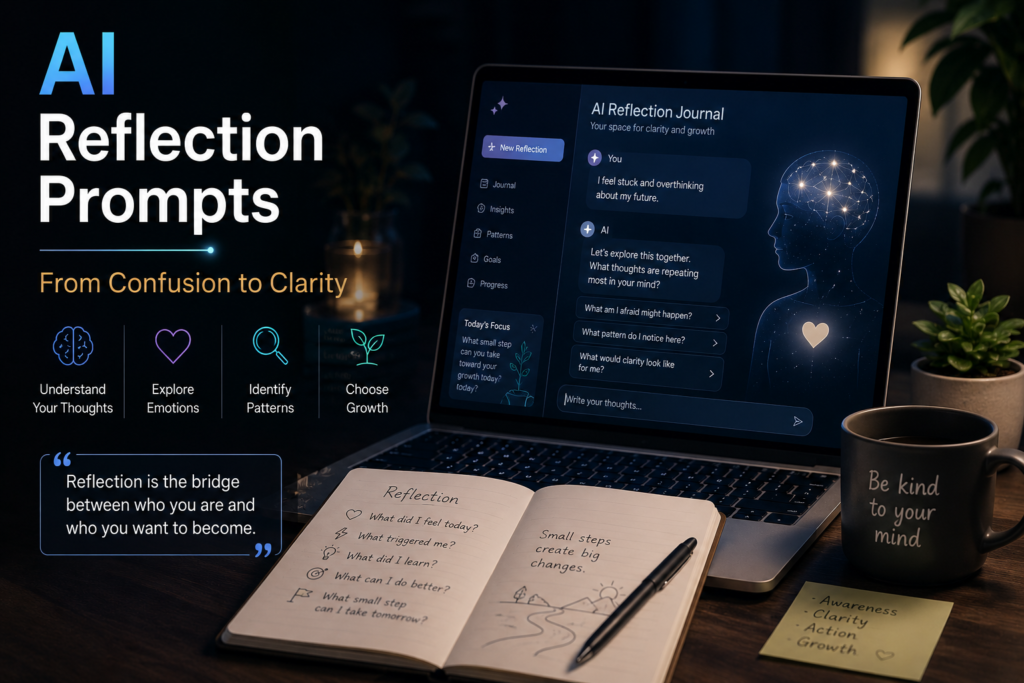
AI journaling for self awareness means using AI to guide your daily reflection instead of writing randomly or only venting emotions.
Traditional journaling can be powerful, but many people get stuck because they repeat the same pain on paper without reaching clarity. AI can help by asking follow-up questions and organizing your thoughts into themes.
For example, if you write, “I felt anxious all day,” AI can help you explore when the anxiety started, what thought triggered it, how your body reacted, what you needed in that moment, and what response would have been healthier. This makes journaling more structured and useful.
However, emotional journaling should be gentle. Do not use AI to force yourself into deep emotional work when you are overwhelmed.
Start simple: name the emotion, notice the body signal, identify the need, and choose one small stabilizing action.
For anxiety-related support, Read Also: AI Apps for Anxiety Relief: How to Choose and Use Them Safely
Morning AI Reflection Method
A morning reflection should prepare your mind, not overload it.
Start with four simple questions:
- What emotion is present in me this morning?
- What does my body feel like today?
- What is one thing I need to handle with calmness?
- What is one small action that will support my growth today?
This method makes AI for personal growth practical because it connects emotion, body awareness, priority, and action. Instead of starting the day with pressure, the reader starts with awareness.
Evening AI Reflection Method
Evening reflection helps you learn from the day without attacking yourself. Ask AI to help you review the day with honesty and compassion.
Use these questions:
- What moment affected me most today?
- What emotion did I feel but not fully understand?
- Did I react from fear, habit, awareness, or choice?
- What did today teach me about my pattern?
- What can I practice differently tomorrow?
This method helps turn daily life into a learning process. It is especially useful for readers who want emotional growth but do not know how to track inner changes.
AI Self Coaching Tools: Helpful Support or Emotional Shortcut?
AI self coaching tools can support reflection, goal-setting, confidence building, emotional organization, and habit awareness. They can help readers prepare for conversations, understand repeated triggers, explore values, and create small action plans.
But there is one risk: AI can become an emotional shortcut. If a person uses AI only to feel reassured, avoid hard conversations, or delay real action, then reflection becomes another form of avoidance.
This is why the best use of AI is balanced.
Use it to understand yourself, but do not use it to escape life.
Use it to prepare for growth, but still practice boundaries, communication, discipline, and real-world action.
For social confidence and real-life practice, Read Also : AI for Social Anxiety: Build Real Confidence
12 AI Self-Reflection Prompts for Personal Growth
Prompts for Emotional Clarity
- What emotion am I feeling most strongly right now, and what may be underneath it?
- What situation triggered me, and what story did my mind create?
- What do I need emotionally that I am not admitting clearly?
Prompts for Self-Awareness
- What pattern keeps repeating in my reactions, choices, or relationships?
- What part of me is trying to protect myself through this behavior?
- What truth am I avoiding because it feels uncomfortable?
Prompts for Growth and Action
- What is one small action I can take today that supports personal growth?
- What habit is no longer aligned with the person I want to become?
- What boundary would help me act with more self-respect?
Prompts for Calm and Regulation
- What can I do in the next five minutes to calm my body before reacting?
- What would I understand if I paused before responding?
- What is the most grounded next step I can take from awareness, not fear?
The Limits of AI Self Reflection
AI self reflection can help you understand your thoughts, emotions, habits, and repeated patterns, but it has limits. AI can organize what you write, ask deeper questions, and help you see connections between your emotions and actions.
But it cannot fully know your nervous system history, childhood experiences, relationship pain, spiritual journey, medical background, or real-life environment.
This is why AI should be used as a reflection tool, not as a final authority. It can support AI for personal growth, but it cannot replace professional therapy, medical care, crisis support, trusted relationships, or your own inner wisdom.
The healthiest approach is to let AI help you think more clearly while keeping responsibility for your choices in your own hands.
If a person is dealing with severe distress, trauma activation, self-harm thoughts, abuse, panic symptoms, or mental health crisis, they should seek professional or emergency support. AI may help with journaling, but human care is still essential.
AI Should Not Replace Therapy or Human Support
Many people like AI self coaching tools because they are available anytime, feel private, and can offer quick structure when the mind feels confused. That can be helpful, especially for daily reflection, goal-setting, journaling, emotional awareness, and decision clarity.
But there is a difference between support and replacement. AI does not diagnose, treat, or fully understand human suffering. It may sound emotionally intelligent, but it does not have lived experience, human attachment, clinical responsibility, or real consciousness.
For readers who want to understand the boundary between AI intelligence and human awareness, Read Also: Can AI Become Conscious? Artificial Intelligence Consciousness Explained
This link fits well because AI self reflection works best when readers understand that AI can process language, but it is not the same as human consciousness, emotional presence, or deep relational healing.
Privacy and Emotional Safety Matter
When using AI journaling for self awareness, privacy should be taken seriously. A reader should avoid sharing highly sensitive personal details, legal details, financial details, private passwords, medical records, or information that could harm them if exposed. Reflection should be honest, but it should also be wise.
A safer method is to describe patterns without exposing every private detail.
For example, instead of writing names, addresses, or specific private information, a person can write: “I felt rejected after a conversation,” or “I noticed fear when someone did not respond.” This still allows AI to help with emotional clarity without unnecessary exposure.
Emotional safety also matters. If reflection starts making someone more anxious, ashamed, obsessive, or dependent on AI reassurance, they should slow down and return to grounding. The goal is clarity, not emotional overload.
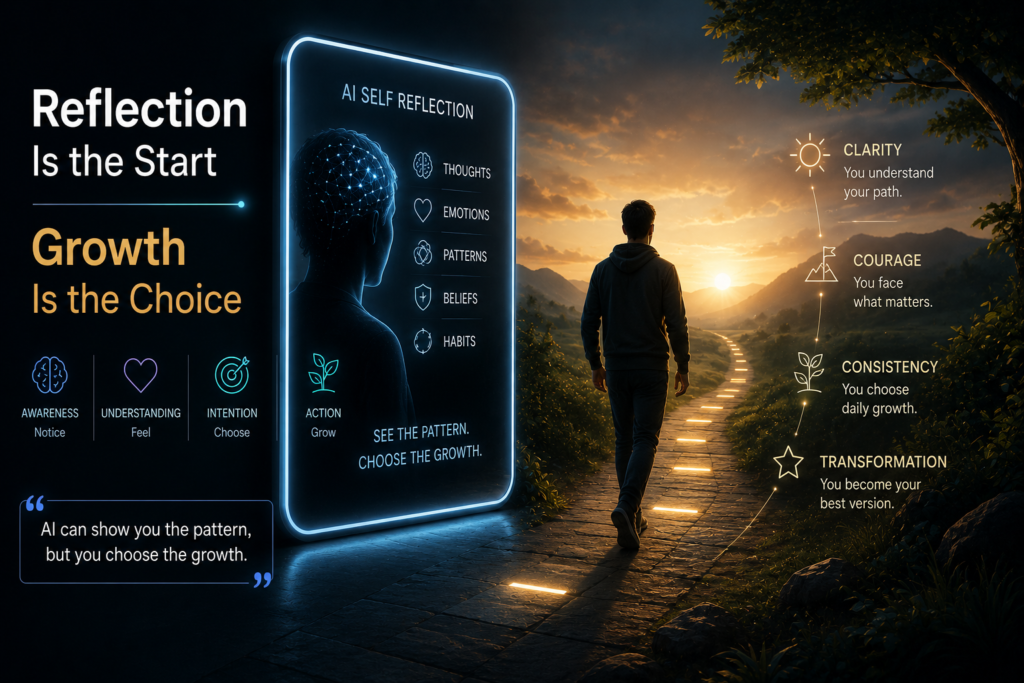
How to Turn AI Reflection Into Real Personal Growth
The real value of AI self reflection is not only insight. It is transformation. Many people understand their patterns but still repeat them. They know they overthink, avoid, react, people-please, self-doubt, or shut down. But knowing the pattern is only step one.
A simple BBH growth model is:
Step 1 — Notice the Pattern
Use AI self-reflection prompts to identify what keeps repeating. Ask: “What is the pattern in my emotions, choices, and reactions?” This turns vague confusion into clear observation.
Step 2 — Regulate Before You React
Before taking action, calm the body. Breathe slowly, pause, walk, journal, or ground yourself. A dysregulated nervous system often chooses protection, not wisdom.
Step 3 — Choose One Honest Action
Growth becomes real when awareness changes behavior. Choose one small action: speak clearly, set a boundary, complete a task, apologize, rest, ask for support, or stop repeating the old loop.
For a deeper healing path, Read Also : Start Here – Your Journey to Mental Clarity & Emotional Healing
Growth Is Not Insight Alone
Insight feels powerful because it gives relief. When you finally understand why you react a certain way, your mind may feel lighter. But insight alone is not the same as healing. Healing needs practice, regulation, repetition, and real-world choices.
This is where AI for personal growth should stay practical.
After every AI reflection session, ask one final question: “What is one action I will take today because of this insight?”
Without that question, reflection can become another form of overthinking.
For readers who need structured tools, Read Also : AI Therapy & Self-Help Tools
This helps guide the reader toward a wider BBH support path instead of leaving them only with one article.
AI Self Reflection in Relationships and Attachment Patterns
One strong use of AI self reflection is understanding relationship patterns. Many people repeat the same emotional loops in love, friendship, family, or communication. They may become anxious when someone pulls away, avoidant when closeness increases, defensive during conflict, or silent when they feel unsafe.
AI can help a person ask:
- “What am I afraid of in this relationship?”
- “Am I reacting from the present moment or from an old attachment wound?”
- “What boundary or communication would be healthier?”
This is where reflection becomes more personal and practical.
For readers exploring relationship patterns, Read Also : AI Relationship Coach for Attachment Styles: Can AI Help Anxious and Avoidant Love?
Snippet-Ready Answer: Can AI Help With Self Reflection?
Yes, AI self reflection can help people understand their thoughts, emotions, habits, and repeated behavior patterns by asking structured questions and organizing their reflections.
It is useful for journaling, emotional clarity, decision-making, personal growth, and self-awareness.
However, AI should be used as a supportive mirror, not as a replacement for therapy, medical advice, crisis care, or human connection.
Frequently Asked Questions About AI Self Reflection
1. What is AI self reflection?
AI self reflection means using AI to explore your thoughts, emotions, choices, habits, and repeated patterns through guided questions. It helps you think more clearly, but it should not replace human wisdom or professional support.
2. Can AI help with personal growth?
Yes, AI for personal growth can help with journaling, emotional clarity, goal-setting, decision-making, and habit awareness. The key is to turn insight into real action instead of only collecting advice.
3. What are the best AI self-reflection prompts?
The best AI self-reflection prompts ask about emotional patterns, hidden fears, repeated behaviors, body signals, values, boundaries, and one small next step. Good prompts create awareness, not self-judgment.
4. Is AI journaling good for self awareness?
Yes, AI journaling for self awareness can help organize emotions, identify triggers, and reveal repeated thoughts. It works best when used gently, honestly, and without sharing unnecessary private information.
5. Are AI self coaching tools safe?
AI self coaching tools can be helpful for reflection, planning, and clarity, but they should not replace therapy, medical care, crisis support, or trusted human relationships. Use them as support, not authority.
Final Thought: AI Can Reflect You, But You Must Choose Growth
AI self reflection can be a powerful tool when it helps you become more honest, calm, and aware. It can help you see patterns that were hidden inside overthinking, shame, fear, or emotional confusion. It can support AI self-reflection prompts, AI journaling for self awareness, and AI self coaching tools in a practical way.
But AI cannot grow for you. It cannot take action, set boundaries, regulate your nervous system, or choose honesty in your daily life. That part belongs to you.
The real purpose of AI is not to replace your inner wisdom. It is to help you hear it more clearly. When reflection becomes awareness, and awareness becomes action, personal growth becomes real.
People Also Ask
1. What is AI self reflection?
AI self reflection means using AI to explore thoughts, emotions, habits, and repeated life patterns through guided questions. It can support self-awareness, but it should not replace therapy or human judgment.
2. Can AI help with personal growth?
Yes, AI for personal growth can help organize thoughts, identify patterns, and create reflection prompts. Real growth still depends on honest action, emotional regulation, and consistent practice.
3. What are good AI self-reflection prompts?
Good AI self-reflection prompts ask about emotions, triggers, repeated behavior, hidden fears, and one small next step. The best prompts create clarity without self-judgment.
4. Is AI journaling good for self awareness?
AI journaling for self awareness can help people name emotions, track patterns, and reflect more clearly. It works best when used gently and without sharing unnecessary private information.
5. Are AI self coaching tools safe?
AI self coaching tools can be helpful for journaling, planning, and clarity, but they are not a replacement for mental health professionals. For severe distress or crisis, human support is essential.