AI attachment support : Can Machines Teach Us Healthy Love?
AI attachment support

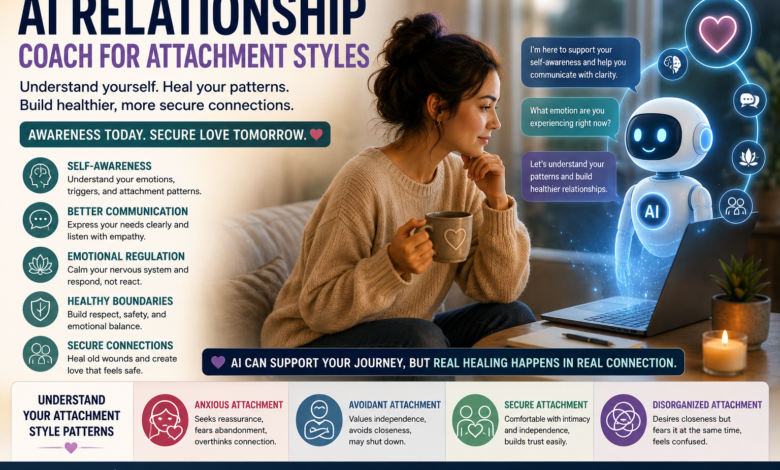
Many people enter relationships wanting love, but their nervous system often reacts from fear, distance, overthinking, or old emotional wounds. This is where an AI relationship coach can become a helpful mirror, not by replacing human connection, but by helping you understand why you react the way you do.
Thank you for reading this post, don't forget to subscribe!In this blog, you will learn how AI relationship coaching can support anxious attachment, avoidant attachment, relationship anxiety, emotional triggers, and healthier communication.
The unique BBH angle is different: this is not just about technology or advice; it explains how an AI relationship coach for attachment styles can support self-awareness, nervous system regulation, and secure bonding without creating dependency.
You will also understand the safe role of AI emotional support and where AI mental health support must stop. This guide helps readers in the USA, UK, Canada, and Australia use AI wisely, emotionally, and responsibly.
What Is an AI Relationship Coach for Attachment Styles?
An AI relationship coach is a digital support tool that helps people slow down, reflect, and understand relationship patterns before reacting from fear, anger, shutdown, or emotional confusion.
For someone with attachment wounds, this can be useful because many relationship reactions do not begin with logic.
They begin inside the nervous system.
- A delayed reply may feel like rejection.
- A small disagreement may feel like abandonment.
- A partner needing space may feel like emotional danger.
This is why an AI relationship coach should not be seen as a machine that teaches love. A better way to understand it is this: AI can become a reflection tool that helps you notice what is happening inside you before you act from an old wound.
Why Attachment Styles Shape the Way We Seek Love
Attachment styles describe how people usually respond to emotional closeness, distance, uncertainty, and conflict in relationships.
- They are not fixed labels, and they should not be used to judge anyone.
- They are patterns that often come from early emotional experiences, past relationships, nervous system memory, and repeated experiences of safety or insecurity.
A securely attached person may feel discomfort in conflict but can usually return to trust.
- A person with anxious attachment may search for reassurance, fear abandonment, or overthink small changes in communication.
- A person with avoidant attachment may pull away when emotions feel too intense.
- A person with disorganized attachment may want closeness and fear it at the same time.
This is where AI relationship coaching can become helpful when used wisely.
It can help users pause and ask: “Am I reacting to the present moment, or am I reacting from an old emotional pattern?” That question alone can reduce impulsive messages, emotional shutdown, and repeated conflict.
For deeper reading, this section can internally link to relationship psychology and emotional patterns.
Why People in the USA, UK, Canada, and Australia Are Turning to AI Emotional Support
Readers in the USA, UK, Canada, and Australia are increasingly searching for emotional support that is private, fast, and available when therapy is expensive, delayed, or difficult to access.
Many people are not looking for a diagnosis. They are looking for a calmer way to understand why they feel rejected, why they cannot stop overthinking, why they avoid difficult conversations, or why love feels unsafe even when the relationship is not clearly harmful.
This is where AI emotional support can feel useful. It can help a person organize thoughts, name emotions, prepare difficult conversations, and notice attachment triggers before sending a message they may regret later. But this support must be used with maturity. AI should not become a replacement partner, therapist, or emotional dependency system.
The healthier use is simple: use AI to reflect, regulate, and communicate better — then return to real human connection with more awareness.
Read Also: attachment and connection in relationships
The BBH View: AI Should Support Awareness, Not Replace Connection
The unique BBH view is that an AI relationship coach for attachment styles should be used as a mirror for awareness, not as a substitute for love.
This difference matters. If a person uses AI only to seek constant reassurance, decode every message, or avoid real conversations, AI may strengthen attachment anxiety instead of healing it. But if a person uses AI to pause, name body sensations, understand emotional triggers, and prepare honest communication, it can support growth.
Attachment healing is not only about better relationship advice. It is also about nervous system regulation. Before a person can communicate clearly, the body must feel safe enough to stay present.
If the nervous system is in threat mode, the mind often creates stories: “They are leaving me,” “I am too much,” “I should disappear,” or “I should protect myself by becoming cold.”
“Healing begins when love is no longer used as a place to hide from yourself.”
Read Also : AI therapy and self-reflection tools
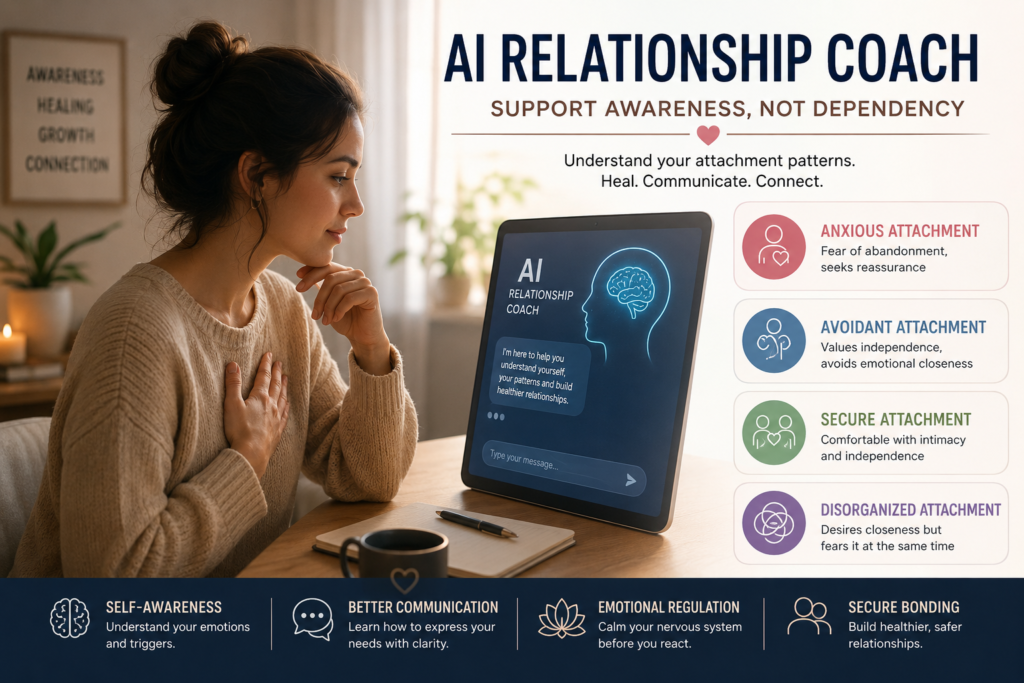
What This Blog Will Help You Understand
This blog will help you understand how an AI relationship coach can support attachment styles without replacing human care. You will learn how AI relationship coaching may help anxious attachment by slowing reassurance-seeking, avoidant attachment by making emotional expression safer, and anxious-avoidant cycles by creating a pause before conflict grows.
You will also understand the difference between healthy AI emotional support and unhealthy dependency. This is important because AI can help with reflection, journaling, emotional organization, and communication practice, but it cannot provide crisis care, trauma treatment, diagnosis, or the warmth of real human repair.
- The goal is not to make technology the center of love.
- The goal is to use technology as a tool that helps the nervous system pause, the mind become clearer, and the heart communicate with more honesty.
Read Also : nervous system regulation in emotional reactions
How AI Relationship Coaching Supports Different Attachment Styles
AI relationship coaching is most useful when it helps a person notice their relationship pattern before that pattern becomes a reaction. Many people do not struggle because they lack love. They struggle because their emotional system reacts too fast when closeness, distance, silence, conflict, or uncertainty appears.
In that moment, the mind may search for proof, the body may feel unsafe, and communication may become either anxious, defensive, cold, or confusing.
An AI relationship coach can help by creating a pause. It can ask reflective questions, help organize emotions, suggest calmer language, and support a person in checking whether they are responding from the present situation or from an old attachment wound.
This is not magic, and it is not therapy. It is a structured reflection tool that can help people use awareness before action.
Read Also: emotional healing after relationship anxiety
Anxious attachment often appears when love feels uncertain. A delayed reply, a short message, a change in tone, or a partner needing space can activate fear of abandonment.
The person may start overthinking, checking the phone, imagining rejection, asking for repeated reassurance, or sending emotional messages before the nervous system has settled.
The pain is real, but the reaction may become stronger than the actual situation.
This is where an AI relationship coach for attachment styles can help the anxious person slow down.
Instead of immediately asking a partner, “Are you upset with me?” or “Do you still love me?” the person can first use AI to identify the feeling underneath the urge.
Is it fear, loneliness, shame, rejection sensitivity, or a real boundary concern? That small pause can prevent many unnecessary conflicts.
Healthy AI emotional support can also help the person prepare a message that is honest but not panic-driven. For example, instead of saying, “You never care about me,” the person may learn to say, “I noticed I felt anxious when communication changed.
Can we talk when you are available?” This protects both emotional truth and relationship safety.
Practical AI Prompt for Anxious Attachment
Use this prompt when the nervous system feels activated:
“Help me understand whether I am reacting from fear of abandonment or from a real relationship concern. Ask me three grounding questions before I send this message.”
This keeps AI as a reflection tool, not a reassurance addiction.
AI Relationship Coach for Avoidant Attachment
Avoidant attachment often appears when emotional closeness feels too intense. A person may care deeply but still feel pressure, discomfort, or inner shutdown when a partner asks for vulnerability.
Instead of saying, “I feel overwhelmed,” they may disappear, become silent, change the topic, act cold, or convince themselves that they do not need anyone.
This pattern is often misunderstood as lack of love, but many times it is a protection strategy.
An AI relationship coach can support avoidant attachment by helping the person translate shutdown into honest communication. Avoidant people may need language that protects space without creating emotional rejection. AI can help them express boundaries with warmth, which is very different from emotional withdrawal.
For example, instead of saying nothing for hours or days, a person can use AI relationship coaching to create a simple message:
- “I care about this conversation, but I am feeling overwhelmed.
- I need some time to think, and I will come back to it tonight.”
- This kind of communication gives space without abandoning the relationship.
This matters because avoidant attachment healing is not about forcing vulnerability. It is about building enough inner safety to stay connected while still respecting the need for emotional space.
Practical AI Prompt for Avoidant Attachment
Use this prompt when you feel like withdrawing:
“Help me explain that I need space without sounding cold or rejecting. Keep the message respectful, honest, and emotionally safe.”
This allows space without creating silence that hurts the other person.
Read Also : anxiety and overthinking in relationships
AI Emotional Support for Anxious-Avoidant Relationship Cycles
One of the most painful relationship patterns is the anxious-avoidant cycle. One partner moves closer when they feel unsafe, while the other moves away when they feel pressured.
- The anxious partner may ask for more communication, reassurance, or emotional clarity.
- The avoidant partner may feel trapped, criticized, or overwhelmed.
- Then the anxious partner feels abandoned, and the avoidant partner feels controlled.
Both are protecting themselves, but both may end up hurting each other.
This is where AI emotional support can become practical. AI can help both people slow the cycle before it becomes a fight. For the anxious person, AI can help reduce panic-driven messages. For the avoidant person, AI can help reduce emotional disappearance. For both, AI can help create communication that is clear, respectful, and less reactive.
The goal is not to make AI the judge of the relationship. The goal is to use it as a pause between trigger and response. That pause can protect love from old survival patterns.
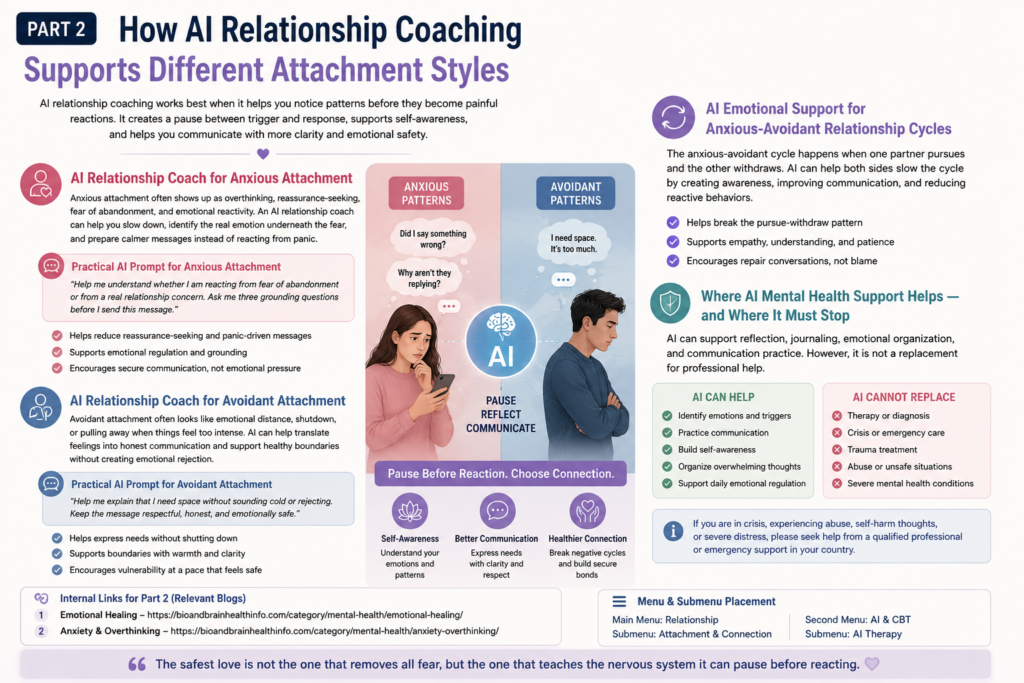
Where AI Mental Health Support Helps — and Where It Must Stop
AI mental health support can help with reflection, journaling, emotional organization, communication practice, and daily self-awareness.
- It can help someone ask better questions before reacting.
- It can help a person identify whether the body is in fear, anger, shame, shutdown, or loneliness.
- It can also help prepare for a difficult conversation in a calmer way.
But AI must have limits. It should not replace therapy, crisis care, medical support, diagnosis, trauma treatment, or real human accountability.
If someone is experiencing abuse, self-harm thoughts, severe depression, panic, trauma flashbacks, dangerous conflict, or emotional instability, AI is not enough. Human support is necessary.
This is especially important for readers in the USA, UK, Canada, and Australia, where many people may use AI because therapy feels expensive, delayed, or difficult to access.
AI can support the space between sessions or help organize thoughts before seeking help, but it should never become the only safety system.
The healthiest use of an AI relationship coach is simple: let it help you pause, reflect, and communicate better — then bring that awareness back into real life.
“The safest love is not the one that removes all fear, but the one that teaches the nervous system it can pause before reacting.”
Read Also : Relationship and Attachment & Connection Read Also: AI & CBT .Explore This too AI Therapy
How to Use an AI Relationship Coach Safely
An AI relationship coach can be helpful when it is used as a reflection tool, not as a replacement for real human care.
This difference is very important. Healthy relationship growth does not happen only by getting quick advice. It happens when a person learns to pause, understand their emotional pattern, regulate their nervous system, and communicate with more honesty.
For attachment styles, AI can support the space between trigger and response. When someone feels anxious, rejected, overwhelmed, or emotionally shut down, AI can help them ask better questions before sending a message or avoiding a conversation.
This is where AI relationship coaching becomes useful: it gives structure when emotions feel too fast.
But AI should never become the final authority over love.
- It should not decide whether someone should stay, leave, accuse, forgive, or trust.
- It should help the person think more clearly, then return to real-life communication, professional support when needed, and personal responsibility.
Healthy Uses of AI Emotional Support
Healthy AI emotional support begins with self-awareness. Instead of asking AI to judge a partner, the better use is asking AI to help you understand your own reaction.
For example, “What emotion may be underneath my urge to send this message?” or “Help me calm down before I respond.” These questions make AI a regulation tool, not a dependency tool.
An AI relationship coach for attachment styles can also help someone prepare for difficult conversations.
- A person with anxious attachment may use it to reduce panic-driven reassurance-seeking.
- A person with avoidant attachment may use it to express the need for space without sounding cold.
- Someone in an anxious-avoidant pattern may use AI to slow the conflict cycle before it becomes blame and withdrawal.
Healthy AI use includes journaling, emotional naming, message drafting, boundary practice, repair language, and trigger tracking. These uses support emotional maturity because they move the person from reaction to reflection.
Read Also: AI Therapy & Self-Help Tools
Unhealthy Uses of AI Relationship Coaching
Unhealthy AI relationship coaching begins when AI becomes a replacement for courage, therapy, or honest communication. If someone keeps asking AI to decode every message, test every partner behavior, or confirm every fear, the tool may accidentally strengthen anxiety.
The person may feel supported for a few minutes, but the deeper attachment wound remains untouched.
AI can also become unhealthy when it is used to avoid real conversations. For example, if a person talks to AI for hours but never expresses a boundary, asks for repair, or takes responsibility in the relationship, the support is incomplete. Reflection must eventually become action.
Another risk is emotional dependency. If someone starts needing AI before every small decision, every message, or every feeling, then AI is no longer supporting secure attachment. It is becoming another reassurance system.
The goal is not to ask AI for emotional permission. The goal is to build enough inner steadiness to communicate with clarity.
When to Seek Human Support Instead of AI Mental Health Support
AI mental health support has limits. It can help organize thoughts, reflect on emotions, and prepare communication, but it cannot provide full therapy, diagnosis, crisis care, trauma treatment, or medical guidance.
This matters because relationship problems sometimes connect with deeper issues such as trauma, abuse, panic, depression, bipolar symptoms, severe anxiety, or self-harm thoughts.
Human support is necessary if someone feels unsafe, controlled, threatened, emotionally abused, physically harmed, or unable to function.
It is also important when attachment pain becomes intense enough to disturb sleep, work, appetite, daily responsibility, or personal safety. In those moments, AI should not be the main support system.
For readers in the USA, UK, Canada, and Australia, AI may feel easier to access than therapy because of cost, waiting lists, privacy concerns, or emotional hesitation. Still, the safest model is balanced: use AI for reflection, but use trusted people, licensed professionals, emergency services, or crisis support when the situation becomes serious.
Read Also : trauma recovery tools for emotional safety
A Simple 7-Day AI Relationship Coach Practice
A simple 7-day practice can help readers use an AI relationship coach with structure instead of dependency.
Day 1: Ask AI to help you identify your attachment style patterns without labeling yourself harshly.
Day 2: Write down one recent relationship trigger and ask AI what emotion may be underneath it.
Day 3: Use AI to rewrite one reactive message into a calmer, more honest message.
Day 4: Ask AI to help you create one healthy boundary sentence.
Day 5: Use AI to explore how your body reacts during relationship stress: chest tightness, stomach tension, numbness, anger, or shutdown.
Day 6: Ask AI to help you prepare a repair conversation without blame.
Day 7: Reflect on one thing you can practice in real life: listening, asking clearly, pausing, apologizing, or expressing a need.
This practice keeps AI as a bridge toward awareness and action, not a place to hide from real connection.
Read Also : Start Here – Your Journey to Mental Clarity & Emotional Healing
“AI can guide the sentence, but healing still happens when the heart chooses honesty.”
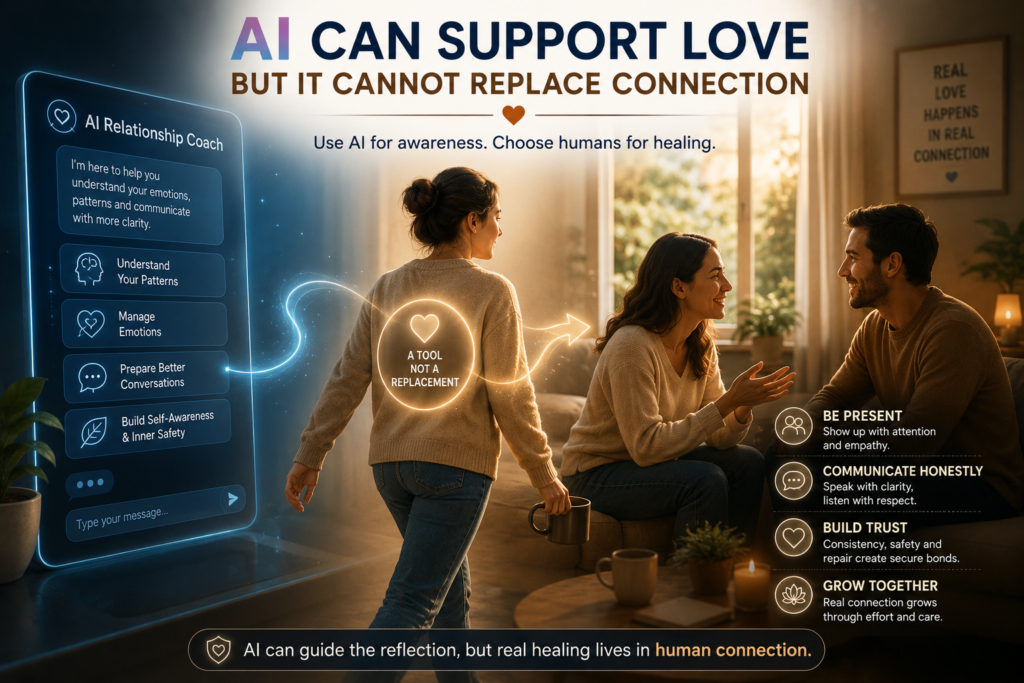
Final Thought: AI Can Support Secure Love, But It Cannot Become Love
An AI relationship coach can support secure love when it helps people pause, understand attachment triggers, regulate emotions, and communicate with more care.
It can make AI relationship coaching useful for anxious attachment, avoidant attachment, relationship anxiety, boundaries, and emotional repair.
But AI cannot become love itself. Love requires presence, responsibility, honesty, repair, and human connection. AI emotional support and AI mental health support are most helpful when they guide a person back to themselves and back to real life with more maturity.
The goal is not to depend on AI for every feeling. The goal is to use AI wisely so the nervous system becomes calmer, the mind becomes clearer, and relationships become less controlled by fear.