How to Stop Being Emotionally Reactive for Good
Why Do I React Before I Think? Break the Cycle

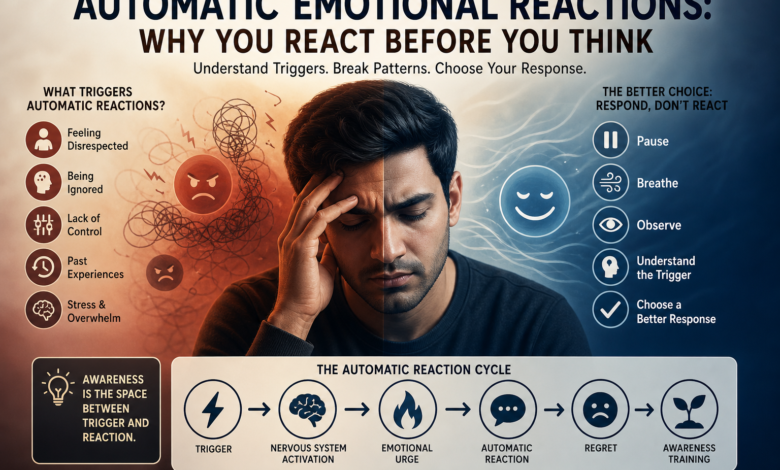
Learning how to stop being emotionally reactive begins with understanding why you sometimes react before thinking. A delayed reply, criticism, misunderstanding, harsh tone, or feeling ignored can trigger an emotional overreaction before your calmer mind has time to understand what is happening.
Thank you for reading this post, don't forget to subscribe!You may speak sharply, send a message too quickly, keep arguing, shut down, or later regret what you said or did. This does not always mean you are weak or immature.
Strong emotional reactions can be influenced by nervous-system activation, past experiences, attachment fears, stress, exhaustion, and the meaning you give the situation.
To control emotional reactions, you first need to recognise early body signals, identify the deeper trigger, pause before acting, and regulate your body.
This guide explains how to respond instead of react, break the reaction–regret cycle, communicate more safely, and build a calmer response without suppressing your real feelings.
How to Stop Being Emotionally Reactive for Good
Learning how to stop being emotionally reactive can feel difficult when you react before thinking and only understand the emotional cost afterward. A delayed reply, criticism, misunderstanding, or dismissive tone may trigger an emotional overreaction before your calmer mind has time to assess what is really happening.
You may promise yourself that next time you will stay calm.
Then something happens.
Someone does not respond.
- A family member dismisses your concern.
- A client keeps misunderstanding the same point.
- A person uses a tone that feels disrespectful.
- A loved one becomes distant without explanation.
Your body reacts before your mind has organised the facts.
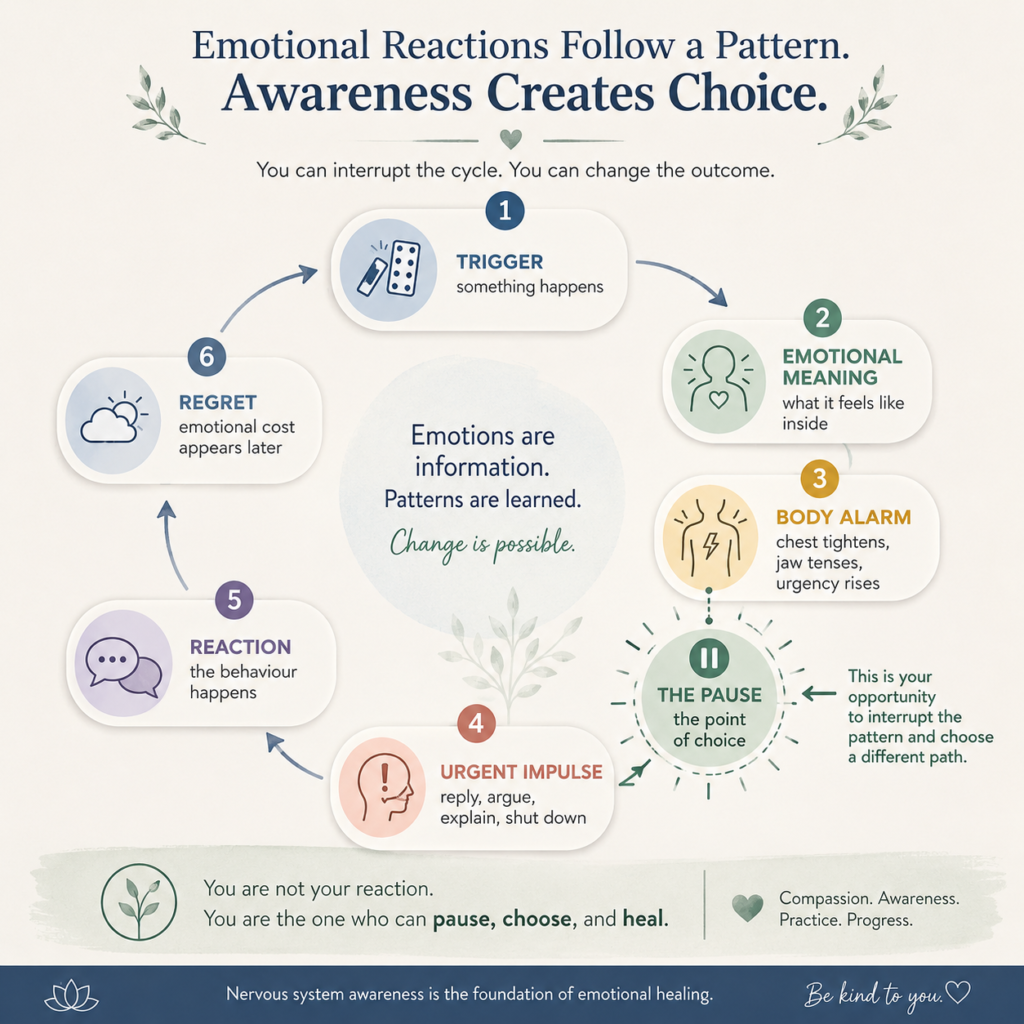
Your chest tightens. Your jaw becomes tense. Your thoughts speed up. You begin preparing an argument. You feel that you must reply immediately, explain everything, defend yourself, or make the other person understand.
Then the reaction happens.
You send a long message. You raise your voice. You keep arguing after the conversation has stopped being useful. You say something harsher than you intended.
Later, when your body becomes calmer, regret arrives.
You may ask:
“Why did I react like that?”
“Why could I not stop myself?”
“Why did something so small affect me so deeply?”
“Why do I seem like a different person when I feel ignored or misunderstood?”
The answer is not simply that you are weak, immature, or incapable of self-control. Emotional reactions usually have a process. They begin with a trigger, an emotional meaning, a body response, and an urgent impulse.
When you understand that process, you gain a place to intervene.
How to Stop Being Emotionally Reactive: The Direct Answer
To learn how to stop being emotionally reactive, begin by noticing activation before it becomes behaviour.
The most useful steps are:
- recognise your earliest body signals;
- identify what the situation emotionally means to you;
- delay communication during peak intensity;
- regulate your body before trying to reason;
- return with clearer words, boundaries, or repair.
The goal is not to stop feeling. The goal is to feel the emotion without allowing the first impulse to make every decision. Emotional regulation is not emotional suppression.
Suppression says:
“I should not feel this.”
Regulation says:
“I feel this strongly, but I will decide how to act.”
That difference is where change begins.
Why You React Before Thinking During Emotional Stress
The nervous system is designed to respond quickly when something feels threatening.
That threat does not always have to be physical.
The body may also react strongly to:
- rejection;
- criticism;
- humiliation;
- uncertainty;
- loss of control;
- feeling ignored;
- feeling misunderstood;
- emotional distance;
- conflict;
- a harsh tone of voice.
When your nervous system detects possible danger, it may push you toward immediate protection. You may attack, defend, explain, withdraw, shut down, overeat, overspend, repeatedly check your phone, or send an impulsive message.
At that moment, your system is not asking:
“What is the wisest response?”
It may be asking:
“How do I stop this pain now?”
This is why advice such as “just calm down” often feels useless. The instruction is directed toward the thinking mind, while the alarm is happening inside the body.
Before you can control emotional reactions, your body may need evidence that immediate action is not necessary.
That evidence can come through a pause, slower breathing, movement, physical grounding, silence, distance from the screen, or postponing the conversation.
To understand this process more deeply, read how the nervous system shapes emotional reactions:
Read Also : nervous-system-and-emotions
How Emotional Overreaction Becomes a Regret Cycle
Emotional overreaction is painful because it rarely ends when the argument ends.
The external situation may last only a few minutes, but the emotional cost may continue for hours.
- You may replay the conversation.
- You may feel ashamed of what you said.
- You may continue feeling angry because your original pain was never understood.
- You may blame yourself for losing control.
This creates a repeated cycle:
Trigger → Emotional meaning → Body activation → Urgent impulse → Reaction → Temporary relief → Regret → Overthinking
The temporary relief matters.
Sending the message may briefly reduce the pressure. Raising your voice may feel more powerful than feeling helpless.
Explaining repeatedly may feel safer than accepting that the other person may never understand. But temporary relief is not the same as resolution.
The reaction may create a second layer of pain:
- damaged trust;
- guilt;
- shame;
- disconnection;
- loss of focus;
- fear of abandonment;
- professional consequences;
- emotional exhaustion.
This is why the reaction-regret cycle feels so heavy. You are not only carrying the original hurt. You are also carrying the consequences of how the hurt came out.
A Human Truth About Reacting Before Thinking
“In my own experience, the hardest part was not only what I said in the emotional moment. It was the silence afterward, when my body became calm and I realised that the reaction had spoken louder than the person I truly wanted to be.”
Sometimes you were not trying to hurt anyone. You were trying desperately to be understood. But when the need to be understood became urgent, your words stopped sounding like pain and started sounding like attack.
That is where compassion and responsibility must exist together.
You do not have to define yourself as bad, unstable, or immature. But you also do not need to pretend the reaction caused no harm.
A more honest statement is:
My pain explains why I became activated, but I am still responsible for learning a safer way to express it.
Why Small Situations Can Create Strong Reactions
Two people can experience the same situation and react very differently.
- A delayed message may be a minor inconvenience to one person.
To another, it may feel like rejection.
- A correction at work may feel useful to one person.
To another, it may feel humiliating.
- A request for space may feel reasonable to one person.
To another, it may feel like abandonment.
The nervous system does not respond only to facts. It also responds to the meaning the mind gives those facts.
| Present Event | Possible Emotional Meaning |
|---|---|
| Someone does not reply | “I do not matter.” |
| Someone disagrees | “They are attacking me.” |
| Plans suddenly change | “I am losing control.” |
| Someone corrects you | “I am being humiliated.” |
| A loved one becomes distant | “I am about to be abandoned.” |
| Someone refuses to explain | “My feelings are not important.” |
The present event may be real. But the emotional intensity may also include older experiences. Understanding this does not mean you are imagining the pain. It means the current moment may be touching an older fear.
Read more about why small situations can activate deeper emotional pain: emotional-triggers-explained-why-small-things-hurt-so-much
Attachment, Rejection, and the Fear Beneath the Reaction
Emotional reactivity often becomes stronger in relationships that matter deeply.
When your sense of safety becomes connected to another person’s attention, reply, approval, or presence, small changes can feel threatening.
You may react strongly because:
- silence feels like punishment;
- distance feels like abandonment;
- disagreement feels like loss of love;
- delayed reassurance feels unbearable;
- boundaries feel like rejection;
- criticism feels like proof that you are not valued.
Repeated messaging may really mean: “Please show me that I still matter.”
Defensiveness may mean: “Please do not see me as worthless.”
Anger may mean: “Please understand how deeply this hurt.”
Overexplaining may mean: “Please do not leave with the wrong idea about me.”
Attachment helps explain the reaction, but it does not excuse harmful behaviour. A person can have genuine abandonment pain and still need to respect another person’s boundary. Understanding the fear is the beginning of responsibility, not the end of it.
For a deeper attachment perspective, read why emotional attachment can intensify your response: why-emotional-attachment-feels-intense
Signs You Are Becoming Emotionally Reactive
The most powerful moment is not after the reaction.
It is the first moment of activation.
Body signs
You may notice:
- chest pressure;
- tight jaw;
- heat in the face;
- shallow breathing;
- stomach tension;
- shaky hands;
- restless movement;
- pressure in the head;
- difficulty sitting still.
Thought signs
Your mind may say:
- “I need to answer now.”
- “They must understand.”
- “I cannot let this go.”
- “They are disrespecting me.”
- “I must prove my point.”
- “If I stay silent, I will lose.”
- “Something bad is about to happen.”
Behaviour signs
You may begin:
- typing long messages;
- checking your phone repeatedly;
- interrupting;
- speaking faster;
- repeating the same point;
- calling several times;
- bringing up unrelated past events;
- making final statements;
- threatening to leave;
- shutting down completely.
When you recognise several of these signs, do not continue as if you are fully regulated.
Say:
“My system is activated. I do not need to decide or respond at this exact moment.”
That sentence creates the first space between feeling and action.
How to Stop Being Emotionally Reactive in the Moment
Learning how to stop being emotionally reactive is easier when you have a clear plan.
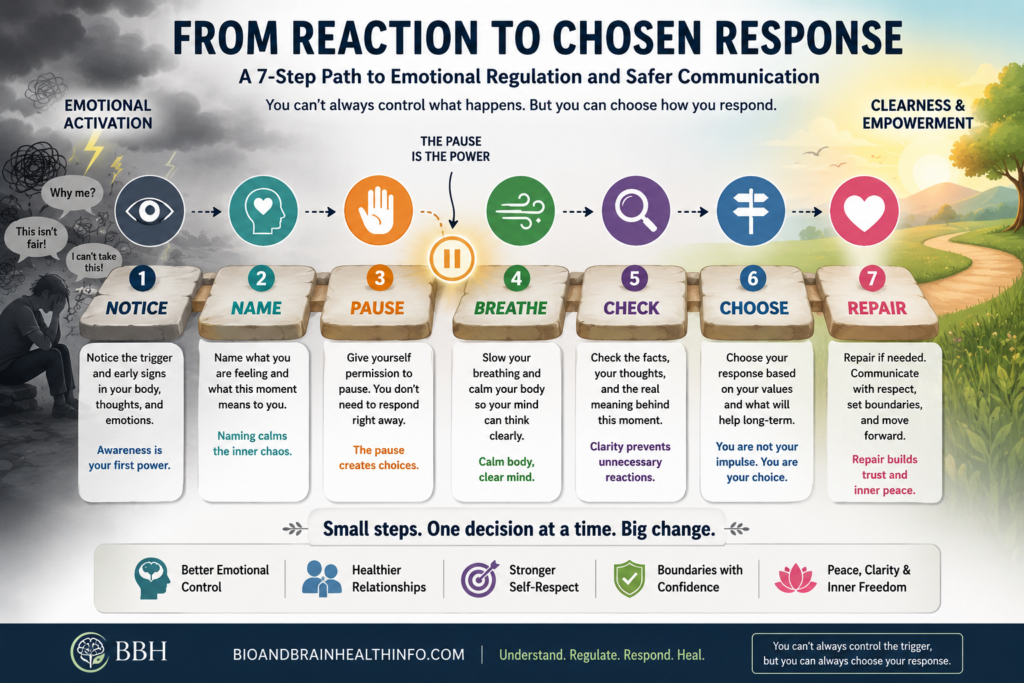
Use the BBH Pause Plan.
Step 1 — Stop the outward action
Do not send the message.
Do not continue the call.
Do not make a major decision.
Do not keep arguing.
Your first task is not to solve the whole relationship.
Your first task is to prevent the emotional peak from creating new damage.
Step 2 — Name the emotion
Say:
- “I feel rejected.”
- “I feel unheard.”
- “I feel ashamed.”
- “I feel controlled.”
- “I feel frightened.”
- “I feel emotionally unsafe.”
Specific language reduces emotional confusion.
Step 3 — Find the body signal
Ask:
“Where is this happening in my body?”
The reaction may be sitting in your chest, jaw, stomach, throat, shoulders, or head.
Notice it before trying to argue with it.
Step 4 — Lower the urgency
Tell yourself:
“This feels urgent, but it may not require an immediate response.”
Urgency is one of the strongest drivers of emotional overreaction.
You do not need perfect calm.
You only need enough space to slow the next action.
Step 5 — Regulate before reasoning
Try one or two practical actions:
- breathe more slowly;
- lengthen the exhale;
- drink water;
- wash your face;
- take a short walk;
- put both feet on the floor;
- relax your hands;
- move into another room;
- write the message without sending it;
- wait before reopening the conversation.
Step 6 — Ask what you actually want
Do you want:
- understanding;
- respect;
- clarification;
- an apology;
- a boundary;
- distance;
- a solution;
- closure?
Your first impulse may not support your real goal.
If you want repair, attacking may make repair less likely.
If you want clarity, repeated accusations may create more confusion.
Step 7 — Decide whether to respond now, later, or not at all
A response is not always required.
Sometimes the safest way to respond instead of react is to wait.
Sometimes it is to send one clear sentence.
Sometimes it is to leave the conversation.
Sometimes it is to accept that the other person may not understand.
Silence should not be used as punishment, but it can be used to prevent an unproductive exchange.
Practical Emotional-Reaction Table
| Trigger | Inner Meaning | Body Signal | Automatic Urge | Possible Cost | Safer Response |
|---|---|---|---|---|---|
| A message is ignored | “I do not matter.” | Chest pressure | Send repeated messages | More anxiety and distance | Put the phone down for 20 minutes |
| Someone criticises you | “I am being attacked.” | Heat and tight jaw | Defend or insult | Conflict and regret | Ask for one specific example |
| You feel misunderstood | “No one listens to me.” | Faster speech | Explain repeatedly | Exhaustion | Write one clear point |
| Plans change suddenly | “I am losing control.” | Stomach tension | Demand certainty | More resistance | Identify what remains controllable |
| Someone sets a boundary | “I am being rejected.” | Panic or anger | Argue against it | Damaged trust | Respect the pause and regulate |
| A family member dismisses you | “My pain does not matter.” | Head pressure | Raise your voice | Escalation | End the conversation temporarily |
| A client delays a decision | “I am being disrespected.” | Restlessness | Send a harsh follow-up | Professional damage | Send one factual reminder |
| A loved one becomes distant | “I am being abandoned.” | Fear and checking | Call repeatedly | Increased distance | Ask once, then give space |
Emotional Reactivity Does Not Always Look Like Anger
Emotional reactivity can appear in many forms.
It may look like:
- anger;
- crying;
- shutdown;
- overexplaining;
- people-pleasing;
- repeated checking;
- impulsive spending;
- overeating;
- withdrawing suddenly;
- blocking someone immediately;
- ending a relationship during conflict;
- apologising excessively;
- agreeing to something you do not want;
- replaying the event for hours.
Some reactions move outward.
Others move inward.
A person may appear quiet while experiencing intense fear, self-attack, or mental chaos.
This is why how to stop being emotionally reactive is not only an anger-management question.
It is about recognising any automatic behaviour used to escape or discharge emotional discomfort.
How to Control Emotional Reactions Without Suppressing Feelings
To control emotional reactions, separate three parts of the experience.
The feeling
“I feel hurt.”
The interpretation
“I believe their silence means I do not matter.”
The action
“I want to send five messages.”
The feeling may be real.
The interpretation may need checking.
The action remains a choice.
Many people combine all three: “I feel hurt, therefore my assumption must be true, therefore I must act immediately.”
A safer approach asks:
- What actually happened?
- What am I assuming?
- What does this remind me of?
- Is there another explanation?
- What response will I respect tomorrow?
The goal is not to distrust every feeling. The goal is to avoid treating every emotional story as the complete truth.
How to Respond Instead of React
A reaction tries to release emotional pressure.
A response tries to communicate reality.
Reaction
“You never care about me. You always ignore me.”
Response
“When I did not receive a reply, I felt anxious and unimportant. Please tell me whether you need time or whether we can discuss this later.”
Reaction
“You are trying to insult me.”
Response
“The way that comment was delivered felt disrespectful. I am willing to discuss the issue, but not through personal attacks.”
Reaction
“Fine. I am done with everyone.”
Response
“I am too activated to continue this conversation safely. I will return when I can speak more clearly.”
Reaction
“You do not understand anything.”
Response
“I do not feel understood yet. Let me explain the main point once, and then I want to hear your view.”
Responding thoughtfully does not guarantee that the other person will respond well.
It only allows you to act in a way that reflects your values.
Secure communication can support healthier repair, but it cannot replace safety, boundaries, or professional help when abuse, coercion, humiliation, or fear is present.
What to Do After an Emotional Overreaction
Even when you understand how to stop being emotionally reactive, you may still react sometimes.
Healing is not measured by perfection.
It is measured by how responsibly you return.
Let your body settle
Do not rush into an apology while you are still defending yourself internally.
Wait until you can recognise both your pain and your behaviour.
Name what you did
Be specific.
“I raised my voice.”
“I sent messages that were unfair.”
“I interrupted repeatedly.”
“I made an accusation without checking the facts.”
Acknowledge the impact
Avoid apologies that shift blame.
Instead of:
“I am sorry, but you made me angry.”
Try:
“I was hurt, but the way I spoke was not acceptable. I understand that it may have made you feel attacked.”
Explain without excusing
You may say:
“I interpreted the situation as rejection, and I reacted from that fear. That explains why I became activated, but it does not excuse how I communicated.”
State what will change
“I will pause before replying next time.”
“I will leave the conversation briefly instead of shouting.”
“I will ask for clarification before assuming the worst.”
Repair becomes more trustworthy when it includes a practical change.
Why Emotional Reactions Keep Repeating
The mind and body often repeat familiar strategies, even when those strategies are costly.
If anger once helped you feel powerful, the nervous system may use anger when you feel helpless.
If overexplaining once helped you avoid punishment or misunderstanding, you may continue explaining long after the conversation becomes unhealthy.
If withdrawal protected you from humiliation, you may disappear whenever conflict begins.
The pattern may have served a purpose in the past.
Ask:
“What was this reaction trying to protect me from?”
Possible answers include:
- rejection;
- shame;
- abandonment;
- helplessness;
- criticism;
- loss of control;
- being misunderstood;
- feeling invisible.
You do not need to hate the old pattern.
You can recognise that it once tried to protect you while admitting that it no longer protects your peace.
Read more about why emotional overreactions keep happening: why-do-i-overreact-emotionally
How to Stop Being Emotionally Reactive Over Time
Lasting change requires more than one calm conversation.
Track repeated triggers
For two weeks, write down:
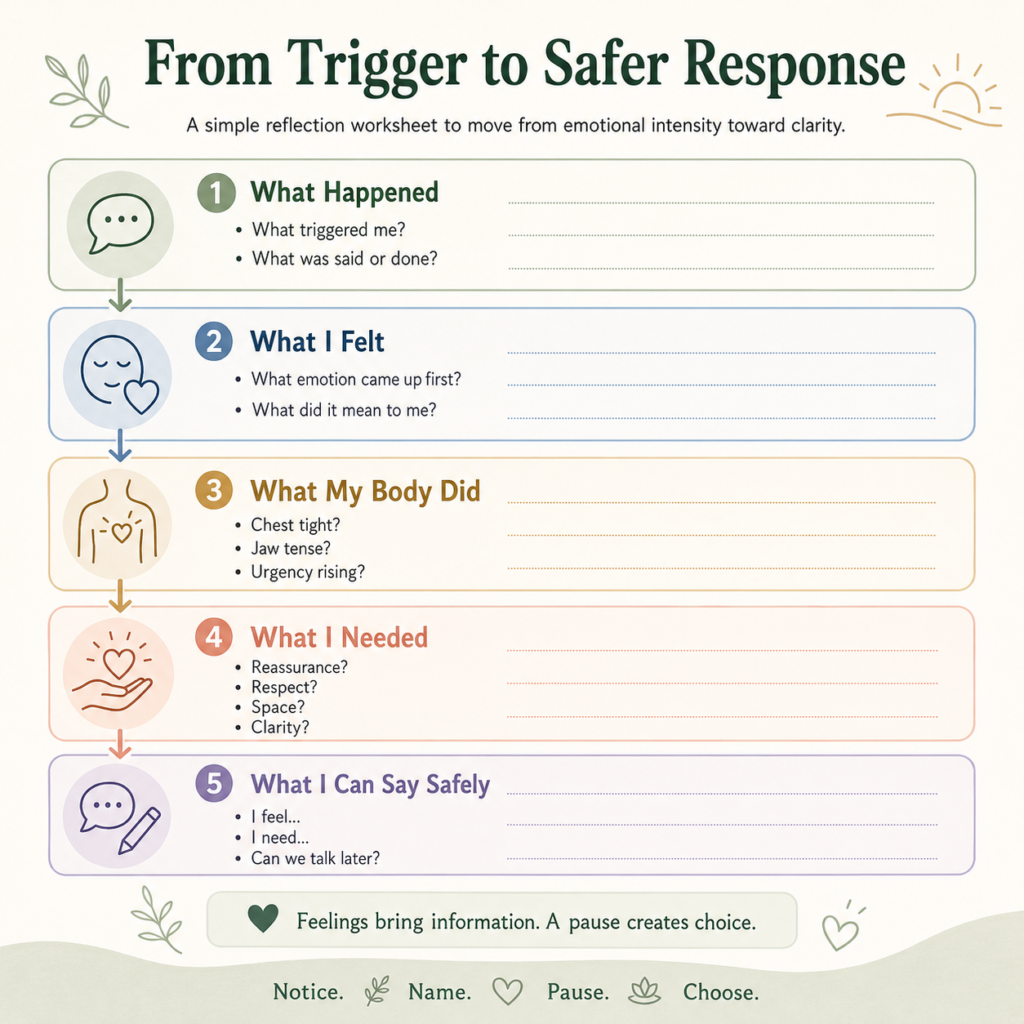
- what happened;
- what you thought it meant;
- what happened in your body;
- what you did;
- what the reaction cost;
- what you needed.
Patterns often become visible on paper before they become visible in the moment.
Reduce nervous-system strain
Emotional regulation becomes harder when you are:
- sleep-deprived;
- physically unwell;
- hungry;
- overstimulated;
- under financial pressure;
- in continuous conflict;
- working without rest.
These factors may not cause the whole pattern, but they can reduce your ability to pause.
Practise small pauses
Do not wait for a major conflict.
Practise pausing before:
- replying to a message;
- correcting someone;
- making a purchase;
- explaining yourself;
- checking the phone again;
- reacting to criticism.
Small pauses strengthen the ability needed during bigger emotional moments.
Build emotional vocabulary
Instead of only saying “angry” or “upset,” ask whether you feel:
- dismissed;
- ashamed;
- frightened;
- betrayed;
- powerless;
- lonely;
- disappointed;
- disrespected;
- confused;
- excluded.
Specific words reduce emotional chaos.
Strengthen boundaries
Regulation is not learning to tolerate repeated disrespect quietly.
A boundary may sound like:
“I will discuss the issue, but I will not stay while I am being insulted.”
“I have already explained my answer.”
“I need time before continuing.”
“This conversation is affecting my health, so I am stepping back.”
Address overthinking afterward
The reaction may end while the mind keeps replaying it.
Read how to calm repetitive thinking after an emotional trigger: how-to-stop-overthinking-and-calm-your-mind
When Professional Support May Be Important
Self-reflection tools can be useful, but some patterns need professional support.
Consider speaking with a qualified mental-health professional when reactions:
- feel uncontrollable;
- happen very frequently;
- involve aggression;
- involve threats;
- include self-harm thoughts or behaviour;
- repeatedly damage relationships;
- interfere with work or sleep;
- involve severe panic or dissociation;
- are connected to traumatic experiences;
- become worse despite your efforts.
A clinician can help assess whether anxiety, trauma, mood symptoms, chronic stress, medication effects, sleep problems, or physical illness may be contributing.
YMYL safety note: Emotional regulation skills can support safer responses, but they cannot replace safety planning, firm boundaries, medical care, or professional mental-health support when aggression, self-harm risk, abuse, or fear is present.
People Also Ask
1. Why do I react before thinking?
You may react before thinking because nervous-system activation can occur faster than reflective thought. When criticism, rejection, uncertainty, or disrespect feels threatening, your body may prepare to protect you before you have assessed the full situation.
2. How can I stop being emotionally reactive?
Start by recognising early body signals, delaying communication, and identifying what the situation means emotionally. Regulate your body before trying to solve the problem, and return when you can speak more clearly.
3. Why do small things cause emotional overreaction?
A small event may activate a deeper meaning. Silence may feel like abandonment, criticism may feel like humiliation, and delay may feel like disrespect. The intensity may involve accumulated stress and previous emotional learning.
4. How can I control emotional reactions during conflict?
Pause when you notice urgency, faster speech, tension, or repetitive arguments. Avoid major decisions during peak activation. Regulate first, then return with one clear statement about what happened and what you need.
5. Is it better to respond instead of react?
Usually, yes. A reaction is driven mainly by immediate pressure, while a response includes awareness of consequences, goals, and values. Responding may involve communication, a boundary, temporary distance, or ending an unsafe interaction.
Frequently Asked Questions
1. Is emotional reactivity the same as anger?
No. Emotional reactivity can include anger, panic, crying, shutdown, people-pleasing, impulsive messages, repeated checking, or withdrawal.
2. Does emotional overreaction mean I am immature?
Not necessarily. Strong reactions may be influenced by stress, past experiences, health, sleep, or difficulty regulating intense emotions. However, understanding the cause does not remove responsibility for harmful behaviour.
3. How long should I wait before responding?
Wait until you can consider the situation without immediately preparing an attack, defence, or final decision. This may take ten minutes, several hours, or longer.
4. What should I say after I react badly?
Try: “I was hurt, but the way I responded was not acceptable. I understand that it affected you. I am going to pause earlier next time and return when I can speak more clearly.”
5. Can emotional reactivity be changed?
Yes. Awareness, body regulation, trigger tracking, clearer boundaries, and safer communication can reduce automatic reactions over time.
Personal Note
I do not believe emotional healing means becoming cold, silent, or unaffected.
Feeling deeply is not the problem. The painful part begins when the feeling becomes so urgent that it speaks before your wisdom can speak.
I have learned that the pause is not weakness.
The pause is where I protect the part of myself that will still be present tomorrow.
- I may still feel angry.
- I may still feel misunderstood.
- I may still wish another person would acknowledge my pain.
But I do not need to surrender my dignity to prove that my pain is real.
My reaction gives me information. It tells me where I feel unsafe, unseen, rejected, or powerless. But the reaction does not have to become my identity.
- I can notice it.
- I can understand it.
- I can take responsibility for it.
And slowly, I can choose a response that sounds more like the person I truly want to be.
BBH Support Resource
Want a simple tool to understand your reaction before it becomes regret?
Download the BBH Reaction–Regret Reflection Worksheet to explore:
- what triggered you;
- what happened inside your body;
- what emotional meaning you gave the situation;
- what hidden need was activated;
- what the reaction cost;
- what safer response you can practise next time.
Email info@bioandbrainhealthinfo.com and write:
“Send me the Reaction–Regret Worksheet.”
External References
American Psychological Association
Page title: Emotion Regulation — APA Dictionary of Psychology
URL: https://dictionary.apa.org/emotion-regulation
National Institute of Mental Health
Page title: I’m So Stressed Out! Fact Sheet
URL: https://www.nimh.nih.gov/health/publications/so-stressed-out-fact-sheet
National Institute of Mental Health
Page title: Caring for Your Mental Health
URL: https://www.nimh.nih.gov/health/topics/caring-for-your-mental-health
National Library of Medicine — PubMed Central
Article title: Emotion Regulation and Impulsivity in Young Adults
URL: https://pmc.ncbi.nlm.nih.gov/articles/PMC3334448/