How to Stop Overthinking and Calm Your Mind Naturally
Why Thought Loops Get Stronger When You Stay Attached to Outcomes


Overthinking does not always stop because someone tells you to “think positive.” Many people search for how to stop overthinking, but the real problem is often deeper than thoughts.
Thank you for reading this post, don't forget to subscribe!The mind keeps returning to the past, imagining the future, and creating “what if” stories because it is emotionally attached to safety, certainty, and one fixed outcome.
This is why detachment for overthinking matters. You do not need to suppress your mind; you need to understand why it keeps repeating the same loop.
👉This blog explains how to detach from thoughts by finding the fear, attachment, and nervous system stress behind them.
You will learn why it feels so hard to stop mental loops, why thoughts become addictive, and how to calm an overactive mind through awareness, emotional acceptance, and one grounded action instead of fighting yourself.
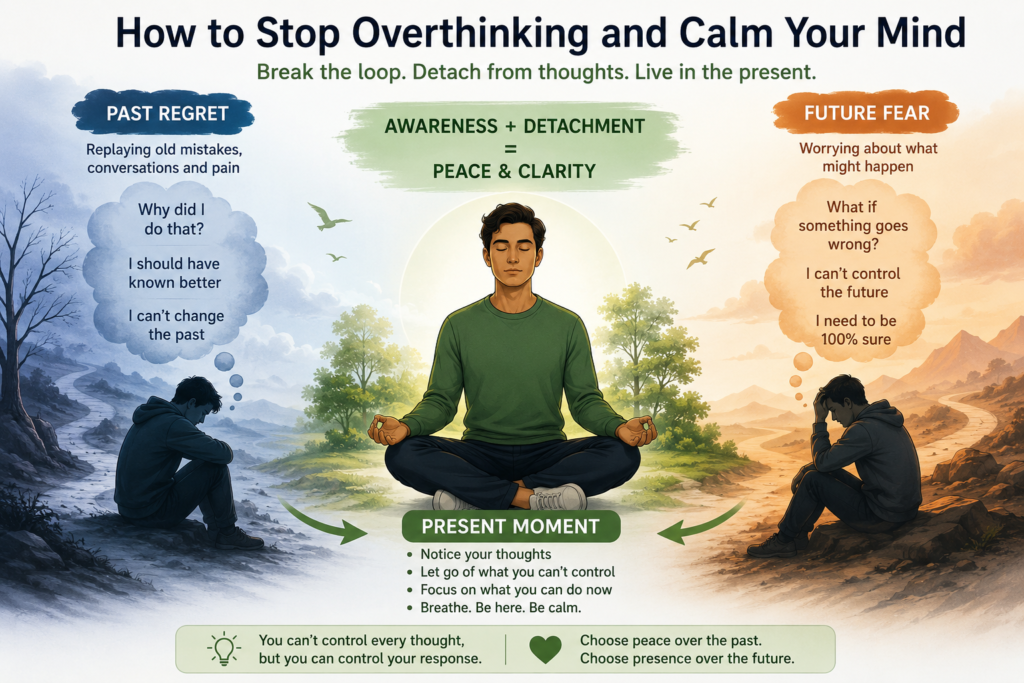
Detachment for Overthinking: Why the Mind Holds On Mentally
Detachment for overthinking is not about becoming emotionless, cold, or careless. It means learning how to create space between your awareness and your thoughts, so every thought does not immediately become your identity, your truth, or your command.
Many people misunderstand detachment because they think it means ignoring feelings. Real detachment is different. It means you can notice a thought without becoming fully controlled by it.
Overthinking becomes stronger when the mind holds on mentally.
It keeps repeating the same question because it believes the answer will finally create safety. But many times, the mind is not searching for wisdom anymore.
It is searching for emotional relief. This is why one thought becomes ten thoughts, and ten thoughts become a full mental storm.
When a person wants to understand how to stop overthinking and calm your mind, the deeper question is not only, “How do I stop this thought?”
The deeper question is, “What am I holding on to inside this thought?” This is where mental health and emotional clarity become important, because the mind needs understanding before it can release the loop.
The deeper skill of how to detach from thoughts begins when you stop treating every thought as a command.
Emotional Attachment to Outcomes Makes Thoughts Feel Urgent
Overthinking becomes intense when your peace depends on one fixed outcome.
- If this person replies, I will feel okay.
- If this work succeeds, I will feel safe.
- If this mistake is corrected, I will feel peaceful.
- If the future becomes clear, I will relax.
- This is how emotional attachment turns thought into pressure.
The mind starts treating uncertainty like danger. Even small possibilities feel heavy because the result has become emotionally loaded.
When the outcome feels too important, the brain does not simply think; it starts scanning, predicting, checking, replaying, and preparing for every possible problem.
This is why people can understand logically that overthinking is not helping, but still feel unable to stop.
Logic may say, “This is enough.”
Emotion says, “No, think again. We are not safe yet.”
That gap between logic and emotional safety is where the overthinking loop grows.
To understand how to stop overthinking and calm your mind, you must notice where your peace has become attached. The moment you see the attachment, you begin to weaken the loop.
This is also why anxiety and overthinking should be understood together, because anxious thoughts often grow when the mind feels emotionally unsafe.
How to Detach From Thoughts Without Suppressing Them
Learning how to detach from thoughts does not mean pushing thoughts away. Suppression often makes thoughts stronger because the mind feels resisted, rejected, or unfinished.
Detachment means allowing the thought to appear without allowing it to control your whole emotional system.
- A thought can come, but you do not have to follow it everywhere.
- A fear can appear, but you do not have to build a full future story around it.
- A regret can visit, but you do not have to punish yourself again. This is the difference between awareness and identification.
When you identify with a thought, you say,
- “This thought is me.” When you detach, you say,
- “This thought is moving through me.”
- That small inner shift is powerful.
It gives you enough space to respond instead of react. This is the practical meaning of how to detach from thoughts: you observe the thought, understand its message, and choose your response with awareness.
This is also connected to how we practice conscious detachment, because conscious detachment does not remove responsibility. It removes emotional slavery to every thought.
You can calm an overactive mind by naming the attachment behind the thought instead of arguing with the thought again and again.
A Thought Is Information, Not Your Whole Reality
A thought may contain information, but it is not always the full truth. The mind can exaggerate danger, predict rejection, repeat old fear, or connect today’s situation with yesterday’s pain.
When you believe every thought immediately, you lose inner space.
A helpful line is: “This is a thought, not my full reality.” This does not deny the thought. It simply stops the thought from becoming the final authority over your peace.
This is one of the simplest ways to practice how to detach from thoughts in daily life.
You Can Listen to a Thought Without Obeying It
Not every thought deserves action. Not every fear deserves a decision. Not every emotional wave deserves a reaction.
Sometimes the most mature response is to notice the thought, breathe, and wait until your nervous system becomes calmer.
This matters because urgency does not always mean truth.
Sometimes urgency only means your body feels unsafe. This is where detachment is different from emotional suppression because healthy detachment allows awareness, while suppression only pushes emotion down.
When you understand the fear beneath the loop, it becomes easier to calm an overactive mind without suppressing emotion.
Why Thoughts Feel Addictive When the Nervous System Feels Unsafe
One reason overthinking feels addictive is that the mind believes the next thought may finally solve the discomfort. It says,
- “Think once more.
- Check once more.
- Replay once more.
- Imagine one more possibility.”
- For a few seconds, thinking may feel like control.
- But after some time, it becomes another form of stress.
This happens because the nervous system is involved. When the body feels unsafe, the brain becomes alert. It starts searching for threats and solutions. The mind may keep scanning the past and future because the body has not received the message that it is safe enough in the present.
This is why overthinking cannot always be solved by logic alone. Sometimes the mind already knows the answer, but the body does not feel calm enough to accept it.
To calm an overactive mind, the body also needs safety. Slow breathing, grounding, walking, relaxing the jaw, and softening the shoulders can help the system return from threat mode to present awareness.

Stop Mental Loops by Finding the Fear Behind the Thought
To stop mental loops, you need to go deeper than the surface thought.
The surface thought may be,
“What if this goes wrong?” But underneath it, the real fear may be,
“What if I cannot handle the pain?”
The surface thought may be, “Why did I make that mistake?”
But underneath it, the real fear may be, “What if this mistake means I am not good enough?”
This is why overthinking often repeats. The mind is not only asking for an answer. It is asking for emotional safety. Until the fear is seen clearly, the mind keeps changing the wording of the same worry. This is why detachment for overthinking must include emotional honesty.
You cannot detach deeply from a thought if you never understand what fear is holding it in place.
A practical way to stop mental loops is to ask three questions:
What am I afraid will happen?
What outcome am I emotionally attached to?
What pain is my mind trying to prevent?
These questions help you move from confusion to awareness. You stop fighting the thought blindly and start understanding the root. This is also a real way to calm an overactive mind, because the mind becomes less chaotic when the hidden fear is named clearly.
Part 2 Closing: Detachment Begins When the Hidden Fear Is Seen
The mind does not release every loop only because you tell it to stop. It begins to release when you understand what it is protecting, what it is attached to, and why it keeps repeating.
This is the deeper meaning of how to detach from thoughts: you do not hate the thought; you stop giving it full control over your identity and peace.
When you practice detachment for overthinking, you begin to see that the thought is not the enemy. The hidden fear, emotional attachment, and unsafe body state are keeping the loop alive.
Once these are seen, you can slowly stop mental loops without forcing yourself. This is a deeper answer to how to stop overthinking and calm your mind, because calm begins when awareness becomes stronger than repetition.
The BBH method teaches how to detach from thoughts by moving from automatic reaction to conscious observation.
Calm an Overactive Mind With the BBH Detachment Method
To calm an overactive mind, you need more than a quick distraction technique. Overthinking is usually not created by one thought alone. It is created by emotional attachment, fear, uncertainty, nervous system stress, and repeated identification with the same mental story. This is why the solution must also work at more than one level.
The BBH method is simple: notice the loop, find the attachment, understand the fear, calm the nervous system, accept uncertainty, and take one grounded action. This method does not ask you to fight your mind. It teaches you how to guide your mind.
When people search for how to stop overthinking and calm your mind, they often want immediate silence. But real calm does not always begin with silence. It begins with awareness. You first see the loop, then you understand why it is repeating, and then you calm the body enough to choose your next step.
This is not suppression. This is conscious detachment.
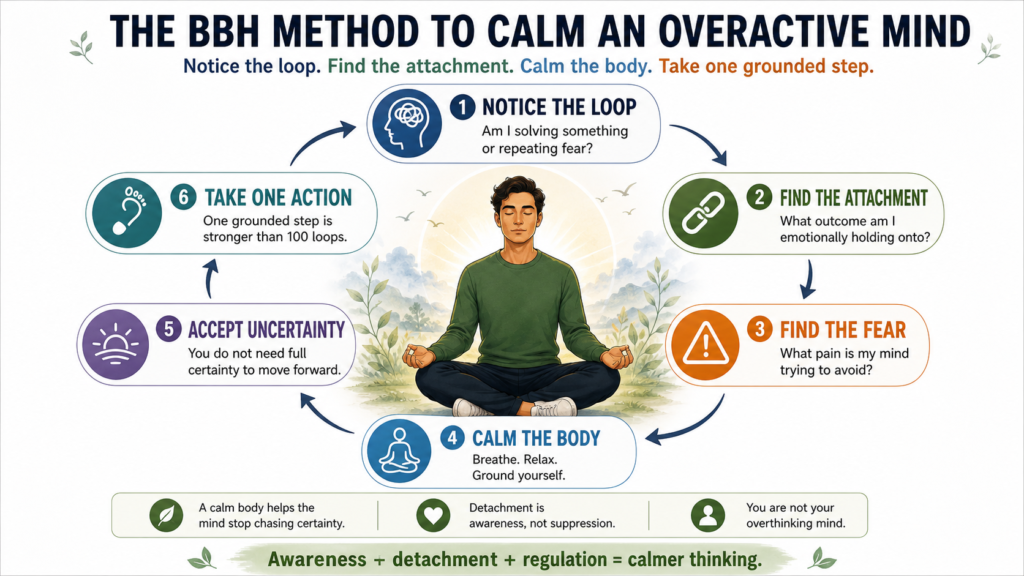
Step 1 — Notice the Loop Before You Believe the Thought
The first step is to notice that you are in a loop. This sounds simple, but it is powerful because overthinking becomes stronger when you believe every thought automatically.
The moment you pause and say, “This is a loop,” you create distance between yourself and the mental pattern.
Ask yourself:
“Am I solving something, or am I repeating the same fear?”
This question helps you separate useful thinking from repetitive thinking. Useful thinking gives direction. Repetitive thinking gives exhaustion. Useful thinking ends with a decision, lesson, or next step. Overthinking keeps asking the same question with different words.
To stop mental loops, do not start by arguing with the thought. Start by naming the pattern.
Say: “My mind is repeating this because it feels unsafe.” Awareness weakens automatic reaction.
Step 2 — Find the Attachment Behind the Thought
Every strong overthinking loop usually has an attachment behind it. You may be attached to a specific answer, a specific person’s reaction, a specific future result, a specific version of yourself, or the need to feel completely certain before acting.
Ask yourself:
“What result am I emotionally attached to right now?”
This question matters because emotional attachment makes the thought feel urgent. If your peace depends on only one outcome, every other possibility will feel threatening. The mind then keeps thinking because it wants to protect that outcome.
This is where detachment for overthinking becomes practical.
You do not say, “I do not care.”
You say, “I care, but I will not make my entire peace dependent on this one result.”
That is healthy detachment. It gives emotional space without making you cold. You can learn more through this guide on how to practice detachment in daily life.
Step 3 — Find the Fear Behind the Attachment
After you find the attachment, go one level deeper.
Ask:
“What pain is my mind trying to protect me from?”
This question reveals the emotional root.
- Sometimes the fear is failure.
- Sometimes it is rejection.
- Sometimes it is loss, regret, shame, financial pressure, health worry, or the fear of making a bad decision.
The mind keeps repeating because it believes thinking more may prevent that pain.
But not every pain can be prevented by thinking.
- Some things need action.
- Some things need acceptance.
- Some things need time.
- Some things need emotional processing.
- When you expect thinking alone to solve everything, the mind becomes overloaded.
This is why learning how to detach from thoughts matters.
You can respect the fear without becoming controlled by it. You can say, “I understand why this fear is here, but I will not let it run my whole mind today.”
Step 4 — Calm the Nervous System Before Solving the Problem
A highly activated body cannot think clearly for long. When your nervous system feels unsafe, the brain keeps scanning for threats. This makes overthinking feel automatic.
You may try to solve the thought, but the body is still sending danger signals.
Before solving the problem, calm the body.
- Take slow breaths.
- Relax your shoulders.
- Unclench your jaw.
- Place your feet on the floor.
- Drink water.
- Walk slowly for a few minutes.
- Put one hand on your chest and one hand on your stomach.
- Look around the room and name five ordinary things you can see.
These actions may look small, but they tell the nervous system: “I am here. I am not inside the past. I am not inside the future. I am in this moment.”
This is why a nervous system reset for anxiety and stress can support deeper mental clarity.
To calm an overactive mind, the body must receive safety first. A calmer body gives the mind space to detach from fear.
A Calm Body Helps the Mind Stop Chasing Certainty
When the body is tense, the mind asks for certainty again and again. It wants a guarantee before it relaxes. But life does not always give guarantees. This is why overthinking can become endless.
A calm body does not remove every problem, but it changes how the brain relates to the problem. The same thought may still exist, but it does not feel as dangerous. The same uncertainty may still be there, but it becomes more manageable.
This is why nervous system regulation is not separate from detachment for overthinking. It supports detachment because the mind can release more easily when the body feels safer.
Step 5 — Accept Uncertainty Without Giving Up Responsibility
Acceptance does not mean giving up. It does not mean you stop caring. It does not mean you allow everything to happen without action. Acceptance means you stop fighting reality long enough to see clearly.
Many people overthink because they cannot emotionally accept uncertainty quickly. The mind keeps asking, “But what if?” because it wants life to become fully predictable. But human life does not work that way.
You can make wise choices, but you cannot control every result.
This is where emotional acceptance becomes strength. You say:
“I do not know everything yet, but I can still take the next right step.”
This line is important because action does not require complete emotional certainty.
- You do not need to feel perfectly calm before doing something useful.
- You only need enough awareness to choose one grounded step.
- This is a practical way to stop mental loops without waiting for the mind to feel completely safe.
Slow breathing, grounding, and one practical action can help calm an overactive mind when thinking becomes repetitive.
Step 6 — Take One Grounded Action Instead of Repeating the Loop
Overthinking keeps energy inside the head. Grounded action brings energy back into life. This does not mean taking a big decision immediately. It means doing one useful thing that supports clarity.
- If you are overthinking work, write the next task.
- If you are overthinking a conversation, decide whether a calm response is needed or whether silence is wiser.
- If you are overthinking the past, write one lesson and stop punishing yourself.
- If you are overthinking the future, prepare what is in your control and release what is not.
One grounded action is stronger than one hundred repeated thoughts.
This is the practical answer to how to stop overthinking and calm your mind.
- You do not defeat overthinking by thinking more about overthinking.
- You reduce it by noticing the loop, calming your body, finding the attachment, accepting uncertainty, and moving into one responsible action.
For deeper support, the reader can start your emotional healing journey with a calmer path instead of staying trapped in mental pressure.
The goal is not to destroy thoughts, but to learn how to detach from thoughts so they no longer control your peace.
Final Thought: You Are Not Your Overthinking Mind
You are not every thought that appears in your mind.
- You are not every fear your brain creates.
- You are not every regret your past brings back.
- You are not every “what if” your future imagination produces.
Thoughts may visit, but they do not have to become your identity. Fear may speak, but it does not have to become your decision-maker. Uncertainty may exist, but it does not have to control your whole nervous system.
The deeper path is not to hate your mind. The deeper path is to understand it, guide it, and detach from the loops that no longer serve your peace.
Overthinking starts reducing when you stop fighting every thought and begin understanding the attachment behind it.
When you learn how to detach from thoughts, calm the body, accept uncertainty, and take one grounded action, you slowly calm an overactive mind with awareness instead of force. That is the deeper way of how to stop overthinking and calm your mind.
With practice, awareness and regulation slowly calm an overactive mind and reduce the need to chase certainty.