Nervous System Reset: A Gentle Stress Routine
A nervous system reset is an everyday way to describe pausing and choosing a manageable response to stress. It is not a biological reboot. You might notice your feet against the floor, look around the room, or take a few easy breaths if that feels comfortable. Then choose one thing you can do next. You can still feel tense and find the pause useful.
Thank you for reading this post, don't forget to subscribe!Think of the end of a demanding workday. You open the front door and hear your phone buzz. You know dinner needs attention, but you stand in the hallway rereading the same message. You might need food, rest, more information, or a few minutes away from the screen. This guide helps you choose a first step without assuming every kind of discomfort needs the same response.
What a nervous system reset means in this guide
The phrase describes a brief coping practice. During stress, you might notice tension, a faster heartbeat, or an urge to scan for what could go wrong. These sensations can be real and distressing. They have more than one possible cause. Start with what is happening, whether you are safe, and what kind of help you need.
The World Health Organization’s stress guide teaches practical skills such as grounding and turning attention toward an activity that matters. Those skills are a way to respond when stress shows up. They do not promise a particular feeling or a fixed timeline. If a technique does not help you in one situation, you can choose a different response. WHO: Doing What Matters in Times of Stress · BBH guide to the nervous system and emotions
What can a nervous system reset change in the next few minutes?
It may help you notice where you are and decide what to do next. You might still feel worried and be able to eat lunch, answer one message, or ask someone to give you a moment. That is a more useful way to judge a short practice than checking whether every sensation disappeared.
Keep the aim concrete. “I want to open the form and read the first question” gives you an action you can see. “I have to feel completely relaxed before I start” may leave you waiting for a feeling you cannot control. If the form contains a decision you genuinely need help with, ask a specific question. Grounding can give you a moment to decide whom to ask.
Try a quick nervous system reset without forcing your breath
- Get into a position that feels supported. Sit with your feet resting on the floor, or notice the surface that supports you.
- Let your eyes rest on an ordinary object. Notice its shape or color. If sound is easier to focus on, notice one steady sound.
- If you want to try breathing, let one or two breaths come and go naturally. Skip counting and breath holds if they feel uncomfortable.
- Name one next action. It can be as small as taking a seat, reading the first line of a message, or calling someone you trust.
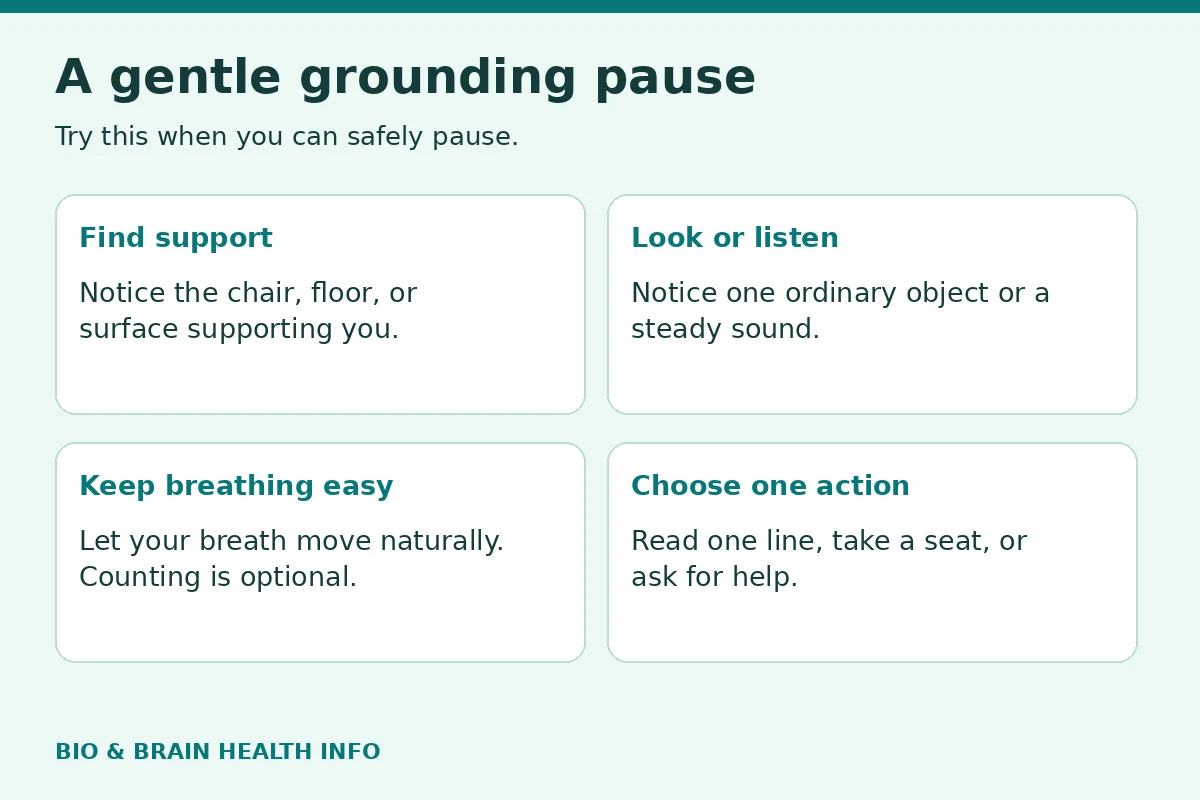
If you already know that counting breaths makes you uneasy, begin with the object or sound. If you’re driving, operating equipment, or doing anything that needs your full attention, wait until you’re safely able to pause. If an exercise increases discomfort, stop. Seek medical advice for symptoms that are new, unexplained, or worsening. NHS gentle breathing instructions · BBH gentle breathing guide
Choose the practice that fits how you feel
A nervous system reset can look different on different days. One evening you may want quiet. Another evening you may feel more unsettled when you sit still. Use what you can observe to choose a starting point.
| What you notice | A starting point | What to do next |
|---|---|---|
| You feel rushed and keep switching tasks. | Stop at one place and notice your contact with the chair or floor. | Write the next task in one sentence. |
| Looking inward makes you more aware of your heartbeat. | Leave your eyes open and look at a neutral object. | Describe one detail and return to an ordinary activity. |
| Counting breaths feels like a test. | Drop the numbers and let breathing return to its usual rhythm. | Try external grounding if focusing on breathing still feels worse. |
| The stress comes from a practical problem. | Name what needs attention, such as a deadline or a question. | Take the smallest action that changes the situation. |
| Your symptoms are unfamiliar, severe, or worsening. | Consider medical assessment rather than trying another exercise. | Call emergency services if symptoms suggest an emergency. |
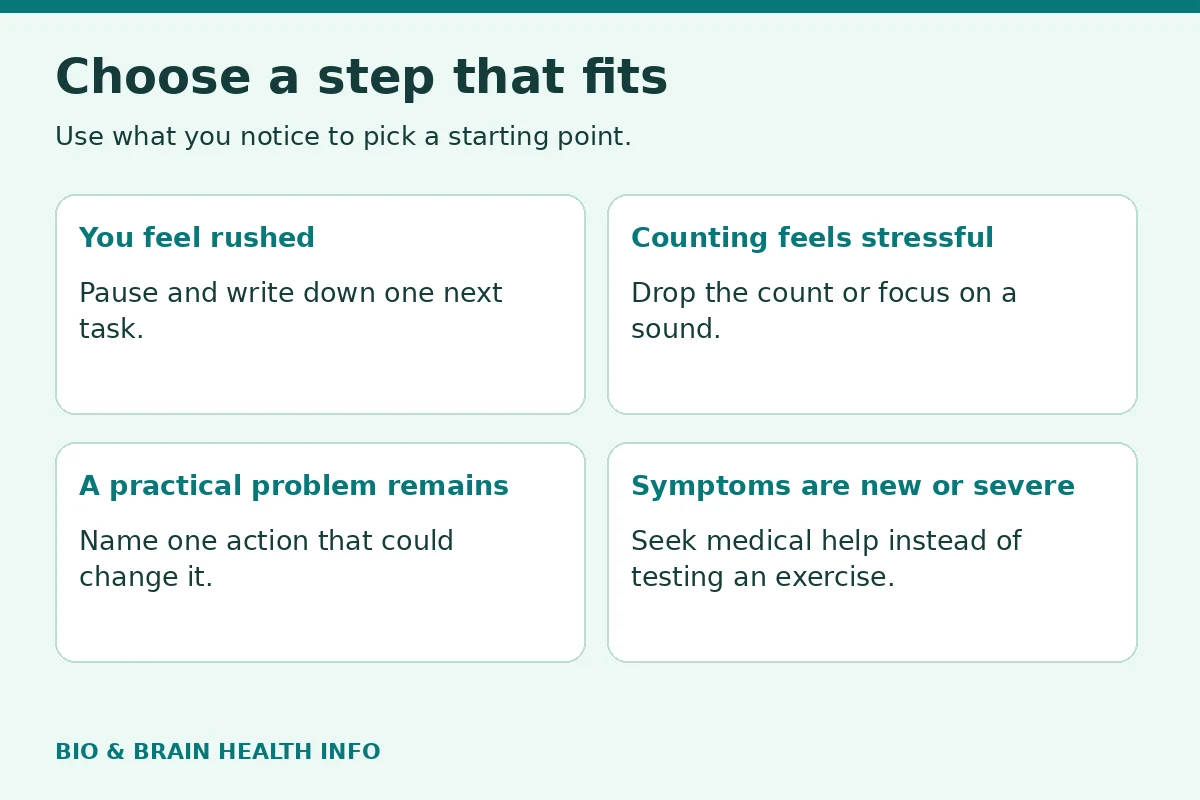
The point of the comparison is to choose an action you can use. Suppose your phone flashes a reminder for an overdue bill. If the worry comes from uncertainty about the amount, look at the statement once you are ready. If you cannot pay it, find out who can explain your options. Coping practice can help you begin that task. It cannot resolve the bill itself.
A worked example when the first attempt makes things worse
A person sits down before a meeting and starts counting breaths. They notice their chest more with each count and begin to wonder if they are doing it wrong. They stop counting, let breathing proceed on its own, and look at a blue folder on the desk. They can then open their notes and read the first line.
If someone feels newly short of breath or has unfamiliar chest discomfort, this example is not a reason to continue practicing. Get advice that fits the symptoms and seek emergency help when indicated. A previous episode of anxiety cannot establish the cause of a new one. NHS shortness-of-breath guidance · BBH guide to overlapping anxiety and heart attack symptoms
What research supports and what remains uncertain
The WHO guide uses grounding as one skill for coping with stress and reconnecting with what you are doing. A short practice may help you direct your attention toward your surroundings. The guide does not establish that the specific routine on this page treats a disorder. You can use it as a practical exercise while keeping any medical or psychological care you need. WHO stress management guide
Fincham and colleagues reviewed randomized controlled trials of breathwork. They found small to medium average improvements in self-reported stress and related mental health outcomes depending on the outcome studied. The trials used different methods and populations. This does not show that everyone should follow a particular count or that breathing is the best option when paying attention to the body increases distress. Fincham et al., 2023, systematic review and meta-analysis
What a “vagus nerve reset” claim can and cannot tell you
If a video promises to reset your nervous system in a fixed number of seconds, ask what was measured and in whom. A report that people felt calmer after an exercise is different from evidence of lasting clinical improvement. A study of a structured course also tells you little about one brief exercise in the middle of an unfamiliar episode. Your own practice log can tell you whether one step was useful to you. It cannot tell you whether a medical condition is present.
Build a ten-minute nervous system reset you can adapt
Ten minutes is one way to make room for practice. There is no need to complete a set sequence if you already know which part helps. You can stop sooner or spend the time dealing with the practical problem.
| Time | What to try |
|---|---|
| First two minutes | Sit somewhere comfortable. Notice one thing you can see and how you are supported. |
| Next three minutes | Try natural, unforced breathing if helpful, or stay with external grounding. |
| Next three minutes | Write down what you know, what remains uncertain, and one action you can take. |
| Final two minutes | Begin the task or decide when you will do it. If you need help, name the person or service you can contact. |
Try it once when you are relatively calm. Pick a routine cue, such as after lunch or before opening work email. The next time, make one adjustment. You might shorten the practice, leave the room lights on, or use a sound instead of following your breath. Pay attention to whether the change made the exercise easier to use.
Change one thing at a time so you can tell what mattered. If you try a new breathing count, close your eyes, and turn on music all at once, it may be hard to tell which part helped or distracted you. If you like a particular cue, keep it. If the whole routine feels like another task to finish, drop the timer and try one supported pause. BBH Nervous System Regulation hub
A note that measures usefulness instead of calm
Write three short lines: “What was happening,” “What I tried,” and “What I could do next.” For example, “Before a call, I felt rushed. I looked at one object and opened my notes. I was still nervous, but I made the call.” You can keep this on paper or skip tracking entirely if it leads to constant checking.
A week later, look for changes that matter to you. Are you able to start the task sooner, ask for help more clearly, or notice when you need a proper break? A missed day is information about your routine. Try a more convenient time before deciding the skill is unusable.
Use the routine before answering a difficult message
Imagine you receive a blunt message late in the afternoon. Your first impulse is to answer every point immediately. Put the phone down if you can. Look at one ordinary object, then reread the message once and pick out the part that requires a decision. A message that says “This isn’t what we agreed” may be asking for a correction, or it may leave you without enough information to act. A reply such as “Which part of the agreement are you referring to?” can help you find out.
If you are still too upset to respond and nothing needs immediate attention, choose a time to return to it. Setting a time can keep a pause from turning into an open-ended delay. If a response does need to go out now, send only the piece of information the other person needs. Afterward, check whether the pause helped you choose your words. The aim is to make the next conversation easier to handle. BBH guide to responding to difficult feedback
When to get more support
A nervous system reset can be one coping option alongside other forms of support. If anxiety or panic repeatedly disrupts sleep, work, travel, or relationships, a healthcare professional can help you assess the pattern and discuss treatment. Say what has changed in everyday life. “I stopped taking the bus because I worry I will be unable to breathe” gives a clinician something to ask about. Tell them about any new physical symptoms and any plan you were already given. U.S. National Institute of Mental Health: Find Help · NHS guidance on anxiety, fear, and panic
In the United States, primary care is one place to start a discussion about symptoms and a referral. Readers in the UK can consult the NHS guidance above. In Canada and Australia, ask a local primary care or mental health service about available assessment and support. For non-emergency BBH resources, visit BBH Mental Health Support Resources. For an outward-focused exercise after appropriate medical assessment, see BBH guide to grounding during familiar panic symptoms.
Frequently asked questions
Can a nervous system reset stop a panic attack?
Some people find grounding or comfortable breathing helpful when familiar anxiety symptoms arise. A technique cannot guarantee the episode will stop. Follow your clinician’s guidance, and get appropriate medical help if symptoms are severe, unfamiliar, or changing. NHS guidance on panic and anxiety
Do I need to breathe deeply?
No fixed depth or count is needed for this guide. If you choose a breathing exercise, keep the breath comfortable and avoid forcing it. If the practice makes you feel worse, stop and return to ordinary breathing. Choose an external grounding activity or seek care as appropriate. NHS breathing exercises for stress
What if sitting still makes me feel worse?
You can keep your eyes open and focus outside yourself. If it is safe, choose an ordinary activity you can do slowly, such as sorting papers or walking around a familiar room. If symptoms are new or concerning, get medical advice before assuming the discomfort is from anxiety.
How do I know whether the exercise helped?
Check what you could do afterward. You might have read the first line of an email, gone back to dinner, or written down one question for your clinician. You can still feel uneasy and notice that you have a clearer next step.
Research and references
- World Health Organization (2020). Doing What Matters in Times of Stress: An Illustrated Guide.
- Fincham, G. W., Strauss, C., Montero-Marin, J., and Cavanagh, K. (2023). Effect of breathwork on stress and mental health: A meta-analysis of randomised-controlled trials. Scientific Reports, 13, 432. DOI: 10.1038/s41598-022-27247-y.
- NHS. Breathing exercises for stress · Anxiety, fear and panic · Shortness of breath.
- U.S. National Institute of Mental Health. Help for mental illnesses.
- American Heart Association. Warning signs of a heart attack.