Woebot Review: Can This CBT Chatbot Help?
Woebot Review: Benefits, Limits, Safety, and AI Therapy Concerns

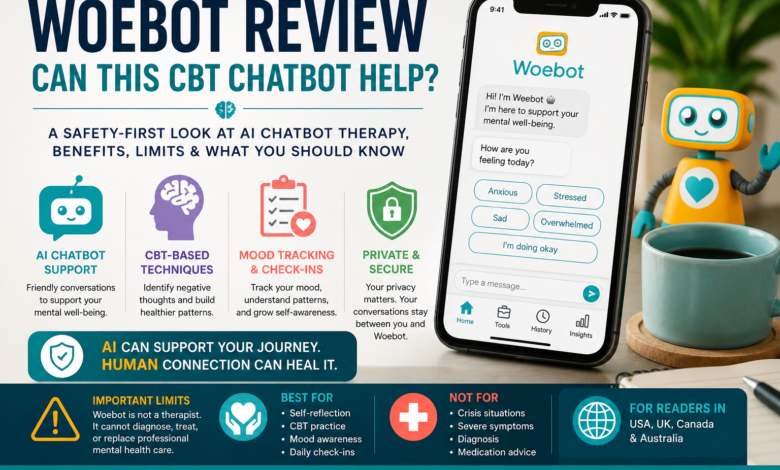
A Woebot review should not only ask whether the app is smart, friendly, or easy to use. The real question is deeper: can a digital tool truly support someone who feels anxious, emotionally stuck, overwhelmed, or alone?
Thank you for reading this post, don't forget to subscribe!This Woebot app review looks beyond normal feature lists and explores Woebot as an AI chatbot therapy tool with both promise and limits.
Many people are curious about using a CBT chatbot for negative thoughts, mood tracking, anxiety, and self-reflection. But mental health support is not only about answering prompts on a screen.
A mental health chatbot may help you pause, notice patterns, and build emotional awareness, but it cannot replace human connection, professional care, crisis support, or deep nervous system healing.
This blog gives you a balanced, safety-first view of what Woebot may help with, where it may fall short, and how to think about AI support responsibly.
What Is Woebot?
Woebot is commonly known as a digital mental health chatbot created to support users through short conversations, emotional check-ins, CBT-style prompts, and self-reflection tools.
It became popular because it offered something many people wanted: quick emotional support without waiting for an appointment, explaining everything to a stranger, or feeling judged.
At its core, Woebot is not a human therapist. It is a chatbot designed to guide users through structured mental health conversations. These conversations often use ideas connected to cognitive behavioral therapy, also known as CBT.
CBT helps people understand the connection between thoughts, emotions, body responses, and behavior.
A CBT chatbot may ask questions such as:
- What happened?
- What thought came up?
- What feeling followed?
- Is there another way to understand this situation?
Woebot as a CBT Chatbot, Not a Human Therapist
The most important point in any honest Woebot review is this: Woebot may support reflection, but it is not a licensed therapist. It cannot diagnose, treat, prescribe, understand your full life context, or replace professional mental health care.
That does not mean it has no value. A structured chatbot can still help some users slow down their thoughts, name emotions, and notice mental patterns. For people who struggle to journal or reflect alone, this type of support may feel useful.
But a chatbot is limited by what you type into it.
A therapist can notice your tone, hesitation, emotional state, body language, risk level, history, and deeper patterns over time.
AI cannot fully replace that human understanding.
Why People Search for a Woebot Review
People do not search for a Woebot review only because they want to test an app. Many search because they feel anxious, lonely, overwhelmed, emotionally tired, or unsure whether AI can support their mental health.
Some readers may be thinking about using Woebot for the first time. Others may have already used it and want to know whether it is genuinely helpful. Some may be comparing AI chatbot therapy with real therapy, especially if therapy feels expensive, unavailable, intimidating, or emotionally difficult.
That is why this review needs a safety-first approach. Mental health apps are not the same as productivity tools. When someone opens a chatbot during emotional pain, they may be vulnerable. They may need clarity, reassurance, grounding, or real human help.
The Safety-First Question This Review Answers
The better question is not only, “Does Woebot work?” The better question is:
What kind of support can Woebot realistically provide, and where should a person still seek human or professional care?
This distinction matters. A mental health chatbot may help with basic reflection, but it cannot know your full medical history, trauma background, family environment, medication needs, diagnosis, or crisis risk.
For readers in the USA, UK, Canada, and Australia, this is especially important because access to therapy, healthcare systems, and crisis support differs by country.
AI support may be convenient, but serious symptoms still need local professional guidance.
Read Also: support reflection when your mind feels overloaded
How Woebot May Support Self-Reflection
One possible benefit of Woebot is that it may help users reflect when their mind feels messy. Many people struggle because they do not know how to name what is happening inside them. They may feel anxious, numb, guilty, irritated, rejected, or mentally heavy without understanding why.
A CBT chatbot can help by asking simple questions at the right moment. This matters because emotional pain often becomes stronger when it stays vague. When a person writes down what they are feeling, the brain begins to organize the experience.
The feeling may not disappear immediately, but it can become easier to understand. That small pause can reduce impulsive reactions, emotional spirals, or harsh self-judgment.
For deeper reading on this idea, you can explore AI Self Reflection for Personal Growth, which explains how AI can support self-awareness when used carefully.
Mood Tracking and Thought Awareness
Mood tracking can be helpful because many emotional patterns repeat before we notice them. Someone may feel anxious every Sunday evening, low after social media use, irritated after certain conversations, or ashamed after small mistakes.
A mental health chatbot may help users record these experiences and notice patterns over time. This can be useful for self-awareness, therapy preparation, journaling, or emotional education.
However, tracking emotions is not the same as healing them. Awareness is the beginning, not the full solution. A person still needs healthy action, nervous system regulation, boundaries, sleep, support, and professional help when symptoms are serious.
Example: From Emotion to Thought Pattern
Imagine someone feels rejected because a friend replies late. At first, the feeling may seem like simple sadness or anger. But after reflection, the deeper thought may appear: “I am not important.”
That one thought can create emotional pain far beyond the original event. The person may withdraw, overthink, send repeated messages, or blame themselves. This is where structured reflection can help.
A CBT chatbot may guide the person to ask:
- Is this thought a fact, or is it an interpretation?
- Is there another possible reason the friend replied late?
- What emotion is being triggered from the past?
This does not solve everything, but it can create space between emotion and reaction.
Woebot and CBT: What Makes It Different From Normal Chatting?
Woebot became known because it is connected with CBT-style support. CBT is structured, practical, and focused on how thoughts influence feelings and actions. This makes it easier to use inside a chatbot format compared with deeper therapy approaches that require long-term human connection.
A normal chatbot may simply respond to what you say. A CBT chatbot tries to guide your attention toward thinking patterns. It may help users notice cognitive distortions such as catastrophizing, mind reading, all-or-nothing thinking, overgeneralizing, or emotional reasoning.
This can be useful because the anxious brain often treats thoughts as facts. The depressed brain may treat hopelessness as truth. The shame-driven mind may treat one mistake as identity.
Cognitive Distortions a CBT Chatbot May Help You Notice
A chatbot using CBT-style prompts may help users recognize thoughts like:
Catastrophizing: “If this goes wrong, everything is ruined.”
Mind reading: “They did not reply, so they must dislike me.”
All-or-nothing thinking: “If I am not perfect, I am a failure.”
Emotional reasoning: “I feel scared, so something bad must be true.”
These patterns are common in anxiety, shame, stress, and low mood. When users learn to notice them, they may become less controlled by automatic thinking.
This is also where AI Tools for Inner Critic Healing and Self-Compassion can support readers who struggle with harsh self-talk.
Why CBT Prompts Can Help but Not Fully Heal
CBT prompts can help you challenge a thought, but healing is not only about thinking differently. Sometimes the body still feels unsafe even after the mind understands the situation logically.
For example, someone may know that a late reply does not mean rejection, but their chest may still feel tight. They may still feel panic, shame, or abandonment fear. This is because emotional pain often lives in both the mind and the nervous system.
That is why this Woebot app review does not present AI as a full answer. It may support mental clarity, but deeper healing often requires emotional safety, body-based regulation, human connection, and sometimes professional treatment.
Can Woebot Help With Anxiety or Low Mood?
Woebot may help some people with mild anxiety or low mood by giving them a place to pause, reflect, and organize their thoughts. Anxiety often grows when the mind starts predicting danger. Low mood often deepens when the mind starts repeating hopeless or self-critical thoughts.
In those moments, a structured conversation may help the user slow down. Woebot may encourage the person to name the worry, separate facts from assumptions, and consider a more balanced interpretation.
For readers exploring safe AI tools for anxiety, AI Apps for Anxiety Relief: How to Choose and Use Them Safely is a useful related guide.
Where Woebot May Help
Woebot may be helpful for light emotional check-ins, daily reflection, CBT practice, journaling support, and noticing thought patterns. It may also help people who feel nervous about opening up to another person at first.
Some users may find it easier to type honestly into a chatbot than speak immediately to a therapist, friend, or family member. That can be a starting point for awareness.
But starting awareness is not the same as complete support. If anxiety, depression, trauma, panic, or emotional dysregulation is affecting daily life, a chatbot should not be the only form of help.
Where Woebot May Not Be Enough
Woebot is not enough for crisis situations, suicidal thoughts, self-harm risk, severe depression, trauma flashbacks, panic attacks, bipolar symptoms, medication concerns, abuse, or situations where someone feels unsafe.
In those moments, a person needs human support. That may include a licensed therapist, psychiatrist, emergency service, crisis helpline, doctor, or trusted person nearby.
This is the main safety message of this review: AI chatbot therapy can support reflection, but it should not be treated as emergency care or a replacement for professional support.
For a broader emotional support perspective, read AI Emotional Support for a Calmer Mind.
BBH Safety Note
“AI can guide reflection, but healing still needs awareness, safety, and human connection.”
This is the core idea behind this article. Woebot may help users pause and think, but healing is not only a conversation with a screen.
Real healing often includes safety in the body, honesty with emotions, supportive relationships, and the courage to seek professional care when needed.
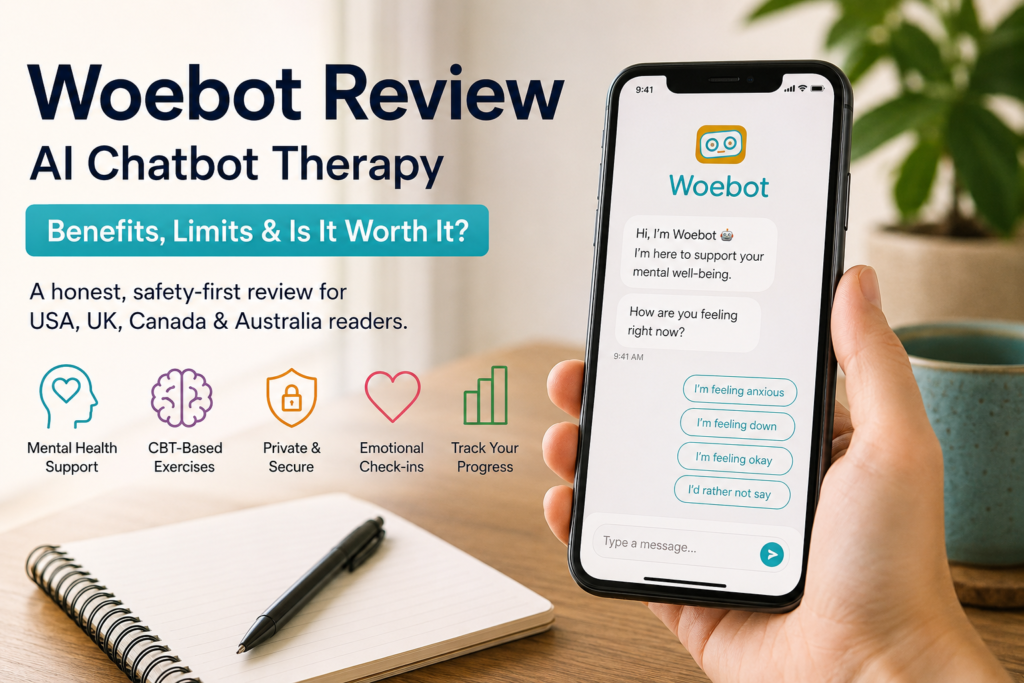
Part 1 Summary
This first part of the Woebot review explains Woebot as a CBT-style digital support tool, not a human therapist. It may help some users with reflection, thought awareness, mood tracking, and basic CBT practice.
The strongest use of Woebot may be helping people pause before reacting to anxious or negative thoughts. But it should not be used as a replacement for therapy, diagnosis, crisis support, medication advice, or deep trauma care.
A balanced Woebot app review must therefore hold two truths together: a mental health chatbot may support awareness, but real recovery often needs nervous system safety, human connection, and qualified professional guidance when symptoms are serious.
Woebot Review: Benefits Users May Notice
A balanced Woebot review should explain both sides clearly. Woebot may not replace therapy, but some users may still find value in its structure. The benefit is not that it becomes a human listener. The benefit is that it can create a guided pause when the mind is anxious, reactive, or full of self-criticism.
For people in the USA, UK, Canada, and Australia, therapy access can be affected by cost, waiting lists, insurance limits, stigma, or hesitation to speak openly. This is why an AI tool may feel attractive. It is private, quick, and available at the moment someone wants to reflect.
But convenience should not be confused with clinical care. Woebot may support self-awareness, but serious mental health symptoms need qualified support.
Quick Emotional Check-Ins
One benefit of Woebot is the ability to check in quickly. A user may not always want a long journaling session, a therapy appointment, or a deep conversation.
Sometimes they only need a short moment to pause and ask, “What am I feeling right now?”
A mental health chatbot can help create that pause. It can ask simple questions, guide the user to name emotions, and reduce the feeling of being mentally scattered.
This may be useful for daily stress, mild anxiety, overthinking, or emotional confusion. It may also help people who struggle to start self-reflection alone.
CBT Practice Between Therapy Sessions
Woebot’s strongest possible use is as a CBT chatbot for between-session practice. In therapy, a person may learn how to identify thoughts, challenge assumptions, or observe emotional triggers. But outside therapy, they may forget to apply those tools.
A chatbot may remind users to practice those skills in daily life. It can guide them through a simple thought check, emotional label, or cognitive reframing exercise.
This is where AI chatbot therapy can be useful as support. It may help a person practice what they are already learning. But it should not be treated as the therapist itself.
Lower Barrier for People Afraid to Open Up
Some people feel ashamed to talk about anxiety, sadness, loneliness, relationship pain, or self-doubt. They may fear judgment. They may worry their problems are “too small” or “too much.” For them, typing into a chatbot may feel easier than speaking to a person first.
This can be a gentle entry point into self-awareness. A person may begin by naming emotions privately, then later feel more ready to speak with a therapist, doctor, friend, or support group.
For readers who struggle with social fear, AI for Social Anxiety: Build Real Confidence.
It helps connect Woebot’s low-pressure support with the larger topic of confidence and safe human interaction.
Important Limits of AI Chatbot Therapy
The most important part of this Woebot app review is safety. Mental health content must not overpromise. A chatbot can respond, but it cannot fully know the person. It can guide a conversation, but it cannot take clinical responsibility like a licensed professional.
Woebot’s own provider instructions stated that Woebot for Adults was not evaluated, cleared, or approved by the U.S. FDA and should be considered an adjunct to clinical care, not a replacement for clinical care.
The same document also says it is not monitored by a human in real time. (Woebot Health)
That distinction matters deeply. A tool may feel supportive, but feeling supported is not the same as being clinically assessed, protected, or treated.
Woebot Cannot Diagnose or Treat You Like a Clinician
A CBT chatbot cannot diagnose depression, anxiety disorder, bipolar disorder, trauma, OCD, panic disorder, or any other mental health condition. It cannot review your medication, understand your full medical background, or coordinate care with your doctor.
This does not make Woebot useless. It simply defines its proper role. It may help you notice thoughts and feelings, but it should not become the authority over your mental health.
For serious symptoms, professional care matters. A licensed clinician can assess risk, diagnosis, medication needs, trauma history, functioning, and treatment direction.
It Cannot Understand Full Context Like a Therapist
Human therapy is not only about giving advice. A therapist listens to patterns over time.
They may notice what the client avoids, repeats, minimizes, or cannot yet express.
They may recognize trauma responses, attachment wounds, mood changes, crisis risk, or family dynamics.
A mental health chatbot cannot fully understand these layers. It works from typed input. If the user does not describe something clearly, the chatbot may miss the deeper issue.
For example, a person may write, “I feel low today.” But behind that sentence may be grief, burnout, abuse, medication side effects, trauma activation, loneliness, or suicidal thoughts. Human support is still essential when the situation is complex.
It May Not Be Safe Enough for Crisis or Severe Symptoms
A safety-first Woebot review must clearly say this: Woebot should not be relied on for crisis support. If someone feels at risk of harming themselves or others, or feels unable to stay safe, they need immediate local emergency help.
This applies everywhere, including the USA, UK, Canada, and Australia. Emergency services, crisis lines, doctors, therapists, or trusted people nearby are the right support in those moments.
AI may offer a calming message, but crisis care requires real-time human response, risk assessment, and protection. A chatbot should never become the only support when someone is in danger.
Is Woebot Still Available?
This is one of the most important updated sections for Google and readers. Many older reviews may still describe Woebot as if the app is widely available in the same way it once was. But updated reporting matters because digital mental health tools can change quickly.
STAT reported in July 2025 that Woebot Health shut down its core therapy chatbot product, while HLTH reported that the company planned to retire its app on June 30, 2025. (STAT)
So readers should not rely only on old app reviews, screenshots, or outdated ranking articles.
Before using any AI chatbot therapy tool, users should check the official app page, provider access, current availability, privacy policy, and service status.
Why Updated Reviews Matter
Mental health technology changes faster than normal wellness products. An app may be available one year, restricted the next, changed into a provider-based tool, or discontinued for direct users.
That is why this Woebot app review includes an availability warning. Readers should verify whether the version they are reading about is still accessible in their country and whether it is designed for public users, clinical partners, adolescents, adults, or research settings.
This is especially important for users in the USA, UK, Canada, and Australia because app availability, healthcare regulation, and digital health access may differ by region.
What Users Should Check Before Relying on Woebot
Before relying on Woebot or any mental health chatbot, check these points carefully:
Is the app currently available in your country?
Is it designed for public users or healthcare partners?
Does it clearly explain what it can and cannot do?
Does it provide crisis resources?
Does it explain privacy and data handling?
Does it say whether it is clinically reviewed, regulated, or only a wellness tool?
This checklist matters because a vulnerable person needs clarity, not marketing confusion. If a tool cannot explain its safety limits clearly, users should be careful.
For broader emotional pattern support, you can internally link here to AI Mental Health Tools for Emotional Pain Mapping.
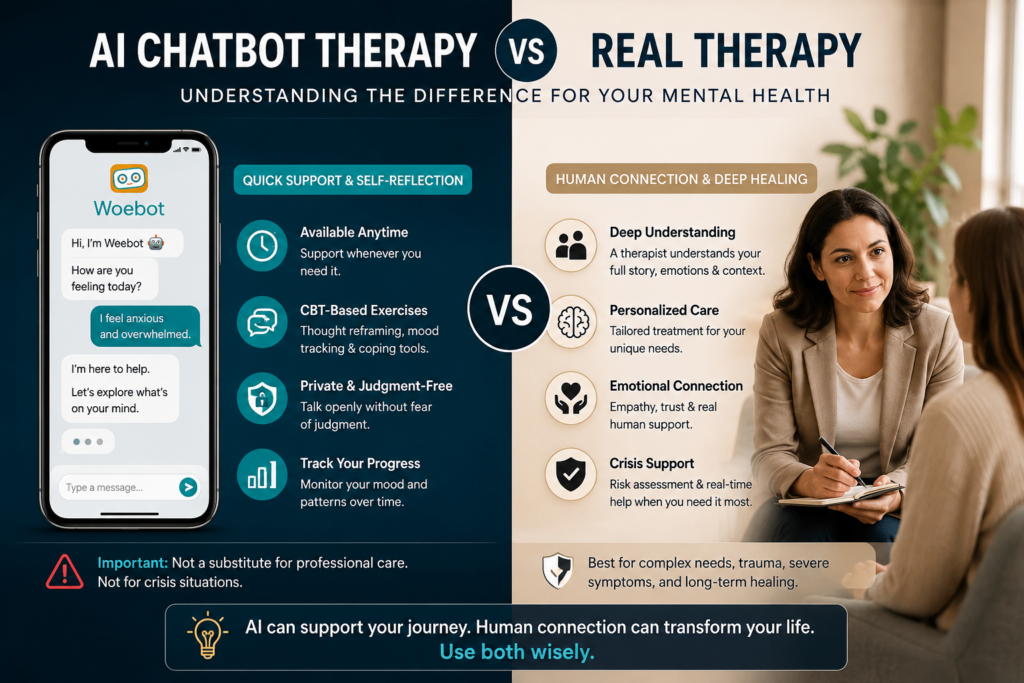
Woebot vs Real Therapy
Many people search for a Woebot review because they are quietly asking a bigger question: “Can this replace therapy?”
The honest answer is no. Woebot may support reflection, but real therapy provides a level of human understanding, accountability, and safety that a chatbot cannot match.
A chatbot can help you write down thoughts. A therapist can help you understand why those thoughts keep returning. A chatbot can give a prompt. A therapist can notice your emotional pattern over weeks and months.
This difference is not small. It is the difference between structured self-help and clinical relationship-based care.
What a CBT Chatbot Can Do
A CBT chatbot may help with simple thought reframing, emotional check-ins, psychoeducation, journaling prompts, and daily awareness practice. It may be useful when someone wants to slow down and organize their mind.
It may also help users prepare for therapy by identifying recurring thoughts, emotional triggers, or behavior patterns. In that way, it can become a supportive tool around care.
This is the best way to think about AI chatbot therapy: it can support healthy reflection, but it should sit beside human support, not above it.
What Only Human Support Can Do
Human support can hold emotional nuance. A therapist, doctor, or trained crisis worker can ask deeper questions, recognize risk, respond to silence, notice emotional shifts, and adapt care to the person’s real life.
A human can also understand cultural context, family pressure, grief, trauma, shame, medication history, and safety concerns more deeply than a chatbot.
This matters because mental health is not only a thought problem. It is also relational, biological, emotional, social, and nervous-system based.
This is why therapy, medical care, peer support, and trusted human relationships remain essential.
USA, UK, Canada, and Australia Safety Note
If you are in the USA, UK, Canada, or Australia, use any mental health app as an extra support tool, not as your only care system. If symptoms are serious, local professional support is still the safer choice.
This includes licensed therapists, primary care doctors, psychiatrists, crisis helplines, emergency services, and local community support.
A chatbot may help you reflect, but it cannot protect you in the same way a real support network can.
Part 2 Summary
This second part of the Woebot review explains the benefits and limits of Woebot more clearly. Woebot may help users with quick check-ins, CBT practice, emotional awareness, and low-pressure self-reflection.
But it cannot diagnose, treat, prescribe, monitor crisis risk, replace therapy, or understand the full context of a person’s life. Updated availability also matters because reports in 2025 said Woebot’s core chatbot app was being retired or shut down, while official materials describe Woebot as adjunct support rather than clinical replacement. (STAT)
The balanced conclusion is simple: a mental health chatbot may support awareness, but real healing still needs safety, human connection, and professional care when symptoms are serious.
Who Might Benefit From Woebot?
A balanced Woebot review should not say that Woebot is useless, and it should not say that Woebot is enough for everyone. The truth is more careful.
Woebot may be useful for people who want light emotional reflection, CBT-style prompts, and a private space to organize their thoughts.
For some users, a mental health chatbot can become a starting point. It may help them name emotions, notice patterns, or prepare for deeper support.
But it should be used with realistic expectations, especially if symptoms are serious or long-lasting.
People Wanting Light Self-Reflection
Woebot may be useful for people who want to pause and understand what they are feeling.
Some people do not need a deep conversation every day, but they do need a simple check-in that helps them ask, “What is happening inside me right now?”
A CBT chatbot can help with this by guiding the user through structured questions. It may help separate facts from assumptions, feelings from thoughts, and reactions from deeper needs.
This can be especially helpful when someone is stressed, overthinking, or emotionally reactive but still able to function safely.
People Already in Therapy
Woebot may also help people who are already working with a therapist, counselor, doctor, or mental health professional. In this case, the chatbot is not replacing care. It is supporting practice between sessions.
For example, a therapist may teach a person to notice cognitive distortions. Later, a chatbot may remind the person to practice that skill during the week.
This is where AI chatbot therapy has a safer role: not as the main treatment, but as a support tool around proper care.
Woebot’s own provider information describes Woebot for Adults as an adjunct to clinical care and says it does not replace clinical care. It also states that Woebot for Adults is not evaluated, cleared, or approved by the U.S. FDA. (Woebot Health)
People Learning About AI Mental Health Tools
Some readers may not want to use Woebot directly. They may simply want to understand how AI mental health tools work. For them, this Woebot app review can be useful as an educational guide.
The bigger lesson is not only about one app. It is about how to think safely around any AI support tool. Users should ask:
- What can this tool do?
- What can it not do?
- What happens if I am in crisis?
- Does it explain privacy?
- Does it encourage real human help when needed?
For deeper reading on why AI is not the same as human awareness, you can read Can AI Become Conscious? Artificial Intelligence Consciousness Explained.
Who Should Not Rely on Woebot Alone?
The most important safety section in this Woebot review is who should not depend on it alone. A chatbot may be supportive for reflection, but mental health can become serious very quickly.
When symptoms affect safety, functioning, relationships, sleep, work, or daily life, human help matters.
This applies strongly to readers in the USA, UK, Canada, and Australia. Each country has its own mental health system, emergency numbers, crisis services, and professional pathways.
A chatbot should never become the only care plan when someone is deeply unwell.
People With Severe Depression, Trauma, Panic, or Crisis Symptoms
Woebot should not be the only support for severe depression, suicidal thoughts, self-harm urges, trauma flashbacks, panic attacks, abuse, addiction, psychosis symptoms, severe OCD spirals, or bipolar mood episodes.
A mental health chatbot may offer a response, but crisis care needs real-time human support. If someone feels unsafe, they should contact local emergency services, a crisis helpline, a doctor, a therapist, or a trusted person immediately.
Woebot user and provider materials state that it is not a crisis service, suicide detection service, prevention service, or crisis intervention service, and that it is not monitored by a human in real time. (Woebot Health)
People Who Need Diagnosis, Medication, or Risk Assessment
A CBT chatbot cannot diagnose mental health conditions. It cannot safely decide whether a person needs medication, medication changes, therapy type, hospitalization, trauma treatment, or crisis planning.
This matters because many symptoms can look similar on the surface.
- Low mood may be depression, burnout, grief, trauma, thyroid issues, medication side effects, or bipolar depression.
- Anxiety may be panic disorder, OCD, trauma response, health anxiety, substance-related anxiety, or stress overload.
A chatbot does not have enough clinical authority to separate these safely. That work belongs to licensed professionals.
People Becoming Emotionally Dependent on AI
This is a unique BBH safety point. Some people may begin using AI support because it feels available, nonjudgmental, and easy. But if they start avoiding people completely and only turning to AI, that can become unhealthy.
Human healing often requires safe connection. A chatbot can simulate conversation, but it cannot fully replace emotional presence, relational repair, accountability, touch, community, shared reality, or human care.
If a person feels more attached to the chatbot than to real support, that is a signal to step back.
AI should help people move toward awareness and safer human connection, not deeper isolation.
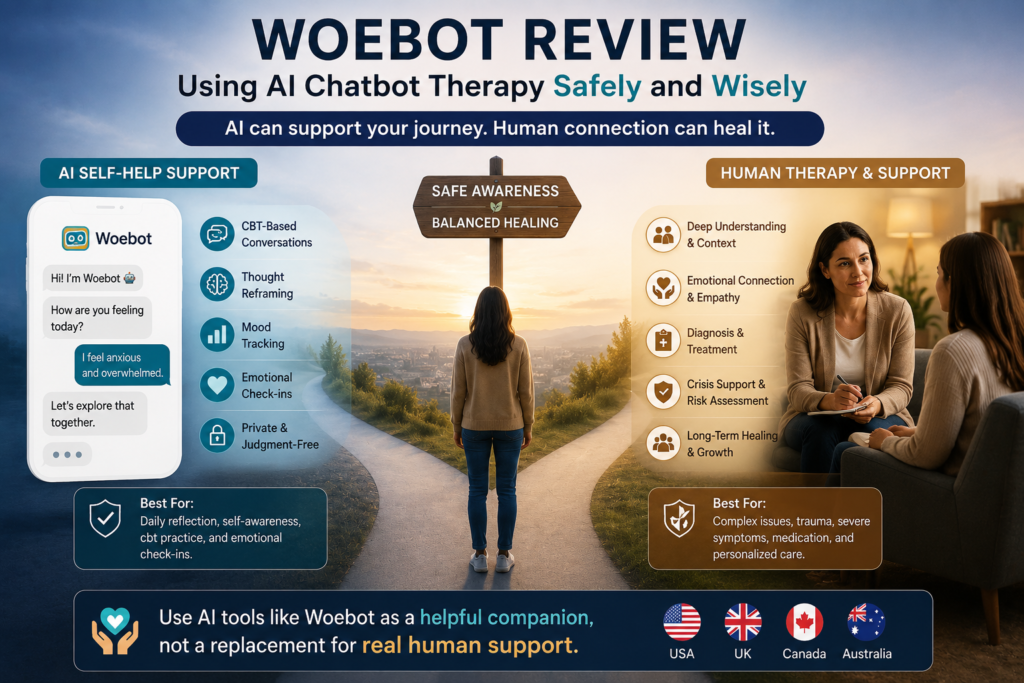
Final Woebot Review: Is It Worth Using?
The final answer is balanced. Woebot may be worth exploring as a light self-help or CBT-style reflection tool, but it should not be treated as a therapist, doctor, emergency service, or complete healing system.
A good Woebot app review must hold two truths together.
- First, AI tools may help people pause, name emotions, and notice thought patterns.
- Second, mental health healing often needs more than prompts.
It needs nervous system safety, human connection, professional care, and daily life changes.
Best Use Case
The best use case for Woebot is light reflection, emotional check-ins, thought awareness, and practicing CBT-style skills. It may help people who want to understand their reactions more clearly or prepare better for therapy conversations.
A CBT chatbot can be useful when the person is stable enough to use it thoughtfully. It may help them slow down before reacting, identify patterns, and choose a healthier next step.
But the best use case is support, not replacement.
Biggest Risk
The biggest risk of AI chatbot therapy is not that it asks simple questions. The biggest risk is that vulnerable users may mistake it for full care.
If someone is deeply depressed, panicking, traumatized, unsafe, or medically complex, a chatbot may feel like help while still being insufficient. That gap can be dangerous if it delays proper care.
This is why users should treat Woebot as one tool inside a wider support system, not the whole system.
BBH Final Verdict
The final verdict of this Woebot review is clear: Woebot may help some people with self-reflection, mood awareness, and CBT-style thinking, but it cannot replace therapy, crisis care, diagnosis, medication guidance, or human support.
A mental health chatbot can open a door to awareness. It cannot walk the whole healing path for you. Real healing needs safety, steady practice, honest support, and sometimes professional treatment.
For readers who want a broader healing direction, continue with Start Here – Your Journey to Mental Clarity & Emotional Healing and the Healing Resources Hub as support-page.
People Also Ask
Is Woebot a real therapist?
No. Woebot is not a real therapist. It is a digital chatbot designed to support emotional check-ins, self-reflection, and CBT-style exercises, but it cannot diagnose, treat, prescribe, or replace licensed mental health care.
Is Woebot based on CBT?
Woebot is commonly associated with CBT-style support. A CBT chatbot may help users notice negative thoughts, challenge assumptions, and reflect on emotional patterns, but this is not the same as working with a trained CBT therapist.
Can Woebot help anxiety?
Woebot may help some people with mild anxiety by guiding them to pause, name worries, and question anxious thoughts. However, severe anxiety, panic attacks, trauma responses, or daily functioning problems should be discussed with a qualified professional.
Can Woebot replace therapy?
No. Woebot should not replace therapy. A chatbot may support reflection between sessions, but real therapy includes human understanding, clinical judgment, risk assessment, and a therapeutic relationship.
Is Woebot safe for mental health?
Woebot may be safe for light self-reflection when used with realistic expectations, but it is not a crisis service. Users should seek immediate local help if they feel unsafe, suicidal, out of control, or unable to cope.
FAQ
Is Woebot free?
Woebot’s access and pricing may change depending on app availability, region, provider partnerships, and product updates. Before relying on any mental health chatbot, check the official app page or Woebot website for current access details.
Is Woebot still available?
Availability may depend on the version, country, and access pathway. Some app store pages still describe Woebot as a chat-based mental health tool, while 2025 reporting said Woebot Health shut down its core chatbot product. Always check the official Woebot website or app listing before depending on it. (App Store)
What is the best alternative to Woebot?
The best alternative depends on your need. For mild self-reflection, other AI mental health tools may help. For anxiety, depression, trauma, crisis symptoms, or medication concerns, a licensed therapist, doctor, psychiatrist, or local crisis service is safer than any app.
Can AI therapy apps help depression?
AI therapy apps may support mood tracking, reflection, and coping skills for some people. But depression can become serious, and apps should not replace professional care if symptoms are severe, persistent, or connected to self-harm thoughts.
When should I seek human help instead?
Seek human help if your symptoms feel intense, unsafe, long-lasting, confusing, or disruptive to daily life. Also seek support if you have suicidal thoughts, self-harm urges, panic attacks, trauma symptoms, mood swings, medication questions, or feel unable to function.
External References
- Woebot Health — Provider Instructions for Use
https://woebothealth.com/img/2024/09/Woebot-for-Adults_Instructions-for-Use_Providers_Jul-18th-2024.pdf - Woebot Health — User Instructions for Use
https://woebothealth.com/img/2024/07/Woebot-for-Adults_Instructions-for-Use_Users_July-18th-2024.pdf - STAT News — Why Woebot, a pioneering therapy chatbot, shut down
https://www.statnews.com/2025/07/02/woebot-therapy-chatbot-shuts-down-founder-says-ai-moving-faster-than-regulators/ - Apple App Store — Woebot: The Mental Health Ally
https://apps.apple.com/us/app/woebot-the-mental-health-ally/id1305375832 - Google Play — Woebot: Your Self-Care Expert
https://play.google.com/store/apps/details?id=com.woebot