Panic Attack Grounding When Body Feels Unsafe
Free AI Prompt to Calm Panic Body Fear

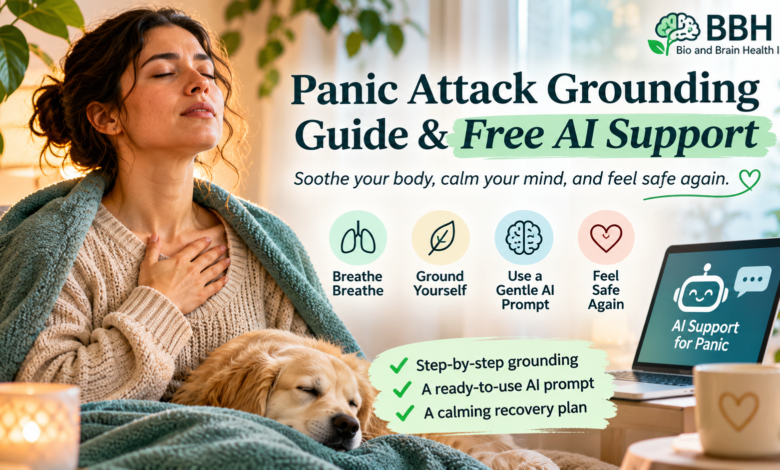
BBH • Immediate Grounding Support
If Panic Is Happening Right Now
One moment. One breath. One safe next step.
⚠ First, Check Your Safety
If you have new or severe chest pain, major difficulty breathing, fainting, sudden weakness, confusion, or another urgent concern, contact local emergency services.
Grounding is not a way to rule out a medical emergency.
Four Gentle Steps to Try
Find Support
Sit or stand where your body feels physically supported.
Notice One Object
Name one ordinary thing you can see.
Release One Breath
Let your breath move gently; do not force a deep inhale.
Choose One Person or Action
Contact someone trusted or follow your agreed care plan.
You do not have to do everything right now.
You do not need to finish the entire article during panic.
Bio and Brain Health Info (BBH) • Educational support, not emergency medical care
THE QUICK ANSWER
What are panic attack grounding techniques?
Panic attack grounding techniques are short sensory and body-awareness practices that help redirect attention toward the present environment when fear has narrowed your focus.
Examples include feeling your feet on the floor, naming objects, noticing sounds, allowing comfortable breathing, and choosing one safe next action.
Grounding does not mean every physical symptom is caused by anxiety. It is a coping skill, not a medical test or a guarantee that a panic attack will stop. Its immediate purpose is simpler: make the next moment easier to navigate without feeding the fear with more frightening predictions.
People often search for panic attack grounding techniques because they want a fast way to escape an overwhelming feeling.
A kinder expectation is to use grounding as one tool among several: medical awareness, practical coping, trusted company, and treatment when appropriate. You can choose a small sensory task even if the fear has not yet faded.
A Gentle Grounding Reflection
“My body feels unsafe even when I know – I am not in danger.”
Use this reflection only when it genuinely describes your situation. Never use it to dismiss new, unusual, or concerning symptoms. Seek medical help when needed.
Why panic feels like danger inside your body
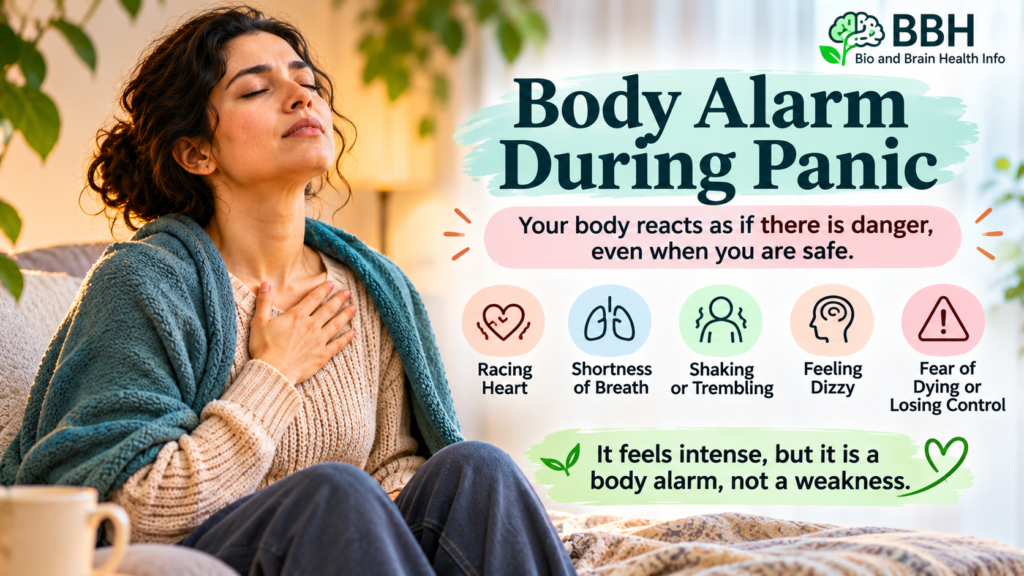
Someone may say, “It is just anxiety,” while your hands are shaking and your mind is asking whether you might die. Those words can miss how physical panic feels. Heartbeat, breath, stomach sensations, dizziness, temperature changes, and a sense of losing control may all become more noticeable at once.
The National Institute of Mental Health describes trembling, racing heartbeat, difficulty breathing, dizziness, and fear of death or losing control among possible panic symptoms.
But similar sensations may also have medical causes, so the first question is not “How do I convince myself this is nothing?” It is “Do I need immediate help, and what is the next responsible step?”
When urgent medical concerns have been addressed, it can help to understand the loop between sensation and interpretation.
Your heart speeds up; you notice it; the mind predicts catastrophe; fear rises; and the heartbeat becomes even more noticeable. The spiral is emotionally convincing because the sensations are real, even when the feared outcome has not happened.
When the fear is “I am going to lose control”
Many people fear the experience of panic itself. They begin checking whether their hands are shaking, whether they can breathe normally, or whether they are about to faint.
That monitoring can make the body seem louder. A steadier approach is to notice the sensation, assess any medical red flags, and then widen your awareness to include the room, the chair, and the person you can contact.
When the fear is “I am alone”
Being alone can make an intense episode feel more frightening. Your mind may imagine that nobody will arrive if something goes wrong. It helps to keep a trusted contact ready before you need one, save a short text message such as “I feel frightened.
Can you stay on the phone with me?”, and know how to get medical help if needed. An AI chat can organize steps, but it cannot physically supervise or protect you.
THE PANIC FEEDBACK LOOP
How Fear Can Amplify Physical Sensations
Understanding the cycle can help you
recognize where to introduce grounding.
Body Sensation
Shaking, heartbeat, breath
Frightening Thought
“Something terrible is happening”
More Alarm
Checking, fear, tension
↻ More alarm can intensify body sensations,
and the cycle may repeat.
Where Grounding Can Help
A grounding step introduces another source of information: the present environment.
Notice your feet on the floor, name an object you can see, or listen to a familiar sound. This may help shift attention away from repeatedly checking frightening sensations.
Safety note: This loop explains one possible panic pattern. New, severe, or unusual physical symptoms should not automatically be attributed to anxiety.
A SENSORY EXERCISE
5-4-3-2-1 grounding technique for panic
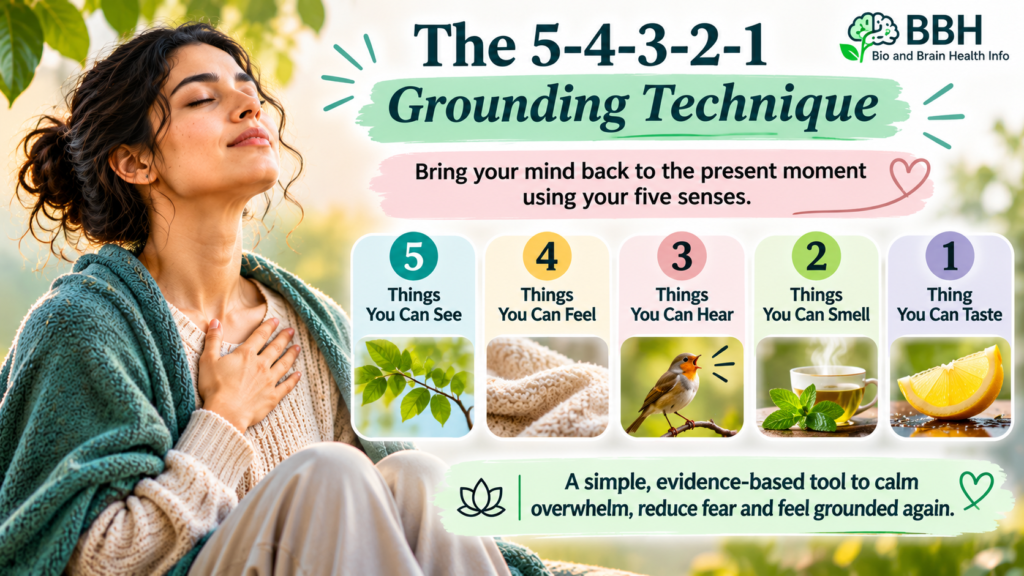
The 5-4-3-2-1 grounding technique, sometimes called the five senses grounding exercise or 54321 grounding method, uses ordinary details around you to give attention a simple task.
You do not have to complete it perfectly. If five things are too many, start with one thing you can see and one surface you can feel.

For example: “I see a door, a cushion, a cup, a plant, and the window. I feel my feet against the rug. I hear the fan.”
This is sensory grounding for anxiety, not a test of memory. If a scent, touch, or body-focused step makes you more uncomfortable, skip it. Look at a neutral object instead.
What if the five senses method feels too complicated?
Use a 1-1-1 version: one thing you see, one surface supporting you, one sound. Sometimes reading a five-step list is too much during acute fear.
Smaller is not a failure; smaller is often more usable. Practice when you are relatively calm so the method feels familiar later.
A GENTLER APPROACH
Breathing exercises for panic without forcing
“Take a deep breath” sounds simple, but it may feel difficult when breathing is already something you fear. If huge inhalations increase discomfort, do not turn breathing into another performance task.
The NHS breathing guidance recommends allowing the breath to move comfortably without forcing it.
THE BBH PRACTICAL ROUTINE
A Gentle Four-Step Breathing Reset
No perfect breathing. No pressure.
Just four gentle steps.
Support
Let a chair or bed hold your weight.
Soften
Unclench your jaw and shoulders.
Exhale
Release the breath gently.
Notice
Look at one ordinary object.
One Minute Is Enough to Begin
Try one minute of comfortable breathing and then return to the room. You can pause at any stage.
Breathing during a panic attack is not about getting the rhythm exactly right; it is about allowing a little less struggle.
Health & Safety:
If breathing difficulty is severe, unusual, or medically worrying, seek urgent medical care rather than relying on this exercise.
Bio and Brain Health (BBH) • Gentle Grounding Support
Panic attack grounding techniques: seven small steps
When you need panic attack help, a simple sequence can be more useful than a long explanation.
These steps combine grounding exercises for panic attacks, one safe thought, and contact with the outside world.
Choose the part that is possible now; you do not have to complete all seven.
THE BBH PRACTICAL ROUTINE
Panic Attack Help: The BBH 7-Step Grounding Sequence
Seven practical steps to respond to panic without putting pressure on yourself.
Name the Moment
“I may be experiencing panic, and I can take one careful step.” Avoid pretending that intense or unfamiliar symptoms are definitely harmless.
Feel Support
Rest your feet on the floor or notice the chair beneath you. It is okay to sit or lie down safely if dizzy.
Look Outward
Slowly identify one or three objects. They do not have to mean anything; ordinary objects are useful.
Allow a Comfortable Breath
Exhale gently rather than repeatedly forcing a big inhale.
Write the Fear
Put one sentence on paper: “I am afraid that _____.” There is no need to debate every thought.
Choose One Action
Contact a trusted person, follow your care plan, move somewhere calmer, or ask for medical help.
Reassess
If you feel worse, symptoms are unfamiliar, or you cannot remain safe, stop self-help and seek appropriate support.
One Step Is Still Progress
You do not have to complete every step perfectly. You can pause, ask for support, and return to grounding when appropriate.
Medical safety:
Grounding does not establish whether symptoms are caused by panic. New or severe chest pain, significant difficulty breathing, fainting, sudden weakness, or confusion require urgent medical assessment.
Bio and Brain Health (BBH) • Practical Panic Support
The usefulness of panic attack grounding techniques lies in their flexibility. Some people need sound and touch, while others prefer a short walk in a safe place, a familiar song, or the company of a pet. No single strategy works for everyone, and none should replace medical evaluation when needed.
WHEN YOU CANNOT THINK CLEARLY
A simple response chart for panic attack symptoms
Keep this table somewhere accessible. A body sensation can be genuinely frightening without automatically confirming the catastrophe you fear. However, the cause cannot be determined by a table or an AI chatbot.
THE BBH PRACTICAL RESPONSE CHART
When Panic Symptoms Feel Frightening
Notice the sensation, recognize the fear, and choose one responsible action.
01 / BODY SENSATION
Hands Are Shaking
What fear says:
“I am losing control.”
One responsible action:
Sit securely, notice the surface beneath you, and seek assessment if shaking is new or concerning.
02 / BODY SENSATION
Heartbeat Feels Loud
What fear says:
“My heart might stop.”
One responsible action:
Check for serious or unusual symptoms first. Then redirect attention to the room if medically appropriate.
03 / BODY SENSATION
Breathing Feels Strange
What fear says:
“I cannot get enough air.”
One responsible action:
Try a gentle, unforced breath only if safe. Severe breathlessness needs urgent medical help.
04 / FRIGHTENING FEAR
Fear of Dying
What fear says:
“This must be an emergency.”
One responsible action:
Take medical warning signs seriously. Do not ask AI to rule out an emergency.
05 / EMOTIONAL EXPERIENCE
You Feel Alone
What fear says:
“Nobody will help me.”
One responsible action:
Contact someone trusted or local emergency support as appropriate. AI is not physical supervision.
06 / THOUGHT PATTERN
Thoughts Keep Racing
What fear says:
“I have to solve everything.”
One responsible action:
Write one fear thought and one safe next action, then return to grounding.
Important Medical Reminder
Panic and medical emergencies can share symptoms. New or severe chest pain, significant breathing difficulty, fainting, sudden weakness, or confusion require urgent medical assessment. Never rely on grounding or AI to rule out a medical emergency.
Notice that each response uses a real action. It does not demand that you “think positively” or promise instant relief. The goal is to reduce confusion, not to make the body obey on command.
FREE BBH RESOURCE
Free AI panic attack grounding tool: copy this prompt
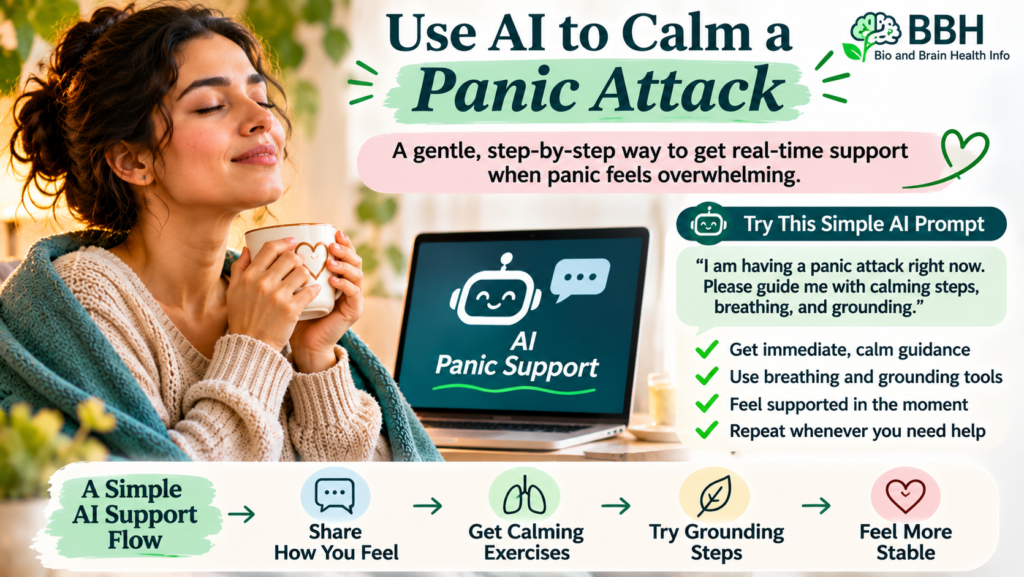
Use this AI grounding prompt with a chatbot of your choice. The prompt is free to copy from BBH; the platform you use may have its own terms or charges. It is a structured conversation starter, not a medical device or emergency service.

BBH • ONE STEP AT A TIME
Your Gentle AI Panic Grounding Prompt
Short sentences • No diagnosis • Safety first
COPY-AND-PASTE AI PROMPT
I may be experiencing panic or intense anxiety. Please respond with calm, very short sentences. Do not diagnose me, claim that my symptoms are harmless, or guarantee that I am medically safe.
First, remind me that new, severe, unusual, or medically concerning symptoms need urgent medical assessment.
If there is no immediate medical emergency, guide me through grounding ONE STEP AT A TIME. Ask me to name one neutral object I can see, then wait. Help me notice a surface supporting my body, a sound in the room, and one gentle, comfortable breath. If I want to continue, guide me through the 5-4-3-2-1 senses exercise. Let me skip anything uncomfortable.
Next, ask me to name one fear thought and one safe action. If I am alone, suggest contacting a trusted person. Avoid repeatedly answering reassurance-seeking questions.
If I mention severe chest pain, significant trouble breathing, fainting, confusion, sudden weakness, or that I might harm myself, tell me to contact local emergency or crisis support immediately.
Please avoid long lists, diagnosis, and overwhelming questions. One step at a time.
Save This Before You Need It
Select and copy the text above. Save it somewhere easy to find, or paste it into your preferred AI chat when you need structured grounding support.
Safety reminder:
AI cannot assess your medical condition, guarantee your safety, or replace emergency services. Seek urgent help for severe or medically concerning symptoms.
Free Panic Attack Grounding Worksheet
Reflect on your body sensations, fear thoughts, grounding steps, and one safe next action.
Opens your email application with the request subject filled in.
Bio and Brain Health (BBH) • Educational Grounding Support
BBH | RESPONSIBLE AI SUPPORT
How to Use This Grounding Prompt Safely
Start With One Small Instruction
Open the saved text when it is useful and ask the AI for one small instruction at a time. If you can only reply with one word, that is enough.
A SIMPLE SENTENCE TO USE
“One step only.”
If AI starts giving long explanations, use the sentence above. If it increases reassurance-seeking, confusion, or fear, stop using it and turn to a trusted person or professional support.
Protect Your Personal Information
Do not enter your full address, identity documents, passwords, detailed medical records, or other sensitive details without understanding the platform’s privacy practices.
INSTEAD, KEEP IT SIMPLE
“I feel frightened and need one grounding step.”
Explore More BBH Support
For another structured conversation example, see the BBH prompt for moments of body fear You can also choose among 25 gentle prompts according to what you need.
Important AI Boundary
An AI conversation cannot confirm that a physical symptom is medically harmless, assess vital signs, monitor your safety, or replace an emergency response. Seek urgent medical help for new, severe,
unusual, or medically concerning symptoms.
Bio and Brain Health (BBH)
• Safe and Responsible AI Guidance
REAL-LIFE SUPPORT
When a routine feels more human than a checklist
Picture someone sitting alone in a quiet room at night. Their hands begin to shake. They fear dying or losing control, and the silence feels as frightening as the sensation itself. They try to find the perfect explanation online, but every new search gives the mind something else to worry about.
A kinder alternative is not to solve every possibility. They sit down. They notice the chair. They put their phone within reach and decide whether they need medical support.
They name one ordinary object. If medically safe to remain at home, they may sit near a pet, put on familiar music, or write a single sentence. None of those steps is a miracle cure; each simply makes the moment more manageable.
For the BBH personal perspective, the fear is not abstract. Shaking, fear of dying, fear of losing control, and being alone can make the body feel like an enemy. Writing, speaking to AI, quiet sitting, music, and the comforting presence of pets can be accessible forms of support. They are meaningful experiences, not proof that a technique works the same way for everyone.
BBH | GENTLE WRITING EXERCISE
Three Sentences to Write When Panic Is Loud
You do not need to explain everything. Start with one honest sentence.
01 | NOTICE YOUR BODY
My body is noticing…
02 | NAME YOUR FEAR
My mind is afraid that…
03 | CHOOSE ONE SAFE ACTION
My next safe action is…
One Sentence Is Enough to Begin
You can write these sentences in a notebook, save them on your phone, or complete them in your own time. You may skip any step that feels uncomfortable.
BBH | Write gently. Choose one next step.
If writing feels difficult, speak the sentences into a voice note or ask a trusted person to read them aloud. For some people, the best option is simply to set the notebook aside and sit with an ordinary sound. A useful tool respects your capacity in that moment.
You do not have to become an expert in panic attack grounding techniques to deserve compassion. A prepared card beside your bed, a short message saved in your phone, and someone who knows how to respond without judgment may matter more than memorizing twenty exercises. Keep the plan easy enough to use on a difficult day.
IF THE PANIC DOES NOT EASE
What if grounding is not helping?
Grounding is not a pass–fail exercise. Some episodes stay intense even when you follow each instruction carefully. That does not mean you failed or that you need to repeat the method more forcefully. More counting, checking, and self-monitoring can sometimes become another source of pressure.
Try making the task smaller. If the five-senses method is too much, notice only the weight of your feet.
- If breathing becomes a source of fear, stop counting breaths and orient to a neutral object.
- If the AI chat keeps you checking for certainty, close it.
- If you need another person, contact one. If symptoms are severe, unfamiliar, or medically concerning, seek medical evaluation.
If panic repeatedly disrupts your sleep, work, travel, relationships, or ability to leave home, a qualified mental health professional can help you build a more reliable treatment plan.
According to the NHS guide to panic disorder, evidence-based treatment can include talking therapies and medication where appropriate.
AFTER THE INTENSE MOMENT
What to do after a panic wave
After an intense episode, you might feel exhausted, embarrassed, confused, or unusually sensitive to noise. You may be tempted to search the internet for every symptom, replay what happened, or criticize yourself for not recovering sooner. Instead, give the next hour a quieter purpose.
THE BBH GENTLE RECOVERY PLAN
What to Do After a Panic Attack
Recovery does not have to happen quickly. Focus on your physical needs, gentle care, and appropriate support.
STEP 01 / PHYSICAL CARE
Check Your Physical Needs
Drink or eat as appropriate to your health and treatment plan; do not ignore possible medical causes of weakness or shaking.
STEP 02 / GENTLE RECOVERY
Let the Body Settle
Reduce unnecessary stimulation if possible, and avoid judging the pace of recovery.
STEP 03 / PERSONAL REFLECTION
Write Two Observations
When you feel ready, reflect on two simple questions:
1. What helped a little?
2. What would I prepare for next time?
STEP 04 / HUMAN CONNECTION
Keep Human Support Available
Tell someone you trust if you need company or practical help.
STEP 05 / ONGOING SUPPORT
Plan Follow-Up
For recurring episodes, discuss symptoms and treatment options with a clinician.
Recovery Is Not a Race
You do not need to analyze everything immediately. Give yourself room to recover, notice what helps, and seek support whenever it is needed.
Medical safety:
Do not assume that weakness, shaking, chest discomfort, or breathing changes are always caused by panic.
Seek urgent care for new or severe symptoms, including significant chest pain, difficulty breathing, fainting, sudden weakness, or confusion.
Bio and Brain Health (BBH) • Recovery and Self-Care
That is where panic attack grounding techniques become a practice rather than a one-time rescue attempt. The goal is not to eliminate every uncomfortable feeling. The goal is to respond with better information, less shame, and more reliable support over time.
HEALTH & SAFETY
When Grounding Is Not Enough
Grounding can support you, but some symptoms require professional or emergency medical care.
When to Seek Emergency Help
Seek emergency medical assistance for new, severe, or unusual chest pain; major breathing trouble; fainting; confusion; sudden weakness; or other concerning symptoms.
Physical symptoms resembling panic can also be caused by medical conditions. Do not assume an episode is harmless simply because you have experienced anxiety before.
Consider Existing Health Conditions
If you have a condition or medication that can affect blood sugar, heart rhythm, or breathing, follow your
clinician’s instructions for checking symptoms and getting care.
If You Cannot Remain Safe
If you feel at risk of harming yourself or cannot remain safe, contact local emergency or crisis support and a trusted person immediately.
When to Arrange Professional Support
For recurring panic, fear of future attacks, avoidance, or major disruption in daily life, arrange a professional assessment.
The Limits of AI Grounding Support
AI support can help organize thoughts and practise grounding, but it cannot diagnose panic attacks or replace therapy, medical care, or emergency services.
Bio and Brain Health (BBH) • Responsible Mental Health Education
A FREE BBH PRINTABLE
BBH Panic Grounding Worksheet
A simple, reusable page to note your body sensations, fear thought, sensory grounding step, gentle breathing approach, safe next action, and what helped afterward.
BBH WORKSHEET PREVIEW
A Reflection After Panic
The BBH worksheet helps you organise what you noticed and the small steps that supported you.
01 BODY SENSATION
What did you notice in your body?
02 FEAR THOUGHT
What was your mind afraid might happen?
03 GROUNDING STEP
Which sensory or breathing step did you try?
04 ONE SAFE ACTION
What was one responsible next action?
Reflect When You Feel Ready
You do not have to complete the worksheet during intense panic. Use it when you feel able to reflect. Notice what helped a little and what you might prepare for next time.
How to Get Your Free Worksheet
The direct PDF download will be added here after the worksheet is uploaded to the BBH WordPress Media Library. Until then, you can request it by email.
Request Your Free BBH Worksheet
Send a simple email request to BBH. The subject and message will be filled in automatically.
Or email
info@bioandbrainhealthinfo.com
with the subject:
Send Me the Panic Grounding Worksheet.
This worksheet is an educational reflection resource, not a substitute for professional treatment, medical assessment, or emergency support.
PEOPLE ALSO ASK
Common Google Questions About Panic Grounding
Clear, practical answers to questions people often have when panic feels moverwhelming.
QUESTION 01
How do you ground yourself during a panic attack?
Start by sitting somewhere physically supported. Notice your feet on the floor, name a few objects around you, and allow your breathing to remain gentle.
Panic attack grounding techniques such as sensory awareness may help redirect attention toward the present. Seek medical assistance for new, severe, or concerning symptoms.
QUESTION 02
Can the 5-4-3-2-1 method stop panic immediately?
The 5-4-3-2-1 grounding technique does not guarantee immediate relief. It encourages you to notice five things you can see, four you can feel, three you can hear, two you can smell, and one you can taste. This sensory exercise may reduce overwhelming thoughts by bringing attention back to your surroundings.
QUESTION 03
What can I do when I am shaking and alone?
Sit somewhere safe, notice the surface supporting your body, and contact someone you trust. If comfortable, try a familiar sound, gentle music, or sitting near your pet.
Shaking can occur during panic, but it can also have medical causes.
New or concerning shaking deserves appropriate medical assessment.
QUESTION 04
Can AI provide panic attack help?
AI can offer simple grounding prompts, gentle breathing reminders, and step-by-step reflection exercises.
Ask for one short instruction at a time. However, AI cannot diagnose panic, determine whether symptoms are medically safe, monitor your physical condition, or replace professional or emergency care.
QUESTION 05
Should I force deep breathing during panic?
No. Repeatedly forcing large breaths may increase discomfort or dizziness.
Instead, allow comfortable, gentle breathing without trying to achieve a perfect rhythm. Relax your shoulders and let the breath move naturally.
Severe or unusual breathing difficulty requires urgent medical assessment.
Health and safety:
Grounding can support emotional regulation, but it cannot establish the cause of physical symptoms. Seek urgent medical assistance for new or severe chest pain, major breathing difficulty, fainting, sudden weakness, confusion, or other emergency warning signs.
Bio and Brain Health (BBH) • Practical Mental Health Education
FREQUENTLY ASKED QUESTIONS
More Questions About Grounding and AI
Practical answers to help you use grounding tools responsibly and prepare for futuremoments of anxiety.
FAQ 01
Is the BBH AI grounding prompt free?
Yes. The BBH grounding prompt is free to copy and use. You can paste it into a compatible AI chatbot to receive short, structured grounding instructions.
However, some AI services may have subscription fees or usage limits. The prompt itself is not a medical
or therapeutic service.
FAQ 02
What is the simplest grounding prompt?
A simple grounding prompt asks for one manageable instruction instead of a long explanation.
“I feel frightened. Please help me notice one thing around me. Give me one step at a time.”
FAQ 03
Can music or pet comfort replace grounding exercises?
Familiar music or sitting near a pet may provide comfort and support present-moment awareness. These
activities can complement sensory grounding exercises, but they do not guarantee relief or replace medical or psychological treatment when needed.
Choose the approach that feels comfortable and appropriate.
FAQ 04
Does panic always mean panic disorder?
No. Experiencing a panic attack does not automatically mean someone has panic disorder. Panic disorder involves recurrent unexpected panic attacks together with persistent concern or related behavioural changes. A qualified clinician can assess symptoms, rule out relevant medical causes, and determine whether a diagnosis is appropriate.
FAQ 05
How do I prepare for the next episode?
Save your preferred grounding prompt, keep contact details for a trusted person accessible, and prepare a brief plan for responding to symptoms. You can also use the BBH Panic Grounding Worksheet to record what helped. If episodes recur or affect daily life, discuss a personalised treatment and safety plan with a clinician.
Medical safety reminder:
Grounding and AI prompts cannot determine whether physical symptoms are harmless.
New or severe chest pain, major breathing difficulty, fainting, sudden weakness, or confusion require urgent medical assessment.
Bio and Brain Health (BBH) • Educational Grounding Support
CONTINUE WITH BBH
Support for the Next Step
Explore more practical guidance for understanding anxiety, body sensations, and gentle AI support.
Begin with the Start Here guide browse the AI & CBT menu or explore our Free AI Tool collection
AI SUPPORT
When Your Body Feels Unsafe
Explore a separate, step-by-step panic prompt for moments when body fear feels overwhelming.
ANXIETY TOOLS
25 Prompts for Anxious Moments
Choose a gentle AI prompt that fits the type of emotional support you need.
BODY SYMPTOMS
When Your Heartbeat Feels Frightening
Understand how anxiety and heartbeat sensations may be connected, and why symptoms require careful medical interpretation.
BODY SYMPTOMS
Why Anxiety Can Cause Shaking
Learn about trembling and shaking, possible explanations, and when professional medical assessment may be necessary.
MORNING ANXIETY
When Fear Arrives as You Wake
Understand how body sensations, thoughts, and daily routines can influence anxious mornings.
More Support From BBH
Not sure where to begin? Visit our Start Here mental health guide for a gentle introduction.
For additional tools and resources, explore the BBH Healing Resources Hub
Bio and Brain Health (BBH)
• Learn, Reflect, and Find Support
SOURCE CHECK
Evidence and further reading