Can Anxiety Cause Heart Palpitations?
When Your Chest Feels Like It Will Explode

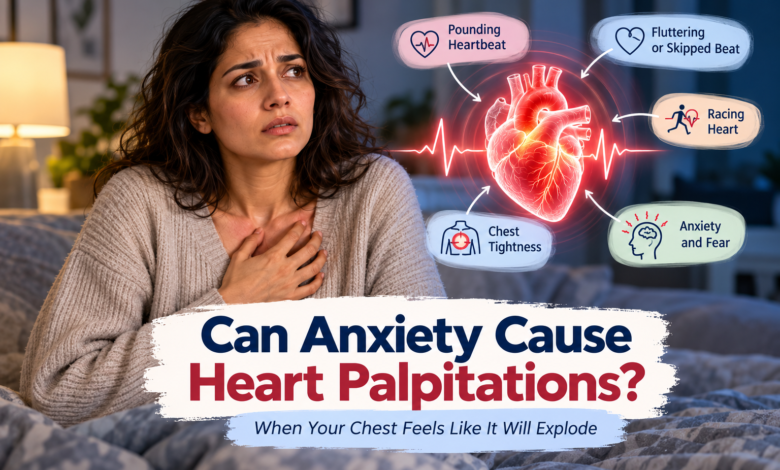
Many people wonder, can anxiety cause heart palpitations, especially when intense stress makes the chest feel frighteningly unfamiliar? Have you ever been sitting quietly when your heart suddenly begins pounding so hard that you wonder whether something terrible is happening?
Thank you for reading this post, don't forget to subscribe!Your breathing changes. Perhaps your hands begin shaking, and you become aware of every heartbeat. The more you monitor the sensation, the more frightened you become. One question keeps repeating: Am I having a heart attack?
Yes, anxiety can cause heart palpitations. The body’s stress response can make the heart beat faster, harder, or more noticeably. Common anxiety heart palpitations symptoms include pounding, fluttering, or a skipped-beat sensation. A racing heart caused by anxiety can appear even at rest, along with other physical symptoms of anxiety attack episodes, such as sweating, trembling, and changes in breathing.
Learning how to calm anxiety heart palpitations starts with understanding the body–brain connection, but anxiety is not the only possible cause. Heart rhythm problems and other medical conditions can produce similar symptoms. This article combines an honest lived experience, a clear medical safety boundary, the science of the fear loop, and practical steps for episodes that have already been medically assessed.
Quick Answer: Can Anxiety Cause Heart Palpitations?
Yes. Anxiety can increase adrenaline and make the heart beat faster or more forcefully, so palpitations may feel like pounding, fluttering or racing. These sensations are real, but they do not prove that anxiety is the cause. New, prolonged, worsening or otherwise concerning symptoms need medical assessment.
⚠ Medical Safety: Know When to Get Help
Medical safety: This is education, not an ECG or a diagnosis. Get emergency help for concerning chest pain or pressure, pain spreading to the arm, jaw, neck or back, fainting, cold sweat, severe difficulty breathing, or other possible heart attack signs.
Do not wait to finish a breathing exercise.
Emergency numbers:
USA/Canada: 911 |
UK: 999 |
Australia: 000
When Your Chest Feels Like It Will Explode
The Night I Thought I Was Dying
The first time this happened to me, I did not understand what anxiety could do to a human body. My heart felt as though it might explode. Pressure filled my chest, and I became frightened that my heartbeat could suddenly stop. Tears kept coming. I remember thinking: Am I dying now?
I went to the hospital believing something serious was happening to my heart. Doctors examined me, performed tests, and gave me medicine for the pain. But even after the tests, the fear remained. Then one doctor asked me something unexpected: “Do you have anxiety?”
I said no. At that time, I understood anxiety as worry, emotional pressure, or overthinking—not as an intense physical experience. My reports were normal, and the episode was explained to me as anxiety.
Why the Explanation Felt Impossible to Accept
When your chest feels as though it might explode, hearing “it is anxiety” can sound far too small for what your body is experiencing. I wanted to understand why my heart had become the centre of my fear before I had consciously decided to panic. Over time, I began to understand that the body can react before the conscious mind makes sense of the situation.
BBH Lived Insight: When Anxiety Takes Cover in the Chest
“I thought anxiety was only emotion and worried thoughts. When body and brain got lost in the loop, anxiety took cover in my chest.”
Sometimes a racing heart caused by anxiety becomes more frightening because of the meaning we attach to the sensation. This insight helped me approach familiar, medically assessed anxiety episodes without ignoring new warning signs.
A normal test during one episode does not guarantee that a later episode has the same explanation. New or different chest symptoms deserve assessment.
Can Anxiety Cause Heart Palpitations?
Readers often ask can anxiety cause heart palpitations even without a clear emotional trigger. The answer is yes, but that answer must sit beside the equally important fact that medical symptoms cannot be diagnosed from a blog.
Yes. Anxiety can activate the autonomic nervous system, which helps regulate automatic functions such as breathing and heart rate. When the brain perceives danger, its sympathetic “fight-or-flight” response prepares the body for action. Stress hormones such as adrenaline can make the heartbeat faster or more forceful.
What Anxiety Heart Palpitations Symptoms Can Feel Like
One person describes a thud under the ribs; another feels a flutter in the chest, a racing pulse while resting, or a sensation that a beat was skipped. These anxiety heart palpitations symptoms may also involve sweating, nausea, tingling, light-headedness, or chest muscle tension.
A palpitation describes what you feel, not why it is happening. Sensation alone cannot reliably distinguish anxiety from an arrhythmia or other medical cause.
Why Anxiety Can Make Your Heart Race
The Fight-or-Flight Response
Imagine hearing a sudden noise behind you. Before you understand its source, your muscles may tense, your breathing may change, and your heartbeat may become stronger. During anxiety, similar protective processes can happen without a visible outside danger.
This explains why a racing heart caused by anxiety can start while you are sitting or lying down. The stress response is not limited to physical exertion, and noticing the heartbeat can itself become a new trigger.
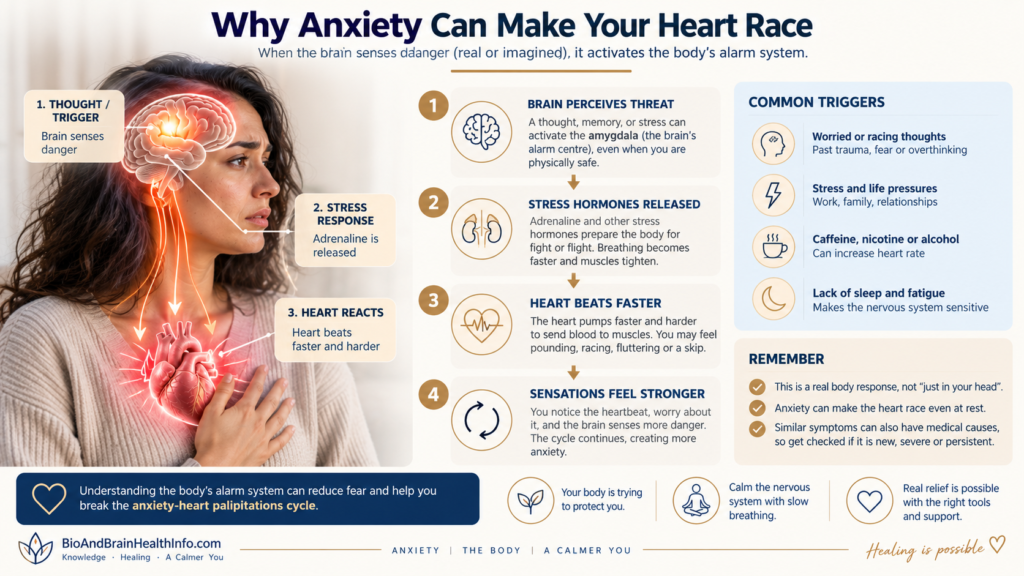
Inside the Body: A Simple Four-Step Map
The brain detects a possible threat.
The sympathetic nervous system increases alertness.
Stress hormones can make the heartbeat faster or stronger.
Noticing the sensation may increase fear and attention.
This response can accompany other physical symptoms of anxiety attack episodes. It is a mechanism, not a home diagnostic test.
Why the Body Sometimes Reacts First
We often imagine anxiety as “worry, then fear, then physical reaction.” In reality, the body and conscious mind exchange signals continuously. You may notice your heart race before identifying what frightened you. The mind may then search for an explanation, which can intensify the fear.
For a related explanation, read practical nervous-system regulation for anxiety and overthinking.
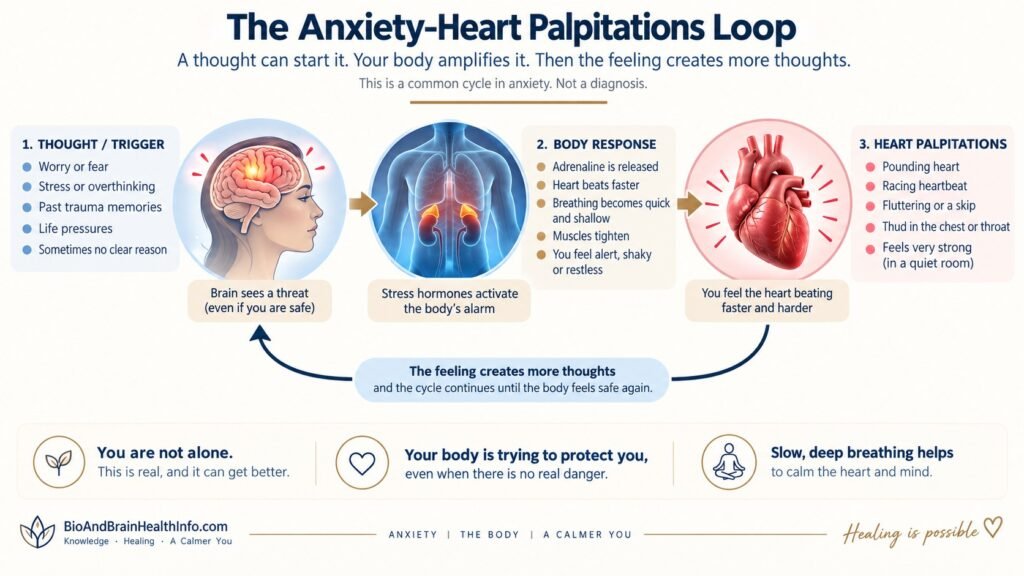
The Anxiety–Heart Palpitations Loop
Understanding can anxiety cause heart palpitations becomes easier when you see how the physical sensation and fearful interpretation can reinforce each other. Not everyone experiences this cycle, and it does not establish a diagnosis.
A possible trigger raises the body’s alarm, the heartbeat becomes more noticeable, and the mind interprets the sensation as danger. Fear then increases the body’s arousal. The loop can repeat even when the original trigger has passed.
Trigger → body alarm → stronger heartbeat → attention to the heartbeat → frightening interpretation → more fear.
Why Repeated Pulse Checking Can Increase Anxiety
For some readers, anxiety heart palpitations symptoms feel worse as attention becomes fixed on each beat, even without a change in the underlying heart rhythm.
Checking a pulse is appropriate when medically advised or when symptoms require attention. But repeatedly checking a familiar, previously assessed sensation for reassurance can turn attention into another part of the cycle. You feel relief for a moment, notice another thud, then check again.
Interoception: Listening to the Body
Interoception means awareness of signals inside the body, such as breathing and heartbeat. This awareness is normal. The challenge begins when every ordinary or unfamiliar sensation is interpreted as proof of immediate danger. Reducing compulsive reassurance checking is different from ignoring symptoms that need clinical care.
When Your Mind Keeps Searching for Certainty
An anxious mind may believe the next search will finally settle the question. That relief can be brief. A racing heart caused by anxiety may become more noticeable each time you return your attention to it. If repetitive thoughts are part of your pattern, explore why emotionally charged thoughts become hard to stop.
Physical Symptoms of an Anxiety Attack
The physical symptoms of anxiety attack episodes may involve multiple body systems. Some arise from breathing changes, muscular tension or sympathetic nervous-system activation, but they are not unique to anxiety.
| Sensation | Possible connection | Safer response |
|---|---|---|
| Pounding heart | Adrenaline and heightened awareness | Assess new or concerning symptoms |
| Tingling or dizziness | Breathing changes or other causes | Seek care if unusual, severe or persistent |
| Chest muscle tension | Stress-related tightening | Do not assume chest pain is muscular |
| Sweating or nausea | Autonomic nervous-system response | Seek emergency care with cardiac red flags |
Remember: A comparison table is educational, not a way to rule out heart disease.
Can Anxiety Cause Heart Palpitations at Night?
In a quiet room, you may become more aware of sensations that would blend into the background during a busy day. Stress, poor sleep, caffeine and earlier frightening episodes can contribute to nighttime worry. However, nighttime palpitations can also have non-anxiety causes.
What to Do When Nighttime Fear Begins
A racing heart caused by anxiety can feel particularly intense in a silent bedroom. Still, do not assume nighttime symptoms are psychological without suitable assessment.
If the symptoms are new, worsening or accompanied by warning signs, seek medical care. For a familiar pattern that has already been assessed, follow your clinician’s plan, reduce unnecessary late-night symptom searching, and practise a comfortable settling routine. You may also find mindfulness approaches for anxiety and overthinking useful.
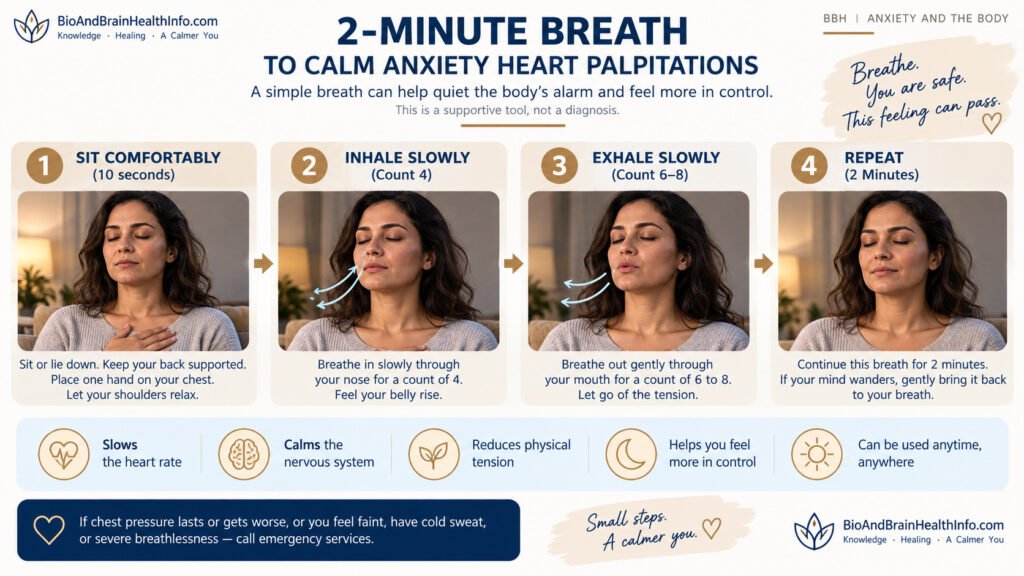
How to Calm Anxiety Heart Palpitations
There is no safe promise that a breathing exercise will stop every palpitation. Learning how to calm anxiety heart palpitations means developing a steadier response to a familiar, clinically assessed anxiety pattern—not overriding symptoms that need medical attention.
First: Respect the Safety Boundary
Seek urgent care for concerning chest pain or pressure, fainting, severe breathing difficulty or other heart attack symptoms. If palpitations are recurrent or unexplained, arrange an appropriate assessment. A relaxation response does not prove the heart is healthy.
Second: Try a Comfortable Two-Minute Breathing Practice
If your symptoms match a medically assessed anxiety pattern and no warning signs are present, sit somewhere comfortable with your back supported. Breathe in gently for about four seconds, then exhale gently for about six. Continue for up to two minutes without straining, holding your breath, or forcing a longer count. Stop if you feel lightheaded or uncomfortable.
BBH Two-Minute Calming Practice
Sit comfortably and support your back.
Relax your shoulders without forcing your breathing.
Inhale gently for roughly four seconds.
Exhale comfortably for roughly six seconds.
Continue for up to two minutes if it feels comfortable.
Third: Ground Your Attention
Grounding does not treat the physical symptoms of anxiety attack episodes directly, but it may reduce the attention and interpretation that keep fear active.
Notice five objects around you, the feel of the chair, and one ordinary sound. Grounding can help shift attention away from repetitive symptom monitoring after appropriate assessment. It is not a substitute for checking medical warning signs.
Fourth: Practise When You Feel Well
Part of learning how to calm anxiety heart palpitations is making calming skills familiar before a stressful moment arrives.
A gentle routine is often easier to learn when your body is calm. Consider brief practice before bed or in the morning. Sleep, a short walk when medically appropriate, and less caffeine if it clearly affects you may help. For a broader set of tools, see ways to use anxiety-support apps responsibly.
Acceptance Can Become a Cooling System
I eventually realised that fighting each familiar sensation could increase my fear. Acceptance is not the belief that every symptom is harmless. It means not automatically adding a catastrophic story to an episode you have already discussed with a clinician.
“Acceptance is not liking it. It is a cooling system. It takes the heat down one step so the breath can come back.”
You may not control the first sensation. But you can learn how to respond to medically assessed anxiety without immediately turning the heartbeat into a prediction of disaster.
Sometimes one step toward calm creates room for a considered decision. This is also why learning how to calm anxiety heart palpitations includes making safer decisions about when not to self-manage.
When Are Heart Palpitations a Medical Emergency?
Asking can anxiety cause heart palpitations should never replace asking whether this particular episode requires medical help. Heart and anxiety symptoms can overlap even if you have previously experienced panic.
Stop Reading and Seek Medical Help When Needed
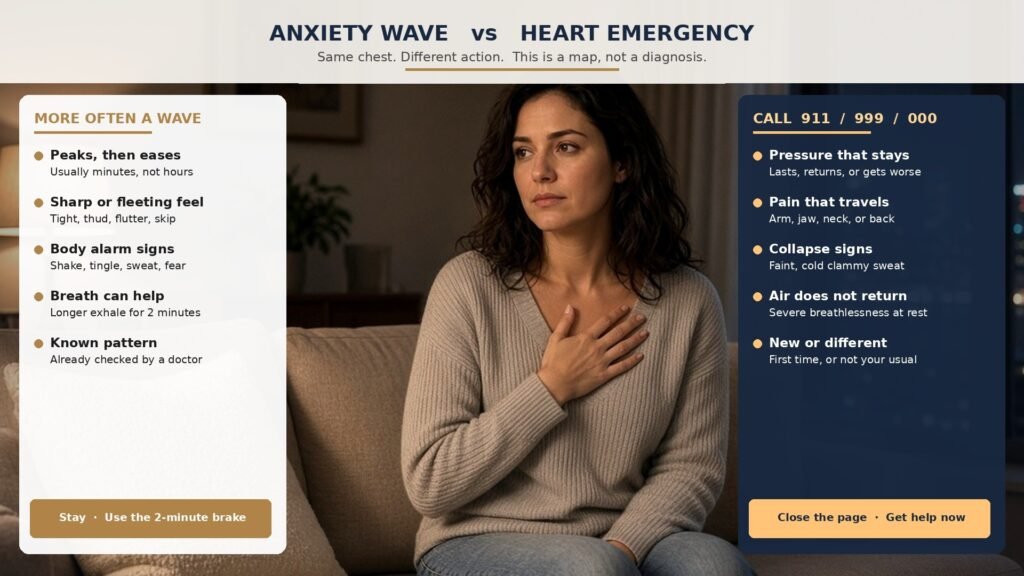
Seek emergency care for concerning chest pressure or pain, pain spreading to the arm, neck, jaw or back, fainting, cold sweat, severe breathlessness, or other symptoms of a possible heart attack.
USA / Canada: 911
United Kingdom: 999
Australia: 000
Important: These symptoms overlap with anxiety and cannot be safely separated by an online checklist.
| Situation | Action |
|---|---|
| New or unexplained palpitations | Arrange medical assessment |
| More frequent, prolonged or changing palpitations | Contact a clinician promptly |
| Palpitations with chest pain, fainting or severe breathlessness | Seek emergency care |
| Familiar episode already assessed as anxiety, with no new warning signs | Follow the clinician’s plan and use supportive coping tools |
Depending on your medical history, an ECG, monitoring or other tests may be needed. An internet article cannot provide that assessment.
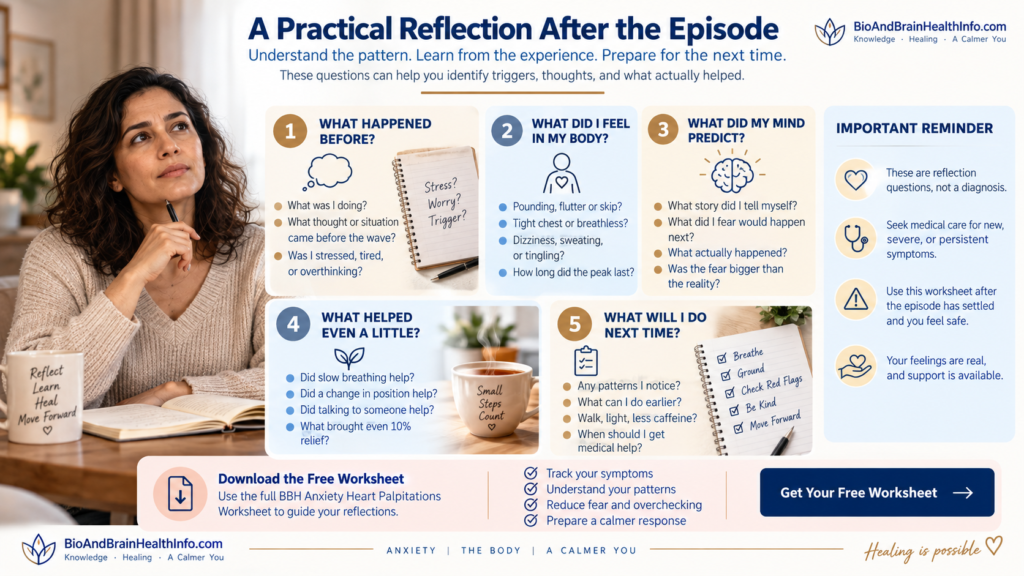
A Practical Reflection After the Episode
Once the episode has settled and you are physically safe, reflect rather than repeatedly searching for reassurance. The questions below are not a diagnosis; they are a way of understanding what happened and preparing to discuss patterns with a professional.
- What was happening just before I noticed the sensation?
- What did I feel in my body, and how long did it last?
- What did my mind predict would happen?
- What helped, even slightly, after medical safety was addressed?
- What would I do next time, including when to seek care?
A structured tool can help you keep track without making every sensation into an emergency prediction. Try our free Fact vs Fear reflection tool for another way to separate fear from confirmed information.
People Also Ask
1. Can Anxiety Cause Heart Palpitations All Day?
They can recur during the day or feel persistent when stress and body awareness remain high. But frequent, prolonged or unexplained anxiety heart palpitations symptoms should not automatically be labelled anxiety. A healthcare professional can help investigate the cause.
2. How Do I Know Whether Heart Palpitations Are From Anxiety?
A racing heart caused by anxiety may appear during stress, fear or panic, sometimes with trembling or breathing changes. However, heart rhythm conditions can feel similar. Symptoms alone cannot confirm a cause; seek medical assessment, especially for new symptoms.
3. Why Does Anxiety Make My Heart Pound When Resting?
The fight-or-flight response can activate without exercise. Adrenaline may increase heart rate or force, and physical symptoms of anxiety attack episodes can begin while sitting or lying down. Other causes must still be considered.
4. Can Anxiety Palpitations Feel Like a Heart Attack?
Yes. Anxiety can cause pounding, sweating, breathlessness and chest discomfort. These physical symptoms of anxiety attack episodes can overlap with possible cardiac symptoms. Seek emergency help for concerning chest pain, fainting, severe breathlessness or other warning signs rather than trying to tell the difference online.
5. How Long Do Heart Palpitations From Anxiety Last?
They may last seconds or minutes, or recur while a person remains stressed. Duration cannot establish the cause. Gentle anxiety-management techniques may help after assessment, but prolonged, changing or worsening palpitations need professional evaluation.
Frequently Asked Questions
1. Can Anxiety Cause an Irregular Heartbeat?
Anxiety can make the heartbeat feel fluttery or irregular, but this feeling does not identify the actual rhythm. Recurrent sensations, especially with dizziness or fainting, deserve medical evaluation.
2. How Can I Calm Anxiety Heart Palpitations Naturally?
After appropriate medical assessment, learning how to calm anxiety heart palpitations may involve gentle breathing, grounding, sleep routines and reducing unnecessary reassurance checks. None of these is a treatment for an undiagnosed cardiac problem.
3. Can Lack of Sleep Make Anxiety Heart Palpitations Worse?
Poor sleep can increase stress sensitivity and awareness of heartbeat sensations. It can intensify anxiety heart palpitations symptoms, but it cannot rule out medical causes of frequent nighttime palpitations.
4. Can Caffeine Cause a Racing Heart and Anxiety?
Caffeine may contribute to palpitations or anxiety in some people. Its effects vary, and a racing heartbeat after caffeine can still need assessment if it is new, intense or recurrent.
5. Should I Stop Checking My Heart Rate?
Follow your clinician’s monitoring instructions. If repeated checking has become a reassurance habit after proper assessment, a mental-health professional may help you reduce the checking cycle without ignoring warning signs.
The Part I Wish Someone Had Explained Earlier
During my first episode, I wanted one answer: Is this my heart or is this anxiety? What I learned later was that the body and mind can intensify each other’s signals, and that understanding the cycle matters. But so does recognising when a symptom is new or needs clinical attention.
When it is safe to do so, I now think in smaller steps: identify the sensation, honour the medical safety boundary, and avoid adding another frightening story to a familiar anxiety wave. One step cooler. Then breathe.
BBH Support Resource
Download the Free Anxiety Heart Palpitations Worksheet
The BBH Anxiety Heart Palpitations Worksheet is a printable reflection resource to record body sensations, anxious predictions, possible triggers, medical warning signs, and helpful responses after an episode.
Free printable PDF | Educational resource | Bio and Brain Health
Unable to download?
Email
info@bioandbrainhealthinfo.com
with the subject Send Me the Heart Palpitations Worksheet.
Optional Further Reading
Calm Your Anxious Mind With AI — 101 Safe Prompts, Worksheets & Trackers
An optional BBH resource for readers interested in guided anxiety reflection, practical worksheets, and structured self-awareness exercises.
Purchase link coming soon.
External Medical References
- Cleveland Clinic: Heart Palpitations and Anxiety
- NHS: Heart Palpitations
- Mayo Clinic: Heart Attack Symptoms: Know What’s a Medical Emergency
- Cleveland Clinic: Heart Palpitations: Symptoms, Causes & Treatment
- Cleveland Clinic: Heart Palpitations at Night
Author: Shubhangi Halande | Bio and Brain Health
Website: bioandbrainhealthinfo.com
Contact: info@bioandbrainhealthinfo.com
Educational disclaimer: This article and its worksheet are not a diagnosis or individual treatment advice. Seek qualified medical care for new, worsening or concerning symptoms. Breathwork and AI support resources do not replace healthcare.