How to Develop Awareness Daily and Stop Reacting on Impulse
Why Your Mind Reacts Before You Realize It — and How Awareness Builds Control

Awareness is not only a calm idea or a meditation word. If you want to learn how to develop awareness, you need to understand what happens before you react, defend, interrupt, overthink, or speak from anger.
Thank you for reading this post, don't forget to subscribe!👉This blog is unique because it does not treat awareness practice as only sitting silently with closed eyes. It explains awareness as a real-life skill that helps you notice ego pain, emotional triggers, nervous system activation, and impulsive reactions before they become behavior.
Through conscious thinking, you begin to see the gap between what you feel and what you choose. You will also learn practical mental observation skills for noticing thoughts, emotions, body tension, and inner impulses in daily situations.
With simple daily mindfulness training, this guide will help you build awareness step by step, reduce stress, respond better, and stop becoming controlled by the same reactions that hurt your peace.
What Does It Really Mean to Develop Awareness Daily?
To understand how to develop awareness, you first need to see awareness as a living skill, not only as a spiritual word.
Awareness means you can notice what is happening inside you before it becomes your behavior. You may still feel anger, irritation, sadness, fear, jealousy, or ego pain, but you do not immediately become those emotions. You begin to observe them.
This is why daily awareness practice is so important. Without awareness, the mind runs on old patterns. A person feels triggered and reacts automatically. But with awareness, a small space appears between feeling and action.
In that space, you can ask, “What am I feeling? What is my impulse? What do I really need here?”
Awareness does not make you emotionless. It makes you more honest. You stop blaming every situation outside and begin seeing your own inner movement too.
Read Also: why self-control fails
Awareness Is the Skill of Seeing Before Reacting
Awareness is the ability to see your thought, emotion, body reaction, and impulse before you act. This is the beginning of conscious thinking. For example, someone may speak too much in a group, interrupt others, or behave as if only their point matters.
👉 Your first reaction may be anger: “Why are they talking so much? Why are they not listening?”
That reaction may be valid, but awareness asks a deeper question: “What is happening inside me right now?”
- Maybe you feel ignored.
- Maybe your ego feels hurt.
- Maybe your body is becoming tense.
- Maybe your nervous system is going into panic or irritation.
This is where mental observation skills begin. You are not only observing the other person. You are also observing your own reaction before it becomes sharp speech, control, withdrawal, or emotional stress.
Read Also: automatic-emotional-reactions
Simple Example of Awareness in Real Life
Imagine you join a social mental health group because you want human connection, emotional safety, learning, and a place to hear how others handle life.
During the discussion, some people keep interrupting the main speaker or repeatedly bring attention back to their own point. You feel angry and irritated.
Without awareness, you may say, “Can you stop speaking?” or “Keep it short.”
But with awareness, you pause and ask, “Why did I join this group?”
Then you remember: “I came here to learn, connect, and grow.”
That moment does not mean the interruption is right. It means you do not let irritation control your behavior.
Why Awareness Is Not Automatic for Most People
Awareness is not automatic because the brain often reacts faster than reflection. When a situation feels threatening, unfair, disrespectful, or emotionally unsafe, the nervous system can activate before the thinking mind fully understands what is happening. This is why people often say things they later regret.
Many reactions are not created in the present moment alone. They come from habit, old emotional pain, past rejection, insecurity, attachment, fear of being ignored, or the desire to feel important. When these patterns are triggered, the mind may defend itself quickly.
This is why how to develop awareness is not only a mindset question. It is also a nervous system and emotional maturity question.
You are training yourself to slow down enough to notice the inner pattern before it controls you. Awareness becomes a bridge between reaction and wisdom.
Read Also: how detachment helps control emotions
The Mind Often Reacts Before You Fully Understand Yourself
The mind often reacts before you fully understand yourself because emotion moves faster than clarity.
- Anger may appear before you notice hurt.
- Irritation may appear before you notice your need for respect.
- Jealousy may appear before you notice your desire to be included.
- Ego pain may appear before you notice your fear of being invisible.
This is why awareness practice must include emotional honesty.
- You are not trying to look calm outside while burning inside.
- You are trying to understand the real inner experience.
When you learn to name what is happening, the reaction becomes less powerful.
A person may think, “I am angry because they are wrong.” But awareness may reveal, “I am angry because I wanted to be heard.” That difference creates maturity. It helps you respond to the real need instead of attacking the surface situation.
Without Awareness, Stress Becomes Behavior
Without awareness, stress does not stay inside. It becomes tone, words, facial expression, withdrawal, control, overexplaining, criticism, or impulsive action. This is where many people create more stress while trying to stop stress.
A person may dislike someone else taking too much attention. But if they react without awareness, they may also begin taking attention in an unhealthy way.
They may interrupt, dominate, or speak harshly in the name of correcting others. This is the deep truth: without awareness, we often become the same energy we are reacting against.
👉This is why impulse control awareness matters. Awareness helps you see not only what is wrong outside, but also what your inner pain is about to do. That pause protects your peace, your dignity, and your growth.
Why This Blog Looks at Awareness Differently
Many blogs explain awareness as meditation, breathing, or being present. Those are useful, but awareness is much bigger than that.
Awareness is also needed in arguments, meetings, family situations, client pressure, relationship triggers, money decisions, emotional eating, phone scrolling, procrastination, and moments of ego pain.
This blog looks at awareness as daily mind training. It connects daily mindfulness training with emotional self-control, nervous system regulation, detachment, and practical decision-making.
Awareness is not only about feeling peaceful. It is about seeing the impulse before the impulse becomes your identity.
That is why this topic belongs strongly under Brain Mastery and Discipline & Action. Awareness helps you train the mind so that your emotions do not automatically become your actions. This makes it practical, psychological, and spiritually grounded without becoming vague.
Read Also: why I can’t stay present
Awareness Practice Is Not Escaping Life
True awareness practice is not escaping life. It is not pretending you are above anger, pain, or frustration. It is learning how to stay awake inside real situations.
You can be in a group discussion, a business meeting, a family conflict, or a stressful day and still notice what is happening within you.
Awareness does not remove every trigger. It changes your relationship with the trigger. Instead of immediately saying, “This person is the problem,” you begin asking, “What is this situation showing me about my reaction, need, fear, or attachment?”
👉That is not weakness. That is power. A person who can observe their own mind has more freedom than a person who only reacts to outer events. Awareness gives you the ability to choose your next step with clarity.
Awareness Means Honest Inner Adjustment
Awareness means honest inner adjustment. It does not mean you suppress anger or accept disrespect blindly. It means you first understand whether your response is coming from clarity or from emotional impulse.
- Sometimes you may need to speak.
- Sometimes you may need to set a boundary.
- Sometimes you may need to listen more.
- Awareness helps you know the difference.
This is where light detachment becomes useful. Detachment does not mean you stop caring. It means you do not become fully controlled by ego pain, emotional urgency, or the need to win the moment.
When you develop mental observation skills, you can see the difference between a healthy boundary and an impulsive reaction. That difference is very important. One protects your peace. The other creates more suffering.
How Lack of Awareness Turns Emotion Into Impulse
Lack of awareness turns emotion into impulse because the mind tries to remove discomfort quickly.
- When anger rises, the impulse may be to speak sharply.
- When sadness rises, the impulse may be to withdraw.
- When ego feels hurt, the impulse may be to prove your point.
- When insecurity rises, the impulse may be to control the conversation.
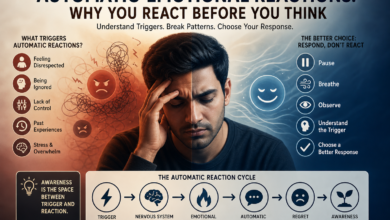
This is why learning how to develop awareness is essential for emotional maturity. Awareness helps you see the chain before it completes itself. The chain often looks like this: trigger, ego pain, impulse, reaction, regret, stress.
Most people only notice the regret stage. They say, “Why did I react like that?” But awareness trains you to notice the earlier stage.
You begin to see the reaction forming inside you before it becomes words, behavior, or emotional damage.
Read Also: what is conscious living
The Trigger → Ego Pain → Impulse Pattern
One powerful way to understand awareness is through this pattern:
Trigger → Ego Pain → Impulse → Awareness Pause → Honest Question → Conscious Response
This pattern is useful because it makes conscious thinking practical. You are not only saying, “I should be calm.” You are learning exactly where the reaction begins.
A trigger is the outside event. Ego pain is the inner meaning your mind gives to that event. Impulse is the action your body and mind want to take quickly.
Awareness pause is the space where you observe instead of reacting. The honest question reveals your real need. The conscious response is the action chosen with maturity.
This system turns awareness into a repeatable skill. It can be used in group discussions, relationships, work stress, parenting, business pressure, and private emotional moments.
Trigger
A trigger is something outside you that activates an inner reaction. It may be a person interrupting, someone ignoring your point, a client speaking harshly, a partner not replying, a family member criticizing you, or a situation not going as planned.
The trigger is real, but it is not the whole story. Awareness helps you see what the trigger awakens inside you.
Ego Pain
Ego pain is the inner hurt that says,
- “Why am I not being heard?”
- “Why are they getting attention?”
- “Why are they acting superior?”
- “Why does my point not matter?”
Ego pain is not always arrogance. Sometimes it is wounded self-worth asking for respect.
Awareness helps you notice ego pain without becoming controlled by it.
Impulse
Impulse is the quick action your mind wants to take to reduce discomfort. It may want to interrupt, correct, dominate, escape, defend, attack, or prove. The impulse feels urgent because the nervous system wants relief.
But not every impulse is wisdom. Impulse control awareness helps you pause before pain becomes behavior.
How Conscious Thinking Creates a Pause Before Reaction
Conscious thinking creates a pause because it brings attention to what is happening inside you. Instead of being fully carried by emotion, you begin to observe it. This does not mean the emotion disappears immediately. It means the emotion no longer has complete control over your next action.
In a difficult moment, conscious thinking may sound like this:
“I am angry right now.
I feel ignored.
My body feels tense.
I want to interrupt.
But is that the response I truly want to choose?”
This simple inner conversation can change the direction of the moment.
This is how awareness becomes practical.
- You do not wait for perfect calm.
- You create enough space to choose better.
Even a few seconds of awareness can stop a reaction that may create hours, days, or months of stress.
Read Also: what is detachment and how to practice conscious living
The Awareness Pause
The awareness pause is the moment between emotional activation and outward behavior. It can be very short, but it is powerful. In that pause, you do not need to solve everything. You only need to notice what is happening.
You can ask,
“What am I feeling?”
“What am I about to do?”
“Will this action help or harm?”
“Am I speaking from clarity or from ego pain?”
These questions strengthen mental observation skills because they train the mind to look inward before moving outward.
The pause is not weakness. It is self-leadership. People often think power means reacting strongly, but real power is the ability to stay conscious when emotion is pushing you toward impulse. The more you practice this pause, the more natural it becomes.
The Honest Question That Changes the Reaction
One honest question can change a reaction. In the group discussion example, the question was simple: “Why did I join this group?” That question brought the mind back to purpose. The answer was connection, learning, safety, and growth.
This is how awareness practice works in real life. It reminds you of your deeper intention when your emotion tries to make the trigger everything. Instead of focusing only on the person who irritated you, you remember your own reason for being there.
Other honest questions may include:
“What do I really need right now?”
“Am I trying to protect myself or control others?”
“Is my response coming from maturity or from hurt?”
“Will this reaction support my growth?”
These questions are simple, but they create inner discipline.
The Question Is Not for Self-Blame
The honest question is not for self-blame. Awareness should never become another way to attack yourself. If you feel angry, irritated, jealous, or hurt, that does not make you bad. It means something inside you needs attention.
The purpose of awareness is not to say, “I should never feel this.”
The purpose is to say, “I feel this, and I want to understand it before I act from it.”
That is emotional maturity. That is also the beginning of healing.
Read Alsso: automatic-emotional-reactions
Mental Observation Skills That Help You Understand Yourself
Mental observation skills are the practical tools that help you understand yourself in real time. Instead of only thinking about what happened, you learn to observe your thought, emotion, body signal, impulse, and deeper need.
This is important because many reactions are layered.
On the surface, you may feel anger.
- Under anger, there may be hurt.
- Under hurt, there may be a need for respect.
- Under that need, there may be an old attachment to being accepted or valued by others.
When you develop awareness daily, you become better at seeing these layers.
- You stop believing every first reaction as the full truth.
- You begin to understand that your first reaction may be only the doorway.
- The deeper truth is often underneath.
This kind of self-observation creates clarity, emotional self-control, and better decision-making.
Observe the Thought
The first skill is to observe the thought. In a triggering moment, the mind may say, “They should stop talking,” “Nobody listens,” “I need to correct this,” or “This is unfair.”
Do not immediately believe or fight the thought. Just notice it.
Thought observation creates distance. You realize, “A thought is happening in me.” This distance is the beginning of conscious thinking.
Observe the Emotion
The second skill is to observe the emotion.
Ask yourself, “Is this anger, irritation, sadness, fear, jealousy, shame, or ego hurt?”
Naming the emotion helps reduce confusion. It also stops you from turning every feeling into action.
Emotional awareness is not emotional weakness. It is emotional intelligence. When you can name the emotion, you can guide it better.
Observe the Body Signal
The third skill is to observe the body signal. Your body may show stress before your mind understands it. You may feel chest tightness, heat in the face, restlessness, shallow breathing, stomach tension, or pressure in the head.
These signals show nervous system activation. Daily mindfulness training helps you notice these body signals earlier, before they become reaction.
Observe the Need Under the Reaction
The fourth skill is to observe the need under the reaction.
Behind anger, there may be a need for respect.
Behind irritation, there may be a need for space.
Behind jealousy, there may be a need for inclusion.
Behind panic, there may be a need for safety.
When you see the need, your response becomes wiser. You stop fighting only the surface and begin caring for the root.
How to Develop Awareness Daily Step by Step
If you want to know how to develop awareness, do not begin with a complicated system.
- Begin with one daily reaction.
- Awareness grows through repetition, not perfection.
- You do not need to become calm all day.
- You need to become honest once a day.
Choose one moment where you felt triggered, irritated, rushed, defensive, distracted, or emotionally uncomfortable.
Then review it gently.
- What happened?
- What did you feel?
- What did your body do?
- What did you want to do?
- What did you actually do?
- What could be a more conscious response next time?
This simple daily review builds awareness practice. Over time, the mind starts noticing patterns earlier. You begin catching reactions before they become behavior. That is how awareness becomes part of your discipline and action system.
Read Also: what is inner peace really
Step 1 — Notice One Reaction Every Day
Start by noticing one reaction every day. Do not try to observe your whole personality at once. That will become heavy. Just choose one moment.
It may be anger, overthinking, phone scrolling, food craving, avoidance, sharp speaking, or emotional withdrawal.
- The goal is not to judge yourself.
- The goal is to build the habit of seeing.
This is the first step in how to develop awareness practically.
Step 2 — Name the Emotion Without Judging It
After noticing the reaction, name the emotion.
👉Say, “This is anger,” “This is fear,” “This is irritation,” “This is sadness,” or “This is ego hurt.” Naming creates clarity.
Many people react because they do not know what they are feeling. They only feel pressure. When you name the emotion, you bring light into the experience. That is a simple but powerful awareness practice.
Step 3 — Ask What the Impulse Wants You to Do
Next, ask what the impulse wants you to do.
Does it want you to interrupt, argue, prove, escape, defend, control, blame, or shut down?
This question is powerful because it separates feeling from behavior.
You may not control the first emotional wave, but you can observe the impulse before obeying it. This is where impulse control awareness becomes real.
Step 4 — Choose One Conscious Response
Finally, choose one conscious response. A conscious response may be taking one breath, listening for one more minute, speaking more calmly, asking a clear question, writing your thoughts first, setting a respectful boundary, or leaving the situation without drama.
This is conscious thinking in action.
- You are not suppressing yourself.
- You are choosing behavior that protects your growth, dignity, and peace.
Daily Mindfulness Training for Real-Life Awareness
Daily mindfulness training should not be limited to sitting silently. It should help you become aware while living.
You can practice awareness while talking, working, driving, eating, using your phone, managing clients, attending meetings, or listening to people who irritate you.
Mindfulness becomes powerful when it enters real life. The goal is not to escape the world. The goal is to stay connected with yourself inside the world. This is why daily mindfulness training works best when it is small, repeatable, and connected to your actual triggers.
You can train awareness through short pauses, body checks, end-of-day reflection, mindful listening, and before-you-speak moments. These practices teach the mind to observe before reacting.
👉Over time, your emotional reactions may still come, but they will not control you as easily.
Read Also: why people make bad decisions
The 60-Second Awareness Check
The 60-second awareness check is simple.
Pause and ask four questions:
“What am I feeling?”
“What am I thinking?”
“What is my body doing?”
“What do I need right now?”
This small practice builds mental observation skills quickly because it brings attention to emotion, thought, body, and need together.
You can use it before meetings, after conflict, during stress, or whenever you feel emotionally activated.
The End-of-Day Awareness Review
At the end of the day, review one reaction. Do not review your whole life.
Ask,
“Where did I react automatically today?”
“What triggered me?”
“What was my impulse?”
“What could I try next time?”
This builds daily awareness without pressure. It also teaches the mind that growth is not punishment. Growth is learning. This is one of the best forms of daily mindfulness training.
The Before-You-Speak Pause
The before-you-speak pause is especially useful in emotional conversations. Before you speak, ask, “Will these words create clarity or more stress?”
This does not mean you stay silent forever. It means you speak from awareness, not from raw impulse.
This pause can protect relationships, group discussions, business communication, and personal dignity. Sometimes one conscious pause prevents a long emotional problem.
Read Also: brain-mastery
Awareness, Detachment, and Emotional Maturity
Awareness and detachment work together. Awareness helps you see what is happening inside you. Detachment helps you not become completely controlled by it. This is the light spiritual layer of the blog, but it is deeply practical.
In daily life, Maya can be understood as unconscious attachment that increases suffering. You may become attached to being heard, being right, being respected, being accepted, or being in control. When this attachment is triggered, the reaction feels very strong.
Awareness helps you see the attachment.
Detachment helps you loosen your grip.
You can still care.
You can still speak.
You can still set boundaries.
But you do not lose yourself in the reaction.
This is emotional maturity: seeing the emotion, understanding the attachment, and choosing a conscious response.
Detachment Does Not Mean You Stop Caring
Detachment does not mean you stop caring. It means you stop letting every emotion command your behavior.
You can care about a group, a person, a goal, or a conversation without needing to control every moment.
This is important for how to develop awareness because awareness without detachment may still become overthinking.
👉Detachment gives awareness space. It allows you to observe without immediately gripping, judging, or reacting.
Awareness Helps You See Maya in Daily Reactions
Awareness helps you see Maya in daily reactions. Maya is not only a big spiritual concept. In daily life, Maya can appear as the illusion that your peace depends on everyone behaving exactly as you want.
When someone interrupts, disagrees, ignores, delays, or disappoints you,
Maya says, “I cannot be okay unless this changes.”
Awareness says, “This is uncomfortable, but I can still choose my response.”
The Inner Witness Helps You Respond With Clarity
The inner witness is the part of you that can observe thought, emotion, impulse, and body reaction without becoming fully lost in them. This witness does not attack you. It watches honestly.
When the inner witness becomes stronger, conscious thinking becomes easier.
You can see anger without becoming anger.
You can see ego pain without becoming ego behavior.
You can see impulse without becoming impulse.
Read Also: discipline-and-action
Conclusion — Awareness Turns Reaction Into Conscious Response
Learning how to develop awareness is one of the most important skills for emotional maturity, discipline, and inner peace.
Awareness helps you notice thoughts, emotions, ego pain, body tension, and impulses before they become automatic behavior. With daily awareness practice, you stop reacting blindly and begin understanding yourself more honestly.
Through conscious thinking, you create a pause between what you feel and what you choose.
Through mental observation skills, you learn to see the thought, emotion, body signal, impulse, and deeper need behind your reaction.
Through daily mindfulness training, you turn awareness into a repeatable habit, not a one-time idea.
Awareness does not mean you never feel anger, irritation, jealousy, sadness, or ego hurt. It means those emotions no longer have to control your behavior.
When awareness grows, reaction becomes response, stress becomes learning, and life becomes a place for conscious growth.
Read Also: Community Support – Free Zoom Healing Space
People Also Ask
1. How do I develop awareness in daily life?
You develop awareness in daily life by noticing one reaction every day. Observe what triggered you, what emotion came up, what your body felt, what impulse appeared, and what response you chose. This simple awareness practice trains the mind to pause before reacting automatically.
2. Why is awareness important for impulse control?
Awareness is important for impulse control because it helps you see the impulse before obeying it. Without awareness, anger, fear, ego pain, or stress can quickly become behavior. With impulse control awareness, you can pause, reflect, and choose a better response.
3. Is awareness the same as mindfulness?
Awareness and mindfulness are closely connected, but awareness is broader. Mindfulness often means paying attention to the present moment. Awareness includes noticing thoughts, emotions, body signals, ego reactions, needs, and behavior patterns. Daily mindfulness training can help build deeper awareness.
4. Can awareness reduce emotional reactions?
Yes, awareness can reduce emotional reactions because it creates space between feeling and action. You may still feel anger or irritation, but conscious thinking helps you understand what is happening before you speak or act from impulse.
5. What are mental observation skills?
Mental observation skills are the ability to notice thoughts, emotions, body sensations, impulses, and inner needs. These skills help you understand yourself clearly instead of reacting from confusion, stress, or old emotional patterns.
Read Also: healing-resources-hub
FAQ
1. What is the first step in awareness practice?
The first step in awareness practice is noticing one emotional reaction without judging yourself. You can begin by asking, “What am I feeling right now?” This small question creates the first pause between emotion and behavior.
2. How long does it take to develop awareness?
Awareness develops through daily repetition. Some people notice small changes within a few days, but deeper awareness grows over weeks and months. The goal is not instant perfection. The goal is consistent daily mindfulness training and honest self-observation.
3. Can awareness help with anger?
Yes, awareness can help with anger because it shows you what is beneath the anger. Sometimes anger hides hurt, fear, disrespect, ego pain, or a need to be heard. When you observe anger clearly, you can respond with more maturity.
4. Why do I react before I think?
You may react before you think because your nervous system responds quickly to stress, threat, rejection, or emotional discomfort. This is why how to develop awareness matters. Awareness trains your mind to slow down and choose consciously.
5. Is awareness spiritual or psychological?
Awareness is both psychological and spiritual. Psychologically, it helps with emotional regulation, impulse control, and self-understanding. Spiritually, it helps you observe ego, attachment, and Maya without becoming controlled by them.
External References
- American Psychological Association — Mindfulness
- National Center for Complementary and Integrative Health — Meditation and Mindfulness: Effectiveness and Safety
- Harvard Health — Self-regulation for adults: Strategies for getting a handle on emotions and behavior
- Greater Good Science Center, UC Berkeley — Mindfulness
- NIH / PubMed Central — Mindfulness and Behavior Change

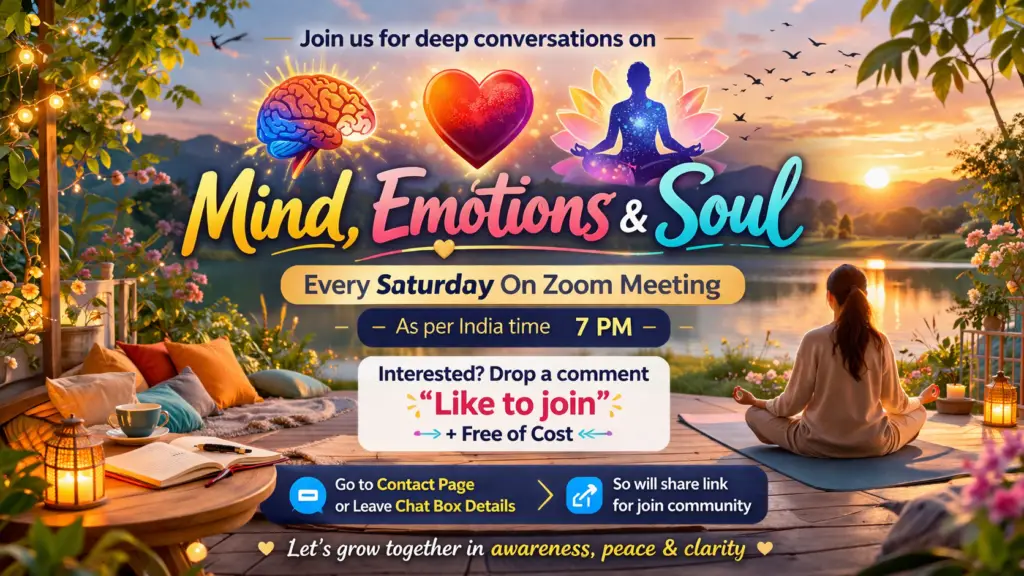
Free weekly Zoom healing community for deep conversations on mind, emotions, and soul — every Saturday at 7 PM IST.