What Is Maya in Real Life? How Ego Creates Hidden Suffering
Maya Meaning in Psychology: Ego, Attachment, and Hidden Suffering

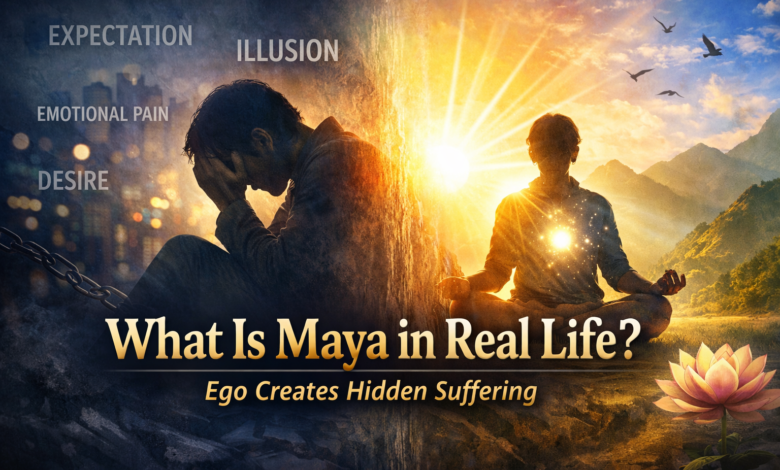
Understanding what is Maya in real life matters because many people suffer without knowing that their pain is not only coming from events, but from interpretation, ego, attachment, and hidden expectations.
Thank you for reading this post, don't forget to subscribe!👉This blog is unique because it does not explain Maya only as a spiritual concept. It connects Maya meaning in psychology with daily emotional reactions, nervous system patterns, identity pressure, and the inner stories people silently believe.
You will learn how ego and suffering are linked when the mind becomes attached to approval, control, relationships, success, or self-image. This article also explains the illusion of ego in a practical way, showing how the false self creates fear, comparison, and emotional heaviness.
Most importantly, it explores emotional attachment and suffering with awareness-based solutions, so readers can understand their pain clearly and begin practicing detachment without escaping life. This is where inner clarity begins.
Introduction — What Is Maya in Real Life and Why It Creates Hidden Suffering
Understanding what is Maya in real life matters because many people suffer without realizing that their pain is not coming only from events, people, or situations.
👉A large part of suffering often comes from interpretation, expectation, ego, emotional memory, and the meaning the mind adds to reality.
This is where Maya becomes more than a spiritual idea. It becomes a daily emotional pattern.
The uniqueness of this blog is that it connects Maya meaning in psychology with real human reactions, not only ancient philosophy.
You will see how ego and suffering are connected, how the illusion of ego makes ordinary situations feel personal, and how emotional attachment and suffering grow when the mind holds tightly to people, outcomes, control, and self-image.
This blog helps the reader understand Maya as something practical: the hidden layer between what happens and how we suffer.
What Is Maya in Real Life? A Simple Meaning for Daily Life
In simple words, Maya in real life means the hidden illusion created by the mind when it mistakes thoughts, fears, expectations, roles, and emotional attachments for complete truth.
A person may believe they are reacting to reality, but many times they are reacting to the meaning their mind has created around reality.
For example, someone does not reply to a message, and the mind immediately says, “They do not care about me.”
A client delays payment, and the mind says, “I am not respected.”
A relationship changes, and the mind says, “My life is falling apart.”
The event may be real, but the emotional story around the event may be Maya.
This is why what is Maya in real life is not only a spiritual question. It is also a psychological and emotional question.
👉Maya appears when the mind becomes attached to one version of reality and starts suffering when life does not match that version.
Maya Is Not Only Spiritual Illusion
Many people hear the word Maya and think it only means the world is false or life is an illusion. But in real life, Maya is more practical than that.
Maya can be seen in the way a person becomes trapped in comparison, approval, fear, control, emotional dependency, and the need for certainty.
Maya does not always look dramatic.
- Sometimes it looks like overthinking.
- Sometimes it looks like anger.
- Sometimes it looks like chasing validation.
- Sometimes it looks like being unable to let go of someone, even when the connection is causing pain.
This is why Maya should not be understood as a reason to escape life. It should be understood as a mirror. It shows where the mind is attached, where the ego feels threatened, and where suffering is being created by unconscious identification.
Read Also: what is conscious living
Maya Meaning in Psychology
Maya meaning in psychology can be understood as the gap between reality and the mind’s interpretation of reality. Psychology shows that human beings do not experience life only as it is.
They experience life through memory, conditioning, beliefs, fear, emotional wounds, nervous system patterns, and identity.
This means two people can face the same situation but suffer differently because their inner meanings are different. One person may see criticism as feedback.
Another person may experience the same criticism as rejection, shame, or personal failure. The situation is external, but the emotional reaction is shaped internally.
In this way, Maya becomes a psychological illusion. It is not that life is meaningless or unreal. It is that the mind often adds a layer of meaning that feels completely true, even when it is only a conditioned interpretation.
Why This Blog Is Different From Normal Maya Explanations
Most explanations of Maya stay either spiritual, philosophical, or abstract. They may say that the world is an illusion, the ego is false, or attachment causes suffering.
👉These ideas are valuable, but many readers still ask, “How does this help me when I am angry, hurt, rejected, anxious, attached, or emotionally overwhelmed?”
This blog is different because it brings Maya into daily life. It explains how ego and suffering are connected when a person becomes attached to self-image, control, approval, success, relationships, or being seen in a certain way.
👉It also explains how the illusion of ego creates hidden pain by making the mind believe, “If this person leaves, I am nothing,” or “If I fail, my identity is destroyed.”
The purpose is not only to define Maya. The purpose is to help the reader see where Maya is operating inside their own reactions, decisions, expectations, and emotional suffering.
Read Also: maya meaning in psychology
Most Articles Explain Maya Spiritually, Not Emotionally
A spiritual explanation may say Maya is illusion. But a reader who is suffering needs to know how that illusion appears inside daily emotional life.
Maya appears when the mind becomes attached to an outcome and then suffers when life moves differently. It appears when the ego turns a situation into a threat to identity.
For example, not getting appreciation may hurt more when a person’s self-worth depends on being recognized.
A disagreement may feel painful when the ego needs to be right.
A delay may feel like disrespect when the mind expects life to follow its preferred timing.
This emotional explanation makes Maya easier to understand because the reader can observe it in real moments. Maya is not far away. It appears in the body, thoughts, reactions, fears, and attachments of ordinary life.
This Blog Explains Maya Through Ego, Attachment, and Daily Suffering
The deeper value of this blog is that it does not separate spirituality from psychology. It shows that emotional attachment and suffering are not signs of weakness.
They are signs that the mind has become attached to something for safety, identity, comfort, or control.
When the ego says, “This must happen for me to feel okay,” Maya becomes stronger.
When the mind says, “This person must behave this way for me to feel secure,” suffering increases.
When identity depends on praise, success, beauty, money, relationship status, or social approval, the illusion becomes painful.
This is where awareness becomes healing. The reader begins to see that the problem is not only outside. The problem is also the inner grip. Maya loses power when a person learns to observe the attachment behind the reaction.
Inner Mirror — How Maya Starts Inside the Mind
Maya usually begins quietly inside the mind before it becomes visible as stress, anger, fear, jealousy, sadness, or emotional collapse. It starts when the mind creates a story and then treats that story as reality. The person may not even notice when this happens because the emotional reaction feels automatic.
For example, the mind may say, “They ignored me,” when the reality is only that someone responded late.
It may say, “I failed,” when the reality is only that one attempt did not work.
It may say, “I am not important,” when the reality is that someone else was busy, distracted, or limited.
This is why understanding what is Maya in real life requires self-observation. Maya is not only outside in society, relationships, money, or status. It also lives inside the meaning-making habit of the mind.
👉When a person learns to pause and observe the story, they begin to separate reality from interpretation.
Read Also: why attachment causes emotional suffering
The Mind Often Reacts to Interpretation, Not Reality
A powerful part of Maya is that the mind reacts more strongly to interpretation than to the actual event. The event may be small, but the meaning attached to it may be heavy.
This is why a small comment can create deep hurt, a delayed reply can create anxiety, and a simple mistake can create shame.
The mind does not only ask, “What happened?”
It also asks, “What does this mean about me?”
If the answer becomes, “I am rejected,” “I am unsafe,” “I am not enough,” or “I am losing control,” then suffering increases quickly.
This is the emotional root of Maya. Reality may be one layer, but interpretation becomes another layer. The more unconscious the interpretation is, the more real it feels.
👉Awareness helps by creating space between the event and the story. In that space, the reader can ask whether the reaction is based on truth or attachment.
Serious Reader Question
Am I reacting to what actually happened, or am I reacting to what I expected should happen?
This question is important because Maya becomes stronger when expectation silently replaces reality.
When the mind can see the difference between the event and the expectation, emotional suffering begins to lose some of its power.
Maya Meaning in Psychology — How Perception Becomes Emotional Reality
Maya meaning in psychology can be understood through one simple truth: the mind does not only respond to what happens; it responds to what it believes the event means.
This is why two people can experience the same situation but feel completely different emotions. One person may see delay as normal. Another person may feel ignored, disrespected, or unsafe.
In daily life, Maya becomes active when perception becomes stronger than reality. The mind receives information from the outside world, but then it filters that information through memory, fear, past pain, expectation, identity, and emotional need. After that, the filtered version feels like truth.
This is why what is Maya in real life is not only a spiritual question. It is also a question of perception.
The person suffers not only because something happened, but because the mind created a painful meaning around it. That meaning may feel real, but it may not be complete truth.
Read Also: emotional detachment vs emotional suppression
Why the Brain Turns Repeated Beliefs Into Truth
The brain learns through repetition.
When a person repeatedly thinks, “I am not enough,” “People leave me,” “I must control everything,” or “I am only valuable when I succeed,” those thoughts slowly become inner rules.
After some time, the mind does not question them. It reacts as if they are facts.
This is how Maya becomes psychological. A belief that was formed through fear, childhood experience, rejection, comparison, or emotional pain can begin to control present reactions.
The person may think they are responding to today’s situation, but actually they may be responding from an old belief that has become emotionally familiar.
This is why awareness is so important. Without awareness, repeated beliefs become invisible. With awareness, the person can begin to ask, “Is this true, or is this a belief my mind learned long ago?” That single question can weaken the illusion.
How Past Pain Shapes Present Reactions
Past pain often becomes a lens through which the present is seen. If someone has experienced rejection, criticism, neglect, betrayal, or emotional instability, the nervous system may become more sensitive to similar signs in the future. Even a small event can feel larger because the body remembers emotional danger.
This does not mean the person is weak or overreacting. It means the mind and body are trying to protect them based on past learning. But this protection can also create Maya because the present moment may be interpreted through an old wound.
For example, a small disagreement may feel like abandonment. A small mistake may feel like failure. A delayed reply may feel like rejection. The real event may be present, but the emotional intensity may come from the past.
Healing begins when the person learns to separate present reality from old emotional memory. This is not denial. It is clarity.
Ego and Suffering — Why the False Self Feels So Heavy
Ego and suffering are deeply connected because ego tries to build safety through identity.
It says, “I am my success,” “I am my relationship,” “I am my image,” “I am my money,” “I am my opinion,” or “I am how others see me.”
When identity becomes attached to these changing things, suffering becomes almost unavoidable.
The ego feels heavy because it constantly needs protection. It fears criticism, rejection, failure, loss, comparison, disrespect, and uncertainty. It wants life to confirm its self-image again and again. But life does not always behave according to the ego’s demand.
This is where the illusion of ego creates pain. The ego makes a person believe that if something outside changes, the self is destroyed.
But in truth, the deeper self is not the same as approval, achievement, relationship status, or social image. When this difference is not understood, the ego turns ordinary life into emotional survival.
Read Also: what is detachment and conscious living
Ego Becomes Painful When Identity Depends on Approval
Approval is not wrong. Every human being naturally wants to be seen, valued, and respected. But suffering increases when approval becomes the foundation of identity.
When a person feels valuable only when others praise them, agree with them, or respond to them positively, their peace becomes controlled by other people’s reactions.
This is one of the clearest forms of Maya. The mind begins to believe, “If they approve of me, I am okay. If they reject me, I am nothing.”
This belief creates emotional instability because people’s opinions are never fully under personal control.
The ego becomes anxious when approval is uncertain.
It becomes angry when respect is not received.
It becomes defensive when criticism appears.
In all these moments, the person is not only reacting to others. They are reacting to a threatened self-image.
👉Real clarity begins when the person can say, “I value respect, but my identity is not dependent on constant approval.”
The Illusion of Ego and the Fear of Losing Control
The illusion of ego becomes stronger when the mind believes control is the same as safety. The ego wants life to move according to its preferred plan because uncertainty feels threatening. It wants people to behave predictably, outcomes to arrive quickly, and situations to match personal expectations.
- But life is not fully controllable.
- People change.
- Results delay.
- Relationships shift.
- Plans fail.
- The more the ego depends on control, the more painful life becomes.
This does not mean a person should stop planning, acting, or taking responsibility. Detachment does not mean carelessness. It means doing the right action without emotionally collapsing when the outcome is not fully under control.
The ego says, “I must control everything to be safe.” Awareness says, “I can act clearly, but I do not have to attach my identity to the result.”
This shift reduces suffering because the person stops fighting reality at every step.
BBH Insight Box
Ego does not only say, “I am important.” Sometimes ego says, “I am unsafe unless life happens my way.”
This is why ego pain can feel like fear, anger, shame, or emotional pressure.
The goal is not to destroy the ego, but to stop letting ego become the only voice guiding life.
Read Also: how to practice detachment in daily life
Emotional Attachment and Suffering — Why Expectations Create Pain
Emotional attachment and suffering become connected when the mind starts depending on something outside for inner stability.
Attachment may be toward a person, result, role, image, relationship, money, success, apology, validation, or future plan. The object may change, but the pattern is similar: “I cannot feel okay unless this happens.”
This emotional dependence creates pressure. The person may still love, work, care, and hope, but underneath there is fear.
- Fear of loss.
- Fear of rejection.
- Fear of failure.
- Fear of not being enough.
- Fear that life will not follow the imagined path.
Maya becomes active when attachment makes the mind believe that peace exists only after a specific outcome. But peace cannot remain stable if it is fully tied to changing conditions. This is why expectations can create hidden suffering even when nothing terrible is happening.
The mind waits for life to obey its emotional demand. When life does not, pain begins.
Why Attachment Makes Ordinary Situations Feel Personal
Attachment makes ordinary situations feel personal because the mind connects the event with identity.
If someone does not reply, it feels like “I am not important.”
If a client delays a decision, it feels like “My work has no value.”
If a relationship becomes distant, it feels like “I am being abandoned.”
The event may need attention, communication, or boundaries, but the emotional suffering becomes heavier when the mind makes it about self-worth. This is why attachment can turn small situations into deep emotional triggers.
When a person is attached, they are not only dealing with the situation. They are dealing with the fear of what the situation means about them. That meaning creates more pain than the event itself.
Awareness helps by separating the outer situation from the inner identity.
A late reply is a late reply.
A delay is a delay.
A disagreement is a disagreement.
The mind may add more meaning, but awareness can question whether that meaning is fully true.
How Expectation Becomes Silent Pressure
Expectation becomes silent pressure when the mind secretly decides how life, people, or results must behave. T
he person may not openly say it, but inside there is a fixed demand: “They should understand me,” “This should happen now,” “I should not fail,” “People should treat me exactly as I expect,” or “My effort should immediately give results.”
When reality does not match this inner demand, suffering begins. The pain feels like disappointment, anger, anxiety, resentment, or helplessness. But underneath, there is often an expectation that was never examined.
This is where Maya becomes very subtle. The person may think, “Life is hurting me,” but sometimes the deeper pain comes from the gap between reality and expectation.
This does not mean every expectation is wrong. Healthy standards, boundaries, and goals matter. But unconscious expectation creates suffering because it makes peace dependent on perfect conditions.
A simple healing question is: “What expectation is my mind holding right now?”
Nervous System and Maya — Why the Body Reacts Before the Mind Understands
Maya is not only mental. It is also connected to the nervous system. Sometimes the body reacts before the conscious mind understands what is happening. The heart beats faster, the stomach tightens, the chest feels heavy, the jaw becomes tense, or the body prepares to fight, run, freeze, or shut down.
This body reaction can make the mental story feel even more true.
If the body feels unsafe, the mind may quickly search for a reason:
“Something is wrong,”
“They are against me,”
“I am losing control,” or
“I cannot handle this.” In this way, nervous system activation can strengthen Maya.
This is why Maya meaning in psychology should include the body. Emotional suffering is not created only by thoughts. It is also shaped by stress patterns, emotional memory, survival responses, and the body’s learned reactions.
When the nervous system calms, perception often becomes clearer. The same situation may look different after the body feels safe again.
Read Also: Start Here – Your Journey to Mental Clarity & Emotional Healing
Stress, Memory, and Emotional Prediction
The nervous system does not only respond to the present. It also predicts danger based on memory. If a person has repeatedly experienced pain in certain situations, the body may start preparing for danger even before anything serious happens.
For example,
- if criticism once created deep shame, even mild feedback may create tension.
- If silence once meant emotional distance, a delayed reply may create anxiety.
- If uncertainty once led to loss, waiting for an answer may feel unbearable.
This is not because the person is choosing suffering. The nervous system is trying to protect them by predicting danger early. But sometimes this prediction becomes Maya because the body reacts to a possible threat as if it is already real.
Awareness and regulation help the person slow down. Instead of immediately believing the body’s alarm, they can ask, “Is this present danger, or is this an old pattern being activated?”
Why Old Pain Can Feel Like Present Danger
Old pain can feel like present danger because emotional memory does not always follow logical time. The thinking mind may know, “This is not the same situation,” but the body may still react as if the old pain is happening again.
This is why a person may feel overwhelmed by something that looks small from the outside. The current event may be small, but it may touch an old wound connected to rejection, helplessness, disrespect, failure, or abandonment. When that happens, the emotional reaction becomes stronger than the situation.
This is another way Maya creates hidden suffering. The person believes the present moment is the full cause of pain, but the deeper cause may include stored emotional memory. Seeing this clearly can reduce self-blame.
The goal is not to judge the reaction. The goal is to understand it, regulate the body, and return to the present moment with more clarity.
Serious Reader Question
Is this reaction coming from the present moment, or from an old emotional pattern?
This question helps the reader create space between current reality and stored emotional memory.
When a person can see the difference, they do not have to believe every emotional alarm as complete truth.
Spiritual Psychology of Maya — Gita Wisdom in Real Life
The spiritual psychology of Maya becomes practical when we understand that suffering does not come only from life events, but also from attachment to identity, control, and outcome.
The Bhagavad Gita does not teach a person to become passive or emotionless. It teaches a deeper way of living where action continues, but inner dependence on the result slowly reduces.
This is important because Maya becomes stronger when the mind says, “I can only be peaceful if life happens exactly my way.”
That belief creates fear before action, anxiety during action, and disappointment after action. In this way, ego and suffering become linked through outcome attachment.
Gita wisdom helps the reader understand what is Maya in real life through daily responsibility.
👉A person can work, love, serve, protect, improve, and make decisions without turning every result into a judgment of their worth. This is where detachment becomes emotional maturity, not escape.
Read Also: Gita Psychology
Maya, Attachment, and the Need for Outcome Control
Maya often appears as the need to control outcomes. The mind wants certainty because certainty feels safe. It wants people to respond in a specific way, work to give results quickly, relationships to remain unchanged, and life to follow the inner script. But when reality moves differently, the ego feels threatened.
This is where emotional attachment and suffering become visible.
The person may think they are only trying to do the right thing, but underneath there may be fear:
“What if I fail?”
“What if they reject me?”
“What if I lose respect?”
“What if life does not happen as I imagined?”
Gita-based detachment does not say, “Do nothing.” It says, “Act with clarity, but do not become internally enslaved by the outcome.” This is a powerful solution because it keeps responsibility alive while reducing emotional collapse. A person still gives effort, but they stop making every result the final proof of who they are.
Detachment Does Not Mean Escaping Life
Many people misunderstand detachment as becoming cold, careless, distant, or emotionally unavailable. That is not real detachment.
True detachment means caring without losing yourself. It means participating in life without becoming trapped by every reaction, expectation, or result.
When a person understands the illusion of ego, they begin to see that ego often confuses attachment with love, control with safety, and approval with self-worth.
Detachment helps separate these things.
You can love someone without depending on them for your entire identity.
You can work hard without making success your only proof of value.
You can set boundaries without becoming hateful.
This is why detachment is not escape. It is a higher form of presence. It allows a person to respond with awareness instead of reacting from fear. In real life, detachment means the mind becomes less controlled by Maya and more guided by clarity.
Read Also: spiritual-psychology
How to Reduce Maya in Daily Life Through Awareness
Reducing Maya in daily life begins with awareness. Awareness does not mean judging yourself, suppressing emotions, or pretending nothing hurts.
Awareness means noticing what is happening inside before automatically believing it. This includes thoughts, body reactions, emotional stories, expectations, and ego fears.
When you understand what is Maya in real life, you begin to see that many painful reactions have two layers. The first layer is the real event. The second layer is the meaning your mind gives to the event. Maya becomes weaker when you can observe both layers clearly.
This is where Maya meaning in psychology becomes useful. The mind creates interpretations, but awareness can question those interpretations. The ego creates identity pressure, but awareness can separate identity from outcome. Attachment creates fear, but awareness can reveal what the mind is gripping.
The goal is not to remove all emotion. The goal is to stop treating every emotional story as complete truth.
Step 1 — Pause Before Believing the Reaction
The first step is to pause before believing the reaction. When a trigger appears, the mind often wants to act quickly. It wants to reply, defend, blame, explain, escape, or control. But fast reaction usually comes from fear, not clarity.
A pause gives the nervous system time to settle. Even a few slow breaths can create enough space to ask, “What am I believing right now?” This question is powerful because Maya grows when emotional stories remain unconscious.
The reaction may say, “I am rejected,” “I am disrespected,” “I am failing,” or “I am unsafe.” But the pause allows you to check whether this is reality, interpretation, old pain, or ego protection. You do not have to deny the emotion. You only need to slow down before letting the emotion lead the action.
Step 2 — Name the Expectation Behind the Pain
The second step is to name the expectation behind the pain. Many emotional reactions become clearer when you ask, “What did I expect here?” Pain often increases when reality does not match a hidden expectation.
For example, you may expect someone to understand you without explanation. You may expect work to give immediate results. You may expect people to always respect your effort. You may expect life to move according to your timing. When this does not happen, suffering begins.
This does not mean all expectations are wrong. Healthy expectations, standards, and boundaries are necessary. But unconscious expectations create hidden suffering because they silently control your peace.
When you name the expectation, Maya becomes visible. You can then decide whether the expectation is fair, realistic, flexible, or attached to ego. This brings emotional maturity because you stop blaming only the situation and start understanding your inner grip.
Step 3 — Separate Identity From Outcome
The third step is to separate identity from outcome. This is one of the most important practices for reducing ego and suffering. The ego suffers deeply when it believes, “If this fails, I am a failure,” “If they leave, I am unworthy,” or “If people criticize me, I am not good enough.”
But an outcome is not the whole identity. A delay is not your worth. A rejection is not your value. A mistake is not your entire character. A relationship ending is not proof that you are impossible to love.
The illusion of ego makes the mind attach identity to changing external results. Awareness gently separates them. You can learn from the outcome without becoming the outcome. You can take responsibility without self-destruction. You can improve without shame.
This shift gives inner freedom because life can still challenge you, but it does not have to define you.
Step 4 — Practice Detachment Without Becoming Cold
The fourth step is to practice detachment without becoming cold. Detachment does not mean “I do not care.” It means “I care with awareness, but I do not give away my whole inner stability to one person, result, or situation.”
This is especially important in relationships, family, business, and personal growth. Without detachment, care can become control. Love can become dependency. Ambition can become self-pressure. Responsibility can become fear.
Real detachment allows warmth and boundaries to exist together. You can love and still say no. You can work hard and still rest. You can support others and still protect your peace. You can desire success and still remain stable if the result takes time.
This is the practical healing of emotional attachment and suffering. When attachment becomes conscious, it no longer controls your entire emotional world. You still live fully, but with less inner slavery.
Read More: maya-illusion
Healing Compass — Practical Reflection Questions for Maya
A healing compass helps the reader use this blog in real life, not only understand it intellectually. Maya becomes weaker when it is observed during daily emotional moments. The goal is not to become perfect. The goal is to become more conscious before reacting.
Whenever emotional pain feels intense, pause and look for the hidden layers.
What story is the mind creating?
What expectation is being threatened?
What identity is being protected?
What outcome is the ego trying to control?
What old emotional memory may be shaping the reaction?
These questions create inner distance. Distance does not remove responsibility. It creates clarity. From clarity, the person can choose a better response, set a healthier boundary, communicate more calmly, or release an unnecessary emotional grip.
This is how awareness turns what is Maya in real life from a concept into a daily practice. You begin to notice Maya not as an enemy, but as a signal showing where attachment, ego, and fear need attention.
Questions to Ask During Emotional Triggers
During emotional triggers, ask questions that separate reality from interpretation. This helps the mind slow down and gives the nervous system time to return from survival reaction to conscious response.
Start with the event.
What actually happened? Then observe the meaning.
What am I telling myself this means?
After that, notice the attachment.
What am I afraid of losing?
Then observe the ego. What self-image feels threatened here?
These questions are not for self-blame. They are for self-understanding. Many people suffer because they react before they can see the hidden story. When the hidden story becomes visible, the reaction becomes easier to regulate.
👉Awareness does not always remove pain immediately, but it changes your relationship with pain. Instead of being controlled by the reaction, you begin to understand it.
Reflection List
- What expectation created this pain?
- Am I reacting to reality or interpretation?
- Is my ego protecting my image?
- Am I attaching my identity to this outcome?
- What can I release without losing myself?
- What action is needed, and what emotional grip is unnecessary?
Conclusion — What Is Maya in Real Life Really Teaching Us?
So, what is Maya in real life really teaching us? It teaches that suffering is not created only by outer events. It is often created by the hidden relationship between perception, ego, attachment, expectation, emotional memory, and identity.
👉Through Maya meaning in psychology, we understand that the mind does not simply see reality; it interprets reality through beliefs, fear, and conditioning.
👉Through ego and suffering, we understand that pain increases when identity depends on approval, control, success, or being seen in a certain way.
👉Through the illusion of ego, we see how the false self turns life situations into personal threats. Through emotional attachment and suffering, we learn why holding too tightly to people, outcomes, and expectations creates inner pressure.
Maya is not something to hate. It is something to observe. When awareness grows, attachment becomes lighter, ego becomes less controlling, and life becomes easier to meet with clarity, responsibility, and inner balance.
Continue your healing path:
To understand this topic more deeply, read our guides on Maya meaning in psychology, why attachment causes emotional suffering, and what detachment really means. For practical daily steps, explore how to practice detachment in daily life and how detachment helps control emotions.
People Also Ask for What is Maya in real life?
What is Maya in real life?
Maya in real life means the mind’s illusion that makes thoughts, expectations, ego, and emotional attachments feel like complete reality. It appears when a person suffers more from interpretation than from the actual situation.
What is Maya meaning in psychology?
Maya meaning in psychology is the gap between reality and mental interpretation. The mind filters life through memory, fear, conditioning, identity, and past experience, so perception can feel more powerful than reality.
How are ego and suffering connected?
Ego and suffering are connected because the ego attaches identity to approval, control, success, relationships, and self-image. When these things change, the person feels threatened, hurt, or emotionally unstable.
What is the illusion of ego?
The illusion of ego is the false belief that your worth depends on image, status, approval, control, or outcome. It makes the mind believe that losing something outside means losing the self.
Why does emotional attachment create suffering?
Emotional attachment creates suffering when inner peace depends completely on a person, result, expectation, or situation. When life does not match that attachment, the mind feels fear, loss, anxiety, or pain.
FAQ About What is Maya in real life?
Is Maya the same as overthinking?
Maya is not exactly overthinking, but overthinking can be one expression of Maya. When the mind keeps repeating fear-based stories and believes them as truth, Maya becomes active through mental loops.
Is ego always bad?
No. Ego is not always bad. A healthy ego helps with identity, decisions, and functioning. Suffering begins when ego becomes attached to control, approval, comparison, and self-image.
Can detachment reduce Maya?
Yes. Detachment can reduce Maya because it helps a person act with awareness without becoming emotionally trapped by outcomes, expectations, or other people’s reactions.
How can I notice Maya in daily life?
You can notice Maya by asking: “Am I reacting to reality, or to my interpretation?” Maya often appears through emotional triggers, expectations, comparison, fear of loss, and identity pressure.
Does Maya mean the world is fake?
No. In practical life, Maya does not mean the world is fake. It means the mind often adds illusion, attachment, and interpretation to reality, which creates unnecessary emotional suffering.
External References
- American Psychological Association — Perception
Use this reference to support the psychology section about how people become aware of events through perception. APA defines perception as the process of becoming aware of objects, relationships, and events through the senses. - American Psychological Association — Ego Functions
URL: https://dictionary.apa.org/ego-functions
Use this reference for the “ego and suffering” section. APA describes ego functions as connected with reality-based personality functioning and self-management. - National Institute of Mental Health — I’m So Stressed Out! Fact Sheet
URL: https://www.nimh.nih.gov/health/publications/so-stressed-out-fact-sheet
Use this reference in the nervous system, stress, and emotional reaction section. NIMH explains stress, anxiety, overwhelm, and coping support. - CDC — Managing Stress
URL: https://www.cdc.gov/mental-health/living-with/index.html
Use this reference for stress regulation and daily coping. CDC notes that stress is normal, but long-term stress can worsen health problems, and daily stress management can help. - The Yoga Institute — What Is Karma Yoga?
URL: https://theyogainstitute.org/what-is-karma-yoga-principles-and-importance-of-karma-yoga
Use this reference for the Gita and detachment section. It explains Karma Yoga as action without attachment to the fruits of action.