Anxiety From News: Why Headlines Overload Your Brain
Your Brain Is Not Weak — It Is Reacting to Too Many Threat Signals

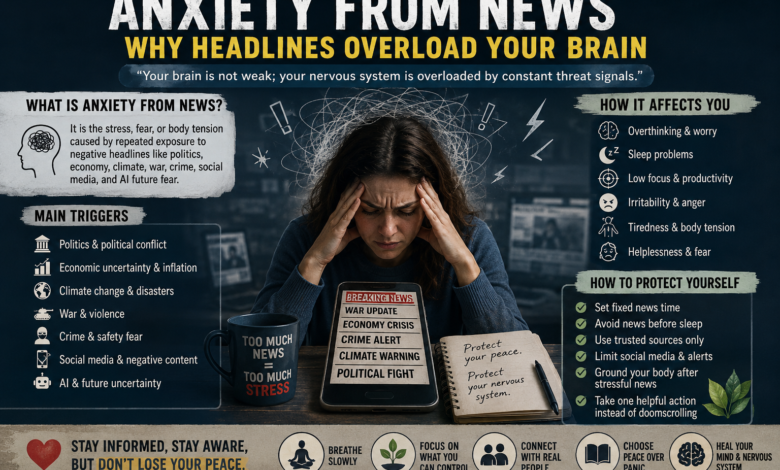
Anxiety from news is not just about being “too sensitive” or unable to handle reality. Today, politics, war, crime, climate fear, economic uncertainty, social media updates, and AI future fear can reach your mind many times a day. This creates news anxiety, where the brain keeps scanning for danger even after the phone is closed.
Thank you for reading this post, don't forget to subscribe!The unique point of this blog is simple: your brain is not weak; your nervous system is overloaded by constant threat signals.
That is why doomscrolling anxiety, media stress, sleep disturbance, body tension, and helpless thoughts often appear together.
This article will help you understand why constant bad news activates the survival brain, how nervous system overload keeps you stuck in fear, and how to stay informed without sacrificing your peace.
You will learn practical boundaries, grounding tools, and a calmer way to receive information without letting headlines control your inner life.
What Is Anxiety From News?
Anxiety from news is the mental, emotional, and physical stress that happens when repeated exposure to threatening headlines keeps your brain in alert mode. It may begin with one serious story, but slowly politics, crime, war, climate fear, economic uncertainty, social media updates, and AI future fear can make the mind feel unsafe even when you are sitting at home.
This is not weakness. This is a nervous system response. Your brain is designed to notice danger, protect you, and prepare your body to react. But when danger signals come through your phone all day, the brain can start treating information like immediate threat.
That is why many people feel restless, tense, helpless, irritated, or unable to sleep after watching or reading the news. This is where news anxiety begins.
For readers who are already trapped in repeated worry loops, link here:
Anxiety & Overthinking
News Anxiety Is More Than Just Worrying About Headlines
News anxiety is not only “thinking too much about the world.” It is a repeated fear cycle where the mind keeps asking, “What will happen next?” A person may check updates again and again, not because the news makes them peaceful, but because uncertainty feels unbearable.
This creates a difficult pattern. First, a headline creates fear. Then the person checks more news to feel informed. For a few minutes, checking may feel like control. But after reading more updates, the fear becomes stronger. Slowly, the mind becomes more alert, the body becomes more tense, and the person feels emotionally drained.
This is why anxiety from news often connects with overthinking. The problem is not information itself. The problem is when information enters the mind without emotional boundaries.
Read Also: Why Your Mind Fears Uncertainty and How to Train It
Why Modern News Feels More Personal Than Before
In the past, people received news at limited times. Today, news follows us through phones, apps, notifications, videos, comments, reels, and social media discussions. A war happening far away, a political fight, a crime report, a climate disaster, or an economic warning can appear on the screen many times in one day.
The brain does not always understand emotional distance. Even if the danger is not happening directly in front of you, images, words, and repeated alerts can still activate fear. This is why media stress feels stronger today. The mind is not only reading information; it is absorbing emotional signals.
For sensitive, thoughtful, or already anxious people, this becomes heavier. They may feel responsible for everything happening in the world, even when they have no direct control over it.
Read Also: How Detachment Helps Control Emotions
Why Your Brain Reacts Strongly to Constant Bad News
Your brain is built with a survival system. Its job is to detect danger quickly, especially negative information. This is why bad news often captures attention faster than neutral or positive news. The brain thinks, “This may affect my safety, my family, my money, my future, or my world.”
When this happens repeatedly, the nervous system can move into high-alert mode. This is called nervous system overload. The body may feel tight, the thoughts may become fast, and the mind may struggle to relax. Even after closing the phone, the internal alarm can continue.
This is the unique BBH angle of this blog: your brain is not weak; your nervous system is overloaded by constant threat signals. The solution is not to ignore reality. The solution is to create a healthier relationship with information.
Your Brain Is Not Weak; It Is Receiving Too Many Threat Signals
Many people blame themselves for feeling disturbed by the news. They think, “Why am I so affected? Why can’t I just stay normal?” But this self-blame makes anxiety from news worse.
A better way to understand it is this: the brain reacts to repeated danger signals because it is trying to protect you. If your phone shows political conflict in the morning, crime news in the afternoon, economic fear in the evening, and social media outrage at night, your nervous system may never get a clear message that it is safe.
This is why grounding, boundaries, and conscious media use matter. You do not need to become emotionally numb. You need to stop giving every headline direct access to your inner peace.
Personal Quote:
“For me, peace did not return when the world became less chaotic; it returned when I stopped giving every headline permission to enter my nervous system.”
The Survival Brain Does Not Know the Difference Between Real Danger and Digital Danger
Your logical mind may know that a headline is only information. But your body may still react as if danger is close. This is because the survival brain responds quickly to images, emotional words, uncertainty, and repeated warnings.
This explains why a person can feel chest tightness, stomach discomfort, headache, anger, sadness, or fear after watching the news. The body is not “imagining” everything. It is responding to perceived threat.
This is also why doomscrolling anxiety becomes powerful. The more a person scrolls, the more threat signals the brain receives. The more threat signals the brain receives, the harder it becomes to feel calm. The phone may be in the hand, but the whole nervous system becomes involved.
The Hidden Link Between Media Stress and Body Symptoms
Media stress does not stay only in the mind. It can show up in the body. A person may notice tight shoulders, shallow breathing, racing thoughts, sleep disturbance, tiredness, irritability, or a heavy feeling in the chest. Some people may also feel emotionally numb because the brain becomes tired from processing too much pain.
This is one reason anxiety from news can feel confusing. The person may think, “Nothing happened to me directly, so why do I feel so disturbed?” But the nervous system does not respond only to personal events. It also responds to repeated signals of danger, loss, conflict, and uncertainty.
When the body receives too much emotional information without recovery time, it starts carrying the weight of the world internally.
Read Also: What Is Inner Peace Really?
When Headlines Start Living Inside the Body
The deeper problem with news anxiety is that headlines do not always leave the mind after you close the screen. They can continue as fear, suspicion, sadness, anger, or helplessness. This is when news stops being information and becomes an emotional atmosphere.
For example, a person may read crime news and feel unsafe outside.
- They may read economic news and feel panic about the future.
- They may watch climate news and feel hopeless.
- They may read political news and feel angry for hours.
- This shows how constant bad news can shift the body into survival mode.
The goal is not to become careless or uninformed. The goal is to stay aware without allowing every update to control your nervous system.
The current uploaded blog already covers news anxiety, doomscrolling, triggers, sleep problems, and when to seek help, but this rewrite makes the structure stronger by adding the BBH nervous-system overload angle and clearer internal linking.
The Doomscrolling Anxiety Loop: Why You Keep Checking Even When It Hurts
Doomscrolling anxiety happens when a person keeps checking negative news even though it increases fear, stress, anger, or helplessness. The mind says, “Just one more update,” but the body keeps receiving more threat signals. This creates a painful loop where the person feels informed for a short time, but emotionally heavier afterward.
This loop is common because uncertainty makes the brain uncomfortable. When politics feels unstable, war news becomes frightening, crime reports feel closer, climate updates feel hopeless, or economic headlines feel threatening, the mind wants more information. It believes that more updates will create more safety.
But in many cases, the opposite happens. More scrolling creates more media stress, more body tension, and more mental alertness. The person is not becoming calmer. The nervous system is becoming more activated.
This is why anxiety from news is not only about what you read. It is also about how often you expose your brain to danger signals without recovery time.
Read Also: mental-health
Why Bad News Becomes Addictive to the Fearful Brain
Bad news can become emotionally addictive because the fearful brain is searching for control. When a person feels uncertain, the mind wants answers. It wants to know what will happen next, who is safe, what danger is coming, and how serious the situation may become.
This does not mean the person enjoys bad news. It means the brain is trying to reduce uncertainty. But each new update often creates another question. One headline leads to another article. One video leads to another comment section. One warning leads to another prediction.
This creates doomscrolling anxiety because the mind keeps chasing certainty in a place that mostly gives more fear. The person may feel unable to stop, even when they know the scrolling is damaging their mood.
The deeper issue is not lack of discipline. The deeper issue is a nervous system searching for safety through information. But information without boundaries can become emotional overload.
Read Also: Why Your Mind Fears Uncertainty and How to Train It
Checking the News Can Feel Like Safety, but It Often Increases Fear
Checking the news can feel like safety because the brain believes, “If I know everything, I can prepare for everything.” This feeling can give short-term relief. But when the news is full of conflict, disaster, threat, and uncertainty, checking again often increases the fear you were trying to reduce.
The loop looks simple: fear appears, you check the news, you feel briefly informed, then another frightening update appears, and fear returns stronger. This repeated cycle can slowly create nervous system overload.
The body may stay tense even when you are not reading the news. The mind may keep replaying headlines. Sleep may become lighter. Focus may reduce. A person may become irritated, suspicious, or emotionally exhausted.
This is why healthy news boundaries are not avoidance. They are protection. You can stay informed without giving every update unlimited access to your nervous system.
Common Triggers Behind Anxiety From News
Anxiety from news can come from many directions because modern news covers almost every survival concern: safety, money, identity, future, health, environment, politics, and relationships. For some people, political conflict is the biggest trigger. For others, crime videos, war images, inflation updates, climate disasters, or AI future fear create the strongest stress.
The problem becomes more serious when all these triggers appear together. A person may wake up to political arguments, see crime news during lunch, read economic fear in the evening, and watch climate or war updates at night. By the end of the day, the brain has received multiple messages that the world is unsafe.
This creates news anxiety because the mind starts expecting danger everywhere. The person may not be directly affected by every event, but emotionally, the nervous system may feel surrounded by threat.
Read Also: Mental Health → Anxiety & Overthinking
Political and Economic News Can Trigger Future Fear
Political and economic news can strongly trigger future fear because they connect directly with stability, money, work, family safety, and social order. When people repeatedly hear about elections, conflict, inflation, recession, job loss, market instability, or government decisions, the mind may begin asking, “What will happen to my life?”
This type of media stress is powerful because it touches survival concerns. Even if the person is safe today, the brain may start worrying about tomorrow. The result can be overthinking, financial fear, anger, helplessness, and constant checking.
For many readers, the issue is not that they do not care about society. They may care deeply. But caring without emotional boundaries can become self-damage. Awareness must be balanced with regulation, otherwise the mind becomes trapped in future threat.
Read Also: How Detachment Reduces Anxiety and Stress
Climate, War, and Crime News Can Trigger Safety Fear
Climate disasters, war updates, and crime news affect the brain differently because they often include strong images, intense language, and visible suffering. The survival brain reacts quickly to danger, destruction, violence, and loss. Even when these events are far away, the body may respond with fear.
This is why some people feel unsafe after reading crime news. Others feel helpless after climate reports. Some feel emotionally disturbed after seeing war images. These reactions are not fake. They are signs that the nervous system is processing repeated threat signals.
However, constant exposure does not always create meaningful action. Sometimes it only creates exhaustion. A person may feel too overwhelmed to help, too anxious to focus, and too heavy to rest.
Healthy awareness means knowing what is happening, but also knowing when your body needs a pause.
Social Media Makes News Anxiety Faster and More Emotional
Social media can make news anxiety faster because it removes the natural boundary between personal life and global crisis. A person may open an app to relax, but within seconds they may see war clips, political anger, crime videos, financial panic, climate fear, and emotional arguments.
Algorithms often push content that creates strong reactions. Anger, fear, shock, and outrage travel quickly. This means the brain may receive emotional news before it has time to prepare or think clearly.
Comment sections can make this worse. Even when the original news is serious, the comments may add panic, blame, insults, conspiracy thinking, or hopelessness. This increases doomscrolling anxiety because the person is no longer reading only information; they are absorbing collective fear.
This is why social media news needs stricter boundaries than traditional news. It is faster, more emotional, and more addictive.
How News Anxiety Affects Sleep, Focus, and Relationships
When anxiety from news becomes regular, it does not stay limited to screen time. It can affect sleep, focus, work, family conversations, and emotional patience. A person may feel mentally tired but still unable to relax. They may try to work, but headlines keep replaying in the mind. They may sit with family, but emotionally remain inside the news cycle.
Sleep is often one of the first areas affected. When the brain sees threatening information before bed, it may stay alert instead of entering rest mode. Focus also becomes weaker because the mind keeps scanning for updates. Relationships can suffer because the person may become more irritated, fearful, argumentative, or emotionally distant.
This is how nervous system overload quietly spreads into daily life. The issue is no longer only the news. The issue is that the body has forgotten how to come back to safety.
Read Also: Brain Health → Nervous System Regulation
Night-Time News Can Keep the Brain in Alert Mode
Night-time news is especially harmful for anxious people because the brain needs safety signals before sleep. If the last thing your mind sees is political conflict, crime, war, economic warning, climate disaster, or AI future fear, the nervous system may not understand that it is time to rest.
This can create racing thoughts, tense breathing, disturbed sleep, emotional dreams, or early-morning anxiety. The person may wake up tired and begin the next day already stressed. Over time, this pattern can make media stress feel normal.
A powerful rule is simple: no stressful news before bed. The night should become a recovery zone, not another battlefield for the nervous system.
Read Also : mindfulness-and-anxiety
How to Reduce Anxiety From News Without Ignoring Reality
Reducing anxiety from news does not mean ignoring the world, becoming careless, or pretending serious problems do not exist.
- The goal is not denial
- . The goal is conscious exposure.
- You can stay informed without allowing every headline to enter your body like an emergency.
Many people feel guilty when they reduce news consumption. They think, “If I stop checking, maybe I am not responsible or aware.” But awareness without regulation can become emotional damage.
A calm person can understand reality more clearly than a panicked person. When your nervous system is overloaded, even useful information can feel unbearable.
The healthier question is not, “Should I care or not care?” The better question is, “How can I care without losing myself?” This is where news boundaries become important. Boundaries do not make you uninformed. Boundaries help you stay emotionally strong enough to respond wisely.
Set a Fixed News Window Instead of Checking All Day
One of the most effective ways to reduce news anxiety is to stop checking updates throughout the day. The brain needs predictable limits. When news appears every hour through notifications, social media, videos, and comment sections, the nervous system never receives a full break.
Choose one or two fixed news windows in the day. For example, you may check reliable news once in the morning and once in the evening, but avoid random checking between work, meals, family time, and rest. This teaches the brain that information has a place, but it does not control the whole day.
This rule is especially helpful for people struggling with doomscrolling anxiety. The goal is not to avoid important information. The goal is to stop using news as a constant emotional background.
Read Also: How Detachment Reduces Anxiety and Stress
Stop Reading News Before Sleep
Night is not the right time to feed the survival brain. If you read stressful headlines before bed, your body may enter alert mode when it should be preparing for rest. This can increase racing thoughts, shallow breathing, tightness, emotional dreams, or early-morning anxiety.
A strong rule is: no stressful news at least one hour before sleep. For highly anxious people, two hours may be better. Replace late-night checking with a calming routine: dim lights, slow breathing, journaling, prayer, soft music, reading something peaceful, or simply sitting without your phone.
This is not weakness. This is nervous system hygiene. Just as your body needs clean food, your mind needs clean emotional input before sleep. If the last thing you consume is fear, your brain may carry that fear into the night.
Use Grounding After Stressful Headlines
Sometimes you will still come across difficult news. A crime report, war update, climate disaster, political conflict, economic warning, or AI future fear may suddenly disturb your peace. In that moment, do not only argue with your thoughts. Bring the body back to safety.
A simple grounding practice can help reduce nervous system overload.
- Put both feet on the floor.
- Relax your shoulders.
- Take a slow breath in and a longer breath out.
- Look around and name five things you can see.
- Touch something solid near you.
- Remind yourself: “This is information. I am here. My body is safe in this moment.”
This practice does not remove world problems, but it tells your survival brain that the headline is not happening inside your room. That distinction is powerful for reducing media stress.
Ask: “Is This Information Helping Me Act or Only Making Me Panic?”
Before reading more, ask one important question: “Is this information helping me act, or is it only making me panic?”
If the information helps you make a wise decision, prepare responsibly, vote, donate, protect your family, support someone, or understand something important, then it has value. But if the information only increases fear without giving you any useful direction, then more exposure may not be helping you.
This question creates a clean mental boundary. Not every update deserves your attention. Not every opinion deserves your emotional energy. Not every frightening prediction deserves a place in your nervous system.
When you use this filter, you move from passive fear to conscious choice. You stop being pulled by every headline and start deciding what information truly deserves your mind.
Build Healthy News Boundaries Without Becoming Uninformed
Healthy news boundaries are not about living blindly. They are about choosing information with wisdom. Start by selecting a few trusted sources instead of jumping between dozens of emotional posts, short clips, and comment sections. Too many sources can increase confusion and media stress.
Turn off unnecessary breaking-news notifications. Mute words or topics that repeatedly trigger panic when you do not need constant updates. Avoid watching the same disturbing video again and again. Repetition makes the brain feel as if the danger is happening repeatedly, even if it is the same event.
Also be careful with social media news. A short clip may not give full context, but it can still create a strong emotional reaction. Before believing or sharing something, pause. Ask whether it is verified, useful, and necessary.
The goal is simple: stay informed through clarity, not through emotional flooding.
Read Also: Start Here – Your Journey to Mental Clarity & Emotional Healing
Replace Doomscrolling With One Useful Action
One reason anxiety from news feels so painful is that people absorb suffering but do not always know what to do with it. The brain receives threat signals, but the body has no action path. This creates helplessness.
A better approach is to replace doomscrolling with one useful action.
- If a climate issue worries you, take one small environmental action.
- If political news worries you, vote, learn calmly, or participate responsibly.
- If war or disaster news hurts your heart, donate if possible or support verified relief work.
- If economic fear is rising, review your budget or make one practical plan.
Action does not need to be big to be meaningful. Even a small constructive step tells the nervous system, “I am not powerless.” This helps break the loop of doomscrolling anxiety and gives your mind a healthier direction.
When Should You Get Help for News Anxiety?
You should consider support when anxiety from news starts affecting your sleep, appetite, work, relationships, concentration, or daily peace.
If you feel panic after reading headlines, avoid normal activities, feel unsafe most of the time, or cannot stop checking the news even when it hurts you, professional support may help.
Therapy, counseling, support groups, or structured nervous system practices can help you understand the fear cycle and rebuild emotional stability. Getting help does not mean you are weak. It means your system has carried too much for too long and deserves care.
This is especially important if news anxiety mixes with past trauma, panic symptoms, depression, obsessive checking, or constant fear about the future. You do not have to handle world heaviness alone.
Read Also: Nervous System Reset Program for Anxiety & Stress
You Deserve Support When the World Feels Too Heavy
The world may continue to be uncertain. Politics may remain noisy. The economy may shift. Climate concerns, war updates, crime reports, social media outrage, and AI future fear may keep appearing. But your nervous system does not need to carry all of it every hour of the day.
You can care about reality and still protect your peace. You can stay informed and still sleep. You can be responsible without becoming emotionally flooded. You can read the news without letting the news define your entire inner life.
The real healing begins when you stop asking,
“Why am I so weak?” and start asking,
“What has my nervous system been forced to carry?”
Your brain is not weak. Your body is asking for boundaries, recovery, and safety. When you learn to receive information consciously, news becomes something you understand — not something that controls you.
People Also Ask
1. What is anxiety from news?
Anxiety from news is stress, fear, or body tension caused by repeated exposure to negative headlines. It often happens when the nervous system receives too many threat signals.
2. Why does the news make me anxious?
The news can make you anxious because your brain reacts strongly to danger, uncertainty, conflict, crime, war, climate fear, and economic stress. Constant exposure can create nervous system overload.
3. Can doomscrolling cause anxiety?
Yes, doomscrolling can increase anxiety because it keeps the brain focused on negative information. This can make fear feel urgent even when you are physically safe.
4. How do I stop anxiety from news?
Set fixed news times, turn off alerts, avoid news before sleep, use trusted sources, and ground your body after stressful headlines. The goal is informed awareness, not emotional flooding.
5. Should I stop watching the news completely?
Not always. It is better to create healthy news boundaries so you stay informed without letting media stress control your sleep, mood, focus, and peace.
FAQ
1. Is news anxiety a real mental health issue?
Yes, news anxiety can seriously affect sleep, focus, mood, and daily peace. WHO notes that anxiety becomes concerning when fear is intense, hard to control, and affects daily life.
2. Why does constant bad news affect the body?
Constant bad news can activate the stress response, which may cause tension, shallow breathing, racing thoughts, and sleep disturbance. WHO also advises limiting news time when it increases stress.
3. Is doomscrolling harmful for mental health?
Yes, Cleveland Clinic explains that doomscrolling means spending too much time consuming negative news, and it can reinforce negative thoughts, fear, stress, sadness, depression, and anxiety.
4. How can I stay informed without media stress?
Use a few trusted sources, check news at fixed times, avoid emotional comment sections, and stop before your body becomes tense. APA recommends media guardrails to reduce news-related stress and overload.
5. When should I get professional help?
Get support if anxiety from news affects sleep, work, relationships, appetite, panic, or daily functioning. Professional help is useful when fear becomes difficult to control or lasts too long.
External References
- American Psychological Association — Media Overload and Mental Health
Website: APA
URL: https://www.apa.org/monitor/2022/11/strain-media-overload - World Health Organization — Stress and Limiting News Time
Website: WHO
URL: https://www.who.int/news-room/questions-and-answers/item/stress - World Health Organization — Anxiety Disorders
Website: WHO
URL: https://www.who.int/news-room/fact-sheets/detail/anxiety-disorders - Cleveland Clinic — What Doomscrolling Is and How to Stop
Website: Cleveland Clinic
URL: https://health.clevelandclinic.org/everything-you-need-to-know-about-doomscrolling-and-how-to-avoid-it - Cleveland Clinic Newsroom — Why You Should Avoid Doomscrolling
Website: Cleveland Clinic
URL: https://newsroom.clevelandclinic.org/2025/10/24/why-you-should-avoid-doomscrolling