Astronaut Deaths in Space: Medical Risks, Mental Health
What Space Teaches About the Body, Brain, and Isolation

Astronaut deaths in space is not only a story about danger outside Earth; it is also a deeper lesson about the human body, brain, fear, isolation, and survival under extreme pressure.
Thank you for reading this post, don't forget to subscribe!Many articles discuss accidents, missions, or space technology, but this blog looks at what most people ignore: how the medical risks of space travel, astronaut mental health, and the psychological effects of space travel reveal the hidden limits of human life.
Space removes ordinary safety — gravity, routine, nature, emotional contact, and control — and this can affect both the human body in space and the mind in ways science is still trying to understand.
👉This article is unique because it connects space medicine with nervous system stress, loneliness, courage, detachment, and inner stability.
It helps readers understand why exploring space also means exploring the unknown space inside the human mind.
Astronaut Deaths in Space: What Is Confirmed and What Is Not
When people search for astronaut deaths in space, they often expect a frightening story of someone dying alone in deep space. The truth needs more care. Confirmed astronaut deaths connected with space programs have mostly happened during launch preparation, launch, re-entry, or mission-related accidents, not from a person simply drifting or dying secretly in outer space.
This distinction matters because fear-based stories can easily turn into rumors, while real history already carries enough seriousness.
The Apollo 1 tragedy happened during a ground test in 1967, when Virgil Grissom, Edward White, and Roger Chaffee lost their lives in a command module fire. T
he Space Shuttle Challenger crew died during launch in 1986, and the Space Shuttle Columbia crew died during re-entry in 2003. These were not hidden mysteries.
They were public tragedies that changed safety thinking in human spaceflight. NASA continues to remember the crews of Apollo 1, Challenger, and Columbia as part of its official Day of Remembrance.
This is why a responsible article on astronaut deaths in space should not depend on cover-up claims, secret suicide stories, or shocking rumors.
The real question is more important: what do these deaths, risks, and extreme missions teach us about the fragile relationship between technology, the human body in space, and the human mind under pressure?
Read Also: nervous system regulation
Why This Topic Needs Careful Fact-Checking
A topic like astronaut deaths in space must be handled with respect because it touches death, fear, mental health, public trust, and the families of real people.
If a blog mixes confirmed tragedies with unsupported claims, the reader may feel shocked for a moment, but the article loses long-term trust. For a health and psychology website, trust is more valuable than sensation.
This is especially important because space-related stories can easily attract myths. Space feels distant, silent, and mysterious, so the human mind naturally fills the unknown with imagination. But imagination is not evidence.
A calm article should separate three things clearly: confirmed accidents, possible health risks, and unverified rumors. When those lines are blurred, the reader may leave with fear instead of clarity.
A better approach is to use verified space-health research and then ask deeper human questions.
- How does isolation affect the brain? How does distance from Earth change emotional safety?
- How do the medical risks of space travel reveal the limits of the body?
- How does training support astronaut mental health, and where might training still not fully predict human emotional reactions?
Why Space Exploration Is Still a Human Health Story
Space exploration is often presented as a story of rockets, engineering, physics, and national achievement. But behind every spacecraft is a human nervous system. Behind every mission plan is a body that needs oxygen, sleep, food, gravity adaptation, emotional contact, and mental stability.
That is why the medical risks of space travel are not a side topic. They are central to whether long missions can succeed.
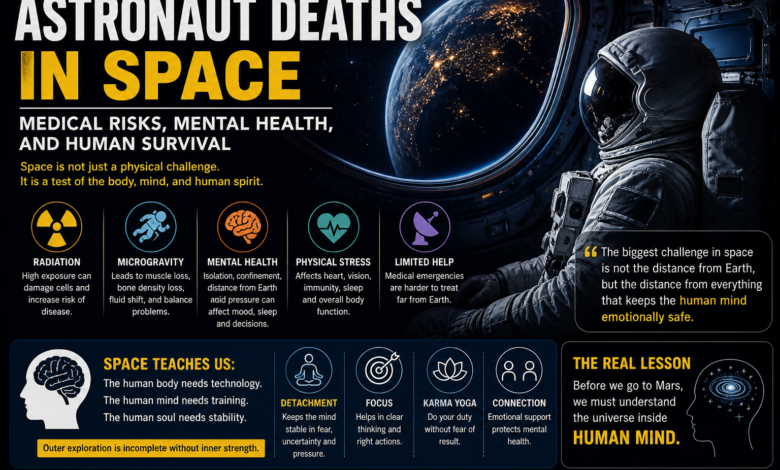
NASA identifies major hazards of human spaceflight, including space radiation, isolation and confinement, distance from Earth, altered gravity, and closed or hostile environments.
These hazards affect more than mission equipment.
They affect the human body in space, decision-making, mood, sleep, physical strength, immunity, and long-term health.
This makes astronaut deaths in space a deeper human-health subject. It is not only about who died or when an accident happened. It is also about what kind of pressure a human being enters when normal earthly protection is removed.
On Earth, people take gravity, fresh air, familiar faces, nature, and quick medical access for granted. In space, every one of these ordinary supports becomes limited, artificial, delayed, or unavailable.
👉For BBH, this is the real uniqueness of the topic: space shows what happens when safety, routine, connection, and control become fragile.
Space Is Also a Mirror of the Human Mind
The most powerful part of space exploration is not only that humans leave Earth. It is that humans carry their mind with them.
A person can wear a space suit, follow training, live inside advanced technology, and still remain human moment to moment.
- Courage does not remove emotion.
- Training does not erase loneliness.
- Discipline does not guarantee that the mind will feel stable every day.
This is where astronaut mental health becomes deeply important. NASA’s Human Research Program recognizes that isolation, radiation, distance from Earth, and other intense space stressors may affect crew mental health.
Research continues because long-duration missions need not only physical survival, but psychological strength, emotional regulation, sleep stability, and healthy crew relationships.
The psychological effects of space travel may include more than stress. They can include loneliness, pressure, silence, uncertainty, confinement, and the emotional shock of seeing Earth from far away.
For one astronaut, that view may create wonder.
For another human mind, it may create a feeling of smallness in front of the unknown.
This does not mean weakness. It means the human brain is still a vast area of discovery.
Read Also: why emotions feel intense
Why This Blog Takes a Different Direction
Many articles about astronaut deaths in space either focus only on accidents or move into dramatic rumors. This blog takes a different direction. It does not use death for fear. It uses space as a serious mirror for health, psychology, nervous system pressure, and inner stability.
The deeper question is not only whether humans can reach Mars.
The deeper question is whether the mind, body, relationships, sleep, food habits, emotional regulation, and spiritual grounding are strong enough to carry human life into extreme isolation.
People often imagine that the future is only about advanced machines, but the future may depend just as much on the ordinary basics of human stability.
If the human body in space needs exercise, oxygen, nutrition, radiation protection, and medical monitoring, the human mind also needs its own support system. It needs focus, detachment, emotional training, meaningful action, and connection.
This is where the BBH angle becomes important: outer exploration is incomplete without inner preparation.
Space may be above Earth, but isolation can happen anywhere. A person can feel isolated inside a city, family, relationship, workplace, or success.
Space simply makes the invisible more visible. It shows that the human mind needs care, training, and grounding wherever it goes.
Medical Risks of Space Travel: How Space Challenges the Human Body
The medical risks of space travel begin because the human body was built for Earth. Our bones, muscles, blood flow, balance system, sleep rhythm, immune function, and nervous system all developed under Earth’s gravity, light cycle, atmosphere, and natural environment.
When a person leaves Earth, the body does not simply “float.” It begins adapting to a completely different survival condition.
This is why the human body in space becomes a living experiment. Space can affect muscle strength, bone density, heart function, balance, vision, sleep, immunity, and stress response.
These changes may not always be visible from outside, but inside the body, many systems are working harder to adjust. The longer the mission, the more serious these changes can become.
When people think about astronaut deaths in space, they may imagine one sudden disaster. But the deeper risk is that space slowly pressures the body and mind through many small changes at the same time.
A human being in space is not only facing distance from Earth; they are facing a complete change in biological support.
How the Human Body in Space Changes Without Earth’s Support
The human body in space loses one of its most important daily anchors: gravity. On Earth, gravity constantly gives the body information.
It tells the muscles how to work, the bones how much strength to maintain, the balance system where the body is positioned, and the heart how to move blood through the body. In microgravity, many of these signals change.
Fluids may shift upward toward the head. The face may look puffier. The legs may lose some normal pressure.
The balance system may become confused because the inner ear is no longer receiving the same gravity-based information. This can create dizziness, motion sickness, disorientation, and changes in coordination.
Muscles and bones also receive less natural loading. On Earth, walking, standing, climbing stairs, and even sitting upright create pressure that helps maintain strength.
In space, the body does not need to fight gravity in the same way. Without regular exercise and medical monitoring, muscles can weaken and bones can lose density.
This shows why the medical risks of space travel are not only about rare accidents. They are about the daily biological cost of living outside Earth’s normal support system.
Read Also: how detachment helps control emotions
Why Microgravity Can Affect Strength, Bones, and Balance
Microgravity changes the way the body understands effort. On Earth, even ordinary movement requires the body to carry weight. In space, movement feels lighter, but that lightness can become a problem because muscles and bones need resistance to remain strong.
This is why astronauts follow strict exercise routines. Exercise is not only fitness in space; it is health protection. It helps reduce muscle loss, supports bone strength, protects circulation, and gives the body a structured rhythm.
Balance can also be affected because the brain is trying to understand movement without normal gravity cues. This shows how deeply the human body in space depends on Earth-based signals we rarely notice.
Why Space Radiation Makes Long Missions More Serious
Radiation is one of the most serious medical risks of space travel, especially for long missions beyond low Earth orbit. On Earth, the atmosphere and magnetic field protect humans from much of the harmful radiation coming from space. Outside that protection, the body may face greater exposure.
Space radiation can increase concern for long-term health because it may affect cells, tissues, and disease risk. This becomes especially important when people talk about Mars missions or long-duration space living.
A short mission and a long mission are not the same health challenge. The farther humans go, the more protection, monitoring, and medical planning they need. This is why space exploration is not only an engineering question. It is also a deep biological question about how much stress the human body can safely carry.
Astronaut Mental Health: Isolation, Loneliness, and Mental Pressure
Astronaut mental health is one of the most important parts of future space travel. A mission may have the best technology, but if the mind becomes unstable, exhausted, lonely, or emotionally overwhelmed, decision-making can suffer. Space requires mental clarity because even small mistakes can become dangerous.
Astronauts are trained carefully, but training does not make them machines. They are human beings living in confined spaces, away from family, nature, normal life, and quick help. Their sleep may be disturbed. Their privacy may be limited. Their relationships with crew members may become more important because the same small group must live and work together under pressure.
This is where the psychological effects of space travel become serious. Isolation can change mood. Confinement can increase irritation. Distance from Earth can create emotional heaviness. The constant awareness that help is far away can increase stress. Even courage needs emotional support.
When people discuss astronaut deaths in space, they should also understand that survival is not only physical. Human survival also depends on emotional regulation, mental endurance, and the ability to stay connected to meaning when normal life disappears.
Read Also : how detachment reduces anxiety and stress
Psychological Effects of Space Travel on the Human Mind
The psychological effects of space travel are not only about fear. They are about living in a condition where the brain loses many ordinary sources of safety.
On Earth, people regulate themselves through sunlight, fresh air, walking outside, meeting loved ones, changing rooms, hearing natural sounds, and feeling connected to normal life. In space, many of these small emotional supports are missing or limited.
This can create loneliness, mental pressure, emotional flatness, irritability, anxiety, or a feeling of disconnection. A person may be surrounded by advanced technology and still feel deeply alone. This is not weakness. It is the nervous system responding to an unusual environment.
There may also be a deeper existential effect. Seeing Earth from space can create awe, gratitude, and unity. But it may also create a powerful realization of human smallness. Some minds may feel inspired by that view. Other minds may feel overwhelmed by the vastness and silence.
This is why astronaut mental health must be treated as seriously as oxygen, food, exercise, and mission safety.
Why Training Cannot Predict Every Moment of the Mind
Astronauts are selected, trained, tested, and prepared with discipline. Their courage is real. Their ability is extraordinary.
But even with strong training, the human mind can shift moment to moment.
A person may be calm one day and emotionally heavy the next.
A person may feel inspired by the mission, then suddenly feel lonely, trapped, or deeply aware of distance from Earth.
This is an important truth: training increases readiness, but it does not remove human unpredictability. The brain is not a fixed machine.
It is connected to sleep, body chemistry, memory, relationships, meaning, fear, fatigue, and environment. When all these systems are placed under pressure, the mind may respond in ways no checklist can fully predict.
That is why the medical risks of space travel and astronaut mental health must be studied together. The body affects the mind, and the mind affects the body. Poor sleep can weaken emotional control. Stress can affect immunity. Isolation can affect motivation. Fear can affect decisions.
Space teaches us that real courage is not the absence of fear. Real courage is learning how to act clearly while fear, uncertainty, and loneliness are present.
Read Also: why your mind fears uncertainty
Why Space Health Is Also Nervous System Health
Space travel challenges the nervous system because it removes familiar signals of safety. The brain must process unusual movement, limited space, artificial routines, delayed communication, mission pressure, and the awareness that Earth is far away. This can keep the body in a higher state of alertness.
When the nervous system stays alert for too long, a person may become more reactive, tired, emotionally sensitive, or mentally strained. This is similar to what happens on Earth during chronic stress, trauma, burnout, or long periods of loneliness. The location is different, but the basic human system is still the same.
This is the deeper BBH connection. The psychological effects of space travel show us that human beings need more than survival equipment. They need regulation, emotional grounding, meaningful routine, healthy connection, and a stable inner framework.
The human body in space needs exercise and medical protection. The mind also needs its own protection: sleep discipline, emotional honesty, connection, focus, detachment, and purpose. Without these, even the most advanced mission can place too much pressure on the human system.
Read Also: Brain and Trauma
Serious Reader Questions
1. If the body struggles without gravity, what happens to the mind when it loses emotional gravity?
Emotional gravity means routine, relationships, nature, purpose, and inner stability. Without these, the mind may feel scattered or unsafe.
2. Can technology take humans farther than their emotional system is ready to go?
Possibly. This is why future space missions must develop mental training as deeply as physical and technical training.
3. Is space isolation completely different from Earth isolation?
Space isolation is more extreme, but the root feeling can happen anywhere. A person may feel isolated in a room, city, family, or relationship when connection and inner safety are missing.
Space Shows What Happens When Safety, Routine, and Control Are Removed
Space is not only a physical distance from Earth. It is a condition where many basic supports of human life are removed or reduced. Gravity changes. Natural routine changes. Fresh air, open space, familiar people, nature, and ordinary movement disappear. Even control becomes limited because every action depends on systems, planning, communication, and survival discipline.
This is why the deeper meaning of astronaut deaths in space is not only about danger. It is about what happens when the human body and mind enter an environment where normal safety is no longer automatic.
On Earth, people often do not notice how much they depend on daily anchors. Sleep timing, food rhythm, walking outside, family contact, sunlight, and normal conversation all quietly support emotional balance.
When these anchors are removed, the nervous system can feel exposed. The psychological effects of space travel reveal that the mind needs more than intelligence and courage. It also needs rhythm, belonging, emotional connection, and a sense of inner safety.
Read Also: Loneliness and Isolation
Isolation Can Happen on Earth, Not Only in Space
Isolation is not only a space problem. A human being can feel isolated under the open sky, inside a city, inside a family, inside success, or even while surrounded by people. Space makes isolation more visible because it removes familiar earthly support, but the basic human experience can happen anywhere.
Many people on Earth already live with emotional isolation.
- They may have a house but no emotional safety.
- They may have relationships but no deep connection.
- They may have work, money, or social contact but still feel unseen inside.
This is why astronaut mental health teaches something bigger than space psychology. It teaches us that the mind needs real connection, not only physical presence.
Loneliness is not always caused by distance. Sometimes it is caused by emotional disconnection, unresolved fear, lack of meaning, or the feeling that no one truly understands what is happening inside.
In space, this loneliness becomes more extreme. But on Earth, many people also carry invisible isolation without calling it a health issue.
This is why isolation must be treated seriously. It can affect sleep, mood, decision-making, motivation, nervous system regulation, and overall health.
Why Inner Stability Matters More Than Distance From Earth
The future may ask whether humans can live on Mars, travel deeper into space, or survive for long periods away from Earth. But the deeper question is not only technological. The deeper question is whether the human body, brain, and mind are ready for that level of uncertainty, silence, confinement, and loss of control.
The human body in space needs oxygen, nutrition, movement, sleep protection, radiation protection, and medical support. In the same way, the mind needs emotional nutrition. It needs meaning, discipline, focus, relationship support, self-awareness, and a way to stay steady when fear appears.
This is where the BBH view becomes important. A human being cannot carry only machines into extreme environments. They must also carry a mental and emotional backup system. That backup system includes healthy food, proper sleep, regulated breathing, meaningful relationships, disciplined action, emotional honesty, and spiritual grounding.
The medical risks of space travel show the limits of the body. But the mental risks of isolation show the deeper truth: if the mind is unstable, even the safest environment can feel unsafe. If the mind is trained, grounded, and connected to purpose, a person can face difficulty with more clarity.
Detachment Is Not Escape; It Is Mental Balance
Detachment does not mean becoming cold, emotionless, or disconnected from life. Real detachment means the mind can experience fear, uncertainty, loneliness, or pressure without completely losing balance. It means a person can see the emotion without becoming fully controlled by the emotion.
In space, this kind of detachment would matter deeply. An astronaut may feel fear, but still needs to act. They may feel loneliness, but still need to cooperate. They may feel pressure, but still need to think clearly. This is also true on Earth.
Detachment is not running away from reality. It is seeing reality more clearly. It helps the mind stop gripping every thought as truth and every emotion as command. In the context of astronaut mental health, detachment can be understood as emotional space inside the mind.
Karma Yoga Helps the Mind Act Without Fear Taking Over
Karma Yoga teaches action without becoming trapped by fear, attachment, or outcome obsession. In simple terms, it means doing the right action with focus, discipline, and sincerity, while not allowing the mind to collapse under imagined results.
This idea fits deeply with space exploration. Astronauts cannot afford to live only inside fear. They must act according to training, duty, teamwork, and mission responsibility. Fear may be present, but action must remain steady. This is also an important lesson for ordinary life.
When a person faces pressure, the mind often wants guarantees. But life does not always provide guarantees. Karma Yoga gives the mind a practical direction: focus on the next right action. This can reduce emotional paralysis and help the nervous system regain structure.
For BBH, this is where spirituality becomes health-supportive. Spirituality is not escape from science. It can become inner training for focus, emotional regulation, courage, detachment, and disciplined living.
Read Also: Start Here – Your Journey to Mental Clarity and Emotional Healing
What Astronaut Deaths in Space Teach Us About Human Survival
The subject of astronaut deaths in space should not be used to create fear. It should be used to understand human survival more honestly.
Space shows that human life is powerful, but also fragile.
Technology can carry the body beyond Earth, but the body still needs protection.
Training can prepare the mind, but the mind still needs emotional support.
The medical risks of space travel teach us that the body depends on gravity, movement, sleep, radiation protection, nutrition, and medical access. The psychological effects of space travel teach us that the mind depends on connection, meaning, routine, emotional regulation, and inner stability.
This is the real human lesson. We may search the sky, explore planets, and dream of Mars, but the human mind itself is also a vast unknown space. The more we explore outside Earth, the more we must understand what is happening inside the brain, nervous system, emotions, and consciousness.
Human courage is beautiful, but courage should be supported by health, wisdom, preparation, and humility.
Read Also: brain-and-trauma
Final Thoughts on Astronaut Deaths in Space and the Human Mind
Astronaut deaths in space is a serious topic, but its deepest lesson is not fear. Its deepest lesson is awareness. Space reminds us that the human body and mind are not separate from environment, connection, routine, gravity, sleep, food, and meaning.
The human body in space needs science. Astronaut mental health needs emotional support. The future of exploration needs technology, but it also needs inner stability. If humans want to go farther into space, they must also go deeper into understanding the mind.
This is why space is more than a destination. It is a mirror. It shows that the unknown is not only above us. The unknown is also inside us. And before humanity can travel safely into deeper space, it must learn how to carry emotional balance, spiritual grounding, and mental health wherever it goes.
People Also Ask
1. Have any astronauts died in space?
Most confirmed astronaut deaths connected with space programs happened during ground tests, launch, re-entry, or mission-related accidents, not from someone secretly dying while floating in deep space. The most known tragedies include Apollo 1, Challenger, and Columbia. A responsible discussion of astronaut deaths in space should separate confirmed history from rumors and fear-based stories.
2. What are the main medical risks of space travel?
The major medical risks of space travel include space radiation, microgravity, muscle loss, bone loss, fluid shifts, sleep disruption, immune changes, vision problems, and limited emergency medical access. NASA identifies five major human spaceflight hazards: radiation, isolation and confinement, distance from Earth, altered gravity, and closed or hostile environments.
3. How does space affect astronaut mental health?
Astronaut mental health can be affected by isolation, confinement, distance from family, mission pressure, limited privacy, sleep disruption, and delayed communication. NASA notes that prolonged isolation and confinement can increase the risk of behavioral issues and psychiatric disorders, including anxiety and depression, which can affect sleep, morale, and decision-making.
4. What are the psychological effects of space travel?
The psychological effects of space travel can include loneliness, emotional pressure, irritability, stress, sleep changes, loss of normal routine, and a stronger awareness of distance from Earth. NASA’s isolation and confinement hazard page explains that behavioral responses can happen when groups live far from Earth in small spaces for long periods.
5. How does the human body in space change?
The human body in space may experience muscle weakening, bone density loss, balance changes, fluid shifts, vision issues, cardiovascular changes, and immune-system stress. A scientific review on human health during space travel notes that long-duration spaceflight can affect multiple systems and that radiation exposure is a serious concern for future missions.
Read Also: neuroscience
FAQ
1. Why is this blog not focused on NASA cover-up stories?
This blog avoids unsupported cover-up claims because astronaut deaths in space is a serious topic involving real people, families, health, and public trust. A BBH article should focus on verified facts, medical risk, mental health, and human learning instead of fear-based speculation.
2. Can isolation affect health even on Earth?
Yes. Isolation can affect sleep, mood, stress hormones, motivation, nervous system regulation, and emotional stability. Space makes isolation extreme, but humans can also feel isolated in cities, families, relationships, work pressure, or success when emotional connection and inner safety are missing.
3. Why is astronaut mental health important for future Mars missions?
Astronaut mental health is essential because Mars missions may involve longer travel, delayed communication, confinement, limited privacy, and distance from Earth. Even trained astronauts remain human, so mental clarity, emotional regulation, sleep, teamwork, and meaning become mission-safety factors.
4. Is spirituality useful for space or extreme isolation?
From a BBH view, spirituality can support stability when it is practical. Detachment, Karma Yoga, focus, disciplined action, sleep, food, relationship guidance, and emotional regulation can help the mind stay grounded. Spirituality here means inner training, not escape from science.
5. What is the biggest lesson from astronaut deaths and space health risks?
The biggest lesson is that human survival needs both outer technology and inner preparation. The medical risks of space travel show the body’s limits, while the psychological effects of space travel show the mind’s need for connection, meaning, routine, and emotional stability.
External References
- NASA — 5 Hazards of Human Spaceflight
https://www.nasa.gov/hrp/hazards/ - NASA — Risk of Behavioral Changes and Psychiatric Disorders
https://www.nasa.gov/reference/risk-of-behavioral-changes-and-psychiatric-disorders/ - NASA — Hazard: Isolation and Confinement
https://www.nasa.gov/hrp/hazard-isolation-and-confinement/ - NASA — Behavioral Health & Performance
https://www.nasa.gov/reference/jsc-behavioral-health/ - NIH / PMC — Human Health during Space Travel: State-of-the-Art Review
https://pmc.ncbi.nlm.nih.gov/articles/PMC9818606/ - NIH / PMC — The Burden of Space Exploration on the Mental Health of Astronauts
https://pmc.ncbi.nlm.nih.gov/articles/PMC8696290/