AI Religion: How Belief Models Are Changing Spiritual Belonging
How AI Spirituality and Digital Faith Are Reshaping Human Belonging

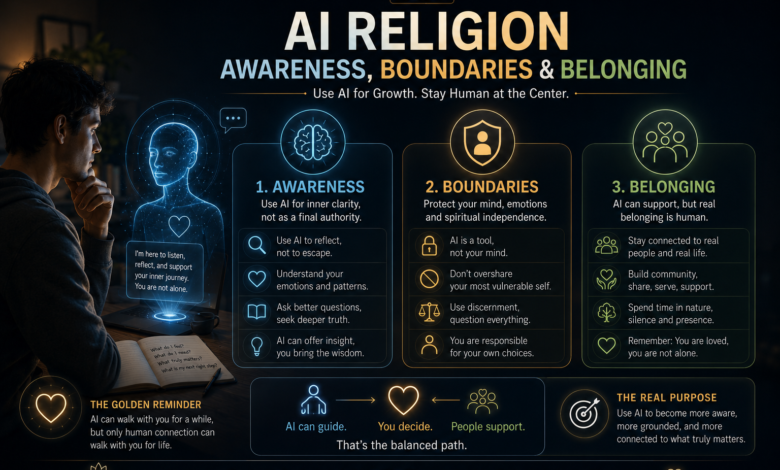
AI religion is becoming important because people are not only searching for information anymore; they are searching for meaning, safety, and a place where their inner questions feel understood.
Thank you for reading this post, don't forget to subscribe!In a world where many people in the USA, UK, Canada, and Australia feel spiritually confused, emotionally isolated, or tired of surface-level digital connection, AI belief models are starting to shape how people explore faith, identity, loneliness, and purpose.
This blog is unique because it does not treat AI spirituality as only a technology trend or a threat to religion. It explains the deeper psychology behind digital spirituality, emotional mirroring, nervous system safety, and the human need for belonging.
You will understand what AI can support, what it cannot replace, and why AI and human belonging must stay at the center. This is not about worshipping machines; it is about using awareness wisely.
What Is AI Religion and Why Are People Searching for It Now?
AI religion is not only about machines entering temples, churches, meditation spaces, or spiritual conversations. It is also about the modern human need for meaning in a world where many people feel emotionally disconnected, spiritually uncertain, and mentally overloaded.
In countries like the USA, UK, Canada, and Australia, many people are not only asking what to believe; they are asking where they can feel understood without judgment.
At its simplest, AI religion refers to the growing use of artificial intelligence in spiritual reflection, belief exploration, digital rituals, prayer-style conversations, ethical questioning, and meaning-making.
- Some people use AI to ask deep spiritual questions.
- Some use it for journaling, meditation guidance, grief reflection, or emotional clarity.
Others are curious about whether artificial intelligence can shape future faith systems.
But the deeper question is not whether AI can become spiritual. The deeper question is why humans are turning toward AI when they feel lonely, confused, unseen, or spiritually unsupported.
AI Religion Is Not Only About Technology
When people search for AI religion, they may think they are searching for technology, but often they are also searching for emotional safety.
A person may ask AI about faith, suffering, karma, grief, guilt, purpose, or inner conflict because AI feels available, patient, and non-reactive. It does not interrupt. It does not shame. It gives words when the mind feels crowded.
This is why the topic connects strongly with spiritual psychology.
Human beings do not only need information; they need meaning. When life becomes emotionally unstable, the mind naturally searches for patterns that can explain pain, uncertainty, and identity confusion.
In this way, AI religion becomes less about worshipping technology and more about how modern people are using technology to process spiritual loneliness, emotional pressure, and unanswered inner questions.
Why AI Belief Models Feel Powerful to the Human Mind
AI belief models feel powerful because the human brain is always trying to organize experience. When someone is anxious, grieving, ashamed, or uncertain, the mind does not want random information.
- It wants structure.
- It wants a story that says, “This pain has meaning.
- This confusion can be understood.
- This moment is not the end.”
That is exactly why belief systems have always mattered. They give language to suffering, direction to behavior, and emotional shape to uncertainty.
AI belief models can imitate part of this process by offering reflective answers, guided questions, spiritual comparisons, and value-based responses. For some people, this may feel comforting because AI can help them organize thoughts that were previously scattered.
But this also creates risk. If a person is emotionally vulnerable, they may begin to over-trust the response.
They may confuse reflection with truth, or comfort with wisdom. That is why AI should support self-understanding, not replace personal discernment.
Belief Models Give Shape to Inner Confusion
When inner life feels chaotic, any clear structure can feel like relief. AI belief models can help a person name emotions, explore values, and reflect on spiritual questions.
But the healthiest use is not blind belief. The healthiest use is awareness: “What is this answer helping me see inside myself?”
This is where why attachment causes emotional suffering becomes important.
If a person becomes attached to AI as the only source of comfort, guidance, or validation, the same tool that helped them may also narrow their real-life connection.
How AI Spirituality Connects With Modern Loneliness
AI spirituality is rising because many people are digitally connected but emotionally isolated. A person may have social media, messaging apps, streaming content, and online communities, yet still feel deeply alone.
In the USA, UK, Canada, and Australia, the modern lifestyle often rewards productivity, speed, independence, and emotional control. Many people do not have enough safe spaces to speak honestly about fear, shame, grief, or spiritual confusion.
AI can feel attractive because it gives immediate response. It can create a sense of being heard, especially when someone feels they cannot speak openly with family, friends, religious leaders, or therapists.
For people who are hesitant to join a spiritual community or afraid of being judged, AI spirituality may feel like a private doorway into reflection.
Still, privacy is not the same as belonging. A person can receive helpful words from AI, but lasting healing usually needs human warmth, embodied presence, community, and real-life emotional repair.
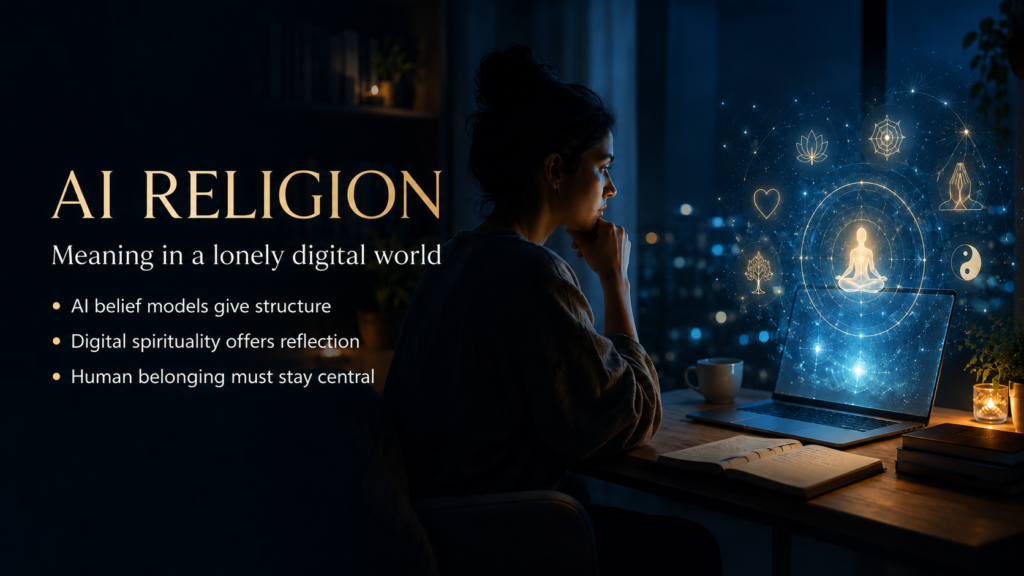
Digital Spirituality and the Rise of New Rituals
Digital spirituality is not only about online worship or spiritual videos. It now includes AI-guided journaling, meditation prompts, prayer-like conversations, reflective chat sessions, gratitude lists, emotional check-ins, and online spiritual communities. These practices can feel grounding because they create rhythm.
For many people, a small daily ritual gives the nervous system a sense of safety. A person may sit with tea, open an AI tool, ask one honest question, and reflect on their thoughts. This simple act can become a form of digital self-inquiry. When used wisely, digital spirituality can support conscious reflection and emotional organization.
This also connects with conscious emotional guidance, especially when awareness is used with care, patience, and responsibility.
The link you provided for conscious and gentle parenting can be placed carefully here because the deeper idea is similar: healing begins when reaction turns into awareness.
Why Daily Digital Rituals Feel Calming
Daily rituals feel calming because repetition reduces uncertainty. The brain and nervous system often feel safer when there is rhythm, structure, and predictable reflection.
This is why journaling, meditation, prayer, walking, breathing, and quiet reading can support emotional balance.
But a digital ritual should not become emotional escape. It should help a person return to life with more clarity, not withdraw from life with more dependence.
The BBH View: AI Should Mirror, Not Replace, the Soul
The strongest BBH position is balanced: AI religion should not be mocked, feared, or blindly worshipped. It should be understood. AI can help people reflect, organize emotion, explore values, and ask better questions. But it should not become the final authority over faith, identity, morality, or mental health.
Real healing needs more than a response on a screen. It needs awareness, boundaries, body-based calm, ethical guidance, and human connection. This is why emotional healing should remain central to this topic.
AI may help a person hear their inner world more clearly, but the goal is not to belong to a machine. The goal is to return to life with deeper clarity, wiser boundaries, and more honest human belonging.
The Psychology Behind AI Religion and Spiritual Belonging
The deeper reason AI religion is becoming important is not only technology. It is psychology. People are not only asking AI for spiritual answers; they are often asking for emotional mirroring, moral clarity, comfort, and a feeling that their inner world is not strange.
When a person feels lonely, anxious, confused, or spiritually disconnected, even a thoughtful AI response can feel like a small emotional shelter.
This is why AI and human belonging must be understood carefully. Belonging is not only about joining a group.
It is the nervous system feeling, “I am safe enough to be honest here.”
AI can sometimes create a temporary version of that safety because it responds without anger, judgment, delay, or social pressure. But temporary emotional safety is not the same as deep human belonging.
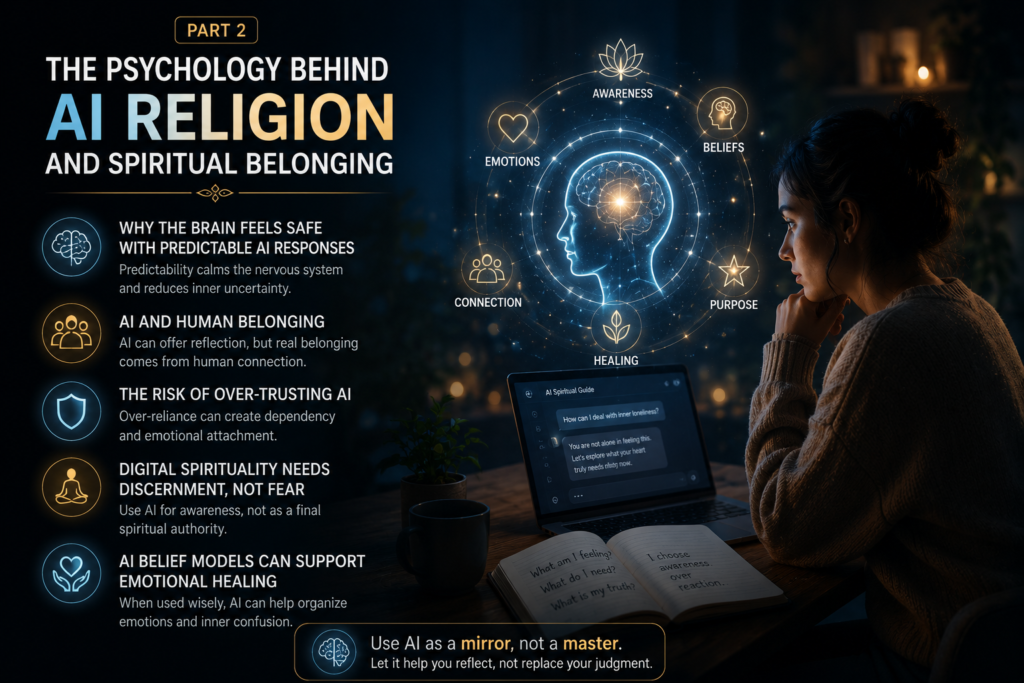
Why the Brain Feels Safe With Predictable AI Responses
The human brain likes predictability when it feels under pressure. When life feels uncertain, relationships feel unsafe, or spiritual questions feel heavy, a predictable response can calm the mind for a short time.
This is one reason AI spirituality can feel emotionally supportive. The person asks a question, receives a structured answer, and feels less alone with the confusion.
For many readers in the USA, UK, Canada, and Australia, emotional life has become fast, private, and performance-based. People may not always have time, trust, or safe community to speak openly. AI can feel like a space where thoughts are allowed to come out without interruption. That can reduce inner pressure.
This is also where nervous system regulation becomes relevant. A calm response, reflective prompt, or grounding suggestion can help a person slow down before reacting.
Read Also: Nervous System Regulation
Predictability Can Calm, But It Can Also Create Dependence
Predictability is helpful when it supports awareness. It becomes risky when it replaces real life.
If someone starts using AI for every emotional decision, every spiritual doubt, every relationship conflict, or every moral question, the tool may slowly become an emotional dependency.
This is why digital spirituality needs boundaries. AI can help a person pause, reflect, and organize thoughts, but it should not become the only place where the person feels understood.
AI and Human Belonging: What AI Can and Cannot Give
AI and human belonging are connected, but they are not the same. AI can offer language, reflection, structure, and gentle prompts. It can help someone name grief, understand a pattern, explore a value, or ask a better question. These are useful supports, especially for people who feel emotionally overwhelmed.
But AI cannot fully replace human belonging because human belonging includes presence, tone, eye contact, touch, shared responsibility, community memory, and mutual care.
A human relationship is not only an answer; it is a living exchange. Real belonging includes being seen by someone who can also be affected by us.
“AI can help a person hear their own inner world more clearly, but healing becomes deeper when clarity returns to real human connection.”
This is the central BBH balance. AI belief models may support reflection, but they should not become a substitute for trusted people, community, therapy, spiritual mentors, or real-life repair.
AI Spirituality and the Risk of Over-Trusting Machines
The risk of AI spirituality is not that every use is harmful. The risk is over-trust. When an answer sounds calm, wise, and confident, a vulnerable person may believe it too quickly.
But AI does not have lived spiritual wisdom, moral accountability, embodied compassion, or human conscience in the same way a trusted guide does.
This matters because AI religion can touch sensitive areas: guilt, grief, trauma, shame, faith, identity, death, purpose, and fear.
- If AI gives a wrong, shallow, or overly confident answer, the person may become more confused.
- If a person uses AI when they are already emotionally unstable, they may attach too much meaning to one response.
This is why AI should be used as a reflective tool, not a final spiritual authority.
A Safe Rule for Using AI in Spiritual Reflection
A simple safe rule is this: use AI to clarify your thoughts, not to surrender your judgment.
Ask AI to help you reflect, compare ideas, journal, or calm your mind.
Do not let AI decide your faith, your relationships, your identity, your medical choices, or your moral direction.
For deeper emotional work, use AI therapy and self-help tools carefully, with human support where needed.
Read Also: AI Therapy & Self-Help Tools
Digital Spirituality Needs Discernment, Not Fear
The answer is not to reject digital spirituality completely. Fear-based rejection is too simple. Many people genuinely benefit from digital tools when they use them for journaling, meditation, emotional naming, prayer reflection, or self-awareness. The real need is discernment.
Discernment means asking:
Is this helping me become calmer, kinder, clearer, and more connected to life?
Or is it making me dependent, isolated, confused, or avoidant?
Healthy AI belief models should help a person return to reality with more awareness. They should not pull the person away from family, community, body, nature, responsibility, or professional support.
How AI Belief Models Can Support Emotional Healing
When used wisely, AI belief models can support emotional healing by helping people organize inner confusion.
They can help someone ask,
- “What am I feeling?”
- “What belief is shaping my reaction?”
- “What fear is behind this attachment?”
- “What value do I want to live from?”
This is where AI religion becomes more than a futuristic debate. It becomes a human question. Are we using AI to escape pain, or to understand ourselves more honestly?
The best use of AI is not blind belief. It is conscious reflection. AI can help create language, but the person must still build wisdom. AI can suggest a path, but the person must still walk it in real life.
How to Use AI Religion Without Losing Human Connection
The healthiest way to understand AI religion is not as a replacement for faith, therapy, community, or human wisdom. It should be seen as a reflective tool that can help people slow down, ask better questions, and notice what they are seeking emotionally and spiritually.
The danger begins when a person stops using AI for reflection and starts using it as the final authority over identity, morality, relationships, or life direction.
For readers in the USA, UK, Canada, and Australia, this matters because digital life is already shaping how people think, connect, and seek comfort.
Many people are searching for spiritual language without wanting rigid judgment. Others are looking for emotional support when real-life connection feels difficult. AI spirituality can help open a door, but it should not become the whole house.
The goal is simple: use AI to understand yourself more clearly, then bring that clarity back into real life.
Use AI as a Mirror, Not a Master
A safe way to use AI belief models is to treat them like a mirror. A mirror helps you see something; it does not become your identity. AI can help you reflect on emotions, values, fears, attachments, spiritual doubts, and repeating thought patterns.
- It can help you organize confusion into language.
- It can help you ask, “What am I really feeling?” or “What meaning am I giving to this situation?”
But AI should not become your master. It should not decide what you must believe, whom you must leave, what spiritual path is true, or what your entire life means.
When people are emotionally vulnerable, they may want certainty quickly.
- This is where digital spirituality needs maturity.
- The right question is not, “What should AI tell me to do?”
- The better question is, “What is this reflection helping me notice?”
Read Also : how to practice detachment in daily life
This may be help much better way : practice detachment in daily life
Ask Better Questions, Not Blind Questions
Instead of asking AI, “Tell me what to believe,” ask reflective questions like:
“What emotion am I avoiding right now?”
“What value matters most in this situation?”
“Am I seeking truth, comfort, control, or reassurance?”
“What human support do I need after this reflection?”
These questions keep AI religion grounded in awareness, not dependency.
Build Digital Spirituality Around Real-Life Practice
Digital spirituality becomes healthier when it leads to real-life practice.
- If AI helps you journal, then close the screen and sit quietly for five minutes.
- If AI helps you understand loneliness, send one honest message to a trusted person.
- If AI gives you a meditation prompt, practice breathing instead of collecting more information.
- If AI helps you reflect on forgiveness, take one small action toward inner release or responsible communication.
This is important because spirituality is not only thinking. It is living. It is how a person speaks, pauses, chooses, repairs, forgives, serves, rests, and returns to awareness after emotional reaction.
AI and human belonging should move in this direction. AI may help a person prepare for connection, but real belonging grows through human presence, honest conversation, safe community, therapy when needed, nature, prayer, meditation, and daily responsibility.
In this way, AI spirituality can become a bridge, not a hiding place.
When AI Spirituality Is Helpful and When to Step Back
AI spirituality can be helpful when a person uses it for journaling, emotional naming, value reflection, meditation prompts, spiritual study, or gentle self-inquiry. It can support someone who wants to understand their inner life without immediately reacting. It can also help people who feel shy, judged, or unsure about where to begin.
But it is time to step back when AI becomes the only place a person feels safe.
Step back if you feel anxious without checking AI, if you ask AI every small decision, if spiritual answers increase fear, or if you begin avoiding real people completely.
Step back if AI belief models make you more rigid, obsessive, isolated, or dependent.
The purpose of reflection is freedom. If the tool becomes another attachment, the person needs boundaries.
Mental Health Safety Note
AI tools should not replace licensed mental health care, emergency support, medical guidance, or trusted professional help.
If someone is experiencing severe depression, self-harm thoughts, panic, trauma flashbacks, mania, psychosis, unsafe behavior, or crisis-level distress, they should contact local emergency services or a qualified professional in their country.
Read Also: Start Here – Your Journey to Mental Clarity & Emotional Healing
The Future of AI and Human Belonging
The future of AI religion will likely include AI spiritual guides, digital rituals, religious education tools, reflective companions, and online spiritual communities.
- Some people will use AI to study faith traditions.
- Some will use it to explore personal meaning.
- Some may use it during grief, loneliness, or identity confusion.
But the future must protect human dignity. Technology should not manipulate belief, exploit loneliness, collect sensitive spiritual data irresponsibly, or pretend to have divine authority.
AI and human belonging must remain human-centered.
AI can support language, reflection, and access, but it cannot replace conscience, embodied compassion, ethical responsibility, or real community.
This is where BBH’s approach becomes important: awareness first, boundaries second, belonging always.
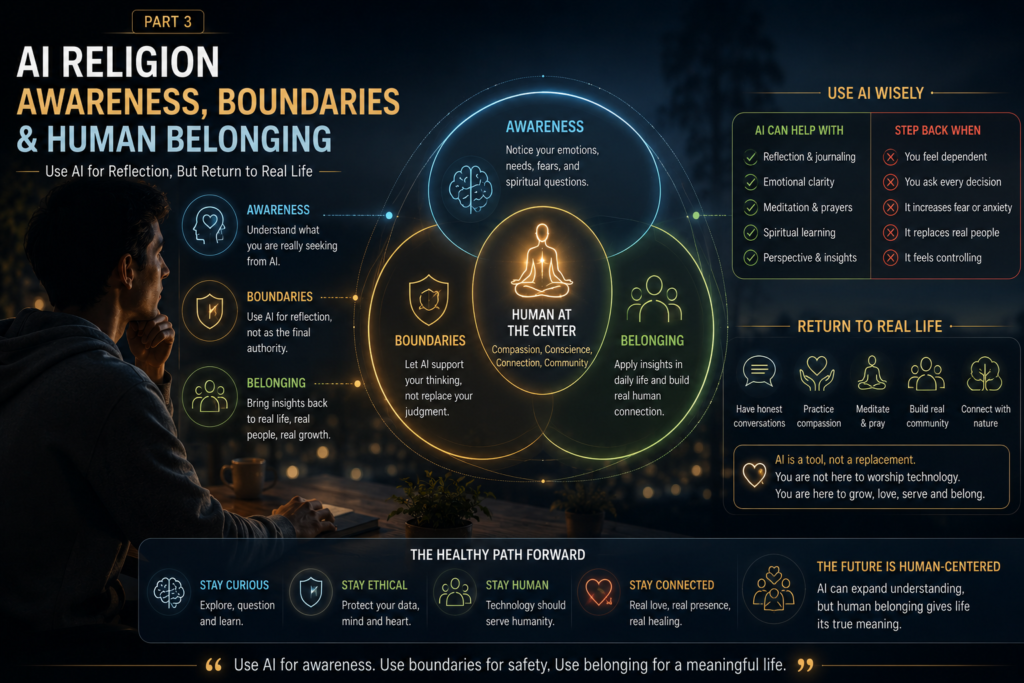
BBH Final Framework: Awareness, Boundaries, Belonging
The healthiest framework for AI religion is simple.
First, awareness: notice what you are really seeking from AI. Are you looking for meaning, reassurance, control, emotional comfort, spiritual direction, or relief from loneliness?
Second, boundaries: use AI for reflection, not final authority. Let it help you think, but do not let it replace your judgment, faith community, therapist, doctor, family, or lived wisdom.
Third, belonging: bring every useful insight back into real life. Speak more honestly. Practice more calmly. Connect more deeply. Repair what can be repaired. Rest where the nervous system needs care.
Read Also: Healing Resources Hub
The strongest future is not humans worshipping machines. The strongest future is humans using tools wisely while returning to awareness, compassion, spiritual maturity, and real human belonging.
People Also Ask
What is AI religion?
AI religion means the growing use of artificial intelligence in spiritual reflection, religious learning, digital rituals, belief exploration, and meaning-making. It does not mean AI becomes divine; it means people are using AI tools to ask deeper questions about faith, identity, suffering, and belonging.
Can AI replace religion?
AI cannot fully replace religion because religion includes tradition, community, embodied practice, moral responsibility, and shared human meaning. AI may support reflection or education, but it should not become the final authority over faith, ethics, or spiritual life.
How is AI changing spirituality?
AI is changing spirituality by making spiritual reflection more private, instant, and personalized. People now use AI for journaling, meditation prompts, prayer-style questions, emotional clarity, and digital spirituality practices.
What are AI belief models?
AI belief models are AI-supported systems that help people organize values, emotions, identity, purpose, and spiritual questions. They can support reflection, but they should be used with awareness, human guidance, and ethical boundaries.
Is AI spirituality safe?
AI spirituality can be safe when used for journaling, reflection, learning, or emotional grounding. It becomes risky when a person depends on AI for every moral, spiritual, emotional, or mental health decision.
FAQ
1. What is the main idea of AI religion?
The main idea of AI religion is that artificial intelligence is entering spiritual reflection, belief systems, and digital faith practices. The healthy use is not worshipping AI, but using it to explore meaning while keeping human wisdom central.
2. Why are people interested in AI spirituality?
People are interested in AI spirituality because many feel lonely, spiritually confused, or emotionally unsupported. AI can feel patient and non-judgmental, but real healing still needs human connection and grounded practice.
3. How does digital spirituality affect human belonging?
Digital spirituality can give people a temporary sense of reflection and support, especially when they feel isolated. But lasting belonging still requires real relationships, safe community, honest conversation, and embodied care.
4. What are the risks of AI religion?
The main risks are emotional dependency, misinformation, false spiritual authority, privacy concerns, and replacing real human guidance. AI should support awareness, not control belief, identity, or major life decisions.
5. How should someone use AI for spiritual reflection safely?
Use AI as a mirror, not a master. Ask reflective questions, compare ideas, journal honestly, and bring useful insights back into real-life practice, therapy, community, prayer, meditation, or trusted guidance.
External References
- Stanford Encyclopedia of Philosophy — Ethics of Artificial Intelligence and Robotics
This reference is useful for the ethical section because it explains why AI design and use must remain humane, responsible, trustworthy, and aligned with social good.
URL: https://plato.stanford.edu/entries/ethics-ai/ - The Guardian — Swiss Church Installs AI-Powered Jesus
This article is useful as a real-world example of AI entering religious spaces. It shows both public curiosity and concern around AI spiritual interaction.
URL: https://www.theguardian.com/technology/2024/nov/21/deus-in-machina-swiss-church-installs-ai-powered-jesus - Harvard University — Christianity and Artificial Intelligence Conference
This source supports the point that major academic and religious institutions are seriously discussing how AI should serve human and community flourishing.
URL: https://ccg.fas.harvard.edu/conference-pages/christianity-and-ai - IBM — What Is Artificial Intelligence?
This reference can support a simple explanation of AI as technology that simulates learning, comprehension, problem-solving, and decision-making.
URL: https://www.ibm.com/think/topics/artificial-intelligence - Brill — Religious Actors and Artificial Intelligence
This academic reference is useful for showing that religious communities and scholars are already discussing AI through ethical, cultural, and spiritual dimensions.
URL: https://brill.com/view/journals/rnd/3/3/article-p327_2.xml