Friendship Attachment: How to Build Healthy Bonds Without Fear
AI Support for Friendship Anxiety, Boundaries, and Emotional Safety

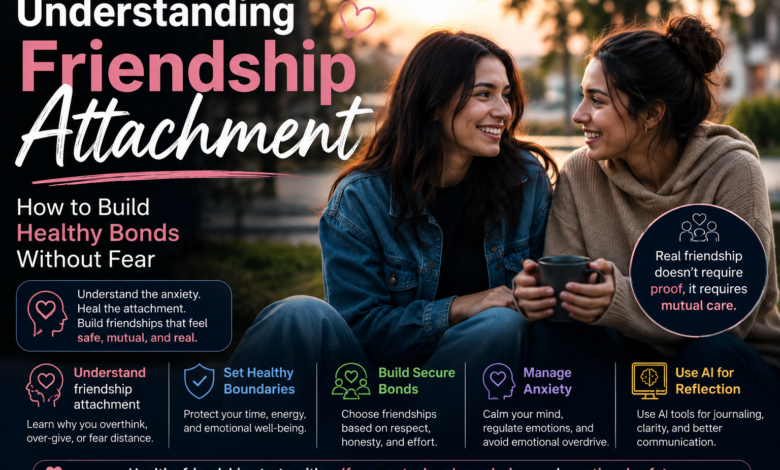
Friendship should feel safe, honest, and emotionally balanced, but for many people, friendship attachment becomes painful when closeness starts feeling like survival. You may overthink replies, fear being replaced, give too much, or feel deeply hurt when a friend becomes distant.
Thank you for reading this post, don't forget to subscribe!This blog is important because it does not explain friendship only as a social issue; it shows how anxious attachment in friendships, friendship anxiety, and emotional attachment in friendship can come from the nervous system’s need for safety, not weakness.
The unique part is that you will learn how to separate real connection from emotional fear, how to build healthy friendship boundaries, and how AI-based reflection can support awareness without replacing real human bonds.
If you want healthy bonds without chasing, over-giving, or losing yourself, this guide will help you understand what is happening inside and how to respond with calm clarity.
What Is Friendship Attachment?
Friendship attachment is the emotional bond that makes a friendship feel meaningful, safe, and important. In a healthy form, it helps you trust people, share your real feelings, enjoy closeness, and feel supported without losing your own identity. But when the bond becomes fear-based, friendship attachment can start feeling heavy.
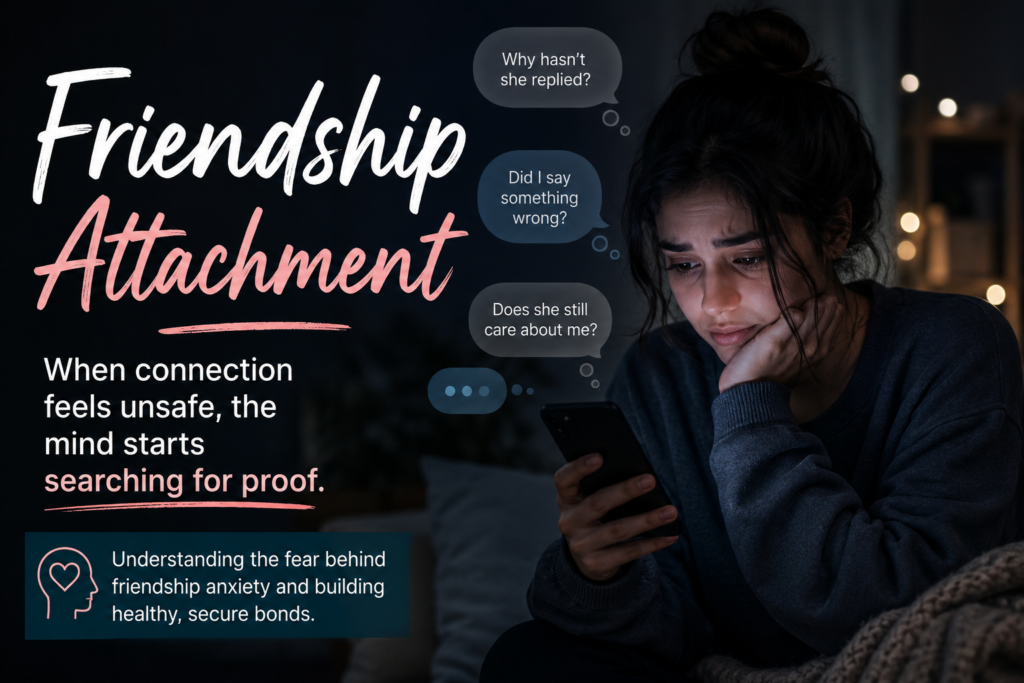
Instead of simply enjoying the connection, your mind may begin asking, “Do they still care?” “Are they ignoring me?” “Did I do something wrong?” or “Will they leave me?”
This is why friendship attachment is not only a social issue. It is also connected to emotional safety, nervous system regulation, and the way your mind learned to understand closeness.
Some people feel calm when a friend takes time to reply. Others feel panic, rejection, shame, or emotional urgency. That difference is often not about weakness. It is about how the nervous system reads distance, silence, inconsistency, and change.
For many readers, the painful part is not friendship itself. The painful part is the fear underneath the friendship. When emotional safety is missing inside, even a small delay in reply can feel like abandonment. This is where anxious attachment in friendships can begin.
Read Also: emotional safety and self-understanding
Why Friendship Attachment Feels So Intense
Friendship can feel intense because humans are wired for connection. The brain does not treat social rejection as a small thing. For many people, emotional distance from a close friend can activate stress, overthinking, and body-level discomfort.
A late reply, changed tone, cancelled plan, or reduced attention may become more than a normal social event. It can feel like proof that the bond is unsafe.
This is why friendship anxiety often feels so real even when there is no clear evidence of rejection.
- The mind starts scanning for signs.
- The body becomes tense.
- The heart wants reassurance.
- The person may keep checking messages, rereading conversations, or imagining worst-case outcomes.
In this state, your reaction is not always coming from the present moment. Sometimes it is coming from an older emotional pattern that learned, “If people become distant, I may lose love.”
This is why healing friendship attachment needs more than positive thinking. It needs awareness, nervous system calming, and healthier boundaries.
Read Also: nervous system regulation
Friendship Attachment vs Normal Closeness
Normal closeness feels warm, respectful, and mutual. You can miss your friend, enjoy talking to them, and value their presence without feeling emotionally destroyed when they are busy. There is trust in the bond. You do not need constant proof that the friendship still exists.
Unhealthy friendship attachment feels different. It often comes with fear, urgency, emotional dependence, and over-analysis. You may feel safe only when your friend is giving attention.
When they are unavailable, your mind may start creating stories: “They are losing interest,” “They found someone better,” or “I am not important anymore.”
This is where emotional attachment in friendship becomes painful. The bond is no longer only about care. It becomes connected to self-worth. Instead of thinking, “My friend is busy,” the nervous system may translate it as, “I am being abandoned.”
That is why the goal is not to stop caring. The goal is to build healthy bonds where care does not require fear, chasing, or self-abandonment.
Signs of Anxious Attachment in Friendships
Anxious attachment in friendships often shows up quietly at first. You may not even notice it because it can look like loyalty, care, or deep emotional investment. But over time, the pattern becomes exhausting. You may feel responsible for keeping the friendship alive, even when the effort is not mutual.
Some common signs include overthinking messages, feeling hurt when replies are delayed, needing frequent reassurance, apologizing too much, fearing replacement, and feeling emotionally unsafe when your friend gives attention to someone else.
You may also feel pressure to be constantly available because you fear that setting limits will make the other person leave.
Another sign is over-giving.
- You may listen more than you are heard.
- You may adjust your time, energy, and emotions to keep the friendship stable.
- You may avoid saying what hurt you because you do not want conflict.
But inside, resentment, sadness, and insecurity slowly build.
This is why friendship attachment needs honest awareness. The problem is not that you love deeply. The problem begins when your peace depends completely on another person’s response.
Read Also : anxiety and overthinking
When Friendship Anxiety Takes Over the Mind
Friendship anxiety begins when the mind cannot relax inside a friendship. Instead of feeling supported, the person feels alert. Instead of trusting the bond, the mind keeps testing it. This can happen even with kind friends because anxiety does not only respond to facts. It also responds to fear, memory, attachment style, and nervous system sensitivity.
You may notice that your mood changes based on your friend’s behavior.
- A warm message makes you feel secure.
- A short reply makes you feel rejected.
- A cancelled plan makes you feel unimportant.
When your emotional state depends too much on another person’s attention, friendship can become unstable inside your body.
This does not mean you are dramatic or needy. It means your system may be looking for safety through the friendship.
The healing direction is to slowly bring that safety back inside yourself. You can still value the friendship, but you do not have to let every small change decide your worth.
Read Also: relationship psychology
Quick Self-Check
Ask yourself these questions with honesty, not shame:
- Do I feel unsafe when a close friend replies late?
- Do I overthink small changes in tone, attention, or energy?
- Do I give too much because I fear losing the friendship?
- Do I feel guilty when I need space or want to set a boundary?
- Do I confuse normal distance with rejection?
- Do I feel emotionally dependent on one friend for stability?
If many of these feel familiar, the answer is not self-blame. The answer is awareness. Friendship attachment can be understood, softened, and healed when you learn how your mind and body react to closeness.
“Sometimes the heart does not ask for too much love; it asks for safer love.”
Why This Matters Before Building Healthy Bonds
Before you can build healthy friendship boundaries, you need to understand what your fear is trying to protect. Many people try to force themselves to “stop caring,” but that rarely works.
The deeper healing is learning how to care without panic, love without losing yourself, and stay connected without chasing reassurance.
This is where the BBH approach becomes different. We do not treat emotional attachment in friendship as a weakness. We look at it through psychology, nervous system safety, self-worth, and practical awareness. When you understand the pattern, you can stop reacting from fear and start responding with clarity.
The next step is learning how boundaries, emotional balance, and AI-supported reflection can help you create safer friendships. AI can help you pause, journal, understand your patterns, and prepare healthier communication.
But the real goal is not to replace friends with tools. The real goal is to build healthy bonds where your connection feels mutual, respectful, and emotionally steady.
Why Healthy Friendship Boundaries Make Bonds Safer
Healthy friendship boundaries do not weaken friendship. They make friendship safer, clearer, and more respectful. Many people with friendship attachment fear boundaries because they think, “If I say no, they will leave,” or “If I need space, they will think I do not care.”
But a healthy bond does not survive because one person keeps sacrificing. It survives because both people can stay honest without fear.
A boundary is not punishment. It is a clear line that protects your emotional energy, time, values, and self-respect. In friendship, boundaries may look like replying when you are emotionally available, saying no without over-explaining, asking for mutual effort, or not becoming someone’s full-time emotional support system.
This matters because anxious attachment in friendships often pushes people to over-adjust. You may ignore your tiredness, hide your hurt, or agree to things you do not want because the friendship feels too important to risk. But real closeness cannot grow where one person is constantly afraid to be honest.
Read Also: healthy relationship growth
Boundaries Are Not Rejection
When the nervous system is anxious, boundaries can feel like rejection.
- If a friend says, “I need time,” your mind may hear, “They do not want me.”
- If someone replies slowly, your body may feel abandoned.
- If a friend spends time with others, your attachment fear may say, “I am being replaced.”
This is why friendship anxiety can make normal friendship changes feel emotionally threatening. But boundaries are not always signs of distance. Sometimes boundaries are signs of emotional maturity.
A friend who can say, “I care about you, but I need rest today,” is not necessarily rejecting you.
They may be protecting the friendship from pressure, resentment, or emotional burnout.
Healthy friendship boundaries create predictability. They teach both people what is okay, what is too much, and how to stay connected without losing themselves. In secure friendships, space does not mean abandonment. Silence does not always mean dislike. A boundary does not always mean the bond is ending.
Emotional Attachment in Friendship Can Become One-Sided
Emotional attachment in friendship becomes painful when one person carries most of the emotional weight. You may be the one who always checks in, always forgives, always adjusts, always listens, and always tries to repair the bond. At first, this may look like deep care. But over time, it can become self-abandonment.
One-sided attachment often grows when a person believes they must earn connection.
They may feel that if they stop giving, the friendship will disappear.
This creates a hidden emotional contract: “I will keep giving so you keep staying.”
But this is not healthy love. It is fear wearing the mask of loyalty.
In healthy bonds, effort moves both ways.
- You do not need to beg for basic respect.
- You do not need to shrink your needs to keep someone close.
- You do not need to become emotionally available all the time just to prove your value.
Signs You Are Over-Giving in Friendship
- You may be over-giving if you always apologize first, even when you are hurt.
- You may be over-giving if you feel guilty for needing space.
- You may be over-giving if you keep accepting low effort because you fear losing the person.
- You may be over-giving if your mood depends completely on their attention.
- You may be over-giving if the friendship feels peaceful only when you are silent about your needs.
This does not mean you should suddenly cut people off. It means you should begin observing whether the bond is mutual, emotionally safe, and respectful.
How AI Can Support Friendship Attachment Without Replacing Friends
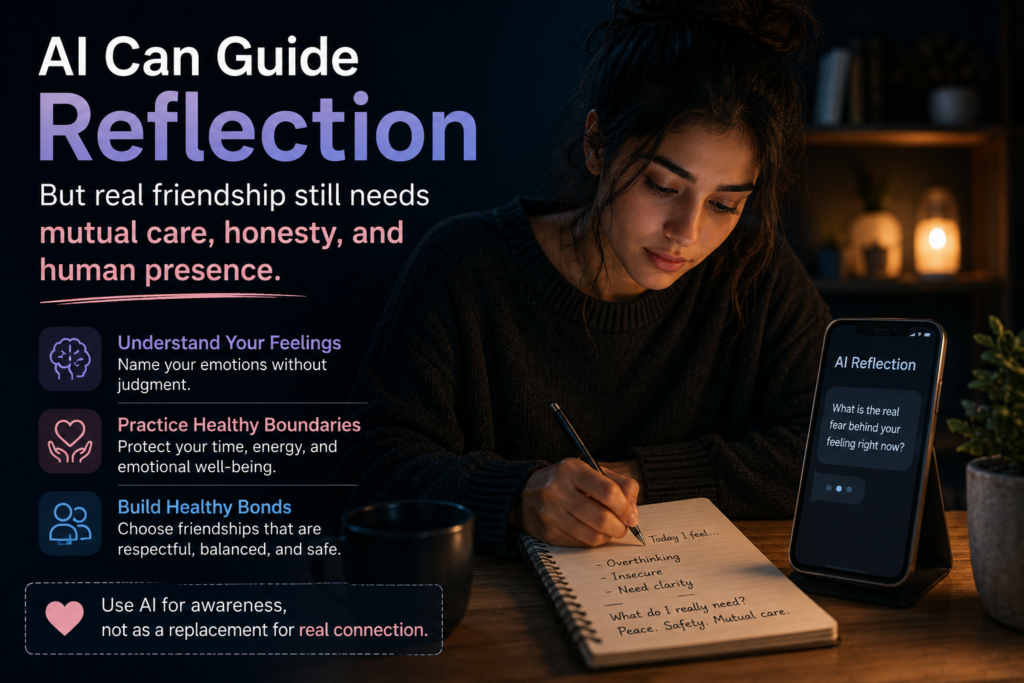
AI can be useful when friendship attachment creates confusion, overthinking, or emotional urgency. Sometimes, before sending a message, your mind may be too activated to see clearly. AI can help you slow down, organize your thoughts, journal your feelings, and separate facts from fear.
For example, instead of immediately texting a friend from panic, you can use AI to ask:
- “What am I actually feeling?”
- “What evidence do I have?”
- “Am I reacting from the present situation or an old fear?”
- “How can I communicate this calmly?”
This can reduce impulsive messages and help you respond with more emotional balance.
AI can also help you practice healthy friendship boundaries. You can ask it to rewrite a message in a calmer tone, prepare a respectful boundary, or reflect on whether a friendship feels mutual. This can be especially helpful for people who struggle with friendship anxiety and fear saying the wrong thing.
Read Also →AI therapy and self-help tools
The Safe Role of AI in Friendship Anxiety
The safe role of AI is reflection, not replacement. It can help you understand your emotional pattern, but it cannot become your only source of comfort. This distinction is important because emotional attachment in friendship already carries a risk of dependence. If the person replaces human connection with AI comfort completely, the deeper wound may remain untouched.
Use AI like a pause button. Use it to calm the first emotional wave, name the fear, and prepare a healthier response.
But after that, the real work is still human: building mutual friendships, practicing honest communication, choosing emotionally available people, and learning how to feel safe inside yourself.
The goal is not to remove your need for connection.
The goal is to stop letting fear control connection.
When AI supports awareness and boundaries, it can be helpful.
When it replaces courage, therapy, real friendship, or honest communication, it becomes a hiding place.
The Risk of Depending on AI for Emotional Comfort
AI may feel available, patient, and non-judgmental. That can be comforting, especially when you feel lonely or afraid of rejection. But friendship healing cannot happen only inside a screen. Real friendships require patience, misunderstanding, repair, respect, and mutual effort. These are human skills.
- If you use AI only to avoid difficult conversations, your friendship attachment may stay stuck.
- If you keep asking AI for reassurance but never practice boundaries, the anxiety may reduce temporarily but return again.
- If you use AI as your main emotional bond, it may feel safe in the moment but make real human connection feel even more difficult.
So the balanced approach is simple: use AI for awareness, not dependence. Use AI to prepare, not escape. Use AI to understand your emotions, not replace people.
Healthy bonds are built when you combine self-reflection with real-world emotional maturity. That is how friendship becomes calmer, safer, and more mutual.
How to Heal Friendship Attachment Without Shaming Yourself
Healing friendship attachment does not mean becoming cold, distant, or emotionally unavailable. It means learning how to stay connected without losing your inner stability.
Many people try to heal by telling themselves, “I should not care this much,” but shame does not create security. It only makes the nervous system more afraid.
A better approach is to understand the pattern with honesty.
- Maybe you feel unsafe when someone replies late.
- Maybe you over-give because distance feels threatening.
- Maybe friendship anxiety makes you read small changes as signs of rejection.
These reactions do not mean you are broken. They show that your system is asking for emotional safety.
The goal is to build healthy bonds where care feels mutual, boundaries feel safe, and your worth does not depend on constant reassurance.
Read Also: Start Here – Your Journey to Mental Clarity & Emotional Healing
Step 1 — Notice the Fear Before You React
The first step is noticing the fear before it becomes action. When anxious attachment in friendships gets activated, the mind often wants immediate relief. You may feel like sending a long message, asking for reassurance, apologizing unnecessarily, or checking whether your friend is online.
Before reacting, pause and ask:
- “What am I afraid this means?”
- This question separates the situation from the story.
- The situation may be, “My friend has not replied.”
- The story may be, “They do not care about me anymore.”
- Healing begins when you can see the difference.
You do not need to suppress the feeling. You only need to slow down enough to avoid letting fear write the next message.
Step 2 — Build Inner Safety Before Asking for Reassurance
Reassurance can feel comforting, but if you depend on it too often, the mind never learns inner safety. This is why healing emotional attachment in friendship requires body-level calming, not only mental analysis.
Before reaching out, try one grounding action.
- Take a short walk.
- Drink water slowly.
- Write the fear in one sentence.
- Breathe deeply for two minutes.
- Put your phone away for ten minutes.
Ask yourself, “What would I need right now if this fear was not controlling me?”
This does not mean you should never ask for support. It means you should first help your nervous system come down from panic. From that calmer place, your message becomes clearer, shorter, and more respectful.
Read Also: Healing Resources Hub
Step 3 — Practice Healthy Friendship Boundaries Slowly
Healthy friendship boundaries are not built in one dramatic conversation. They are built through small, repeated acts of self-respect.
You can start by replying when you are genuinely available, saying “I need some time to think,” not over-explaining every feeling, and allowing your friend to have a life outside the friendship.
For someone with friendship attachment, even small boundaries may feel uncomfortable at first. That is normal.
Your system may interpret boundaries as danger because it learned that closeness requires constant availability. But healthy friendship does not require you to be emotionally open all the time.
A safe friend will not need you to abandon yourself to keep the connection alive. Mutual friendship allows both people to care, rest, speak, listen, and grow.
Step 4 — Choose Friends Who Match Emotional Effort
Healing is not only about changing yourself. It is also about choosing better relational environments. If you keep investing in emotionally unavailable, dismissive, or one-sided friendships, your friendship anxiety may keep getting triggered.
Look for friends who communicate with respect, repair after conflict, value your feelings, and do not punish you for having boundaries.
Secure friendship does not mean there is never distance or misunderstanding. It means both people can return to honesty without control, chasing, or emotional games.
You deserve friendships where effort moves both ways. You deserve bonds where you are not only useful when you are listening, helping, or giving. Real friendship gives space to your needs too.
Read Also: emotional healing support
When Friendship Anxiety Needs More Than AI Support
AI can help you journal, reflect, prepare messages, and notice patterns. But AI should not become the only place where your emotions feel safe. If friendship anxiety is causing panic, isolation, sleep problems, emotional shutdown, obsessive checking, or repeated distress, professional support may be needed.
A therapist can help you understand attachment wounds, trauma patterns, social fear, and emotional regulation in a deeper way. AI can support awareness, but it cannot fully replace human care, clinical judgment, or real relational healing.
Use AI as a tool, not as your emotional home. The deeper goal is not to avoid people. The goal is to become steady enough to connect with people in a healthier way.
Therapist vs AI Tool: What Each Can and Cannot Do
| Support Type | Helpful For | Limitation |
|---|---|---|
| AI Tool | Journaling, reflection, message practice, emotional naming | Cannot replace therapy, diagnosis, or real human relationship |
| Therapist | Trauma work, attachment healing, anxiety treatment, deeper emotional patterns | Requires time, trust, and consistent sessions |
| Trusted Friend | Real connection, mutual care, emotional presence | Should not become your only emotional support system |
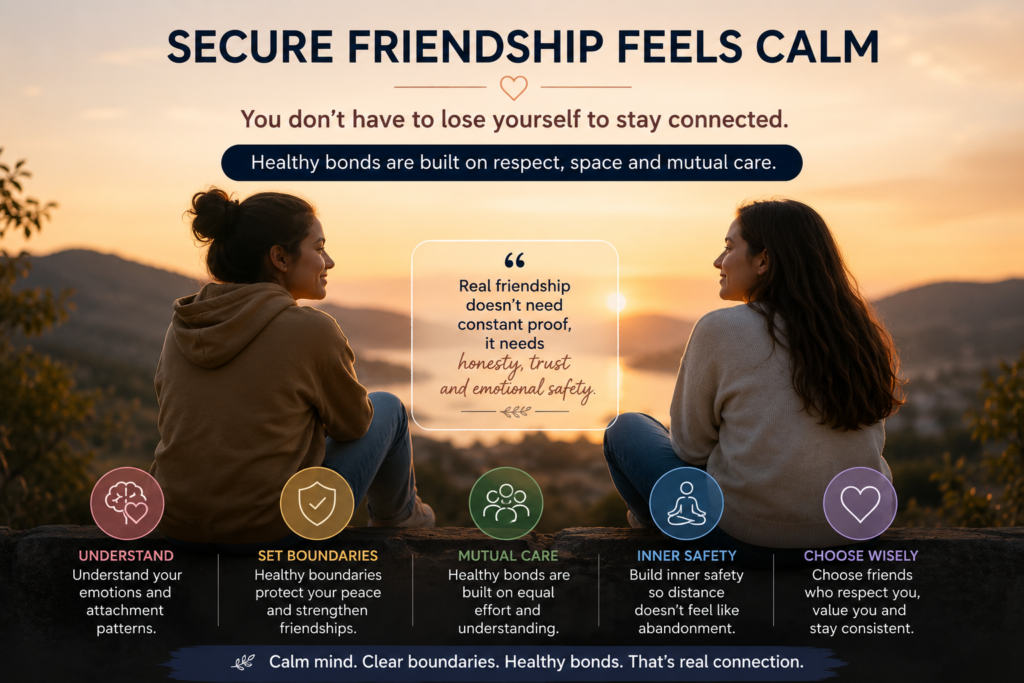
Final Takeaway — Secure Friendship Is Built, Not Begged For
Friendship attachment becomes painful when care turns into fear, and connection turns into self-abandonment. But this pattern can change. You can learn to pause before reacting, regulate your body before seeking reassurance, set healthier boundaries, and choose friendships that respect your emotional effort.
Healthy bonds are not built by chasing proof. They are built by mutual care, honest communication, emotional safety, and self-respect.
AI can support your reflection, but real healing happens when you bring that awareness into your body, your boundaries, and your relationships.
“The right friendship does not make you beg for safety; it helps you remember that connection can feel calm.”