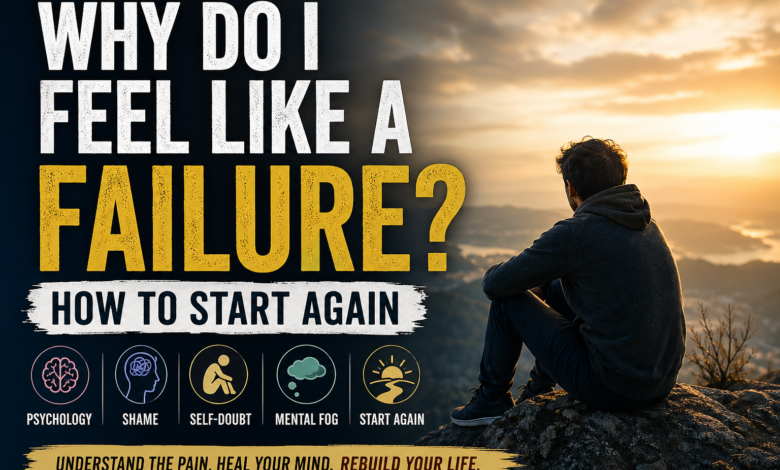
Feeling like a failure can come from shame, self-doubt, mental fog, and emotional exhaustion, but small steps can help you start again.
Feeling lost does not always mean you are lazy, weak, or broken. Many people silently ask, why do I feel like a failure, even when they are trying to survive, manage responsibilities, and hold themselves together.
Thank you for reading this post, don't forget to subscribe!
👉This blog is important because it explains feeling like a failure from a deeper angle: not only success or mistakes, but shame, mental fog, emotional exhaustion, loneliness, body neglect, and nervous system overload.
Most advice only says “work harder” or “stay positive,” but this blog shows the hidden failure psychology behind shutdown, avoidance, scrolling, and self-attack.
You will also understand how self doubt and failure grow together when your mind starts using one difficult phase as proof that you are not enough.
👉More importantly, you will learn how to overcome feeling like a failure through small, realistic steps that rebuild trust, clarity, and emotional strength from inside.
Why Do I Feel Like a Failure Even When I Am Trying?
Many people silently ask, why do I feel like a failure, even when they are not sitting still in life. They may be trying to manage family pressure, work stress, money tension, health problems, emotional pain, or private loneliness.
From outside, it may look like nothing serious is happening. But inside, every small task feels heavy, every delay feels personal, and every mistake becomes another reason to blame yourself.
This is why feeling like a failure is so painful. It does not always come after one big defeat. Sometimes it comes slowly, through repeated tiredness, comparison, disappointment, and emotional overload.
You may not even know when your mind started treating one difficult phase as proof that you are not capable.
The deeper truth is this: failure is an event, but shame tries to turn it into identity. You may fail at a task, lose focus, make a wrong decision, or fall behind in one area of life. But that does not mean your whole life has failed.
This blog looks at failure psychology from a different angle.
It does not only ask, “What did you do wrong?”
It asks, “What is happening inside your mind, body, emotions, and nervous system that makes you feel so defeated?”
Feeling Like a Failure Is Often an Emotional State, Not Your Identity
When you are emotionally tired, your brain does not always judge reality clearly.
A small delay can feel like proof that you are useless.
One unfinished task can feel like your whole life is collapsing.
One comparison with another person can make you feel far behind, even if your journey has been completely different.
This is where self doubt and failure start feeding each other. First, something does not go well. Then self-doubt says, “See, this always happens to you.” After that, your mind starts collecting more proof against you. You remember old mistakes, missed chances, broken plans, and painful words from the past.
But this is not truth. This is emotional filtering.
When your mind is in pain, it does not show you the full picture. It shows you the most painful parts again and again. That is why feeling like a failure can become stronger even when your actual situation is still fixable.
👉You are not your most difficult moment. You are not your lowest thought. You are not the version of yourself that appears when shame is speaking louder than awareness.
Why One Difficult Phase Can Make You Question Your Whole Life
One of the hardest parts of failure psychology is that the mind often generalizes pain.
👉 Instead of saying, “This one thing did not work,” the mind says, “Nothing ever works for me.” Instead of saying, “I am struggling right now,” it says, “I am a failure.”
This is why one difficult phase can become mentally dangerous. It can make you question your ability, your future, your intelligence, your worth, and even your identity. You may start thinking that everyone else is moving forward while you are stuck in the same place.
But life does not move in equal lines for everyone.
Some people grow early.
Some people recover late.
Some people look successful outside while struggling deeply inside.
Some people need more time because they are not only building success; they are also healing wounds, rebuilding confidence, and learning how to trust themselves again.
That is why asking why do I feel like a failure is not a weak question. It is an important question. It means some part of you is trying to understand your pain instead of blindly accepting it as truth.
The Difference Between Failing at Something and Becoming a Failure
Failing at something means one action, plan, relationship, habit, business, exam, decision, or goal did not work as expected. Becoming a failure is a false identity your mind creates when shame takes control.
There is a big difference between these two.
A failed attempt can teach you.
A failure identity can freeze you.
A mistake can guide you. Shame can silence you.
A setback can redirect you. Self-attack can make you stop trying completely.
This is why the first step in how to overcome feeling like a failure is not motivation.
The first step is separation.
You have to separate what happened from who you are.
You may have failed at something, but you are not failure itself.
The Hidden Failure Psychology Behind Self-Attack
The most painful part of feeling like a failure is not always the outside result. It is the inner voice that starts attacking you after the result.
That voice may say,
“You are late again.”
“You are behind again.”
“You never change.”
“You cannot do anything properly.”
Slowly, the mind becomes harsher than the world.
This is where failure psychology becomes important. Many people think they need more discipline, but what they actually need first is less self-attack. A mind that is constantly insulted from inside does not become stronger. It becomes more afraid, more avoidant, and more exhausted.
When you shame yourself every time you struggle, your brain starts connecting action with emotional danger. Then even small tasks feel threatening because your mind knows that if you fail, you will punish yourself again.
This is why you may avoid work, delay decisions, scroll endlessly, or feel frozen even when you know what you should do.
👉You are not always avoiding the task. Sometimes you are avoiding the pain of judging yourself again.
How Shame Changes the Way You See Yourself
Shame is different from healthy regret.
Regret says, “I did something that did not help me.”
Shame says, “I am the problem.”
Regret can guide change.
Shame damages identity.
When shame grows, it changes your inner mirror. You stop seeing your effort. You stop seeing your survival. You stop seeing your small progress. You only see what is missing, late, broken, unfinished, or imperfect.
This is why feeling like a failure can become so convincing. Shame does not feel like an opinion. It feels like truth. But just because a thought feels heavy does not mean it is accurate.
A person can be exhausted and still be valuable.
A person can be behind and still be capable.
A person can feel lost and still be rebuilding.
A person can fail many times and still not be a failure.
When shame tells you that your struggle is your identity, awareness has to interrupt it.
👉You can say: “This is pain speaking. This is not my full truth.”
Why Self Doubt and Failure Often Grow Together
Self doubt and failure often become a cycle. First, you try something and it does not go the way you expected. Then you doubt yourself. Because you doubt yourself, you take less action. Because you take less action, you feel more behind. Because you feel behind, the feeling of failure becomes stronger.
This cycle can quietly damage confidence.
The mind starts waiting for certainty before action. But certainty often comes after action, not before it. You do not always feel confident first and then move. Sometimes you move in a small way, and confidence slowly returns because you gave yourself proof.
That is why the question is not only why do I feel like a failure.
👉The deeper question is: “What small proof can I give myself today that I am still capable of movement?”
👉You do not need to rebuild your whole life in one day. You need to rebuild trust with yourself one honest step at a time.
Reader Reflection: 3 Questions for Deeper Connection
Have you been calling yourself a failure because of one difficult phase, one mistake, or one area of life that has not improved yet?
When you struggle, do you speak to yourself with support, or does your inner voice become harsh, insulting, and hopeless?
What would change if you stopped seeing this phase as proof that you failed and started seeing it as a signal that you need recovery, structure, and self-trust?
You are not a failure because you are struggling. You may be carrying shame, exhaustion, fear, and self-doubt without enough inner support. The work starts by separating your identity from your current phase.
Why Mental Fog Makes You Feel Like You Are Failing in Life
Mental fog can make life feel heavier than it actually is. You may sit with your phone, open one app after another, think about work, remember pending tasks, and still feel unable to begin. From the outside, this may look like laziness. From the inside, it feels like your mind is filled with noise but has no clear direction.
This is one hidden reason behind feeling like a failure. Many people do not fail because they do not care. They struggle because their brain is tired, overstimulated, emotionally loaded, and unable to organize action. When the mind loses clarity, even simple tasks begin to feel like big life problems.
This is why failure psychology cannot only focus on discipline.
👉Sometimes the real question is not, “Why am I not working harder?” The deeper question is, “Why does my brain feel unsafe, foggy, or frozen when I try to move?”
When you understand this, the question why do I feel like a failure becomes less about weakness and more about inner overload.
The Home Brain Fog Problem Nobody Talks About
One of the most painful parts of mental fog is that it often happens in private. Outside the home, you may still look normal. You may talk to people, answer calls, finish urgent work, or smile when needed. But once you are alone, your energy suddenly drops.
At home, you may sit for hours without doing anything meaningful.
You may make tea and forget to drink it.
You may open your laptop but keep staring at the screen.
You may scroll without interest, not because you are enjoying it, but because your brain does not know what else to do.
This private collapse can increase self doubt and failure.
👉You begin to think,
“Why can’t I act normally?
Why am I wasting my life?
Why am I not like other people?”
But the truth is, many people are not lazy at home. They are emotionally drained where no one can see them.
This is the hidden pain most motivation advice ignores.
Why You Can Look Fine Outside but Feel Frozen Inside
A person can look functional and still feel frozen inside. This is why many people do not receive help early. Others assume they are fine because they are still talking, working, posting, smiling, or managing responsibilities. But internally, they may be carrying emotional exhaustion, loneliness, fear, shame, and pressure.
When this inner freeze continues, feeling like a failure becomes stronger.
You may not understand why normal tasks feel so difficult.
You may know what needs to be done, but your body does not cooperate.
You may plan your day in the morning, but by afternoon you feel scattered, heavy, and guilty.
This is not always a character problem. Sometimes it is nervous system overload.
When your body feels unsafe or exhausted, it may choose shutdown instead of action. That shutdown can look like procrastination, avoidance, numbness, or distraction. But underneath, your system may be asking for regulation before performance.
Scrolling, Forgetting, Staring, and Avoiding Are Signals
Scrolling for hours, forgetting small things, staring at the wall, delaying simple work, or avoiding decisions are not always signs that you do not care. Sometimes they are signals that your mind is overloaded.
This does not mean every habit should be excused. But it does mean the solution should be wiser than self-attack.
If you only shame yourself, the pattern usually becomes stronger. Shame increases pressure. Pressure increases avoidance. Avoidance increases guilt. Guilt increases the feeling of failure.
That is why how to overcome feeling like a failure begins with reading your signals correctly.
👉Instead of saying, “I am useless,” you can ask,
“What is my mind avoiding?
What does my body need?
What small action can I do without forcing my whole life to change today?”
This shift is small, but it is powerful.
How Emotional Exhaustion Creates Failure Thinking
Emotional exhaustion changes the way you see yourself. When you are tired for too long, you do not only lose energy. You also lose patience, hope, clarity, and self-respect. A small problem starts feeling like a final defeat. A normal delay feels like personal failure.
This is where failure psychology becomes deeply emotional. Failure is not only about results. It is also about the meaning your mind attaches to those results. If you already feel exhausted, one unfinished task may feel like proof that you are falling behind in life.
Emotional exhaustion also makes the inner critic louder.
You may think, “I should be stronger by now,” or “Other people can handle life better than me.”
These thoughts make self doubt and failure grow together.
The more you doubt yourself, the less energy you have to act. The less you act, the more you feel like you are failing.
This is why healing the feeling of failure must include emotional recovery.
When Your Brain Avoids Action Because It Feels Unsafe
Many people think action only requires motivation. But sometimes action also requires safety. If your mind connects work, effort, decisions, or change with criticism and shame, it may resist action even when the action is good for you.
For example,
if every unfinished task leads to harsh self-talk, your brain starts seeing tasks as emotional danger.
If every small mistake becomes proof that you are not enough, your brain starts avoiding situations where mistakes are possible.
If every attempt brings pressure to be perfect, your nervous system may prefer delay over risk.
This is why feeling like a failure can create more failure-like behavior. Not because you truly want to fail, but because your system is trying to protect you from more inner pain.
To move again, you must reduce the threat around action.
Start small.
Make the task safer.
Remove the demand to be perfect.
Let action become a signal of support, not punishment.
Body Before Brain: Why Sleep, Food, Water, and Movement Matter
When you ask why do I feel like a failure, it is important to check the body too. Many people try to solve emotional pain only through thinking, but the brain works inside the body.
If you are dehydrated, hungry, sleep-deprived, inactive, or overloaded with stress, your thoughts can become darker and heavier.
This does not mean water or sleep will solve every life problem. But body neglect can make every problem feel worse.
Before judging your whole life, check simple foundations.
Did you sleep enough?
Did you eat properly?
Did you drink water?
Did you move your body?
Did you sit in sunlight?
Did you breathe slowly for even two minutes?
Sometimes the first step in how to overcome feeling like a failure is not a big decision. It is giving your body enough support so your mind can think clearly again.
Reader Reflection: 3 Questions for Deeper Connection
Do you ever look normal to others while feeling frozen, heavy, or disconnected inside?
Have you been calling yourself lazy when your body and mind may actually be emotionally overloaded?
What basic body support have you ignored recently: sleep, food, water, movement, sunlight, or rest?
Mental fog, emotional exhaustion, and body shutdown can make you feel like you are failing, even when you are actually overloaded. Before attacking yourself, learn to read the signals your mind and body are sending.
How to Overcome Feeling Like a Failure Step by Step
When you are deeply tired, the idea of changing your whole life can feel impossible. That is why how to overcome feeling like a failure should not begin with extreme pressure. It should begin with one small, honest action that tells your mind, “I am still here. I can still move.”
Many people fail to recover because they create a huge plan when their body and mind are already overloaded. They decide to change everything: wake up early, exercise daily, stop scrolling, finish pending work, fix money, repair relationships, and become fully disciplined at once. This sounds powerful, but for an exhausted mind, it often becomes another reason to collapse.
The better way is smaller and steadier.
Choose one action that is simple enough to complete today.
Drink water.
Take a shower.
Open your work file.
Clean one corner.
Write three lines.
Walk for five minutes.
Send one message.
Finish one pending task.
Starting again does not need drama. It needs proof.
Start With a Five-Minute Action Instead of a Big Life Change
The five-minute action works because it lowers emotional resistance. When your mind is already asking, why do I feel like a failure, a big goal can feel threatening. But a five-minute action feels possible. It does not demand perfection. It only asks for movement.
For example, instead of saying, “I will fix my whole routine today,” say, “I will work for five minutes.”
Instead of saying, “I will clean everything,” say, “I will clear one small area.”
Instead of saying, “I will rebuild my confidence,” say, “I will complete one action I promised myself.”
This small action matters because it interrupts the failure identity. When you complete even one small step, your mind receives new evidence. It starts seeing that you are not completely stuck. You are not powerless. You are not finished.
You may still feel low after five minutes, but something important has changed: you acted without waiting to feel perfect.
Rebuild Trust With Yourself Through Small Proof
Trust does not return only through positive thinking. It returns through repeated proof. When self doubt and failure have been connected for a long time, your mind may not believe big promises.
If you say, “Everything will change from tomorrow,” your mind may quietly remember all the times tomorrow did not work.
So do not begin with big promises. Begin with small proof.
Small proof means completing actions that are too simple to avoid.
Make your bed.
Drink water.
Reply to one message.
Write one paragraph.
Walk outside for five minutes.
Read one page.
Pay one pending bill.
Organize one file.
Do one task without announcing it to anyone.
Each small proof tells your nervous system: “I can trust myself again.” This is how failure psychology begins to shift.
You stop building your identity around what went wrong.
You start building your identity around what you are practicing now.
Confidence is not only something you feel. Sometimes confidence is something you collect, one completed action at a time.
One Small Action Is Better Than One More Self-Attack
Self-attack may feel like discipline, but it usually creates more fear. When you insult yourself, your mind does not become clear. It becomes defensive, ashamed, and tired. That is why one small action is better than another hour of blaming yourself.
If you are feeling like a failure, do not ask, “How can I punish myself into becoming better?”
Ask, “What is the smallest useful action I can take right now?”
This question changes everything. It takes you out of shame and brings you back to movement.
How to Stop Self Doubt After Failure
To stop self-doubt after failure, you need to stop treating one chapter as your whole story. This is not easy, especially when you are tired, embarrassed, or disappointed in yourself. But it is necessary.
Self doubt and failure grow when your mind uses the past as permanent proof. It says, “You failed before, so you will fail again.”
But the past is information, not a life sentence. It can show you what needs adjustment, but it does not have the authority to define your entire future.
You may need better structure.
You may need support.
You may need rest.
You may need skill-building.
You may need a healthier environment.
You may need emotional regulation before discipline.
None of these needs prove that you are a failure.
They prove that you are human and that your system needs a wiser path forward.
Separate Your Identity From Your Current Situation
Your current situation is real, but it is not your full identity.
You may be behind in work.
You may be struggling with money.
You may feel emotionally low.
You may have lost confidence.
You may feel disconnected from your old self.
But these are conditions, not your complete truth.
This separation is one of the most important parts of how to overcome feeling like a failure. Without separation, every problem becomes personal.
👉A late task becomes “I am useless.” A failed plan becomes “I never succeed.” A low mood becomes “I am broken.”
With separation, you can speak differently: “I am facing a hard phase.” “I need structure.” “I need recovery.” “I need one step.” “I need support.” “I am not finished.”
This kind of language does not deny reality. It changes your relationship with reality. You stop turning pain into identity.
Sometimes the feeling of failure becomes too heavy to carry alone.
If your sadness stays for a long time,
if you feel hopeless,
if you isolate yourself completely,
if you cannot do basic daily tasks, or
if your thoughts become unsafe, support is not weakness.
Support is protection.
Many people delay asking for help because shame says, “You should handle this alone.” But healing does not always happen alone. Sometimes you need a trusted person, a therapist, a doctor, a mentor, a support group, or a safe community where you can speak honestly without being judged.
This blog can help you understand failure psychology, but it cannot replace professional care when emotional pain becomes severe. If you are feeling unsafe or unable to cope, reach out immediately to someone reliable or local emergency support.
👉 Asking for help does not mean you failed. It means some part of you still wants to live, recover, and rebuild.
Final Thoughts: You Are Not a Failure, You Are Rebuilding
If you have been asking why do I feel like a failure, pause for a moment and look deeper.
Maybe you are not weak.
Maybe you are ashamed.
Maybe you are exhausted.
Maybe your mind is foggy because your body has been neglected.
Maybe your confidence is low because you have been attacking yourself for too long.
The answer is not to force yourself with hatred. The answer is to rebuild with awareness, structure, body support, and small proof.
You do not need to become a completely new person overnight.
You need to stop using one hard phase as proof that your whole life is over.
You need to return to yourself through one honest step, then another, then another.
Failure is not your identity. It is a signal. It may be showing you where you need support, where you need regulation, where you need a new plan, and where you need to stop abandoning yourself.
Reader Reflection: 3 Questions for Deeper Connection
What is one five-minute action you can complete today without waiting to feel confident first?
What small proof can you give yourself this week that you are still capable of movement?
Can you stop using this difficult phase as your identity and start seeing it as a recovery signal?
Starting again does not require perfect confidence. It requires one small action, repeated with patience, until your mind begins to trust you again.
People Also Ask
1. Why do I feel like a failure even when I am trying?
You may feel like a failure because shame, emotional exhaustion, comparison, and self-doubt are making one difficult phase feel like your whole identity.
2. Is feeling like a failure a sign of depression?
Not always, but if sadness, hopelessness, low energy, sleep changes, or loss of interest continue, it may be important to seek professional support. NIMH explains that depression can affect feelings, thinking, sleep, eating, and daily functioning.
3. Why does failure hurt so much emotionally?
Failure hurts deeply when your mind connects the result with self-worth. Shame can make a mistake feel like proof that you are not enough.
4. How can I stop feeling like a failure?
Start with one small action, reduce self-attack, regulate your body, and rebuild trust with yourself through repeated small proof.
5. Can mental fog make me feel like I am failing?
Yes. Mental fog, burnout, and emotional exhaustion can make simple tasks feel difficult. Cleveland Clinic describes burnout as physical, emotional, or mental exhaustion, often with fatigue and reduced motivation.
The main reason is often not real failure, but shame, comparison, emotional overload, and repeated self-criticism.
2. How is failure psychology connected to self-doubt?
Failure psychology shows how one setback can trigger fear, shame, and self-doubt, making you avoid action and lose confidence.
3. Why do I feel lazy when I am actually exhausted?
Emotional exhaustion can look like laziness from outside. Harvard’s Academic Resource Center notes that procrastination is often driven more by emotional and motivational factors than laziness.
4. What is the first step to overcome feeling like a failure?
The first step is separating your identity from your situation. Say, “I am struggling,” not “I am a failure.”
5. When should I ask for help?
Ask for help if hopelessness, isolation, sadness, or inability to function continues. In India, the Vandrevala Foundation offers free 24/7 mental health support by phone or WhatsApp.